


India’s solar energy sector continues its remarkable growth trajectory in 2026, with ambitious targets driving unprecedented demand for professional solar installations. As an EPC company operating in this dynamic market, your success hinges not just on quality installation and procurement, but critically on the foundation of every project: professional solar design services. Whether you’re executing rooftop installations for commercial clients or developing utility-scale ground-mount projects, understanding what constitutes comprehensive solar design in India is essential for maximizing project ROI, ensuring regulatory compliance, and delivering installations that perform optimally for decades.
This comprehensive guide explores everything solar EPC companies need to know about professional solar design services in India—from the components of quality design to selecting the right engineering partner for your projects. With India’s solar capacity expanding rapidly and competition intensifying, the difference between project success and costly rework often comes down to the quality of engineering design that precedes installation.
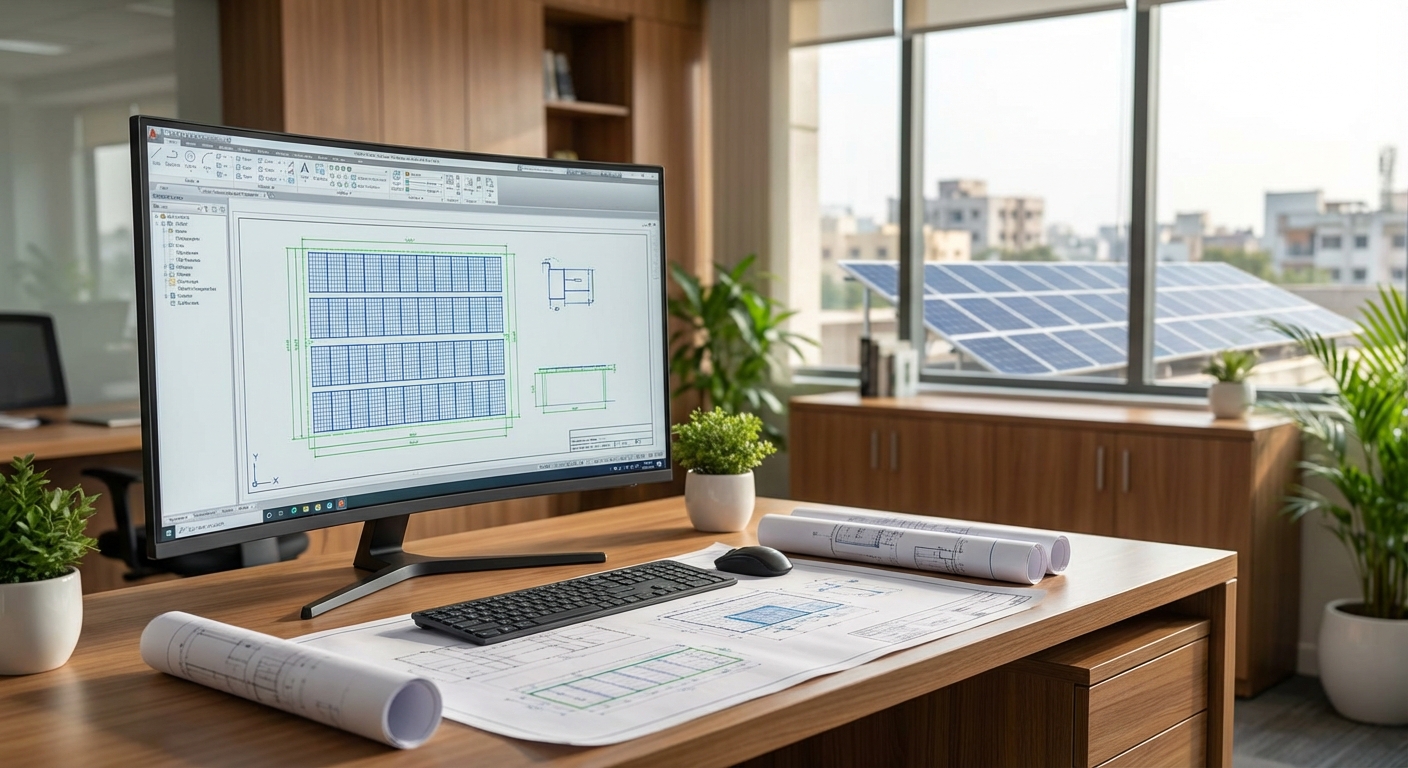
Understanding Solar Design Services in India’s Growing Renewable Energy Market
India’s renewable energy landscape has transformed dramatically, with solar power leading the charge toward the nation’s ambitious clean energy goals. As of 2026, the country has established itself as one of the world’s largest solar markets, with installations spanning from residential rooftops in urban centers to massive utility-scale solar farms across states like Rajasthan, Gujarat, Karnataka, and Tamil Nadu.
For solar EPC companies, this growth presents both tremendous opportunity and significant challenges. The complexity of modern solar projects demands specialized engineering expertise that goes far beyond basic electrical knowledge. Professional solar design services have evolved into a critical differentiator, directly impacting project feasibility, cost-effectiveness, energy generation efficiency, and long-term performance.
The Indian solar market’s unique characteristics—diverse climate zones, varying regulatory frameworks across states, grid infrastructure challenges, and cost-sensitive customers—require design approaches specifically tailored to local conditions. Generic or inadequate design can result in:
- Underperforming systems that fail to meet energy generation projections
- Regulatory delays due to incomplete or non-compliant permit documentation
- Structural failures from inadequate engineering for local wind and seismic loads
- Installation complications that increase labor costs and project timelines
- Customer dissatisfaction and warranty claims that damage your reputation
Professional solar design services address these risks by providing comprehensive engineering solutions that optimize every aspect of your project before a single panel is installed. The right design partner brings specialized expertise in solar-specific engineering, deep understanding of Indian regulations and standards, and proven methodologies that have been refined across hundreds of successful projects.
What Professional Solar Design Services Include
Comprehensive solar design services in India encompass far more than simply determining how many panels fit on a roof. Professional design is a multi-disciplinary engineering process that addresses electrical, structural, civil, and regulatory aspects of solar installations. Understanding what quality design services should include helps EPC companies evaluate potential partners and ensure they receive the documentation needed for successful project execution.
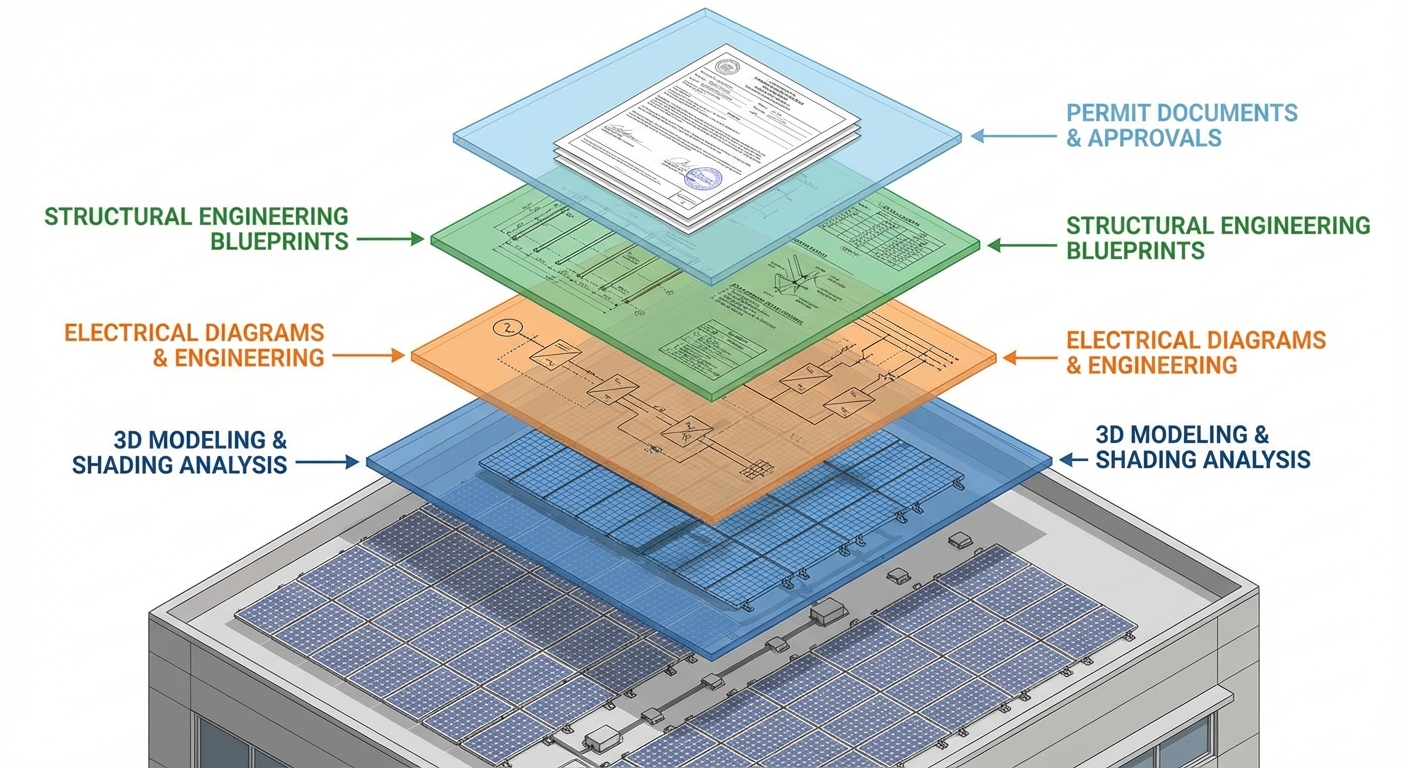
3D Pre-Design: The Foundation of Successful Solar Projects
The preliminary design phase establishes project feasibility and provides stakeholders with clear visualization of the proposed installation. 3D pre-design services create accurate digital models of the site with proposed solar arrays, allowing EPC companies to:
- Present professional proposals to clients with realistic visualizations
- Identify potential installation challenges before committing to contracts
- Perform preliminary shading analysis to estimate energy generation
- Determine approximate system sizing and equipment requirements
- Calculate initial cost estimates with greater accuracy
- Evaluate multiple design scenarios to optimize system configuration
Quality 3D pre-design utilizes satellite imagery, site photographs, and preliminary measurements to create models that accurately represent existing conditions. This phase typically includes preliminary module layout, basic electrical configuration, and initial performance projections that inform project feasibility decisions.
MW Scale Detailed Engineering Design
Once a project moves forward, detailed engineering design produces the comprehensive technical documentation required for procurement, installation, and commissioning. For megawatt-scale commercial, industrial, and utility projects, this phase is particularly critical and should include:
Electrical Engineering Documentation:
- Single-line diagrams (SLD) showing complete electrical architecture
- Module layout drawings optimized for maximum energy generation
- String configuration and inverter sizing calculations
- DC and AC cable sizing with voltage drop calculations
- Earthing and lightning protection system design
- Protection and switchgear specifications
- Equipment specifications and bill of quantities (BOQ)
Performance Analysis:
- Detailed shading analysis using industry-standard software
- Energy generation projections with month-by-month breakdown
- Performance ratio calculations
- Financial modeling inputs for ROI analysis
Technical Specifications:
- Complete equipment specifications for procurement
- Installation guidelines and best practices documentation
- Testing and commissioning procedures
- Operation and maintenance recommendations
Professional detailed engineering ensures that installation teams have clear, unambiguous documentation that minimizes field questions, reduces errors, and accelerates project completion.
Solar Permit Design and Regulatory Compliance
Navigating India’s solar regulatory landscape requires expertise in both national standards and state-specific requirements. Solar permit design services ensure your projects meet all applicable codes and regulations, including:
- Indian Standards (IS Codes): Compliance with IS 16221 for grid-connected systems, IS 1893 for seismic design, IS 875 for wind loads, and other relevant standards
- Central Electricity Authority (CEA) Regulations: Technical standards for connectivity and safety
- State-specific requirements: Net metering regulations, subsidy documentation, and local utility interconnection standards
- Building codes: Structural load compliance and fire safety requirements
- Environmental clearances: Documentation for large-scale ground-mount projects
Proper permit design includes all drawings, calculations, and documentation required by authorities, formatted according to their specific submission requirements. This specialized service can reduce approval timelines from months to weeks, directly impacting project cash flow and customer satisfaction.
Civil and Structural Engineering Components
Solar installations must withstand decades of exposure to wind, rain, temperature extremes, and in some regions, seismic activity. Solar civil and structural engineering services provide:
- Structural load calculations for rooftop installations
- Foundation design for ground-mount systems
- Mounting structure specifications and drawings
- Wind and seismic load analysis per Indian standards
- Soil testing interpretation and foundation recommendations
- Structural certification for permit submissions
This expertise is particularly crucial in India’s diverse geography, where coastal installations face different challenges than desert or mountainous locations. Professional structural engineering prevents costly failures and ensures long-term system integrity.
The Complete Solar Design Process: From Site Survey to Final Documentation
Understanding the solar design workflow helps EPC companies plan project timelines, gather necessary information, and collaborate effectively with design partners. While specific processes vary by project complexity and design firm, a comprehensive solar design process in India typically follows these stages:
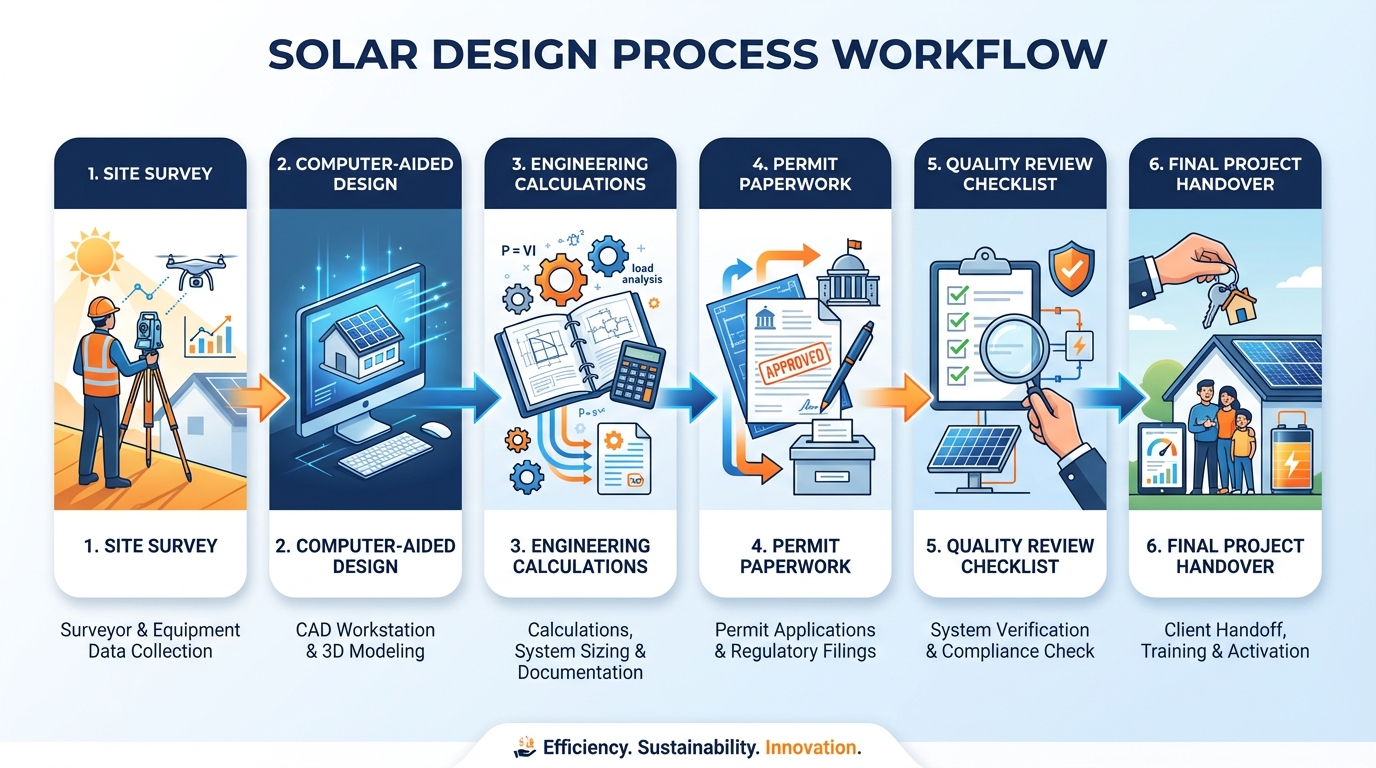
Step 1: Initial Consultation and Project Requirements Gathering
The design process begins with understanding your project’s specific requirements, constraints, and objectives. Professional design partners will request:
- Site location and basic dimensions
- Client energy consumption data or target system capacity
- Budget parameters and equipment preferences
- Timeline requirements and project milestones
- Specific regulatory or client requirements
- Site photographs and any existing documentation
This consultation phase establishes clear expectations, identifies potential challenges early, and ensures the design approach aligns with your project goals.
Step 2: Site Survey and Feasibility Assessment
Comprehensive site surveys form the foundation of accurate design. Professional site survey services across India should include:
- Detailed dimensional measurements using surveying equipment
- Roof condition assessment for structural integrity
- Shading analysis identifying obstacles and their impact
- Electrical infrastructure evaluation
- Access and logistics assessment for installation planning
- Photographic documentation from multiple angles
- For ground-mount projects: topographical survey and soil testing coordination
Quality site surveys eliminate assumptions that lead to design errors. Many design firms now offer site survey services across India, providing consistent data collection regardless of project location.
Step 3: Preliminary Design and System Sizing
Using site survey data, designers create preliminary layouts and system configurations. This phase includes:
- 3D modeling of the site with proposed solar arrays
- Initial module layout optimization
- System sizing to meet energy requirements or maximize available space
- Preliminary equipment selection
- Initial performance and financial projections
- Design alternatives evaluation if applicable
The preliminary design is typically reviewed with the EPC company to confirm the approach before investing in detailed engineering.
Step 4: Detailed Engineering and Documentation
Once the preliminary design is approved, engineers develop comprehensive technical documentation including all electrical, structural, and civil engineering drawings and calculations. This phase produces the complete package needed for procurement, permitting, and installation.
For a typical MW-scale project, detailed engineering might take 2-4 weeks depending on complexity, with larger projects requiring proportionally more time. Design firms with substantial engineering teams can often accelerate timelines through parallel workstreams.
Step 5: Permit Design and Regulatory Submissions
Permit-specific documentation is prepared according to the requirements of relevant authorities. This may involve:
- Formatting drawings to authority specifications
- Preparing technical specifications and compliance statements
- Obtaining structural engineer certifications
- Compiling submission packages with all required forms
- Coordinating with local authorities on submission procedures
Experienced design partners understand the nuances of different state regulations and can navigate submission processes efficiently.
Step 6: Final Review and Project Handover
Before project handover, quality design firms conduct internal reviews to verify accuracy and completeness. The final deliverable package typically includes:
- Complete drawing sets in PDF and editable CAD formats
- Calculation sheets and technical reports
- Equipment specifications and BOQ
- Permit submission packages
- 3D models and visualization renders
- Performance analysis reports
Professional design partners also provide post-delivery support to answer installation questions and make minor revisions as field conditions require.
Quality Standards and Best Practices in Solar Design India
The quality of solar design directly impacts system performance, safety, and longevity. Understanding the standards and best practices that should govern solar design in India helps EPC companies evaluate design quality and hold partners accountable.
Applicable Indian Standards and Codes
Professional solar design must comply with relevant Indian Standards (IS Codes) including:
- IS 16221: Installation and commissioning of grid-connected solar photovoltaic systems
- IS 1893: Criteria for earthquake resistant design of structures
- IS 875: Code of practice for design loads (including wind loads)
- IS 732: Code of practice for electrical wiring installations
- IS 3043: Code of practice for earthing
- National Electrical Code (NEC): Safety standards for electrical installations
Additionally, designs should reference international standards where applicable, such as IEC standards for equipment specifications and testing procedures.
Quality Assurance in Design Process
Reputable design firms implement quality assurance processes including:
- Multi-level review: Designs reviewed by senior engineers before delivery
- Calculation verification: Independent checking of critical calculations
- Software validation: Use of industry-standard design software (PVsyst, AutoCAD, Helioscope, etc.)
- Standards compliance checklists: Systematic verification against applicable codes
- Drawing coordination: Ensuring consistency across all documentation
Common Design Errors and How to Avoid Them
Even experienced EPC companies can fall victim to design errors that create installation challenges or performance issues. Common problems include:
- Inadequate shading analysis: Failing to account for seasonal sun angles or future obstructions
- Undersized cables: Excessive voltage drop reducing system performance
- Improper string configuration: Mismatched strings causing inverter inefficiency
- Insufficient structural analysis: Underestimating wind or seismic loads
- Poor cable routing: Creating installation difficulties or safety hazards
- Incomplete BOQ: Missing components discovered during installation
Professional design partners with extensive project experience have refined their processes to systematically avoid these pitfalls.
Design Optimization for Indian Climate Conditions
India’s diverse climate zones require design approaches tailored to local conditions:
- High-temperature regions: Accounting for temperature derating in performance calculations
- Coastal areas: Specifying corrosion-resistant materials and enhanced earthing
- High-wind zones: Conservative structural design with appropriate safety factors
- Dust-prone areas: Considering soiling losses in energy projections
- Monsoon regions: Drainage design and waterproofing considerations
Design firms with extensive India-specific experience understand these regional variations and incorporate appropriate measures into their designs.
How to Choose the Right Solar Design Partner for Your EPC Company
Selecting the right design partner is one of the most important decisions an EPC company makes. The quality, accuracy, and completeness of design documentation directly impacts every subsequent project phase. Consider these critical factors when evaluating potential solar design partners in India:
Team Size and Engineering Expertise
The depth of a design firm’s engineering team directly impacts their capacity, turnaround time, and technical capabilities. Look for partners with:
- Substantial in-house engineering teams: Firms with 50+ engineers can handle multiple projects simultaneously without compromising quality or timelines
- Diverse expertise: Teams including electrical, structural, and civil engineers provide comprehensive solutions
- Solar-specific experience: Engineers who specialize in solar design understand nuances that general electrical engineers may miss
- Senior oversight: Experienced senior engineers reviewing junior work ensures quality and mentorship
A large, specialized team indicates a firm’s commitment to the solar sector and ability to scale with your growing project pipeline.
Portfolio and Track Record Evaluation
Past performance is the best predictor of future results. Evaluate potential partners based on:
- Total capacity designed: Firms with hundreds of megawatts of completed designs have refined their processes
- Number of projects completed: Diverse project experience across different scales and types
- Client base: Working with multiple EPC companies demonstrates reliability and quality
- Geographic coverage: Experience across different Indian states and international markets
- Project types: Capability across rooftop, ground-mount, carport, and other installation types
Request case studies or references from existing clients to understand the partner’s working style and reliability.
Technical Capabilities and Software Tools
Modern solar design requires sophisticated software tools and technical capabilities:
- Design software: PVsyst for performance analysis, AutoCAD for drawings, structural analysis software
- 3D modeling capabilities: Creating accurate visualizations and shading analysis
- Simulation tools: Energy generation modeling with weather data and system losses
- Documentation systems: Professional drawing standards and version control
Ask potential partners about their software stack and technical methodologies to ensure they use industry-standard tools.
Turnaround Time and Project Management
In competitive solar markets, speed matters. Evaluate design partners on:
- Typical turnaround times: How quickly can they deliver preliminary and detailed designs?
- Rush project capabilities: Can they accelerate timelines when needed?
- Project management processes: Clear communication, milestone tracking, and status updates
- Revision responsiveness: How quickly do they address feedback and make changes?
Large engineering teams can typically offer faster turnaround through parallel workstreams and resource flexibility.
Cost-Effectiveness vs. Quality Balance
While cost is always a consideration, the cheapest design option often proves most expensive when errors require rework or poor design reduces system performance. Consider:
- Value proposition: What deliverables are included in the quoted price?
- Hidden costs: Are revisions included or charged separately?
- Long-term relationship pricing: Do they offer better rates for ongoing partnerships?
- ROI impact: How does design quality affect your project profitability?
The right partner provides cost-effective services without compromising the quality that ensures project success.
Communication and Collaboration Processes
Effective collaboration requires clear communication channels and responsive support:
- Dedicated project contacts: Single point of contact for each project
- Communication methods: Email, phone, video calls, project management platforms
- Language capabilities: English proficiency for clear technical communication
- Time zone compatibility: Availability during your business hours
- Feedback incorporation: Willingness to iterate based on your input
Post-Design Support and Revisions
Design needs don’t end at project handover. Quality partners provide:
- Installation support: Answering field questions during construction
- Minor revisions: Adjusting designs for field conditions
- Technical clarifications: Explaining design decisions to installers or inspectors
- Documentation updates: Providing as-built drawing support if needed
This ongoing support ensures smooth project execution and demonstrates the partner’s commitment to your success.
Why Specialized Solar Engineering Expertise Matters
Some EPC companies question whether specialized solar design services are necessary, considering using general electrical engineers or in-house staff. Understanding why solar-specific engineering expertise matters helps justify the investment in professional design partners.
Solar Design vs. General Electrical Engineering
While solar installations involve electrical systems, they present unique challenges that general electrical engineers may not fully understand:
- DC system design: Solar arrays operate on DC power with different safety and design considerations than AC systems
- String configuration optimization: Balancing voltage, current, and shading requires specialized knowledge
- Performance modeling: Accurate energy generation projections require understanding of solar-specific losses and weather patterns
- Mounting system integration: Electrical design must coordinate with structural and mechanical systems
- Inverter technology: Understanding string inverters, central inverters, and optimizers requires specialized expertise
- Solar-specific codes: Regulations like IS 16221 are unfamiliar to general electrical engineers
Engineers who specialize in solar design have completed hundreds of projects, encountering and solving challenges that general engineers may face for the first time on your project.
Impact of Design Quality on Project ROI
Design quality directly affects your project’s financial performance through multiple channels:
- Energy generation accuracy: Optimized designs maximize kWh production, increasing revenue or savings
- Component optimization: Right-sizing equipment reduces costs without sacrificing performance
- Installation efficiency: Clear documentation reduces labor hours and errors
- Reduced rework: Accurate designs eliminate costly field changes
- Faster approvals: Compliant permit designs accelerate project timelines
- Warranty protection: Proper engineering reduces failure risk and warranty claims
The cost of professional design services is typically less than 2% of total project cost but can impact 20-30% of project profitability through these various mechanisms.
Risk Mitigation Through Expert Design
Poor design creates risks that can devastate project economics and company reputation:
- Structural failures: Inadequate engineering can lead to collapse during storms
- Electrical hazards: Improper design creates fire and shock risks
- Performance shortfalls: Systems that underperform projections lead to customer disputes
- Regulatory violations: Non-compliant designs can result in fines or forced modifications
- Warranty voids: Improper installation based on poor design may void equipment warranties
Professional design partners carry professional liability insurance and have quality processes that minimize these risks.
Maximizing Project ROI Through Professional Solar Design
The return on investment from professional solar design services extends far beyond avoiding errors. Strategic design optimization creates value throughout the project lifecycle.
Energy Generation Optimization
Expert designers maximize energy production through:
- Optimal tilt and orientation: Balancing seasonal variations for maximum annual generation
- Shading mitigation: Strategic layout to minimize shade impact
- String configuration: Optimizing voltage and current for inverter efficiency
- Temperature considerations: Accounting for local climate in performance projections
- Soiling and degradation: Realistic long-term performance modeling
Even small percentage improvements in energy generation compound over 25-year system lifetimes, significantly impacting project economics.
Cost Optimization Through Smart Engineering
Professional designers identify cost savings opportunities including:
- Right-sized components: Avoiding over-specification that increases costs unnecessarily
- Optimized cable routing: Minimizing cable lengths and sizes
- Efficient layouts: Maximizing capacity within available space
- Alternative equipment evaluation: Comparing options to find best value
- Installation-friendly designs: Layouts that reduce labor requirements
Reducing Installation Time and Complexity
Clear, comprehensive documentation accelerates installation through:
- Unambiguous instructions: Installers understand exactly what to build
- Complete BOQ: All materials ordered correctly the first time
- Coordinated drawings: Electrical, structural, and civil plans align perfectly
- Installation sequences: Logical construction progression
- Detail drawings: Complex connections clearly illustrated
Faster installation reduces labor costs and accelerates project cash flow.
Long-Term Performance and Maintenance
Quality design considers the entire system lifecycle:
- Accessible layouts: Maintenance personnel can safely access equipment
- Monitoring integration: Proper design of monitoring systems for performance tracking
- Expansion provisions: Designs that accommodate future capacity additions
- Durable specifications: Materials and methods that ensure 25+ year lifetimes
Site Survey and Feasibility: Critical First Steps
Accurate solar design begins with comprehensive site assessment. Site survey and land feasibility services establish the foundation for all subsequent engineering work.
Comprehensive Site Survey Components
Professional site surveys for solar projects should include:
- Dimensional measurements: Precise measurements using laser distance meters or surveying equipment
- Roof assessment: Structural condition, roofing material, age, and load-bearing capacity evaluation
- Obstruction mapping: Identifying and measuring all objects that could cast shadows
- Electrical infrastructure: Main service panel location, capacity, and condition
- Access evaluation: Material delivery routes and equipment access for installation
- Site photographs: Comprehensive photo documentation from multiple angles and elevations
- Utility information: Transformer location, service voltage, and grid connection points
Land Feasibility for Ground-Mount Projects
Large-scale ground-mount projects require additional feasibility analysis:
- Topographical survey: Contour mapping to understand grading requirements
- Soil testing: Geotechnical investigation for foundation design
- Environmental assessment: Identifying sensitive areas or protected species
- Grid connectivity: Distance to interconnection point and capacity availability
- Land use restrictions: Zoning, agricultural designations, or other limitations
- Access roads: Existing infrastructure or need for new construction
Site Survey Services Across India
For EPC companies operating across multiple states, partnering with design firms that offer site survey services across India provides consistency and efficiency. Centralized survey coordination ensures:
- Standardized data collection procedures
- Consistent quality regardless of location
- Seamless integration with design processes
- Single point of accountability
- Faster turnaround from survey to design
Design partners with national reach can deploy survey teams to any location, eliminating the need for EPC companies to coordinate local surveyors in each market.
Frequently Asked Questions About Solar Design Services in India
How long does solar design take?
Timeline varies by project complexity and scope. Preliminary 3D pre-design typically takes 2-5 business days. Detailed engineering for residential rooftop projects may require 1-2 weeks, while MW-scale commercial or utility projects typically need 2-4 weeks. Permit design adds another 3-7 days depending on authority requirements. Design firms with large engineering teams can often accelerate these timelines through parallel workstreams. Rush services may be available for time-sensitive projects.
What information do I need to provide to start the design process?
At minimum, provide site location/address, approximate system size or energy requirements, site photographs, and any existing documentation (property surveys, electrical drawings, etc.). For detailed design, you’ll need comprehensive site survey data, client energy consumption history, budget parameters, equipment preferences, and timeline requirements. The design partner will provide a detailed checklist of required information during initial consultation.
What deliverables should I expect from professional solar design services?
Comprehensive design packages typically include: 3D site models and visualizations, complete electrical drawings (single-line diagrams, module layouts, cable routing), structural calculations and drawings, civil engineering plans for ground-mount projects, equipment specifications and BOQ, performance analysis reports with energy generation projections, permit submission packages formatted for local authorities, and CAD files in both PDF and editable formats. Specific deliverables vary by project scope and should be clearly defined in the service agreement.
How much do professional solar design services cost?
Design service costs vary based on project size, complexity, and scope of services required. Pricing may be structured per kilowatt, per project, or as a percentage of total project cost. For accurate pricing tailored to your specific projects, contact design service providers directly. Consider that design costs typically represent 1-3% of total project cost but can significantly impact overall project profitability through optimized performance and reduced installation costs.
Can designs be modified after completion if site conditions change?
Yes, professional design partners typically provide revision services to accommodate field conditions or client changes. Minor revisions (small layout adjustments, equipment substitutions) are often included in the original scope. Major revisions (significant capacity changes, complete redesigns) may incur additional fees. Discuss revision policies and costs during partner selection. Quality design firms provide installation support to answer field questions and make necessary adjustments for successful project completion.
What software is used for professional solar design?
Industry-standard software includes PVsyst for performance simulation and energy modeling, AutoCAD for electrical and structural drawings, SketchUp or similar tools for 3D modeling, Helioscope for preliminary design and shading analysis, PVcase for utility-scale projects, and specialized structural analysis software for load calculations. Professional design firms invest in licensed software and trained engineers to ensure accurate, reliable results. Ask potential partners about their software capabilities during evaluation.
Do design partners provide support during installation?
Reputable design partners provide post-design support including answering installation questions, clarifying design intent, making minor field adjustments, and assisting with inspector or utility questions about the design. The level of support varies by provider and should be clarified in the service agreement. Some firms offer on-site commissioning support or installation supervision as additional services. This ongoing support ensures smooth project execution and demonstrates the partner’s commitment to project success.
Partner with Expert Solar Design Services for Your Next Project
As India’s solar market continues its rapid expansion in 2026, the competitive advantage increasingly belongs to EPC companies that deliver projects with superior performance, faster timelines, and fewer complications. Professional solar design services in India provide the engineering foundation that makes this possible.
From comprehensive 3D pre-design that helps you win more proposals, to detailed engineering that accelerates installation, to permit design that navigates regulatory requirements efficiently—quality design services impact every aspect of project success. The right design partner brings specialized solar engineering expertise, proven processes refined across hundreds of projects, and the capacity to scale with your growing business.
Heaven Designs Private Limited has established itself as a trusted partner for solar EPC companies across India and internationally, with a team of over 50 skilled engineers delivering cost-effective, accurate solar project designs. With 628+ MW of completed design work for 752+ clients across multiple countries, the company brings deep expertise in maximizing energy generation while optimizing project costs.
Whether you’re planning residential rooftop installations, commercial and industrial projects, or utility-scale solar farms, professional design services ensure your projects are built on a foundation of engineering excellence. The investment in quality design—typically just 1-3% of project cost—delivers returns through optimized performance, reduced installation time, minimized rework, and enhanced customer satisfaction.
Ready to elevate your solar projects with professional engineering design services? Get a Quick Proposal Now! to discuss your project requirements and discover how expert solar design can maximize your project ROI. For immediate assistance, reach out to the Heaven Designs team at +91 90811 00297 or service@heavendesigns.in.
In India’s competitive solar market, the difference between good projects and great projects often comes down to the quality of engineering that precedes installation. Choose design partners who bring proven expertise, comprehensive capabilities, and commitment to your success—and watch your solar business thrive.