


For solar EPC companies operating in India’s rapidly expanding renewable energy market, one strategic decision can significantly impact profitability, project quality, and competitive positioning: whether to build an in-house solar design team or partner with specialized solar design consultancies. As India continues its ambitious journey toward 500 GW of renewable energy capacity, solar EPC India companies face increasing pressure to deliver accurate, cost-effective designs while managing operational expenses and maintaining quality standards.
This decision isn’t merely about cost savings—it’s about aligning your design capabilities with your business strategy, project pipeline, and growth trajectory. The wrong choice can lead to quality issues, missed deadlines, cost overruns, and ultimately, dissatisfied clients. The right choice, however, can become a competitive advantage that accelerates growth and enhances project margins.
In this comprehensive guide, we’ll analyze both approaches from multiple angles—cost implications, quality considerations, turnaround times, scalability factors, and strategic fit—to help you make an informed decision that positions your EPC company for success in 2026 and beyond.
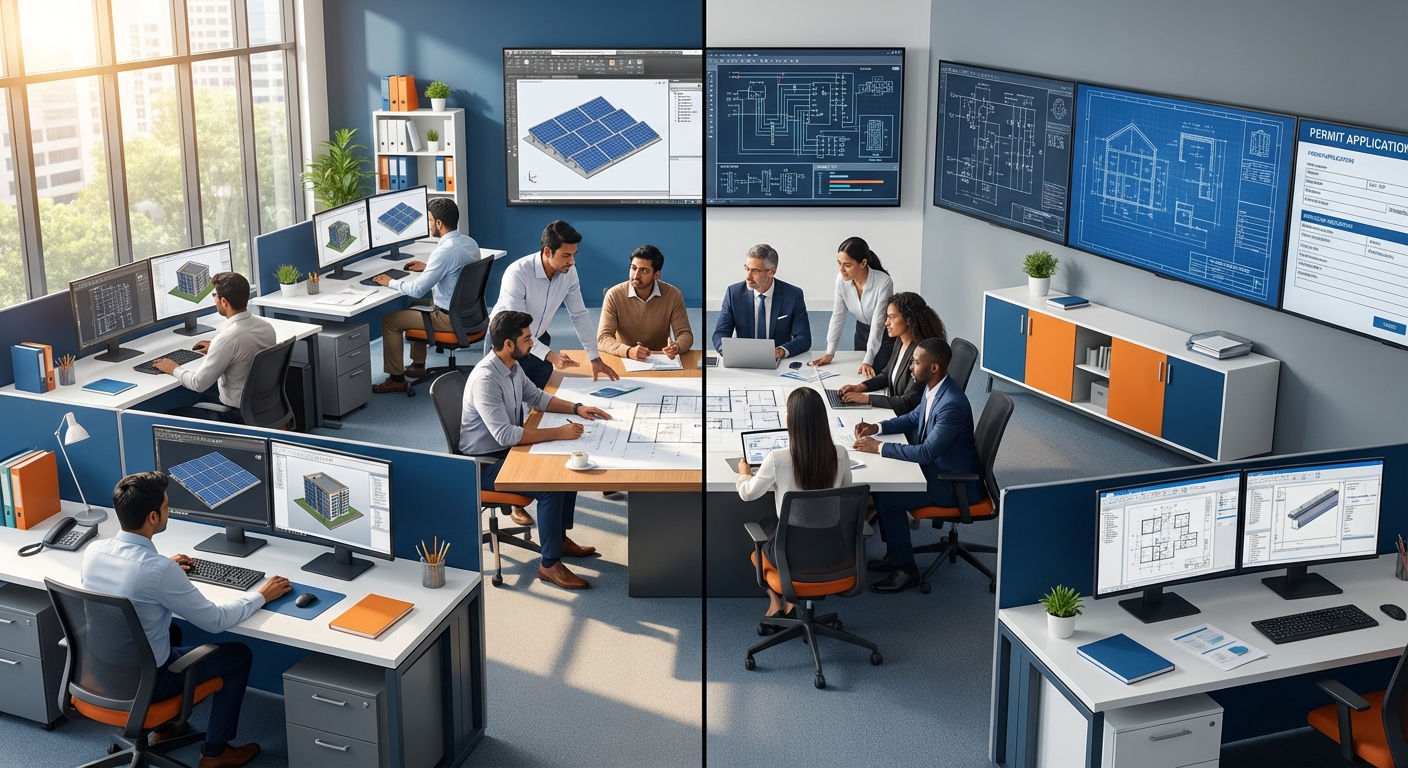
The Critical Design Decision Facing Solar EPC India Companies
The solar energy landscape in India has transformed dramatically over the past decade. What began as a nascent industry has evolved into a sophisticated market where solar design India capabilities directly influence project success rates, profit margins, and client satisfaction. As of 2026, Indian solar EPCs are handling increasingly complex projects—from large-scale ground-mount installations to intricate rooftop solar systems on commercial and industrial facilities.
Design quality impacts every downstream aspect of a solar project. Accurate permit design ensures regulatory compliance and faster approvals. Precise structural engineering India calculations prevent costly rework and safety issues. Comprehensive site survey India data enables realistic project planning and accurate cost estimation. When design goes wrong, the consequences ripple through procurement, construction, commissioning, and long-term performance.
The fundamental question facing solar EPC companies is whether to develop these critical capabilities internally or leverage the expertise of specialized design partners. Each approach offers distinct advantages and challenges, and the optimal choice depends on your specific business context, project volume, financial position, and strategic objectives.
Understanding both models thoroughly is essential before making this strategic decision. Let’s examine each approach in detail, starting with the in-house model that many established EPCs consider as they scale their operations.
Understanding In-House Solar Design Teams
An in-house solar design team represents a significant organizational investment that goes far beyond simply hiring a few engineers. Building effective internal design capabilities requires assembling a multidisciplinary team with diverse expertise, establishing robust processes, investing in specialized software and infrastructure, and maintaining continuous training programs to keep pace with evolving technologies and regulations.
A comprehensive in-house solar design team typically includes several key roles: solar engineers who handle system design and energy modeling, electrical engineers for interconnection and electrical drawings, structural engineers for mounting system calculations and civil engineering, CAD specialists for detailed technical drawings, and project coordinators who manage workflows and client communication. Depending on your project mix, you may also need specialists in rooftop solar India installations, ground-mount systems, or specific technologies like bifacial modules or tracking systems.
Beyond personnel, the infrastructure requirements are substantial. Professional-grade design software India licenses for tools like PVsyst, AutoCAD, HelioScope, SAP2000, and other specialized applications can cost lakhs of rupees annually. You’ll need powerful workstations, secure data storage systems, project management platforms, and communication tools. Office space, utilities, and administrative support add to the overhead.
The investment doesn’t end with initial setup. Continuous training is essential as solar technology evolves, building codes change, and new design methodologies emerge. Retention strategies—competitive salaries, career development opportunities, and engaging work—are necessary to prevent the loss of trained talent to competitors or specialized consultancies.
Key Advantages of In-House Design
Despite the substantial investment required, in-house design teams offer compelling advantages for certain EPC companies. Direct control over the design process is perhaps the most significant benefit. When designers sit within your organization, you can adjust priorities instantly, reallocate resources to urgent projects, and maintain close oversight of quality standards without coordinating with external partners.
Communication efficiency improves dramatically when design teams work alongside procurement, project management, and construction personnel. Quick clarifications, impromptu design reviews, and collaborative problem-solving happen naturally when everyone shares the same physical or organizational space. This integration can reduce miscommunication errors and accelerate decision-making during critical project phases.
Proprietary knowledge retention represents another strategic advantage. When your team develops innovative design approaches, optimized component selections, or efficient construction methodologies, that intellectual property remains within your organization. Over time, this accumulated expertise can become a competitive differentiator, particularly if you specialize in specific project types or challenging installation environments.
For EPCs with consistently high project volumes, in-house teams can offer long-term cost advantages. Once you’ve made the initial investment in team building and infrastructure, the marginal cost of each additional design decreases. If you’re consistently designing 100+ MW annually with predictable project flow, the per-project cost of in-house design may eventually fall below outsourcing rates.
Challenges and Hidden Costs of In-House Teams
The challenges of building and maintaining in-house design capabilities are often underestimated, particularly by EPCs making the transition from outsourced to internal design. Recruitment and retention of skilled solar engineers remains one of the most persistent challenges in India’s competitive renewable energy market. Experienced professionals with expertise in solar design, structural engineering, and permit preparation are in high demand, and attracting them requires competitive compensation packages that may strain budgets.
Training costs extend beyond initial onboarding. Solar technology evolves rapidly—new module technologies, inverter capabilities, mounting systems, and design software updates require continuous learning. Sending engineers to training programs, purchasing updated software versions, and allocating time for skill development represent ongoing engineering cost investments that many EPCs fail to budget adequately.
Software licensing and infrastructure expenses accumulate quickly. Professional-grade design tools require annual subscriptions or maintenance fees. As your team grows, these costs scale proportionally. Additionally, you’ll need IT support, data backup systems, cybersecurity measures, and periodic hardware upgrades to maintain productivity and protect sensitive project data.
Perhaps the most overlooked challenge is overhead during low-volume periods. Solar project pipelines fluctuate due to policy changes, seasonal variations, financing availability, and market conditions. When project flow slows, your in-house team still requires salaries, benefits, and infrastructure support. This fixed cost burden can significantly impact profitability during lean periods, forcing difficult decisions about layoffs or accepting unprofitable projects to keep teams occupied.
Quality consistency presents another challenge, particularly for smaller in-house teams. When one or two key engineers handle most designs, their departure creates knowledge gaps and quality risks. Illness, vacation, or resignation can disrupt project timelines and force rushed hiring decisions that compromise quality standards.
Understanding Outsourced Solar Design Services
Specialized solar design consultancies offer an alternative model that has gained significant traction among solar EPC India companies of all sizes. These dedicated design partners maintain large teams of experienced engineers, invest heavily in advanced design software and tools, and focus exclusively on delivering high-quality solar engineering services to EPC clients.
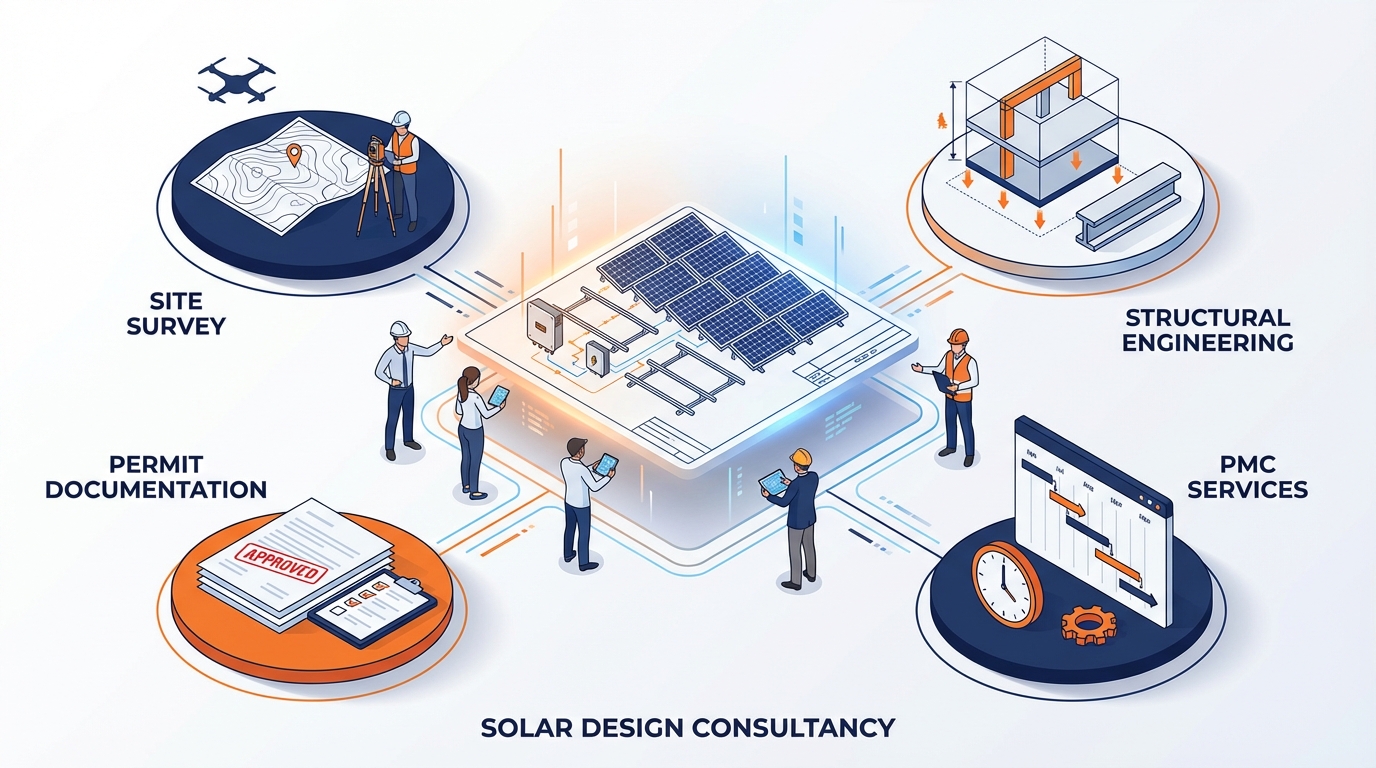
The outsourced model encompasses a broad range of services tailored to different EPC needs. Permit design services ensure that your projects meet local building codes, electrical standards, and regulatory requirements, producing documentation that accelerates approval processes. Structural engineering India services provide detailed calculations for mounting systems, roof load analysis, and foundation design. Site survey India services deliver comprehensive site assessments, including topographic surveys, shading analysis, and geotechnical investigations.
For larger projects, PMC services India (Project Management Consultancy) offer end-to-end engineering oversight, from initial feasibility study India through detailed engineering design and construction support. This comprehensive approach ensures design consistency across all project phases and provides experienced technical guidance throughout project execution.
The design partner model represents a collaborative relationship rather than a transactional vendor arrangement. Leading solar design consultancies work as extensions of your team, understanding your specific requirements, quality standards, and client expectations. They adapt their processes to align with your workflows, maintain consistent communication, and build institutional knowledge about your preferred approaches and standards.
Companies like Heaven Designs exemplify this partnership approach, having completed 628+ MW of design work for 752+ solar EPC clients across multiple countries. With a team of over 50 skilled engineers and consultants based in Surat, Gujarat, they provide the depth of expertise and capacity that would be challenging for most individual EPCs to replicate internally.
Key Advantages of Outsourcing Solar Design
Outsourcing to specialized design consultancies offers several compelling advantages that address common pain points faced by solar EPCs. Access to specialized expertise tops the list—established design partners employ teams with diverse experience across project types, technologies, and regulatory environments. When you encounter an unusual rooftop configuration, complex structural challenge, or unfamiliar permitting jurisdiction, your design partner likely has relevant experience to draw upon.
This expertise depth extends to specialized services that may be needed occasionally but don’t justify full-time hires. Need geotechnical analysis for a ground-mount project? Require advanced energy modeling for a complex shading scenario? Your design partner can deploy specialists without you maintaining these capabilities in-house.
Scalability without hiring overhead provides tremendous operational flexibility. When you win a large project or experience seasonal volume increases, your design partner can allocate additional resources to meet deadlines without you going through lengthy recruitment processes. Conversely, during slower periods, you simply reduce outsourced volume without carrying fixed labor costs. This variable cost structure aligns expenses directly with revenue-generating activity.
Cost predictability improves financial planning and project estimation. Outsourced solar design cost is typically structured as a per-project or per-MW fee, making it easy to calculate design expenses during proposal development. You avoid the uncertainty of estimating internal team utilization rates, overhead allocation, and productivity variations that complicate in-house cost accounting.
Faster turnaround times often result from dedicated resource allocation and specialized workflows. Design consultancies optimize their processes specifically for efficiency, maintain templates and standardized approaches for common project types, and can assign multiple engineers to accelerate large or urgent projects. The design timeline from project kickoff to final deliverables is often shorter than in-house teams can achieve, particularly for EPCs with smaller internal design groups.
Advanced design software and tools come included in the service. Rather than investing in expensive software licenses, training, and IT infrastructure, you benefit from your design partner’s technology investments. Leading consultancies maintain licenses for multiple design platforms, structural analysis tools, and specialized applications, selecting the optimal tool for each project requirement.
Potential Drawbacks of Outsourcing
Despite its advantages, outsourcing solar design does present certain challenges that EPCs should consider carefully. Less direct control over the design process requires trust in your partner’s capabilities and processes. While you can specify requirements and review deliverables, you don’t have the same immediate oversight as with in-house teams. This requires clear communication protocols, well-defined scopes of work, and regular progress updates to maintain visibility.
Communication coordination becomes more important when design teams work externally. Establishing effective channels for questions, clarifications, and design reviews requires deliberate effort. Time zone differences (for international design partners) or simply the lack of physical proximity can slow certain types of collaboration, though modern communication tools have largely mitigated these challenges.
Dependency on external partners introduces relationship risk. If your primary design partner experiences capacity constraints, quality issues, or business disruptions, your project pipeline may be affected. Maintaining relationships with multiple design partners or having contingency plans can mitigate this risk but requires additional management effort.
Some EPCs worry about perceived loss of competitive advantage when outsourcing design. The concern is that design partners working with multiple EPCs might share insights or approaches across clients. Reputable consultancies maintain strict confidentiality and develop customized solutions for each client, but this perception persists in some quarters.
Cost Comparison: In-House vs Outsourced Solar Design
Understanding the true cost comparison between in-house and outsourced solar design requires looking beyond simple salary-versus-fee calculations. A comprehensive analysis must account for all direct and indirect costs, consider project volume variations, and evaluate long-term financial implications.
For an in-house design team, direct costs include salaries and benefits for all design personnel. In India’s major solar markets, experienced solar engineers command annual salaries ranging from ₹6-12 lakhs, structural engineers ₹7-15 lakhs, and senior design managers ₹15-25 lakhs. For a modest team of five engineers plus one manager, annual salary costs alone could range from ₹40-70 lakhs, depending on experience levels and location.
Benefits and statutory contributions (PF, ESI, gratuity, insurance) typically add 20-30% to base salaries, bringing total compensation costs to ₹50-90 lakhs annually for a six-person team. Recruitment costs, including job postings, recruiter fees, and interview time, can add ₹2-5 lakhs per hire.
Software and infrastructure costs accumulate across multiple categories. Professional design software licenses (PVsyst, AutoCAD, HelioScope, SAP2000, ETABS, and others) can cost ₹5-15 lakhs annually depending on the number of seats and specific tools required. Workstations, monitors, and IT equipment represent ₹3-5 lakhs in initial investment plus periodic replacement costs. Office space, utilities, furniture, and administrative support add ongoing overhead that varies by location but could range from ₹3-8 lakhs annually for a small team.
Training and development costs are often underestimated. Sending engineers to software training, technical workshops, or industry conferences costs ₹50,000-2 lakhs annually per engineer. Online courses, certification programs, and reference materials add to this investment.
Summing these components, a modest six-person in-house design team might cost ₹65-120 lakhs annually in total, depending on salary levels, location, and infrastructure choices. This represents the fixed cost base that must be supported regardless of project volume.
For outsourced design, cost structures are typically project-based or capacity-based. Solar design cost for outsourced services generally ranges from ₹15,000-50,000 per MW for basic design packages, ₹50,000-1.5 lakhs per MW for comprehensive detailed engineering, and ₹1.5-3 lakhs per MW for full-service packages including PMC services, depending on project complexity, timeline requirements, and scope of deliverables.
For rooftop projects, pricing is often per-project rather than per-MW, ranging from ₹10,000-50,000 per site depending on system size and complexity. Permit design services might cost ₹15,000-40,000 per project, while comprehensive site survey India services range from ₹20,000-80,000 depending on site size and survey scope.
The break-even analysis depends heavily on annual project volume. Consider an EPC designing 50 MW annually across various projects. At an average outsourced cost of ₹75,000 per MW, total design expenses would be ₹37.5 lakhs—well below the ₹65-120 lakh cost of maintaining an in-house team. Even at 100 MW annually (₹75 lakhs in outsourced costs), outsourcing remains competitive with in-house costs while offering greater flexibility.
The break-even point typically occurs somewhere between 100-200 MW of consistent annual volume, depending on specific cost structures and project mix. However, this calculation assumes consistent volume—a critical assumption that often doesn’t hold in practice. When volume fluctuates, the variable cost structure of outsourcing provides significant financial advantages.
Hidden costs affect both approaches. In-house teams face productivity losses during training periods, knowledge loss when employees depart, and quality costs from less experienced engineers. Outsourcing involves coordination time, potential rework if requirements aren’t clearly communicated, and the opportunity cost of not building internal expertise.
ROI considerations extend beyond immediate costs. In-house teams may enable faster response times for urgent client requests, support business development with immediate design support, and build proprietary methodologies that enhance competitiveness. Outsourcing frees capital for core business activities, reduces financial risk during market downturns, and provides access to expertise that would be prohibitively expensive to maintain internally.
Quality and Expertise Considerations
Quality in solar design encompasses multiple dimensions: technical accuracy, regulatory compliance, constructability, optimization for performance and cost, and completeness of documentation. Both in-house and outsourced approaches can deliver high-quality results, but the path to achieving consistent quality differs significantly.
For in-house teams, quality depends heavily on individual engineer capabilities, internal quality control processes, and organizational commitment to excellence. Smaller teams face challenges maintaining expertise across all required disciplines. A generalist solar engineer may handle electrical design competently but lack deep expertise in structural engineering or geotechnical analysis. This breadth-versus-depth tradeoff can impact quality for complex or unusual projects.
Specialized design consultancies typically offer greater expertise depth across disciplines. With larger teams, they can employ specialists in structural engineering India, electrical design, civil engineering, permitting, and energy modeling. When you encounter a challenging rooftop with complex structural constraints, your design partner can assign an engineer who has handled dozens of similar situations rather than someone encountering it for the first time.
Track record and proven experience provide important quality indicators. Established design consultancies have completed hundreds or thousands of projects, encountering and solving a wide variety of technical challenges. This accumulated experience translates into better problem anticipation, more robust designs, and fewer construction-phase surprises. Heaven Designs’ portfolio of 628+ MW across 752+ projects demonstrates the breadth of experience that informs their design approach.
Quality assurance processes differ between models. In-house teams must establish their own review procedures, checklists, and quality gates. This requires discipline and organizational commitment, particularly when project deadlines create pressure to skip review steps. Specialized consultancies typically maintain formal quality management systems with multiple review layers, standardized checklists, and independent verification processes that catch errors before deliverables reach clients.
Permit design accuracy represents a critical quality dimension with direct business impact. Designs that fail to meet local building codes, electrical standards, or utility interconnection requirements cause project delays, rework costs, and client dissatisfaction. Design partners specializing in specific regions or jurisdictions maintain current knowledge of local requirements, inspector preferences, and approval processes that improve first-time approval rates.
For rooftop solar India projects, quality considerations include accurate structural load calculations, proper waterproofing details, code-compliant electrical designs, and constructability for diverse roof types. Expertise in Indian building practices, material availability, and local installation standards ensures designs that work in real-world conditions rather than just on paper.
Turnaround Time and Scalability Analysis
Project timelines directly impact EPC competitiveness and client satisfaction. The ability to deliver designs quickly and scale capacity to match project flow represents a critical operational capability that differs significantly between in-house and outsourced approaches.
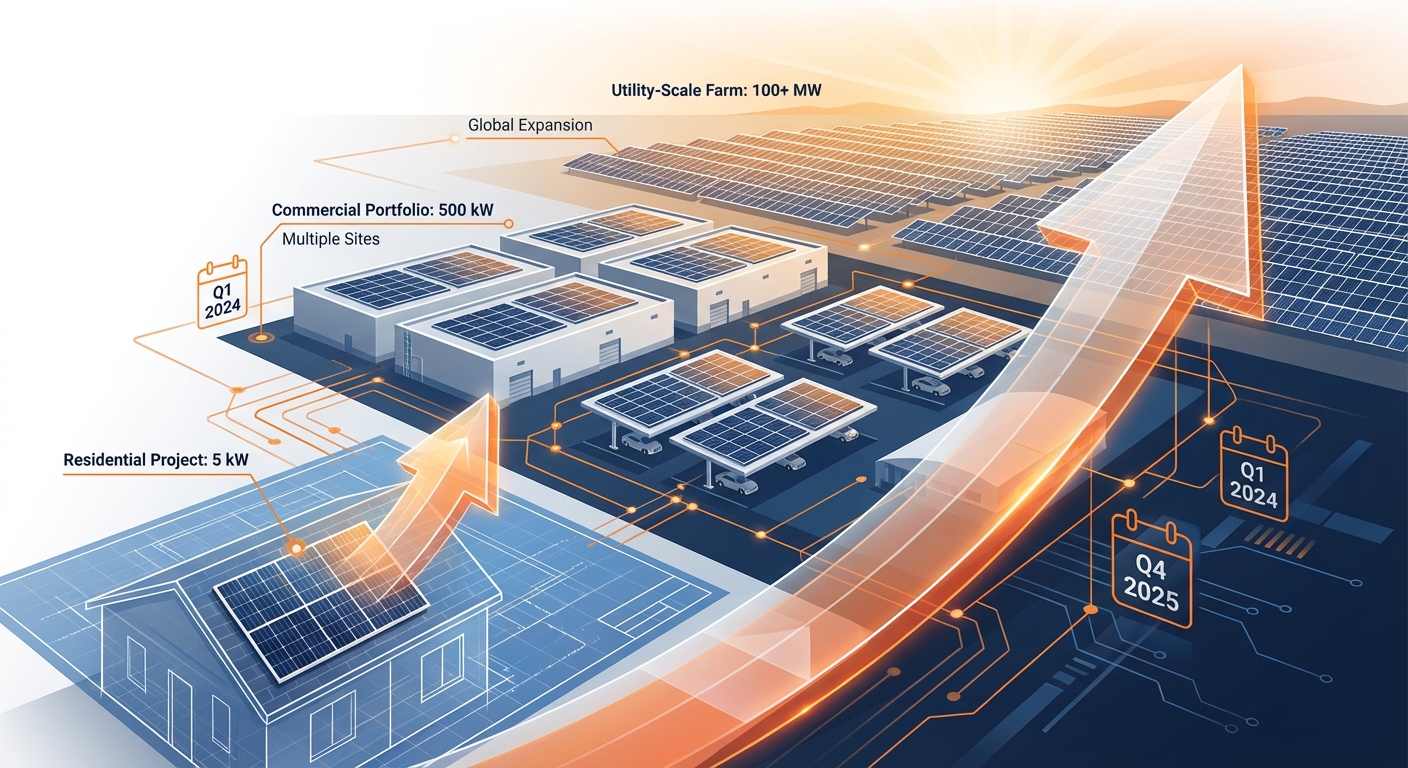
Design timeline expectations vary by project type and complexity. A simple residential rooftop system might require 3-5 days for complete permit-ready design. A commercial rooftop installation could need 1-2 weeks for comprehensive engineering. Large ground-mount projects might require 3-6 weeks for detailed engineering design including structural calculations, electrical drawings, and civil engineering plans.
In-house teams offer potential advantages for very quick-turnaround projects when capacity is available. If your design team has open capacity and can immediately allocate resources to an urgent project, you can potentially achieve faster turnaround than coordinating with an external partner. However, this advantage disappears when your team is already fully utilized or when the project requires specialized expertise your team lacks.
Scalability represents perhaps the most significant operational difference between approaches. In-house teams have fixed capacity determined by team size. When project volume exceeds capacity, you face difficult choices: work overtime (reducing quality and increasing burnout risk), extend timelines (potentially disappointing clients), or rush hiring (compromising quality of new hires). Scaling down during slow periods means carrying underutilized resources or making painful layoff decisions.
Outsourced design provides inherent scalability. Established design consultancies maintain larger teams specifically to handle volume fluctuations across their client base. When you need to design 20 MW this month and 80 MW next month, your design partner can flex resources accordingly. This scalability extends to specialized requirements—if you suddenly need PMC services India for a large project or a comprehensive feasibility study India for a new opportunity, your partner can deploy appropriate expertise without you maintaining these capabilities full-time.
Handling multiple concurrent projects tests organizational capacity. In-house teams must carefully manage workload distribution, prioritize competing deadlines, and maintain quality across simultaneous projects. Smaller teams can become bottlenecks when multiple projects reach design-intensive phases simultaneously. Design consultancies with 50+ engineers can assign dedicated resources to each project, maintaining parallel workflows without resource conflicts.
Geographic expansion creates additional scalability challenges. If you’re expanding from one region to another, in-house teams may lack familiarity with new jurisdictions’ permitting requirements, local building codes, or regional installation practices. Design partners with national or international experience can provide immediate expertise in new markets without you building local knowledge from scratch.
Site survey India logistics illustrate practical scalability differences. Conducting site surveys requires local presence, specialized equipment, and trained personnel. Maintaining survey capabilities across multiple regions requires significant infrastructure investment. Design partners with established survey networks can mobilize resources quickly across diverse locations, providing faster turnaround and broader geographic coverage than most EPCs can justify maintaining internally.
Decision Framework: Choosing the Right Approach for Your EPC
Making the strategic choice between in-house and outsourced solar design requires honest assessment of your business situation, project pipeline, financial position, and strategic objectives. Rather than seeking a universal “best” answer, focus on identifying the approach that aligns with your specific context and goals.
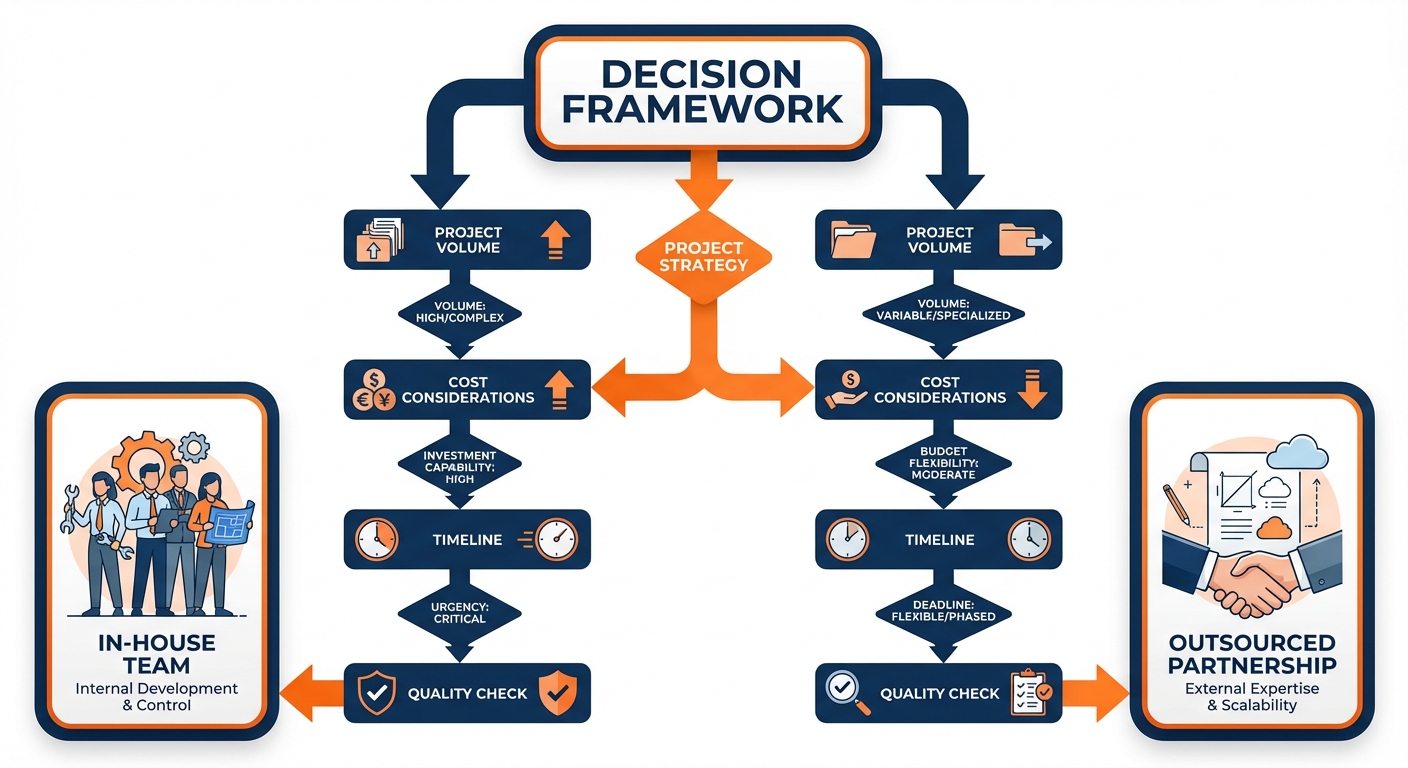
Several key factors should inform your decision. Project volume and consistency represents the most fundamental consideration. Calculate your annual design volume in MW, number of projects, and project type distribution. More importantly, assess volume consistency—does your pipeline remain relatively stable month-to-month, or does it fluctuate significantly due to seasonal patterns, policy changes, or market conditions?
Business stage and financial position matter significantly. Startup EPCs with limited capital and unproven project pipelines face very different considerations than established companies with consistent revenue and strong balance sheets. Early-stage companies typically benefit from outsourcing’s lower capital requirements and operational flexibility, while mature companies with predictable volume may justify in-house investment.
Geographic reach and service area complexity influence design requirements. EPCs operating in a single city or region face simpler permitting and regulatory environments than those serving multiple states or countries. Broader geographic reach increases the expertise breadth required, favoring specialized design partners with multi-jurisdictional experience.
Specialization versus diversification in project types affects design team requirements. EPCs focusing exclusively on rooftop solar India installations for commercial clients can build focused in-house expertise more easily than diversified EPCs handling residential rooftops, commercial installations, and ground-mount projects across various sizes and technologies.
Strategic priorities and competitive positioning provide important context. If design innovation represents a core competitive differentiator and you’re developing proprietary methodologies, in-house capabilities may be strategically important. If your competitive advantage lies in execution excellence, customer relationships, or financing capabilities, outsourcing design allows you to focus resources on your core strengths.
When In-House Design Makes Sense
In-house design teams make strategic sense for solar EPC India companies meeting several specific criteria. High, consistent project volume represents the primary justification. If you’re consistently designing 150+ MW annually with relatively stable month-to-month flow, the economics of in-house design become compelling. At this volume, the per-project cost of internal design falls below typical outsourcing rates, and you can maintain full team utilization without excessive idle time.
Standardized, repetitive project types favor in-house approaches. If 80% of your projects follow similar patterns—for example, commercial rooftop installations on industrial warehouses using standard mounting systems—your team can develop deep expertise and highly efficient workflows for these specific applications. Template-based approaches and standardized processes maximize productivity for repetitive work.
Strong financial position for upfront investment is essential. Building an effective in-house team requires capital for recruitment, training, software, and infrastructure, plus the financial stability to carry fixed costs during market fluctuations. Companies with strong balance sheets and access to working capital can make this investment without compromising operational flexibility.
Strategic intellectual property and proprietary methods justify in-house capabilities when design innovation represents a competitive advantage. If you’re developing unique mounting systems, optimized layouts for specific building types, or innovative approaches that differentiate your offerings, keeping design in-house protects this intellectual property.
Long-term market presence commitment indicates readiness for in-house investment. If you’re building a sustainable business for the long term in stable markets, the initial investment in team building pays dividends over many years. Conversely, if you’re testing new markets or uncertain about long-term commitment, outsourcing provides flexibility to exit or pivot without stranded investments.
When Outsourcing is the Better Choice
Outsourcing to specialized design consultancies makes strategic sense for many solar EPC India companies, particularly those in growth phases or with variable project pipelines. Variable or growing project flow represents a primary indicator favoring outsourcing. If your monthly design volume fluctuates significantly—perhaps 10 MW some months and 60 MW others—the variable cost structure of outsourcing aligns expenses with revenue while avoiding the fixed costs of maintaining capacity for peak periods.
Need for specialized services that you require occasionally but not continuously strongly favors outsourcing. Comprehensive PMC services India, detailed feasibility study India work, complex structural engineering for unusual installations, or geotechnical analysis for large ground-mount projects may be needed periodically but don’t justify full-time specialists. Design partners provide access to these capabilities on-demand without ongoing overhead.
Limited capital for team building affects many growing EPCs. If your capital is better deployed in business development, project financing, or execution capabilities, outsourcing design preserves cash while still providing access to high-quality engineering services. This is particularly relevant for startup and early-growth-stage companies establishing market presence.
Focus on core EPC execution strengths allows you to concentrate resources where you have competitive advantages. If your differentiation comes from superior installation quality, strong customer relationships, innovative financing, or excellent project management, outsourcing design lets you focus management attention and capital on these core strengths rather than building secondary capabilities.
Geographic expansion without local hiring enables rapid market entry. When expanding to new regions or states, partnering with design consultancies that already understand local permitting requirements, building codes, and installation practices provides immediate capability without the time and cost of building local teams. This accelerates market entry and reduces expansion risk.
Project type diversification benefits from outsourcing’s breadth of expertise. EPCs handling diverse project types—residential rooftops, commercial installations, ground-mount systems, carports, and agricultural solar—require broad expertise across multiple disciplines. Maintaining this expertise breadth in-house requires larger teams, while design partners can provide specialists for each project type.
Real-World Scenarios: Making the Right Choice
Examining specific scenarios helps illustrate how different business contexts lead to different optimal choices. These examples reflect common situations facing solar EPC India companies in 2026.
Scenario 1: Startup EPC with 10-20 MW Annual Pipeline – A new EPC company based in Pune has secured initial clients and expects to design 10-20 MW in their first year, primarily commercial rooftop projects. They have limited capital and uncertain month-to-month project flow. Recommendation: Outsource design completely. The variable costs align with their uncertain revenue, capital is preserved for business development and execution capabilities, and they gain access to experienced design expertise that would be impossible to hire at their scale. As they grow and stabilize their pipeline, they can reassess.
Scenario 2: Established EPC with 100+ MW Consistent Volume – A mature EPC company in Gujarat consistently designs 120-150 MW annually, primarily ground-mount projects for utility-scale developers. Their project types are relatively standardized, and they have strong financial position. Recommendation: Consider hybrid approach with core in-house team. They could build a core team of 4-6 engineers handling standard projects, while outsourcing specialized work (complex structural engineering, PMC services for largest projects, overflow during peak periods). This captures cost benefits of in-house design while maintaining flexibility.
Scenario 3: Regional EPC Expanding to New Markets – A successful EPC operating in Karnataka and Tamil Nadu is expanding to Maharashtra and Rajasthan. They currently have a small 3-person in-house design team familiar with their existing markets. Recommendation: Partner with design consultancy for new markets. Rather than hiring and training engineers for new jurisdictions, partnering with a design consultancy experienced in the new markets provides immediate capability. Their existing in-house team continues handling familiar markets while the partner handles new regions. This reduces expansion risk and accelerates market entry.
Scenario 4: Specialized EPC Focusing on Commercial Rooftop Solar India – An EPC specializing exclusively in commercial and industrial rooftop installations has built a strong brand in this niche. They complete 200+ rooftop projects annually with relatively consistent monthly flow. Recommendation: Build focused in-house team. Their high volume, consistent flow, and specialized focus justify a dedicated in-house team that develops deep expertise in commercial rooftop design. They can create highly efficient workflows, template-based approaches, and proprietary methods that become competitive advantages. They might still outsource occasional specialized needs like complex structural analysis for unusual buildings.
These scenarios illustrate that the optimal choice depends on specific business context rather than universal rules. Honest assessment of your situation against these factors guides better decisions than simply following industry trends or competitor approaches.
The Hybrid Approach: Best of Both Worlds
Many successful solar EPC India companies find that a hybrid approach combining selective in-house capabilities with strategic outsourcing provides optimal flexibility and cost-effectiveness. Rather than viewing the decision as binary, consider how to blend both approaches to match your specific needs.
A common hybrid model maintains a small core in-house team handling routine projects and providing immediate design support for business development, while outsourcing specialized work, overflow volume, and projects requiring expertise beyond the core team’s capabilities. For example, you might employ 2-3 engineers who handle standard residential and small commercial projects, provide quick preliminary designs for proposals, and coordinate with outsourced partners for larger or more complex work.
This approach offers several advantages. You maintain internal design knowledge and immediate responsiveness for common situations while accessing specialized expertise and scalable capacity when needed. Fixed costs remain manageable since you’re supporting a smaller team, while variable outsourcing costs align with project-specific revenue. Your in-house team can also serve as informed clients who effectively manage outsourced relationships, review deliverables, and ensure quality.
Strategic partnership with design consultancies works best when you establish long-term relationships rather than transactional project-by-project engagements. A trusted design partner who understands your quality standards, preferred approaches, and client expectations can function almost like an extension of your team. Companies like Heaven Designs develop these deep partnerships with EPC clients, learning their specific requirements and adapting processes to align with client workflows.
Flexibility and risk mitigation represent key benefits of hybrid approaches. You’re not entirely dependent on external partners, so you maintain some capability if a design partner experiences capacity constraints or quality issues. Conversely, you’re not locked into fixed team costs if market conditions deteriorate, since you can reduce outsourced volume while maintaining core capabilities.
Transition strategies from outsourced to in-house (or vice versa) become more manageable with hybrid approaches. If you’re currently outsourcing all design but considering building internal capabilities, you can hire one or two engineers to handle simple projects while continuing to outsource complex work. This allows gradual team building, learning, and capability development without the risk of immediately replacing all outsourced services. Similarly, if you’re downsizing an in-house team, you can transition work to outsourced partners gradually rather than making abrupt changes.
Key Questions to Ask Before Making Your Decision
Before committing to in-house, outsourced, or hybrid approaches, work through these critical questions to clarify your situation and requirements:
Financial Assessment Questions:
- What is our realistic annual design volume in MW and number of projects for the next 2-3 years?
- How consistent is our monthly project flow, or does it fluctuate significantly?
- What capital do we have available for upfront investment in team building and infrastructure?
- What is our current solar design cost as a percentage of project revenue, and how does this compare to industry benchmarks?
- Can we sustain fixed team costs during potential market downturns or slow periods?
- What is our break-even point where in-house costs equal outsourced costs at our specific volume?
Operational Capability Questions:
- Do we have experience recruiting, managing, and retaining technical engineering talent?
- Can we provide career development opportunities that retain skilled solar engineers long-term?
- Do we have the management bandwidth to oversee an in-house design team effectively?
- What is our current design quality level, and how would each approach impact quality?
- Do we need specialized capabilities (PMC services, complex structural engineering, multi-jurisdictional permitting) regularly or occasionally?
- How important is design turnaround speed to our competitive positioning?
Strategic Alignment Questions:
- Is design innovation a core competitive differentiator for our business, or do we compete on other factors?
- Are we developing proprietary design methods or intellectual property that requires in-house protection?
- What is our geographic service area, and how many different permitting jurisdictions do we serve?
- How diverse are our project types (residential, commercial, ground-mount, etc.)?
- What is our long-term commitment to the solar market and specific geographic regions?
- Where should we focus our limited management attention and capital—design capabilities or other business areas?
Partner Evaluation Criteria (if considering outsourcing):
- What is the design consultancy’s track record and portfolio in projects similar to ours?
- Do they have specific expertise in our target markets and project types (e.g., rooftop solar India)?
- What is their team size and capacity to handle our volume, including peak periods?
- How do they ensure quality control and what is their revision/rework rate?
- What are their typical design timeline commitments for different project types?
- How do they handle communication, project updates, and coordination with our team?
- What design software and tools do they use, and how does this align with our requirements?
- Can they provide references from similar EPC clients?
Working through these questions systematically, ideally with input from finance, operations, and business development stakeholders, provides the clarity needed to make informed strategic decisions rather than reactive choices based on immediate pressures.
Conclusion: Strategic Design Decisions for Solar EPC Success in 2026
The choice between in-house and outsourced solar design represents a strategic decision that significantly impacts your EPC company’s operational efficiency, financial performance, and competitive positioning. As we’ve explored throughout this comprehensive analysis, there is no universal “right” answer—the optimal approach depends entirely on your specific business context, project pipeline, financial position, and strategic objectives.
For solar EPC India companies with high, consistent project volumes (150+ MW annually), standardized project types, strong financial positions, and strategic focus on design innovation, building in-house capabilities can deliver long-term cost advantages and competitive differentiation. The upfront investment in team building, software, and infrastructure pays dividends through lower per-project costs and proprietary expertise development.
For EPCs with variable project flow, diverse project types, limited capital for team building, or strategic focus on execution rather than design, partnering with specialized solar design consultancies provides access to world-class expertise, operational flexibility, and cost structures that align with revenue. Companies like Heaven Designs, with proven track records across 628+ MW and 752+ projects, offer the depth of experience and scalable capacity that would be challenging for individual EPCs to replicate internally.
Many successful EPCs find that hybrid approaches combining selective in-house capabilities with strategic outsourcing provide optimal flexibility. A small core team handling routine work and coordinating with outsourced partners for specialized or overflow projects balances cost control with capability access.
As India’s solar market continues its rapid growth trajectory toward ambitious renewable energy targets, the EPCs that thrive will be those that align their design capabilities strategically with their business models, rather than following generic industry trends or competitor approaches. Whether you choose in-house, outsourced, or hybrid approaches, the key is making deliberate, informed decisions based on honest assessment of your situation and clear understanding of the tradeoffs involved.
The solar design landscape will continue evolving with new technologies, software tools, and service models emerging. Regularly reassessing your design strategy—perhaps annually or when significant business changes occur—ensures your approach remains aligned with your current situation rather than past circumstances.
If you’re a solar EPC company evaluating your design strategy and considering outsourced partnerships, Heaven Designs offers comprehensive solar design India services tailored to EPC needs. From permit design and site survey India services to complete detailed engineering and PMC services India, their team of 50+ experienced engineers provides the expertise, capacity, and quality that supports EPC success. Get a Quick Proposal Now! to discuss how a strategic design partnership could enhance your operational efficiency and project quality, or reach out directly at service@heavendesigns.in or +91 90811 00297 to explore customized solutions for your specific requirements.
The right design strategy empowers your EPC business to deliver exceptional projects, satisfy clients, and build sustainable competitive advantages in India’s dynamic solar market. Make this strategic choice deliberately, and position your company for long-term success in the renewable energy future.