


Introduction: The Strategic Importance of Choosing the Right Solar Engineer
In the rapidly evolving solar energy landscape of 2026, the success of your EPC projects hinges on one critical decision: selecting the right solar engineer partner. As solar installations become increasingly complex and competitive margins tighten, the engineering design phase has emerged as a make-or-break factor that directly impacts project profitability, timeline adherence, and long-term performance.
For solar EPC companies operating in India and across global markets, the stakes have never been higher. A skilled solar engineering partner doesn’t just deliver drawings—they optimize energy generation, minimize material costs, ensure regulatory compliance, and ultimately determine whether your project achieves its ROI targets. Conversely, partnering with an inadequate design firm can lead to costly rework, permit delays, structural failures, and damaged client relationships.

The Indian solar market alone is projected to add significant capacity in 2026, with commercial, industrial, and utility-scale projects demanding increasingly sophisticated engineering solutions. Meanwhile, EPCs are expanding internationally, requiring design partners who understand diverse regulatory environments, grid interconnection standards, and regional construction practices.
This comprehensive guide presents 12 critical evaluation factors that every solar EPC company must consider when selecting a solar design partner. Whether you’re outsourcing your first project or reevaluating existing partnerships, these criteria will help you make informed decisions that maximize project success and establish long-term competitive advantages.
1. Team Size and Engineering Expertise
The foundation of any reliable solar engineering partnership is the team behind the designs. When evaluating a potential solar engineer partner, the size and composition of their engineering team directly correlates with their capacity, reliability, and ability to handle your project portfolio.
Why team size matters: A robust engineering team ensures that your projects receive dedicated attention without bottlenecks. Companies with larger teams can handle multiple concurrent projects, accommodate urgent requests, and maintain consistent quality even during peak periods. For instance, a design firm with 50+ engineers can typically manage dozens of simultaneous projects across different scales and complexities, whereas smaller teams may struggle with capacity constraints.
However, team size alone isn’t sufficient—the depth of specialized expertise is equally crucial. Solar projects require multidisciplinary knowledge spanning:
- Electrical engineering: System design, inverter selection, string configuration, cable sizing, and protection schemes
- Structural engineering: Foundation design, mounting structure calculations, wind and seismic load analysis
- Civil engineering: Site grading, drainage, access roads, and earthwork specifications
- Mechanical engineering: Tracker systems, cooling solutions, and equipment specifications
- Regulatory compliance specialists: Permit requirements, grid codes, and safety standards
When evaluating a solar design partner, request detailed information about their team composition. Ask about the engineer-to-project ratio, which should ideally allow for thorough attention to each assignment. Verify professional certifications, educational backgrounds, and years of experience in solar-specific applications rather than general engineering.
Additionally, consider the team’s continuity and retention rates. High employee turnover can disrupt project knowledge transfer and quality consistency. Established firms with stable teams demonstrate better institutional knowledge and refined processes developed over years of collaboration.
2. Proven Project Portfolio and Track Record
Past performance is the most reliable predictor of future results. A comprehensive project portfolio provides tangible evidence of a solar engineering firm’s capabilities, experience range, and quality standards.
When reviewing a potential partner’s portfolio, focus on these key metrics:
Cumulative MW capacity: The total megawatts of solar projects designed indicates scale experience. A firm that has completed 600+ MW of design work demonstrates proven capability in handling substantial project volumes. This experience translates to refined processes, encountered and solved edge cases, and deep understanding of what works in real-world implementations.
Number of completed projects: While total capacity matters, the number of individual projects reveals versatility. A partner with 750+ completed projects has navigated diverse site conditions, client requirements, and technical challenges. This breadth of experience means they’re less likely to encounter unfamiliar situations that could delay your project.
Project type diversity: Evaluate whether the firm has experience across the full spectrum of solar installations:
- Rooftop solar systems (residential and commercial)
- Ground-mount utility-scale projects
- Carport and canopy installations
- Floating solar systems
- Agricultural solar (agrivoltaics)
- Hybrid systems with battery storage
A diverse portfolio indicates adaptability and comprehensive technical knowledge. If your EPC company specializes in commercial rooftop installations, ensure your design partner has extensive experience in that specific segment, including structural assessments of existing buildings and complex roof penetration details.
Geographic experience: For EPCs operating across multiple regions or countries, international project experience is invaluable. A design partner with projects spanning 3+ countries understands varying regulatory frameworks, climate considerations, and regional construction standards. This global perspective prevents costly mistakes when expanding into new markets.
Don’t hesitate to request case studies and client references. Reputable firms should readily provide detailed examples of similar projects, including challenges encountered and solutions implemented. Contact previous clients directly to inquire about their experience, particularly regarding accuracy of designs, responsiveness to revisions, and post-delivery support.
3. Turnaround Times and Project Delivery Speed
In the competitive solar EPC business, project timelines directly impact your ability to secure contracts, manage cash flow, and satisfy client expectations. Your solar engineering partner’s turnaround time becomes a critical component of your overall project schedule.
Understanding realistic design timeline expectations is essential for proper project planning. Typical turnaround times vary based on project complexity:
- Residential rooftop systems (5-10 kW): 2-5 business days for permit-ready designs
- Commercial rooftop installations (50-500 kW): 5-10 business days including structural analysis
- MW-scale ground mount projects (1-10 MW): 2-4 weeks for complete detailed engineering
- Utility-scale projects (10+ MW): 4-8 weeks depending on complexity and scope
However, standard timelines tell only part of the story. Evaluate a partner’s capacity to handle expedited projects when business demands require faster delivery. Firms with larger teams and established processes can often accommodate rush requests without compromising quality, though this may involve premium pricing.
Be wary of partners who promise unrealistically fast turnarounds. A 10 MW ground-mount project that legitimately requires three weeks of engineering work cannot be properly completed in three days. Such promises often result in rushed, error-prone designs that create far greater delays during permitting or construction phases.
The key is finding the right balance between speed and quality assurance. Ask potential partners about their process for managing urgent requests, how they prioritize projects, and what safeguards prevent quality degradation under time pressure. The best firms maintain quality standards regardless of timeline by having sufficient capacity and efficient workflows rather than cutting corners.
Additionally, inquire about their communication protocols during the design phase. Regular progress updates, milestone confirmations, and proactive identification of potential delays demonstrate professional project management that keeps your overall EPC timeline on track.
4. Quality Assurance and Review Processes
The difference between adequate and exceptional solar engineering lies in the rigor of quality assurance processes. Design errors discovered during construction can cost 10-100 times more to fix than catching them during the design review phase, making robust QA protocols a non-negotiable requirement.
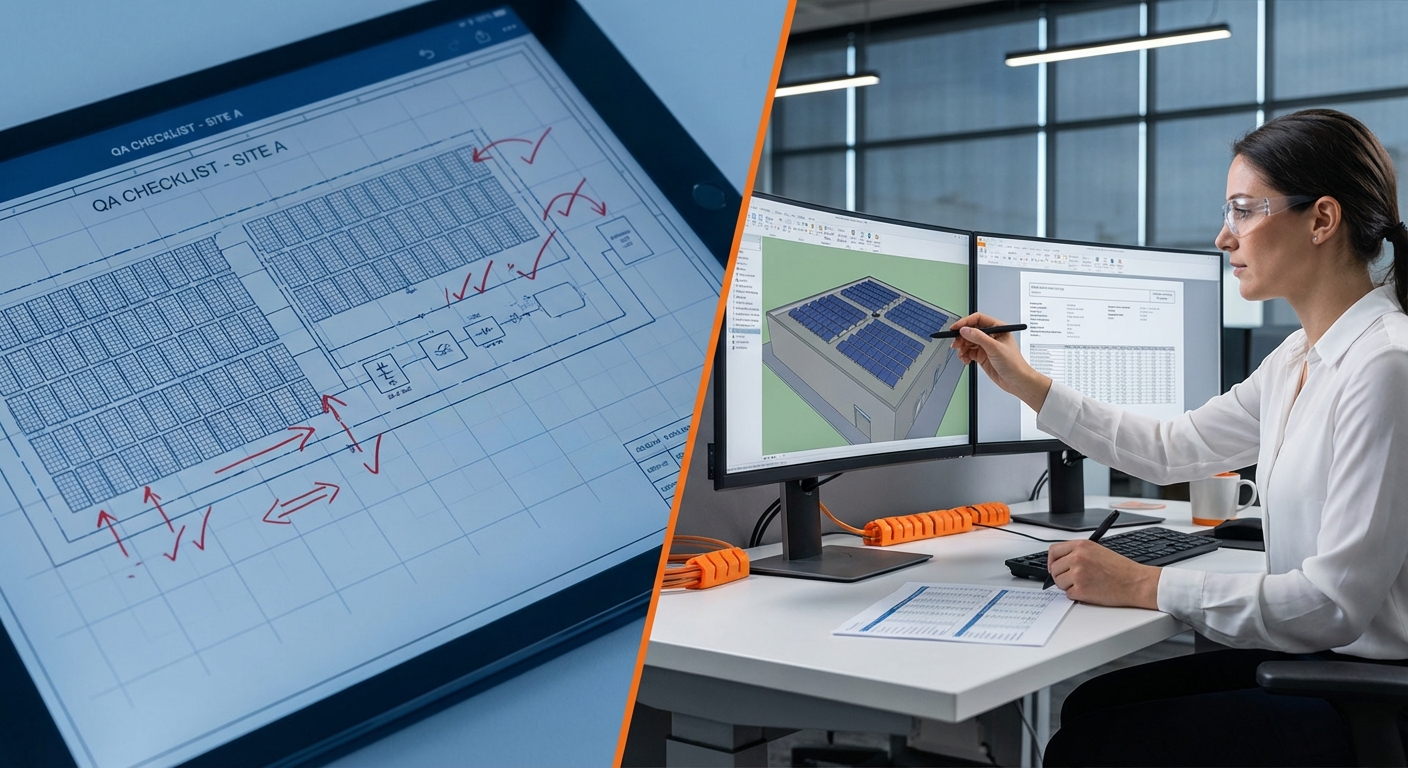
A comprehensive quality assurance system should include multi-level review and approval workflows. Best-in-class solar engineering firms typically implement a three-tier review process:
Tier 1 – Designer self-check: The primary engineer reviews their own work against a detailed checklist covering calculations, code compliance, drawing standards, and specification accuracy.
Tier 2 – Peer review: A second engineer with equivalent or greater expertise independently reviews the complete design package, verifying calculations, checking for constructability issues, and ensuring consistency across all documents.
Tier 3 – Senior engineer approval: A senior technical leader or principal engineer conducts a final review focusing on critical elements, regulatory compliance, and overall design optimization before release.
This multi-layered approach catches errors that single-person reviews might miss and ensures knowledge transfer across the team. Ask potential partners to describe their specific review workflow and who is responsible at each stage.
Error detection and correction protocols are equally important. Even with rigorous reviews, occasional issues may arise. How does the firm handle discovered errors? Do they have a formal process for root cause analysis and corrective action? Firms that track error types and implement continuous improvement demonstrate commitment to quality excellence.
Compliance verification deserves special attention. Your solar design partner should have systematic procedures for ensuring adherence to:
- National and local electrical codes (NEC, IEC standards)
- Building codes and structural requirements
- Fire safety regulations
- Grid interconnection standards
- Environmental and zoning regulations
- Manufacturer specifications and warranties
Request examples of their quality metrics and performance tracking. Leading firms monitor key performance indicators such as design accuracy rates, revision frequency, permit approval success rates, and client satisfaction scores. This data-driven approach to quality management indicates a mature, professional organization committed to continuous improvement.
5. Design Software Capabilities and Technology Stack
The tools a solar engineering firm uses directly impact design accuracy, optimization capabilities, and compatibility with your existing workflows. In 2026, design software capabilities have become a critical differentiator among solar engineering partners.
Industry-standard software platforms that professional solar engineers should utilize include:
Energy modeling and simulation:
- PVsyst: The gold standard for detailed solar system performance modeling, shading analysis, and energy yield predictions
- Helioscope: Cloud-based design platform offering rapid layout optimization and financial modeling
- PVWatts: For preliminary energy estimates and feasibility assessments
- SAM (System Advisor Model): For advanced performance and financial analysis
CAD and technical drawing:
- AutoCAD: Essential for creating precise electrical single-line diagrams, site plans, and construction drawings
- Revit: For building information modeling (BIM) on complex commercial projects
- SketchUp or similar 3D tools: For visualization and client presentations
Structural analysis:
- STAAD.Pro, ETABS, or SAP2000: For detailed structural calculations and load analysis
- Manufacturer-specific tools: For mounting system design and verification
Beyond software ownership, evaluate the firm’s proficiency and experience with these tools. How long have they been using each platform? Do they stay current with software updates and new features? Can they leverage advanced capabilities for optimization rather than just basic functionality?
3D modeling and visualization capabilities have become increasingly important for client communication and construction coordination. Partners who can provide realistic 3D renderings, virtual site tours, and clash detection analysis add significant value beyond basic 2D drawings.
The accuracy of simulation and energy predictions directly affects project financial modeling and client expectations. Ask about the firm’s track record of predicted versus actual energy generation. Reputable partners should be able to demonstrate that their designs consistently perform within 5% of modeled predictions when properly constructed and maintained.
Finally, consider technology integration and file format compatibility. Can the firm deliver files in formats compatible with your project management systems, construction teams, and client requirements? Do they use cloud-based collaboration platforms that facilitate real-time communication and document sharing? Seamless technology integration reduces friction and accelerates project workflows.
6. Comprehensive Service Offerings
The scope of services offered by your solar engineering partner significantly impacts project efficiency and coordination. While some EPCs prefer to manage different project phases with specialized vendors, there are substantial advantages to partnering with a firm that provides comprehensive, end-to-end engineering services.
A full-spectrum solar design partner should offer services spanning the entire project lifecycle:
Pre-design and feasibility phase:
- Solar 3D pre-design: Preliminary layouts and energy estimates for proposal development
- Feasibility studies: Technical and economic viability assessments
- Site evaluation: Remote analysis using satellite imagery, GIS data, and available documentation
These early-stage services help EPCs qualify opportunities, develop accurate proposals, and set realistic client expectations before committing to detailed engineering.
Site survey and assessment:
- Physical site surveys: On-ground measurements, condition assessments, and documentation
- Structural surveys: Roof condition analysis, load-bearing capacity verification for rooftop projects
- Geotechnical assessment coordination: Soil testing and foundation recommendations for ground-mount installations
- Shading analysis: Detailed evaluation of obstructions and seasonal shading impacts
For EPCs operating across India, having a design partner with site survey capabilities throughout the country eliminates coordination challenges and ensures seamless information flow from field assessment to final design.
Detailed engineering design:
- Complete electrical design including single-line diagrams, equipment specifications, and protection schemes
- Structural engineering for mounting systems and foundations
- Civil engineering for site preparation, grading, and drainage
- Mechanical specifications for trackers and auxiliary systems
Permit design and regulatory compliance:
- Permit-ready drawing packages tailored to local authority requirements
- Code compliance documentation and calculations
- Interconnection application support
- Environmental and zoning compliance documentation
Navigating the permit design process across different jurisdictions can be one of the most time-consuming aspects of solar projects. Partners with extensive permitting experience can significantly accelerate approval timelines.
Project management consultancy (PMC):
- Construction oversight and quality monitoring
- Vendor coordination and technical support
- Commissioning support and performance verification
- As-built documentation
For MW-scale projects, PMC services ensure that designs are properly implemented and provide technical expertise throughout construction, bridging the gap between engineering and execution.
The advantage of comprehensive service offerings is streamlined coordination, consistent quality across project phases, and single-point accountability. When site survey data, structural analysis, and electrical design all come from the same team, information gaps and coordination errors are minimized.
7. Communication Standards and Project Management
Even the most technically proficient solar engineering firm will fail to meet your needs if communication is poor. Effective collaboration requires clear communication protocols, responsive project management, and alignment on expectations from project initiation through delivery.
The foundation of good communication is having a dedicated project manager and single point of contact for each engagement. This person should understand your project requirements, coordinate internal resources, and serve as your primary interface with the engineering team. Avoid partners where you’re passed between different people for updates or must navigate unclear organizational structures.
Communication frequency and reporting protocols should be established upfront. Best practices include:
- Project kickoff meetings to align on scope, timeline, and deliverables
- Regular progress updates at defined milestones (e.g., 25%, 50%, 75% completion)
- Proactive notification of any issues or potential delays
- Structured review cycles with clear feedback incorporation processes
- Final delivery meetings to walk through completed designs and address questions
Ask potential partners about their standard communication cadence and whether it can be customized to your preferences. Some EPCs prefer daily updates on fast-track projects, while others are satisfied with weekly summaries for routine work.
For EPCs operating internationally or across multiple time zones, time zone considerations become critical. A solar design partner based in India offers significant advantages for companies in Asian, Middle Eastern, and European markets with overlapping business hours. However, even with time differences, professional firms should provide reasonable response times and schedule calls at mutually convenient times.
Modern collaboration tools and document sharing systems facilitate efficient communication regardless of geography. Evaluate whether potential partners use:
- Cloud-based project management platforms (Asana, Monday.com, or similar)
- Secure file sharing systems (Google Drive, Dropbox, or dedicated portals)
- Video conferencing for complex technical discussions
- Collaborative review tools for markup and feedback on drawings
- Email and messaging systems with reasonable response time commitments
Beyond tools, assess the responsiveness and professionalism of the team during your initial interactions. How quickly do they respond to inquiries? Are their communications clear and professional? Do they ask thoughtful questions that demonstrate understanding of your needs? These early indicators often predict the quality of ongoing collaboration.
Finally, clarify escalation procedures for urgent issues or concerns. Who do you contact if your primary project manager is unavailable? How are disputes or disagreements resolved? Clear escalation paths prevent small issues from becoming project-threatening problems.
8. Pricing Transparency and Cost Structure
Understanding the true cost of solar engineering services requires looking beyond headline prices to evaluate complete cost structures, what’s included in base pricing, and how charges align with value delivered. Engineering cost transparency is essential for accurate project budgeting and avoiding unexpected expenses.
Solar engineering firms typically use one of several pricing models:
Per-MW pricing: Common for utility-scale and large commercial projects, where design fees are calculated based on system capacity (e.g., per MW of DC capacity). This model provides predictable costs for similar project types but may not account for complexity variations.
Per-project pricing: Fixed fees for complete design packages, often used for residential and small commercial projects. This approach offers budget certainty but requires clear scope definition to avoid disputes over what’s included.
Hourly or time-and-materials: Less common for standard projects but appropriate for consulting services, feasibility studies, or projects with undefined scope. This model provides flexibility but less cost predictability.
Retainer or subscription models: For EPCs with consistent project flow, some design partners offer monthly retainers covering a certain number of projects or engineering hours. This can provide cost savings and priority service for high-volume clients.
Regardless of pricing model, demand clarity on what’s included in base pricing versus additional services. A comprehensive proposal should specify:
- Deliverables included (drawings, calculations, specifications, reports)
- Number of revision rounds included
- Site survey costs (if applicable)
- Permit application support
- Rush delivery premiums
- Travel expenses for site visits
- Post-delivery technical support duration
Hidden costs and scope creep are common sources of friction in engineering partnerships. Ensure the agreement clearly defines what constitutes a revision versus a scope change, and how additional work is priced.
Payment terms and milestone-based billing should align with project phases and deliverable completion. Typical structures include:
- Upfront deposit (20-30%) upon project initiation
- Progress payments at defined milestones (e.g., 40% at preliminary design, 30% at final design)
- Final payment upon delivery and acceptance
Be cautious of partners requiring 100% payment upfront, as this provides little leverage if deliverables are unsatisfactory. Conversely, firms willing to work entirely on net-30 or net-60 terms after delivery demonstrate confidence in their work quality.
The critical consideration is cost-effectiveness versus quality balance. The cheapest option rarely delivers the best value. Low-cost providers may cut corners on analysis depth, use junior engineers, or provide minimal support. These savings evaporate quickly when designs require extensive revisions, fail permit review, or create construction issues.
Instead, evaluate total cost of ownership including:
- Initial design fees
- Revision and rework costs
- Permit resubmission expenses
- Construction delays from design errors
- Opportunity cost of extended timelines
A moderately higher-priced partner who delivers accurate, optimized designs that sail through permitting and construction often provides far better ROI than bargain-basement alternatives.
For EPCs seeking cost-effective solutions without compromising quality, consider partners based in regions with favorable cost structures. Indian solar engineering firms, for example, often provide world-class technical expertise at significantly lower costs than Western counterparts due to regional economic factors, offering compelling value propositions for international EPCs.
9. Regulatory Knowledge and Compliance Expertise
Solar projects operate within complex regulatory frameworks that vary by location, project type, and utility jurisdiction. Your solar engineering partner’s depth of regulatory knowledge directly impacts permit approval success, grid interconnection timelines, and long-term project compliance.
A competent solar engineer must maintain current understanding of:
Electrical codes and standards:
- National Electrical Code (NEC) – particularly Articles 690 (Solar PV Systems) and 705 (Interconnected Electric Power Production Sources)
- IEC standards for international projects
- Local amendments and interpretations that vary by jurisdiction
- Rapid shutdown requirements and evolving safety standards
Building codes and structural requirements:
- International Building Code (IBC) and local variants
- Wind load calculations per ASCE 7 or regional standards
- Seismic design requirements in earthquake-prone regions
- Fire setback and access requirements
- Roof load capacity verification for existing structures
Grid interconnection standards:
- Utility-specific technical requirements
- IEEE 1547 standards for distributed energy resources
- Power quality and protection requirements
- Metering and monitoring specifications
For EPCs operating in India, partners should have deep familiarity with:
- Central Electricity Authority (CEA) regulations
- State-specific solar policies and net metering rules
- Bureau of Indian Standards (BIS) requirements
- MNRE guidelines and subsidy program compliance
- State electricity board interconnection procedures
Beyond knowing the rules, experienced partners understand permit approval processes and what different authorities prioritize during review. This institutional knowledge helps design packages that address reviewer concerns proactively, reducing back-and-forth iterations and accelerating approvals.
The regulatory landscape continues evolving in 2026, with new safety requirements, grid integration standards, and environmental regulations emerging regularly. Ask potential partners how they stay current with evolving regulations:
- Participation in industry associations and standards committees
- Regular training and professional development programs
- Subscriptions to code update services and technical publications
- Relationships with authorities having jurisdiction (AHJs)
- Documentation of lessons learned from permit reviews
For EPCs expanding into new geographic markets, a design partner with multi-jurisdictional experience provides invaluable guidance on regional variations and potential pitfalls. They can advise on which design approaches work well in specific locations and which are likely to face resistance from local authorities.
Request examples of how the firm has navigated complex regulatory challenges. Have they successfully permitted projects in jurisdictions known for strict requirements? Can they provide case studies of creative solutions that satisfied both technical requirements and regulatory constraints?
10. Scalability and Growth Capacity
Your solar engineering partnership should be a long-term relationship that grows with your business. Evaluating a potential partner’s scalability and growth capacity ensures they can support your expansion plans rather than becoming a bottleneck as your project volume increases.
Ability to scale with your business growth depends on several factors:
Team capacity and hiring capability: Can the firm expand their engineering team to match your growing project pipeline? Companies with established recruitment processes, training programs, and attractive work environments can scale more readily than those struggling with talent acquisition and retention.
Infrastructure and systems: Do they have project management systems, quality assurance processes, and technology infrastructure that can handle increased volume without degrading quality or communication? Scalable firms have invested in systems that work efficiently at both small and large scales.
Financial stability: Growing partnerships often involve larger projects, longer payment cycles, and greater financial commitments. Ensure your partner has the financial stability to invest in resources before revenue arrives and weather the cash flow dynamics of scaling operations.
Evaluate their capacity for handling multiple concurrent projects. Ask about their current project load, typical capacity utilization, and how they manage resource allocation across clients. Firms operating at 100% capacity have no buffer for your urgent requests or growth, while those with some capacity headroom can be more responsive and flexible.
Understanding their resource allocation and capacity planning processes provides insight into how they’ll manage your projects as volume increases:
- Do they use formal capacity planning tools and forecasting?
- How do they prioritize projects when demand exceeds capacity?
- What’s their policy on accepting new work relative to existing commitments?
- Do they have contingency plans for handling unexpected volume spikes?
The long-term partnership potential extends beyond just handling more projects. As your relationship matures, look for partners who:
- Develop deep understanding of your preferences, standards, and client base
- Proactively suggest process improvements and efficiency gains
- Invest in customization of templates and workflows specific to your needs
- Offer preferential pricing or terms for high-volume, long-term commitments
- Collaborate on business development for new market opportunities
Consider whether the firm’s growth trajectory aligns with yours. A rapidly growing design firm may offer exciting capabilities and competitive pricing, but ensure their growth is managed sustainably without compromising quality. Conversely, a stagnant firm may lack the innovation and investment needed to support your evolving needs.
For EPCs with ambitious expansion plans, discuss your growth projections openly with potential partners. Can they commit to supporting your planned volume increases? What investments would they need to make? How would pricing and service levels evolve as the partnership scales?
11. Client Support and Post-Delivery Services
The relationship with your solar engineering partner shouldn’t end when final drawings are delivered. Comprehensive client support and post-delivery services distinguish exceptional partners from merely adequate ones, providing value throughout the construction and commissioning phases.
Revision policies and design iteration support should be clearly defined upfront. Understand:
- How many revision rounds are included in base pricing?
- What constitutes a revision versus a scope change?
- What’s the turnaround time for incorporating feedback?
- How are additional revisions priced if needed?
Quality partners typically include 2-3 revision rounds for normal design refinements and client feedback incorporation. They should also distinguish between revisions due to design errors (which should be corrected at no charge) and changes in client requirements or site conditions (which may incur additional fees).
Technical support during the construction phase is invaluable when field conditions differ from design assumptions or installation questions arise. Ask whether the partner provides:
- Phone and email support for contractor questions
- Clarification of design intent and specifications
- Field modification review and approval
- Site visit support for complex installations (and associated costs)
- Commissioning assistance and performance verification
Some firms include 30-90 days of post-delivery technical support in their base pricing, while others charge hourly for construction-phase assistance. Clarify these terms to avoid surprises when your installation team needs guidance.
Documentation and training provided should enable your team to understand and utilize the designs effectively:
- Comprehensive design packages with all drawings, calculations, and specifications
- Design basis reports explaining key decisions and assumptions
- Equipment datasheets and manufacturer documentation
- Bill of materials with part numbers and sourcing information
- Walkthrough sessions explaining complex design elements
For EPCs building internal engineering capabilities, some partners offer training on their design approaches, software tools, and best practices, facilitating knowledge transfer and capability development.
Warranty and liability considerations protect both parties in the event of design errors or performance issues:
- Professional liability insurance coverage and limits
- Design warranty period and what’s covered
- Limitation of liability clauses and their reasonableness
- Process for addressing discovered errors or omissions
- Performance guarantee terms (if applicable)
While no one anticipates problems, understanding how issues would be resolved provides peace of mind and demonstrates the partner’s confidence in their work quality.
The best engineering partners view themselves as long-term collaborators in your project success rather than transactional service providers. They’re invested in ensuring their designs perform as intended and your projects achieve their goals, providing support that extends well beyond the initial delivery date.
12. Red Flags and Warning Signs to Avoid
Recognizing warning signs during the partner evaluation process can save you from costly mistakes and problematic relationships. Certain red flags should prompt serious reconsideration or additional due diligence before committing to a solar engineering partnership.

Unrealistic turnaround promises top the list of concerning indicators. If a firm promises delivery timelines significantly faster than industry norms without clear explanation of how they achieve this speed, be skeptical. As discussed earlier, quality engineering requires adequate time for design, calculation, review, and quality assurance. Promises that sound too good to be true usually are, resulting in rushed, error-prone work that creates far greater problems downstream.
Lack of portfolio or verifiable references should raise immediate concerns. Established solar engineering firms should readily provide:
- Detailed portfolio with project examples similar to your needs
- Client references you can contact directly
- Verifiable credentials and certifications
- Company history and team backgrounds
Firms that are evasive about their experience, refuse to provide references, or can’t demonstrate relevant project history may lack the capabilities they claim.
Poor communication or unresponsive teams during the sales process predict worse communication during actual projects. If potential partners are slow to respond to inquiries, miss scheduled calls, or provide vague answers to specific questions, these patterns will likely intensify once they have your business. Professional firms demonstrate responsiveness and clear communication from first contact.
Hidden costs and unclear pricing structures create budget uncertainty and relationship friction. Warning signs include:
- Reluctance to provide detailed written proposals
- Vague scope definitions that leave room for interpretation
- Numerous “additional charges” that aren’t disclosed upfront
- Pricing that seems significantly lower than competitors without clear explanation
- Unwillingness to commit to fixed pricing for defined scope
Transparent partners provide clear, detailed proposals that specify exactly what’s included, what costs extra, and under what circumstances additional charges apply.
Outdated software or methodologies indicate a firm that hasn’t kept pace with industry evolution. In 2026, solar engineering requires current software versions, modern design approaches, and awareness of latest technologies and standards. Partners still using outdated tools or referencing obsolete code versions will produce designs that face permitting challenges and miss optimization opportunities.
Additional red flags to watch for:
- No formal quality assurance process: Reliance on single-person design without peer review
- Unwillingness to provide sample deliverables: Refusal to show examples of their drawing quality and documentation
- Overpromising capabilities: Claiming expertise in every possible project type and technology without demonstrated experience
- High employee turnover: Frequent changes in team members or project contacts
- Lack of professional insurance: Inadequate or no professional liability coverage
- Pressure tactics: Aggressive sales approaches or pressure to commit quickly without adequate evaluation time
- Poor online reputation: Negative reviews, complaints, or concerning information in online research
Trust your instincts during the evaluation process. If something feels off or a partner’s claims don’t align with their demonstrated capabilities, it’s worth investigating further or considering alternatives. The cost of choosing the wrong engineering partner far exceeds the time invested in thorough due diligence.
Making Your Final Decision: A Practical Evaluation Framework
With 12 critical factors to consider, making a systematic, objective decision requires a structured evaluation framework. This practical approach helps you compare potential partners and select the one best aligned with your needs and priorities.

Creating a weighted scorecard for partner evaluation brings objectivity to what can otherwise be an overwhelming decision. Start by listing the 12 factors discussed in this guide, then assign weights based on your specific priorities:
| Evaluation Criteria | Weight (%) | Partner A Score | Partner B Score |
|---|---|---|---|
| Team Size & Expertise | 10% | – | – |
| Project Portfolio | 15% | – | – |
| Quality Assurance | 15% | – | – |
| Pricing & Value | 12% | – | – |
| Communication & PM | 10% | – | – |
Score each partner on a 1-10 scale for each criterion, multiply by the weight, and sum the weighted scores. This quantitative approach reduces bias and facilitates clear comparison, though it should be balanced with qualitative judgment.
Conducting pilot projects or trial engagements provides the most reliable evaluation method. Before committing to a long-term partnership or high-value projects, consider starting with:
- A single small-to-medium project to assess quality and process
- A feasibility study or preliminary design to evaluate technical capabilities
- A time-limited trial period with defined success metrics
This low-risk approach lets you experience the partnership firsthand before making larger commitments. Evaluate not just the final deliverables but the entire collaboration experience—communication quality, responsiveness to feedback, problem-solving approach, and professionalism.
Checking references and conducting due diligence should be thorough and systematic:
- Contact at least 3-5 client references, asking specific questions about quality, timeliness, communication, and problem resolution
- Request references for projects similar to yours in size, type, and complexity
- Research the company’s reputation through online reviews, industry forums, and professional networks
- Verify credentials, certifications, and professional licenses
- Check financial stability through business credit reports if appropriate for large commitments
- Review sample deliverables to assess drawing quality, documentation completeness, and attention to detail
Don’t skip reference checks or accept only the references provided—ask if you can speak with other clients or request additional contacts.
Negotiating partnership terms and SLAs should address:
- Service level agreements: Specific commitments on turnaround times, revision cycles, and response times
- Quality standards: Defined deliverable requirements and acceptance criteria
- Pricing and payment terms: Clear fee structures, payment schedules, and terms for additional work
- Intellectual property: Ownership of designs and right to reuse for similar projects
- Confidentiality: Protection of your client information and project details
- Liability and insurance: Professional liability coverage and limitation of liability terms
- Termination provisions: Conditions under which either party can exit the relationship
- Dispute resolution: Process for addressing disagreements or performance issues
Document these terms in a formal agreement that protects both parties and sets clear expectations. Well-structured contracts prevent misunderstandings and provide framework for resolving issues if they arise.
Conclusion: Partnering for Solar Project Success
Selecting the right solar engineer partner is one of the most consequential decisions your EPC company will make. As we’ve explored through these 12 critical evaluation factors, the choice extends far beyond comparing prices or turnaround times—it’s about finding a partner whose capabilities, values, and approach align with your business objectives and quality standards.
The ideal solar engineering partnership delivers:
- Technical excellence through experienced teams, rigorous quality assurance, and current technology capabilities
- Operational efficiency via reliable turnaround times, clear communication, and scalable capacity
- Strategic value through comprehensive services, regulatory expertise, and long-term collaboration
- Financial transparency with clear pricing, predictable costs, and demonstrable ROI
For solar EPC companies operating in India and international markets in 2026, these factors have never been more critical. As projects grow in complexity, competition intensifies, and margins tighten, your engineering partner becomes a key differentiator in winning projects, delivering quality, and building lasting client relationships.
The evaluation framework presented in this guide—from assessing team expertise and project portfolios to identifying red flags and conducting systematic comparisons—provides a roadmap for making informed decisions. Take the time to thoroughly evaluate potential partners, conduct pilot projects, check references, and negotiate clear terms. The investment in proper partner selection pays dividends through every project you complete together.
Heaven Designs Private Limited exemplifies many of the qualities discussed throughout this guide. With a team of over 50 skilled engineers and consultants based in Surat, Gujarat, they’ve completed 628+ MW of design work for 752+ solar EPC clients across multiple countries. Their comprehensive service offerings span solar 3D pre-design, MW-scale detailed engineering, project management consultancy, civil and structural engineering, site surveys, and permit design—providing end-to-end support for solar projects of all scales.
Their focus on cost-effective, accurate designs that maximize energy generation while optimizing project costs aligns with the core needs of EPCs seeking to deliver value to their clients. With experience across residential rooftop, commercial, industrial, and ground-mount installations throughout India and internationally, they bring the portfolio depth and technical expertise that successful partnerships require.
Whether you’re evaluating Heaven Designs or other potential partners, apply the criteria outlined in this guide systematically. Ask the tough questions, verify claims with evidence, and trust your assessment of both technical capabilities and cultural fit.
Ready to explore a solar engineering partnership that can elevate your project quality and business growth? Get a Quick Proposal Now! to discuss your specific needs and learn how the right design partner can transform your solar EPC operations. You can also reach out directly at +91 90811 00297 or service@heavendesigns.in to start a conversation about your upcoming projects.
The solar energy future is bright, and with the right engineering partner by your side, your EPC company is positioned to capture the opportunities ahead while delivering exceptional value to your clients. Choose wisely, partner strategically, and build the foundation for sustained success in the dynamic solar industry of 2026 and beyond.