


Introduction: The High Cost of Choosing the Wrong Design Partner
For solar EPC companies, selecting the right design partner can mean the difference between profitable projects and costly disasters. A poor choice doesn’t just impact one project—it can damage client relationships, erode profit margins, and compromise your reputation in an increasingly competitive market. In India’s rapidly growing solar sector and across global markets, the stakes have never been higher.
The consequences of partnering with an inadequate solar design firm extend far beyond delayed timelines. EPCs face permit rejections that stall projects for months, structural design errors that require expensive rework, inaccurate energy generation estimates that disappoint clients, and hidden costs that eviscerate project budgets. According to industry data, design-related issues account for up to 30% of project delays in the solar EPC sector, directly impacting cash flow and client satisfaction.
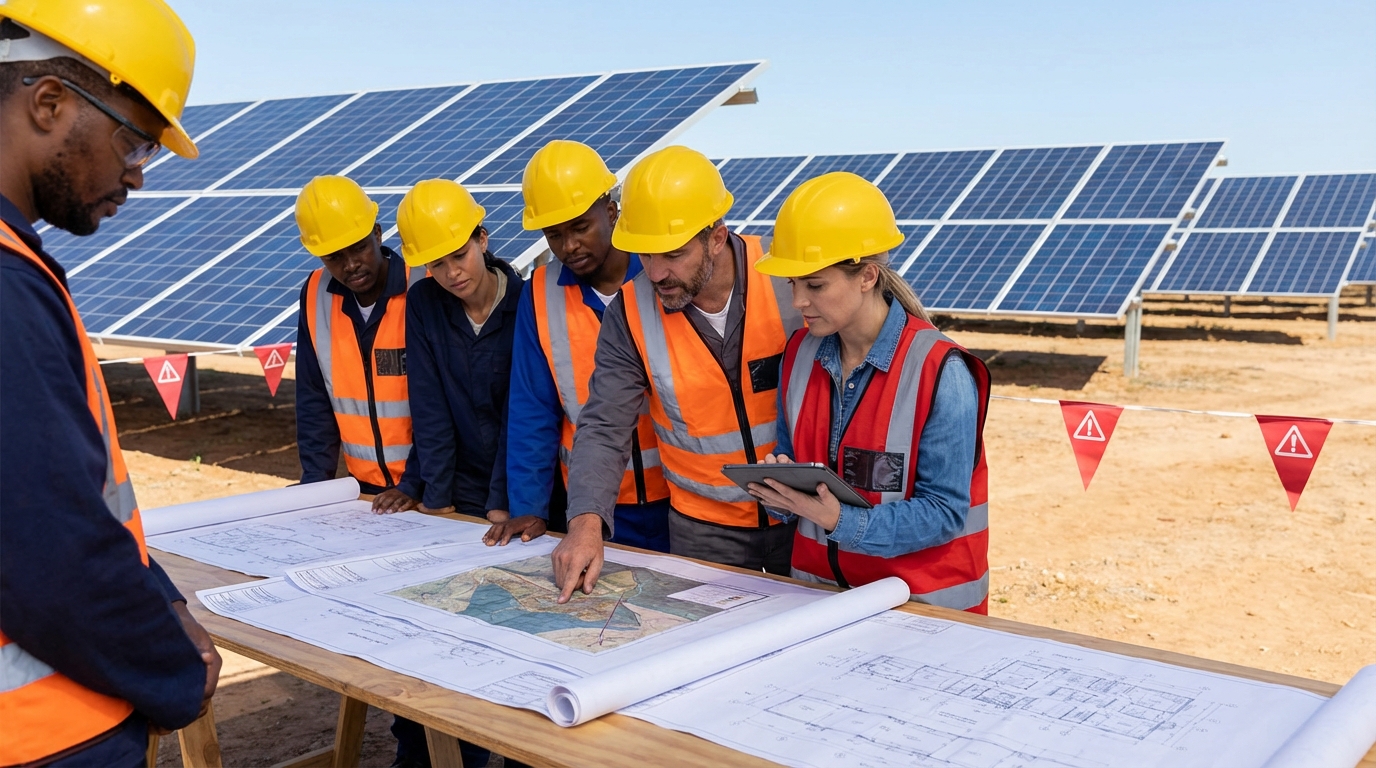
Whether you’re an established EPC company in India managing megawatt-scale commercial installations or a residential solar installation business seeking reliable permit design support, recognizing red flags early in the partner selection process is critical. This comprehensive guide identifies 10 warning signs that should make any EPC company pause and reconsider before committing to a solar design partnership.
From inadequate expertise and poor communication to hidden costs and unrealistic promises, we’ll explore each red flag in detail, provide real-world context, and outline what you should expect from a professional solar design partner instead. By the end of this guide, you’ll have a clear framework for evaluating potential design partners and protecting your business from costly mistakes.
1. Lack of Specialized Solar Engineering Expertise
One of the most critical red flags when evaluating a potential design partner is the absence of specialized solar engineering expertise. While general civil or electrical engineering firms may claim they can handle solar projects, the reality is that solar design requires highly specialized knowledge that goes far beyond traditional engineering disciplines.
Solar-specific expertise encompasses understanding of photovoltaic system behavior, solar irradiation patterns, module mounting structures, inverter sizing, DC/AC electrical design, and the unique structural loads that solar installations impose on buildings and ground-mount systems. A firm without this specialized background will inevitably produce designs that are either over-engineered (increasing costs unnecessarily) or under-engineered (creating safety risks and performance issues).
Warning signs of insufficient solar expertise include:
- Team members with general engineering backgrounds but no demonstrated solar project experience
- Inability to discuss solar-specific design software and calculation methodologies
- Vague responses when asked about previous solar project types and scales
- No understanding of solar industry standards like IEC, IEEE, or local solar regulations
- Lack of familiarity with different mounting systems, module technologies, or inverter configurations
When evaluating a potential partner’s expertise, ask specific questions about their team composition. How many solar engineers do they employ full-time? What is their collective experience in MW capacity designed? Have they worked on projects similar to yours in scale and complexity—whether rooftop commercial installations, ground-mount utility projects, or residential solar systems?
A credible solar design company should readily provide information about their engineering team’s qualifications, certifications, and track record. For instance, a specialized firm might have completed hundreds of megawatts of design work across diverse project types, demonstrating depth of experience that a generalist firm simply cannot match. This specialized expertise directly translates to more accurate designs, fewer revisions, and smoother permit approvals.
2. Inadequate Portfolio or Limited Project Experience
A design partner’s portfolio tells the story of their capabilities—or lack thereof. EPCs should be immediately cautious when a potential partner cannot provide a robust portfolio of completed solar projects with verifiable details and client references.
Red flags in portfolio presentations include:
- Generic stock images instead of actual project photographs and drawings
- Vague project descriptions without specific MW capacity, location, or project type details
- Claims of experience that cannot be verified through client references
- Portfolio dominated by very small projects when you need MW-scale design capabilities
- No diversity in project types (only ground-mount or only rooftop, for example)
- Inability to provide detailed case studies showing design challenges and solutions
When reviewing a potential solar design partner’s portfolio, look for quantifiable achievements. How many total megawatts have they designed? How many clients have they served? Across how many regions or countries have they delivered projects? These metrics provide concrete evidence of experience and capability.
For EPC companies operating in India or serving international markets, it’s particularly important that your design partner has experience with the specific regulatory environments, climatic conditions, and project types relevant to your business. A firm that has successfully delivered rooftop solar India projects understands the unique challenges of Indian building codes, monsoon wind loads, and local utility interconnection requirements—knowledge that cannot be easily replicated by firms without regional experience.
Don’t hesitate to request detailed case studies and client references. A professional design firm will gladly connect you with previous clients who can speak to their experience, quality of deliverables, communication practices, and post-design support. If a potential partner is reluctant to provide references or cannot produce verifiable project examples, consider it a major warning sign.
3. Poor Communication Practices and Unresponsive Teams
Communication quality during the initial evaluation phase is often the best predictor of how a design partnership will function throughout actual project execution. If a potential design partner exhibits poor communication practices before you’ve even signed a contract, these issues will only magnify once you’re working together on time-sensitive projects.
Critical communication red flags include:
- Delayed responses to inquiries (taking days to respond to emails or calls)
- Vague or incomplete answers to specific technical questions
- No designated point of contact or project manager assigned to your account
- Difficulty scheduling meetings or calls to discuss project requirements
- Language barriers that impede clear technical communication
- Lack of proactive updates during sample project discussions
- Unclear escalation procedures when issues arise
Effective communication is particularly crucial in solar design partnerships because projects involve numerous technical details, revision cycles, and coordination between design, permitting, and construction phases. When your design partner is unresponsive or unclear in their communications, every aspect of the project suffers—timelines slip, misunderstandings lead to design errors, and your relationship with your end client becomes strained.
What should you expect instead? Professional solar design firms establish clear communication protocols from the outset. They assign dedicated project managers who serve as your primary point of contact, provide regular project status updates without prompting, respond to inquiries within defined timeframes (typically within 24 hours for urgent matters), and maintain detailed documentation of all project communications and decisions.
During your evaluation process, pay attention to how potential partners communicate. Are they proactive in asking clarifying questions about your requirements? Do they provide clear, detailed responses to your technical inquiries? Do they follow up promptly after meetings? These early interactions reveal the communication culture you can expect throughout your partnership.
4. Unrealistic Timelines and Over-Promising Delivery
When a potential design partner promises delivery timelines that seem too good to be true, they probably are. Over-promising on project schedules is a common tactic used by inexperienced or desperate firms to win business, but it inevitably leads to missed deadlines, rushed work, and compromised quality.
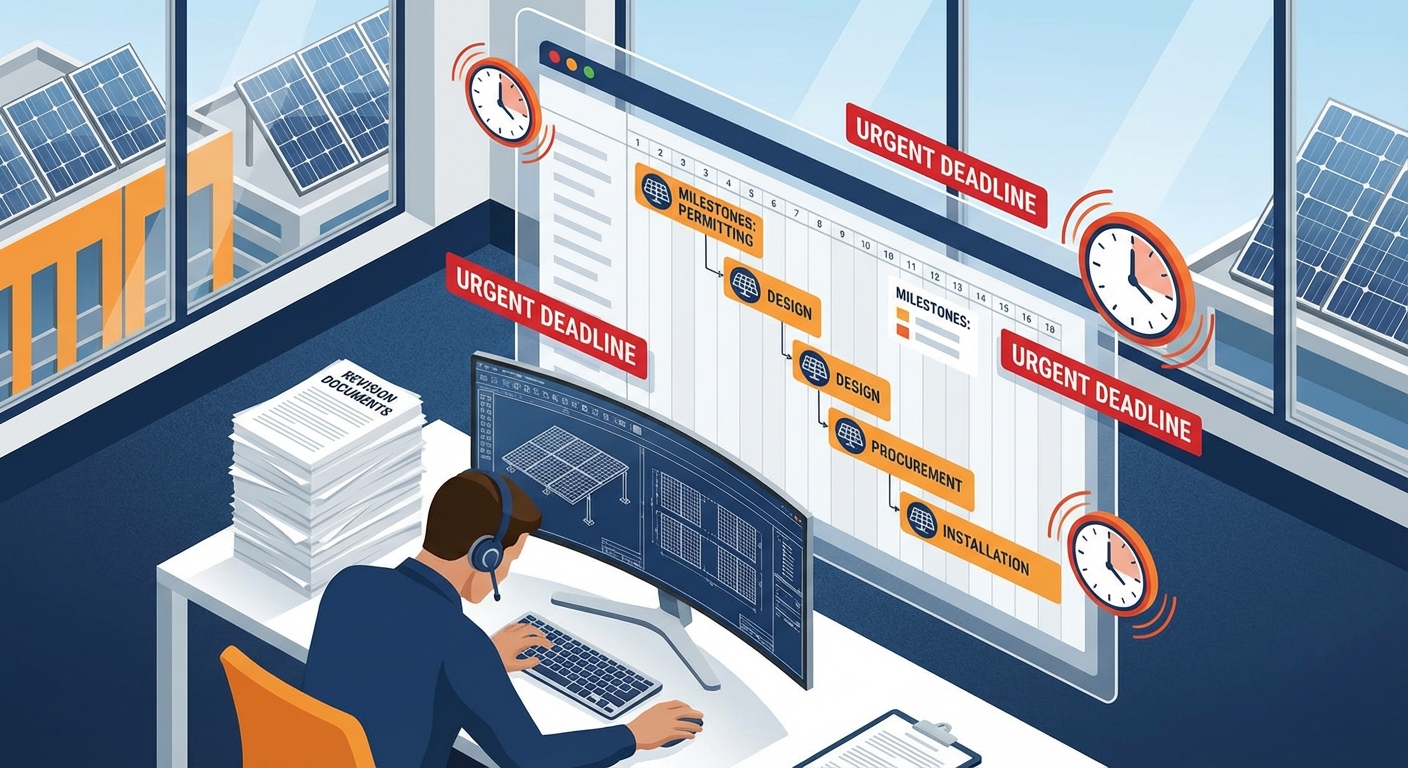
Understanding realistic design timelines is essential for EPCs to identify when a potential partner is making unrealistic promises. Industry-standard timelines vary based on project scope and complexity:
- Residential rooftop solar design (3-10 kW): 3-5 business days for permit-ready drawings
- Commercial rooftop solar (50-500 kW): 1-2 weeks for detailed engineering design
- MW-scale ground-mount projects: 3-6 weeks for comprehensive detailed engineering
- Site surveys and feasibility studies: 1-2 weeks depending on location and accessibility
- Structural engineering assessments: 1-2 weeks for detailed structural analysis and calculations
Red flags related to timelines include:
- Promises to deliver complex MW-scale designs in just a few days
- No discussion of revision cycles or quality review time in the timeline
- Unwillingness to provide a detailed project schedule with milestones
- History of missed deadlines with previous clients (revealed through reference checks)
- No buffer time for permit authority feedback or client revisions
The risks of unrealistic timelines extend far beyond simple delays. When design firms rush to meet impossible deadlines, quality suffers dramatically. Rushed permit designs get rejected by authorities, requiring time-consuming resubmissions. Inadequate structural engineering calculations can lead to safety issues or system failures. Incomplete solar drawings force construction teams to make field assumptions, increasing installation costs and error rates.
Professional design partners provide realistic timelines based on project complexity and build in appropriate time for quality control reviews, client feedback cycles, and potential revisions. They communicate clearly about factors that might affect schedules—such as site survey accessibility, complexity of structural assessments, or permit authority review periods—and work collaboratively to establish achievable milestones.
When evaluating timeline commitments, ask potential partners to walk you through their design process step-by-step and explain how they arrive at their estimated delivery dates. Firms with genuine expertise can articulate their workflow clearly and justify their timelines based on resource allocation and quality control requirements.
5. Absence of Quality Control and Review Processes
Quality control is the backbone of reliable solar design work, yet many firms lack structured QC processes—a red flag that EPCs cannot afford to ignore. Without rigorous quality assurance, even experienced engineers can produce designs with errors that lead to permit rejections, construction delays, and safety issues.
Warning signs of inadequate quality control include:
- No documented quality control process or design review checklist
- Single-person review where the designer checks their own work without peer review
- Absence of design standards or templates that ensure consistency
- No software validation or cross-checking of calculations
- Inability to explain their QC process when asked
- No final review by senior engineers before deliverable submission
- Lack of version control or change tracking in design documents
The impact of poor quality control manifests throughout the project lifecycle. During the permitting phase, designs with errors or omissions get rejected by authorities, causing delays that can extend for weeks or months. During construction, installers discover design inconsistencies or missing information, leading to costly field changes and schedule disruptions. Post-installation, inadequate designs may result in underperforming systems or structural failures that damage your reputation and create liability issues.
What should robust quality control look like in a professional solar design partner? Industry-leading firms implement multi-level review processes that include:
- Self-review: The designing engineer performs initial quality checks against design standards
- Peer review: Another engineer with similar expertise reviews the design for technical accuracy
- Senior review: An experienced senior engineer or technical director performs final validation
- Software validation: Design calculations are cross-checked using multiple software tools
- Checklist verification: Standardized checklists ensure all required elements are included
- Drawing coordination: All drawings are checked for consistency and coordination between disciplines
For specialized aspects like structural engineering India projects, additional reviews by licensed structural engineers ensure that designs meet local building codes and safety standards. For permit design work, QC processes should include verification against specific authority requirements and local regulations.
When evaluating potential partners, ask detailed questions about their quality control procedures. Request to see their QC checklists or design standards documentation. Ask how many review levels each project undergoes and who is responsible for final sign-off. A firm that takes quality seriously will have clear, documented processes and will be proud to share them with potential clients.
6. Hidden Costs and Unclear Pricing Structures
Transparent pricing is fundamental to any successful business partnership, yet many EPCs discover hidden costs only after committing to a design partner. Unclear pricing structures and surprise charges can quickly transform what appeared to be a cost-effective partnership into a budget-busting nightmare.
Red flags in pricing and cost structures include:
- Reluctance to provide detailed written quotations with itemized deliverables
- Vague scope of work that doesn’t clearly define what’s included in the base price
- No clear policy on revisions—how many are included, and what additional revisions cost
- Separate charges for elements that should be standard (like basic calculations or standard drawing sets)
- Unclear payment terms or demands for large upfront payments before work begins
- No discussion of potential additional costs for complex site conditions or design challenges
- Pricing that seems significantly lower than market rates without clear explanation
Common hidden costs that EPCs encounter with less transparent design partners include:
- Revision fees charged after the first or second round of changes
- Additional charges for “extra” drawings that should be standard deliverables
- Fees for design clarifications or construction support during installation
- Charges for file format conversions or providing editable source files
- Rush fees for normal turnaround times
- Travel costs for site surveys that weren’t disclosed upfront
The impact of hidden costs extends beyond the immediate financial burden. Budget overruns on design services reduce your project margins, potentially making projects unprofitable. Surprise charges create tension in the partnership and erode trust. Time spent negotiating unexpected fees delays project progress and diverts attention from execution.
What should transparent pricing look like? Professional solar design firms provide detailed proposals that clearly outline:
- Scope of work: Specific deliverables included (drawing types, calculation packages, report formats)
- Base pricing: Clear cost for the defined scope, typically structured by project size or complexity
- Revision policy: Number of revision rounds included and cost for additional revisions
- Timeline: Standard delivery timeline and any expedite fees if applicable
- Payment terms: Payment schedule tied to project milestones
- Exclusions: Clear statement of what’s not included in the base price
- Additional services: Optional services with transparent pricing (like PMC services India or extended construction support)
When evaluating solar design cost proposals, don’t automatically choose the lowest bidder. Extremely low pricing often indicates either hidden costs that will emerge later or inadequate resources that will compromise quality. Instead, look for partners who provide detailed, transparent pricing that reflects the true value and complexity of professional solar engineering work.
Request written proposals from potential partners and compare them carefully. Ask clarifying questions about anything that’s unclear. A reputable firm will welcome these questions and provide straightforward answers, while firms with something to hide will be evasive or defensive.
7. Limited or Outdated Design Software and Tools
The quality and accuracy of solar design work depends heavily on the software tools and technologies used by your design partner. Firms relying on outdated software or manual calculation methods cannot deliver the precision and efficiency that modern solar projects demand.
Red flags related to design software and tools include:
- Inability to name specific design software platforms they use
- Reliance on outdated software versions that lack current features and databases
- Heavy dependence on manual calculations without software validation
- No use of 3D modeling tools for complex installations
- Lack of specialized structural analysis software for engineering calculations
- No CAD software for professional drawing production
- Inability to provide designs in industry-standard file formats
Modern solar design requires sophisticated software tools across multiple disciplines. For accurate energy modeling and system design, industry-standard platforms like PVsyst, Helioscope, or similar tools are essential. For structural engineering calculations, specialized software that can model wind loads, seismic forces, and structural stresses is critical. For producing professional construction drawings, current CAD platforms are non-negotiable.
The impact of inadequate or outdated design software India tools manifests in several ways:
- Accuracy issues: Outdated weather databases or calculation methods produce inaccurate energy generation estimates
- Efficiency problems: Manual processes take longer and are more prone to human error
- Compatibility challenges: Outdated file formats create problems for clients and construction teams
- Limited capabilities: Inability to model complex scenarios or optimize designs effectively
- Compliance risks: Older software may not incorporate current codes and standards
When evaluating potential design partners, ask specific questions about their software toolkit. What platforms do they use for energy modeling? What structural analysis software do they employ? What CAD systems produce their drawings? How do they ensure their software databases and calculation methods remain current?
Professional solar design firms invest significantly in maintaining current software licenses, training their teams on the latest features, and validating their tools against industry standards. They should be able to discuss their software capabilities confidently and explain how different tools are applied to different aspects of the design process.
Additionally, ask about their quality assurance approach to software-generated results. Even the best software requires experienced engineers to interpret results, validate outputs, and apply engineering judgment. A firm that blindly trusts software outputs without critical review is as problematic as one using outdated tools.
8. No Site Survey or Feasibility Study Capabilities
Accurate solar design begins with comprehensive site assessment, yet some design partners attempt to create designs based solely on satellite imagery and remote data—a practice that inevitably leads to problems during installation. The absence of proper site survey and feasibility study capabilities is a critical red flag for EPCs.

Warning signs related to site assessment capabilities include:
- Claims that site visits are unnecessary for accurate design
- Reliance exclusively on satellite imagery or Google Earth for site information
- No in-house team or established partners for conducting physical site surveys
- Inability to provide site survey services in your target regions
- No structured feasibility study process or deliverable templates
- Lack of proper surveying equipment or measurement tools
- No experience with different site types (rooftop, ground-mount, carport, etc.)
The risks of designs created without proper site assessment are substantial. Remote data cannot capture critical details like existing structural conditions, shading from nearby objects, roof obstructions, soil conditions for ground-mount projects, electrical infrastructure locations, or access constraints. Designs based on incomplete site information frequently require expensive modifications during construction when field conditions don’t match design assumptions.
For EPC companies operating across India or international markets, partnering with a design firm that offers comprehensive site survey India capabilities provides significant advantages. Professional site surveys should include:
- Physical measurements: Accurate dimensions of installation areas using surveying equipment
- Structural assessment: Evaluation of existing structures for solar load capacity
- Shading analysis: On-site measurement of shading patterns throughout the day
- Electrical infrastructure: Documentation of existing electrical systems and interconnection points
- Access evaluation: Assessment of equipment access routes and installation logistics
- Photographic documentation: Comprehensive photo documentation of site conditions
- Soil testing: For ground-mount projects, soil analysis for foundation design
Similarly, comprehensive feasibility study India services should evaluate project viability before detailed design begins. Feasibility studies assess factors like solar resource availability, grid connectivity, regulatory requirements, financial viability, and technical constraints—providing EPCs with the information needed to make informed go/no-go decisions before investing in full design development.
When evaluating potential design partners, ask about their site survey capabilities and processes. Do they have teams deployed in your target regions? What equipment and methodologies do they use? Can they provide sample site survey reports? For firms serving multiple regions, do they have established networks of survey partners or in-house teams that can mobilize quickly?
A design partner with strong site assessment capabilities not only produces more accurate designs but also helps EPCs avoid costly surprises during construction. The investment in proper site surveys and feasibility studies pays dividends through smoother project execution and fewer change orders.
9. Insufficient Understanding of Local Regulations and Permit Requirements
Navigating the complex landscape of solar regulations, building codes, and permit requirements demands specialized knowledge that varies significantly across regions. A design partner lacking expertise in local regulatory environments will produce designs that face permit rejections, delays, and costly revisions.
Red flags indicating insufficient regulatory knowledge include:
- Unfamiliarity with local building codes and electrical standards in your target markets
- No experience with specific permit authorities or utility interconnection processes
- Generic designs that don’t account for regional requirements
- Inability to discuss specific regulatory challenges in your operating regions
- No established relationships with permit authorities or utility companies
- History of permit rejections or multiple resubmission cycles
- Lack of knowledge about recent regulatory changes or updates
The regulatory landscape for solar projects in India alone is complex, with variations across states, municipalities, and utility territories. Requirements differ for rooftop solar India installations versus ground-mount projects, for grid-connected versus off-grid systems, and for residential versus commercial applications. Design partners must understand National Building Code requirements, state-specific solar policies, local fire safety regulations, electrical safety standards, and utility interconnection procedures.
For EPCs serving international markets, regulatory expertise becomes even more critical. Building codes, wind load calculations, seismic design requirements, electrical standards, and permit processes vary dramatically across countries and regions. A design partner claiming to serve global markets must demonstrate genuine expertise in the specific regulatory environments where you operate.
The impact of inadequate regulatory knowledge manifests most painfully during the permitting phase. Designs that don’t comply with local requirements get rejected by authorities, forcing time-consuming revisions and resubmissions. Each rejection cycle delays project timelines by weeks or months, impacting your commitments to clients and your project cash flow. Multiple rejection cycles also damage your reputation with permit authorities, potentially making future approvals more difficult.
What should you expect from a design partner with strong regulatory expertise? They should:
- Demonstrate detailed knowledge of regulations in your specific operating regions
- Maintain current understanding of regulatory changes and updates
- Produce permit design packages that consistently achieve first-time approvals
- Provide guidance on permit application processes and authority expectations
- Offer support during permit review processes, including responding to authority questions
- Understand utility interconnection requirements and application procedures
- Stay informed about incentive programs and compliance requirements
When evaluating potential partners, ask specific questions about their regulatory experience in your target markets. What is their permit approval rate? How many resubmission cycles do their designs typically require? Can they provide examples of successfully permitted projects in specific jurisdictions? Do they have established relationships with permit authorities that facilitate smoother approvals?
For EPC companies, partnering with a design firm that has deep regulatory expertise translates directly to faster project execution, fewer delays, and more predictable timelines—all of which improve profitability and client satisfaction.
10. Lack of Post-Design Support and Project Management Services
The design phase doesn’t end when drawings are delivered. Professional design partners provide ongoing support throughout permit review, construction, and commissioning phases—yet many firms disappear after delivering initial designs, leaving EPCs to navigate challenges alone.
Warning signs of inadequate post-design support include:
- No mention of construction support or design clarification services in proposals
- Additional charges for answering questions about their own designs
- Unresponsiveness when permit authorities request clarifications or revisions
- No project management consultancy (PMC) capabilities for larger projects
- Lack of field support when installation teams encounter design-related questions
- No process for handling design modifications required during construction
- Inability to provide as-built drawing updates after construction
The value of comprehensive post-design support cannot be overstated. During permit review, authorities frequently request clarifications, additional calculations, or minor design modifications. Having your design partner available to respond quickly keeps the approval process moving. During construction, installation teams inevitably encounter field conditions that require design interpretation or minor adjustments. Immediate access to the design team prevents costly installation delays.
For MW-scale commercial and utility projects, comprehensive PMC services India capabilities provide even greater value. Project management consultancy services extend beyond basic design support to include:
- Construction oversight: Monitoring installation quality and compliance with design specifications
- Quality assurance: Verifying that construction matches design intent
- Change management: Evaluating and documenting field changes when necessary
- Progress monitoring: Tracking project milestones and identifying potential delays
- Commissioning support: Assisting with system testing and performance verification
- Documentation: Producing as-built drawings and final project documentation
EPCs working on complex projects benefit enormously from design partners who offer integrated PMC capabilities. Rather than coordinating between separate design and project management firms, you have a single partner who understands the project from conception through completion, ensuring continuity and accountability.
When evaluating potential design partners, ask detailed questions about their post-design support model. What level of support is included in their standard pricing? How do they handle permit authority questions and revision requests? Do they provide construction support, and if so, what does that entail? For larger projects, do they offer comprehensive PMC services?
Professional solar design firms view their relationship with EPCs as a partnership that extends throughout the project lifecycle, not just a transactional delivery of drawings. They understand that their success is measured not just by the quality of initial designs, but by the ultimate success of installed projects. This partnership mindset translates to responsive support, proactive problem-solving, and commitment to project success from design through commissioning.
How to Properly Vet a Solar Design Partner: A Checklist for EPCs
Armed with knowledge of the 10 critical red flags, EPCs need a systematic approach to evaluating potential solar design partners. This comprehensive checklist provides a framework for thorough partner assessment:

Initial Evaluation Questions
- How many years has your firm specialized in solar design?
- How many full-time solar engineers and consultants do you employ?
- What is your total MW capacity of completed design work?
- How many EPC clients have you served?
- In which geographic regions do you have project experience?
- What types of solar projects do you specialize in (rooftop, ground-mount, carport, etc.)?
Technical Capability Assessment
- What design software platforms do you use for energy modeling, structural analysis, and CAD?
- What is your quality control process, and how many review levels does each project undergo?
- Do you provide site survey and feasibility study services in our target regions?
- What is your expertise with local regulations and permit requirements in our markets?
- Can you provide structural engineering services for both rooftop and ground-mount projects?
- What design standards and templates do you follow?
Portfolio and Reference Verification
- Request detailed case studies of projects similar to yours in scale and type
- Ask for client references and actually contact them to discuss their experience
- Review sample deliverables (drawings, calculations, reports) to assess quality
- Verify claimed project experience through client testimonials or project documentation
- Ask about their most challenging project and how they overcame obstacles
Process and Communication Evaluation
- Who will be our primary point of contact, and what is their experience level?
- What is your typical response time for client inquiries?
- How do you provide project status updates throughout the design process?
- What is your process for handling revisions and client feedback?
- How do you manage projects with tight deadlines or complex requirements?
Pricing and Terms Clarification
- Request detailed written proposals with itemized deliverables and pricing
- Clarify what’s included in base pricing and what constitutes additional charges
- Understand revision policies—how many rounds are included?
- Discuss payment terms and milestone-based payment schedules
- Ask about pricing for different project scales to understand their cost structure
- Clarify post-design support included versus additional support services
Timeline and Capacity Assessment
- What are realistic timelines for projects of different scales and complexity?
- What is your current project load and capacity to take on new work?
- How do you handle multiple concurrent projects while maintaining quality?
- What factors might extend timelines, and how do you communicate delays?
- Can you scale resources to handle varying project volumes?
Trial Project Strategy
Before committing to a long-term partnership, consider starting with a pilot project to evaluate the design partner’s capabilities firsthand:
- Select a representative project that reflects your typical work
- Evaluate their performance across all dimensions: quality, timeliness, communication, support
- Assess how they handle feedback and revisions
- Test their responsiveness during permit review and construction phases
- Use the pilot project experience to inform your long-term partnership decision
Long-Term Partnership Considerations
- Does the firm demonstrate commitment to long-term client relationships?
- Are they investing in growing their capabilities and staying current with industry trends?
- Do they show flexibility in adapting to your specific processes and requirements?
- Are they proactive in suggesting improvements or identifying potential issues?
- Do they view the relationship as a partnership or just a transaction?
By systematically working through this checklist, EPCs can make informed decisions about design partnerships based on objective criteria rather than marketing claims or lowest pricing. The time invested in thorough vetting pays dividends through years of successful project collaboration.
Conclusion: Partnering with the Right Solar Design Company Makes All the Difference
The 10 red flags outlined in this guide—from lack of specialized expertise and inadequate portfolios to poor communication, unrealistic timelines, absent quality control, hidden costs, outdated tools, missing site survey capabilities, insufficient regulatory knowledge, and lack of post-design support—represent critical warning signs that EPCs must recognize when evaluating potential design partners.
The consequences of ignoring these red flags extend far beyond individual project challenges. The wrong design partnership damages your reputation with clients, erodes project profitability, creates operational inefficiencies, and ultimately limits your growth potential in an increasingly competitive solar market. Conversely, partnering with the right solar design firm amplifies your capabilities, accelerates project execution, improves quality outcomes, and strengthens your competitive position.
What distinguishes exceptional design partners from mediocre ones? Exceptional firms bring deep specialized expertise developed through hundreds of projects and thousands of megawatts of design experience. They invest in their teams, maintaining large groups of dedicated solar engineers who understand the nuances of different project types, regional requirements, and technical challenges. They implement rigorous quality control processes that consistently deliver accurate, permit-ready designs. They communicate proactively and responsively, treating your projects with the urgency they deserve. They provide transparent pricing without hidden surprises. They leverage current design software and methodologies to ensure accuracy and efficiency. They offer comprehensive services from initial feasibility studies through detailed engineering, site surveys, permit design, and post-design support including PMC services for complex projects.
For solar EPC companies operating in India’s dynamic market or serving international clients, the right design partnership becomes a strategic competitive advantage. When your design partner consistently delivers accurate designs on time, achieves first-time permit approvals, provides responsive support throughout construction, and helps you optimize project costs, you can confidently take on more projects, serve clients better, and grow your business profitably.
As you evaluate current or potential design partnerships, use the red flags and evaluation checklist provided in this guide to conduct thorough assessments. Don’t be swayed by the lowest pricing or the most aggressive promises. Instead, look for partners who demonstrate genuine expertise, proven track records, transparent practices, and commitment to your success.
At Heaven Designs, we understand the critical importance of reliable design partnerships for EPC success. With over 50 dedicated engineers and consultants, we’ve delivered 628+ MW of design work for 752+ solar EPC clients across multiple countries. Our comprehensive services span from initial solar 3D pre-design and feasibility studies through detailed engineering, structural engineering, site surveys across India, and permit design to ongoing project management consultancy. We’ve built our reputation on delivering accurate, cost-effective designs that help EPCs maximize project profitability while ensuring quality and compliance.
If you’re seeking a solar design partner who brings specialized expertise, proven processes, transparent practices, and genuine commitment to your project success, we invite you to explore how Heaven Designs can support your growth. Get a Quick Proposal Now! to discuss your specific requirements, or contact our team directly at +91 90811 00297 or service@heavendesigns.in.
The right design partnership transforms how you execute solar projects—making the difference between struggling with constant challenges and confidently delivering successful projects that delight clients and drive profitable growth. Choose wisely, evaluate thoroughly, and partner with firms that demonstrate the expertise, processes, and commitment your business deserves.