


For solar EPC companies operating in India and international markets, every rupee invested in project development must deliver measurable returns. Yet many EPCs overlook one of the most critical factors affecting project profitability: the quality of engineering design. Understanding and calculating design ROI is essential for making informed decisions about where to allocate resources in your solar projects.
Professional solar design services represent a small fraction of total project costs—typically 1-3% of the overall budget—but their impact ripples through every phase of project execution. From material procurement to installation efficiency, from energy generation to permit approvals, quality engineering design directly influences your bottom line. This comprehensive guide shows you exactly how to calculate the return on investment from professional solar design services and demonstrates why cutting corners on design is one of the costliest mistakes an EPC can make.
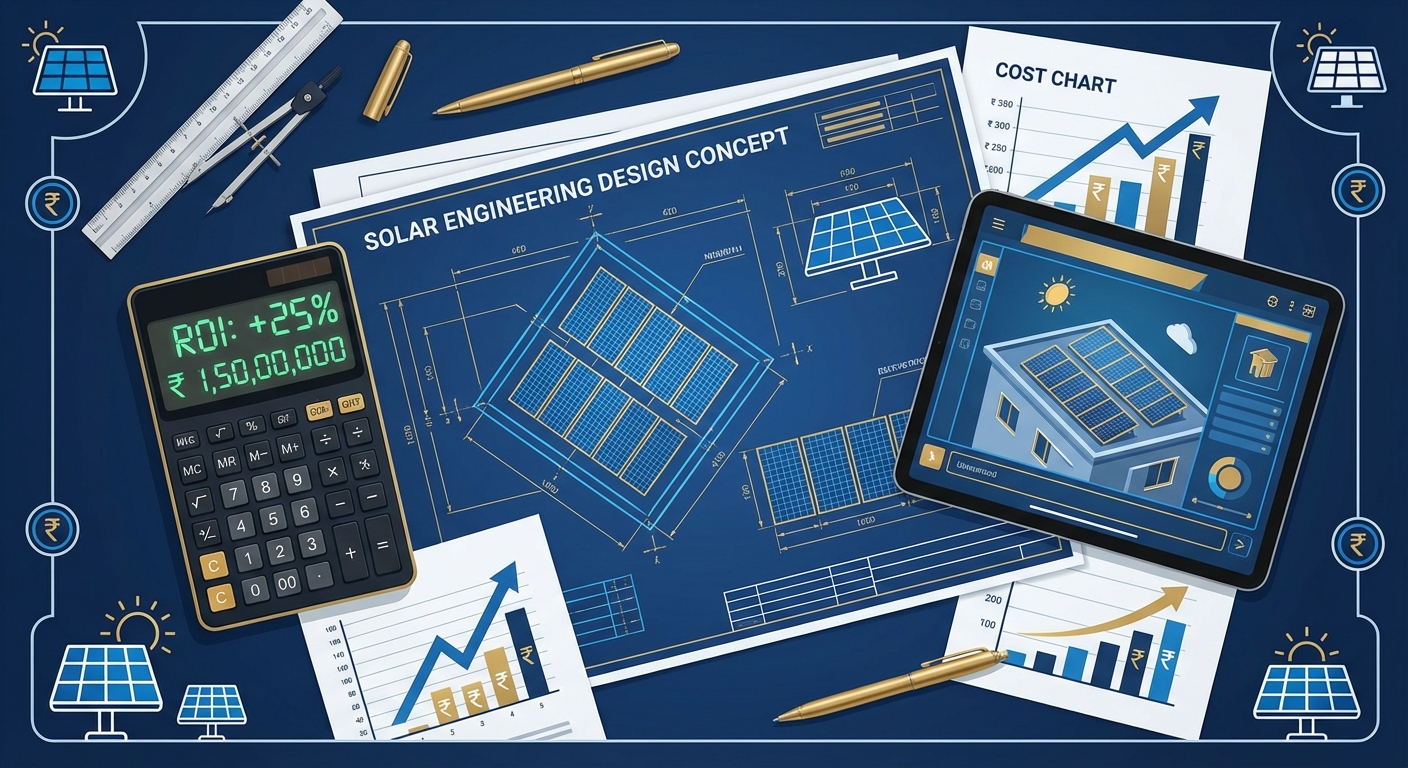
Understanding Design ROI in Solar Projects
Design ROI measures the financial return generated from investing in professional engineering design services compared to the cost of those services. For solar projects, this calculation extends far beyond simple cost comparison. It encompasses material savings, energy optimization, installation efficiency, compliance benefits, and long-term performance improvements.
The hidden costs of poor design decisions often don’t surface until installation begins or, worse, after commissioning. An undersized cable can cause voltage drops that reduce energy generation by 2-3% over the project’s lifetime. Improper structural calculations can require expensive retrofitting or additional materials. Inadequate site surveys can lead to installation delays costing thousands per day. These cascading failures make design ROI one of the most important metrics for solar EPCs to track.
In India’s competitive solar market, where project margins are tight and clients demand maximum value, quality engineering design becomes a competitive advantage. EPCs who invest in comprehensive feasibility studies and detailed engineering documentation consistently deliver projects on time, within budget, and with superior performance characteristics.
The entire project lifecycle benefits from quality design work. During procurement, optimized designs reduce material costs by 5-15%. During installation, clear documentation and accurate measurements cut labor hours by 10-20%. During commissioning, properly designed systems require fewer adjustments and corrections. Over the project’s 25-year lifespan, optimized energy generation can increase revenue by 3-8% compared to poorly designed systems.
1. Calculate Material Cost Savings Through Optimized Design
Material costs typically represent 60-70% of total solar project expenses, making this the largest opportunity for design ROI improvement. Professional structural engineering services analyze site-specific conditions to determine the exact materials needed, no more, no less.
Consider a 1 MW ground mount solar project in Gujarat. A generic design might specify heavy-duty racking suitable for high wind zones, costing ₹45 lakhs for the complete mounting structure. However, a site-specific structural engineering analysis reveals the location experiences moderate wind loads, allowing for optimized racking that costs ₹38 lakhs, a savings of ₹7 lakhs on this component alone.
Module layout optimization is another critical factor. Advanced design software can arrange panels to maximize capacity within available space while minimizing cable runs and balance-of-system components. For a commercial rooftop project, optimized layout might fit 250 kW where a basic design only accommodated 230 kW, a 20 kW increase that generates additional revenue without increasing roof space costs.
Cable routing efficiency directly impacts copper costs, which have risen significantly in recent years. Professional electrical design determines the shortest, most efficient cable paths while maintaining proper voltage levels. For MW-scale projects, optimized cable design typically reduces copper requirements by 8-12%, translating to savings of ₹3-5 lakhs per MW.
Here’s a practical ROI calculation for material optimization on a 1 MW commercial project:
- Professional design cost: ₹2.5 lakhs
- Structural optimization savings: ₹7 lakhs
- Cable routing efficiency: ₹4 lakhs
- Layout optimization (additional 20 kW capacity): ₹6 lakhs in additional revenue over project life
- Total material savings: ₹11 lakhs
- Design ROI: (₹11 lakhs / ₹2.5 lakhs) × 100 = 440% return
This calculation doesn’t even include the downstream benefits of faster installation and improved performance. The material savings alone justify the investment in professional engineering design services multiple times over.
2. Measure Energy Generation Optimization Impact
Energy generation directly determines project revenue over its 25-year operational life. Even small improvements in system efficiency compound into substantial financial gains. This is where design ROI becomes most dramatic, as the benefits accumulate year after year.
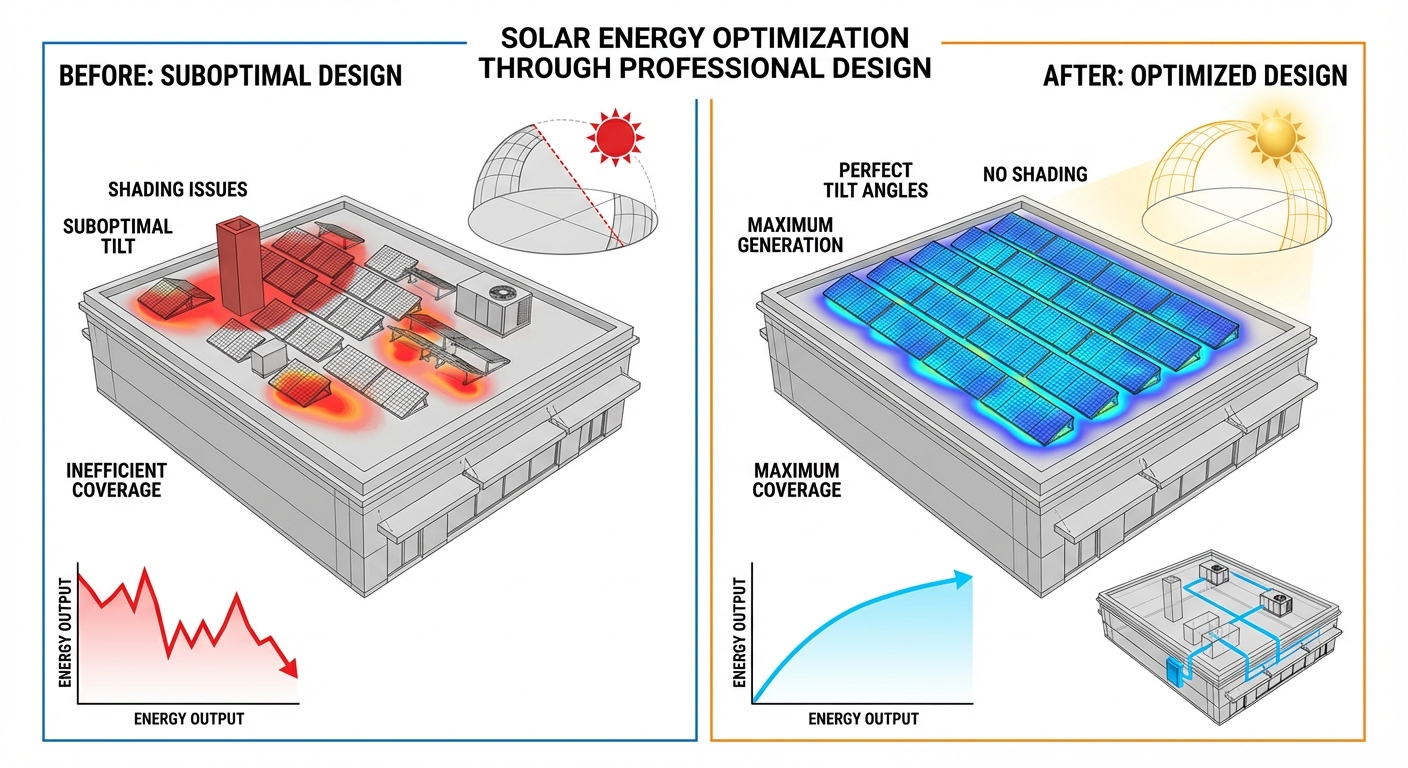
Professional design software performs comprehensive shading analysis that identifies and eliminates generation losses. A commercial rooftop in Mumbai might experience shading from nearby buildings, HVAC equipment, or parapet walls. Basic designs often ignore these factors, resulting in 5-10% generation losses. Advanced 3D modeling identifies shading patterns throughout the year and optimizes panel placement to minimize impact.
Tilt angle and orientation optimization varies by location across India. In northern regions like Delhi, optimal tilt differs from southern locations like Chennai. Professional designers use location-specific solar data to determine the exact angles that maximize annual energy production. For a 500 kW rooftop system, proper tilt optimization can increase generation by 3-5%, worth ₹1.5-2.5 lakhs annually at current electricity rates.
String design and inverter sizing also impact generation efficiency. Undersized inverters clip peak production, while oversized inverters operate inefficiently during low-light conditions. Professional electrical design matches string configurations to inverter specifications for optimal performance across all operating conditions.
Let’s calculate the long-term design ROI from energy optimization on a 1 MW ground mount project:
- Baseline generation (basic design): 1,500 MWh annually
- Optimized generation (professional design): 1,575 MWh annually (5% improvement)
- Additional generation: 75 MWh per year
- Revenue at ₹4.50/kWh: ₹3.375 lakhs per year
- 25-year additional revenue: ₹84.375 lakhs (present value)
- Design cost for optimization: ₹3 lakhs
- Energy optimization ROI: (₹84.375 lakhs / ₹3 lakhs) × 100 = 2,812% return
This calculation demonstrates why energy optimization delivers the highest long-term design ROI of any project component. The initial investment in professional design services pays for itself many times over through improved generation performance.
3. Quantify Installation Error Reduction Benefits
Installation errors represent one of the most expensive yet preventable costs in solar projects. Rework, material waste, and project delays can quickly erode profit margins. Detailed engineering design documentation prevents these costly mistakes before they occur.
The true cost of installation errors extends beyond immediate rework expenses. Consider a structural miscalculation that requires additional foundation work after installation has begun. Direct costs include new materials (₹2-3 lakhs), additional labor (₹1.5 lakhs), and equipment rental extensions (₹50,000). Indirect costs include project delays (₹75,000 per week in lost revenue), client relationship damage, and potential penalty clauses.
Professional site survey services provide accurate measurements and site conditions that eliminate guesswork during installation. For rooftop projects, precise structural load calculations prevent situations where installed systems exceed roof capacity, requiring expensive modifications. For ground mount projects, detailed soil analysis ensures proper foundation design the first time.
Clear, comprehensive engineering drawings reduce installation time by 10-20%. When installers have detailed cable routing diagrams, mounting specifications, and connection details, they work more efficiently with fewer questions and corrections. For a typical 1 MW project with 40 days of installation work, this efficiency gain saves 4-8 days of labor costs.
Here’s an ROI calculation for error reduction on a 750 kW commercial rooftop project:
- Professional design and site survey cost: ₹2 lakhs
- Avoided structural rework: ₹4 lakhs
- Reduced installation time (6 days saved at ₹25,000/day): ₹1.5 lakhs
- Avoided project delay penalties: ₹2 lakhs
- Total error prevention savings: ₹7.5 lakhs
- Installation efficiency ROI: (₹7.5 lakhs / ₹2 lakhs) × 100 = 375% return
These savings directly impact project profitability and client satisfaction. EPCs who consistently deliver error-free installations build reputations that lead to repeat business and referrals, multiplying the design ROI benefits over time.
4. Factor in Permit Approval Speed and Compliance Savings
Time is money in solar project development. Every week of delay in permit approvals postpones revenue generation and ties up working capital. Professional permit design services accelerate approvals while ensuring full regulatory compliance.
In India, permit requirements vary by state and municipality. Gujarat has different standards than Maharashtra, and urban areas often have stricter requirements than rural locations. Professional designers understand these regional variations and prepare documentation that meets all local requirements the first time. This expertise is particularly valuable for EPCs working across multiple states or expanding into new markets.
The time value of money makes permit delays expensive. A 1 MW project generating ₹6 lakhs monthly revenue loses ₹1.5 lakhs for each week of delay. If professional permit design reduces approval time from 8 weeks to 5 weeks, that’s ₹4.5 lakhs in accelerated revenue, often more than the entire design cost.
Compliance costs extend beyond initial permits. Non-compliant designs can trigger stop-work orders, fines, or required modifications during construction. In some cases, installed systems may fail final inspection, requiring expensive corrections before commissioning. Professional engineering design eliminates these risks by ensuring compliance from the start.
For international projects, compliance becomes even more critical. Different countries have varying electrical codes, structural standards, and safety requirements. EPCs expanding globally need design partners who understand international regulations and can prepare documentation that meets local standards.
Calculate the design ROI from faster permit approvals on a 1 MW project:
- Professional permit design cost: ₹1.5 lakhs
- Time saved in approvals: 3 weeks
- Revenue acceleration (3 weeks at ₹1.5 lakhs/week): ₹4.5 lakhs
- Avoided compliance issues and potential fines: ₹2 lakhs
- Total permit efficiency savings: ₹6.5 lakhs
- Permit design ROI: (₹6.5 lakhs / ₹1.5 lakhs) × 100 = 433% return
These benefits make professional permit design services one of the highest-return investments in the entire project development process. The combination of faster approvals and guaranteed compliance delivers immediate and lasting value.
5. Build Your Complete Design ROI Calculation Framework
Now that we’ve examined individual components, let’s build a comprehensive framework for calculating total design ROI across your solar projects. This methodology helps EPCs make data-driven decisions about design investments and track performance over time.
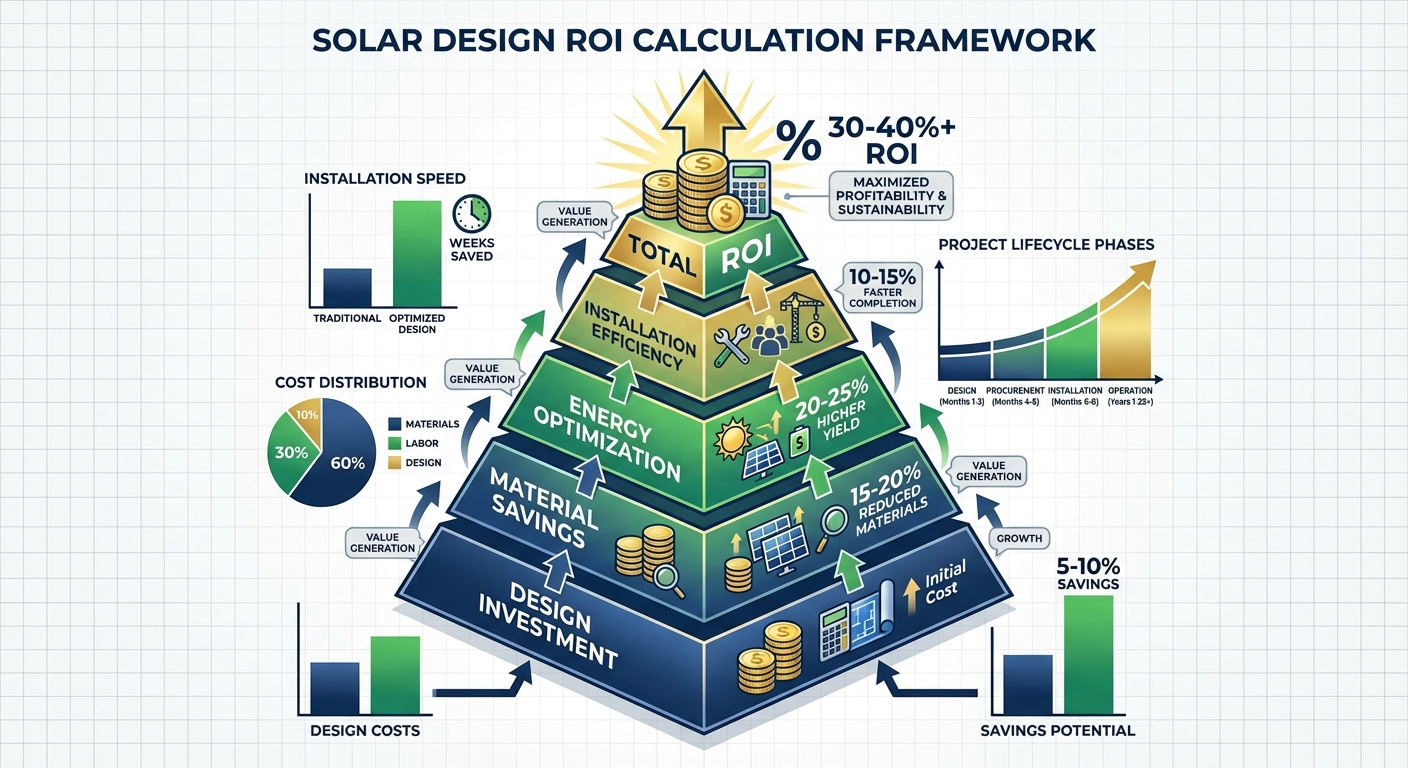
Step 1: Identify all design-related costs. Include professional design fees, site survey expenses, engineering consultancy charges, and any software or tools required. For a typical 1 MW project, total design costs range from ₹2.5-4 lakhs depending on project complexity and services required.
Step 2: Calculate material savings. Compare optimized design material costs against baseline or generic design costs. Track savings in structural components, electrical materials, mounting systems, and balance-of-system equipment. Document the specific design decisions that generated each saving.
Step 3: Quantify energy generation improvements. Use design software to model generation differences between basic and optimized designs. Calculate the present value of additional revenue over the project’s operational life. Apply appropriate discount rates (typically 8-10%) to account for time value of money.
Step 4: Measure installation efficiency gains. Track actual installation time against industry benchmarks. Calculate labor cost savings from reduced installation duration. Include avoided rework costs and error correction expenses.
Step 5: Account for timeline acceleration. Calculate revenue acceleration from faster permit approvals and reduced project duration. Include avoided delay penalties and working capital benefits from earlier commissioning.
Step 6: Add long-term performance benefits. Consider reduced maintenance costs from proper design, lower failure rates from quality engineering, and improved system reliability over the project lifetime.
Here’s a comprehensive cost-benefit example for a 1 MW ground mount project in Rajasthan:
Design Investment:
- Detailed engineering design: ₹2.5 lakhs
- Site survey and feasibility study: ₹1 lakh
- Structural engineering: ₹75,000
- Permit design: ₹50,000
- Total design cost: ₹4.75 lakhs
Measurable Returns:
- Material optimization savings: ₹11 lakhs
- Energy generation improvement (5% over 25 years, present value): ₹65 lakhs
- Installation efficiency gains: ₹6 lakhs
- Permit acceleration and compliance: ₹5 lakhs
- Reduced maintenance costs (present value): ₹8 lakhs
- Total quantifiable benefits: ₹95 lakhs
Design ROI Calculation:
- Net benefit: ₹95 lakhs – ₹4.75 lakhs = ₹90.25 lakhs
- ROI percentage: (₹90.25 lakhs / ₹4.75 lakhs) × 100 = 1,900% return
- Payback period: Less than 2 months from project commissioning
This framework demonstrates that professional design services deliver returns of 15-20 times the initial investment for typical MW-scale projects. The design ROI becomes even more favorable for larger projects where economies of scale amplify the benefits.
Key metrics to track across your project portfolio include design cost as percentage of total project cost (target: 1-3%), material savings percentage (target: 5-15%), installation time reduction (target: 10-20%), and energy generation improvement (target: 3-8%). Consistent tracking helps identify best practices and optimize future project designs.
Real-World Design ROI Examples from Solar EPC Projects
Let’s examine specific project examples that demonstrate design ROI across different solar installation types. These real-world scenarios show how quality engineering design impacts profitability in various contexts.
Commercial Rooftop Solar Project (500 kW, Maharashtra): An EPC company invested ₹2 lakhs in comprehensive design services including 3D modeling, shading analysis, and structural engineering. The optimized design increased system capacity from 480 kW to 510 kW within the same roof space, improved energy generation by 4% through better tilt angles, and reduced installation time by 5 days. Total benefits: ₹8.5 lakhs in material savings and efficiency gains, plus ₹42 lakhs in additional lifetime revenue from improved generation. Design ROI: 2,425%.
Ground Mount MW-Scale Project (2 MW, Gujarat): This project utilized professional PMC services and detailed engineering design costing ₹7 lakhs. Site-specific structural analysis reduced foundation requirements by 15%, saving ₹18 lakhs. Optimized electrical design reduced cable costs by ₹6 lakhs. Professional permit design accelerated approvals by 4 weeks, generating ₹12 lakhs in earlier revenue. Total first-year benefits: ₹36 lakhs. Design ROI: 514% in year one, with ongoing generation benefits over 25 years.
Industrial Solar Installation (750 kW, Tamil Nadu): An industrial client required a complex rooftop design working around existing equipment and structural constraints. The EPC invested ₹3.5 lakhs in specialized engineering design. The professional approach avoided ₹6 lakhs in potential structural reinforcement costs, optimized panel placement to achieve 98% of theoretical maximum capacity, and provided documentation that secured permits in 3 weeks instead of the typical 8 weeks. Total benefits: ₹15 lakhs. Design ROI: 429%.
Comparing in-house design versus professional design services reveals important insights. EPCs with in-house design teams still benefit from partnering with specialized design firms for complex projects, international work, or capacity overflow. The cost of maintaining a full-time design team (₹40-60 lakhs annually for 3-4 engineers) often exceeds the cost of outsourcing design work (₹2-4 lakhs per MW), especially for EPCs completing fewer than 15-20 MW annually.
Professional design partners bring specialized expertise in areas like regional design requirements, advanced software tools, and experience across hundreds of projects. This expertise translates to better designs, fewer errors, and higher design ROI compared to less experienced in-house teams.
Typical ROI ranges for quality engineering design investment vary by project type. Residential rooftop projects (under 10 kW) see 300-600% returns. Commercial rooftops (100-1000 kW) achieve 800-1,500% returns. MW-scale ground mount projects deliver 1,500-2,500% returns. The larger the project, the more favorable the design ROI becomes due to economies of scale and the compounding impact of generation improvements.
Maximizing Your Solar Project Design ROI in 2026
Understanding how to calculate and improve design ROI gives solar EPCs a powerful tool for optimizing project profitability. The evidence is clear: professional engineering design services deliver returns of 15-25 times the initial investment through material savings, energy optimization, installation efficiency, and compliance benefits.
The key takeaway is that design costs represent 1-3% of total project expenses but influence 100% of project outcomes. Every material purchased, every installation hour worked, and every kilowatt-hour generated over 25 years is determined by design decisions made at the project’s beginning. Cutting corners on design to save a few lakhs inevitably costs tens of lakhs in lost efficiency, errors, and suboptimal performance.
When should EPCs invest in professional design services? The answer is straightforward: for every project where profitability matters. This includes all commercial and industrial installations, MW-scale ground mount projects, complex rooftop designs, projects in new geographic markets, and any installation where clients expect maximum performance and reliability. Even for smaller residential projects, standardized professional designs deliver better results than ad-hoc approaches.
Choosing the right design partner maximizes your design ROI. Look for firms with extensive project experience, specialized expertise in your target markets, advanced design software capabilities, and a track record of delivering projects on time and within budget. The design partner should understand regional requirements across India, provide comprehensive documentation, and offer ongoing support through installation and commissioning.
Action steps for EPCs to implement ROI tracking include establishing baseline metrics for current projects, documenting design costs and benefits for each installation, comparing professional design outcomes against previous projects, calculating actual ROI using the framework provided in this guide, and using data to refine design investment decisions for future projects. Consistent tracking transforms design ROI from an abstract concept into a concrete competitive advantage.
As India’s solar market continues growing in 2026 and beyond, EPCs who master design ROI calculation will outperform competitors who view design as a commodity expense. The difference between adequate design and optimized design is the difference between marginal profitability and exceptional returns. Understanding the relationship between design timeline and project costs helps EPCs plan more effectively and maximize returns across their entire project portfolio.
Ready to improve your solar project profitability through professional engineering design? Heaven Designs specializes in comprehensive design services that maximize design ROI for EPC companies across India and international markets. With over 628 MW of completed design work for 752+ clients and a team of 50+ specialized engineers, we deliver cost-effective, accurate designs that optimize every aspect of project performance. Get a Quick Proposal Now! to discover how our engineering expertise can boost your project profitability, or contact us directly at +91 90811 00297 or service@heavendesigns.in to discuss your specific project requirements and calculate the potential design ROI for your next solar installation.
This blog post was written using thestacc.com