


Choosing the right solar design partner can make or break your EPC business. In 2026, as solar projects in India and globally become increasingly complex, the stakes have never been higher. A poor design partner can lead to permit rejections, costly rework, project delays, and damaged client relationships. Conversely, the right solar design partner evaluation process can help you identify a collaborator who accelerates your growth, enhances your reputation, and protects your bottom line.
For solar EPC companies operating in India’s rapidly expanding renewable energy market, selecting a design partner requires more than just comparing price quotes. You need a systematic approach that evaluates technical capabilities, quality standards, communication protocols, and contract terms. This comprehensive 15-point solar design partner evaluation checklist will help you assess potential partners before signing contracts, ensuring you make informed decisions that protect your business and delight your clients.

Why Solar Design Partner Selection Matters More Than Ever in 2026
The solar industry has matured significantly over the past few years. What once were straightforward rooftop installations have evolved into complex megawatt-scale projects requiring sophisticated engineering, detailed structural analysis, and comprehensive regulatory compliance. In India alone, the solar capacity additions continue to accelerate, with commercial, industrial, and utility-scale projects demanding higher levels of technical precision.
The financial risks of choosing the wrong design partner are substantial. Consider these potential consequences:
- Permit rejections that delay project timelines by weeks or months
- Design errors discovered during installation, requiring expensive rework
- Structural failures or underperformance due to inadequate engineering
- Compliance issues that expose your company to legal liability
- Client dissatisfaction that damages your reputation and future business prospects
A thorough solar design partner evaluation process protects you from these risks. By systematically assessing potential partners across 15 critical dimensions, you can identify design firms that align with your quality standards, operational requirements, and business objectives. This checklist approach transforms partner selection from a subjective decision into an objective, data-driven process.
1. Technical Capabilities and Software Expertise
The foundation of any solar design partner evaluation begins with technical capabilities. Your design partner must demonstrate proficiency in industry-standard software tools and possess the technical skills to handle diverse project types.
Essential software expertise includes:
- PVsyst for energy yield simulation and performance modeling
- AutoCAD for detailed engineering drawings and construction documents
- Helioscope or similar tools for preliminary design and shading analysis
- SketchUp or similar 3D modeling software for visualization and client presentations
- Structural analysis software like STAAD.Pro or SAP2000 for load calculations
Beyond software, evaluate whether the partner can handle the specific project types you typically encounter. Do they have experience with rooftop commercial installations, ground-mount utility projects, carport structures, or floating solar? A partner specializing in residential rooftop may struggle with the complexities of a 10 MW ground-mount project requiring detailed civil engineering.
Ask potential partners to demonstrate their technical capabilities through sample projects or pilot assignments. Request detailed drawings, energy simulations, and structural calculations from previous work. This hands-on evaluation reveals far more than marketing materials ever could.
2. Team Credentials and Engineering Qualifications
The quality of your design deliverables depends entirely on the people creating them. During your solar design partner evaluation, scrutinize the educational background, professional credentials, and ongoing training of the design team.
Key credentials to verify:
- Engineering degrees from recognized institutions (B.Tech, M.Tech in relevant disciplines)
- Professional engineering licenses where applicable
- Solar-specific certifications (NABCEP, MNRE-approved training programs)
- Software certifications from vendors like PVsyst or Autodesk
Team size matters significantly for scalability and reliability. A design firm with only 2-3 engineers may struggle to handle multiple concurrent projects or accommodate your growth. Conversely, a larger team of 50+ engineers can provide redundancy, specialized expertise, and the capacity to scale with your business needs.
Inquire about the firm’s approach to ongoing training and skill development. The solar industry evolves rapidly, with new technologies, regulations, and best practices emerging constantly. Your design partner should invest in continuous education to keep their team current with industry developments.
3. Portfolio Verification and Project Experience
Claims are easy to make, but verification is essential. When conducting your solar design partner evaluation, don’t simply accept portfolio statistics at face value. Request detailed evidence of completed projects, including:
- Total megawatts designed with breakdown by project type and geography
- Number of completed projects and client companies served
- Sample deliverables from representative projects (with client permission)
- Client testimonials with verifiable contact information
Geographic experience is particularly important for EPC companies operating in India. Solar design requirements vary significantly across regions due to different wind zones, seismic zones, soil conditions, and local regulations. A design partner with extensive India-specific experience understands these nuances and can navigate regional compliance requirements effectively.
For example, a ground-mount project in Gujarat faces different wind load requirements than one in Kerala. A partner familiar with these regional variations can deliver designs that pass local authority inspections on the first submission, saving you valuable time. Learn more about regional considerations in our complete regional design guide for ground mount projects in India.
Request case studies that demonstrate the partner’s experience with projects similar to yours in scale, complexity, and location. A firm that has successfully designed 500+ MW across 750+ projects brings proven expertise that reduces your risk.
4. Quality Assurance Processes and Standards
Quality assurance separates professional design firms from amateur operations. Your solar design partner evaluation must examine the systematic processes that ensure accuracy, consistency, and compliance in every deliverable.
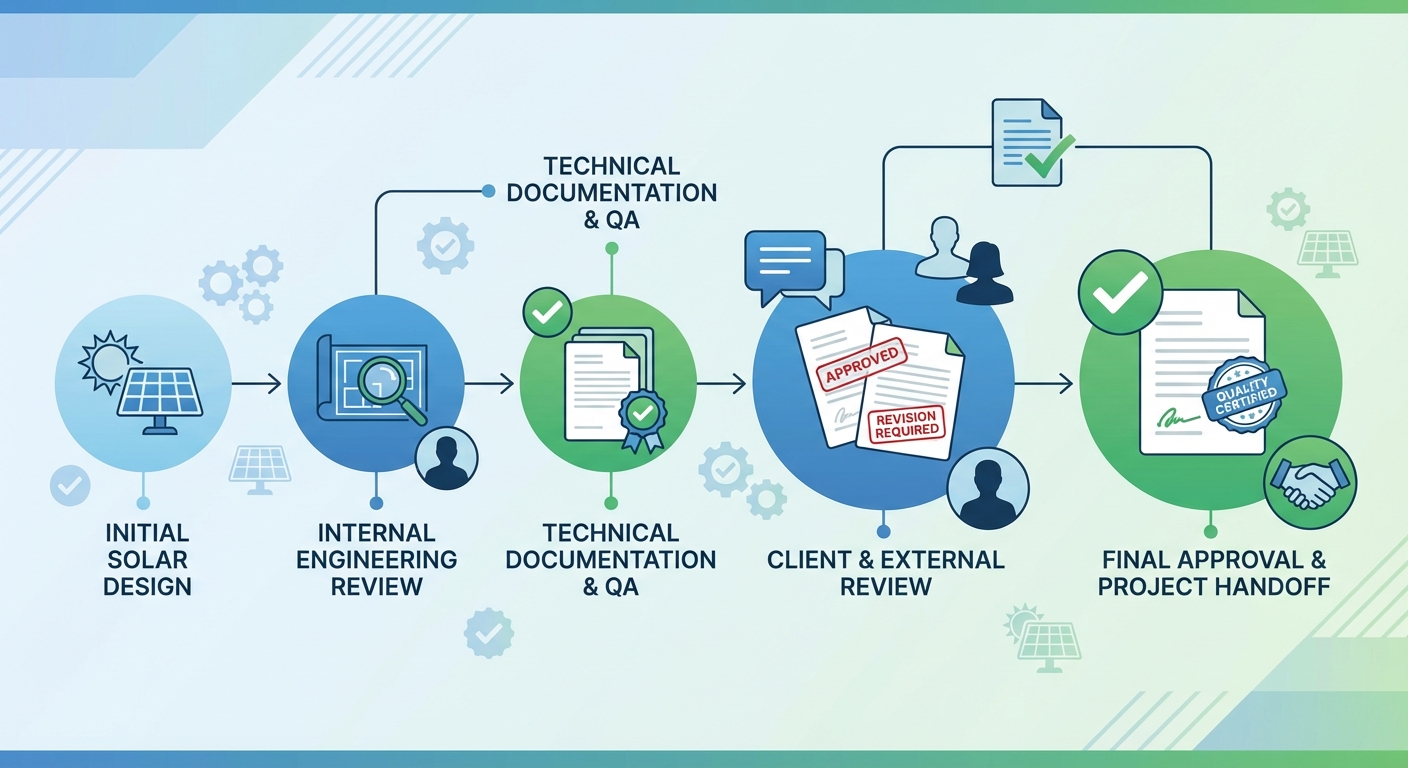
Essential quality assurance elements include:
- Multi-level review processes where senior engineers check junior engineers’ work
- Standardized checklists that verify all required elements are included
- Quality control checkpoints at key milestones throughout the design process
- Compliance verification against relevant codes and standards (IEC, IEEE, NEC, Indian standards)
- Error tracking systems that identify patterns and drive continuous improvement
Ask potential partners to walk you through their quality assurance workflow step-by-step. How many review stages does a typical design pass through? Who has final approval authority? What happens if errors are discovered after delivery?
Professional design firms maintain documented quality management systems, often aligned with ISO 9001 or similar frameworks. These systems provide consistency and accountability, ensuring that quality doesn’t depend on individual personalities but is built into the organizational process.
5. Communication Protocols and Project Management
Even the most technically capable design partner becomes a liability if communication breaks down. Your solar design partner evaluation should assess how the firm manages client relationships, handles project coordination, and maintains transparency throughout the design process.
Critical communication factors to evaluate:
- Dedicated project manager assignment who serves as your single point of contact
- Communication channels (email, phone, video calls, project management platforms)
- Response time commitments for different types of inquiries
- Regular status updates and progress reporting schedules
- Time zone compatibility for international projects requiring real-time collaboration
For EPC companies in India working with design partners, time zone alignment can significantly impact project efficiency. A partner based in India offers the advantage of same-day communication and easier coordination compared to firms operating in vastly different time zones.
Request a demonstration of the partner’s project management tools and reporting systems. Modern design firms use collaborative platforms that provide real-time visibility into project status, deliverable completion, and upcoming milestones. This transparency builds trust and enables proactive problem-solving.
6. Turnaround Time Guarantees and Delivery Schedules
Time is money in the solar EPC business. Project delays cascade through your entire operation, affecting installation schedules, client commitments, and cash flow. Your solar design partner evaluation must address delivery timelines and the partner’s track record of meeting deadlines.
Key questions to ask:
- What are standard turnaround times for different project types and sizes?
- Can the partner accommodate rush projects when needed, and at what cost?
- What percentage of projects are delivered on or before the promised date?
- Are there penalties or guarantees if deadlines are missed?
Be wary of partners who promise unrealistically fast turnarounds. Quality design work requires adequate time for analysis, calculation, review, and quality assurance. A partner who consistently delivers in half the industry-standard time may be cutting corners that will come back to haunt you during permitting or installation.
Conversely, excessively long turnaround times can bottleneck your entire operation. Find a partner who balances speed with quality, and who has demonstrated the capacity to scale their delivery during peak seasons without compromising standards. Understanding how project duration impacts your budget can help you evaluate whether a partner’s timelines align with your financial planning.
7. Revision Policies and Change Management
Solar projects rarely proceed exactly as initially planned. Client requirements change, site conditions differ from initial surveys, or utility interconnection requirements evolve. Your design partner’s revision policy directly impacts your flexibility and costs.
During your solar design partner evaluation, clarify these revision-related terms:
- Number of revisions included in the base project price
- Definition of a revision versus a scope change
- Process for requesting and tracking revisions
- Turnaround time for revision requests
- Pricing for additional revisions beyond what’s included
Some design partners include 2-3 rounds of revisions in their standard pricing, while others charge for every change. Neither approach is inherently better, but you need clarity upfront to avoid surprise costs and disputes later.
Equally important is how the partner handles scope changes. If your client decides to increase system size from 500 kW to 750 kW mid-project, how does the design partner adjust pricing and timelines? A clear, documented change management process protects both parties and maintains the working relationship.
8. Pricing Transparency and Cost Structure
Price is always a consideration, but the lowest bid often proves most expensive in the long run. Your solar design partner evaluation should focus on pricing transparency and value rather than simply the bottom-line number.
Understand the complete cost structure:
- Pricing model (per kW, per project, monthly retainer, or hybrid)
- What’s included in the base price (drawings, calculations, revisions, support)
- Additional charges for rush projects, extra revisions, site visits, or specialized services
- Payment terms (upfront, milestone-based, or upon completion)
- Volume discounts for ongoing partnerships or multiple projects
Beware of hidden costs that emerge after contract signing. Some design partners quote attractive base prices but charge separately for every additional service, turning a seemingly affordable option into an expensive proposition.
Request detailed proposals that itemize all costs and clearly define what’s included. Compare proposals on an apples-to-apples basis, ensuring you’re evaluating equivalent scopes of work. The most valuable partner delivers high-quality work at fair prices with complete transparency about costs.
9. Compliance Knowledge and Regulatory Expertise
Regulatory compliance is non-negotiable in solar project development. Your design partner must possess deep knowledge of applicable codes, standards, and approval processes to ensure your projects sail through permitting without delays.
Essential compliance expertise includes:
- Indian building codes and standards (National Building Code, IS codes for structural design)
- State and local regulations that vary across India’s different jurisdictions
- Utility interconnection requirements for different distribution companies
- International standards (IEC, IEEE, NEC) for projects outside India
- Environmental and safety regulations applicable to solar installations
During your solar design partner evaluation, assess how the partner stays current with evolving regulations. Solar codes and standards update regularly, and a partner who relies on outdated knowledge will produce designs that fail modern compliance requirements.
Ask about the partner’s experience with permit approval processes in your target markets. A design firm that has successfully obtained permits across multiple Indian states understands what local authorities expect and can format deliverables accordingly. This expertise dramatically increases first-time approval rates and accelerates project timelines.
For projects requiring comprehensive upfront analysis, consider partners who also offer solar feasibility study services to identify regulatory and technical constraints before detailed design begins.
10. Structural and Civil Engineering Capabilities
Solar installations are fundamentally structural systems that must withstand decades of environmental stresses. Your design partner’s structural and civil engineering capabilities directly impact system safety, longevity, and performance.
Critical structural engineering competencies include:
- Wind load calculations based on local wind zone classifications
- Snow load analysis for regions experiencing seasonal snowfall
- Seismic design appropriate to India’s various seismic zones
- Foundation design tailored to different soil conditions and bearing capacities
- Structural member sizing and material specifications
Many solar design firms focus primarily on electrical design and energy modeling, outsourcing structural engineering to third parties. While this approach can work, it introduces coordination challenges and potential quality inconsistencies. A design partner with in-house structural engineering expertise provides integrated, cohesive designs where electrical and structural elements are optimized together.
For ground-mount projects, civil engineering capabilities become equally important. Grading plans, drainage design, access roads, and site preparation all require specialized expertise. A comprehensive design partner handles these elements seamlessly, providing complete construction-ready documentation.
11. Client References and Testimonials
Past performance is the best predictor of future results. Your solar design partner evaluation must include direct conversations with the partner’s existing clients to understand their real-world experience.
When requesting references, ask for:
- Contact information for at least 3-5 current or recent clients
- Clients with similar project types and scales to yours
- Both long-term partners and recent clients to assess consistency
- Permission to view actual project deliverables (with confidential information redacted)
Key questions to ask references:
- How long have you worked with this design partner?
- What percentage of designs pass permit review on the first submission?
- How responsive is the partner to questions and revision requests?
- Have you experienced any significant quality issues or project delays?
- Would you recommend this partner to other EPC companies?
- What are the partner’s greatest strengths and weaknesses?
Be cautious of partners who are reluctant to provide references or who only offer carefully curated testimonials. Legitimate design firms with strong track records are proud to connect you with satisfied clients who can vouch for their capabilities.
Also research the partner’s industry reputation through professional networks, industry associations, and online reviews. Word-of-mouth feedback from other EPC companies provides valuable insights that formal references may not reveal.
12. Scalability and Capacity to Handle Growth
Your business needs will evolve over time. The ideal design partner grows with you, scaling their support as your project pipeline expands. Your solar design partner evaluation should assess the partner’s capacity to accommodate your current needs and future growth.
Scalability factors to consider:
- Team size and structure that provides redundancy and specialized expertise
- Ability to handle multiple concurrent projects without quality degradation
- Process for scaling up during peak seasons or sudden demand increases
- Resource allocation systems that ensure your projects receive adequate attention
- Long-term partnership approach versus transactional project-by-project relationships
A design partner with a team of 50+ engineers can absorb fluctuations in your project volume without compromising delivery timelines. They can assign specialized engineers to complex projects while handling routine designs efficiently. This scalability provides the flexibility you need as your EPC business grows.
Discuss the partner’s vision for long-term collaboration. Are they interested in becoming a strategic partner who understands your business deeply, or do they prefer arms-length transactional relationships? The best partnerships develop over time as the design firm learns your preferences, standards, and client expectations.
13. Data Security and Intellectual Property Protection
Solar project designs contain sensitive information about your clients, sites, and business strategies. Your solar design partner evaluation must address how the partner protects this confidential data and respects intellectual property rights.
Essential security and IP considerations:
- Non-disclosure agreements (NDAs) that legally protect your confidential information
- Data storage and security measures including encryption, access controls, and backup systems
- Intellectual property ownership clearly defined in contracts
- Employee confidentiality agreements that bind the partner’s staff
- Data retention and deletion policies after project completion
Clarify who owns the design deliverables once you’ve paid for them. In most cases, you should receive full ownership rights to use, modify, and reuse the designs as needed. Some partners attempt to retain ownership or restrict usage, which can create problems if you need to modify designs later or share them with other contractors.
Ask about the partner’s cybersecurity practices, especially if they’ll access your internal systems or store project data on cloud platforms. A data breach that exposes your client information can damage your reputation and create legal liability.
14. Support Services and Post-Delivery Assistance
The design partner’s job doesn’t end when they deliver the final drawings. Installation challenges, permit questions, and field modifications often require ongoing support. Your solar design partner evaluation should clarify what post-delivery assistance is included and what costs extra.
Valuable support services include:
- Technical support during installation to answer contractor questions
- Permit resubmission assistance if authorities request clarifications or modifications
- Site visit availability for complex projects requiring on-site engineering support
- As-built drawing updates to reflect field modifications
- Warranty on design work covering errors and omissions
Some design partners include reasonable post-delivery support in their base pricing, while others charge hourly rates for any assistance after final delivery. Neither approach is wrong, but you need clarity upfront to budget appropriately and avoid surprise costs.
Particularly valuable is a partner who offers site survey and feasibility services in addition to design. This integrated approach ensures that designs are based on accurate site data and realistic assumptions, reducing the likelihood of installation surprises. A partner who can conduct site surveys across India provides comprehensive support from project inception through completion.
15. Contract Terms That Protect Your EPC Business
The final element of your solar design partner evaluation is the contract itself. Even the most capable design partner becomes a risk if the contract doesn’t adequately protect your interests and clearly define expectations.
Essential contract clauses to include:
- Scope of work with detailed deliverables list and specifications
- Delivery timelines with specific milestones and deadlines
- Quality standards and acceptance criteria for deliverables
- Revision policy clearly defining what’s included and what costs extra
- Payment terms tied to milestone completion and deliverable acceptance
- Liability and indemnification provisions that allocate risk appropriately
- Professional liability insurance requirements (errors and omissions coverage)
- Termination clauses that allow exit if performance is unsatisfactory
- Dispute resolution mechanisms (mediation, arbitration, jurisdiction)
- Confidentiality and IP ownership clearly defined
Pay particular attention to liability provisions. If a design error causes project delays, cost overruns, or safety issues, who bears the financial responsibility? Professional design firms carry errors and omissions insurance to protect both parties, but the contract should clearly define the limits and process for claims.
Termination clauses provide an exit strategy if the partnership isn’t working. While you hope to never use them, having clear terms for ending the relationship protects you from being locked into an unsatisfactory arrangement.
Consider having a legal professional review contracts before signing, especially for long-term partnerships or high-value projects. The modest cost of legal review is insignificant compared to the potential costs of a poorly structured agreement.
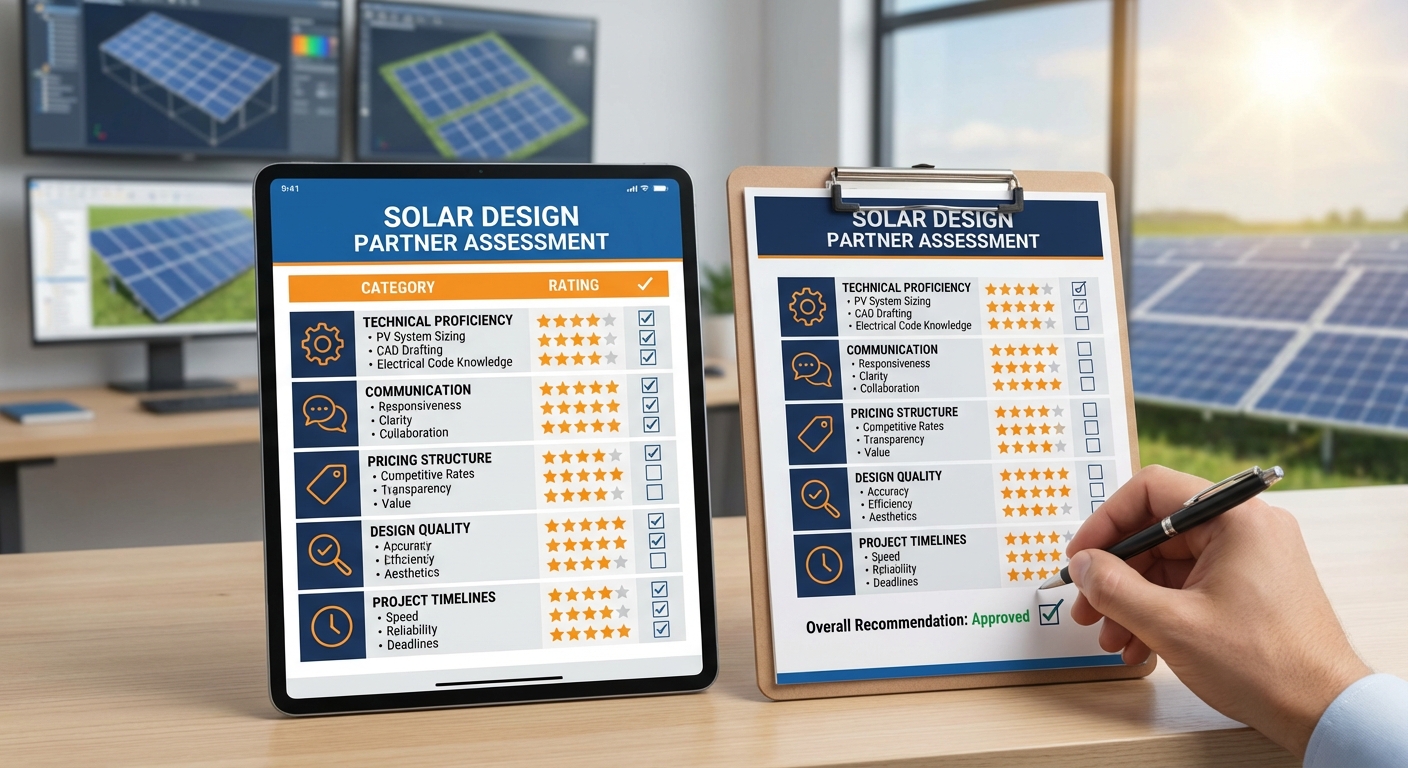
Implementing Your Solar Design Partner Evaluation Process
Now that you understand the 15 critical evaluation points, how do you implement this solar design partner evaluation framework systematically?
Create a scoring system that assigns weights to each of the 15 criteria based on your priorities. For example, if regulatory compliance is your top concern, assign it higher weight than pricing. Rate each potential partner on a scale of 1-10 for each criterion, then calculate weighted scores to compare objectively.
Conduct pilot projects before committing to long-term partnerships. Start with a small, non-critical project that allows you to evaluate the partner’s capabilities, communication, and quality in a low-risk environment. A successful pilot builds confidence for larger commitments.
Consider the long-term partnership approach rather than selecting partners project-by-project. A strategic design partner who understands your business, standards, and clients becomes increasingly valuable over time. They learn your preferences, anticipate your needs, and deliver more efficiently with each successive project.
For solar EPC companies in India seeking a design partner that excels across all 15 evaluation criteria, Heaven Designs offers a compelling solution. With a team of 50+ skilled engineers and consultants, Heaven Designs has completed 628+ MW of design work for 752+ solar EPC clients across multiple countries. Their comprehensive service portfolio includes solar 3D pre-design, MW-scale detailed engineering design, project management consultancy, civil and structural engineering, site surveys, and permit design services.
Based in Surat, Gujarat, Heaven Designs combines deep India-specific expertise with international standards compliance. Their quality assurance processes, transparent pricing, and commitment to on-time delivery address the key concerns identified in this solar design partner evaluation checklist. Whether you’re developing residential rooftop projects, commercial installations, or utility-scale ground-mount systems, their scalable team can support your growth trajectory.
Ready to evaluate Heaven Designs as your solar design partner? Don’t leave this critical decision to chance. Use this 15-point checklist to conduct a thorough assessment, request a pilot project to experience their capabilities firsthand, and discover how the right design partner can accelerate your EPC business growth while reducing risk. Get a Quick Proposal Now! to discuss your specific project requirements and learn how Heaven Designs can support your solar EPC operations in 2026 and beyond.
The solar market in India continues to expand rapidly, creating tremendous opportunities for EPC companies who can deliver quality projects efficiently. Your design partner plays a crucial role in your success. By implementing this comprehensive solar design partner evaluation process, you’ll make informed decisions that protect your business, delight your clients, and position you for sustainable growth in the dynamic renewable energy sector.
For immediate assistance or to schedule a consultation with Heaven Designs’ engineering team, contact them directly at service@heavendesigns.in or call +91 90811 00297. Their team is ready to answer your questions, provide sample deliverables, and demonstrate how they meet each criterion in this solar design partner evaluation checklist.
This blog post was written using thestacc.com