


Solar EPC companies across India face a critical decision in 2026: should they partner with onshore Indian design firms or offshore international providers for their engineering needs? With India’s solar capacity expanding rapidly and project complexity increasing, choosing the right design outsourcing India model directly impacts project costs, quality, timelines, and ultimately, profitability. This comprehensive comparison examines the real-world differences between offshore and onshore solar design outsourcing to help you make an informed decision for your business.
The stakes are high. A wrong choice can lead to costly design revisions, permit delays, compliance issues, and strained client relationships. Meanwhile, the right design partner becomes a competitive advantage, enabling faster project delivery, better margins, and superior technical outcomes. Let’s dive into the detailed comparison that will guide your outsourcing strategy.
Understanding Design Outsourcing India: The Growing Landscape
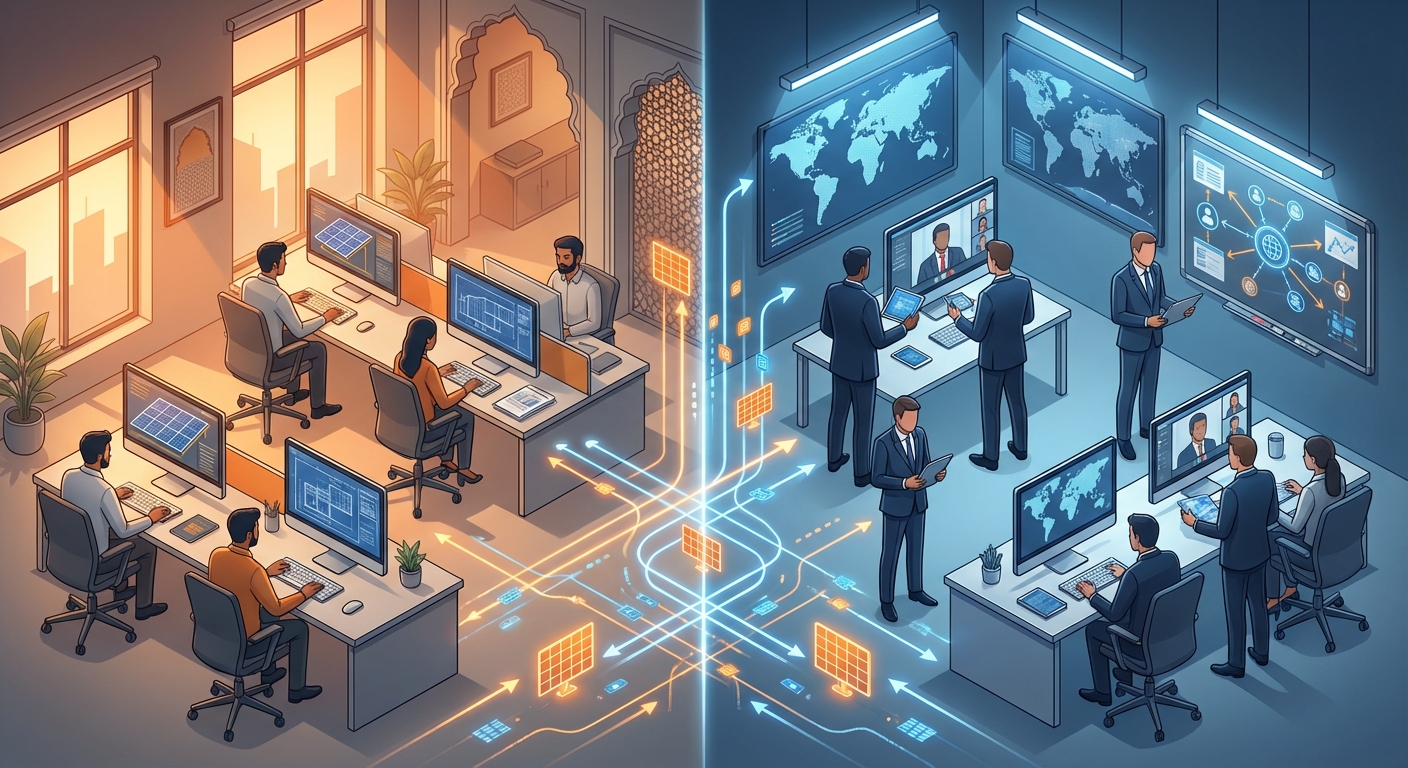
The term design outsourcing India encompasses two distinct models that solar EPC companies must understand. Onshore outsourcing refers to partnering with design firms located within India, such as specialized solar engineering companies based in cities like Surat, Mumbai, or Bangalore. These firms employ Indian engineers who understand local regulations, work in compatible time zones, and possess deep familiarity with regional project conditions.
Offshore outsourcing, conversely, involves engaging design service providers based outside India—typically in countries like the United States, Europe, Australia, or Southeast Asia. These international firms offer their engineering expertise to Indian solar projects from distant locations, often leveraging different cost structures and technical approaches.
In 2026, India’s solar design outsourcing landscape has matured significantly. The country has emerged as both a major destination for global solar design work and a source market where domestic EPCs evaluate international design partners. This dual role creates a unique dynamic. Indian solar EPC companies now have access to a sophisticated ecosystem of local design specialists who have completed thousands of megawatts of projects, alongside established offshore providers with global portfolios.
Several factors drive the growing evaluation of outsourcing options. First, the sheer volume of solar installations has outpaced many EPCs’ internal design capabilities. Second, the technical complexity of modern solar projects—incorporating advanced mounting systems, energy storage integration, and sophisticated electrical designs—demands specialized expertise. Third, competitive pressure forces EPCs to optimize costs while maintaining quality standards. Finally, the need for faster project turnaround in a competitive bidding environment makes efficient design partnerships essential.
The choice between offshore and onshore design outsourcing India models isn’t simply about cost. It encompasses quality assurance, communication efficiency, regulatory compliance, and strategic alignment with your business objectives. Understanding these dimensions is crucial for solar EPC companies aiming to scale their operations in 2026 and beyond.
Cost Structure Comparison: Offshore vs Onshore Design Outsourcing India
Cost considerations often dominate the outsourcing decision, but the true financial picture extends far beyond headline design fees. Let’s examine the complete cost structure for both models.
Onshore Indian Design Firm Costs
When partnering with an onshore design firm in India, solar EPC companies typically encounter transparent, competitive pricing structures. For a 1 MW commercial rooftop solar project, comprehensive design services from an Indian firm generally range from ₹80,000 to ₹1,50,000, depending on project complexity and scope. This typically includes preliminary design, detailed engineering drawings, structural calculations, electrical single-line diagrams, and permit-ready documentation.
For ground mount utility-scale projects, onshore Indian providers often charge between ₹60,000 to ₹1,00,000 per MW for complete design packages. The economies of scale for larger projects bring per-megawatt costs down significantly. A 10 MW ground mount project might cost ₹6,00,000 to ₹8,00,000 for full engineering design services.
The cost advantages of onshore design outsourcing India stem from several factors. Indian engineering talent offers exceptional value—qualified solar design engineers with 3-5 years of experience command salaries significantly lower than their Western counterparts while delivering comparable technical quality. Operational costs for Indian firms, including office space, software licenses, and infrastructure, remain moderate compared to developed markets.
Offshore International Provider Costs
Offshore design services from providers based in the United States, Europe, or Australia typically command premium pricing. The same 1 MW commercial rooftop project might cost $3,000 to $6,000 (approximately ₹2,50,000 to ₹5,00,000), representing a 150-250% premium over onshore Indian rates. Ground mount utility projects from offshore providers often range from $2,000 to $4,000 per MW (₹1,65,000 to ₹3,30,000 per MW).
These higher rates reflect the cost structures in developed economies—higher salaries, expensive office locations, and premium operational expenses. While offshore providers may argue that their pricing reflects superior expertise or quality, the reality is that much of the cost difference stems from geographic economic factors rather than technical capabilities.
Hidden Costs That Change the Equation
The headline design fee tells only part of the story. Hidden costs can dramatically alter the true financial comparison between offshore and onshore models.
Communication overhead represents a significant hidden cost with offshore providers. Time zone differences between India and Western countries mean that real-time collaboration becomes challenging. A question that could be resolved in a 10-minute call with an onshore partner might require a 24-hour email exchange cycle with an offshore provider. Over the course of a project, these delays accumulate, extending timelines and increasing internal coordination costs.
Revision cycles become more expensive with offshore partners. When design revisions require multiple rounds of back-and-forth communication across time zones, the process that takes 2-3 days with an onshore partner can stretch to 1-2 weeks with an offshore provider. For EPCs working on tight project schedules, these delays translate directly into opportunity costs and potential penalty clauses.
Compliance and localization costs often emerge as unexpected expenses with offshore providers. International design firms may lack familiarity with Indian building codes, state-specific regulations, and local authority requirements. This knowledge gap frequently necessitates additional revision rounds, local engineering reviews, or supplementary documentation—all adding costs that weren’t included in the original quote.
Currency fluctuation risk affects offshore arrangements. When contracts are denominated in foreign currencies, exchange rate movements can significantly impact the effective cost in rupees. A design contract priced at $5,000 might cost ₹4,15,000 when signed (at ₹83/$) but ₹4,40,000 by payment time if the rupee weakens to ₹88/$—a 6% cost increase with no additional value.
ROI Calculation Framework
To accurately compare costs, solar EPC companies should calculate the total cost of design ownership, which includes direct design fees, internal coordination time, revision costs, compliance adjustments, and timeline impacts. For most Indian solar projects, onshore design outsourcing India delivers superior ROI when all factors are considered. The combination of competitive base pricing, minimal hidden costs, and faster turnaround typically results in 30-50% lower total costs compared to offshore alternatives.
Consider a solar EPC company executing 50 MW of projects annually. Choosing onshore design partners at ₹80,000 per MW versus offshore providers at ₹2,50,000 per MW represents a direct savings of ₹85,00,000 (₹8.5 million) annually. When factoring in reduced revision cycles, faster project completion, and lower coordination overhead, the total financial advantage often exceeds ₹1 crore per year for mid-sized EPCs.
Quality Standards & Technical Expertise
Cost advantages mean little if quality suffers. Solar EPC companies must evaluate the technical capabilities and quality standards of both offshore and onshore design partners to ensure project success.
Engineering Qualifications in Indian Firms
The maturation of India’s solar industry has produced a robust ecosystem of qualified solar design professionals. Leading onshore firms employ engineers with degrees from recognized Indian technical universities, IITs, NITs, and state engineering colleges, who have specialized in renewable energy, electrical engineering, civil engineering, and structural engineering disciplines.
Many Indian solar design professionals hold relevant certifications and have completed specialized training in solar-specific software platforms like PVsyst, AutoCAD, STAAD.Pro, and Helioscope. Firms with 5+ years in the market have developed deep institutional knowledge, having completed hundreds of projects across diverse conditions, from rooftop installations in Mumbai’s coastal environment to ground mount projects in Rajasthan’s desert climate.
Quality onshore providers implement rigorous internal review processes. Multi-level checking systems ensure that designs undergo peer review, senior engineer validation, and quality assurance checks before delivery. This systematic approach minimizes errors and ensures consistency across projects.
Offshore Provider Expertise
Offshore design providers often possess strong technical credentials, with engineers holding degrees from international universities and certifications from organizations like NABCEP (North American Board of Certified Energy Practitioners). Their experience typically spans multiple international markets, providing exposure to diverse design standards and approaches.
However, this international experience doesn’t always translate to advantages for Indian projects. Solar design isn’t a one-size-fits-all discipline. The specific requirements of Indian projects, understanding IS codes (Indian Standards), regional wind and seismic zones, local mounting system availability, and state electricity board requirements, demand localized expertise that offshore providers often lack.
Regulatory Knowledge: The Critical Differentiator
Perhaps the most significant quality factor distinguishing onshore and offshore providers is regulatory compliance expertise. Indian solar projects must comply with a complex web of regulations: National Building Code of India, IS 875 (wind and seismic loads), IS 800 (structural steel), IS 456 (concrete structures), state-specific solar policies, and local authority building regulations.
Onshore Indian design firms navigate these requirements daily. They understand that a project in Gujarat faces different wind load calculations than one in Kerala. They know which local authorities require specific documentation formats and which approvals must be obtained in what sequence. This knowledge is embedded in their processes and deliverables.
Offshore providers, regardless of their technical sophistication, typically lack this granular regulatory knowledge. The result is often designs that are technically sound in principle but require significant modifications to achieve compliance with Indian standards. These gaps emerge during permit applications or structural approvals, causing delays and additional costs that undermine the value proposition of offshore outsourcing.
Software and Technical Tools
Both onshore and offshore providers generally have access to industry-standard design software India professionals use, including PVsyst for energy modeling, AutoCAD for drafting, and structural analysis tools. The software itself isn’t a differentiator. Rather, it’s the application of these tools within the context of Indian project requirements that matters.
Leading onshore firms have developed customized templates, calculation sheets, and design libraries specifically tailored to Indian conditions, standard mounting system configurations, pre-validated structural designs for common scenarios, and permit documentation templates that match local authority expectations. This localized toolset accelerates design work and improves accuracy.
Communication Efficiency & Project Management
Effective communication forms the backbone of successful design partnerships. The differences between offshore and onshore models in this dimension significantly impact project outcomes.
Time Zone Alignment: The Onshore Advantage
When your EPC office in Mumbai needs to discuss a design clarification with your onshore partner in Surat, you pick up the phone and have a real-time conversation. Questions get answered immediately. Design adjustments happen within hours. This seamless communication is perhaps the most undervalued advantage of onshore design outsourcing India.
Consider a typical scenario: your site team discovers an unexpected obstruction during a site visit that affects the panel layout. With an onshore partner operating in the same time zone, you can schedule a call within the hour, share photos and site measurements, and receive a revised layout by end of day. The entire issue resolves in 4-6 hours.
The same scenario with an offshore provider in the United States creates a different timeline. Your discovery happens at 2 PM IST (3:30 AM EST). You send an email with details. The offshore team sees it when they start work at 9 AM EST (6:30 PM IST), by which time your office is closing. They review the information, have questions, and respond at 2 PM EST (11:30 PM IST). You see their questions the next morning, respond, and wait another cycle. What took 6 hours with an onshore partner now takes 2-3 days.
Language and Cultural Alignment
While English serves as the business language for both models, the nuances of communication differ significantly. Indian onshore providers understand the context of Indian solar projects intuitively. When you mention “DISCOM requirements” or “CEA regulations” or “monsoon construction constraints,” onshore partners immediately grasp the implications without lengthy explanations.
Cultural alignment extends to business practices and expectations. Indian onshore firms understand the competitive dynamics of the Indian solar market, the importance of festival season project timelines, and the relationship-oriented nature of Indian business culture. This shared context reduces friction and builds stronger working relationships.
Real-Time Collaboration Capabilities
Modern solar projects often require collaborative problem-solving. When your structural engineer needs to discuss foundation design with the design partner’s structural specialist, or when your electrical team wants to review protection schemes with the design firm’s electrical engineer, real-time collaboration becomes invaluable.
Onshore partnerships enable spontaneous collaboration. Video calls, screen sharing sessions, and joint problem-solving happen naturally during overlapping business hours. This collaborative approach accelerates decision-making and improves design quality through immediate feedback loops.
Offshore arrangements, constrained by time zone differences, force collaboration into scheduled meetings that must be planned days in advance. The spontaneity and agility that characterize effective engineering collaboration become difficult to achieve.
Project Management Tools and Workflows
Both onshore and offshore providers utilize modern project management platforms, tools like Asana, Trello, Microsoft Teams, or specialized engineering collaboration software. The technology itself isn’t the differentiator. Rather, it’s the responsiveness and availability that matter.
With onshore partners, project management tools facilitate real-time collaboration during business hours. Status updates happen throughout the day. Questions posted in the morning receive responses within hours. The project management platform becomes a dynamic collaboration space.
With offshore partners, the same tools function more as asynchronous communication channels. Updates and responses arrive overnight. The platform becomes a repository for information exchange rather than a real-time collaboration environment.
Response Times and Availability
For solar EPC companies managing multiple projects simultaneously, designer responsiveness directly impacts operational efficiency. Onshore design partners typically offer response times measured in hours during business days. Urgent issues can often be addressed with same-day turnaround.
Offshore providers, despite best intentions, face structural constraints on responsiveness. Even with dedicated account managers and communication protocols, the time zone barrier means that urgent requests submitted during Indian business hours won’t receive attention until the next Indian evening at earliest. For EPCs operating in fast-paced competitive environments, these delays create operational challenges.
Turnaround Times & Project Delivery Speed
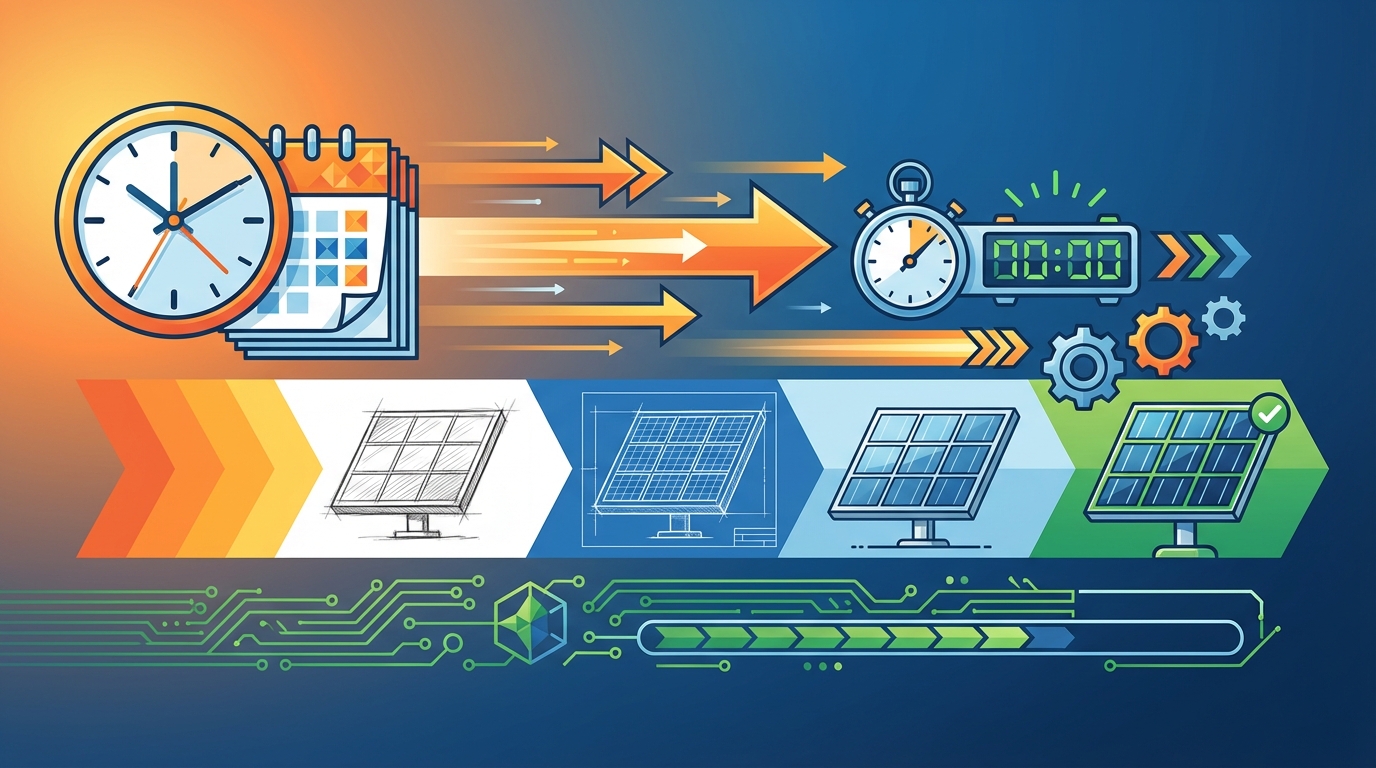
In India’s competitive solar market, speed matters. The EPC company that can deliver accurate designs faster wins more bids, completes projects ahead of schedule, and builds stronger client relationships. Turnaround time differences between offshore and onshore models significantly impact competitive positioning.
Typical Design Timelines: Onshore Indian Providers
Established onshore design firms in India have optimized their workflows for rapid delivery without compromising quality. For a 1 MW commercial rooftop project, a complete design package, including preliminary design, detailed engineering drawings, structural calculations, and electrical documentation, typically requires 5-7 business days from project kickoff to final delivery.
For ground mount utility-scale projects, timelines scale with project size but benefit from economies of scale. A 5 MW ground mount project might require 10-12 business days for complete design documentation, while a 10 MW project extends to 15-18 business days. The per-megawatt design time actually decreases for larger projects as standardized approaches apply across multiple arrays.
These timelines assume clear project information at the outset, site survey data, electrical interconnection details, and client requirements. When information is incomplete, onshore partners can quickly iterate through clarification cycles due to time zone alignment, minimizing overall timeline impact.
Leading onshore firms also offer expedited services for time-sensitive projects. When an EPC faces a tight bid deadline or accelerated project schedule, onshore partners can often mobilize additional resources and deliver designs in 3-4 business days for standard projects, albeit sometimes at premium pricing.
Offshore Provider Turnaround Considerations
Offshore design providers typically quote longer timelines for equivalent projects. The same 1 MW commercial rooftop might require 10-15 business days, while a 5 MW ground mount could extend to 20-25 business days. These extended timelines reflect several factors beyond the actual design work.
First, communication cycles add time. Each clarification question or information request introduces a 24-hour delay due to time zone differences. A project requiring three rounds of clarification, common for complex sites, adds 3-4 days to the timeline compared to same-day resolution with onshore partners.
Second, offshore providers often serve multiple geographic markets, potentially creating resource allocation challenges. Your Indian project competes for attention with projects in other regions, and scheduling may not prioritize your timeline as urgently as an onshore partner focused primarily on the Indian market.
Third, the localization work required to adapt designs to Indian standards adds time. Offshore engineers may need additional review cycles to ensure compliance with IS codes and local requirements, extending the overall delivery timeline.
Impact of Time Zones on Project Velocity
The time zone factor affects not just individual communication exchanges but overall project velocity. Consider the design review and revision process, which typically involves multiple iterations.
With an onshore partner, a typical revision cycle works like this: design delivered Monday morning, your team reviews Monday afternoon, feedback provided Monday evening, revised design delivered Tuesday afternoon. Total cycle time: 1.5 days.
With an offshore partner in the United States, the same cycle extends significantly: design delivered Monday morning IST (Sunday evening EST), your team reviews Monday afternoon IST, feedback provided Monday evening IST (Monday morning EST), offshore team works on revisions Monday EST (Monday night/Tuesday morning IST), revised design delivered Tuesday evening EST (Wednesday morning IST). Total cycle time: 2.5-3 days.
Over a project requiring three revision cycles, typical for complex designs, the time zone impact adds 3-5 days to the overall timeline. For EPCs working on tight schedules, this difference can be critical.
Rush Project Capabilities and Flexibility
The Indian solar market often demands flexibility. Bid deadlines shift, client requirements change, and project schedules accelerate unexpectedly. In these situations, design partner flexibility becomes crucial.
Onshore Indian design firms typically offer greater flexibility for rush projects. They can mobilize teams outside standard hours if needed, work through weekends when projects demand it, and adjust resource allocation quickly to meet urgent deadlines. The cultural context of Indian business, where relationship-oriented service and flexibility are valued, supports this responsiveness.
Offshore providers, operating in different business cultures and serving multiple markets, often have less flexibility. Rush services may be unavailable, or may command significant premium pricing. The structural constraints of time zone differences also limit how much acceleration is possible through extended work hours.
Design Iteration and Revision Cycles
Few solar projects proceed from initial design to final approval without revisions. Client feedback, site condition changes, and regulatory requirements often necessitate design adjustments. The efficiency of revision cycles significantly impacts overall project timelines.
Onshore design outsourcing India partnerships excel in revision efficiency. Same-day or next-day revision turnaround is standard for minor adjustments. Even substantial design changes typically complete within 2-3 business days. The combination of time zone alignment, cultural understanding, and market focus enables rapid iteration.
Offshore revision cycles, constrained by communication delays and time zone barriers, typically require 3-5 business days for minor revisions and 5-7 days for substantial changes. These extended cycles can significantly impact overall project timelines, particularly for projects requiring multiple revision rounds.
For solar EPC companies evaluating design partners, understanding these timeline differences is essential. In a market where speed creates competitive advantage, the turnaround time benefits of onshore design outsourcing India often outweigh any perceived advantages of offshore alternatives. To better understand how project timelines impact overall costs, explore our detailed analysis of solar design timeline and cost relationships.
Regulatory Compliance & Local Expertise in Design Outsourcing India
Regulatory compliance represents perhaps the most critical differentiator between offshore and onshore design outsourcing models. In India’s complex regulatory environment, local expertise isn’t just valuable, it’s essential for project success.
Understanding Indian Building Codes and Solar Regulations
Indian solar projects must comply with a comprehensive framework of national and state-level regulations. The National Building Code of India (NBC) establishes fundamental requirements for structural safety, fire protection, and building services. Solar-specific regulations overlay these general requirements with additional standards for electrical safety, grid interconnection, and renewable energy systems.
Key Indian Standards (IS codes) that govern solar design include IS 875 for wind and seismic loads, IS 800 for structural steel design, IS 456 for concrete structures, and IS 732 for electrical installations. Each of these standards contains specific provisions that directly impact solar project design, from wind load calculations for panel mounting structures to electrical protection requirements for grid-connected systems.
Onshore Indian design firms work with these codes daily. They understand not just the letter of the regulations but their practical application. They know which provisions apply to different project types, how local authorities interpret specific requirements, and what documentation formats satisfy regulatory reviewers.
Offshore providers, even highly qualified ones, typically lack this granular familiarity. They may reference international standards like IBC (International Building Code) or ASCE 7 (American Society of Civil Engineers wind load standards) that don’t directly apply to Indian projects. Translating designs from international standards to Indian codes requires additional work, introduces potential errors, and extends timelines.
State-Specific Permit Requirements and Variations
India’s federal structure creates significant regulatory variation across states. Each state has its own electricity regulatory commission, solar policy framework, and permitting procedures. What works for a project in Gujarat may not satisfy requirements in Tamil Nadu or Uttar Pradesh.
For example, some states require detailed structural stability certificates from licensed structural engineers before issuing solar installation permits. Others mandate specific electrical protection schemes or grid interconnection studies. Some states have streamlined single-window clearance systems, while others require multiple approvals from different departments.
Onshore design firms with experience across multiple Indian states understand these variations. They tailor design documentation to match state-specific requirements, reducing permit approval times and avoiding costly resubmissions. This localized knowledge is nearly impossible for offshore providers to replicate without maintaining dedicated Indian regulatory specialists, an investment that undermines their cost structure.
Local Authority Coordination and Approval Processes
Beyond state-level regulations, local municipal authorities and urban development bodies impose additional requirements. Building plan approvals, structural stability certificates, fire safety clearances, and occupancy certificates all involve local authority interactions.
Onshore design partners understand local authority processes intimately. They know which documentation formats local engineers expect, what level of detail satisfies reviewers, and how to address common objections or questions. Many established onshore firms have built relationships with local authority technical staff through years of project submissions, facilitating smoother approval processes.
Offshore providers lack this local authority interface capability. EPCs working with offshore design partners often find themselves serving as intermediaries, translating between international design approaches and local authority expectations. This intermediary role adds workload, extends timelines, and increases the risk of approval delays.
Structural Engineering Compliance for Indian Conditions
India’s diverse geography creates varied structural engineering challenges. Seismic zones range from Zone II (low seismic activity) to Zone V (highest seismic risk). Wind zones vary from coastal areas with cyclone risk to inland regions with different wind patterns. Soil conditions range from stable rock to expansive clay to coastal sand.
Onshore structural engineering India specialists design for these specific conditions daily. They understand how to apply IS 1893 (seismic design code) for different zones, how to calculate wind loads per IS 875 for various terrain categories, and how to design foundations for different soil types per IS 2950.
This localized structural expertise ensures that solar mounting structures, foundations, and support systems are neither over-engineered (wasting money) nor under-engineered (risking failure). The balance requires intimate knowledge of Indian conditions and codes, knowledge that offshore providers typically lack.
Site-Specific Considerations
Beyond regulatory compliance, successful solar design requires understanding site-specific factors that vary dramatically across India. Coastal projects face corrosion challenges requiring specific material selections. Desert projects must account for extreme temperature variations and dust accumulation. Mountainous terrain projects require specialized foundation designs for sloped sites.
Onshore design firms have encountered these diverse conditions across hundreds of projects. They’ve developed design solutions, material specifications, and construction approaches tailored to Indian site realities. This experiential knowledge, accumulated through years of work across India’s varied geography, represents a competitive advantage that offshore providers cannot easily replicate.
For solar EPC companies, the regulatory compliance and local expertise advantages of onshore design outsourcing India are compelling. The risk of permit delays, approval rejections, or compliance issues with offshore providers often outweighs any perceived cost savings. When regulatory compliance is critical to project success, local expertise becomes non-negotiable. For comprehensive guidance on navigating site-specific challenges, refer to our complete solar feasibility study process guide.
Real-World Case Studies: Offshore vs Onshore Outcomes
Examining real-world experiences provides valuable insights into how offshore and onshore design outsourcing models perform in practice. While specific company names are omitted for confidentiality, these case studies reflect common patterns observed across the Indian solar industry.
Case Study 1: Commercial EPC Choosing Onshore Design Partner
A mid-sized solar EPC company based in Maharashtra was executing 30-40 MW of commercial and industrial rooftop projects annually. Previously, the company maintained an internal design team of four engineers, but growing project volume and increasing complexity strained their capacity. The company evaluated both offshore and onshore design outsourcing options.
The Decision: After pilot projects with both models, the EPC selected an onshore design partner based in Gujarat specializing in solar engineering services.
Outcomes after 18 months:
- Cost savings: Design costs averaged ₹95,000 per MW compared to ₹2,40,000 per MW quoted by offshore providers, a 60% reduction in direct design expenses
- Timeline improvement: Average design turnaround decreased from 12-15 days (internal team) to 6-8 days (onshore partner), enabling faster bid responses and project execution
- Permit success rate: First-time permit approval rate increased from 65% to 92%, significantly reducing project delays
- Revision efficiency: Design revision cycles completed in 1-2 days versus 3-5 days with offshore pilot projects
- Scalability: The EPC successfully scaled to 55 MW annual capacity without adding internal design staff
Key Success Factors: Time zone alignment enabled daily communication and rapid problem-solving. The onshore partner’s familiarity with Maharashtra building regulations and local authority requirements streamlined permit approvals. Cultural alignment and shared business context built a strong working relationship that facilitated collaboration on complex projects.
Case Study 2: International Developer Using Offshore Services
An international renewable energy developer with projects across Asia decided to use their established offshore design partner (based in the United States) for a 20 MW ground mount solar project in Rajasthan. The developer had successfully used this offshore partner for projects in other countries and assumed the same approach would work for their Indian project.
The Decision: The developer engaged their existing offshore design partner to maintain consistency with their global design standards and processes.
Challenges encountered:
- Regulatory compliance issues: Initial designs referenced ASCE standards rather than IS codes, requiring complete structural redesign after local authority rejection
- Timeline delays: The project experienced a 6-week delay due to multiple design revision cycles to achieve compliance with Indian standards
- Communication challenges: Time zone differences (12.5 hours) created 24-48 hour response cycles for clarifications, slowing decision-making
- Local coordination burden: The developer’s Indian project team spent significant time serving as intermediaries between the offshore designer and local authorities
- Cost overruns: Additional revision cycles and extended timelines increased total design costs by approximately 40% beyond the original contract
Resolution: After the initial project challenges, the developer engaged a local Indian solar engineer to review and localize designs from their offshore partner before submission to authorities. This hybrid approach improved outcomes but added costs and complexity.
Lessons Learned: International design standards and approaches don’t automatically translate to Indian projects. Regulatory compliance requires local expertise. The perceived benefit of maintaining global design consistency proved less valuable than ensuring designs matched local requirements from the outset.
Case Study 3: Hybrid Approach for Multi-State Portfolio
A large solar EPC company with projects across multiple Indian states developed a hybrid outsourcing approach. They maintained a small internal design team for preliminary design and client interaction, while outsourcing detailed engineering to an onshore Indian design firm with multi-state experience.
The Approach: Internal team handled site surveys, preliminary layouts, and client presentations. Onshore design partner delivered detailed engineering drawings, structural calculations, electrical designs, and permit documentation tailored to each state’s requirements.
Results:
- Successfully executed 80+ MW across seven states in one year
- Maintained design quality consistency while accommodating state-specific regulatory variations
- Achieved 88% first-time permit approval rate across diverse jurisdictions
- Optimized costs by focusing internal resources on client-facing activities while leveraging specialized design expertise for technical deliverables
Key Insight: The hybrid model combined the benefits of internal market knowledge with specialized design capabilities from an experienced onshore partner. The success depended on clear role definition, effective communication protocols, and the onshore partner’s multi-state regulatory expertise.
Common Pitfalls and How to Avoid Them
Across these case studies and broader industry experience, several common pitfalls emerge in design outsourcing decisions:
Pitfall 1: Prioritizing headline cost over total cost of ownership. The lowest per-MW design fee doesn’t guarantee the best financial outcome when hidden costs, revision cycles, and timeline delays are factored in.
Pitfall 2: Underestimating regulatory compliance complexity. Assuming that technically sound designs will automatically satisfy Indian regulatory requirements leads to costly surprises during permit applications.
Pitfall 3: Overlooking communication efficiency impacts. Time zone differences seem manageable in theory but create significant operational friction in practice, affecting project velocity and team productivity.
Pitfall 4: Failing to validate local expertise claims. Not all design firms claiming Indian market expertise actually possess deep regulatory knowledge and multi-state experience. Thorough due diligence is essential.
Pitfall 5: Neglecting scalability considerations. Choosing a design partner based solely on current project volume without considering future growth needs can necessitate disruptive partner changes later.
Decision Framework: Choosing the Right Design Outsourcing India Model
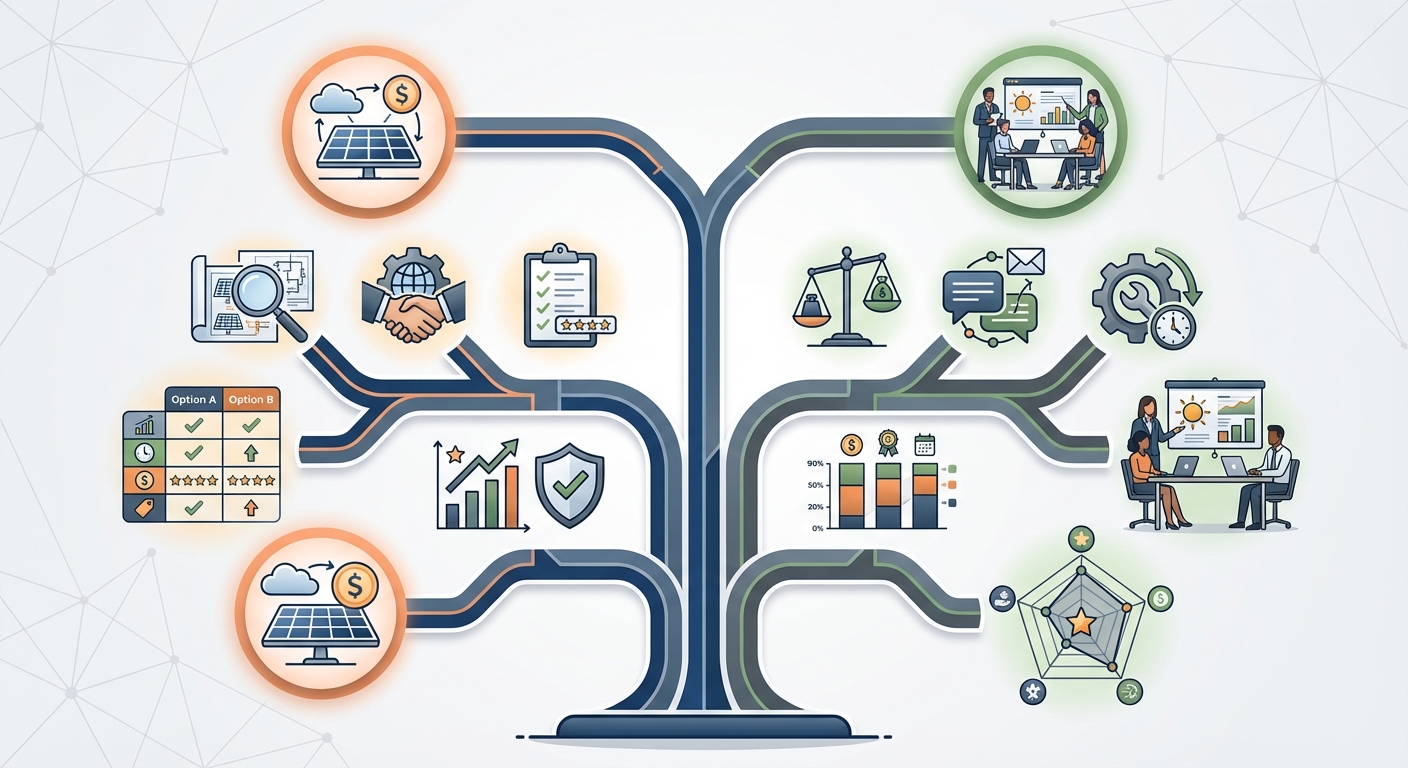
Selecting between offshore and onshore design outsourcing requires systematic evaluation across multiple dimensions. This decision framework helps solar EPC companies make informed choices aligned with their specific needs and circumstances.
Key Evaluation Criteria Checklist
Use this comprehensive checklist to assess potential design partners:
Technical Capabilities:
- Demonstrated experience with similar project types (rooftop, ground mount, carport, etc.)
- Portfolio of completed projects in India with verifiable references
- Engineering team qualifications and relevant certifications
- Proficiency with industry-standard design software (PVsyst, AutoCAD, STAAD.Pro, etc.)
- Quality assurance processes and design review procedures
- Structural engineering capabilities for Indian conditions
Regulatory Expertise:
- Familiarity with Indian Standards (IS codes) and National Building Code
- Experience with state-specific solar policies and permit requirements
- Track record of successful permit approvals across multiple jurisdictions
- Understanding of local authority processes and documentation requirements
- Knowledge of DISCOM interconnection requirements and procedures
Operational Factors:
- Time zone alignment and availability during your business hours
- Communication responsiveness and typical response times
- Project management systems and collaboration tools
- Typical turnaround times for different project types
- Capacity to handle your project volume and growth trajectory
- Flexibility for rush projects and expedited timelines
Commercial Considerations:
- Transparent pricing structure with clear scope definitions
- Competitive rates compared to market benchmarks
- Payment terms and currency considerations
- Revision policy and associated costs
- Contract flexibility and scalability provisions
Strategic Alignment:
- Cultural fit and communication style compatibility
- Long-term partnership potential versus transactional relationship
- Commitment to your success and willingness to invest in relationship
- Innovation capabilities and continuous improvement approach
- References from existing clients in similar situations
When Onshore Design Outsourcing India Makes Sense
Onshore Indian design partners represent the optimal choice for most solar EPC companies operating primarily in the Indian market. This model is particularly advantageous when:
Your projects are exclusively or primarily in India. When all or most of your work involves Indian sites, Indian regulations, and Indian clients, onshore partners deliver maximum value through their localized expertise.
Speed and responsiveness are competitive differentiators. If your market demands rapid bid responses, fast project execution, and agile problem-solving, time zone alignment and communication efficiency become critical success factors.
Regulatory compliance is complex or varies across states. For EPCs working across multiple Indian states with varying requirements, onshore partners with multi-state experience provide essential regulatory navigation capabilities.
Cost optimization is a priority. When project margins are tight and cost efficiency matters, the combination of competitive pricing and minimal hidden costs makes onshore outsourcing financially superior.
You value collaborative partnerships. If you prefer working closely with design partners, engaging in joint problem-solving, and building long-term relationships, onshore partners offer better collaboration opportunities.
When Offshore Might Be Appropriate
While onshore design outsourcing India offers advantages for most scenarios, offshore providers may be appropriate in specific circumstances:
Your company operates across multiple countries. If you’re an international developer with projects in India, Southeast Asia, and other regions, maintaining a single global design partner might provide consistency benefits that outweigh India-specific advantages.
You require highly specialized expertise unavailable locally. For projects involving cutting-edge technologies or specialized applications not yet common in India, offshore providers with specific niche expertise might be necessary.
You have established offshore relationships with proven India capabilities. If you already work with an offshore provider that has successfully completed multiple Indian projects and developed localized expertise, continuing that relationship may make sense.
Your internal team can handle localization and compliance. If you maintain strong internal engineering capabilities to review, localize, and ensure compliance of offshore designs, you can mitigate some offshore disadvantages.
Hybrid Models and Their Applications
Some solar EPC companies find value in hybrid approaches that combine elements of both models:
Onshore primary with offshore specialty: Use onshore Indian partners for standard projects while engaging offshore specialists for unique technical challenges requiring niche expertise.
Internal preliminary with onshore detailed: Maintain internal capabilities for site surveys and preliminary design while outsourcing detailed engineering to specialized onshore firms.
Multi-partner portfolio approach: Engage multiple onshore design partners with different geographic or technical specializations to optimize capabilities across your project portfolio.
Questions to Ask Potential Design Partners
During your evaluation process, ask these critical questions to assess design partner suitability:
- How many solar projects have you completed in India in the past 24 months, and what was the total MW capacity?
- Can you provide references from solar EPC clients with similar project profiles to ours?
- What is your typical turnaround time for a 5 MW ground mount project, and what factors might extend that timeline?
- How do you ensure compliance with state-specific regulations across different Indian states?
- What is your design revision policy, and how do you handle changes requested after initial delivery?
- How do you staff projects, and what qualifications do the engineers assigned to our work possess?
- What quality assurance processes do you implement before delivering designs?
- How do you handle urgent situations or rush projects when we face tight deadlines?
- What project management and communication tools do you use, and how frequently will we receive updates?
- Can you walk us through a recent project that encountered challenges and how you resolved them?
The answers to these questions reveal not just technical capabilities but also communication style, problem-solving approach, and cultural fit, all essential factors for successful long-term partnerships.
The Future of Design Outsourcing India in Solar Sector
As India’s solar industry continues its rapid growth trajectory toward ambitious renewable energy targets, the design outsourcing landscape is evolving. Understanding emerging trends helps solar EPC companies make forward-looking partnership decisions.
Emerging Trends in Solar Design Outsourcing
Several trends are reshaping the design outsourcing landscape in 2026 and beyond:
Specialization and niche expertise: Design firms are increasingly specializing in specific project types, rooftop commercial, utility-scale ground mount, floating solar, agrivoltaics, or solar-plus-storage. This specialization enables deeper expertise and more efficient processes for specific applications. EPCs benefit by matching projects to specialized partners rather than seeking generalist providers.
Technology integration: Advanced design tools incorporating artificial intelligence, machine learning, and automation are accelerating design processes and improving accuracy. Leading onshore Indian firms are adopting these technologies, further enhancing their efficiency advantages. Automated preliminary design tools, AI-powered shading analysis, and machine learning-based energy yield optimization are becoming standard capabilities.
Integrated service offerings: Design firms are expanding beyond pure design services to offer integrated solutions including site surveys, feasibility studies, PMC services India, and owner’s engineer roles. This integration enables EPCs to consolidate multiple service needs with single partners, simplifying coordination and improving project outcomes.
Performance-based contracting: Some design partnerships are evolving toward performance-based models where design fees tie partially to project outcomes, energy yield achievement, construction cost optimization, or timeline performance. This alignment of incentives strengthens partnerships and focuses design work on value creation rather than just deliverable completion.
Technology’s Role in Bridging Offshore-Onshore Gaps
While technology cannot fully eliminate the advantages of onshore design outsourcing India, it is narrowing some gaps. Advanced collaboration platforms, cloud-based design tools, and virtual reality site visualization are improving offshore communication efficiency. However, these technologies benefit onshore partnerships equally, maintaining the relative advantage of time zone alignment and local expertise.
The most significant technology impact may be in standardization and automation. As more design elements become standardized and automated, the pure engineering work component decreases while the regulatory compliance, localization, and project management components increase in relative importance. This trend actually strengthens the case for onshore partners, as these higher-value activities depend heavily on local expertise that technology cannot easily replicate.
India’s Evolving Position in Global Solar Design Market
India is simultaneously a major market for solar design services and an emerging exporter of design expertise to other developing solar markets. Indian design firms are increasingly serving clients in Southeast Asia, Africa, and the Middle East, leveraging their cost competitiveness and experience with challenging project conditions.
This dual role, domestic market and export hub, is driving quality improvements and capability development across the Indian solar design sector. Competition for both domestic and international clients pushes firms to enhance technical capabilities, adopt advanced tools, and improve service delivery. Solar EPC companies benefit from this competitive dynamic through access to increasingly sophisticated design partners at competitive prices.
Recommendations for Solar EPC Companies in 2026
Based on current trends and the comprehensive comparison of offshore versus onshore models, several recommendations emerge for solar EPC companies:
Prioritize onshore design outsourcing India for core business. For projects in India, onshore partners deliver superior value across cost, quality, speed, and compliance dimensions. The evidence strongly supports onshore partnerships as the default choice for Indian solar projects.
Invest in strategic design partnerships, not transactional relationships. The most successful EPCs treat design partners as strategic collaborators rather than commodity service providers. Invest time in building strong relationships, sharing knowledge, and aligning on quality standards and business objectives.
Evaluate partners on total value, not just design fees. Look beyond headline pricing to assess total cost of ownership, including communication efficiency, revision cycles, compliance success rates, and timeline performance. The cheapest option rarely delivers the best value.
Validate regulatory expertise thoroughly. Don’t assume that technical competence automatically includes regulatory compliance capabilities. Specifically assess partners’ knowledge of Indian standards, state-specific requirements, and local authority processes.
Plan for scalability from the outset. Choose design partners with capacity to grow with your business. Changing partners as you scale creates disruption and inefficiency. Select partners who can support your growth trajectory for years to come.
Leverage specialized expertise strategically. For standard projects, work with established onshore partners with proven processes. For unique technical challenges, don’t hesitate to engage specialized expertise, whether onshore or offshore, when specific capabilities are required.
Stay informed about technology developments. Monitor emerging design technologies and tools that can improve efficiency and quality. Partner with design firms that invest in technology adoption and continuous improvement.
For solar EPC companies navigating India’s competitive market in 2026, the choice between offshore and onshore design outsourcing significantly impacts business performance. The evidence presented in this comprehensive comparison demonstrates that onshore Indian design partners deliver superior value for most scenarios through their combination of cost competitiveness, regulatory expertise, communication efficiency, and rapid turnaround times. For region-specific design considerations, explore our detailed regional design guide for ground mount projects across India.
As you evaluate your design outsourcing strategy, remember that the right partner becomes a competitive advantage, enabling faster project delivery, better margins, higher quality outcomes, and stronger client relationships. Choose wisely, invest in the partnership, and leverage specialized design expertise to scale your solar EPC business successfully.
Ready to experience the advantages of onshore design outsourcing India with a proven partner? Heaven Designs has delivered 628+ MW of solar design work for 752+ EPC clients across multiple countries, combining technical excellence with deep regulatory expertise and rapid turnaround times. Our team of 50+ specialized engineers understands the unique challenges of Indian solar projects and delivers cost-effective, accurate designs that maximize energy generation while optimizing project costs. Whether you’re planning commercial rooftop installations, utility-scale ground mount projects, or complex industrial solar systems, our comprehensive design services ensure your projects succeed from concept to commissioning. Get a Quick Proposal Now! or reach out directly at +91 90811 00297 or service@heavendesigns.in to discuss how our onshore design expertise can accelerate your solar EPC business in 2026.
This blog post was written using thestacc.com