


Solar EPC companies operating in India face an increasingly complex web of regulatory requirements in 2026. From central government mandates to state-specific policies, grid connection protocols to environmental clearances, navigating solar compliance has become one of the most challenging aspects of project execution. A single compliance oversight can delay projects by months, inflate costs significantly, and even jeopardize project viability.
This comprehensive FAQ addresses the 25 most critical solar compliance questions that EPC companies ask when designing and executing solar projects across India. Whether you’re working on rooftop installations, ground-mount solar farms, or megawatt-scale commercial projects, understanding these regulatory requirements is essential for successful project delivery.
Understanding Solar Compliance in India’s Evolving Regulatory Landscape
Solar compliance refers to the adherence to all applicable regulations, standards, technical specifications, and legal requirements governing the design, installation, and operation of solar power systems in India. For EPC companies, compliance is not merely a bureaucratic checkbox—it’s a fundamental requirement that impacts project timelines, costs, and long-term performance.
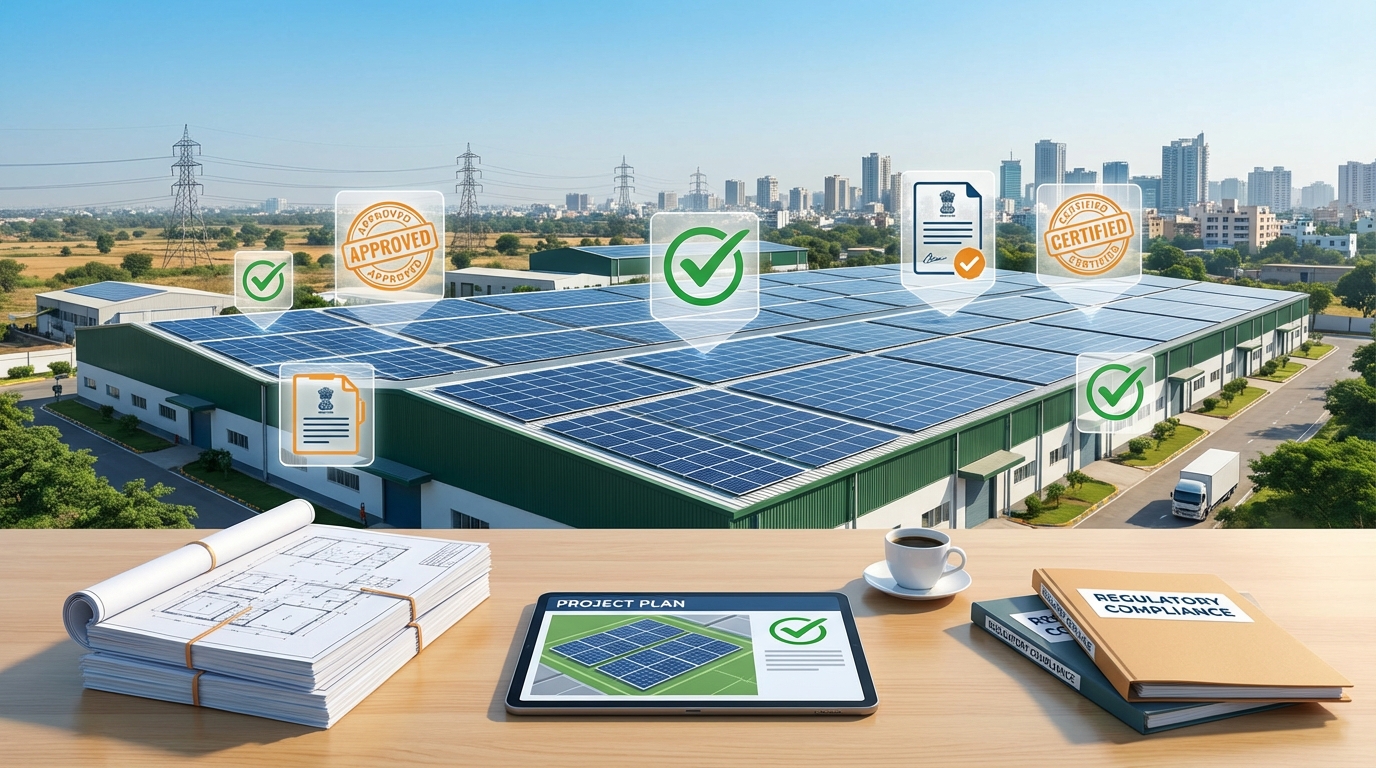
India’s solar regulatory framework operates on multiple levels. The Ministry of New and Renewable Energy (MNRE) sets national policies and guidelines, while the Central Electricity Authority (CEA) establishes technical standards for grid connectivity. State governments implement their own solar policies, and State Electricity Regulatory Commissions (SERCs) govern tariffs and net metering regulations. Additionally, the Bureau of Indian Standards (BIS) mandates equipment certification requirements.
The consequences of non-compliance are severe. Projects may face approval delays ranging from weeks to several months, financial penalties from regulatory authorities, rejection of subsidy applications, grid connection refusals, and in extreme cases, complete project shutdowns. For EPC companies working on tight margins and strict timelines, these setbacks can be financially devastating.
Heaven Designs has supported over 752 solar EPC clients across India in navigating these compliance challenges. With a team of 50+ specialized engineers based in Surat, Gujarat, the company integrates regulatory compliance into every phase of solar design and engineering services, ensuring that projects meet all applicable standards before construction begins. This proactive approach to solar compliance has helped clients avoid costly delays and achieve faster project approvals.
Central Government Regulations & National Solar Policies
Q1: What are the key central government regulations for solar projects in 2026?
In 2026, solar projects in India must comply with several central government regulations. The Electricity Act 2003 provides the legal framework for power generation and distribution. The National Electricity Policy and Tariff Policy establish guidelines for renewable energy integration. MNRE’s guidelines for grid-connected rooftop and small solar power plants set technical and financial norms. Additionally, the Solar Park Scheme and PM-KUSUM program have specific compliance requirements for participating projects.
The Approved List of Models and Manufacturers (ALMM) mandate, enforced since April 2024, requires all solar modules used in government-subsidized projects to be from ALMM-listed manufacturers. This regulation significantly impacts equipment procurement decisions for EPC companies.
Q2: How do MNRE guidelines impact solar EPC projects?
MNRE guidelines establish the benchmark standards for solar project design, installation, and commissioning. These guidelines specify minimum technical requirements for system components, installation practices, safety measures, and performance guarantees. For rooftop solar projects, MNRE guidelines define eligibility criteria for subsidies, net metering provisions, and standardized documentation formats.
EPC companies must ensure their designs align with MNRE’s technical specifications, including minimum efficiency standards for modules and inverters, structural safety requirements, and electrical protection systems. Non-compliance with MNRE guidelines can result in subsidy rejection and disqualification from government tenders.
Q3: What is the role of CEA in solar project approvals?
The Central Electricity Authority plays a crucial role in technical compliance for solar projects. CEA regulations mandate technical standards for connectivity to the grid, including voltage and frequency parameters, power quality requirements, and protection systems. For projects above certain capacity thresholds (typically 5 MW for solar), CEA approval is mandatory before grid connection.
CEA’s Technical Standards for Connectivity of Distributed Generation Resources specify requirements for anti-islanding protection, reactive power capability, fault ride-through capability, and communication protocols. These standards ensure that solar installations do not adversely affect grid stability.
Q4: Are there specific compliance requirements for PM-KUSUM scheme projects?
Yes, the PM-KUSUM (Pradhan Mantri Kisan Urja Suraksha evam Utthaan Mahabhiyan) scheme has distinct compliance requirements. Component A (ground-mounted solar power plants) requires land ownership documentation, environmental clearances for projects above 2 MW, and compliance with state-specific land use regulations. Component B (standalone solar pumps) mandates BIS-certified equipment and adherence to MNRE’s technical specifications for solar pumps.
Component C (grid-connected solar pumps) requires net metering agreements with distribution companies and compliance with state solar policies. All PM-KUSUM projects must use ALMM-listed modules and follow prescribed procurement procedures for subsidy eligibility.
Q5: How do GST regulations affect solar project compliance?
Solar projects are subject to Goods and Services Tax (GST) at varying rates depending on project type and components. As of 2026, solar modules attract 5% GST, while inverters and other electrical equipment may have different rates. For EPC contracts, the applicable GST rate depends on whether the project qualifies as goods or services under tax regulations.
Compliance requires proper GST registration, accurate tax invoicing, input tax credit documentation, and timely filing of returns. For projects spanning multiple states, understanding inter-state GST implications is essential. Incorrect GST compliance can lead to tax notices, penalties, and project cost escalations.
State-Level Solar Compliance Requirements
State-level regulations add another layer of complexity to solar compliance in India. Each state has its own solar policy, net metering regulations, and approval processes, making it essential for EPC companies to understand regional variations.

Q6: How do state solar policies differ across India?
State solar policies vary significantly in their approach to renewable energy promotion. Gujarat’s solar policy emphasizes large-scale solar parks and offers streamlined single-window clearances. Maharashtra focuses on mandatory solar installations for certain building categories and has robust net metering provisions. Rajasthan, with its abundant solar resources, has policies favoring utility-scale projects and land lease frameworks.
Karnataka has implemented aggressive rooftop solar targets with specific compliance requirements for commercial and industrial consumers. Tamil Nadu’s policy includes banking provisions for excess solar generation and specific technical standards for grid integration. Understanding these state-specific nuances is critical for project planning and feasibility assessment.
Q7: What are the net metering and gross metering compliance requirements?
Net metering and gross metering regulations are governed by State Electricity Regulatory Commissions. Net metering allows consumers to offset their electricity consumption with solar generation, with excess power fed to the grid. Compliance requirements include capacity limits (typically up to 1 MW for commercial consumers), bidirectional meter installation, interconnection agreements with distribution companies, and adherence to technical standards.
Gross metering involves selling all generated solar power to the utility at predetermined tariffs. This requires separate metering arrangements, power purchase agreements, and compliance with grid code requirements. Each state has different capacity thresholds, banking periods, and settlement mechanisms that EPCs must navigate.
Q8: Which states require mandatory solar installations for buildings?
Several states have enacted mandatory solar installation requirements for specific building categories. Karnataka mandates solar installations for all new residential buildings above 1,000 square meters and commercial buildings above 10,000 square meters. Maharashtra requires solar installations for new buildings with sanctioned loads above 20 kW.
Delhi has made rooftop solar mandatory for all new government buildings and buildings with connected loads above 500 kW. Punjab requires solar installations for all new industrial units. These mandates specify minimum capacity requirements, technical standards, and compliance verification procedures that must be followed during building plan approvals.
Q9: How do state electricity regulatory commissions impact compliance?
State Electricity Regulatory Commissions (SERCs) play a pivotal role in solar compliance by regulating tariffs, net metering policies, renewable purchase obligations, and grid connectivity standards. SERCs issue regulations on interconnection procedures, metering requirements, and dispute resolution mechanisms.
For EPC companies, understanding SERC regulations is essential for project economics and technical design. SERCs determine feed-in tariffs, banking charges, and wheeling charges that impact project viability. They also establish timelines for distribution companies to process solar connection applications, providing recourse for delays.
Q10: What are the key differences between Gujarat, Maharashtra, and Rajasthan solar regulations?
Gujarat offers one of India’s most business-friendly solar regulatory environments with single-window clearances through GEDA (Gujarat Energy Development Agency), streamlined land acquisition processes, and robust evacuation infrastructure. The state has clear guidelines for both rooftop and ground-mount projects with minimal bureaucratic hurdles.
Maharashtra emphasizes distributed solar generation with strong net metering provisions and mandatory solar requirements for large consumers. The state has detailed technical standards for grid integration and requires multiple approvals from MSEDCL (Maharashtra State Electricity Distribution Company Limited) and local authorities.
Rajasthan focuses on utility-scale solar development with extensive solar park infrastructure and land lease policies favoring large projects. The state has specific regulations for ground-mount solar installations, including environmental clearance requirements and transmission connectivity procedures. Understanding these regional differences is crucial for project planning and execution.
Grid Connection & Technical Compliance Standards
Q11: What are the CEA technical standards for grid connectivity?
CEA’s technical standards for grid connectivity are comprehensive and mandatory for all solar installations. The Central Electricity Authority (Technical Standards for Connectivity to the Grid) Regulations 2007, as amended, specify voltage and frequency operating ranges, power quality parameters including harmonic distortion limits, and reactive power capability requirements.
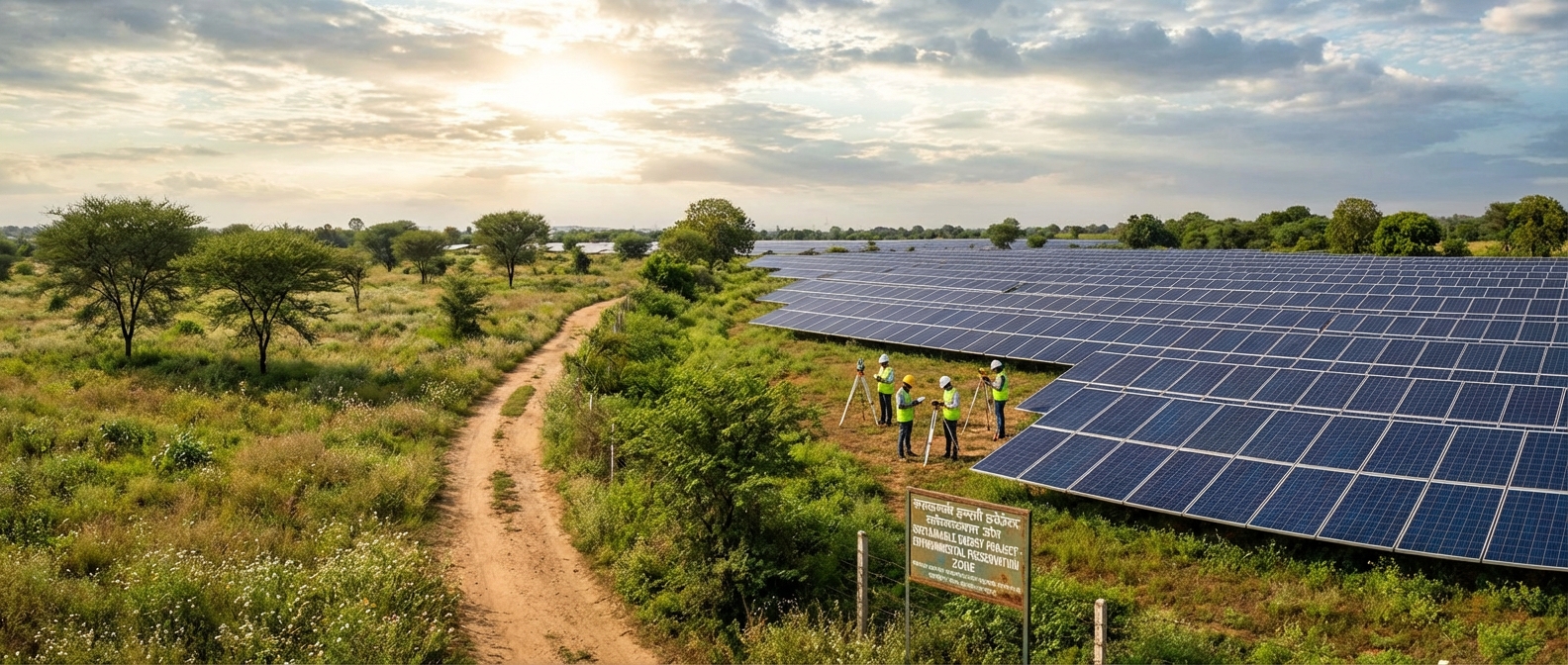
Solar installations must maintain power factor within specified limits, typically between 0.95 lagging and 0.95 leading. Voltage variations must be controlled within ±10% of nominal voltage. Total harmonic distortion must not exceed 5% for voltage and 8% for current. These standards ensure that solar generation does not compromise grid stability or power quality.
Q12: What documentation is required for grid connection approval?
Grid connection approval requires extensive documentation. Essential documents include a detailed single-line diagram showing all electrical components, equipment specifications and test certificates, structural stability certificates for mounting systems, and electrical safety certificates from licensed electrical contractors.
Additional requirements include net metering or interconnection agreements, proof of land ownership or lease agreements, building plan approvals for rooftop installations, and environmental clearances for large projects. Distribution companies also require insurance certificates, commissioning reports, and as-built drawings before final connection approval.
Q13: How long does the grid connection approval process take?
The grid connection approval timeline varies by state and project capacity. For rooftop solar systems under 10 kW, the process typically takes 15-30 days from application submission to meter installation, assuming all documentation is complete. For systems between 10 kW and 1 MW, the timeline extends to 45-90 days due to additional technical scrutiny and site inspections.
Large ground-mount projects above 1 MW may require 3-6 months for complete grid connection approval, including feasibility studies, transmission system studies, and coordination with multiple authorities. Delays often occur due to incomplete documentation, technical objections, or capacity constraints in the local grid infrastructure.
Q14: What are the anti-islanding and grid protection requirements?
Anti-islanding protection is a critical solar compliance requirement to prevent solar systems from continuing to energize the grid during utility outages. This protects utility workers and prevents equipment damage. CEA standards mandate that solar inverters must detect grid disconnection and cease power export within 2 seconds.
Grid protection requirements include over-voltage and under-voltage protection, over-frequency and under-frequency protection, and short-circuit protection with appropriately rated circuit breakers. Isolation transformers or equivalent protection must be provided to prevent DC injection into the AC grid. All protection systems must be tested and certified before commissioning.
Q15: Do rooftop and ground-mount projects have different grid compliance needs?
Yes, rooftop and ground-mount projects have distinct compliance requirements. Rooftop solar systems typically connect at low voltage (LT) or high voltage (HT) levels depending on capacity, with simpler interconnection procedures. They must comply with building structural safety standards, fire safety regulations, and local municipal bylaws in addition to electrical standards.
Ground-mount projects, especially those above 1 MW, require more rigorous compliance including transmission system studies, dedicated substations, land use clearances, and environmental impact assessments. They often connect at higher voltage levels (33 kV or above) requiring more sophisticated protection and control systems. The approval process involves multiple authorities including state transmission utilities and load dispatch centers.
Safety Standards & Equipment Certification
Q16: What BIS standards apply to solar equipment in India?
The Bureau of Indian Standards has established comprehensive standards for solar equipment. IS 14286 specifies requirements for solar photovoltaic modules, covering electrical performance, mechanical strength, and environmental durability. IS 16221 addresses grid-connected solar inverters, defining efficiency, power quality, and protection requirements.
Other critical BIS standards include IS 16169 for solar cables, IS 13939 for earthing practices, and IS 15081 for solar charge controllers. As of 2026, BIS certification is mandatory for solar modules, inverters, and batteries used in Indian solar projects. Using non-BIS certified equipment can result in project rejection and legal liabilities.
Q17: Is ALMM (Approved List of Models and Manufacturers) compliance mandatory?
ALMM compliance is mandatory for all government-subsidized solar projects and projects under government schemes including rooftop solar programs, PM-KUSUM, and solar park projects. The ALMM list, maintained by MNRE, includes only those solar module manufacturers and models that meet specified quality and performance criteria.
For private commercial and industrial projects without government subsidies, ALMM compliance is not legally mandatory but is increasingly preferred by project developers and financiers as a quality assurance measure. EPC companies must verify ALMM status before equipment procurement to ensure project eligibility for subsidies and government benefits.
Q18: What fire safety standards must solar installations meet?
Fire safety is a critical aspect of solar compliance, especially for rooftop installations. The National Building Code of India 2016 includes provisions for solar installation fire safety, requiring adequate spacing between modules for firefighting access, fire-resistant cable routing, and accessible emergency disconnects.
Solar installations must have DC isolators at accessible locations, clearly marked emergency shutdown procedures, and fire-resistant cable trays. For large rooftop installations, fire detection and suppression systems may be required. Compliance with local fire department regulations and obtaining fire safety certificates is mandatory before commissioning in many jurisdictions.
Q19: Are there specific structural safety certifications required?
Yes, structural safety certifications are mandatory for solar installations. For rooftop solar, a structural stability certificate from a licensed structural engineer is required, confirming that the building can safely support the additional load of solar panels, mounting structures, and wind/seismic forces.
The certification must verify compliance with IS 875 (Code of Practice for Design Loads for Buildings and Structures) covering dead loads, live loads, wind loads, and seismic loads. For ground-mount projects, foundation design certifications and soil investigation reports are required. Heaven Designs provides comprehensive solar civil and structural engineering services that ensure all structural compliance requirements are met, preventing costly redesigns and approval delays.
Q20: How do electrical safety regulations impact solar design?
Electrical safety regulations significantly influence solar system design. The Indian Electricity Rules 1956, as amended, mandate proper earthing systems, adequate cable sizing for current-carrying capacity, and appropriate protection devices against overcurrent, short circuits, and earth faults.
Solar designs must incorporate proper cable management to prevent mechanical damage, UV-resistant cables for outdoor installations, and appropriate voltage ratings for all components. Lightning protection systems are required for exposed installations. All electrical work must be supervised by licensed electrical contractors, and electrical safety certificates must be obtained before grid connection approval.
Environmental Clearances & Land Compliance
Q21: When is environmental clearance required for solar projects?
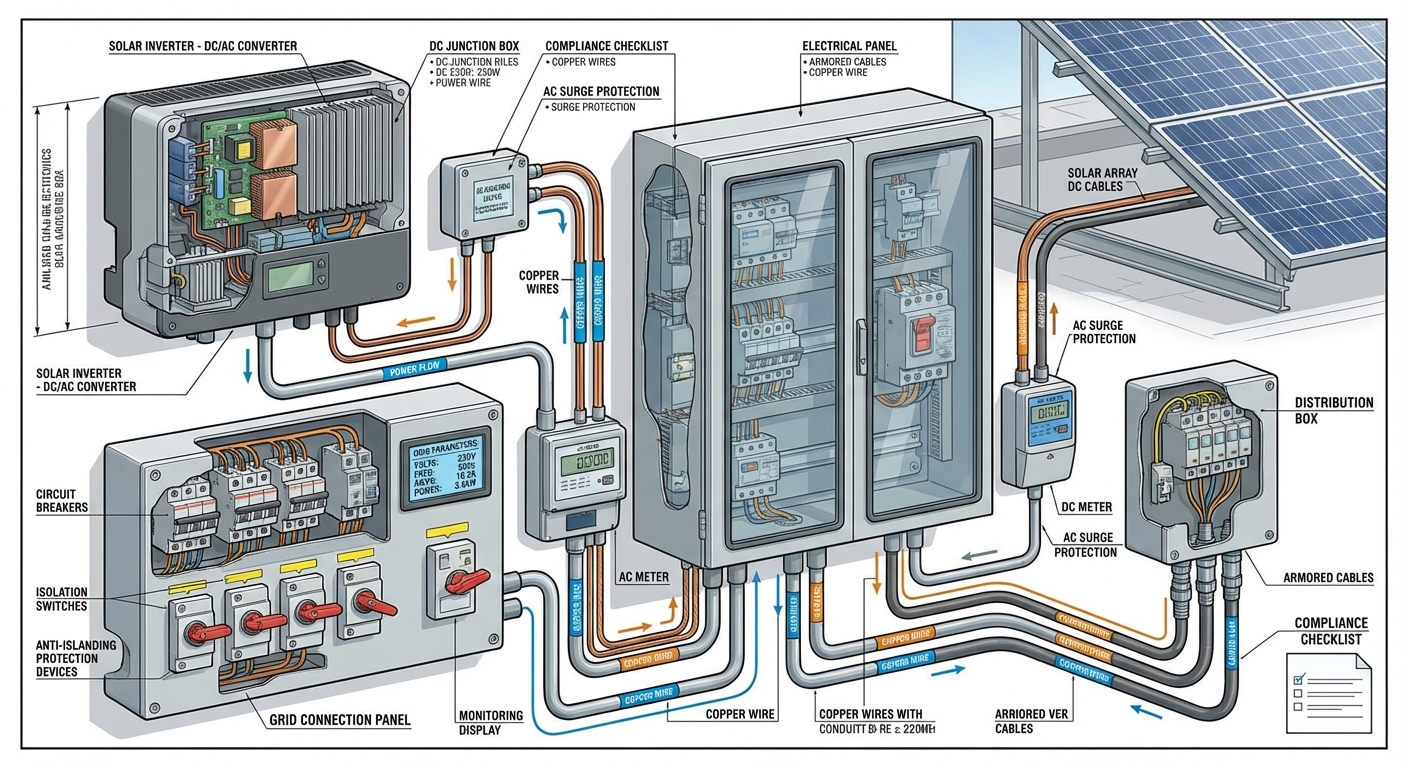
Environmental clearance requirements depend on project capacity and location. Under the Environment Impact Assessment (EIA) Notification 2006, as amended, solar projects above 20 MW capacity require environmental clearance from the State Environment Impact Assessment Authority (SEIAA) or the Ministry of Environment, Forest and Climate Change (MoEFCC) depending on location and sensitivity.
Projects in ecologically sensitive areas, coastal regulation zones, or near protected forests may require environmental clearance regardless of capacity. The clearance process involves environmental impact assessment studies, public consultations, and compliance with prescribed environmental management plans. The process typically takes 4-6 months and must be completed before project construction begins.
Q22: What are the land use regulations for ground-mount solar farms?
Land use regulations for ground-mount solar farms vary by state and land classification. Agricultural land conversion for solar projects requires approval from revenue authorities and may be subject to restrictions in certain states. Some states like Rajasthan and Gujarat have streamlined processes for solar land conversion, while others impose stringent conditions.
Land lease agreements must comply with state-specific regulations regarding lease duration, rental terms, and land restoration obligations. For government or forest land, special permissions from respective departments are required. Zoning regulations, setback requirements from property boundaries, and access road provisions must be verified during site selection and feasibility studies.
Q23: Are there restrictions on agricultural land conversion for solar?
Yes, several states have restrictions on converting agricultural land for solar projects. Some states prohibit conversion of prime agricultural land or impose minimum land holding requirements. Others require that solar projects on agricultural land maintain a certain percentage for continued agricultural activities (agrivoltaics).
The conversion process typically requires approval from district collectors or revenue authorities, payment of conversion fees, and compliance with land ceiling acts. Some states offer exemptions for solar projects under specific schemes or for projects that demonstrate minimal impact on agricultural productivity. EPC companies must conduct thorough due diligence on land status before project initiation.
Q24: What forest clearance requirements apply to solar projects?
Solar projects proposed on forest land or within 10 km of protected areas require forest clearance under the Forest (Conservation) Act 1980. The clearance process involves approval from the State Forest Department and, for projects above certain thresholds, from the MoEFCC at the central level.
The process requires detailed project reports, compensatory afforestation plans, and payment of Net Present Value (NPV) for forest land diversion. Wildlife clearances are required if the project falls within wildlife corridors or habitats. Given the lengthy approval process (often 12-18 months), most solar developers avoid forest land for project development.
Q25: How do coastal regulation zones affect solar installations?
Solar projects in Coastal Regulation Zones (CRZ) are subject to the CRZ Notification 2019, which classifies coastal areas into different zones with varying restrictions. CRZ-I (ecologically sensitive areas) generally prohibits new construction including solar installations. CRZ-II (developed areas) and CRZ-III (relatively undisturbed areas) have specific setback requirements and height restrictions.
Solar projects in CRZ areas require clearance from the State Coastal Zone Management Authority and must demonstrate minimal environmental impact. Rooftop solar on existing buildings in CRZ areas faces fewer restrictions compared to ground-mount installations. Compliance with CRZ regulations is critical for coastal states like Gujarat, Maharashtra, Tamil Nadu, and Kerala.
Documentation, Permits & Approval Timeline
Successful solar compliance requires meticulous documentation and understanding of approval timelines. EPC companies must prepare and submit numerous documents across different stages of project development.
Complete Documentation Checklist
Essential documents for solar project approval include:
- Technical Documents: Detailed engineering drawings, single-line diagrams, equipment datasheets, structural design calculations, electrical load calculations, and protection system schematics
- Compliance Certificates: BIS certificates for equipment, ALMM compliance certificates, structural stability certificates, electrical safety certificates, and fire safety approvals
- Legal Documents: Land ownership or lease deeds, building plan approvals, environmental clearances, forest clearances (if applicable), and power purchase agreements
- Regulatory Applications: Grid connection applications, net metering agreements, subsidy applications, and state nodal agency registrations
- Financial Documents: Project cost estimates, financing arrangements, GST registration, and insurance policies
Typical Approval Timeline
Understanding approval timelines helps in realistic project scheduling:
- Residential Rooftop (up to 10 kW): 2-4 weeks for complete approval including net metering
- Commercial Rooftop (10 kW to 1 MW): 6-12 weeks including technical approvals and grid connection
- Ground-Mount (1-5 MW): 3-6 months including land clearances, environmental assessments, and grid connectivity
- Large Solar Parks (above 5 MW): 6-12 months including all statutory clearances, transmission approvals, and power evacuation arrangements
These timelines assume complete and accurate documentation. Incomplete submissions can extend timelines significantly.
Common Documentation Mistakes That Cause Delays
EPC companies frequently encounter delays due to avoidable documentation errors:
- Submitting outdated equipment certificates or non-ALMM compliant module specifications
- Incomplete structural drawings lacking load calculations or foundation details
- Single-line diagrams that don’t match actual site conditions or lack required protection devices
- Missing signatures or certifications from licensed professionals
- Incorrect land documents or unclear ownership chains
- Inadequate electrical safety provisions or non-compliant earthing designs
How Professional Design Services Streamline Approvals
Professional solar design services significantly accelerate the approval process by ensuring compliance from the design stage itself. Heaven Designs integrates regulatory requirements into every project phase, from preliminary design through detailed engineering.
With experience across 628+ MW of solar projects and deep knowledge of regional regulations, the company’s engineers prepare documentation that meets all statutory requirements on first submission. This includes accurate permit design that addresses local building codes, comprehensive electrical designs complying with CEA standards, and structural engineering that satisfies safety certifications.
The company’s site survey services across India ensure that feasibility assessments account for regulatory constraints, preventing costly redesigns later. By identifying compliance requirements during the design phase, Heaven Designs helps EPC companies avoid the most common cause of project delays—regulatory non-compliance discovered during approval processes.
Navigating Solar Compliance with Expert Design Partners
The complexity of solar compliance in India demands specialized expertise that goes beyond basic engineering knowledge. Successful EPC companies recognize that compliance is not an afterthought but an integral part of project design and execution.
Heaven Designs has built its reputation on delivering compliance-ready solar designs that accelerate project approvals and reduce execution risks. With a dedicated team of 50+ engineers and consultants based in Surat, Gujarat, the company brings deep understanding of both central and state-level regulations across India’s diverse regulatory landscape.
Compliance Integration Across Project Phases
Heaven Designs ensures solar compliance through systematic integration at every project stage:
- Feasibility Stage: Identifying applicable regulations, assessing compliance requirements, and evaluating regulatory risks during initial project assessment
- Design Stage: Incorporating technical standards, safety requirements, and equipment specifications that meet all certification requirements
- Documentation Stage: Preparing comprehensive permit designs, engineering drawings, and compliance certificates required for approvals
- Approval Support: Assisting with regulatory submissions, addressing technical queries from authorities, and facilitating timely approvals
Benefits of Working with Experienced Solar Design Consultants
Partnering with experienced design consultants offers multiple advantages for EPC companies:
- Reduced Approval Timelines: Compliance-ready designs eliminate back-and-forth with regulatory authorities, accelerating project schedules
- Cost Optimization: Avoiding redesigns and compliance-related delays prevents cost overruns and maintains project margins
- Risk Mitigation: Professional designs reduce the risk of project rejection, grid connection refusal, or post-installation compliance issues
- Regional Expertise: Understanding state-specific regulations ensures appropriate compliance strategies for projects across different locations
- Technical Credibility: Designs from established consultancies carry greater weight with regulatory authorities, facilitating smoother approvals
Real-World Compliance Challenges Solved Through Proper Design
Heaven Designs has helped numerous EPC clients overcome complex compliance challenges. In one case, a 5 MW ground-mount project in Maharashtra faced grid connection rejection due to inadequate reactive power compensation design. The company’s engineers redesigned the inverter configuration and protection systems to meet MSEDCL’s technical requirements, securing approval within three weeks.
For a commercial rooftop project in Karnataka, initial structural designs failed to account for enhanced wind load requirements under local building codes. Heaven Designs conducted fresh structural analysis, redesigned the mounting system with appropriate safety factors, and obtained structural stability certification, preventing a potential project abandonment.
In Gujarat, a solar park developer struggled with environmental clearance documentation for a 20 MW project. The company’s PMC team prepared comprehensive environmental management plans, coordinated with SEIAA authorities, and secured clearance within the stipulated timeline, keeping the project on schedule.
Your Partner for Compliance-Ready Solar Projects
Navigating solar compliance in India’s evolving regulatory environment requires more than technical competence—it demands specialized knowledge, regional expertise, and proactive compliance integration. Heaven Designs brings all these elements together, helping EPC companies deliver projects that meet regulatory standards while optimizing costs and timelines.
Whether you’re planning a residential rooftop installation, a commercial solar project, or a megawatt-scale solar farm, ensuring regulatory compliance from the design stage is critical for project success. With 752+ satisfied clients and 628+ MW of completed design work, Heaven Designs has proven expertise in delivering compliance-ready solar engineering solutions across India.
Don’t let compliance challenges delay your next solar project. Partner with Heaven Designs for comprehensive solar design and engineering services that integrate regulatory requirements from day one. Our team understands the intricacies of central and state regulations, grid connection standards, safety certifications, and environmental clearances. We ensure your projects are designed right the first time, accelerating approvals and reducing execution risks. Contact us today at service@heavendesigns.in or call +91 90811 00297 to discuss your project requirements. Get a Quick Proposal Now! and experience the difference that compliance-focused solar design makes in project delivery.
This blog post was written using thestacc.com