


For solar EPC companies operating in India’s rapidly expanding renewable energy market, understanding design pricing models is critical to maintaining healthy profit margins and delivering competitive bids. With India targeting 500 GW of renewable energy capacity by 2030, the demand for professional solar design services has never been higher. Yet many EPCs struggle to evaluate which pricing structure delivers the best value for their specific project portfolio.
The choice between fixed-price contracts, hourly billing, and per-MW rates can significantly impact your project economics, timeline flexibility, and overall profitability. Each design pricing model offers distinct advantages depending on project type, scope clarity, and scale. Making the wrong choice can lead to budget overruns, scope disputes, or paying for services you don’t need.
This comprehensive guide breaks down the three dominant solar design pricing models used by engineering service providers in 2026, helping you understand when each approach makes financial sense for residential, commercial, and utility-scale projects. We’ll explore hidden costs that catch EPCs off guard, negotiation strategies to secure better terms, and real-world cost scenarios across different project scales.
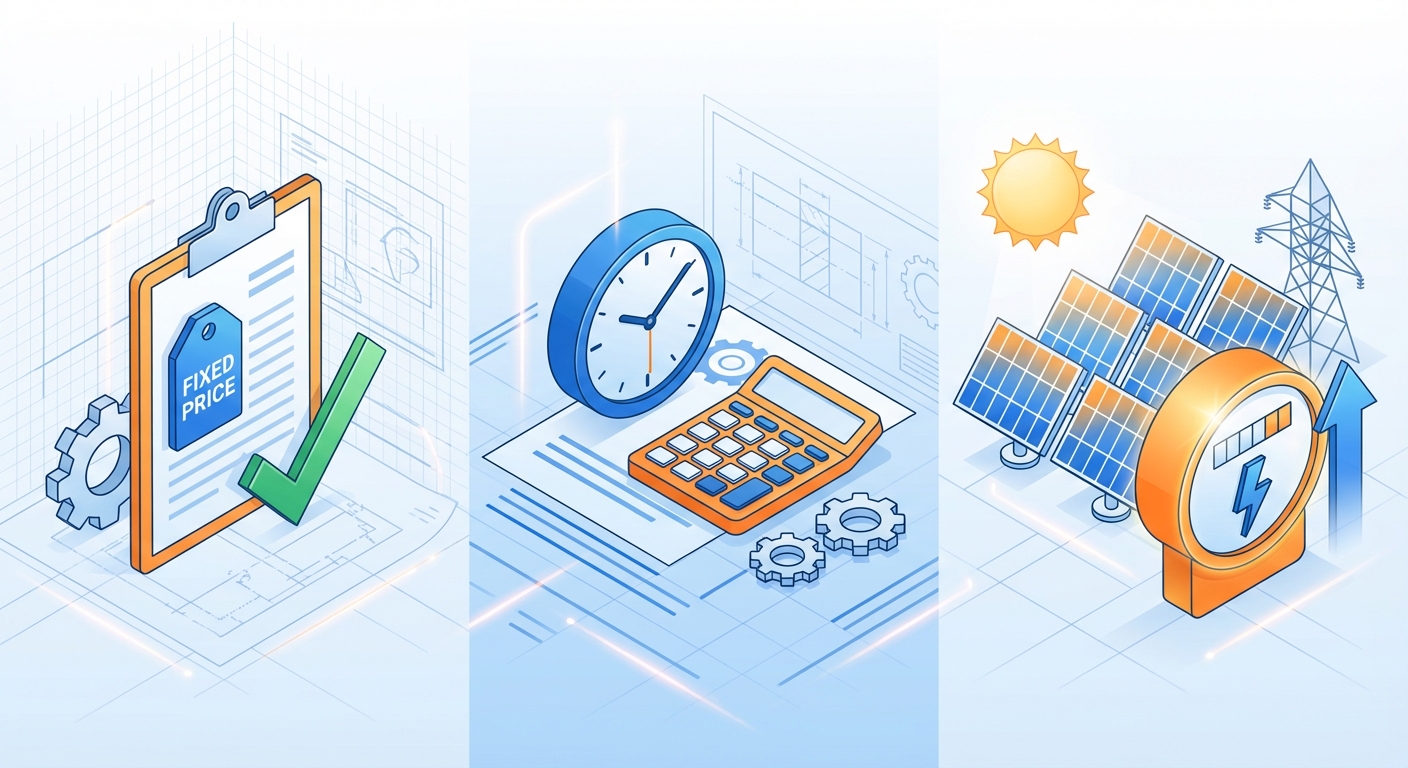
Understanding Solar Design Pricing Models in India’s Growing Market
Solar design pricing has evolved considerably as India’s solar industry has matured. In 2026, professional engineering design services represent approximately 2-5% of total project costs for most solar installations, but this relatively small percentage has an outsized impact on project success. Poor design choices can lead to underperforming systems, permit rejections, structural failures, or costly rework during construction.
The three primary design pricing models emerged to serve different market needs. Fixed-price contracts provide budget certainty for well-defined projects. Hourly billing offers flexibility for complex or evolving engineering challenges. Per-MW rates deliver scalable, transparent pricing for large-scale installations where capacity is the primary cost driver.
Understanding design pricing becomes especially important when you consider that design quality directly affects energy generation, structural integrity, and long-term system performance. A comprehensive solar feasibility study conducted during the early design phase can prevent costly mistakes downstream, but the pricing model you choose determines how these services are structured and billed.
For EPCs managing diverse project portfolios across India, from rooftop solar installations in Mumbai to utility-scale ground mount projects in Rajasthan, selecting the appropriate design pricing model for each project type is essential for maintaining competitive advantage while ensuring design quality.
Fixed-Price Contract Model: Predictable Budgeting for Solar Projects
Fixed-price contracts represent the most straightforward design pricing approach. Under this model, the engineering service provider quotes a single, predetermined price for delivering a defined scope of work. Whether the design takes 40 hours or 80 hours to complete, the EPC pays the agreed amount.
How Fixed-Price Design Contracts Work
In a typical fixed-price arrangement for solar design services, the scope is clearly defined upfront. For example, a 50 kW commercial rooftop project might include preliminary 3D design, detailed engineering drawings, structural calculations, electrical single-line diagrams, and permit-ready documentation for a fixed fee. The design partner assumes the risk of scope completion within the quoted price.
This model works best when project requirements are well-understood and unlikely to change. Residential rooftop solar projects, standardized commercial installations, and repeat project types with similar characteristics are ideal candidates for fixed-price design contracts.
Advantages of Fixed-Price Design Pricing
Budget certainty stands as the primary advantage. EPCs can accurately forecast design costs when preparing client proposals, eliminating the risk of cost overruns during the design phase. This predictability simplifies financial planning and improves cash flow management.
Simplified procurement is another benefit. With a single price point, comparing proposals from different design partners becomes straightforward. You can evaluate providers based on deliverables, timeline, and total cost without complex hourly rate calculations.
Risk transfer to the design partner protects EPCs from inefficiencies. If the design takes longer than expected due to the provider’s learning curve or internal challenges, that’s not your problem. The fixed price holds regardless of the time invested.
Disadvantages and Limitations
Fixed-price contracts offer limited flexibility for scope changes. If your client requests modifications mid-project or site conditions reveal unexpected challenges, change orders typically come with premium pricing. Design partners protect themselves from scope creep by charging higher rates for additions.
You may also pay a risk premium embedded in the quote. Since the design partner assumes completion risk, they often build contingency into their pricing. For straightforward projects, you might pay more than the actual work warrants.
Scope definition disputes can arise when deliverables aren’t precisely specified. What constitutes “complete” structural engineering? How many revision rounds are included? Ambiguity in the contract leads to friction and potential additional charges.
Hidden Costs in Fixed-Price Design Contracts
Watch for revision limits in your contract. Many fixed-price agreements include two or three revision rounds, with additional iterations billed separately at hourly rates that may exceed the original per-hour equivalent.
Expedited delivery fees can add 20-40% to the base price if your project timeline accelerates. What seemed like a competitive fixed price becomes expensive when you need faster turnaround.
Excluded services represent another hidden cost. Site surveys, feasibility studies, geotechnical investigations, and specialized structural engineering for challenging sites are often separate line items, not included in the base design pricing.
Best Use Cases for Fixed-Price Design Pricing
Fixed-price contracts work exceptionally well for residential rooftop solar projects with standard specifications. A 5 kW residential system on a typical pitched roof follows predictable design patterns, making fixed pricing efficient for both parties.
Commercial rooftop projects with straightforward structural conditions also benefit from fixed pricing. A 100 kW installation on a reinforced concrete flat roof with good access and no shading complications fits the fixed-price model perfectly.
Repeat project types where you’re working with the same design partner on similar installations allow for competitive fixed pricing based on established workflows and mutual understanding of requirements.
Hourly Billing Model: Flexibility for Complex Engineering Projects
Hourly billing charges for actual time spent on design and engineering work, typically with different rates for various expertise levels. Senior structural engineers command higher hourly rates than CAD technicians, and the final invoice reflects the actual hours invested by each team member.
How Hourly Design Billing Works
Under hourly billing, the design partner tracks time spent on your project and invoices based on agreed hourly rates. A typical rate structure might include senior engineers at ₹3,000-5,000 per hour, mid-level engineers at ₹1,500-2,500 per hour, and design technicians at ₹800-1,200 per hour. The final design pricing depends on project complexity and the team composition required.
Most hourly arrangements include regular time tracking reports and estimated hour ranges to provide some cost predictability. However, the final bill can vary significantly from initial estimates if the project proves more complex than anticipated.
Advantages of Hourly Billing
Maximum flexibility for evolving project requirements makes hourly billing ideal when scope isn’t fully defined. As your understanding of site conditions improves or client requirements change, the design can adapt without renegotiating contracts.
Pay only for actual work performed means you’re not subsidizing risk premiums or contingencies built into fixed prices. For straightforward projects that complete quickly, hourly billing can deliver significant savings compared to fixed-price quotes that include buffer.
Suitable for specialized engineering challenges where the solution path isn’t clear upfront. Complex structural engineering for challenging sites, custom mounting solutions, or innovative design approaches benefit from the exploratory nature of hourly billing.
Disadvantages and Risks
Unpredictable final costs create budgeting challenges. What starts as an estimated 60-hour project might expand to 90 hours if complications arise, impacting your project margins and client relationships.
Requires close monitoring to prevent inefficiencies. Without oversight, hourly billing can incentivize slower work or unnecessary perfectionism. You need project management bandwidth to review time reports and ensure reasonable progress.
Potential for scope ambiguity can lead to billing disputes. When is the design “complete”? How much iteration is reasonable? Without clear deliverable definitions, hourly projects can drift.
Hidden Costs in Hourly Billing
Communication overhead gets billed to your project. Meetings, email exchanges, clarification calls, and coordination time all appear on the invoice. What seemed like a quick question becomes a billable half-hour.
Project management time from the design partner’s side is typically billed hourly. The project manager coordinating your design work charges their time to your project, adding to the total cost.
Learning curve charges can occur when the design partner encounters unfamiliar challenges. You’re essentially paying for their education on your project, which feels unfair but is inherent to the hourly model.
Best Use Cases for Hourly Billing
Feasibility studies and site assessments work well on hourly billing since the investigation scope depends on what you discover. A comprehensive feasibility study might reveal issues requiring deeper analysis, making fixed pricing impractical.
Custom engineering solutions for unique sites or innovative mounting systems benefit from hourly flexibility. When you’re pushing technical boundaries or working with unusual structural conditions, hourly billing accommodates the exploratory process.
Projects with uncertain scope where site conditions, regulatory requirements, or client preferences remain fluid during the design phase are better served by hourly billing than trying to define fixed scope prematurely.
Per-MW Rate Model: Scalable Design Pricing for Utility-Scale Projects
Per-MW rate design pricing charges based on the project’s installed capacity, typically expressed as a cost per megawatt. This model dominates utility-scale solar projects and large commercial installations where capacity is the primary project characteristic driving design complexity and effort.
How Per-MW Design Pricing Works
Under per-MW pricing, a design partner might quote ₹50,000-₹150,000 per MW for complete detailed engineering design services. A 10 MW ground mount project would therefore cost ₹5-15 lakhs for comprehensive design deliverables including layout optimization, electrical design, structural engineering, and construction documentation.
The per-MW rate typically includes a defined scope of deliverables standardized across projects of similar type. This creates transparency and allows for easy benchmarking against industry standards and competitor pricing.
Advantages of Per-MW Rate Pricing
Scales naturally with project size, making it intuitive for EPCs to budget design costs as a percentage of total project value. Larger projects benefit from economies of scale, while smaller projects pay proportionally less.
Industry-standard benchmarking becomes possible when everyone uses per-MW rates. You can quickly assess whether a design pricing proposal is competitive by comparing per-MW rates across multiple providers and against industry averages.
Transparent and predictable pricing simplifies financial modeling. Once you know the per-MW rate and project capacity, design costs are straightforward to calculate and include in client proposals.
Aligns incentives between EPC and design partner. Both parties benefit from optimizing system capacity within site constraints, as higher capacity means more revenue for the design partner and better project economics for the EPC.
Disadvantages and Limitations
May not account for site complexity adequately. A 5 MW project on flat, unobstructed land requires far less design effort than a 5 MW installation on hilly terrain with multiple elevation changes, yet the per-MW rate might be identical.
Can penalize smaller projects where fixed overhead costs don’t scale linearly. A 1 MW project might require nearly as much project setup, coordination, and documentation as a 2 MW project, but per-MW pricing charges half as much.
Scope definition still matters. What’s included in the per-MW rate varies significantly between providers. Some include comprehensive PMC services and structural engineering, while others cover only basic electrical and layout design.
Hidden Costs in Per-MW Rate Pricing
Site complexity multipliers can increase the base per-MW rate by 25-50% for challenging sites. Steep slopes, poor soil conditions, difficult access, or complex shading scenarios trigger additional charges.
Structural engineering add-ons for specialized mounting systems, elevated structures, or seismic design requirements often come as separate line items beyond the base per-MW rate.
PMC services and construction support may be excluded from the base design pricing. Project management consultancy during construction, site supervision, and commissioning support typically require additional fees.
Revision and optimization iterations beyond the initial design submission might be billed separately, especially if client-driven changes require significant rework of completed designs.
Best Use Cases for Per-MW Rate Pricing
Ground mount utility-scale projects are the natural fit for per-MW pricing. These projects share similar design patterns, and capacity is the dominant factor determining design effort. A ground mount project in India benefits from standardized per-MW pricing that reflects industry norms.
Large commercial and industrial installations above 500 kW typically use per-MW pricing. At this scale, the design effort correlates reasonably well with capacity, making per-MW rates more accurate than fixed pricing.
Portfolio projects where an EPC is developing multiple similar installations benefit from per-MW pricing consistency. You can negotiate volume discounts while maintaining the same rate structure across all projects.
Comparing Design Pricing Models by Project Type
Selecting the optimal design pricing model depends heavily on project characteristics. Different solar installation types have distinct requirements that favor particular pricing approaches.

Residential Rooftop Solar: Fixed-Price Delivers Best Value
For residential rooftop solar installations ranging from 3-10 kW, fixed-price contracts typically offer the best value and simplicity. These projects follow predictable design patterns with limited variation. A fixed price of ₹8,000-₹15,000 for complete permit design, structural calculations, and electrical drawings provides budget certainty without the overhead of tracking hours or calculating per-MW rates for such small capacities.
Hourly billing adds unnecessary complexity for straightforward residential projects, while per-MW rates become impractical at small scales. A 5 kW residential system would cost only ₹250-750 at typical per-MW rates, which doesn’t cover the fixed overhead of project setup and coordination.
Commercial and Industrial Projects: Balancing Cost and Complexity
Commercial rooftop and ground mount projects from 50 kW to 1 MW occupy a middle ground where multiple pricing models can work depending on project specifics.
For straightforward commercial rooftops with standard structural conditions, fixed-price contracts in the ₹40,000-₹150,000 range provide simplicity and predictability. The scope is clear, and design patterns are well-established.
For complex commercial sites with challenging structural conditions, shading issues, or multiple roof types, hourly billing offers the flexibility to address unforeseen complications without constant change order negotiations.
As projects approach 1 MW capacity, per-MW pricing becomes increasingly attractive. A rate of ₹80,000-₹120,000 per MW provides transparent pricing that scales appropriately with project size.
Utility-Scale Ground Mount: Per-MW Rates Dominate
For utility-scale projects above 1 MW, per-MW rates are the industry standard and deliver the most appropriate pricing structure. Design effort scales reasonably linearly with capacity at this scale, and per-MW pricing provides the transparency and benchmarking that large projects require.
Typical per-MW rates for utility-scale ground mount projects in India range from ₹50,000-₹150,000 per MW depending on scope comprehensiveness, site complexity, and service provider expertise. A 10 MW project might command ₹80,000 per MW (₹8 lakhs total) for detailed engineering design, while a 50 MW project could negotiate ₹60,000 per MW (₹30 lakhs total) with volume discounts.
Fixed-price contracts become impractical at utility scale due to the significant variation in site conditions and requirements. Hourly billing lacks the transparency and predictability that large project financing requires.
Mixed Portfolios: Combining Pricing Models Strategically
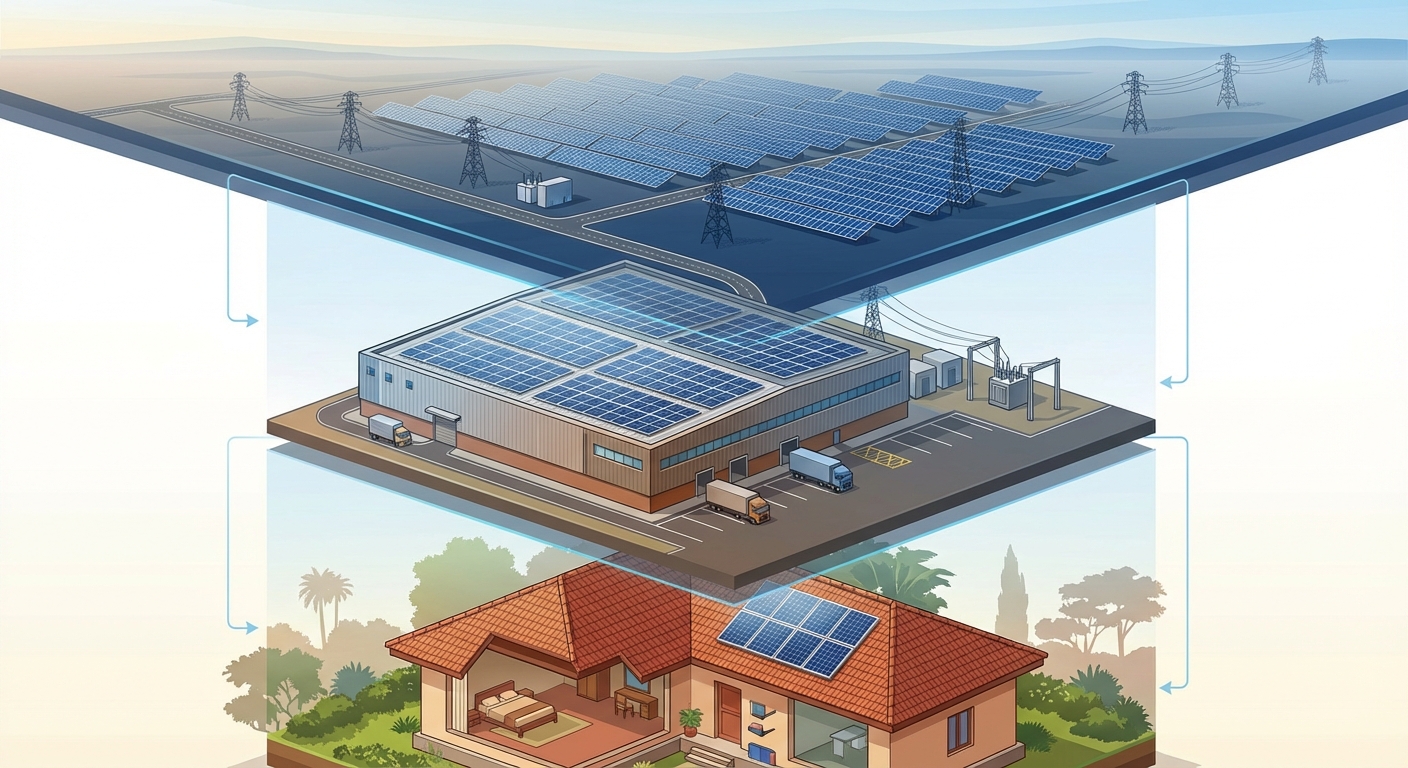
EPCs managing diverse project portfolios should use different pricing models for different project types rather than forcing a single approach across all work. Negotiate fixed-price agreements for your residential and small commercial pipeline, per-MW rates for utility-scale projects, and reserve hourly billing for feasibility studies and complex custom engineering challenges.
This strategic approach optimizes design pricing across your portfolio while maintaining appropriate risk allocation and cost predictability for each project category.
Hidden Costs in Solar Design Pricing: What EPCs Must Watch For
Regardless of which design pricing model you choose, several hidden costs frequently catch EPCs off guard. Understanding these potential additional charges helps you evaluate true total cost and negotiate more comprehensive agreements.
Revision and Iteration Charges
Most design contracts include a limited number of revision rounds, typically two or three iterations. Additional revisions triggered by client changes, evolving requirements, or EPC feedback often incur charges of ₹5,000-₹25,000 per revision round depending on the extent of changes required.
Clarify upfront what constitutes a “revision” versus normal design refinement. Some providers count any change request as a revision, while others distinguish between minor adjustments and substantial rework.
Site Survey and Feasibility Study Costs
Comprehensive site surveys, land feasibility assessments, and geotechnical investigations are frequently excluded from base design pricing. These critical early-phase services might add ₹20,000-₹100,000 to project costs depending on site size and complexity.
For projects requiring detailed site assessment, ensure your design pricing proposal clearly specifies whether site survey costs are included or billed separately. Some design partners bundle these services, while others treat them as distinct offerings.
Structural Engineering and Civil Design
Specialized structural engineering for challenging sites, custom mounting solutions, or seismic design requirements often comes as a separate line item beyond basic design pricing. Structural calculations, foundation design, and civil engineering drawings might add 20-40% to base design costs.
This is particularly relevant for ground mount projects on difficult terrain or rooftop installations requiring structural reinforcement. Clarify whether structural engineering is included in your quoted design pricing or requires additional fees.
Permit Design and Compliance Documentation
While basic permit-ready drawings are typically included in design pricing, specialized compliance documentation for specific authorities, detailed permit application support, or multiple jurisdiction submissions might incur additional charges.
If your project requires permits from multiple authorities or involves complex regulatory compliance, confirm that all necessary documentation is included in the base design pricing.
Rush Delivery and Expedited Timeline Premiums
Accelerated project timelines often trigger premium pricing of 20-50% above standard rates. If you need design deliverables in two weeks instead of the standard four weeks, expect to pay significantly more.
Understanding standard design timelines and their cost implications helps you plan project schedules to avoid unnecessary rush charges while meeting client commitments.
Software Licensing and Tool Access Fees
Some design partners pass through costs for specialized design software, simulation tools, or database access required for your project. These charges might appear as line items for PVsyst modeling, structural analysis software, or satellite imagery access.
While these costs are typically modest (₹5,000-₹15,000), they can add up across multiple projects. Clarify whether software costs are included in the base design pricing or billed separately.
Negotiating Solar Design Pricing: Strategies for EPCs to Maximize Value
Effective negotiation with design partners can significantly reduce costs while maintaining quality. Several proven strategies help EPCs secure better design pricing terms.
Volume Discounts and Portfolio Pricing
If you have a pipeline of multiple projects, negotiate volume-based pricing that rewards the design partner with consistent work in exchange for reduced per-project rates. A commitment to 10 projects over six months might secure 15-25% discounts compared to one-off project pricing.
Portfolio pricing works particularly well with per-MW rates. A design partner might offer ₹80,000 per MW for a single 5 MW project but reduce that to ₹65,000 per MW if you commit to 50 MW of design work over the year.
Bundling Services for Better Rates
Combining multiple services into a single agreement often yields better pricing than purchasing each service separately. Bundling preliminary design, detailed engineering, structural engineering, and PMC services together can reduce total costs by 10-20% compared to separate contracts.
Design partners prefer comprehensive engagements that provide more revenue and deeper project involvement. Use this preference to negotiate better bundled rates that benefit both parties.
Payment Terms and Milestone-Based Pricing
Flexible payment terms can sometimes be traded for better pricing. Offering faster payment (15 days instead of 45 days) or upfront deposits might secure 5-10% discounts from design partners managing cash flow.
Milestone-based payment structures tied to deliverable completion protect both parties. Typical milestones include 30% at project kickoff, 40% at preliminary design approval, and 30% at final deliverable submission. This structure ensures quality while managing risk.
Long-Term Partnership Agreements
Establishing a preferred design partner relationship with annual agreements or multi-year commitments delivers better pricing than project-by-project negotiations. Design partners invest in understanding your standards, preferences, and processes, leading to efficiency gains that translate to cost savings.
Long-term partnerships also reduce procurement overhead, improve communication, and create alignment on quality standards. The relationship value often exceeds the direct cost savings.
What to Include in Your RFP for Accurate Quotes
To receive comparable, accurate design pricing proposals, your request for proposal should include:
- Detailed project specifications: capacity, location, mounting type, structural conditions
- Complete scope of deliverables: specific drawings, calculations, and documents required
- Timeline requirements: desired delivery schedule and any critical milestones
- Revision policy: number of included iterations and process for changes
- Site information: available site data, survey status, known challenges
- Compliance requirements: specific permits, authorities, or standards to meet
- Preferred pricing model: fixed-price, hourly, or per-MW rate structure
The more specific your RFP, the more accurate and comparable the proposals you receive. Vague requirements lead to widely varying quotes that are difficult to evaluate fairly.
Red Flags in Design Pricing Proposals
Watch for warning signs that indicate potential problems:
- Significantly lower pricing than competitors without clear explanation suggests scope gaps or quality compromises
- Vague deliverable descriptions that don’t specify exactly what you’ll receive create opportunities for disputes
- No revision policy or unlimited revisions (which is unrealistic) indicates unclear expectations
- Lack of timeline commitments suggests the provider may not prioritize your project
- Hidden fee structures with numerous potential add-ons that make true cost comparison impossible
A professional design pricing proposal should be transparent, detailed, and realistic about deliverables, timeline, and total cost.
Real-World Design Pricing Scenarios: Cost Analysis for Different Project Scales
Understanding typical design pricing across different project scales helps EPCs benchmark proposals and budget accurately. These scenarios reflect 2026 market rates in India for comprehensive design services.
5 kW Residential Rooftop: Typical Design Cost Breakdown
A standard 5 kW residential rooftop installation typically incurs design costs of ₹10,000-₹15,000 under a fixed-price contract. This includes preliminary 3D design, electrical single-line diagram, structural calculations for roof mounting, and permit-ready drawings.
Design costs represent approximately 1.5-2% of the total ₹250,000-₹300,000 project cost. The fixed-price model works well here because scope is predictable and standardized.
100 kW Commercial Rooftop: Comparing Pricing Models
A 100 kW commercial rooftop project might be priced three ways:
- Fixed-price: ₹75,000-₹120,000 for complete design deliverables
- Hourly billing: 60-90 hours at blended rate of ₹1,500-₹2,000/hour = ₹90,000-₹180,000
- Per-MW rate: ₹100,000 per MW × 0.1 MW = ₹10,000 (too low for practical use at this scale)
For this project size, fixed-price contracts typically deliver the best value and predictability. Hourly billing might be appropriate if site conditions are uncertain or structural challenges are anticipated.
1 MW Ground Mount Project: Per-MW Rate Analysis
A 1 MW ground mount project using per-MW pricing at ₹100,000 per MW yields ₹100,000 total design cost. This should include layout optimization, electrical design, structural engineering for mounting systems, and construction documentation.
Design costs represent approximately 0.2-0.3% of the ₹40-50 million total project cost. At this scale, per-MW pricing becomes practical and provides appropriate cost allocation.
10 MW Utility-Scale Project: Economies of Scale
A 10 MW utility-scale ground mount project might be priced at ₹70,000-₹90,000 per MW, yielding ₹7-9 lakhs total design cost. The reduced per-MW rate reflects economies of scale in design effort.
Comprehensive design services at this scale should include detailed engineering design, PMC services, structural engineering, geotechnical recommendations, and construction support. Design costs represent approximately 0.15-0.2% of the ₹400-500 million total project cost.
How Design Costs Impact Overall Project Economics
While design costs represent a small percentage of total project investment, their impact on project economics is substantial. Quality design improves energy generation by 3-8% through optimal layout and component selection, reduces construction costs by preventing rework and errors, and minimizes long-term maintenance issues.
An additional ₹50,000 invested in comprehensive design for a 1 MW project can easily generate ₹500,000 in additional lifetime value through improved performance and reduced problems. Design pricing should be evaluated based on value delivered, not just lowest cost.
Choosing the Right Design Pricing Model for Your Solar EPC Business
Selecting the optimal design pricing model requires matching pricing structure to project characteristics, your business model, and risk tolerance. No single approach works for all situations.
Decision Framework: Matching Pricing Model to Project Characteristics
Use this framework to guide your design pricing model selection:
Choose fixed-price contracts when:
- Project scope is well-defined and unlikely to change
- You need budget certainty for client proposals
- Project follows standard design patterns (residential, simple commercial)
- You want to minimize procurement and management overhead
Choose hourly billing when:
- Project scope is uncertain or likely to evolve
- Site conditions are unknown and may present challenges
- You need custom engineering solutions or innovative approaches
- You have project management bandwidth to monitor progress
Choose per-MW rates when:
- Project capacity exceeds 500 kW
- You’re developing utility-scale ground mount installations
- You want transparent, benchmarkable pricing
- You have multiple similar projects for volume pricing
Questions to Ask Potential Design Partners
When evaluating design partners and their pricing proposals, ask:
- What exactly is included in your quoted design pricing? What’s excluded?
- How many revision rounds are included, and what do additional revisions cost?
- What is your standard delivery timeline, and what are rush delivery charges?
- Are site surveys, feasibility studies, and structural engineering included or separate?
- Do you offer volume discounts for multiple projects or long-term commitments?
- What payment terms and milestone structure do you propose?
- Can you provide references from similar projects with comparable pricing?
- How do you handle scope changes or unforeseen complications?
These questions reveal the true total cost and help you compare proposals accurately across different pricing models and providers.
Evaluating Total Cost of Ownership Beyond Initial Design Fees
The lowest design pricing doesn’t always deliver the best value. Consider total cost of ownership including:
- Rework costs from design errors or inadequate documentation
- Construction delays caused by incomplete or unclear designs
- Permit rejections requiring redesign and resubmission
- Performance shortfalls from suboptimal layout or component selection
- Coordination time required to manage the design partner relationship
A design partner charging 20% more but delivering higher quality, faster turnaround, and better communication often provides superior value compared to the lowest-cost option.
Building Long-Term Relationships for Better Pricing
The most successful EPCs develop strategic partnerships with design service providers rather than treating design as a transactional commodity. Long-term relationships deliver:
- Better pricing through volume commitments and partnership agreements
- Improved quality through mutual understanding of standards and expectations
- Faster turnaround as the design partner learns your processes and preferences
- Priority treatment during busy periods when capacity is constrained
- Collaborative problem-solving rather than adversarial contract enforcement
Investing in design partner relationships pays dividends across your entire project portfolio.
Taking the Next Step: Getting Customized Design Pricing Proposals
Understanding design pricing models is the first step. The next step is obtaining customized proposals for your specific project portfolio that allow you to compare options and select the best design partner for your needs.
When you’re ready to explore design pricing options for your upcoming solar projects, having detailed conversations with experienced design service providers helps you understand how different pricing models apply to your specific situation. Whether you’re developing residential rooftop installations, commercial projects, or utility-scale ground mount systems across India, the right design pricing structure can significantly impact your project profitability and success.
Heaven Designs has delivered comprehensive solar engineering design services for 752+ EPC clients across 628+ MW of projects, with expertise in all three pricing models tailored to different project types and scales. Our team of 50+ engineers understands the nuances of design pricing and works with EPCs to structure agreements that provide value, transparency, and quality. Get a Quick Proposal Now! to discuss your project portfolio and receive customized design pricing options that match your specific requirements.
For immediate assistance with design pricing questions or to discuss your upcoming projects, reach out directly at +91 90811 00297 or email service@heavendesigns.in. Our team is ready to help you navigate design pricing models and select the approach that maximizes value for your solar EPC business in 2026 and beyond.
This blog post was written using thestacc.com