

Three weeks before commissioning, a 1.5 MW rooftop project in Ahmedabad stalled. The structural drawings had been approved, procurement was complete, and the installation crew was on standby. Then the DISCOM inspection flagged a single-line diagram that didn’t match the state’s updated interconnection requirements. The result: a six-week delay, a full documentation rework, and a client relationship that never fully recovered.
That project didn’t fail because of bad intentions. It failed because of design errors that slipped through without a proper review process. For solar EPC companies in India, this scenario plays out more often than anyone likes to admit. The solar market is growing fast, timelines are tight, and the pressure to move quickly creates the perfect conditions for costly mistakes.
This guide identifies 20 of the most common and damaging design errors that EPC companies encounter, covering everything from engineering calculations and structural design to documentation, site surveys, and regulatory compliance. More importantly, it gives you the quality control checkpoints and selection criteria you need to stop these errors before they become project problems.
Why Solar Design Errors Cost EPC Companies More Than They Realize
The direct cost of a design error is easy to see: a redesign fee, a delayed permit, an extra site visit. The indirect costs are far harder to quantify. A project that underperforms because of a flawed energy yield estimate damages your reputation with the client. A structural failure during installation creates liability exposure. A permit rejection that pushes commissioning past the client’s deadline can trigger penalty clauses.
In India’s solar market, the stakes are especially high. State-specific DISCOM requirements vary significantly. Wind and seismic zones differ across regions. Rooftop load-bearing standards are inconsistently documented. These variables mean that a design approach that worked perfectly in Maharashtra may produce serious design errors when applied to a project in Tamil Nadu or Rajasthan.
According to industry data, rework caused by design errors accounts for a significant share of cost overruns in solar EPC projects. When you factor in the cost of redesign, procurement delays, extended site supervision, and client management time, a single avoidable error can consume the entire engineering margin on a project. Understanding where these errors originate is the first step toward eliminating them.
Engineering Calculation Errors: The Most Expensive Design Mistakes
Calculation errors sit at the core of most costly design errors in solar projects. They are often invisible until the system is commissioned and underperforms, by which point the EPC company is already fielding complaints.
Error 1: Incorrect Shading Analysis
Shading analysis is one of the most technically demanding parts of solar design. When a solar engineer uses outdated satellite data, ignores nearby structures, or applies generic shading factors instead of site-specific modeling, the energy yield estimate becomes unreliable. Systems designed with poor shading analysis routinely underperform by 8 to 15 percent compared to projections.
Error 2: Wrong Tilt and Azimuth Angle Calculations
Optimal tilt and azimuth angles vary by latitude, roof orientation, and local climate. Using a standard tilt angle without running location-specific simulations is a common shortcut that reduces annual energy generation. For a 500 kW system, even a 5-degree tilt error can translate into measurable annual generation losses.
Error 3: Inaccurate Energy Yield Estimates
Energy yield simulations in tools like PVsyst or HelioScope are only as accurate as the inputs. Using incorrect irradiance data, wrong performance ratio assumptions, or outdated module degradation curves produces estimates that don’t match real-world output. This is one of the most common design errors that damages EPC credibility with clients. For a deeper look at how design quality affects project budgets, see our guide on Solar Design Timeline & Cost: How Project Duration Impacts Budget.
Error 4: Inverter Sizing Mistakes
Undersized inverters clip DC output during peak generation hours, reducing annual yield. Oversized inverters add unnecessary capital cost. Both are avoidable with proper DC-to-AC ratio calculations, yet inverter sizing errors remain among the most frequently flagged issues in design reviews.
Error 5: String Sizing Errors
String sizing must account for minimum and maximum operating temperatures, module Voc and Vmp tolerances, and inverter MPPT voltage windows. Errors here cause clipping losses, inverter faults, or safety hazards. A qualified solar engineer should verify string sizing calculations independently before the design is finalized.
Structural and Civil Design Errors That Fail on Site
Structural design errors are particularly dangerous because they often go undetected until installation is underway or, worse, until a weather event exposes the weakness. Structural engineering India expertise is not optional for solar projects; it is a fundamental requirement.
Error 6: Ignoring Location-Specific Wind and Snow Load Data
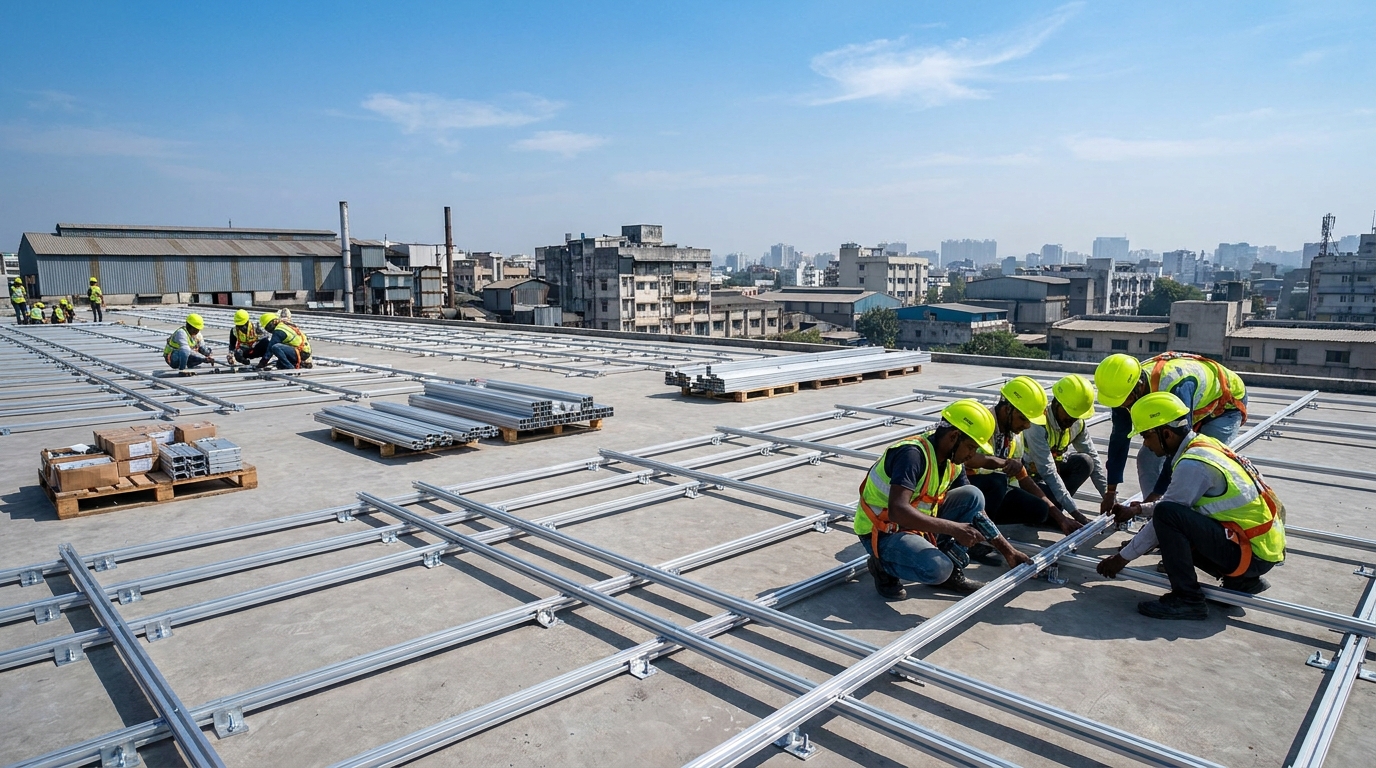
India’s wind zones range from Zone I to Zone V, with dramatically different design wind speeds. A mounting structure designed for a low-wind zone in central India will be dangerously inadequate for a coastal project in Andhra Pradesh or Odisha. Using generic wind load assumptions instead of IS 875 Part 3 compliant calculations is a structural design error that can result in catastrophic system failure.
Error 7: Generic Mounting Calculations Not Matched to Soil Conditions
Ground-mount projects require foundation designs based on actual soil bearing capacity data. When a solar engineer applies standard pile depths without a geotechnical assessment, the result can be foundations that shift, settle, or fail under load. This is especially common in projects where the design partner has not conducted or reviewed a proper site survey India.
Error 8: Rooftop Load-Bearing Capacity Not Verified
Rooftop solar adds dead load, wind uplift forces, and maintenance live loads to an existing structure. Designing a rooftop system without a structural assessment of the existing building is one of the most serious design errors an EPC can make. In older industrial buildings across India, roof structures are frequently found to be inadequate for the intended solar load once a proper assessment is conducted.
Error 9: Incorrect Pile Depth or Foundation Design
For ground-mount projects, pile depth must account for soil type, frost depth (in northern states), and lateral wind loads. Shallow piles in expansive clay soils or sandy terrain are a recurring structural design error that leads to racking misalignment and module damage after the first monsoon season.
Error 10: Missing Drainage Planning in Civil Design
Water pooling under ground-mount arrays accelerates corrosion, creates maintenance hazards, and can undermine foundations over time. Civil design that ignores site drainage is a common oversight, particularly in flat terrain projects across Gujarat and Rajasthan. Comprehensive solar design India must include drainage planning as a standard deliverable.
Documentation and Drawing Errors That Trigger Permit Rejections
Even technically sound designs can fail at the permit stage if the documentation package contains errors. Permit design rejections are among the most frustrating and avoidable project delays an EPC company faces.
Error 11: Incomplete Single-Line Diagrams
Single-line diagrams (SLDs) must show every protection device, metering point, disconnect switch, and interconnection component required by the relevant DISCOM. Missing a single mandatory element, such as an anti-islanding relay or a net metering connection point, results in immediate rejection. This is one of the most common design errors in permit submissions across Indian states.
Error 12: Drawings Not Compliant With State DISCOM Requirements
Each state’s DISCOM has specific drawing format requirements, title block standards, and technical notation conventions. A design package prepared for a Maharashtra DISCOM submission will not meet the requirements of Karnataka or Uttar Pradesh without significant revision. EPCs working across multiple states must ensure their design partner understands and applies state-specific standards.
Error 13: Missing or Incorrect Equipment Datasheets
Permit packages require approved equipment datasheets for modules, inverters, and protection devices. Submitting outdated datasheets, using equipment not on the DISCOM’s approved vendor list, or including datasheets that don’t match the specified equipment are all design errors that trigger rejection and delay.
Error 14: Version Control Issues in Drawing Sets
When design revisions are not properly tracked, drawing sets become inconsistent. An SLD from revision 3 submitted alongside a layout drawing from revision 1 creates contradictions that reviewers will flag. Proper version control is a basic quality management requirement that many smaller design teams fail to implement consistently.
Error 15: Missing Safety and Compliance Notes
Permit drawings must include mandatory safety notes, installation standards references (such as IS 16169 or IEC 62548), and compliance declarations. Omitting these notes is a straightforward design error that signals to reviewers that the design team lacks regulatory awareness. For a comprehensive look at how feasibility and compliance connect, see our Solar Feasibility Study in India: Complete Process Guide for EPC Companies in 2026.
Site Survey and Feasibility Errors That Undermine the Entire Project
Design errors don’t always originate in the design phase. Many of the most damaging mistakes are rooted in poor site data collected during the survey and feasibility stages. Garbage in, garbage out applies directly to solar design India.
Error 16: Relying on Satellite Imagery Instead of a Physical Site Survey
Satellite imagery is a useful starting point, but it cannot replace a physical site survey India. Roof conditions, existing penetrations, structural anomalies, shading obstructions not visible from above, and grid connection points all require on-site verification. Designs built on satellite data alone routinely require significant revision once the installation team arrives on site.
Error 17: Failing to Account for Future Shading Obstructions
A site that is shade-free today may not be shade-free in three years. Nearby construction, tree growth, and new rooftop equipment are all potential future shading sources. A thorough feasibility study India should assess not just current shading but likely future obstructions over the system’s 25-year life. Ignoring this is a design error that clients will eventually notice.
Error 18: Incorrect Area Measurement Leading to Wrong System Sizing
Overestimating available roof or land area leads to designs that don’t fit the actual site. Underestimating it means leaving generation capacity on the table. Accurate area measurement, accounting for setbacks, equipment clearances, and unusable zones, is a fundamental requirement of any reliable site survey India.
Error 19: Ignoring Grid Connectivity Constraints
A system sized at 500 kW may not be approvable at the nearest grid connection point if the local feeder is already at capacity. Failing to assess grid connectivity constraints during the feasibility phase is a design error that can force costly system resizing or expensive grid upgrades after the design is complete. For ground-mount projects specifically, our Ground Mount India: Complete Regional Design Guide 2026 covers regional grid considerations in detail.
Compliance and Regulatory Errors That Stall Projects
India’s solar regulatory landscape is complex and evolving. MNRE guidelines, BIS standards, state DISCOM requirements, and local building codes all intersect in a solar design package. A solar engineer who is not current with the latest regulatory requirements will produce designs that create compliance problems downstream.
Error 20: Designs Not Aligned With Current Regulations
This is the broadest and most consequential of all design errors. Regulatory non-compliance can manifest as an incorrect protection scheme, a non-compliant earthing design, a module specification that doesn’t meet BIS certification requirements, or a net metering configuration that doesn’t match the current state policy. Each of these issues requires redesign, re-submission, and additional approval time.
The challenge for EPC companies is that regulations change. A design standard that was current 18 months ago may have been superseded. Working with a design partner who actively tracks regulatory updates, particularly across multiple Indian states, is one of the most effective ways to eliminate compliance-related design errors.
How to Catch Design Errors Before They Become Project Problems
Identifying design errors early is far less expensive than discovering them during installation or at the permit stage. Every EPC company should have a structured design review process that includes the following checkpoints.

Quality Control Checkpoints for Design Review
- Calculation verification: Have a second engineer independently verify energy yield, string sizing, and inverter selection calculations before the design is finalized.
- Drawing consistency check: Confirm that all drawings in the package reference the same revision, equipment specifications, and site dimensions.
- Regulatory compliance review: Cross-check the design against the current DISCOM requirements for the specific state where the project is located.
- Structural load confirmation: Verify that wind load, dead load, and live load calculations reference the correct IS standards and location-specific data.
- Site data reconciliation: Compare design assumptions (roof area, shading, grid connection) against the actual site survey report before finalizing the design.
- Equipment datasheet validation: Confirm that all specified equipment is on the relevant DISCOM’s approved vendor list and that datasheets match the current product specifications.
Red Flags to Watch for in Design Deliverables
When reviewing deliverables from a design partner, these warning signs suggest that design errors may be present:
- Energy yield estimates that seem unusually high compared to similar projects in the same region
- Structural calculations that reference generic wind zones rather than the project’s specific location
- Single-line diagrams that look identical across multiple projects with different specifications
- Drawing title blocks with incorrect project details, suggesting copy-paste from a previous project
- No reference to the specific state DISCOM’s technical standards in the permit package
- Absence of a revision history or version control log in the drawing set
- Equipment specifications that don’t match the current product datasheets from the manufacturer
Using Design Software to Cross-Check Calculations
Leading design software India platforms like PVsyst, HelioScope, and AutoCAD Solar provide built-in validation tools that can catch many calculation-level design errors. EPCs should require their design partners to provide simulation reports as part of the standard deliverable package, not just the final output numbers. A simulation report allows your team to verify the inputs used, not just the results produced.
Choosing a Design Partner Who Delivers Error-Free Solar Design in India
The most reliable way to reduce design errors is to work with a design partner whose internal processes are built around quality control. Here is what to look for when evaluating solar design companies in India.

Team Size and Specialization
A team of 50+ engineers with dedicated specialists in electrical design, structural engineering, and permit documentation is fundamentally more capable of catching design errors than a small generalist team. Specialization matters because the technical depth required for structural engineering cost analysis, energy simulation, and regulatory compliance are genuinely different skill sets.
Documented QC Processes
Ask any prospective design partner to describe their quality control workflow. How many engineers review a design before it is delivered? What checklists do they use? How do they handle regulatory updates across different states? A design company that cannot clearly articulate its QC process is one that relies on individual engineer judgment rather than systematic error prevention.
Track Record Across Project Types and Geographies
Experience with diverse project types, rooftop, ground-mount, commercial, industrial, and across multiple Indian states, reduces the risk of location-specific or project-type-specific design errors. Ask for examples of completed projects similar to yours, and verify that the design company has experience with the specific state DISCOM requirements relevant to your project.
Revision and Error Correction Policy
Even the best design teams occasionally make mistakes. What matters is how they handle them. A reputable design partner will have a clear policy for addressing errors, including timelines for correction and accountability for rework costs. Avoid partners who are vague about their revision process or who push back on legitimate correction requests.
Why Specialized Solar Design Companies Outperform Generalists
A civil engineering firm that occasionally takes on solar projects will not have the same depth of solar-specific knowledge as a company whose entire practice is built around solar design India. The nuances of module-level power electronics, DISCOM-specific documentation requirements, and solar-specific structural loading are learned through volume and repetition. A specialized solar engineer who has completed hundreds of similar designs will catch errors that a generalist simply won’t recognize.
“The cost of a design error is never just the cost of fixing the drawing. It’s the delay, the rework, the client conversation, and the margin you’ll never recover. The only economical approach is to get the design right the first time.”
Heaven Designs Private Limited brings a team of 50+ engineers and a track record of 628+ MW of completed design work across 752+ solar EPC clients to every project. Their structured QC process, state-specific regulatory expertise, and specialization in solar design India are built specifically to eliminate the design errors described in this guide. Whether you need MW-scale detailed engineering, structural design, permit documentation, or a comprehensive feasibility study India, the team is equipped to deliver accurate, compliant, and error-free designs on schedule.
If your EPC company is dealing with design quality issues, facing permit rejections, or simply wants to reduce the risk of costly errors on your next project, the right time to act is before the next design package goes out the door. Reach out to the Heaven Designs team directly at service@heavendesigns.in or call +91 90811 00297 to discuss your project requirements. When you’re ready to eliminate design errors from your solar EPC workflow for good, Get a Quick Proposal Now! and let a specialized team of solar engineers take the risk off your plate.
This blog post was written using thestacc.com