


As India’s solar energy sector continues its exponential growth trajectory in 2026, solar EPC companies and developers face a critical strategic decision: should they invest in building an in-house project management team or partner with specialized PMC services India providers? This decision significantly impacts project costs, quality outcomes, delivery timelines, and ultimately, the bottom line of your solar business.
With MW-scale solar projects becoming increasingly complex—involving intricate engineering design, regulatory compliance, structural calculations, and multi-stakeholder coordination—the project management approach you choose can make the difference between profitable, on-time project delivery and costly delays with quality compromises. This comprehensive comparison analyzes both approaches across multiple dimensions to help you make an informed decision that aligns with your business goals and project portfolio.

Understanding PMC Services for Solar Projects in India
Project Management Consultancy (PMC) services for solar projects encompass comprehensive project oversight, engineering design coordination, quality assurance, timeline management, and stakeholder communication throughout the solar installation lifecycle. In the Indian solar context, PMC services have evolved significantly beyond basic project coordination to include specialized technical expertise in solar engineering, regulatory compliance, and performance optimization.
Professional PMC services India providers like Heaven Designs offer end-to-end project management for MW-scale solar installations, combining deep technical knowledge with proven project delivery methodologies. These services typically include:
- Detailed engineering design coordination covering electrical, civil, and structural aspects
- Site survey and feasibility study management to assess project viability
- Permit design and regulatory compliance ensuring all documentation meets local and national standards
- Quality assurance and technical review of all engineering deliverables
- Timeline and milestone tracking to keep projects on schedule
- Vendor and contractor coordination across multiple project stakeholders
- Risk identification and mitigation planning throughout project phases
The Indian solar market in 2026 has witnessed a maturation of PMC services, with specialized providers developing deep expertise in regional challenges such as varied soil conditions across states, monsoon-related construction constraints, grid connectivity complexities, and state-specific regulatory requirements. This specialization has made external PMC services increasingly attractive for solar EPCs looking to deliver consistent quality across diverse project locations.
For solar developers and EPC companies, the fundamental question becomes: can we replicate this level of specialized expertise, proven processes, and scalable resources internally, or does partnering with established PMC services deliver superior value?
The In-House Project Management Model: Structure and Requirements
Building an effective in-house project management capability for solar projects requires substantial investment in human resources, infrastructure, and organizational development. Understanding the full scope of requirements is essential before committing to this approach.
Team Composition and Roles
A functional in-house project management team for MW-scale solar projects typically requires:
- Senior Project Manager with 8-10 years of solar industry experience to oversee multiple concurrent projects
- Solar Design Engineers (2-3 professionals) specializing in electrical, civil, and structural design
- Site Survey Specialists capable of conducting comprehensive feasibility assessments
- Permit and Compliance Coordinator familiar with regulatory requirements across different Indian states
- Quality Assurance Engineer to review all technical deliverables
- CAD Technicians proficient in solar design software for creating detailed engineering drawings
- Project Coordinators for day-to-day stakeholder communication and documentation
This represents a minimum team of 7-10 professionals for an EPC company handling 50-100 MW of annual project volume. Smaller project portfolios may struggle to justify this headcount, while larger volumes may require proportionally larger teams.
Infrastructure and Technology Requirements
Beyond personnel, in-house teams require significant technology investments:
- Solar design software licenses including PVsyst, AutoCAD, Helioscope, or similar platforms (₹5-15 lakhs annually)
- Project management tools for timeline tracking, resource allocation, and collaboration
- Structural analysis software for engineering calculations and load assessments
- Site survey equipment including drones, GPS devices, and measurement tools
- Office infrastructure including workstations, high-performance computers, and collaborative spaces
Training and Development Timeline
Even when hiring experienced professionals, developing team cohesion and establishing standardized processes for solar project management typically requires 6-12 months. During this ramp-up period, project delivery may be slower and quality inconsistencies more common as the team establishes workflows and learns from initial projects.
Ongoing training is essential as solar technology, design software, and regulatory requirements evolve. Budget 5-10% of personnel costs annually for professional development to maintain competitive expertise levels.
Cost Analysis: PMC Services vs In-House Team
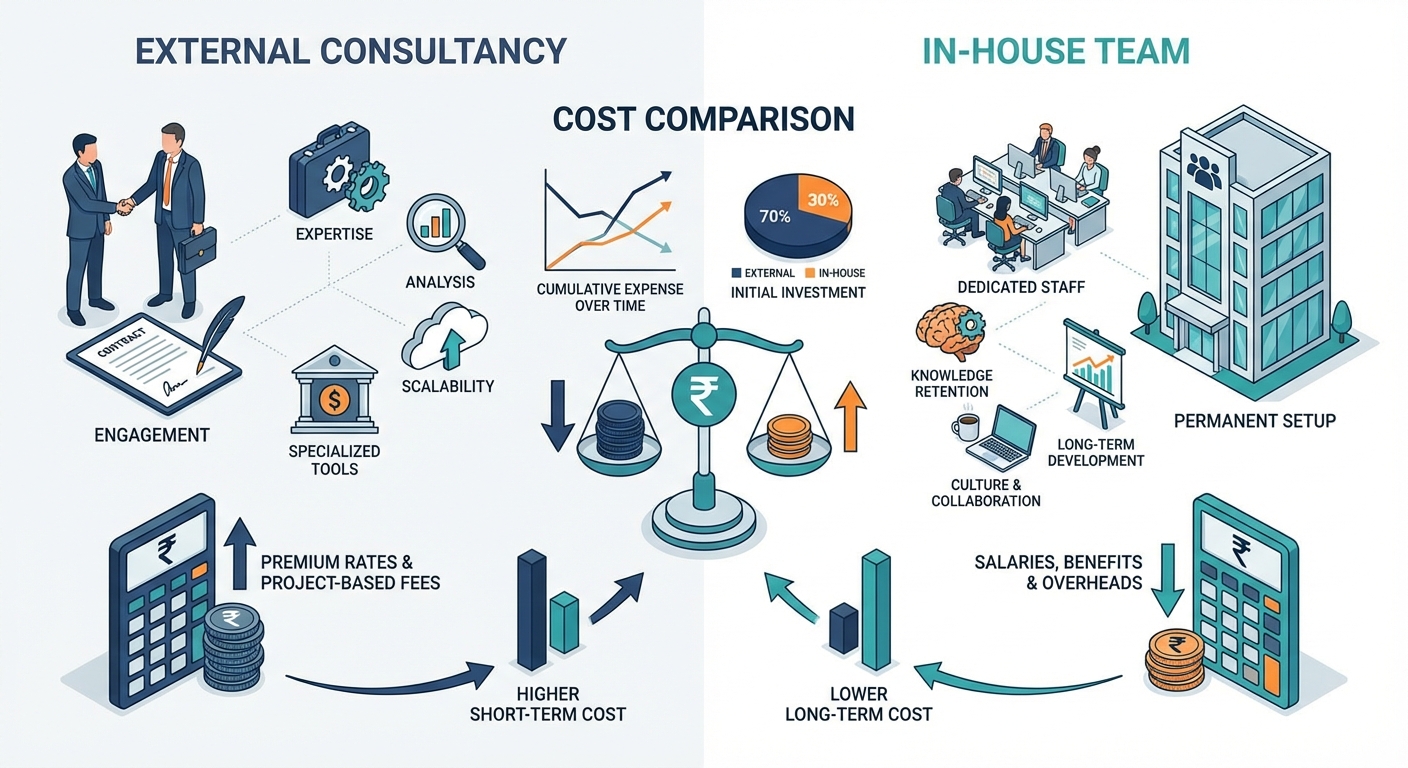
The financial comparison between PMC services India and in-house project management extends far beyond simple salary comparisons. A comprehensive cost analysis reveals significant differences in both direct and indirect expenses.
Direct Costs of PMC Services
Professional PMC services for solar projects in India typically charge based on project scope and complexity:
- Small-scale projects (1-5 MW): ₹2-4 lakhs per MW for comprehensive PMC services including detailed engineering design
- Medium-scale projects (5-20 MW): ₹1.5-3 lakhs per MW with economies of scale
- Large-scale projects (20+ MW): ₹1-2 lakhs per MW for full project management consultancy
These fees typically cover all aspects of project management, engineering design, quality assurance, and documentation—providing predictable, project-based pricing with no ongoing overhead when projects aren’t active.
Total Cost of In-House Team Ownership
Building and maintaining an in-house project management team involves multiple cost layers:
Personnel Costs (Annual):
- Senior Project Manager: ₹15-25 lakhs
- Solar Design Engineers (3): ₹8-15 lakhs each = ₹24-45 lakhs
- Site Survey Specialist: ₹6-10 lakhs
- Permit Coordinator: ₹5-8 lakhs
- QA Engineer: ₹8-12 lakhs
- CAD Technicians (2): ₹4-6 lakhs each = ₹8-12 lakhs
- Project Coordinator: ₹4-7 lakhs
- Total Personnel: ₹70-119 lakhs annually
Additional Overhead (Annual):
- Software licenses and subscriptions: ₹8-15 lakhs
- Office space and infrastructure: ₹6-12 lakhs
- Training and professional development: ₹4-8 lakhs
- Equipment and tools: ₹3-6 lakhs
- Benefits, insurance, and statutory costs: ₹10-18 lakhs (15-20% of salaries)
- Total Overhead: ₹31-59 lakhs annually
Total In-House Cost: ₹101-178 lakhs per year (approximately ₹1-1.5 crores annually)
Break-Even Analysis by Project Volume
The cost-effectiveness of each approach varies significantly based on annual project volume:
Low Volume (20-40 MW annually): PMC services cost ₹40-120 lakhs vs in-house costs of ₹101-178 lakhs. PMC services deliver 15-40% cost savings while providing specialized expertise.
Medium Volume (50-100 MW annually): PMC services cost ₹75-300 lakhs vs in-house costs of ₹101-178 lakhs. At the lower end of this range, in-house teams may achieve cost parity, but PMC services still offer flexibility advantages.
High Volume (100+ MW annually): In-house teams may achieve lower per-MW costs, but require proportionally larger teams and infrastructure. Many high-volume EPCs adopt hybrid models, maintaining core in-house capabilities while outsourcing specialized design work and overflow projects to PMC partners.
Critically, in-house costs remain fixed regardless of project volume fluctuations, while PMC services scale directly with project activity—providing significant financial flexibility for businesses with variable project pipelines.
Quality and Expertise Comparison
Quality outcomes and technical expertise represent perhaps the most significant differentiators between PMC services and in-house teams, with implications extending far beyond immediate project delivery to long-term business reputation and client satisfaction.
Specialized Expertise Depth
Established PMC services India providers like Heaven Designs bring concentrated expertise developed across hundreds of projects. With over 628 MW of completed design work across 752+ solar EPC clients, specialized PMC firms accumulate knowledge that would take years for individual in-house teams to develop:
- Diverse project experience across rooftop, ground-mount, commercial, industrial, and utility-scale installations
- Geographic knowledge spanning multiple Indian states with varying soil conditions, weather patterns, and regulatory environments
- Problem-solving repository drawing from solutions to thousands of unique engineering challenges
- Best practice methodologies refined through continuous project delivery and client feedback
In-house teams, particularly in their early years, lack this breadth of experience. Even experienced hires bring knowledge from limited previous employers, whereas PMC firms aggregate expertise from entire teams working across diverse client portfolios.
Access to Advanced Tools and Methodologies
Professional PMC services maintain investments in premium solar design software and engineering tools that may be cost-prohibitive for individual EPCs to license for in-house teams. Heaven Designs and similar providers utilize comprehensive software suites for:
- Advanced 3D solar modeling and shading analysis
- Structural engineering calculations and load assessments
- Energy yield optimization and performance modeling
- Automated permit drawing generation
- Quality assurance and design validation
These tools, combined with standardized processes developed across hundreds of projects, ensure consistent quality and reduce the risk of costly design errors that can plague less experienced in-house teams.
Quality Assurance and Review Processes
Mature PMC services implement multi-layer quality assurance processes where every design undergoes peer review by senior engineers before client delivery. This institutional quality control is difficult to replicate in smaller in-house teams where the same individuals who create designs may also review them, increasing error risk.
Heaven Designs’ team of 50+ engineers enables comprehensive quality checks where structural engineers review civil designs, electrical specialists validate interconnection plans, and senior consultants provide final approval—creating redundancy that catches potential issues before they impact project execution.
Continuous Learning and Industry Knowledge
PMC firms serving multiple clients across diverse projects maintain current knowledge of:
- Latest regulatory changes across different Indian states
- Emerging solar technologies and installation methodologies
- Updated building codes and structural requirements
- Grid interconnection standards and utility requirements
- Industry best practices and performance benchmarks
In-house teams may lag in awareness of developments outside their immediate project experience, potentially missing opportunities for cost optimization or inadvertently using outdated approaches.
Project Timeline and Delivery Speed
Time-to-completion directly impacts project profitability, client satisfaction, and the ability to take on new business. The project management approach significantly influences delivery speed across multiple dimensions.
Immediate Capacity and Ramp-Up Time
When partnering with established PMC services, projects can commence immediately with experienced teams already familiar with solar project workflows. There’s no ramp-up period—the PMC provider assigns engineers who have completed similar projects and can begin detailed design work within days of project kickoff.
In-house teams, even when fully staffed, require project-specific onboarding for each new installation. If the team is newly formed or includes recent hires, this learning curve extends project timelines by 2-4 weeks per project during the first year of operation.
Scalability During Peak Periods
Solar EPC businesses often experience seasonal project clustering or win multiple projects simultaneously, creating temporary capacity constraints. PMC services providers can scale resources dynamically:
- Parallel project execution by assigning additional engineers from their larger team pool
- Flexible resource allocation matching project complexity with appropriate expertise levels
- No capacity ceiling as PMC firms can handle overflow without hiring delays
In-house teams face hard capacity limits. When project volume exceeds team capacity, companies must either delay projects (disappointing clients), rush work (compromising quality), or hire additional staff (requiring months for recruitment and onboarding).
Design Timeline Benchmarks
Typical design timeline comparisons for a 5 MW commercial solar project:
Experienced PMC Services:
- Site survey and feasibility study: 5-7 days
- Preliminary design and layout: 7-10 days
- Detailed engineering design: 15-20 days
- Permit drawings and documentation: 5-7 days
- Total: 32-44 days
In-House Team (Established):
- Site survey and feasibility study: 7-10 days
- Preliminary design and layout: 10-14 days
- Detailed engineering design: 20-28 days
- Permit drawings and documentation: 7-10 days
- Total: 44-62 days
The 30-40% timeline advantage with experienced PMC services compounds across multiple projects, enabling EPCs to complete more installations annually and improve cash flow through faster project turnover.
Risk Management and Liability Considerations
Risk exposure represents a critical but often underestimated factor in the PMC services versus in-house decision. The approach you choose significantly impacts your company’s liability profile and financial risk.
Professional Liability and Insurance
Established PMC services India providers carry professional liability insurance covering errors and omissions in their engineering designs and project management recommendations. If a design flaw leads to structural failure, performance shortfalls, or safety issues, the PMC firm’s insurance provides financial protection.
With in-house teams, your company bears full liability for any design errors or project management failures. While you can purchase professional liability insurance for your team, premiums may be substantial, and claims directly impact your company’s insurance history and future costs.
Design Error Risk and Financial Impact
Solar project design errors can be catastrophically expensive:
- Structural failures requiring complete rework: ₹50 lakhs to ₹2 crores depending on project scale
- Permit rejections causing project delays: ₹10-30 lakhs in holding costs and lost revenue
- Performance shortfalls from suboptimal design: 5-15% energy generation losses over project lifetime
- Safety incidents from inadequate engineering: potential injury liability and reputation damage
Experienced PMC services with proven track records across hundreds of projects have refined processes that minimize these risks. Heaven Designs’ completion of 628+ MW across 752+ clients demonstrates the reliability that comes from extensive project experience and established quality assurance protocols.
Regulatory Compliance Risk
India’s solar regulatory environment varies significantly across states, with different requirements for:
- Grid interconnection standards and documentation
- Building permits and structural approvals
- Environmental clearances for ground-mount projects
- Fire safety and electrical codes
- Land use and zoning compliance
PMC firms working across multiple states maintain current knowledge of these varying requirements, reducing the risk of compliance failures that can halt projects or require expensive modifications. In-house teams working primarily in limited geographic areas may lack awareness of requirements in new markets, creating risk when expanding service territories.
Warranty and Accountability Structures
Professional PMC services typically provide warranties on their engineering designs and project management deliverables, offering recourse if issues arise. Clear contractual terms define responsibilities and remediation processes.
With in-house teams, accountability is internal—there’s no external party to hold responsible for errors, and remediation costs come entirely from your company’s resources. This can create challenging situations when design flaws emerge during or after construction.
Scalability and Flexibility Analysis
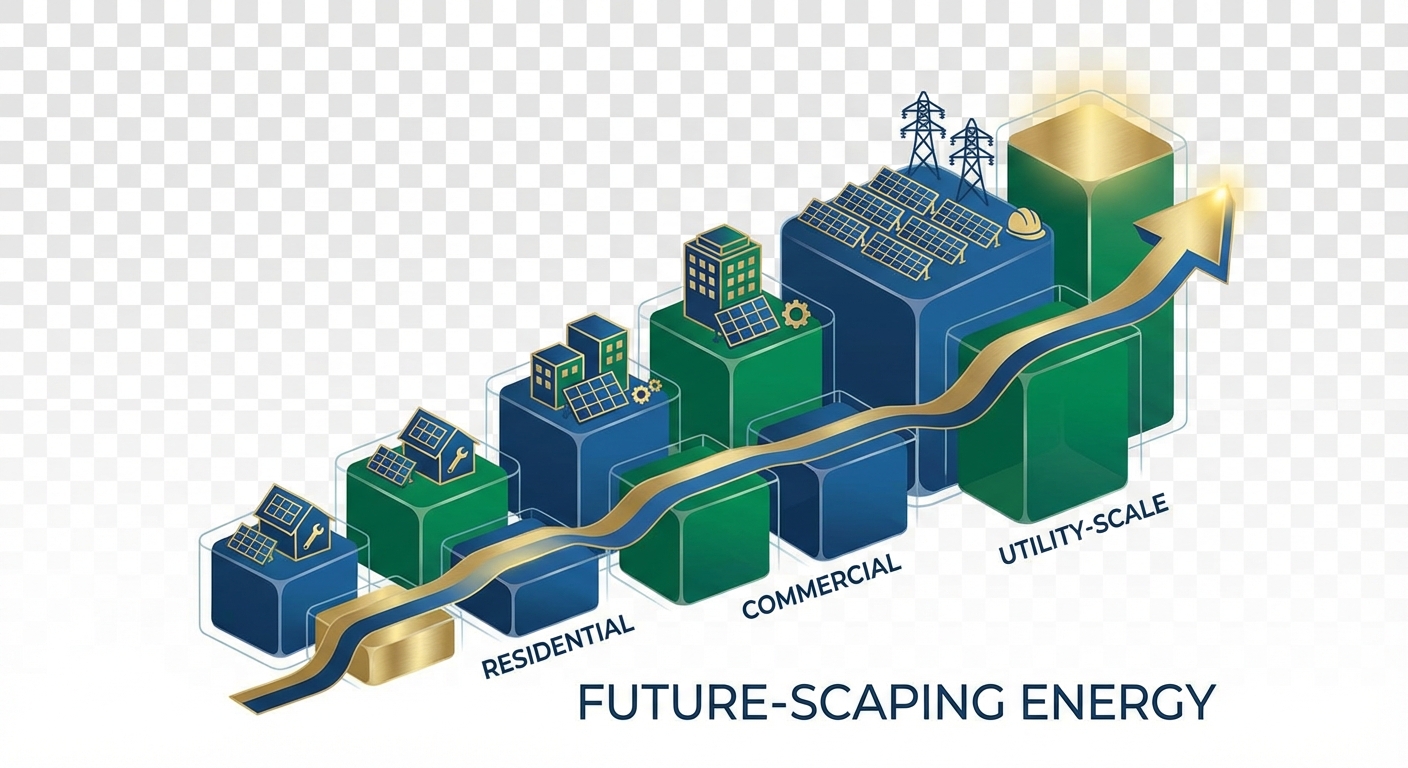
The ability to scale operations efficiently and adapt to changing business conditions represents a strategic advantage that extends beyond individual project execution to overall business growth potential.
Geographic Expansion Capabilities
Solar EPCs looking to expand into new Indian states or international markets face different challenges depending on their project management approach:
With PMC Services: Established providers like Heaven Designs already possess experience across multiple regions and can immediately support expansion into new markets. Their existing knowledge of regional variations in soil conditions, weather patterns, regulatory requirements, and local construction practices enables rapid market entry without geographic learning curves.
With In-House Teams: Geographic expansion requires either relocating existing team members (disrupting operations and personal lives) or hiring local talent (requiring months for recruitment and integration). The team must develop new regional expertise through trial and error, potentially experiencing quality issues or delays during the learning period.
Project Type Diversification
Many solar EPCs begin with a focus on specific project types (e.g., commercial rooftop installations) and later diversify into ground-mount, industrial, or utility-scale projects. Each project type requires distinct expertise:
- Rooftop solar demands structural load assessment expertise and building integration knowledge
- Ground-mount projects require civil engineering for foundations and land grading
- Industrial installations need specialized electrical design for high-voltage integration
- Utility-scale projects involve complex grid interconnection and substation design
PMC services providers maintain specialists across all project types, enabling clients to diversify offerings without building new internal capabilities. In-house teams must either hire additional specialists (increasing fixed costs) or attempt to upskill existing staff (requiring time and potentially compromising quality during the transition).
Variable Cost Structure Advantages
Perhaps the most significant scalability advantage of PMC services is the variable cost structure that aligns expenses directly with revenue:
During High-Volume Periods: PMC services scale seamlessly to handle increased project flow without hiring delays or capacity constraints. You pay for services as projects generate revenue.
During Low-Volume Periods: When project pipelines thin due to seasonal factors, market conditions, or business cycles, PMC service costs decrease proportionally. There are no idle employees to pay or unutilized infrastructure costs.
In-house teams represent fixed costs that continue regardless of project volume. During slow periods, you maintain full payroll and overhead while generating reduced revenue—a cash flow challenge that can threaten business viability during extended downturns.
Technology and Methodology Updates
Solar technology, design software, and engineering methodologies evolve continuously. PMC services providers invest in staying current because their competitive position depends on offering cutting-edge capabilities across their entire client base.
In-house teams require dedicated budget and time for technology updates, software upgrades, and methodology training—investments that may be deferred during tight financial periods, gradually eroding competitive positioning.
When to Choose PMC Services vs In-House: Decision Framework
The optimal choice between PMC services India and in-house project management depends on multiple factors specific to your business situation, growth trajectory, and strategic objectives. This framework helps evaluate which approach aligns with your circumstances.
Choose PMC Services When:
1. Annual Project Volume Below 75-100 MW: At lower volumes, the fixed costs of in-house teams exceed PMC service costs while delivering less specialized expertise. The break-even point varies based on project complexity and team efficiency, but most EPCs find PMC services more cost-effective below this threshold.
2. Variable or Unpredictable Project Pipeline: If your project flow fluctuates significantly month-to-month or season-to-season, the variable cost structure of PMC services provides financial flexibility that fixed in-house costs cannot match.
3. Geographic Expansion Plans: When entering new states or international markets, partnering with PMC services that already possess regional expertise accelerates market entry and reduces risk compared to building local in-house capabilities.
4. Limited Access to Specialized Talent: If your location makes recruiting experienced solar engineers challenging, or if you cannot offer compensation competitive with major metros, PMC services provide access to expertise regardless of your geographic constraints.
5. Focus on Core Competencies: EPCs that want to concentrate resources on installation execution, client relationships, and business development rather than building internal design capabilities benefit from outsourcing project management to specialists.
6. Rapid Growth Phase: During periods of fast business expansion, PMC services scale immediately without the delays inherent in recruiting, hiring, and onboarding in-house staff.
Consider In-House Teams When:
1. Consistent High-Volume Pipeline (100+ MW annually): At very high project volumes with predictable flow, in-house teams may achieve cost advantages while maintaining quality, though many high-volume EPCs still use hybrid models.
2. Highly Specialized or Proprietary Approaches: If your business differentiates through unique design methodologies or proprietary technologies requiring deep internal knowledge, in-house teams provide better control.
3. Extremely Tight Integration Requirements: Some business models require project management teams to be physically co-located with installation crews or to participate in daily on-site decision-making, making external PMC services less practical.
4. Long-Term Strategic Investment: Companies with 5-10 year horizons and confidence in sustained high project volumes may view in-house capability development as a strategic asset worth the upfront investment and ongoing overhead.
Hybrid Model: The Best of Both Approaches
Many successful solar EPCs adopt hybrid models that combine in-house and external PMC services:
- Core in-house team handles project management coordination and client relationships
- External PMC services provide specialized solar design, structural engineering, and detailed technical documentation
- Flexible scaling using PMC partners for overflow projects during peak periods
- Geographic specialization with in-house teams in primary markets and PMC services for expansion regions
This approach provides cost efficiency, specialized expertise, and scalability while maintaining internal project oversight and client relationship control. Heaven Designs serves as a design partner for many EPCs using this hybrid model, functioning as an extension of their internal teams.
Real-World ROI Comparison for Indian Solar Projects
Return on investment analysis must extend beyond simple cost comparisons to encompass the full financial impact of each approach on business profitability and growth potential.
ROI Metrics for PMC Services Approach
Solar EPCs using professional PMC services typically experience:
Immediate Positive ROI: No upfront investment required—costs begin only when projects commence. First project generates positive cash flow immediately after installation and commissioning.
Higher Project Margins: Faster project completion (30-40% timeline reduction) enables more projects annually with the same installation crew capacity. If an EPC can complete 15 projects instead of 11 due to faster design turnaround, that’s 36% more revenue with minimal additional overhead.
Reduced Risk Costs: Lower error rates and professional liability coverage reduce the financial impact of design issues. Even one avoided major error (₹50 lakhs to ₹2 crores) can justify PMC service costs for an entire year.
Cash Flow Advantages: Variable costs that scale with revenue improve cash flow management, particularly important for growing businesses or during market fluctuations.
Example ROI Calculation (50 MW Annual Volume):
- PMC services cost: ₹1.5 crores (₹3 lakhs per MW)
- Avoided in-house team costs: ₹1.3 crores
- Additional projects from faster timelines: 3 extra projects = ₹45 lakhs additional margin
- Avoided design error (probability-weighted): ₹15 lakhs
- Net benefit: ₹73 lakhs annually
ROI Calculation for In-House Teams
In-house project management teams require longer time horizons to achieve positive ROI:
Year 1: Negative ROI due to upfront hiring costs, infrastructure investment, training period, and learning curve inefficiencies. Typical Year 1 loss: ₹30-60 lakhs compared to using PMC services.
Year 2-3: Approaching Break-Even as team efficiency improves and processes mature. ROI becomes neutral to slightly positive if project volume remains consistently high.
Year 4+: Potential Positive ROI if project volume sustains above break-even thresholds and team turnover remains low. However, ongoing training, software updates, and salary increases continue to require investment.
Risk Factors Impacting In-House ROI:
- Team turnover: Losing key engineers resets the learning curve and requires expensive replacement hiring
- Volume fluctuations: Project pipeline decreases turn fixed costs into losses
- Technology changes: Major software or methodology shifts require retraining investments
- Market expansion: Geographic or project type diversification requires additional hires or capability development
Long-Term Financial Implications (3-5 Year Outlook)
Over a 3-5 year horizon, the financial comparison depends heavily on business trajectory:
Growth Scenario: EPCs experiencing rapid growth (30%+ annually) find PMC services enable faster scaling without the constraints of building internal capacity. The ability to enter new markets quickly and handle variable project flow provides competitive advantages that translate to market share gains worth far more than cost differences between approaches.
Stable High-Volume Scenario: Established EPCs with consistent 100+ MW annual pipelines may achieve cost advantages with mature in-house teams, though many still maintain PMC partnerships for specialized work or overflow capacity.
Variable or Declining Scenario: Market downturns or business challenges make in-house fixed costs particularly painful, while PMC services provide flexibility to reduce costs in proportion to revenue decreases.
The most financially successful solar EPCs in India’s competitive 2026 market tend to be those that maintain flexibility—using PMC services as their primary approach or as a significant component of hybrid models—enabling them to adapt quickly to changing market conditions while maintaining consistent quality.
Frequently Asked Questions About PMC Services India
What is the typical cost difference between PMC services and in-house teams for a 10 MW solar project?
For a 10 MW project, professional PMC services typically cost ₹15-30 lakhs for complete project management and detailed engineering design. An in-house team’s allocated cost for the same project (considering annual overhead divided by project volume) ranges from ₹20-40 lakhs depending on team efficiency and utilization rates. PMC services generally deliver 20-35% cost savings for EPCs handling fewer than 75-100 MW annually, while also providing faster delivery and specialized expertise.
How quickly can PMC services start on a new solar project compared to building an in-house team?
Established PMC services providers can commence project work within 2-5 business days of contract execution and information transfer. Building an in-house team requires 3-6 months for recruitment, hiring, onboarding, and process establishment, with an additional 6-12 months before the team reaches full efficiency. This 9-18 month timeline difference represents significant opportunity cost for EPCs looking to execute projects quickly or respond to market opportunities.
Do PMC services providers understand regional variations across different Indian states?
Professional PMC services India firms like Heaven Designs work across multiple states and accumulate extensive knowledge of regional variations in soil conditions, weather patterns, regulatory requirements, and local construction practices. This geographic expertise is difficult for in-house teams to replicate unless they operate at very large scale across many regions. When selecting a PMC partner, verify their experience in your target states and request references from projects in those locations.
Can we maintain quality control when using external PMC services?
Quality control with PMC services is maintained through clear contractual specifications, defined deliverable standards, milestone reviews, and approval processes. Reputable PMC providers implement internal quality assurance with peer reviews and senior engineer sign-offs before client delivery. Many EPCs find quality is actually higher with experienced PMC services compared to newly formed in-house teams, as PMC firms have refined processes across hundreds of projects. Establish clear communication protocols and review checkpoints to maintain oversight while benefiting from external expertise.
What happens if our project volume increases significantly—can PMC services scale?
Scalability is a primary advantage of PMC services. Established providers maintain teams of 50+ engineers (Heaven Designs has over 50 professionals) enabling them to handle volume increases by allocating additional resources to your projects. Discuss scalability explicitly during PMC partner selection, and consider establishing framework agreements that define how resource allocation and pricing work as volume increases. Most PMC firms welcome growing client relationships and can scale more rapidly than you could hire and onboard in-house staff.
Is there a hybrid approach combining in-house teams with external PMC services?
Hybrid models are increasingly common and often represent the optimal approach. Many successful EPCs maintain small in-house teams for project coordination, client relationships, and site management while partnering with PMC services for specialized detailed engineering design, permit design, and technical documentation. This provides cost efficiency, access to specialized expertise, and scalability while maintaining internal project oversight. The hybrid approach works particularly well for EPCs with 50-150 MW annual volumes or those operating across diverse project types and geographic regions.
How do we evaluate the quality and reliability of PMC services providers?
Evaluate PMC services providers based on:
- Track record: Total MW designed and number of completed projects (Heaven Designs: 628+ MW across 752+ clients)
- Team size and expertise: Number of engineers and their specializations
- Geographic experience: Projects completed in your target states or regions
- Client references: Speak with current clients about quality, timeliness, and communication
- Technical capabilities: Software tools, design methodologies, and quality assurance processes
- Delivery timelines: Average project completion times for similar scope
- Professional credentials: Engineering certifications, industry memberships, and insurance coverage
Request sample deliverables from previous projects to assess documentation quality and completeness before committing to a partnership.
Making Your Decision: Next Steps for Solar EPCs and Developers
The choice between PMC services India and in-house project management represents a strategic decision with long-term implications for your solar business. Based on this comprehensive analysis, most solar EPCs and developers in India’s 2026 market will find professional PMC services deliver superior value through:
- Cost efficiency with variable expenses that scale with project revenue rather than fixed overhead
- Specialized expertise accumulated across hundreds of projects and diverse geographic regions
- Faster project delivery enabling more installations annually with the same field crew capacity
- Reduced risk exposure through professional liability coverage and proven quality assurance processes
- Scalability and flexibility to handle volume fluctuations and geographic expansion without hiring delays
- Access to advanced tools and methodologies that may be cost-prohibitive for individual EPCs
In-house teams may make sense for very high-volume EPCs (100+ MW annually) with predictable project pipelines and long-term strategic horizons, though even these organizations often benefit from hybrid models that combine internal coordination with external specialized expertise.
Evaluate Your Specific Situation
To make the right decision for your business, assess:
- Current and projected annual project volume over the next 3-5 years
- Project pipeline predictability and seasonal or market-driven fluctuations
- Geographic service area and expansion plans into new states or international markets
- Project type diversity (rooftop, ground-mount, commercial, industrial, utility-scale)
- Available capital for upfront investment in team building and infrastructure
- Access to specialized talent in your location and ability to offer competitive compensation
- Strategic priorities regarding where to focus internal resources and capabilities
Partner with Proven PMC Services Expertise
Heaven Designs brings over 628 MW of completed solar design work across 752+ EPC clients, providing the specialized expertise, proven processes, and scalable resources that enable solar EPCs and developers to deliver high-quality projects efficiently and profitably. Our team of 50+ engineers specializes in comprehensive solar engineering design services including:
- MW-scale Project Management Consultancy (PMC) services
- Detailed engineering design for all project types and scales
- Site survey and feasibility study services across India
- Solar permit design ensuring regulatory compliance
- Civil and structural engineering tailored for solar installations
- 3D pre-design and layout optimization
Whether you’re evaluating PMC services for the first time, looking to replace an underperforming provider, or considering a hybrid model that combines internal and external capabilities, we invite you to discuss your specific project management needs and explore how our expertise can enhance your solar business performance.
Ready to optimize your solar project management approach? Get a Quick Proposal Now! or contact our team at +91 90811 00297 or service@heavendesigns.in to discuss how Heaven Designs’ PMC services can deliver better outcomes for your solar projects across India.
The right project management approach can be the difference between struggling with inconsistent quality and delayed timelines versus building a reputation for reliable, high-quality solar installations that drive business growth and client satisfaction. Make the strategic choice that positions your solar EPC or development business for long-term success in India’s rapidly expanding renewable energy market.