


In India’s rapidly expanding solar energy sector, the difference between winning and losing a project often comes down to how well you can visualize and communicate your design vision. For solar EPC companies competing in 2026’s dynamic market, solar 3D pre-design services have become an essential tool for creating compelling proposals, identifying potential issues before they become costly problems, and accelerating project timelines. This comprehensive guide explores everything EPCs need to know about 3D design India services, from the complete process workflow to deliverables, accuracy expectations, and regional considerations across India’s diverse terrain and climate conditions.
Whether you’re planning a rooftop installation in Mumbai’s coastal environment, a ground-mount project in Rajasthan’s desert terrain, or a commercial solar farm in Karnataka’s varied landscape, understanding the 3D pre-design process will help you make informed decisions, optimize your engineering investments, and present professional proposals that convert prospects into clients.
What is Solar 3D Pre-Design and Why It Matters for Indian EPCs
Solar 3D pre-design represents the critical preliminary phase in the solar project lifecycle, occurring after initial feasibility assessment but before detailed engineering design begins. Unlike comprehensive detailed engineering design that produces construction-ready documents, 3D design India services focus on creating accurate three-dimensional visualizations and preliminary layouts that help EPCs and their clients understand what the finished project will look like.
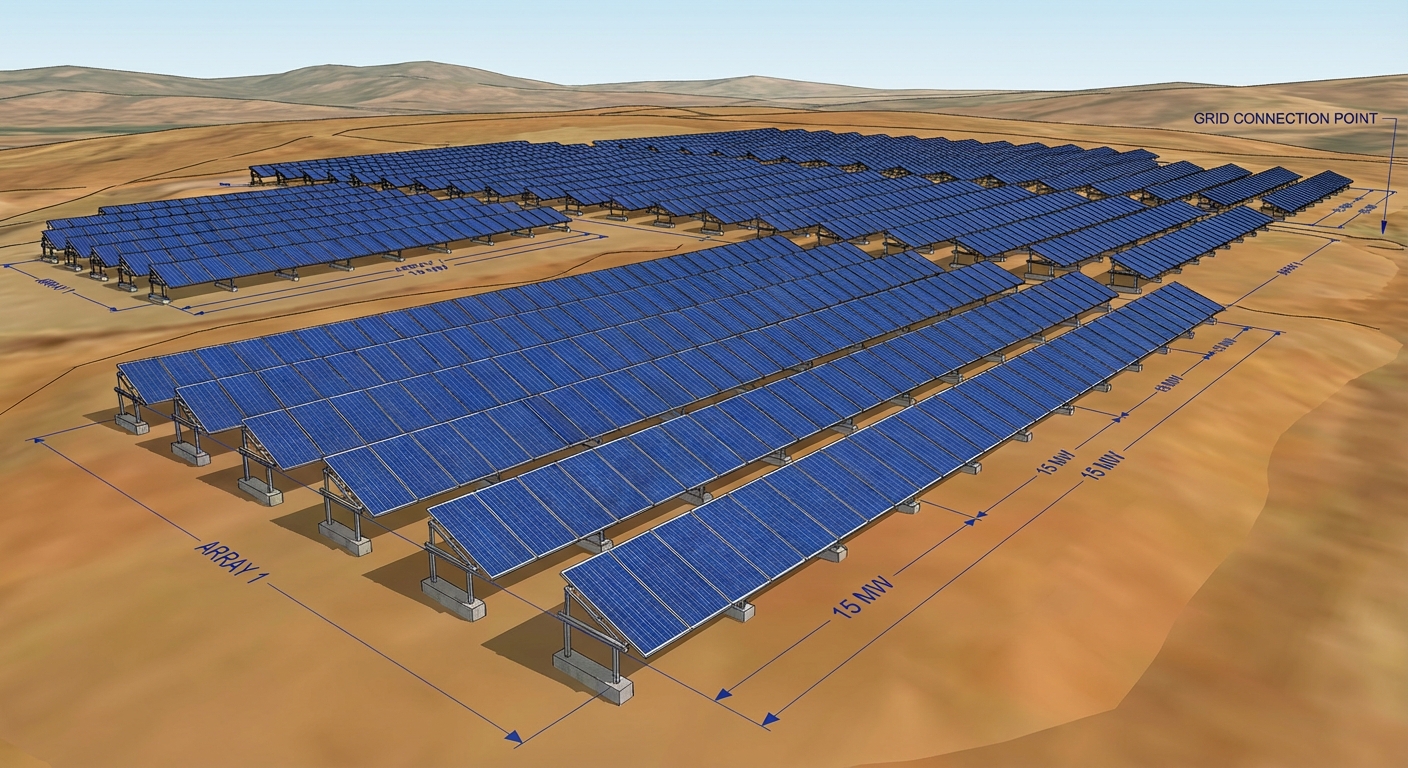
This phase serves multiple strategic purposes for solar EPC companies operating in India’s competitive market. First, it provides a visual communication tool that transforms technical concepts into tangible representations clients can immediately understand. Second, it identifies potential design challenges, site constraints, and optimization opportunities before significant engineering resources are committed. Third, it establishes preliminary project parameters including equipment placement, energy yield estimates, and cost projections that inform business decisions.
For EPCs working across India’s diverse geography, from coastal regions to mountainous terrain, 3D pre-design services account for location-specific factors that impact project viability. A project in Gujarat’s flat industrial zones requires different considerations than one in Himachal Pradesh’s hilly terrain or Tamil Nadu’s high-wind coastal areas. The 3D modeling process captures these regional nuances early, preventing costly redesigns during later project phases.
The impact on proposal quality cannot be overstated. EPCs using professional 3D visualizations report significantly higher conversion rates compared to those presenting only 2D drawings or technical specifications. Clients—whether commercial building owners, industrial facility managers, or project developers—can see exactly how solar panels will integrate with their property, understand shading patterns throughout the day, and visualize the project’s aesthetic impact. This clarity builds confidence and accelerates decision-making.
In 2026, as India pushes toward ambitious renewable energy targets and solar project competition intensifies, the ability to quickly produce accurate, professional 3D pre-designs has become a competitive differentiator. EPCs partnering with specialized solar design companies gain access to advanced modeling capabilities, experienced engineering teams, and efficient workflows that would be cost-prohibitive to develop in-house.
The Complete 3D Design India Process: From Site Assessment to Preliminary Layout
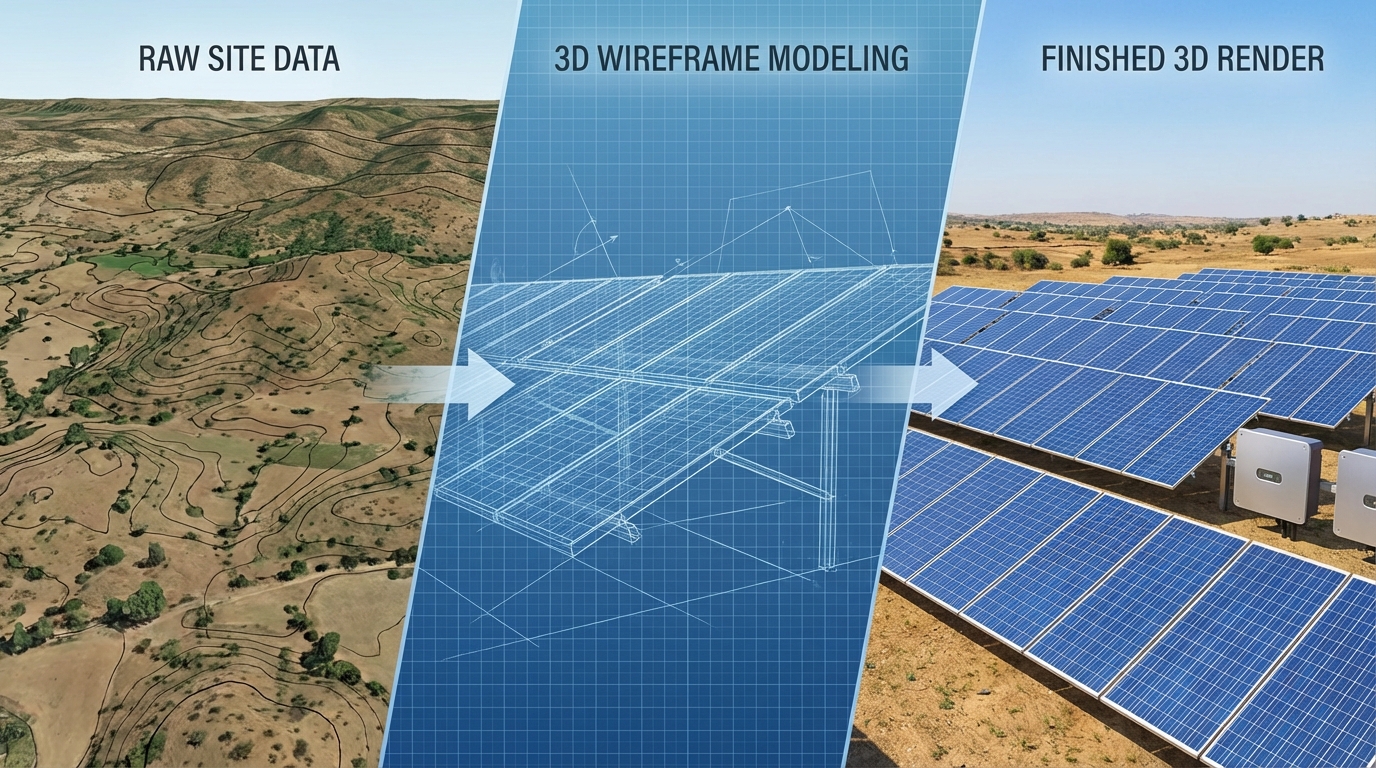
Understanding the complete workflow for 3D design India projects helps EPCs set realistic expectations, prepare necessary data, and collaborate effectively with design partners. The process typically unfolds in five distinct phases, each building on the previous stage to create increasingly refined project visualizations.
Phase 1: Site Data Collection and Assessment
Every successful 3D pre-design begins with comprehensive site data. For projects across India, this includes satellite imagery, topographic surveys, site photographs, and existing infrastructure documentation. EPCs working with professional design partners typically provide GPS coordinates, property boundaries, and any available survey data. Advanced feasibility study services may include drone surveys or on-site assessments that capture elevation changes, existing structures, vegetation, and access points.
The quality of input data directly impacts the accuracy of 3D models. For rooftop projects, detailed building dimensions, roof pitch measurements, and structural load information are essential. Ground-mount projects require terrain contours, soil conditions, and drainage patterns. In India’s varied landscape, site-specific factors like monsoon water flow patterns, seasonal shading from nearby structures or trees, and local wind conditions must be documented during this initial phase.
Phase 2: Terrain and Climate Analysis
Once site data is collected, experienced solar engineers analyze how India’s regional characteristics will impact the project. Coastal areas like Kerala or Goa require considerations for salt corrosion and cyclone wind loads. Desert regions in Rajasthan demand attention to dust accumulation and extreme temperature variations. Hilly terrain in states like Uttarakhand or Himachal Pradesh necessitates careful slope analysis and terracing strategies.
Climate analysis examines solar irradiation patterns specific to the location, seasonal variations in sun path, and weather factors that affect energy production. This regional intelligence, accumulated through hundreds of projects across India, informs preliminary design decisions about panel orientation, tilt angles, and row spacing that maximize energy yield while accounting for local conditions.
Phase 3: Preliminary Layout Creation
With site and climate data analyzed, the actual 3D modeling begins. Using specialized solar design software, engineers create three-dimensional representations of the site, accurately modeling terrain elevation, existing structures, and site boundaries. Solar panels, mounting structures, inverters, and electrical infrastructure are then positioned according to engineering best practices and site-specific constraints.
This phase involves iterative optimization. Engineers test different layout configurations, adjusting panel placement to minimize shading, optimize land use, and maximize energy production. For rooftop projects, the layout accounts for roof penetrations, HVAC equipment, and maintenance access requirements. Ground-mount designs consider internal access roads, equipment placement for efficient cable runs, and perimeter fencing.
Phase 4: Shadow Analysis and Energy Modeling
One of the most valuable aspects of 3D design India services is comprehensive shadow analysis. The 3D model simulates sun movement throughout the year, identifying shading patterns from nearby buildings, trees, terrain features, or even inter-row shading within the solar array itself. This analysis is particularly important in India’s urban environments where rooftop projects may be affected by surrounding high-rise buildings, or in hilly regions where terrain creates complex shading scenarios.
Energy modeling uses the 3D layout and shadow analysis to generate preliminary energy yield estimates. These projections account for location-specific solar irradiation data, system losses, temperature effects, and shading impacts. While not as detailed as final engineering calculations, these estimates provide reliable guidance for financial modeling and project feasibility decisions.
Phase 5: Visualization and Documentation
The final phase produces client-ready deliverables. High-quality 3D renderings show the project from multiple angles, often including photorealistic visualizations that blend the proposed solar installation with actual site photographs. These visualizations become powerful tools for client presentations, stakeholder approvals, and marketing materials.
Technical documentation accompanies the visual materials, including preliminary layout drawings, equipment lists, and energy production estimates. This package provides EPCs with everything needed to present professional proposals and make informed decisions about proceeding to detailed engineering design.
Key Deliverables in Solar 3D Pre-Design Services
When partnering with a professional solar design company for 3D pre-design services in India, EPCs should expect a comprehensive deliverable package that supports both technical planning and client communication. Understanding these deliverables helps set appropriate expectations and ensures you receive maximum value from the pre-design investment.
3D Visualization Models and Renderings
The centerpiece of any 3D design India project is the three-dimensional model itself. Professional services provide multiple visualization formats, including interactive 3D models that can be rotated and viewed from any angle, high-resolution static renderings showing the project from key perspectives, and photorealistic composites that overlay the proposed solar installation onto actual site photographs. These visualizations typically include accurate representations of solar panels, mounting structures, inverters, combiner boxes, and other visible equipment.
For client presentations, many design partners provide both daytime renderings showing the solar installation in operation and contextual views that demonstrate how the project integrates with surrounding infrastructure. Urban rooftop projects might include aerial views showing the installation in relation to nearby buildings, while ground-mount projects showcase the full site layout with access roads and perimeter features.
Preliminary Layout Drawings and Site Plans
Beyond visual renderings, technical layout drawings provide dimensioned plans showing exact panel placement, equipment locations, and site infrastructure. These drawings typically include a site plan showing property boundaries, solar array footprint, and setback distances; panel layout diagrams indicating row spacing, tilt angles, and orientation; and equipment placement plans showing inverter locations, transformer positions, and electrical routing paths.
For projects across India’s varied terrain, these layouts account for regional requirements. Coastal installations might show additional structural reinforcement details, while hilly terrain projects include elevation views demonstrating how panels follow ground contours or utilize terracing strategies.
Shadow Analysis Reports
Comprehensive shadow analysis documentation shows shading patterns throughout the year, typically presented as monthly or seasonal shadow maps. These reports identify periods of maximum shading impact, quantify energy losses due to shading, and highlight any design modifications made to minimize shading effects. For EPCs, this analysis provides confidence that the preliminary design has addressed one of the most critical factors affecting solar project performance.
Energy Yield Estimates and Performance Projections
Preliminary energy modeling produces estimated annual energy production figures, monthly generation profiles accounting for seasonal variations, and performance ratio estimates based on system design and location. While these estimates are refined during detailed engineering, they provide reliable guidance for financial modeling, helping EPCs and their clients understand expected project returns and payback periods.
Preliminary Bill of Materials
Most 3D pre-design services include a preliminary equipment list specifying panel quantities and specifications, inverter requirements, mounting structure estimates, and major electrical components. This bill of materials enables initial cost estimation and vendor discussions, though final quantities are confirmed during detailed engineering.
Technical Summary Documentation
A comprehensive technical summary ties all deliverables together, documenting design assumptions, site-specific considerations, key performance metrics, and recommendations for the detailed engineering phase. This documentation ensures smooth transition from pre-design to full engineering and provides a reference for future project phases.
How 3D Modeling Helps EPCs Identify Issues Early
One of the most valuable benefits of investing in professional 3D design India services is early identification of potential challenges that could derail projects or inflate costs during later phases. The three-dimensional modeling process reveals issues that might be missed in traditional 2D planning or desktop feasibility studies.
Terrain and elevation challenges become immediately apparent in 3D models. For ground-mount projects across India’s varied landscape, the modeling process identifies areas requiring significant grading or earthwork, spots where drainage could cause problems during monsoon season, and locations where natural terrain features create shading or access difficulties. EPCs can address these issues in preliminary planning rather than discovering them during construction when solutions are far more expensive.
Shading and obstruction problems are precisely quantified through 3D shadow analysis. In urban environments, nearby buildings, water tanks, or communication towers may cast shadows that significantly impact energy production. The 3D model simulates these effects throughout the year, allowing designers to adjust panel placement or recommend vegetation removal before finalizing the design. For rooftop projects, the analysis identifies optimal panel placement that avoids shading from HVAC equipment, parapets, or adjacent structures.
Access and logistics planning benefits enormously from 3D visualization. The model reveals whether equipment delivery vehicles can reach installation areas, if crane access is feasible for rooftop projects, and whether internal access roads in ground-mount installations are adequately positioned. These logistical considerations, often overlooked in 2D planning, can significantly impact installation costs and timelines.
Structural considerations emerge during the 3D modeling process. For rooftop installations, the visualization helps identify potential structural load issues, roof penetration challenges, or areas where additional reinforcement may be needed. Ground-mount projects reveal locations where soil conditions or slope angles may require specialized foundation designs. Identifying these requirements during pre-design allows EPCs to budget appropriately and engage structural engineering India specialists early in the process.
Electrical routing optimization is another area where 3D modeling adds value. The three-dimensional perspective helps engineers plan efficient cable runs that minimize material costs while maintaining code compliance. The model identifies optimal inverter and combiner box locations that balance electrical efficiency with maintenance accessibility.
Regulatory and compliance issues can be anticipated through careful 3D analysis. The model helps verify that designs meet setback requirements, height restrictions, and other local regulations. For projects requiring permits, the 3D visualizations and technical documentation support permit design submissions and regulatory approvals.
Cost optimization opportunities become visible when the complete project is modeled in three dimensions. Engineers can test alternative layouts, compare different equipment configurations, and identify design modifications that reduce costs without sacrificing performance. This optimization during the pre-design phase, when changes are inexpensive, delivers far greater value than attempting similar optimizations during detailed engineering or construction.
Timeline and Accuracy Expectations for 3D Design India Projects
Understanding realistic timelines and accuracy standards for 3D design India services helps EPCs plan project schedules and set appropriate expectations with clients. The design timeline varies based on project size, complexity, and data availability, but experienced design partners follow predictable workflows that deliver consistent results.
For residential rooftop projects ranging from 5 kW to 50 kW, the typical 3D pre-design timeline spans 3 to 5 business days from data submission to final deliverables. These smaller projects benefit from streamlined workflows and standardized design approaches. The timeline assumes EPCs provide complete site data including roof dimensions, photographs, and any structural information at project initiation.
Commercial and industrial rooftop installations from 50 kW to 500 kW typically require 5 to 10 business days for comprehensive 3D pre-design. These projects involve more complex roof layouts, multiple roof levels, and greater attention to structural considerations and electrical design. The additional time allows for thorough shadow analysis, multiple layout iterations, and detailed energy modeling.
Ground-mount projects from 500 kW to 5 MW generally need 10 to 15 business days for complete pre-design services. These larger installations require extensive terrain modeling, careful consideration of site access and infrastructure, and more sophisticated energy analysis. The timeline includes multiple review cycles where EPCs can provide feedback and request design adjustments.
Utility-scale projects exceeding 5 MW may require 15 to 25 business days or more, depending on site complexity and project scope. These major installations often involve multiple project phases, extensive stakeholder coordination, and integration with broader PMC services India engagements.
Several factors can extend these baseline timelines. Incomplete or poor-quality site data requires additional information gathering, potentially adding several days to the schedule. Complex terrain with significant elevation changes demands more detailed modeling and analysis. Sites with multiple existing structures, extensive vegetation, or unusual shading scenarios need additional engineering time. Projects requiring multiple design iterations or significant layout modifications will naturally take longer than straightforward installations.
Accuracy expectations for 3D pre-design differ from detailed engineering but remain sufficient for informed decision-making. Panel quantity estimates typically fall within 5-10% of final engineering numbers, providing reliable guidance for budgeting and procurement planning. Energy yield projections generally achieve 10-15% accuracy compared to final performance modeling, adequate for financial feasibility analysis and client presentations. Equipment placement and layout dimensions are accurate enough for preliminary site planning and cost estimation, though final positions are refined during detailed engineering.
The accuracy of 3D pre-design improves significantly with high-quality input data. Projects with professional site surveys, drone-captured topography, and detailed structural information achieve accuracy at the higher end of these ranges. Conversely, projects relying solely on satellite imagery and limited site documentation may see accuracy at the lower end.
EPCs should view 3D pre-design accuracy as appropriate for its intended purpose: creating compelling visualizations, identifying major design issues, and supporting go/no-go decisions. When projects proceed to detailed engineering, the preliminary 3D work provides an excellent foundation that accelerates the detailed design process, often reducing overall project timelines despite the additional pre-design phase.
Regional Considerations: 3D Design Across Indian Terrain and Climate
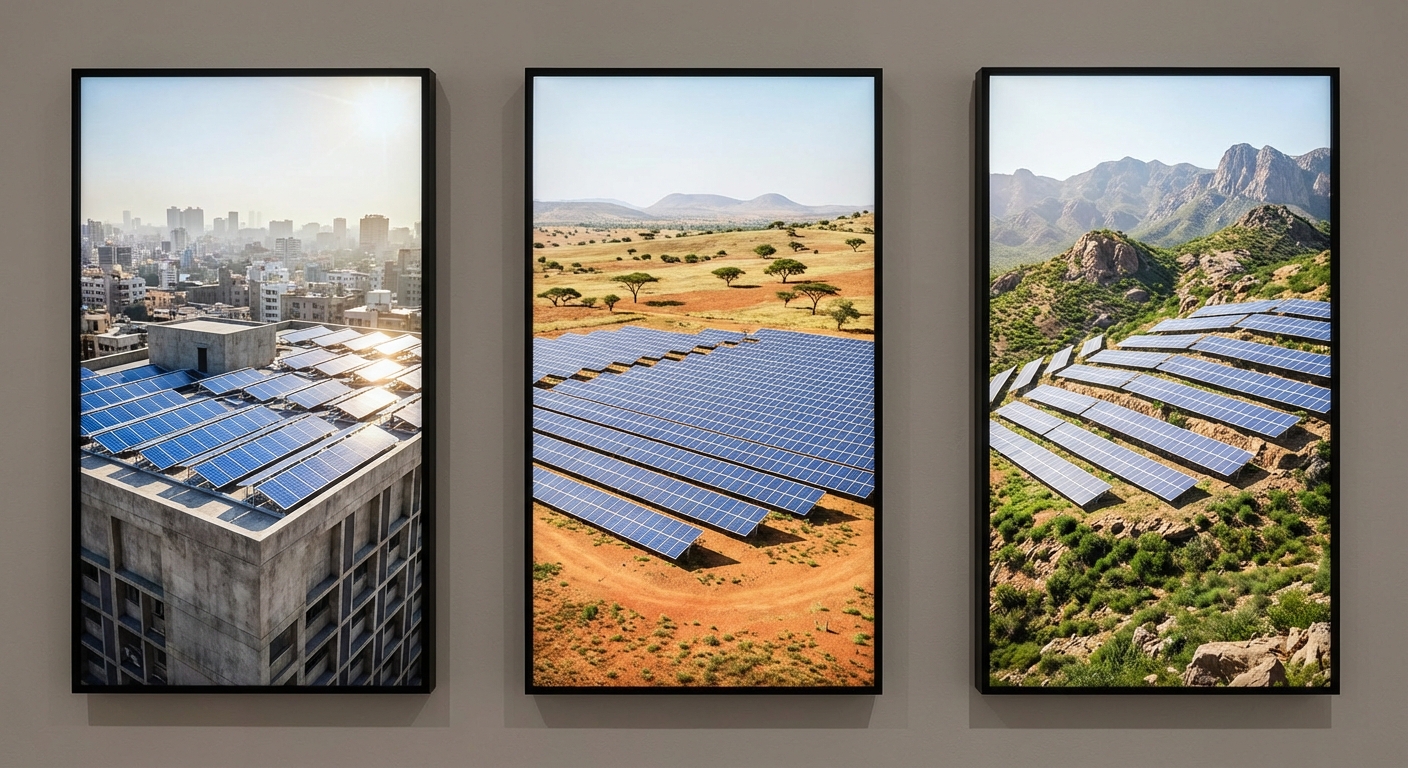
India’s remarkable geographic and climatic diversity means that effective 3D design India services must account for dramatically different conditions across regions. Professional solar design partners with extensive experience across the country understand these regional nuances and incorporate them into preliminary designs.
Coastal Regions: Wind and Corrosion Considerations
Solar projects in coastal states like Gujarat, Maharashtra, Kerala, Tamil Nadu, and Goa face unique challenges that must be addressed during 3D pre-design. High wind loads from cyclones and coastal storms require robust mounting structures with enhanced anchoring. The 3D modeling process accounts for these wind considerations, ensuring preliminary designs include appropriate structural margins.
Salt-laden air in coastal environments accelerates corrosion of metal components. Pre-design specifications for coastal projects typically recommend corrosion-resistant materials and protective coatings. The 3D model helps visualize equipment placement that minimizes exposure to prevailing winds carrying salt spray.
Coastal regions also experience high humidity and occasional flooding during monsoon season. The 3D design process considers equipment elevation, drainage patterns, and protection strategies for electrical components. For rooftop installations in coastal cities, the modeling accounts for building sway in high winds and ensures panel mounting systems accommodate structural movement.
Desert and High-Temperature Regions
States like Rajasthan, parts of Gujarat, and western regions experience extreme temperatures and intense solar irradiation. While high irradiation benefits energy production, extreme heat affects equipment performance and longevity. The 3D pre-design process for these regions incorporates temperature derating factors in energy modeling and may recommend equipment with higher temperature ratings.
Dust accumulation is a significant concern in desert environments. The 3D modeling considers panel tilt angles that facilitate natural dust removal during occasional rains while optimizing energy capture. Row spacing in ground-mount designs accounts for dust clouds raised by winds, minimizing soiling of downwind panels.
Water scarcity in desert regions impacts cleaning strategies. The pre-design phase helps EPCs plan for dry cleaning access or minimal water cleaning systems, with equipment placement that facilitates maintenance operations.
Hilly and Mountainous Terrain
Projects in states like Himachal Pradesh, Uttarakhand, parts of Karnataka, and northeastern regions face terrain challenges that make 3D modeling especially valuable. The three-dimensional visualization clearly shows how solar arrays can follow natural contours, utilize terracing, or require grading to create suitable installation areas.
Slope analysis in the 3D model identifies areas where erosion control measures are needed, locations requiring retaining walls or terracing, and spots where natural drainage must be preserved. For ground-mount installations in hilly terrain, the pre-design process often reveals that following natural contours, despite creating a less uniform appearance, delivers better economics than extensive earthwork.
Hilly regions often experience different microclimates and shading patterns than flat terrain. The 3D shadow analysis accounts for terrain-induced shading, particularly important during winter months when sun angles are lower. The modeling may reveal that certain slopes or aspects are unsuitable for solar installation due to excessive shading or poor orientation.
Urban Environments and Rooftop Installations
Cities across India present their own design challenges. Urban rooftop projects must account for surrounding high-rise buildings that create shading, limited roof space requiring optimization, existing rooftop equipment and infrastructure, and structural limitations of older buildings. The 3D pre-design process is particularly valuable in urban contexts, where the visualization helps building owners understand how solar installations integrate with existing rooftop uses.
Urban projects also face regulatory considerations including building code compliance, fire safety access requirements, and aesthetic concerns in heritage or commercial districts. The 3D model supports permit applications and stakeholder approvals by clearly demonstrating compliance with these requirements.
Monsoon and High-Rainfall Regions
States like Kerala, parts of Karnataka, Maharashtra, and northeastern regions experience heavy monsoon rainfall. The 3D design process for these areas emphasizes drainage planning, ensuring water doesn’t pool around equipment or foundations. Panel tilt angles are optimized not just for energy production but also for self-cleaning during rains.
Ground-mount projects in high-rainfall areas require careful attention to erosion control and water management. The 3D terrain modeling identifies natural drainage patterns that must be preserved and areas where water diversion or retention may be needed.
Creating Compelling Client Proposals with 3D Pre-Design
The ultimate value of professional 3D design India services lies in their ability to transform technical solar concepts into compelling visual narratives that win projects. EPCs who effectively leverage 3D visualizations in their proposals consistently outperform competitors relying on traditional 2D drawings or purely technical presentations.
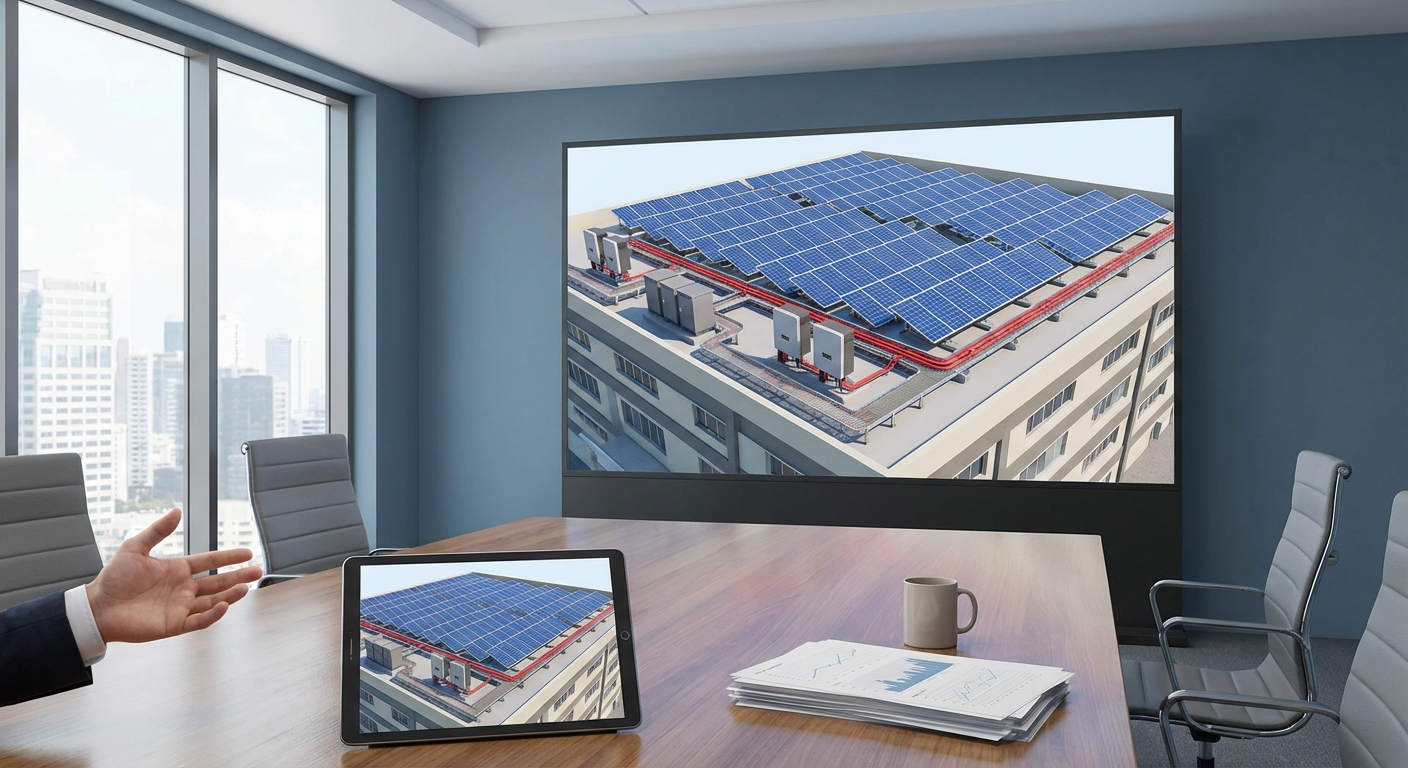
Visual communication breaks down technical barriers that often intimidate potential solar clients. Building owners, facility managers, and project developers may lack technical expertise to interpret engineering drawings, but everyone understands a photorealistic 3D rendering showing exactly how solar panels will look on their property. This immediate comprehension accelerates decision-making and builds confidence in the proposed solution.
Effective proposal presentations using 3D models typically follow a narrative structure. Begin with contextual views showing the existing site, then introduce the proposed solar installation through wide-angle renderings that demonstrate overall project scope. Follow with detailed views highlighting key features like equipment placement, mounting systems, and integration with existing infrastructure. Include shadow analysis visualizations showing how the system performs throughout the day and across seasons. Conclude with energy production graphics and financial projections supported by the preliminary design.
The competitive advantage of professional 3D visualizations cannot be overstated in India’s crowded solar EPC market. When multiple companies bid on the same project, the EPC presenting sophisticated 3D models and comprehensive visualizations immediately distinguishes itself as more professional, technically capable, and client-focused. This perception often justifies premium pricing and wins projects even when competing against lower-cost alternatives.
Client communication throughout the project lifecycle benefits from 3D models. During initial discussions, the visualizations help clients articulate their preferences and concerns. When design modifications are needed, updated 3D renderings quickly show the impact of changes. For stakeholder approvals—whether building management committees, corporate leadership, or regulatory authorities—the visual materials facilitate understanding and consensus.
Marketing and business development efforts gain powerful tools from 3D pre-design deliverables. EPCs can showcase completed project visualizations in marketing materials, website galleries, and social media content. The professional appearance of 3D renderings elevates brand perception and attracts higher-quality leads. Some EPCs even use 3D visualizations in proactive business development, creating unsolicited preliminary designs for target prospects to demonstrate potential and initiate conversations.
The return on investment for professional 3D pre-design services typically manifests in higher proposal conversion rates, ability to command premium pricing, faster sales cycles due to clearer client understanding, reduced post-sale changes and scope creep, and stronger client relationships built on clear communication. EPCs tracking these metrics consistently report that the cost of professional 3D design services is recovered many times over through improved business outcomes.
Choosing the Right 3D Design Partner in India
Selecting the right solar design company for 3D pre-design services significantly impacts project outcomes, proposal quality, and overall business success. EPCs should evaluate potential design partners across several critical dimensions to ensure they receive professional, reliable, and cost-effective services.
Engineering team experience and expertise should be the primary consideration. Look for design partners with substantial track records in solar projects across India’s diverse regions. A team that has designed projects in coastal Gujarat, hilly Himachal Pradesh, and urban Mumbai brings invaluable regional knowledge to your projects. Ask about the size and composition of the engineering team, larger teams with specialized expertise in different project types typically deliver more comprehensive services than small generalist operations.
Technical capabilities and software infrastructure matter significantly. Professional design partners invest in industry-leading design software India tools including PVsyst, AutoCAD, SketchUp, Helioscope, and specialized 3D rendering platforms. These tools enable accurate modeling, comprehensive analysis, and high-quality visualizations. Inquire about the specific software and methodologies used for shadow analysis, energy modeling, and 3D rendering.
Portfolio and track record provide concrete evidence of capabilities. Request examples of previous 3D pre-design projects similar to your needs. Evaluate the quality of visualizations, completeness of deliverables, and sophistication of technical documentation. Strong design partners can demonstrate hundreds of completed projects across various scales and types, from residential rooftops to utility-scale ground-mount installations.
Communication and project management processes directly impact your experience and project timelines. Effective design partners provide clear points of contact, regular project updates, and structured review processes. They should accommodate reasonable revision requests and respond promptly to questions. Ask about typical communication channels, update frequency, and how revisions are handled.
Turnaround time and reliability are critical for EPCs working on competitive bids with tight deadlines. Evaluate the design partner’s typical timelines for projects similar to yours and their track record for meeting deadlines. Reliable partners build buffer time into schedules and communicate proactively if delays occur.
Cost structure and value proposition should align with your business model. While solar design cost is certainly a consideration, the lowest price rarely delivers the best value. Evaluate pricing in context of deliverable quality, turnaround time, and the level of expertise provided. Some design partners offer tiered service levels, allowing you to select appropriate depth of analysis for different project types.
Integration with broader services can provide significant advantages. Design partners who offer comprehensive capabilities, from initial feasibility study India services through 3D pre-design to detailed engineering and PMC services, enable seamless project progression. This integration eliminates handoff issues between different service providers and ensures consistency throughout the project lifecycle.
Geographic presence and site visit capabilities may be important for complex projects. While much 3D pre-design work can be done remotely, having a design partner with site survey India capabilities or regional presence can be valuable for projects requiring detailed on-site assessment.
Client references and testimonials from other EPCs provide valuable insights into working relationships and service quality. Don’t hesitate to ask for references and contact them to discuss their experiences, particularly regarding communication, reliability, and problem-solving when challenges arise.
Frequently Asked Questions About Solar 3D Design India
What software is used for 3D solar design?
Professional 3D design India services typically use a combination of specialized software tools. PVsyst and Helioscope handle solar-specific calculations including energy modeling and shadow analysis. AutoCAD and SketchUp create detailed 3D models and technical drawings. Rendering software like Lumion or V-Ray produces photorealistic visualizations. Many design companies also use proprietary tools developed specifically for solar project workflows. The specific software matters less than the expertise of the engineers using these tools and their experience with Indian project conditions.
How much does 3D pre-design cost?
The solar design cost for 3D pre-design services varies based on project size, complexity, and deliverable scope. Residential rooftop projects typically range from modest fees for basic visualization to higher costs for comprehensive packages. Commercial and industrial projects scale based on system size and complexity. Ground-mount installations generally command higher fees due to terrain modeling requirements and more extensive analysis. Rather than focusing solely on cost, EPCs should evaluate the return on investment, professional 3D pre-design typically pays for itself through higher proposal conversion rates and reduced engineering rework. Contact design partners directly for project-specific quotes, as pricing often depends on your specific requirements and ongoing relationship volume.
What data is needed to start 3D pre-design?
The minimum data requirements include site location coordinates, property boundaries or roof dimensions, and clear photographs of the site. For better accuracy, provide topographic survey data, detailed site measurements, information about existing structures and obstructions, electrical infrastructure details, and any structural information for rooftop projects. The more complete your initial data, the more accurate the preliminary design and the faster the turnaround time. Many design partners can work with limited initial data and refine the model as additional information becomes available.
Can 3D pre-design be done remotely?
Yes, most 3D design India services are delivered remotely using satellite imagery, drone data, and information provided by EPCs. Remote design is cost-effective and efficient for the majority of projects. However, complex sites with unusual terrain, significant existing infrastructure, or limited available data may benefit from on-site surveys. Many design partners offer hybrid approaches, conducting initial modeling remotely and recommending site visits only when necessary to resolve specific questions or gather additional data.
How does 3D pre-design integrate with permit design?
The 3D pre-design phase creates an excellent foundation for subsequent permit design work. The preliminary layouts, equipment specifications, and technical documentation from pre-design accelerate permit drawing preparation. The 3D visualizations often support permit applications, helping regulatory authorities understand the proposed project. Many design partners offer integrated services where the 3D pre-design seamlessly transitions into permit-ready drawings, ensuring consistency and reducing overall project timelines. The preliminary design identifies potential permit issues early, allowing time to address them before formal submissions.
Take the Next Step with Professional 3D Design India Services
As India’s solar market continues its rapid expansion in 2026, the EPCs who thrive will be those who combine technical excellence with compelling client communication. Professional 3D design India services provide both, delivering accurate preliminary designs that identify issues early while creating powerful visualizations that win projects and build client confidence.
Whether you’re planning your first solar project or your hundredth, partnering with an experienced solar design company for 3D pre-design services accelerates your project timeline, improves proposal quality, and optimizes your engineering investments. The comprehensive process, from site assessment through preliminary layout, shadow analysis, and energy modeling, ensures your projects start on solid foundations with clear visibility into potential challenges and opportunities.
Heaven Designs Private Limited brings over 628 MW of design experience across 752+ projects to every 3D pre-design engagement. Our team of 50+ specialized engineers understands the unique requirements of solar projects across India’s diverse terrain and climate conditions, from coastal installations to hilly terrain, urban rooftops to rural ground-mount systems. We deliver comprehensive 3D visualizations, accurate preliminary layouts, and detailed technical documentation that help EPCs win more projects and execute them more efficiently.
Ready to elevate your solar proposals with professional 3D design India services? Get a Quick Proposal Now! to discuss your upcoming projects and discover how our comprehensive pre-design services can give you a competitive edge in India’s dynamic solar market. Our team is ready to help you visualize success, identify opportunities, and present compelling proposals that convert prospects into satisfied clients.
For immediate assistance with your solar design needs, reach out to our team at service@heavendesigns.in or call +91 90811 00297. Let’s work together to bring your solar projects from concept to reality with precision, professionalism, and proven expertise.
This blog post was written using thestacc.com