


In the competitive solar EPC industry, the difference between a profitable project and a costly failure often comes down to one critical factor: solar design accuracy. As solar installations scale across India and global markets in 2026, even minor design errors can cascade into permit rejections, structural failures, energy underperformance, and significant financial losses. For solar EPC companies managing multiple megawatt-scale projects, these mistakes aren’t just technical oversights—they’re business-threatening vulnerabilities that erode client trust and profit margins.
With over 628+ MW of design work completed for 752+ solar EPC clients, Heaven Designs has witnessed firsthand how preventable design errors derail projects. This comprehensive guide examines the 20 most critical solar design mistakes that EPCs make during the engineering phase, why they occur, and most importantly, how to avoid them. Whether you’re handling rooftop solar installations in Mumbai, ground-mount projects in Rajasthan, or commercial solar developments internationally, understanding these pitfalls will help you deliver accurate, compliant, and profitable solar projects.
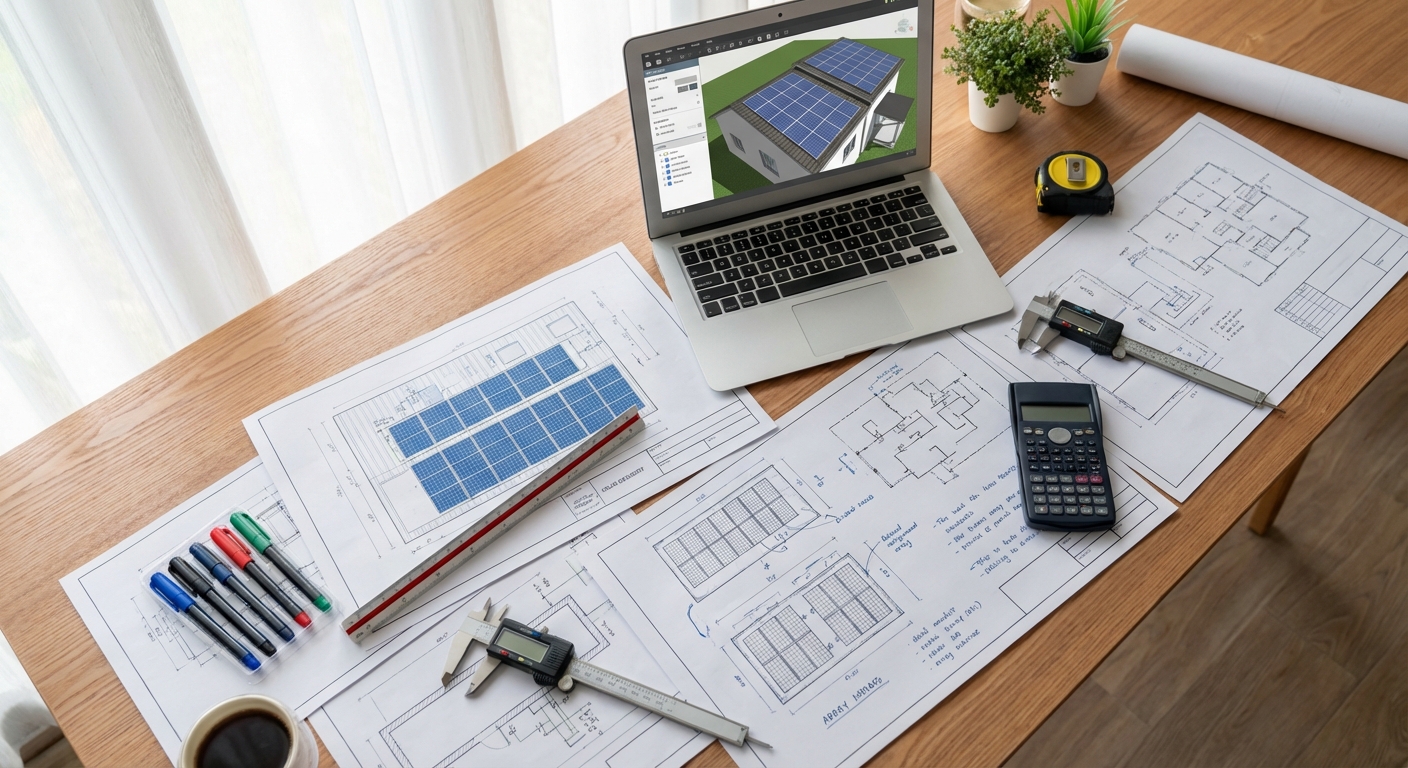
1. Inaccurate Energy Yield Calculations
Why This Happens: Many EPCs rely on outdated simulation software, generic irradiation databases, or simplified calculation methods that don’t account for location-specific variables. Some teams use online calculators without understanding their limitations, while others apply standard derating factors that don’t reflect actual site conditions.
The consequences are severe. When projected energy generation exceeds actual performance by even 10-15%, clients face financial shortfalls that undermine the entire project ROI. Performance guarantees become liabilities, and your reputation suffers when systems consistently underperform expectations.
Solution: Implement validated simulation tools like PVsyst, Helioscope, or SAM that incorporate detailed meteorological data specific to your project location. Use TMY (Typical Meteorological Year) data from reliable sources like NREL or local meteorological departments. Account for all system losses including soiling (particularly critical in dusty Indian conditions), temperature coefficients, inverter efficiency curves, and cable losses. Professional solar design services utilize calibrated models that have been validated against actual installation performance data.
2. Inadequate Site Survey and Feasibility Analysis
Why This Happens: Time pressure and cost-cutting measures often lead EPCs to conduct superficial site surveys. Teams may rely solely on satellite imagery, skip structural assessments, or fail to identify critical site constraints like nearby construction plans, soil conditions for ground-mount projects, or roof age and condition.
The impact becomes apparent during installation when teams discover structural inadequacies, unexpected shading sources, or access limitations that weren’t documented. These surprises lead to design revisions, procurement delays, and cost overruns that eliminate project profitability.
Solution: Conduct comprehensive site surveys that include physical inspections, structural assessments, electrical infrastructure evaluation, and photographic documentation from multiple angles and times of day. For rooftop projects, assess roof condition, waterproofing, load-bearing capacity, and existing penetrations. For ground-mount installations, conduct geotechnical surveys and topographical mapping. Professional site survey services across India ensure no critical detail is overlooked, providing the foundation for accurate design work.
3. Structural Load Miscalculations
Why This Happens: Structural engineering is often treated as an afterthought rather than an integral part of solar design. EPCs may use generic mounting system specifications without calculating actual dead loads, live loads, and dynamic loads specific to the structure. Some teams lack in-house structural engineering expertise and make assumptions about load-bearing capacity.
The risks are catastrophic. Roof collapses, mounting system failures, and safety incidents not only result in property damage and potential injuries but also expose EPCs to significant legal liability and insurance claims.
Solution: Engage qualified structural engineers to perform detailed load calculations for every project. Calculate total system weight including modules, mounting structures, cable trays, and maintenance loads. Assess existing structure capacity through engineering analysis or physical testing. Design reinforcement solutions where needed. Heaven Designs’ solar civil and structural engineering services ensure that every installation meets safety standards and local building codes, protecting both the structure and your business from liability.
4. Ignoring Local Wind and Snow Load Requirements
Why This Happens: EPCs sometimes apply standardized mounting system designs across different geographic regions without accounting for local environmental conditions. In India, wind loads vary significantly from coastal areas like Gujarat and Tamil Nadu to inland regions, yet designs often use generic specifications.
This oversight leads to permit rejections from local authorities, insurance coverage issues, and actual structural failures during extreme weather events. A mounting system adequate for Bangalore may be completely insufficient for cyclone-prone coastal regions.
Solution: Design according to IS 875 (Code of Practice for Design Loads for Buildings and Structures) and local building codes that specify wind and snow loads for your specific location. Calculate wind uplift forces, overturning moments, and dynamic loads based on regional wind speed data. For elevated or exposed installations, conduct wind tunnel testing or CFD analysis. Ensure mounting system certifications match or exceed local requirements. Professional solar design teams stay current with evolving codes and regional variations across India and international markets.
5. Poor Cable Sizing and Electrical Design
Why This Happens: Electrical design is sometimes simplified to reduce material costs, with EPCs selecting cable sizes based on current-carrying capacity alone without properly accounting for voltage drop, temperature derating, and future expansion. Some teams lack expertise in DC system design, which differs significantly from traditional AC electrical work.
Undersized cables result in voltage drop that reduces system efficiency and energy generation. More critically, they create fire hazards through overheating, especially in bundled cable runs or high-temperature environments common in Indian summers.
Solution: Perform comprehensive electrical calculations that account for maximum current, ambient temperature, installation method, cable bundling, and acceptable voltage drop limits (typically 3% for DC circuits). Use appropriate cable types rated for outdoor UV exposure, temperature extremes, and DC applications. Include proper overcurrent protection, disconnects, and surge protection devices. Document all calculations in detailed single-line diagrams and cable schedules. Professional solar engineering design ensures electrical systems are both safe and optimized for performance.
6. Inadequate Shading Analysis
Why This Happens: Shading analysis is often conducted using simplified tools or at a single point in time, missing seasonal variations, nearby construction plans, or vegetation growth. Some EPCs rely on 2D analysis that doesn’t capture the three-dimensional nature of shadow casting throughout the day and year.
The result is significant energy generation shortfalls when actual shading proves more extensive than projected. Even partial shading on a few modules can disproportionately impact string performance, especially in systems without optimizers or microinverters.
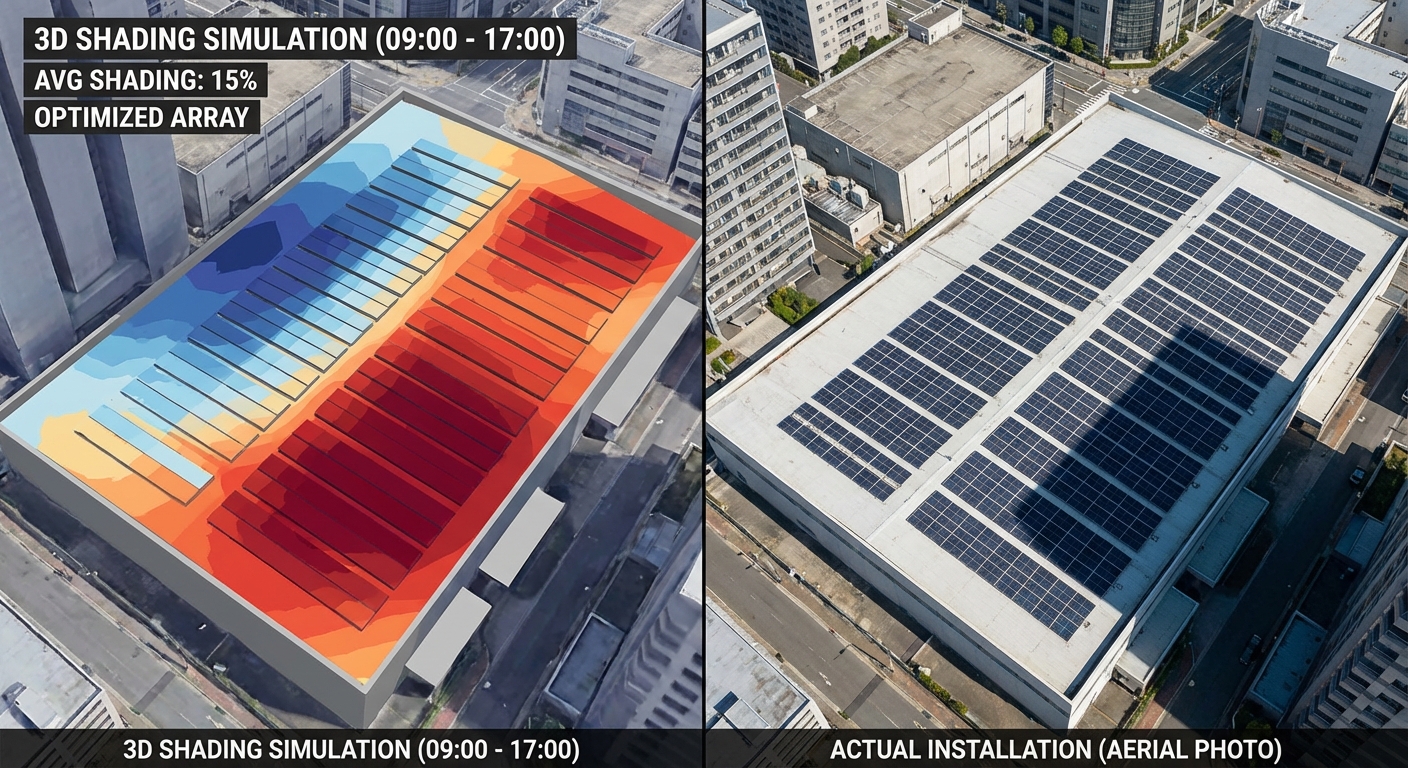
Solution: Conduct comprehensive shading analysis using 3D modeling tools that simulate sun paths throughout the entire year. Document all potential shading sources including nearby buildings, trees, chimneys, HVAC equipment, and planned construction. Generate shading reports showing monthly and annual shading losses. For complex sites, consider site visits at different times of day to validate simulation results. Design string configurations that minimize the impact of unavoidable shading through strategic module placement and electrical design. Heaven Designs’ Solar 3D Pre-Design services provide detailed shading analysis that accurately predicts system performance.
7. Incorrect Module Layout and Orientation
Why This Happens: EPCs sometimes prioritize system capacity over optimal orientation, cramming maximum modules onto available space without considering tilt angle optimization, row spacing, or orientation. Others apply standard tilt angles without site-specific analysis of latitude, seasonal generation patterns, or client energy consumption profiles.
Suboptimal layouts reduce energy generation, create unnecessary shading between rows, waste available space, and may even violate setback requirements for fire access or maintenance.
Solution: Optimize module layout based on site-specific factors including latitude, roof orientation, available space, structural constraints, and client energy needs. For flat roofs, calculate optimal tilt angles that balance energy generation with wind loads and spacing requirements. Consider seasonal generation patterns—higher tilt angles favor winter generation while lower tilts optimize summer output. Use design software to model multiple layout scenarios and select the configuration that maximizes energy generation per unit area while meeting all code requirements. Factor in maintenance access pathways and fire safety setbacks from the initial design phase.
8. Inverter Sizing Errors
Why This Happens: Inverter selection is sometimes based on simple capacity matching without considering DC-to-AC ratios, inverter efficiency curves, clipping losses, or future expansion. Some EPCs oversize inverters to avoid any possibility of clipping, wasting capital on unnecessary capacity. Others undersize to reduce costs, creating bottlenecks that limit system performance.
Incorrect inverter sizing either wastes capital investment or limits energy generation, directly impacting project economics and client satisfaction.
Solution: Calculate optimal DC-to-AC ratios based on site irradiation profiles, system orientation, and inverter efficiency curves. For most Indian locations, ratios between 1.1 and 1.3 optimize economics by accepting minimal clipping losses in exchange for better inverter utilization. Consider inverter efficiency at partial loads, as systems operate below peak capacity most of the time. Evaluate string voltage ranges across temperature extremes to ensure compatibility. For commercial and industrial projects, consider multiple smaller inverters rather than single large units to improve partial-load efficiency and provide redundancy. Professional solar design services model inverter performance across annual operating conditions to optimize selection.
9. Incomplete or Inaccurate Permit Documentation
Why This Happens: Permit requirements vary significantly across Indian states, municipalities, and DISCOMs, yet EPCs often use template documentation without customizing for local requirements. Teams may lack familiarity with specific authority expectations, submit incomplete technical drawings, or fail to include required certifications and calculations.
Permit rejections cause project delays that cascade through installation schedules, procurement timelines, and client commitments. Each resubmission cycle adds weeks or months to project timelines, increasing soft costs and risking client relationships.
Solution: Develop comprehensive permit design packages that include all required documentation: site plans, electrical single-line diagrams, structural calculations, equipment specifications, interconnection applications, and safety compliance documentation. Research specific requirements for each jurisdiction before submission. Include professional engineer stamps where required. Maintain relationships with local authorities to understand evolving requirements. Heaven Designs specializes in solar permit design that ensures compliance and minimizes approval timelines, having successfully navigated permit processes across multiple Indian states and international markets.
10. Neglecting Fire Safety and Access Requirements
Why This Happens: Fire codes for solar installations are evolving, and many EPCs aren’t aware of requirements for firefighter access pathways, rapid shutdown systems, or setbacks from roof edges and ridges. These requirements are often discovered during permit review or inspection, necessitating design changes.
Non-compliant designs face permit rejection, costly redesigns, and reduced system capacity when access pathways must be added after initial layout optimization.
Solution: Incorporate fire safety requirements from the initial design phase. Maintain required setbacks from roof edges (typically 1-1.5 meters), ridges, and hips. Design clear access pathways for firefighters, usually 1.2-1.5 meters wide. Include rapid shutdown systems that comply with evolving electrical codes. Label all system components clearly for emergency responders. For large rooftop installations, coordinate with local fire departments during the design phase to ensure compliance with their specific requirements. Build these constraints into your layout optimization to avoid surprises during permitting.
11. Poor Grounding and Earthing Design
Why This Happens: Grounding and earthing systems are often simplified or treated as installation details rather than design requirements. EPCs may not specify proper bonding between all metallic components, adequate earth electrode systems, or lightning protection for elevated installations.
Inadequate grounding creates serious safety hazards, increases lightning damage risk, and can cause equipment failures through ground faults or surge events. In India’s monsoon climate, proper lightning protection is critical for system longevity.
Solution: Design comprehensive grounding systems that bond all metallic components including module frames, mounting structures, cable trays, and equipment enclosures. Specify earth electrode systems with adequate resistance values (typically below 5 ohms). Include lightning protection systems for ground-mount installations and elevated rooftop systems. Use proper grounding conductors sized according to fault current calculations. Document grounding design in detailed drawings showing bonding connections, earth electrode locations, and conductor routing. Ensure compliance with IS 3043 (Code of Practice for Earthing) and IEC standards for lightning protection.
12. Ignoring Thermal Management
Why This Happens: Many EPCs don’t adequately consider the thermal environment of solar installations, particularly in hot climates like India where ambient temperatures regularly exceed 40°C. Module mounting without adequate ventilation, inverter placement in direct sun, or inadequate spacing between modules and roof surfaces all contribute to thermal issues.
Elevated operating temperatures reduce module efficiency (typically 0.4-0.5% per degree Celsius above 25°C), shorten equipment lifespan, and can cause premature failures. Inverters operating above rated temperatures derate output or shut down entirely during peak generation hours.
Solution: Design for thermal management by maintaining adequate spacing between modules and roof surfaces (minimum 100-150mm) to allow air circulation. Orient inverters away from direct sun exposure or provide shading structures. Consider active cooling for inverter rooms in hot climates. Account for temperature coefficients in energy generation calculations. For rooftop installations, consider reflective roof coatings or ventilated mounting systems that reduce module operating temperatures. Professional solar design incorporates thermal analysis to optimize system performance in actual operating conditions.
13. Inadequate String Design and Configuration
Why This Happens: String design is sometimes simplified to create uniform configurations without considering voltage ranges across temperature extremes, MPPT input requirements, or the impact of partial shading. Some designs mix modules with different specifications or orientations within the same string, creating mismatch losses.
Poor string design results in voltage incompatibilities that prevent system operation, inefficient MPPT utilization that reduces energy harvest, and increased losses from current mismatch in series-connected modules.
Solution: Calculate string lengths based on inverter MPPT voltage windows across the full operating temperature range (typically -10°C to 70°C for module temperature). Ensure maximum open-circuit voltage never exceeds inverter limits at minimum temperature, and minimum operating voltage stays within MPPT range at maximum temperature. Keep modules with identical specifications, orientation, and tilt within each string. Design string configurations that align with roof sections to minimize the impact of partial shading. Balance string lengths across MPPT inputs for optimal inverter utilization. Document string configurations clearly in electrical drawings with module counts, voltage calculations, and current ratings.
14. Overlooking Grid Connection Requirements
Why This Happens: Grid interconnection requirements vary significantly across DISCOMs in India and utilities internationally. EPCs sometimes design systems without early coordination with the utility, leading to surprises regarding metering requirements, protection schemes, power factor specifications, or grid code compliance.
Non-compliant designs delay commissioning while equipment is modified or replaced, and some utilities may reject interconnection applications entirely if systems don’t meet their technical specifications.
Solution: Initiate utility coordination during the design phase, not after installation. Obtain and review the specific DISCOM’s technical requirements for solar interconnection. Ensure inverters meet grid code requirements including voltage and frequency ride-through, anti-islanding protection, and power quality standards. Design metering arrangements that comply with net metering or gross metering requirements. Include required protection devices such as directional relays, under/over voltage protection, and under/over frequency protection. For large commercial and industrial projects, coordinate with utilities on interconnection capacity, transformer upgrades, and protection coordination. Professional solar EPC design services navigate these requirements across different utility territories.
15. Insufficient Bill of Materials (BOM) Accuracy
Why This Happens: BOMs are sometimes generated from preliminary designs without updating for final revisions, or they lack sufficient detail regarding cable lengths, connector types, mounting hardware, and balance-of-system components. Some EPCs use generic BOMs without site-specific customization.
Inaccurate BOMs lead to material shortages during installation, emergency procurement at premium prices, installation delays while waiting for components, and budget overruns that eliminate project profitability.
Solution: Generate detailed BOMs from final, approved designs that include every component with specifications, quantities, and vendor part numbers. Calculate cable lengths with appropriate contingencies for routing and terminations. Include all mounting hardware, connectors, labels, and consumables. Organize BOMs by system section (DC array, AC electrical, mounting, etc.) for easier procurement and installation tracking. Review BOMs against design drawings to verify accuracy. Update BOMs whenever design changes occur. Professional MW Scale Detailed Engineering Design services produce comprehensive BOMs that eliminate procurement surprises and support accurate project budgeting.
16. Poor Documentation and Drawing Quality
Why This Happens: Time pressure often leads to rushed documentation with unclear drawings, missing details, or inconsistencies between different drawing sets. Some EPCs produce minimal documentation assuming installation teams will “figure it out,” while others lack CAD expertise to produce professional-quality drawings.
Poor documentation causes installation errors, rework, delays, and communication gaps between design and installation teams. Unclear drawings lead to field questions that slow installation progress and may result in systems built differently than designed.
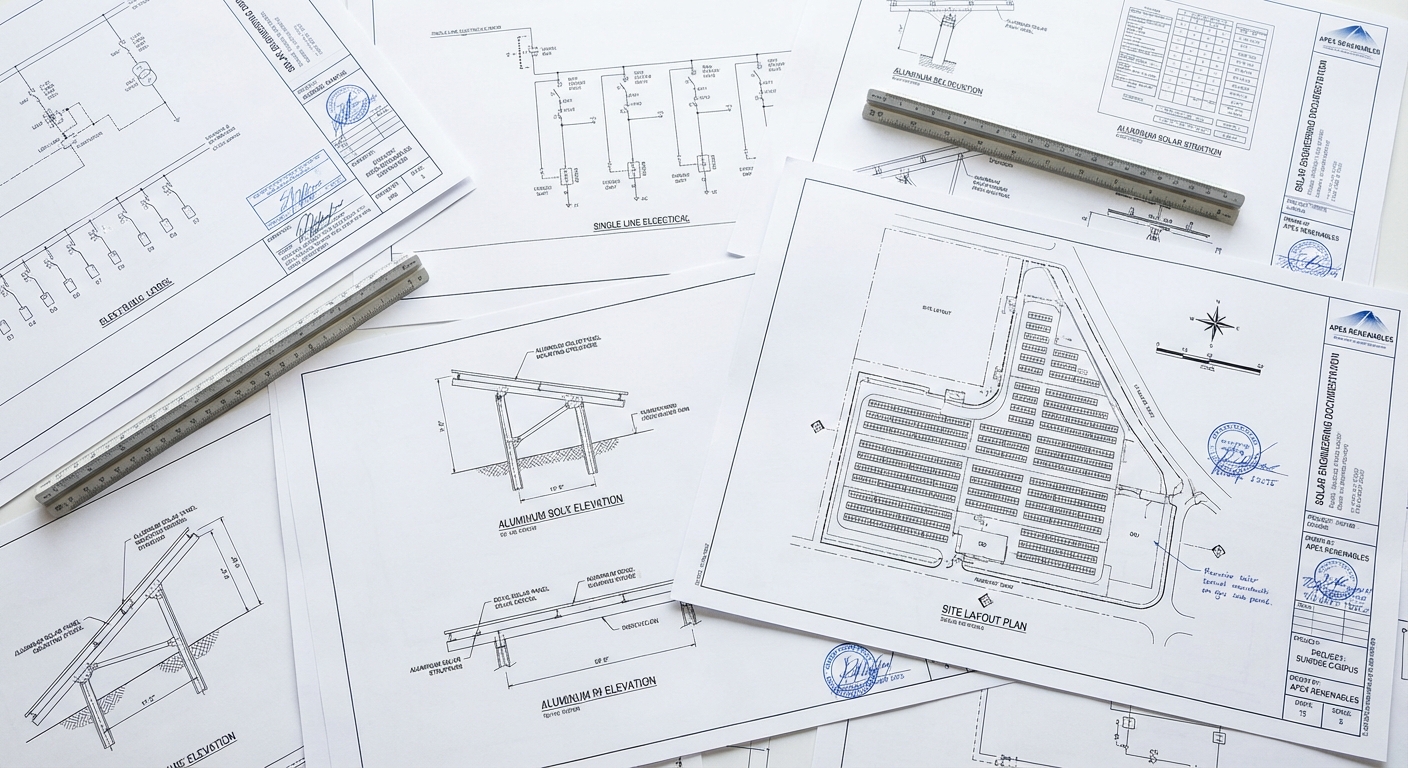
Solution: Produce comprehensive, professional-quality documentation including: site layout plans showing module locations and dimensions; electrical single-line diagrams with all components and ratings; mounting structure details and installation instructions; cable routing plans with conduit sizes and lengths; equipment specifications and datasheets; and installation notes addressing site-specific considerations. Use professional CAD software to ensure clarity and accuracy. Implement drawing review processes to catch errors before release. Maintain version control and document all revisions. Include sufficient detail that installation teams can work independently without constant design team consultation. Heaven Designs’ engineering team produces detailed, professional drawings that serve as clear roadmaps for installation teams, reducing errors and accelerating project completion.
17. Neglecting Future Expansion Possibilities
Why This Happens: Designs often focus solely on current capacity requirements without considering client growth plans, available space for future additions, or electrical infrastructure that could accommodate expansion. This short-term thinking saves minimal costs initially but creates expensive limitations later.
When clients want to expand capacity, they discover that electrical panels are fully utilized, mounting structures can’t accommodate additional modules, or roof space was inefficiently used. Retrofitting for expansion costs significantly more than designing for it initially.
Solution: Discuss future expansion plans with clients during the feasibility study phase. Design electrical infrastructure with spare capacity in panels, inverters with room for additional strings, and conduit systems that can accommodate future circuits. Plan module layouts that allow for logical expansion phases. Document expansion pathways in design drawings. For clients with uncertain future needs, design modular systems that can grow incrementally. The marginal cost of expansion-ready design is minimal compared to retrofit costs, and it positions you as a strategic partner rather than just a vendor.
18. Inadequate Monitoring System Design
Why This Happens: Monitoring systems are often treated as add-ons rather than integral design components. EPCs may specify basic monitoring without considering the client’s need for performance tracking, troubleshooting capabilities, or integration with building management systems.
Without proper monitoring, performance issues go undetected, O&M teams struggle to diagnose problems, and clients lack visibility into system performance and ROI. This leads to energy generation losses and client dissatisfaction.
Solution: Design comprehensive monitoring systems that track performance at appropriate granularity—string-level monitoring for commercial systems, module-level for critical applications. Include weather stations to normalize performance data. Specify monitoring platforms that provide alerts for underperformance, equipment faults, and grid issues. Consider client requirements for data access, reporting, and integration with existing systems. Design communication infrastructure (cellular, ethernet, or WiFi) with adequate coverage and redundancy. Include monitoring system design in electrical drawings showing sensor locations, communication routing, and power supplies. Professional solar design integrates monitoring from the beginning, ensuring systems can be effectively managed throughout their operational life.
19. Ignoring Local Material Availability
Why This Happens: Designers sometimes specify equipment or materials based on familiarity or perceived quality without researching local availability, lead times, or import requirements. This is particularly problematic for international EPC projects or when specifying specialized components.
Specifying unavailable materials leads to procurement delays, expensive air freight to meet deadlines, or last-minute substitutions that require design revisions and may compromise system performance.
Solution: Research material availability in the project location during the design phase. Maintain relationships with suppliers and distributors to understand lead times and stock levels. Design with locally available, quality materials where possible, specifying imported components only when necessary for performance or compliance. Identify acceptable alternatives for critical components before procurement begins. For projects in India, leverage the growing domestic solar manufacturing ecosystem for modules, mounting structures, and balance-of-system components. Consider procurement timelines in project scheduling. Professional solar design services with experience across multiple markets understand regional material availability and design accordingly.
20. Lack of Design Review and Quality Control
Why This Happens: Time and budget pressure often leads EPCs to skip formal design review processes. Single engineers may complete designs without peer review, or reviews may be superficial checklists rather than thorough technical evaluations. Some organizations lack senior engineers with the expertise to conduct meaningful reviews.
Without rigorous review, errors compound through the design process and aren’t discovered until installation or commissioning. By then, corrections are exponentially more expensive and time-consuming than catching issues during design.
Solution: Implement multi-stage design review processes with clear checkpoints: preliminary design review after site survey and initial layout; detailed design review before documentation release; and final review before submission to client or authorities. Assign senior engineers to review work by junior team members. Use checklists that cover all critical design elements: structural calculations, electrical sizing, code compliance, drawing accuracy, and BOM completeness. Encourage a culture where finding errors during review is valued, not penalized. Consider third-party design reviews for complex or high-value projects. Heaven Designs’ team of over 50 engineers implements rigorous quality control processes with multiple review stages, ensuring that designs are accurate, compliant, and optimized before reaching clients.
How Professional Solar Design Services Prevent These Mistakes
The 20 mistakes outlined above share a common thread: they’re all preventable with proper expertise, processes, and quality control. For many solar EPC companies, the question isn’t whether these mistakes are serious—it’s how to avoid them while managing multiple projects, controlling costs, and meeting aggressive timelines.
This is where partnering with specialized solar design consultancies transforms from an expense into a strategic investment. Professional design services bring several critical advantages:
Specialized Expertise: Design consultancies focus exclusively on solar engineering, developing deep expertise across project types, technologies, and regulatory environments. Heaven Designs’ team of over 50 engineers and consultants brings specialized knowledge in structural engineering, electrical design, permit compliance, and project management consultancy that would be difficult and expensive for individual EPCs to maintain in-house.
Proven Processes: Professional design firms implement systematic processes with built-in quality control, peer review, and compliance verification. Having completed 628+ MW of design work across 752+ projects, Heaven Designs has refined processes that catch errors before they reach installation, ensuring accuracy and consistency across all deliverables.
Cost Effectiveness: While professional design services represent an upfront investment, they eliminate the far greater costs of design errors: permit rejections, installation delays, material waste, rework, and warranty claims. For EPCs managing variable project pipelines, outsourcing design also eliminates the fixed costs of maintaining large in-house engineering teams during slow periods.
Scalability: Design consultancies can scale resources up or down based on your project pipeline, providing additional capacity during busy periods without the long-term commitment of hiring. This flexibility is particularly valuable for EPCs experiencing growth or seasonal variation in project volume.
Technology Investment: Professional design firms invest in advanced design software, simulation tools, and CAD systems that individual EPCs might find difficult to justify. These tools enable more accurate analysis, faster design iterations, and higher-quality documentation.
Regulatory Knowledge: Navigating permit requirements across different Indian states, municipalities, and DISCOMs requires current knowledge of evolving regulations. Design consultancies maintain this knowledge across multiple jurisdictions, ensuring compliance regardless of project location.
Focus on Core Competencies: By outsourcing design, EPCs can focus on their core strengths: client relationships, project management, installation excellence, and business development. This specialization allows each partner to excel in their domain, delivering better overall project outcomes.
Heaven Designs serves as a design partner for solar EPCs globally, providing comprehensive services from initial Solar 3D Pre-Design and feasibility studies through detailed engineering, structural analysis, and PMC services for megawatt-scale projects. With a track record of 628+ MW designed across 752+ clients in 3+ countries, the company brings proven expertise in avoiding the costly mistakes that derail solar projects.
The ROI of professional design services is clear: projects complete faster with fewer delays, installations proceed smoothly with accurate documentation, permits are approved on first submission, and systems perform as projected. Most importantly, clients receive reliable, high-performing solar installations that meet their energy and financial goals—building your reputation and generating referrals for future business.
Conclusion: Elevate Your Solar EPC Business with Error-Free Design
The solar industry in India and globally is at an inflection point in 2026. As installations scale and competition intensifies, the EPCs that thrive will be those that deliver consistently excellent projects—on time, on budget, and performing as promised. Design excellence is the foundation of this consistency.
The 20 critical mistakes outlined in this guide represent the most common and costly errors that undermine solar projects. From inaccurate energy calculations and structural failures to permit rejections and poor documentation, each mistake carries significant financial and reputational consequences. Yet all are preventable with proper expertise, processes, and quality control.
For solar EPC companies, the path forward is clear: invest in design excellence, whether by building internal capabilities or partnering with specialized consultancies. The marginal cost of professional solar design services is minimal compared to the costs of errors, delays, and underperforming systems. More importantly, design excellence becomes a competitive differentiator that wins clients, enables premium pricing, and builds long-term business value.
As you evaluate your current design processes, ask yourself: How many of these 20 mistakes have impacted your projects? What is the true cost of design errors to your business? And most importantly, what would be possible if every project was designed right the first time?
Heaven Designs partners with forward-thinking solar EPCs to eliminate design errors and deliver exceptional project outcomes. With comprehensive services spanning site surveys, detailed engineering, structural analysis, permit design, and project management consultancy, we provide the expertise and capacity to support your growth while maintaining the highest quality standards.
Ready to elevate your solar projects with error-free design? Get a Quick Proposal Now! or contact our team at service@heavendesigns.in or +91 90811 00297 to discuss how professional solar design services can transform your EPC business. Let’s build solar projects that perform as promised, every time.
About Heaven Designs: Based in Surat, Gujarat, Heaven Designs Private Limited specializes in comprehensive solar engineering design services for EPC companies globally. With a team of over 50 skilled engineers and consultants, we’ve completed 628+ MW of design work for 752+ solar EPC clients across 3+ countries, delivering cost-effective and accurate solar project designs focused on maximizing energy generation while optimizing project costs.