


For solar EPC companies operating in India’s rapidly expanding renewable energy market, understanding the intricate relationship between design timeline and project costs is no longer optional—it’s essential for maintaining competitive margins and delivering value to clients. In 2026, as solar installations continue to surge across residential, commercial, and utility-scale segments, the pressure to balance speed with budget optimization has never been more intense. A compressed design timeline might seem like a pathway to faster project completion, but without strategic planning, it can trigger a cascade of cost overruns that erode profitability and strain client relationships.
The reality is that every phase of solar project design—from initial feasibility studies to final permit documentation—carries specific time requirements and associated costs. When EPCs rush through these phases or fail to account for complexity factors unique to Indian markets, they often face expensive revision cycles, regulatory delays, and compromised design quality. This comprehensive guide explores how design timeline decisions directly impact your project budget, providing actionable insights for residential solar installation companies, commercial developers, and MW-scale project managers across India and international markets.
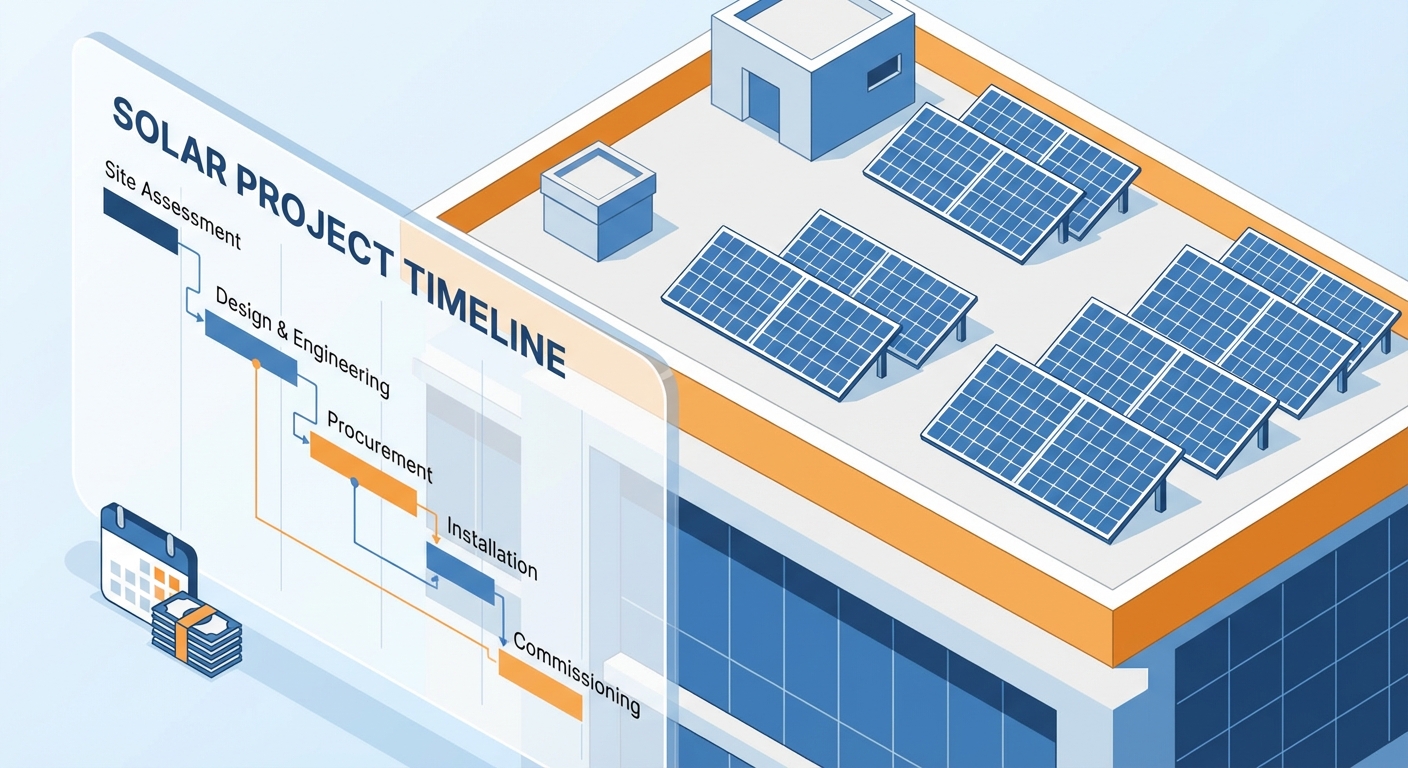
Understanding the Critical Link Between Design Timeline and Project Costs
The connection between project duration and budget in solar design is more nuanced than simple linear relationships. While it might seem intuitive that faster timelines cost more, the reality involves multiple interdependent factors that solar EPC companies must navigate carefully. In India’s diverse solar market, where projects range from 3 kW residential rooftop installations to 100+ MW ground mount solar farms, timeline planning becomes a strategic lever for cost management.
When EPC companies approach solar design India projects without realistic timeline expectations, they typically encounter three major cost drivers. First, rushed preliminary designs often miss critical site-specific factors—shading analysis, structural load calculations, or grid connection constraints, that require expensive redesigns later. Second, compressed timelines force design teams to work overtime or allocate additional resources, increasing labor costs significantly. Third, inadequate time for regulatory review and permit preparation leads to submission rejections, creating costly delays that compound throughout the project lifecycle.
Consider a typical scenario: A commercial solar developer in Maharashtra needs a 500 kW rooftop design completed in two weeks instead of the standard four-week timeline. While the expedited service might carry a 25-30% premium on solar design cost, the hidden expenses often prove more substantial. The rushed feasibility study might overlook structural reinforcement requirements, discovered only during detailed engineering, adding weeks to the timeline and thousands to the budget. The permit design, prepared without adequate utility coordination time, faces rejection for grid compliance issues, requiring a complete electrical redesign.
Conversely, strategic timeline planning that aligns with project complexity delivers measurable budget benefits. When EPCs allocate appropriate time for each design phase, they enable thorough site surveys, comprehensive engineering analysis, and proactive stakeholder coordination. This approach reduces revision cycles, minimizes change orders, and ensures first-time permit approval, all factors that significantly lower total project costs. For solar EPC India companies managing multiple concurrent projects, this timeline discipline becomes a competitive advantage that improves both profitability and client satisfaction.
The impact on project ROI extends beyond immediate design costs. Properly timed design phases allow for value engineering opportunities, identifying cost-saving alternatives in equipment selection, mounting structures, or electrical configurations, that rushed timelines simply cannot accommodate. A well-planned design timeline also facilitates better procurement coordination, enabling EPCs to secure materials at optimal pricing rather than paying premiums for expedited delivery to compensate for design delays.
Standard Solar Design Timeline Breakdown by Project Scale
Understanding typical timeline expectations for different project scales provides the foundation for accurate budget planning and realistic client communication. In 2026, solar design timelines in India vary significantly based on system size, complexity, and regulatory requirements, with each project category presenting distinct timeline characteristics and cost implications.
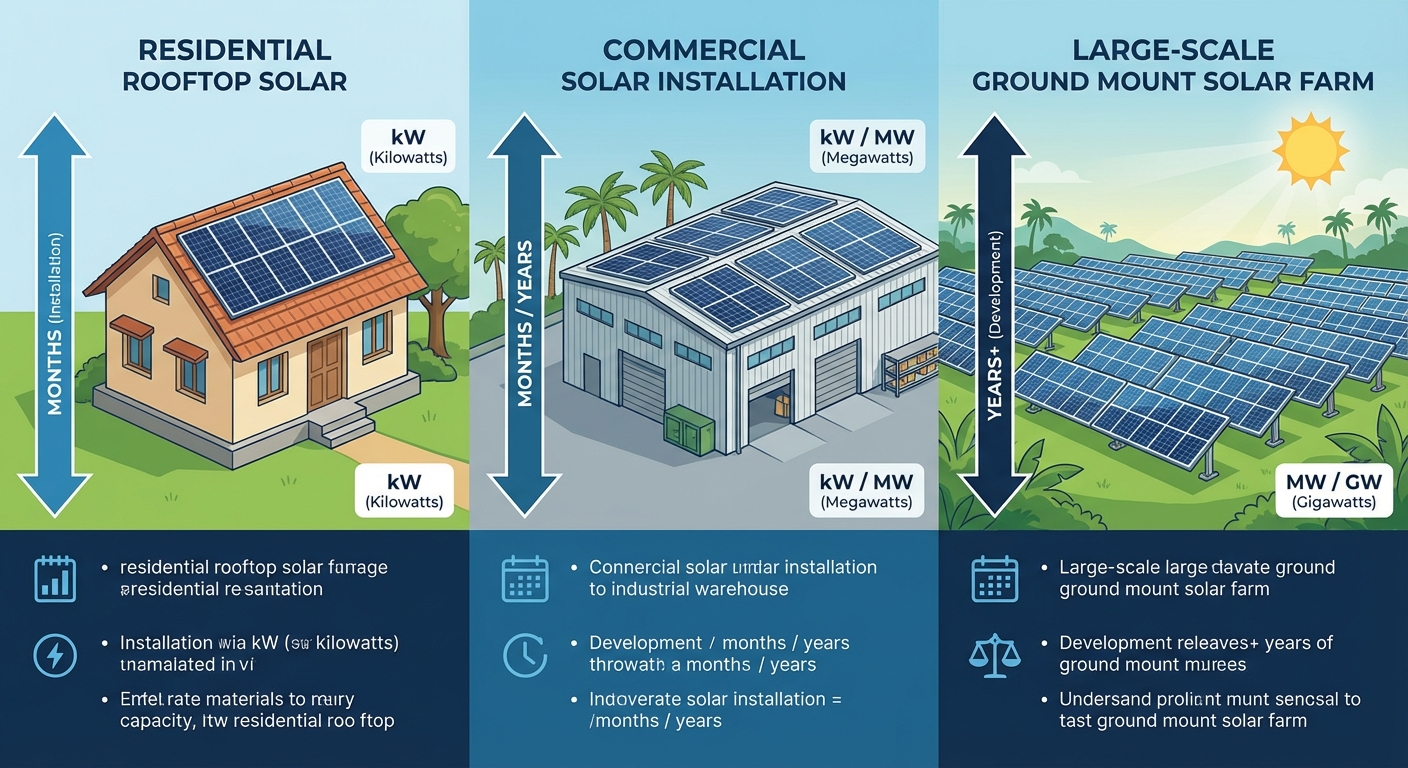
Residential Rooftop Solar Design Timeline (1-10 kW Systems)
For rooftop solar India projects in the residential segment, the complete design cycle typically spans 1-2 weeks for straightforward installations. This timeline includes a 1-2 day site survey to assess roof conditions, shading factors, and electrical infrastructure. The preliminary design phase, often utilizing design software India tools for 3D modeling and energy yield calculations, requires 2-3 days. Detailed engineering and permit design documentation, including single-line diagrams, structural calculations, and municipal compliance documents, typically takes 3-5 days.
However, residential projects with complexity factors, tile roofs requiring custom mounting, significant shading requiring optimizer integration, or older electrical panels needing upgrades, may extend to 3 weeks. The engineering cost for residential designs remains relatively modest, but timeline extensions due to incomplete site data or multiple revision requests can increase costs by 40-60% compared to standard timelines.
Commercial and Industrial Solar Design Timeline (10 kW – 1 MW)
Commercial projects represent the sweet spot for many solar EPC India companies, with design timelines typically ranging from 3-6 weeks depending on system size and site complexity. A comprehensive site survey India for commercial installations requires 3-5 days, including structural assessment, electrical load analysis, and utility coordination. The feasibility study India phase, critical for commercial projects, adds another 5-7 days to evaluate technical viability, regulatory requirements, and preliminary cost estimates.
Preliminary 3D design and energy modeling for commercial projects typically requires 1-2 weeks, allowing for multiple layout iterations to optimize roof space utilization and energy generation. The detailed engineering phase, encompassing electrical design, structural engineering India calculations, civil drawings, and equipment specifications, spans 2-3 weeks. Final permit documentation, including fire safety compliance, building department approvals, and utility interconnection applications, adds another 1-2 weeks.
For a 250 kW commercial rooftop in Gujarat, a realistic end-to-end design timeline of 5 weeks allows for quality engineering while maintaining cost efficiency. Attempting to compress this to 3 weeks typically increases design costs by 30-40% and raises the risk of costly revision cycles.
MW-Scale Ground Mount and Utility Projects Timeline (1 MW+)
Large-scale solar projects demand the most comprehensive design timelines, typically spanning 8-16 weeks for complete engineering documentation. These projects require extensive feasibility study India work, including geotechnical investigations, environmental assessments, and grid impact studies, which alone can take 3-4 weeks. The preliminary design phase for MW-scale projects involves detailed site planning, module layout optimization, and preliminary electrical design, requiring 2-3 weeks.
Detailed engineering for utility-scale projects is the most time-intensive phase, spanning 6-10 weeks and involving multiple engineering disciplines. This includes civil and grading plans, foundation designs, electrical single-line and three-line diagrams, cable routing, inverter and transformer specifications, SCADA system design, and comprehensive structural engineering India calculations for mounting structures and equipment foundations. The PMC services India component often runs parallel to design, adding project management oversight and quality assurance.
For a 10 MW ground mount project in Rajasthan, a realistic 12-week design timeline allows for thorough engineering across all disciplines, multiple internal review cycles, and proactive coordination with utilities and regulatory authorities. This timeline supports optimal solar design cost management by preventing rushed work, reducing errors, and enabling value engineering opportunities that can save significant capital expenditure during construction.
How Design Timeline Phases Impact Your Budget
Each phase of the solar design process carries distinct cost structures and timeline requirements that directly influence total project budgets. Understanding these phase-specific impacts enables solar EPC India companies to allocate resources strategically and identify where timeline adjustments deliver the greatest cost benefits or risks.
Feasibility Study and Site Survey Phase Costs
The initial feasibility study India and site survey India phase typically represents 10-15% of total design costs but exerts disproportionate influence on downstream expenses. A thorough site survey requiring 3-5 days for commercial projects might cost more upfront than a rushed 1-day assessment, but it prevents expensive surprises during detailed engineering. When site surveys miss critical factors, existing structural deficiencies, underground utilities, or access constraints, the resulting design changes can increase total project costs by 15-25%.
For MW-scale projects, comprehensive feasibility work including geotechnical testing, topographic surveys, and environmental assessments may require 3-4 weeks and represent a significant budget line item. However, this investment pays dividends by informing accurate foundation designs, optimal grading plans, and realistic project cost estimates. Skipping or rushing this phase to save time and money almost invariably leads to change orders and timeline extensions during construction that far exceed the initial savings.
Preliminary 3D Design Phase Investment
The preliminary design phase, where solar engineer teams create 3D models, conduct shading analysis, and optimize system layouts, typically requires 1-2 weeks for commercial projects and represents 15-20% of design costs. This phase allows for client feedback and design iterations before committing to detailed engineering, making it a critical cost control point. Adequate time allocation here, typically 2 weeks for a 500 kW commercial project, enables exploration of multiple layout options, equipment alternatives, and value engineering opportunities.
When EPCs compress this phase to save time, they often lock into suboptimal designs that cannot be easily modified during detailed engineering without significant rework costs. A preliminary design completed in 3-4 days instead of 2 weeks might save a week on the schedule, but it eliminates the iterative refinement that identifies cost-saving opportunities and prevents expensive mid-project design changes.
Detailed Engineering Design Cost Factors
Detailed engineering represents the largest component of solar design cost, typically 50-60% of total design budgets, and requires the most substantial timeline allocation. For commercial projects, this phase spans 2-3 weeks; for MW-scale projects, 6-10 weeks. The timeline directly correlates with engineering quality and cost efficiency. When design teams have adequate time, they can conduct thorough calculations, coordinate across disciplines (electrical, structural, civil), and identify potential issues before they become construction problems.
Compressed detailed engineering timelines force teams to work overtime, increase the risk of calculation errors, and limit coordination between engineering disciplines. A 500 kW commercial project that should receive 3 weeks of detailed engineering but is compressed to 1.5 weeks typically sees 20-30% higher design costs due to overtime labor, plus increased risk of errors that create construction delays and change orders.
Permit Design and Documentation Expenses
The final permit design phase, preparing documentation for regulatory approvals and utility interconnection, typically requires 1-2 weeks for commercial projects and represents 15-20% of design costs. This phase demands meticulous attention to local regulations, utility requirements, and building codes, all of which vary significantly across Indian states and municipalities. Adequate timeline allocation enables thorough review of permit requirements, preparation of compliant documentation, and proactive coordination with approval authorities.
When EPCs rush permit documentation to meet aggressive project timelines, they frequently face submission rejections that create costly delays. A permit package prepared in 3 days instead of the recommended 1-2 weeks might save time initially, but a single rejection and resubmission cycle typically adds 2-4 weeks to the project timeline and increases design costs by 15-25% due to rework and extended project management overhead.
The True Cost of Expedited Solar Design Services
In the competitive solar EPC market, situations inevitably arise where compressed timelines become necessary, a client needs to meet a fiscal year deadline, a regulatory incentive is expiring, or a construction window is closing due to seasonal factors. Understanding when expedited services make financial sense and how to request them strategically can mean the difference between smart timeline management and budget-busting rush fees.
Expedited solar design India services typically carry premium pricing of 25-50% above standard rates, depending on the degree of timeline compression and project complexity. For a commercial 300 kW project with a standard 4-week design timeline and baseline cost, requesting 2-week delivery might add 30-35% to the design budget. For MW-scale projects, where standard timelines span 12-16 weeks, compressing to 8-10 weeks can increase engineering cost by 40-50% due to the need for additional engineering resources and extended work hours.
However, expedited services make financial sense in specific scenarios. When a project qualifies for time-sensitive incentives or accelerated depreciation benefits that expire at fiscal year-end, the premium for rushed design may be negligible compared to the financial benefits captured. Similarly, when construction schedules are constrained by weather windows, monsoon seasons in many parts of India limit construction activities, paying for expedited design to maximize the available construction period can optimize overall project economics.
The quality versus speed trade-off represents the most significant risk in expedited timelines. While experienced design partner companies with substantial engineering capacity can often deliver accelerated timelines without compromising quality, there are practical limits. Compressing a 4-week commercial design to 2 weeks is generally feasible with premium pricing and adequate resources. Attempting to compress it to 1 week crosses into territory where quality compromises become inevitable, insufficient time for thorough calculations, limited peer review, and inadequate coordination across engineering disciplines.
Risk factors in accelerated design schedules include increased probability of calculation errors, missed site-specific constraints, inadequate value engineering, and permit documentation issues. These risks translate to potential costs that can far exceed the expedited service premium. A design error in structural calculations discovered during construction might require emergency engineering revisions and construction delays costing 10-20 times the original design fee savings.
When requesting expedited services strategically, solar EPC India companies should focus on specific project phases rather than compressing the entire timeline. For example, if preliminary design and site survey have been completed on a standard timeline, requesting expedited detailed engineering and permit documentation is lower risk than rushing the entire process. Similarly, having complete and accurate site data ready before engaging design services enables faster turnaround without quality compromises. Clear communication about which timeline elements are truly critical versus which have flexibility allows design partners to allocate resources optimally and minimize unnecessary rush fees.
Revision Cycles and Design Delays: Budget Impact Analysis
One of the most significant yet often underestimated cost factors in solar project design is the impact of revision cycles and timeline delays. While initial solar design cost estimates typically assume 1-2 minor revision rounds, real-world projects frequently experience 3-5 revision cycles, each adding time and expense that compound throughout the project lifecycle.
Design revision rounds typically add 3-7 days per cycle for commercial projects and 1-2 weeks for MW-scale projects. Each revision cycle incurs direct costs, additional engineering hours, project management overhead, and extended timeline costs, that typically range from 10-20% of the original design fee per major revision. For a commercial 500 kW project with a baseline design cost, three major revision cycles can increase total design expenses by 30-60%, not including the opportunity cost of delayed project completion.
Common causes of timeline extensions and revision cycles include incomplete or inaccurate site data, changing client requirements, utility interconnection requirement changes, and regulatory approval feedback. In India’s diverse solar market, incomplete site surveys represent the single largest driver of design revisions. When initial site assessments miss critical factors, actual roof structural capacity, existing electrical infrastructure limitations, or site access constraints, the resulting design changes ripple through all engineering disciplines.
Changing client requirements mid-project represent another major revision driver. When clients request layout modifications, equipment changes, or capacity adjustments after preliminary design approval, the impact extends beyond simple drawing updates. Electrical calculations must be redone, structural loads recalculated, and permit documentation revised. A seemingly simple request to change from string inverters to central inverters after detailed engineering is 60% complete might require 2-3 weeks of rework and increase design costs by 25-35%.
Client feedback loops and their financial impact deserve particular attention in design timeline planning. When EPCs establish clear review milestones and response timelines with clients, they minimize costly delays. However, when client review and approval processes extend beyond planned durations, a 3-day review period stretching to 2 weeks, the design team must either pause work (creating restart inefficiencies) or proceed at risk (potentially requiring rework if feedback necessitates changes).
Strategies to minimize revision-related costs focus on front-loading accuracy and communication. Comprehensive site survey India work that captures all relevant site conditions, even if it requires an extra 1-2 days and slightly higher upfront cost, prevents multiple downstream revision cycles. Clear documentation of client requirements and formal approval processes at each design phase, feasibility, preliminary design, detailed engineering, create checkpoints that prevent late-stage changes. Proactive utility coordination during preliminary design rather than after detailed engineering completion identifies interconnection requirements early, avoiding costly electrical redesigns.
For solar EPC India companies managing design budgets, building contingency into timeline and cost estimates for 1-2 minor revision cycles is prudent. However, implementing the preventive strategies above, thorough site surveys, clear approval processes, and proactive stakeholder coordination, minimizes the likelihood of exceeding this contingency and keeps projects on schedule and budget.
Project Complexity Factors That Extend Design Timeline
Beyond project scale, numerous complexity factors can significantly extend solar design timelines and increase associated costs. Understanding these factors enables more accurate timeline planning and helps solar EPC India companies identify when standard timeline estimates require adjustment.
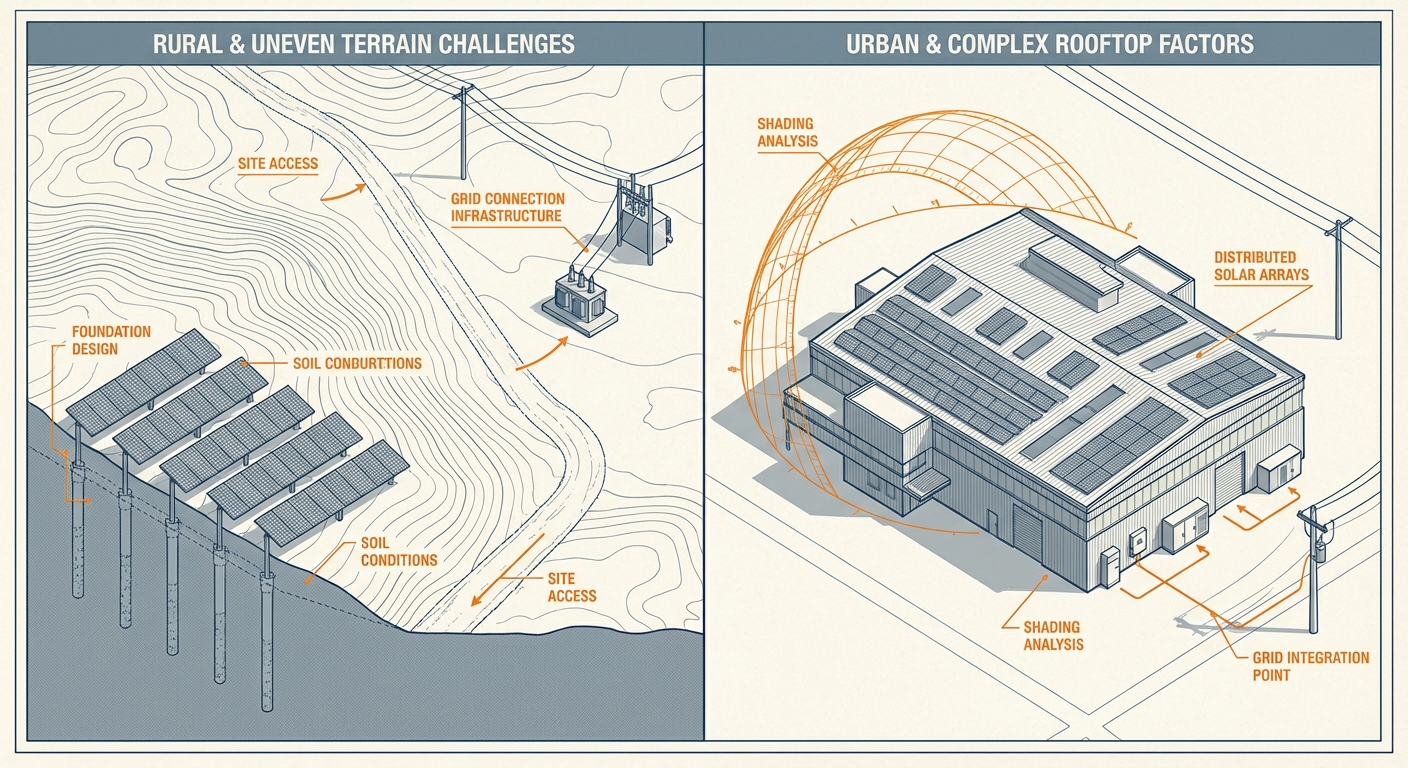
Site-Specific Challenges
Terrain complexity represents a major timeline factor for ground mount projects. A flat, cleared site with minimal grading requirements might follow standard design timelines, while a site with significant elevation changes, rocky soil conditions, or drainage challenges can add 2-4 weeks to the design schedule. The additional time accommodates detailed topographic analysis, custom grading plans, and specialized foundation designs that account for soil conditions and slope stability.
Shading analysis complexity varies dramatically based on site context. A commercial rooftop with minimal obstructions requires standard shading analysis completed in 1-2 days. However, a site with multiple roof levels, significant HVAC equipment, nearby tall structures, or vegetation requires detailed hourly shading simulation across the full year, potentially adding 3-5 days to the preliminary design phase. This additional analysis time directly impacts solar design cost but is essential for accurate energy yield predictions and optimal layout design.
Structural constraints, particularly common in rooftop solar India projects on older commercial and industrial buildings, can extend design timelines substantially. When initial structural assessments reveal load-bearing capacity concerns, the design process must incorporate detailed structural engineering India analysis, potential reinforcement designs, and coordination with structural consultants. This can add 2-3 weeks to commercial project timelines and increase engineering costs by 30-50%.
Regulatory and Permit Complexity Across Indian States
India’s federal structure creates significant variation in solar regulations, permit requirements, and approval processes across states and municipalities. Projects in states with streamlined solar policies and clear permit processes, such as Gujarat or Rajasthan, typically follow standard timelines. However, projects in states with less developed solar regulatory frameworks or municipalities with complex approval requirements can add 2-4 weeks to the permit design phase.
Net metering regulations, building code requirements, and fire safety standards vary significantly across jurisdictions, requiring solar engineer teams to customize documentation for each location. This customization takes additional time but is essential for first-time permit approval. Projects that attempt to use standardized permit packages without accounting for local requirements frequently face rejections that create costly delays exceeding the time that would have been required for proper customization.
Grid Connection Requirements and Utility Coordination
Utility interconnection requirements represent one of the most unpredictable timeline factors in solar design. Some utilities have clear, published interconnection standards and responsive engineering review teams, enabling straightforward coordination. Others have opaque requirements, slow response times, and frequently changing standards that can add weeks or months to project timelines.
For MW-scale projects requiring dedicated substations or transmission upgrades, utility coordination can extend design timelines by 4-8 weeks or more. The design process must accommodate utility study timelines, incorporate utility feedback into electrical designs, and often iterate multiple times to achieve utility approval. This extended coordination increases PMC services India requirements and project management costs proportionally.
Custom Engineering Requirements for Unique Installations
Projects with non-standard requirements, floating solar installations, agrivoltaic systems, solar carports, or building-integrated photovoltaics, require custom engineering that extends timelines significantly. These projects lack standardized design templates and require specialized analysis, custom structural designs, and often innovative solutions to unique challenges. Timeline extensions of 30-50% compared to standard projects are common, with proportional cost increases.
Multi-Location Projects and Coordination Overhead
When EPCs manage solar programs across multiple sites, such as a retail chain installing rooftop solar across 20 locations, coordination overhead extends timelines even when individual sites are relatively simple. Each site requires separate surveys, customized designs accounting for local conditions, and individual permit packages. While economies of scale reduce per-site costs, the overall program timeline extends due to sequential site surveys, staggered design phases, and the project management complexity of coordinating multiple concurrent designs.
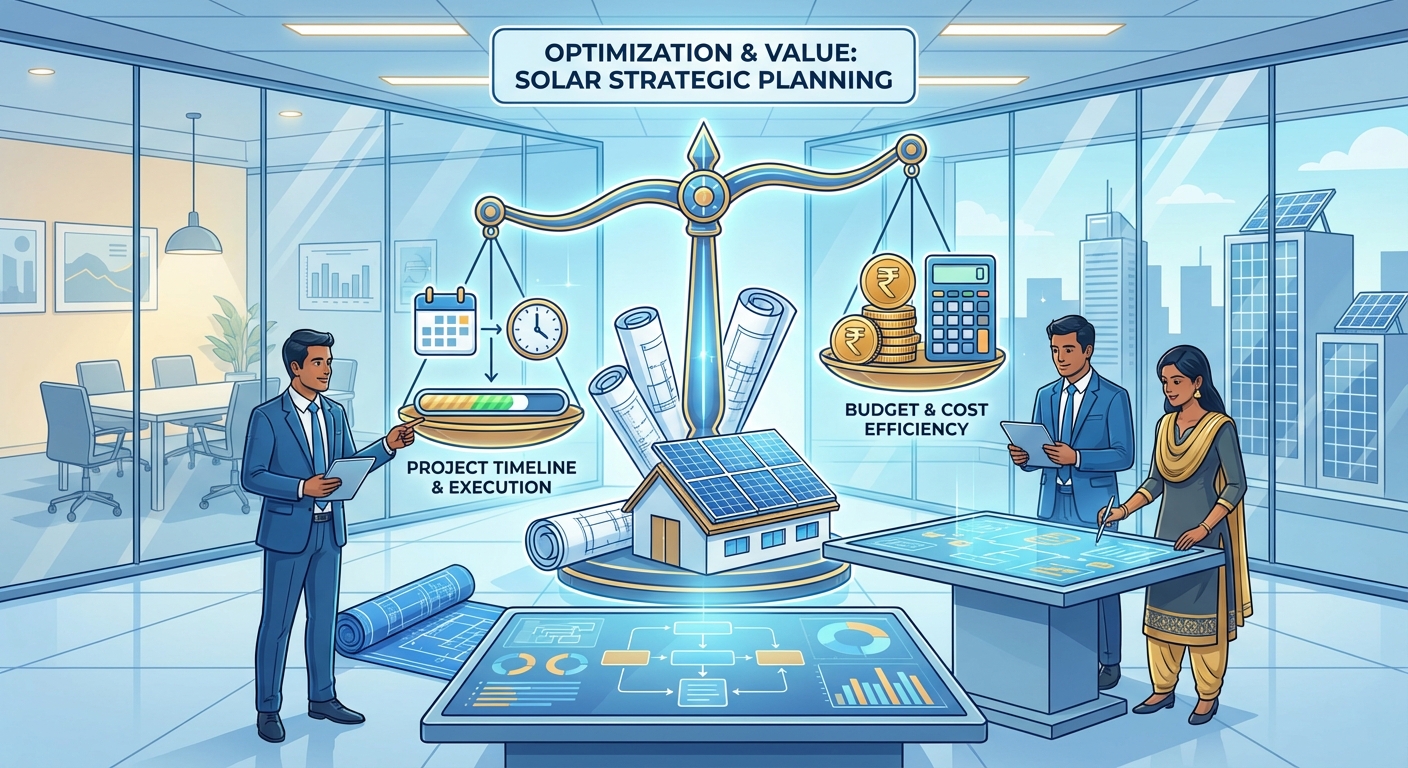
Strategic Timeline Planning for Budget Optimization
Effective design timeline management requires strategic planning that balances speed with cost-effectiveness while accounting for project-specific complexity factors. Solar EPC companies that master this balance gain competitive advantages through improved profitability, higher client satisfaction, and more predictable project delivery.
Setting Realistic Design Timeline Expectations
The foundation of strategic timeline planning is setting realistic expectations based on project scale, complexity, and resource availability. For residential projects, standard 1-2 week timelines are appropriate for straightforward installations, with 3-week estimates for complex sites. Commercial projects should be planned with 4-6 week design timelines as the baseline, adjusted upward for complexity factors. MW-scale projects require 12-16 week planning horizons, with extensions for sites with significant challenges or regulatory complexity.
Building buffer time into these estimates, typically 15-20% of the baseline timeline, accommodates unforeseen challenges without triggering crisis management. A commercial project planned with a 5-week design timeline that includes a 1-week buffer can absorb minor delays or revision cycles without impacting overall project schedules or requiring expensive expedited services.
Balancing Speed with Cost-Effectiveness
The optimal design timeline is rarely the fastest possible timeline. Instead, it’s the timeline that delivers quality engineering, minimizes revision cycles, and enables value engineering opportunities while meeting project schedule requirements. For most projects, this optimal timeline aligns closely with standard timelines based on project scale.
When schedule pressures require timeline compression, strategic approaches focus on specific phases rather than across-the-board acceleration. For example, if a commercial project’s construction schedule requires 2 weeks faster design delivery, compressing the detailed engineering phase by 1 week and the permit documentation phase by 1 week through additional resource allocation is lower risk than attempting to compress the feasibility and preliminary design phases, where thoroughness is critical for downstream efficiency.
Best Practices for EPC Companies Planning Design Budgets
Effective budget planning for solar design India projects incorporates both direct design costs and timeline-related cost factors. Best practices include allocating 10-15% contingency for revision cycles, factoring in complexity premiums for challenging sites, and accounting for the full cost of expedited services when compressed timelines are necessary.
EPCs should also consider the opportunity cost of design delays. A 2-week delay in design completion might seem minor, but if it pushes construction into monsoon season or causes a project to miss an incentive deadline, the financial impact can be substantial. In these scenarios, paying a 30% premium for expedited design services that prevent a 2-week delay may be highly cost-effective.
Communication Strategies with Design Partners
Clear communication with design partner companies establishes the foundation for successful timeline and budget management. Providing complete site data upfront, establishing clear approval milestones and response timelines, and communicating schedule constraints early enables design teams to plan resources optimally and identify potential timeline risks proactively.
Regular status updates and milestone reviews, weekly for commercial projects, bi-weekly for MW-scale projects, keep all stakeholders aligned and enable early identification of issues that could impact timelines or budgets. When changes become necessary, discussing them promptly with design partners allows for assessment of timeline and cost impacts before commitments are made.
Building Buffer Time for Unforeseen Challenges
Even with thorough planning, solar projects encounter unforeseen challenges, unexpected site conditions, utility requirement changes, or regulatory updates. Building appropriate buffer time into project schedules, typically 1 week for residential projects, 1-2 weeks for commercial projects, and 2-4 weeks for MW-scale projects, provides resilience without requiring expensive crisis management when challenges arise.
This buffer time should be explicitly planned and communicated to stakeholders, not hidden or used to pad estimates. When projects proceed smoothly and buffer time isn’t needed, it creates opportunities for early completion that delights clients. When challenges arise, the buffer absorbs them without triggering schedule failures or budget overruns.
Choosing the Right Design Partner for Timeline and Cost Efficiency
The selection of a design partner profoundly impacts both timeline adherence and cost efficiency throughout the project lifecycle. Solar EPC companies should evaluate potential design partners across multiple dimensions that directly affect timeline and budget performance.
Team Size and Capacity Considerations
Design companies with substantial engineering teams, such as Heaven Designs with over 50 skilled engineers and consultants, offer significant advantages for timeline management. Large teams can absorb multiple concurrent projects without resource constraints, accommodate expedited timelines when necessary without compromising quality on other projects, and provide redundancy when individual engineers face unexpected availability issues.
Smaller design firms may offer competitive pricing but often face capacity constraints that create timeline risks. When their limited engineering resources are fully allocated, new projects face queuing delays, and unexpected complexity in one project can create cascading delays across their entire portfolio.
Track Record with Timeline Adherence
A design partner’s historical performance with timeline adherence provides the best predictor of future performance. EPCs should request references from previous clients specifically addressing timeline performance, ask about the percentage of projects delivered on or ahead of schedule, and inquire about how the design company handles timeline challenges when they arise.
Companies with strong track records, such as Heaven Designs’ completion of 628+ MW of design work for 752+ solar EPC clients, demonstrate the systems, processes, and experience necessary for consistent timeline performance across diverse project types and complexity levels.
Technology and Software Capabilities That Accelerate Delivery
Advanced design software India capabilities and technology infrastructure directly impact design efficiency and timeline performance. Design partners utilizing industry-leading software for 3D modeling, shading analysis, electrical calculations, and structural engineering can complete design phases faster and with higher accuracy than those using outdated or manual methods.
Automation capabilities for routine calculations, standardized templates for common project types, and integrated design workflows that minimize handoffs between engineering disciplines all contribute to faster delivery without compromising quality. When evaluating design partners, EPCs should inquire about their technology stack and how it supports efficient project delivery.
How Heaven Designs Optimizes Both Timeline and Cost for EPC Clients
Heaven Designs Private Limited has developed systematic approaches to timeline and cost optimization that benefit solar EPC India clients across all project scales. With a team of over 50 engineers and consultants based in Surat, Gujarat, the company maintains the capacity to handle multiple concurrent projects while meeting aggressive timelines when required.
The company’s comprehensive service portfolio, spanning Solar 3D Pre-Design, MW Scale Detailed Engineering Design, PMC services India, Solar Civil and Structural Engineering, and Site Survey & Land Feasibility services across India, enables integrated project delivery that minimizes coordination delays and handoff inefficiencies. When a single design partner handles all engineering disciplines, timeline compression becomes more feasible without quality compromises.
Heaven Designs’ experience across 628+ MW of completed design work provides deep familiarity with regulatory requirements across Indian states, utility interconnection standards, and common complexity factors that impact timelines. This experience enables accurate timeline estimation, proactive risk identification, and efficient navigation of regulatory approval processes that often create delays for less experienced design providers.
The company’s focus on cost-effective and accurate solar project designs that maximize energy generation while optimizing project costs aligns directly with EPC companies’ needs for budget-conscious timeline management. By delivering designs that minimize revision cycles, achieve first-time permit approval, and incorporate value engineering opportunities, Heaven Designs helps clients avoid the hidden costs that often accompany compressed timelines or inexperienced design partners.
Taking Control of Your Solar Design Timeline and Budget
The relationship between design timeline and project costs in solar EPC work is complex but manageable with strategic planning, realistic expectations, and the right design partner. As India’s solar market continues its rapid expansion in 2026 and beyond, EPC companies that master timeline and budget optimization will gain decisive competitive advantages through improved profitability, higher client satisfaction, and more predictable project delivery.
The key insights for effective timeline and cost management include understanding standard timelines for different project scales, recognizing complexity factors that require timeline adjustments, strategically evaluating when expedited services make financial sense, implementing processes to minimize costly revision cycles, and selecting design partners with the capacity, experience, and technology to deliver consistent timeline performance.
Whether you’re managing residential rooftop solar India installations, commercial and industrial projects, or MW-scale utility developments, the principles of strategic design timeline planning remain consistent: allocate adequate time for thorough engineering, build appropriate buffers for unforeseen challenges, communicate clearly with all stakeholders, and partner with experienced design companies that have demonstrated track records of timeline and budget performance.
For solar EPC companies seeking to optimize their design timeline and cost performance, partnering with an experienced design company that understands the nuances of India’s solar market and maintains the capacity to deliver quality engineering on schedule is essential. Heaven Designs’ comprehensive engineering services, substantial team capacity, and proven track record across 752+ EPC clients provide the foundation for successful timeline and budget management across projects of all scales and complexity levels.
Ready to optimize your solar project design timeline while controlling costs? Heaven Designs offers comprehensive solar engineering design services tailored to your project requirements and schedule constraints. Our team of 50+ engineers delivers cost-effective, accurate designs that maximize energy generation and minimize revision cycles. Get a Quick Proposal Now! to discuss your project timeline and budget requirements, or contact our team directly at +91 90811 00297 or service@heavendesigns.in to explore how strategic design timeline planning can improve your project profitability and client satisfaction.