


In India’s rapidly expanding solar energy sector, the difference between a profitable megawatt-scale project and a costly failure often comes down to one critical step: a comprehensive feasibility study. For EPC companies planning solar installations across India’s diverse terrain and regulatory landscape, understanding the complete feasibility study process isn’t just beneficial—it’s essential for project success and financial viability.
A solar feasibility study in India serves as the foundation for every successful solar project, providing EPC companies with detailed technical, environmental, and economic assessments before committing significant capital. With India targeting 500 GW of renewable energy capacity by 2030, the demand for accurate feasibility studies has never been higher. Yet many EPC companies still underestimate this crucial phase, leading to project delays, cost overruns, and in some cases, complete project abandonment.
This comprehensive guide walks you through the entire feasibility study process for solar projects in India, from initial land assessment to final financial viability analysis. Whether you’re planning a 5 MW rooftop installation in Gujarat or a 100 MW ground-mount project in Rajasthan, understanding these fundamentals will help you make informed decisions and maximize your project’s return on investment.
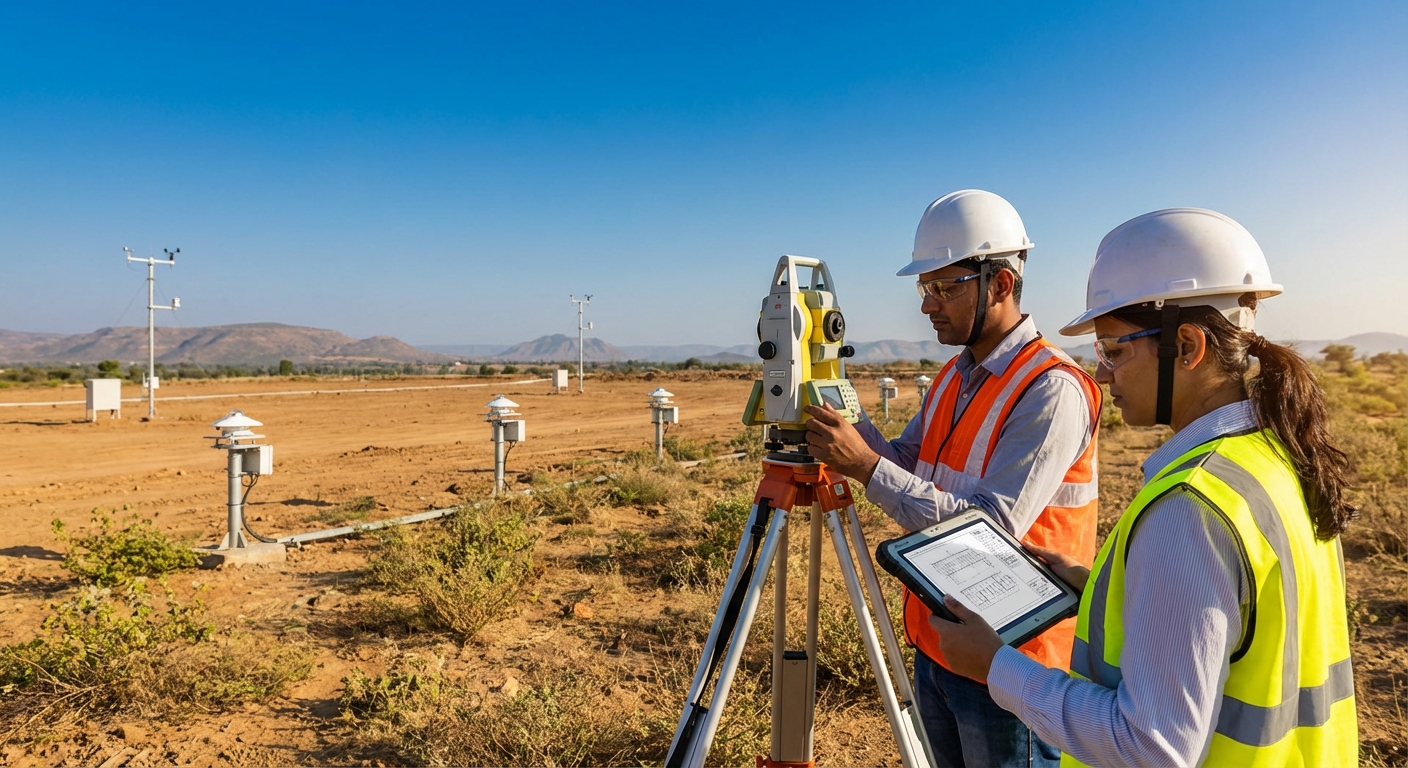
What is a Solar Feasibility Study and Why It Matters for Indian EPC Companies
A solar feasibility study is a comprehensive evaluation that determines whether a proposed solar project is technically viable, environmentally sustainable, and financially profitable. In the Indian context, this assessment goes beyond basic solar resource analysis to include state-specific regulatory requirements, grid connectivity challenges, land acquisition complexities, and regional environmental considerations.
For EPC companies operating in India, a thorough feasibility study serves multiple critical functions. First, it provides data-driven insights that inform investment decisions, helping stakeholders understand whether a project should proceed, be modified, or be abandoned before significant capital is deployed. Second, it identifies potential risks and challenges early in the project lifecycle, when mitigation strategies are most cost-effective to implement.
The financial implications are substantial. Industry data suggests that projects undertaken without proper feasibility studies face a 40-60% higher risk of cost overruns and schedule delays. In contrast, projects backed by comprehensive feasibility assessments typically achieve their projected energy yields within 5-8% accuracy and maintain budget adherence rates above 85%.
In India’s complex regulatory environment, feasibility studies also play a crucial role in securing financing and regulatory approvals. Financial institutions and investors increasingly require detailed feasibility reports before committing funds to solar projects. Similarly, state electricity boards and regulatory authorities often request feasibility documentation as part of the grid connectivity and environmental clearance processes.
The study also helps EPC companies optimize project design from the outset. By understanding site-specific constraints and opportunities during the feasibility phase, engineers can make informed decisions about panel orientation, mounting structures, inverter placement, and electrical infrastructure—choices that directly impact the project’s 25-year energy generation profile and overall profitability.
Key Components of a Comprehensive Solar Feasibility Study in India
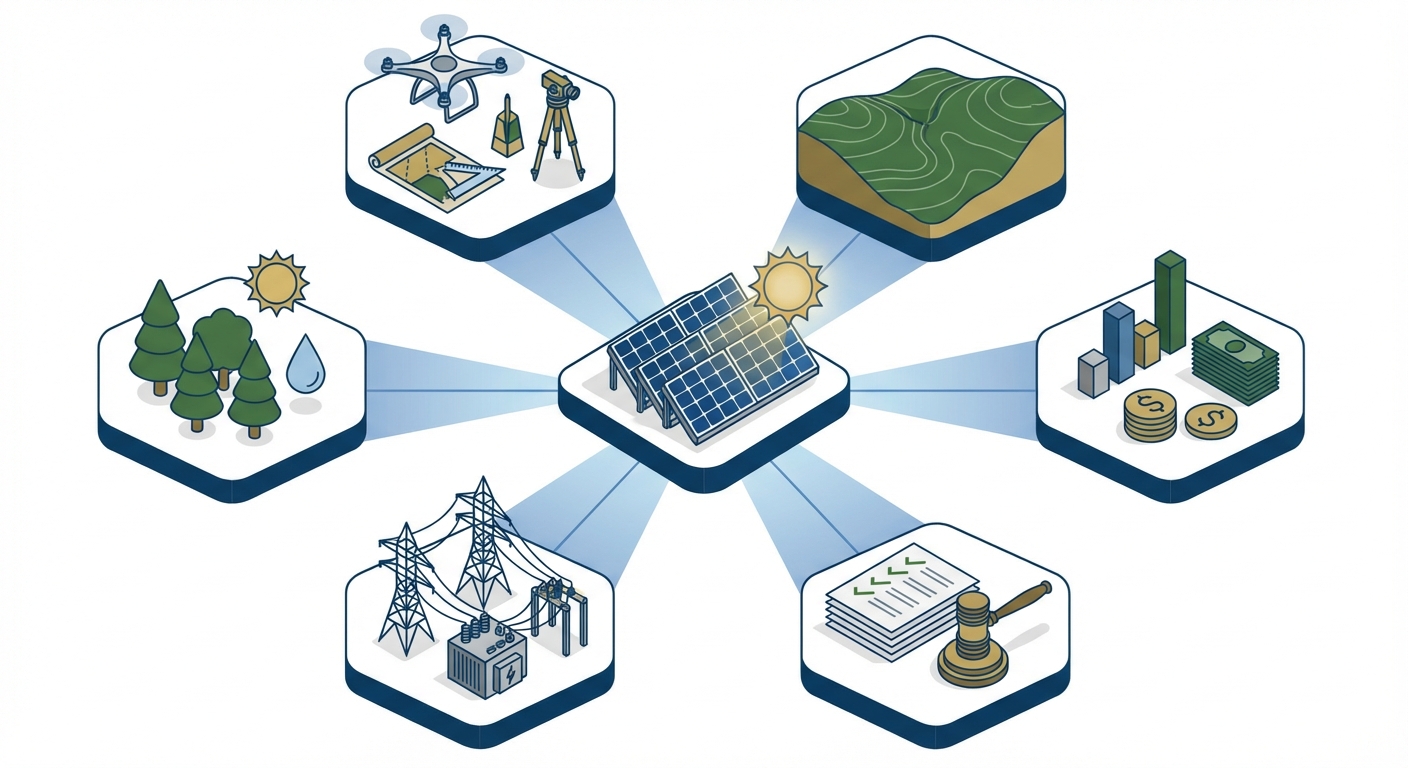
A complete solar feasibility study in India encompasses six interconnected assessment areas, each providing critical data that informs the project’s viability. Understanding these components helps EPC companies ensure nothing is overlooked during the evaluation phase.
Site Assessment and Land Evaluation
The foundation of any solar project begins with thorough site and land evaluation. In India, where terrain varies dramatically from the Thar Desert to coastal regions and mountainous areas, site assessment takes on particular importance.
Solar irradiation analysis forms the cornerstone of site assessment. India receives 4-7 kWh per square meter per day of solar radiation depending on location, with states like Rajasthan, Gujarat, and parts of Maharashtra offering the highest solar potential. A proper feasibility study includes multi-year irradiation data analysis, accounting for seasonal variations, monsoon impacts, and local weather patterns that affect energy generation.
Land topography and soil conditions require detailed evaluation, particularly for ground-mount installations. The study must assess land slope, drainage patterns, soil bearing capacity, and potential for erosion. In states like Uttar Pradesh and Bihar, where soil conditions vary significantly, geotechnical investigations become essential for determining foundation requirements and structural engineering specifications.
Shadow analysis identifies potential shading from nearby structures, trees, hills, or future developments that could impact panel performance. This analysis must account for the sun’s path throughout the year at the specific latitude, ensuring optimal panel placement and spacing.
Access to the site and logistics considerations often determine project feasibility in remote locations. The study evaluates road access for heavy equipment, distance from major transportation hubs, availability of construction materials locally, and accommodation options for installation crews. Projects in remote areas of Rajasthan or Gujarat may face significantly higher logistics costs that impact overall project economics.
Land ownership verification and legal due diligence prevent costly disputes later. This includes confirming clear title, checking for encumbrances or litigation, verifying land use classification, and ensuring the land can be legally used for solar power generation. In India, where land records can be complex and vary by state, this legal verification is non-negotiable.
Technical and Engineering Assessment
The technical assessment evaluates the engineering feasibility of the proposed solar installation, providing the data needed for detailed design work later in the project lifecycle.
Solar resource assessment goes beyond basic irradiation data to include detailed energy yield calculations. Using specialized software and historical weather data, engineers model the expected energy generation over the project’s lifetime, accounting for panel degradation, soiling losses, temperature coefficients, and system inefficiencies. For a 10 MW project in Gujarat, for example, this analysis might project 16-17 million kWh of annual generation in the first year.
Grid infrastructure and evacuation capacity assessment is particularly critical in India, where grid constraints often limit project development. The study must evaluate the nearest substation’s capacity, available evacuation infrastructure, voltage levels, distance to interconnection points, and any grid upgrades required. In many Indian states, grid connectivity has become the primary bottleneck for solar project development, making this assessment essential.
Structural engineering requirements vary dramatically based on location. Coastal areas require corrosion-resistant materials and cyclone-resistant designs. Northern regions must account for occasional hailstorms. Areas with high wind speeds need robust mounting structures. The feasibility study identifies these requirements early, allowing accurate cost estimation and appropriate technology selection.
Equipment selection and technology evaluation consider the specific project requirements and site conditions. This includes comparing crystalline silicon versus thin-film technologies, evaluating string inverters versus central inverters, assessing fixed-tilt versus tracking systems, and selecting appropriate mounting structures. The study must balance performance, cost, and long-term reliability based on site-specific factors.
Environmental and Regulatory Compliance
India’s environmental and regulatory framework for solar projects involves multiple layers of approvals and compliance requirements that vary by state and project scale.
Environmental clearances depend on project size and location. Projects above certain capacity thresholds require Environmental Impact Assessment (EIA) studies and clearances from state or central pollution control boards. The feasibility study identifies which clearances apply and estimates the time and cost required to obtain them.
State-specific solar policies significantly impact project viability. Gujarat offers different incentives and regulations compared to Maharashtra or Tamil Nadu. Some states provide capital subsidies, accelerated depreciation benefits, or preferential tariffs. Others impose local content requirements or mandate specific technical standards. The feasibility study must account for these state-level variations.
Land use permissions and conversion requirements often present unexpected challenges. Agricultural land may require conversion to non-agricultural use, a process that varies in complexity and timeline across states. Some states restrict solar installations on certain land classifications. Understanding these requirements during feasibility prevents costly delays during project execution.
Water availability affects both construction and operations. While solar projects require minimal water compared to thermal power plants, water is needed for panel cleaning and construction activities. In water-scarce regions like Rajasthan, the feasibility study must address water sourcing and conservation strategies.
Community and stakeholder considerations increasingly influence project success. The study should assess potential community concerns, identify local employment opportunities, and evaluate any cultural or social sensitivities that might affect project acceptance.
Financial Viability and Economic Analysis
The financial assessment determines whether the project makes economic sense for investors and stakeholders, providing the business case for proceeding with development.
Capital expenditure (CAPEX) estimation includes all upfront costs: solar panels, inverters, mounting structures, electrical infrastructure, civil works, grid connectivity charges, land costs, and development expenses. In 2026, typical CAPEX for utility-scale solar projects in India ranges from ₹3.5-4.5 crore per MW, depending on location, technology choices, and site conditions.
Operational expenditure (OPEX) projections cover the 25-year project lifetime, including operations and maintenance, panel cleaning, security, insurance, land lease payments (if applicable), and periodic equipment replacement. Accurate OPEX estimation is crucial for long-term financial modeling.
Revenue modeling analyzes expected income from electricity generation. This includes power purchase agreement (PPA) rates, merchant power opportunities, renewable energy certificate (REC) revenues, and any state or central incentives. The model must account for tariff escalations, policy changes, and market dynamics over the project lifetime.
Return on investment (ROI) calculations provide the bottom-line metric investors care about most. The feasibility study calculates internal rate of return (IRR), net present value (NPV), payback period, and levelized cost of energy (LCOE). For most utility-scale projects in India, investors typically target IRRs of 12-16% and payback periods of 6-8 years.
Risk assessment identifies financial, technical, and regulatory risks that could impact returns. This includes tariff payment risks, grid curtailment possibilities, equipment performance guarantees, force majeure events, and policy changes. The study should quantify these risks where possible and suggest mitigation strategies.
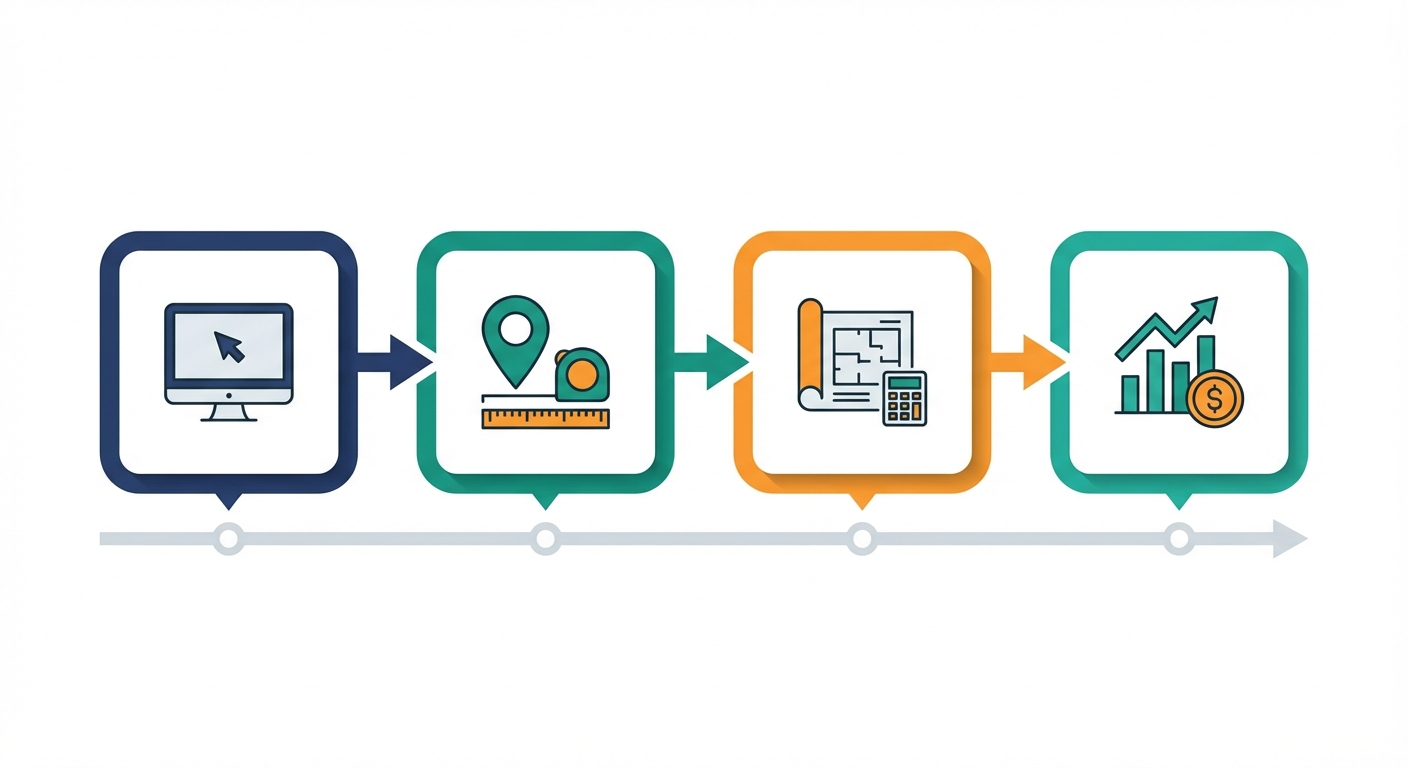
The Complete Feasibility Study Process: Step-by-Step Timeline
Understanding the feasibility study timeline helps EPC companies plan their project development schedules and allocate resources effectively. While timelines vary based on project complexity and scale, a typical comprehensive feasibility study for a MW-scale solar project in India follows this four-phase approach.
Phase 1: Preliminary Assessment and Desktop Study (1-2 weeks)
The process begins with a desktop study using available data and remote assessment tools. Engineers analyze satellite imagery, review historical solar irradiation databases, examine topographical maps, and conduct preliminary grid connectivity research. This phase also includes initial regulatory research to understand applicable policies and requirements.
During this phase, the team identifies obvious red flags that might make the site unsuitable, such as protected forest areas, severe topographical challenges, or complete absence of grid infrastructure. This preliminary screening prevents wasting resources on detailed studies for fundamentally unviable sites.
Phase 2: Site Survey and Data Collection (2-3 weeks)
The site survey phase involves physical inspection and data collection at the proposed location. A team of engineers and surveyors visits the site to conduct topographical surveys, soil testing, shadow analysis, and photographic documentation. They also meet with local authorities, utility representatives, and community stakeholders.
This phase includes installing temporary solar monitoring equipment if long-term irradiation data isn’t available for the specific location. While this extends the timeline, it provides invaluable site-specific data for energy yield calculations. For projects across different Indian states, professional site survey services ensure consistent data quality and comprehensive assessment.
The team also collects all necessary documentation during this phase, including land records, existing utility infrastructure details, environmental baseline data, and regulatory application requirements.
Phase 3: Technical Analysis and Engineering Evaluation (2-4 weeks)
With site data collected, engineers conduct detailed technical analysis. This includes energy yield modeling using specialized software, structural engineering calculations, electrical system design, and grid integration studies. The team evaluates different technology options and configuration scenarios to identify the optimal project design.
This phase also involves coordination with utility companies to understand grid connectivity requirements, available capacity, and interconnection procedures. In India, where grid connectivity can be complex, this coordination often reveals critical constraints that impact project design and timeline.
Environmental and regulatory analysis continues during this phase, with detailed assessment of clearance requirements, application preparation, and timeline estimation for approvals.
Phase 4: Financial Modeling and Report Preparation (1-2 weeks)
The final phase synthesizes all technical findings into comprehensive financial models. Engineers and financial analysts work together to develop detailed CAPEX and OPEX estimates, revenue projections, and return calculations. Sensitivity analysis examines how changes in key variables (tariff rates, equipment costs, energy yields) impact project returns.
The team prepares a detailed feasibility report documenting all findings, including executive summary, technical specifications, financial analysis, risk assessment, and recommendations. This report serves as the foundation for investment decisions and subsequent detailed engineering design work.
For a typical 10-25 MW ground-mount project, the complete feasibility study process takes 6-11 weeks. Larger projects or sites with complex challenges may require 12-16 weeks. Smaller rooftop projects can often be assessed in 3-5 weeks. Factors that accelerate the process include readily available site data, clear land titles, and straightforward grid connectivity. Delays typically result from land documentation issues, complex regulatory requirements, or grid infrastructure uncertainties.
Essential Documentation Required for Solar Feasibility Studies in India
Gathering the right documentation upfront streamlines the feasibility study process and prevents delays. EPC companies should prepare or obtain the following documents before initiating a comprehensive feasibility study.
Land documents and ownership papers form the foundation of legal due diligence. This includes property title deeds, land revenue records (7/12 extracts in Maharashtra, Khata certificates in Karnataka, etc.), survey maps, and encumbrance certificates proving clear title. For leased land, lease agreements and landowner consent documents are required.
Topographical surveys and maps provide essential site data. While these can be generated during the feasibility study, existing survey data accelerates the process. High-resolution satellite imagery, contour maps, and any previous engineering surveys of the site prove valuable.
Grid connectivity documents include details of the nearest substation, available evacuation capacity, voltage levels, and any existing interconnection agreements. Letters of intent or preliminary approvals from the state electricity board, if already obtained, should be included.
Environmental clearance applications and baseline data help assess environmental compliance requirements. This includes information about nearby protected areas, water bodies, forest land, or ecologically sensitive zones that might impact project development.
Financial and project proposal documents outline the project’s basic parameters: proposed capacity, expected investment, ownership structure, and financing approach. While these may evolve based on feasibility findings, initial proposals help frame the study’s scope.
State-specific documentation requirements vary significantly. Gujarat requires different paperwork compared to Tamil Nadu or Uttar Pradesh. Working with experienced solar design and engineering partners familiar with regional requirements ensures all necessary documentation is identified and obtained.
State-Specific Considerations Across India
India’s federal structure means solar project feasibility varies significantly across states, each with unique policies, challenges, and opportunities. Understanding these regional differences is crucial for accurate feasibility assessment.
Gujarat remains one of India’s most solar-friendly states, with excellent solar irradiation (5.5-6.0 kWh/m²/day), supportive policies, and relatively streamlined approval processes. The state offers robust grid infrastructure in most regions and has established clear procedures for solar project development. However, land costs in prime solar zones have increased significantly, impacting project economics. Gujarat’s success in solar deployment means experienced local contractors and suppliers are readily available, potentially reducing project costs.
Rajasthan offers India’s highest solar potential with vast land availability and excellent irradiation levels exceeding 6.0 kWh/m²/day in many areas. The state has become a hub for utility-scale solar development. However, feasibility studies must carefully assess grid evacuation capacity, as some regions face transmission constraints. Water scarcity is another critical consideration, requiring careful planning for panel cleaning and construction activities. Land acquisition is generally easier than in more densely populated states, but remote locations can increase logistics costs.
Maharashtra presents opportunities driven by high industrial and commercial electricity demand. The state offers good solar potential (5.0-5.5 kWh/m²/day) and strong power purchase markets. However, land acquisition can be complex and expensive, particularly near industrial centers. The state’s varied terrain requires careful site assessment, with coastal areas requiring corrosion-resistant designs and inland areas facing different challenges. Maharashtra’s regulatory environment is generally supportive, but approval timelines can be longer than in some other states.
Tamil Nadu offers excellent solar potential, particularly in southern and western regions, along with strong industrial demand for power. The state has pioneered wind energy and increasingly focuses on wind-solar hybrid projects, which may offer advantages in certain locations. Coastal considerations are important for projects near the Bay of Bengal or Arabian Sea, requiring cyclone-resistant designs and corrosion protection. Tamil Nadu’s grid infrastructure is relatively well-developed, though connectivity assessment remains essential.
Uttar Pradesh and emerging markets represent growing opportunities as solar development expands beyond traditional solar states. These regions often offer lower land costs and untapped potential, but may present challenges in grid infrastructure, regulatory familiarity, and local contractor availability. Feasibility studies in these emerging markets require extra diligence in assessing grid connectivity, regulatory timelines, and local resource availability.
Regional variations in regulations and incentives significantly impact project economics. Some states offer capital subsidies, others provide tax benefits or accelerated depreciation. Banking regulations for surplus power, net metering policies for rooftop installations, and renewable purchase obligations all vary by state. A comprehensive feasibility study must account for these state-specific factors to provide accurate financial projections.
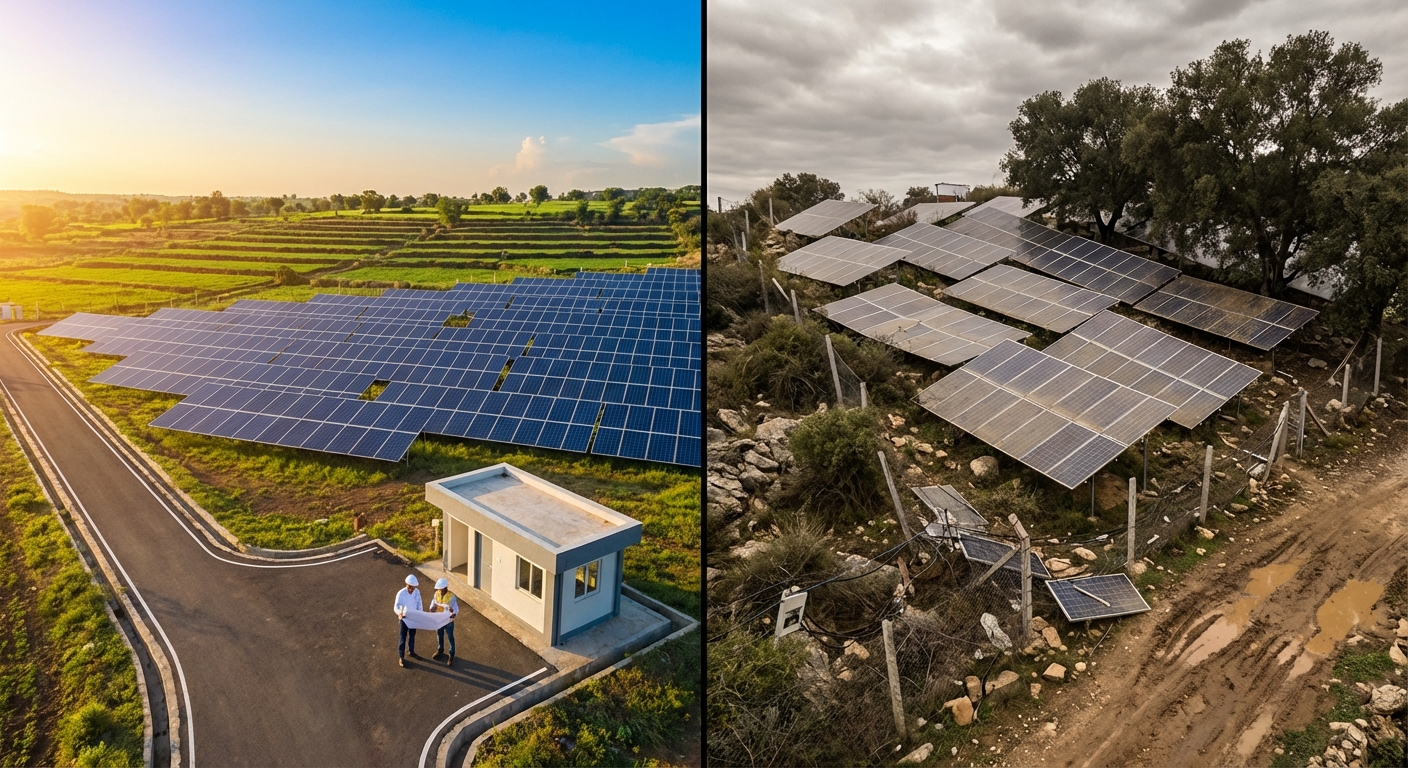
Common Pitfalls and How Professional Feasibility Studies Prevent Project Failures
The solar industry in India has witnessed numerous project failures and cost overruns that could have been prevented with thorough feasibility studies. Understanding these common pitfalls helps EPC companies appreciate the value of comprehensive upfront assessment.
Underestimating grid connectivity challenges ranks among the most common and costly mistakes. Many EPC companies assume grid connectivity will be straightforward, only to discover during project execution that the nearest substation lacks capacity, requires expensive upgrades, or involves lengthy approval processes. A proper feasibility study identifies these constraints early, allowing realistic timeline and cost planning. In some cases, grid limitations may make a site completely unviable, information that saves millions in avoided development costs.
Inadequate soil and structural analysis leads to foundation failures, structural inadequacies, and costly redesigns during construction. India’s diverse geology means soil conditions vary dramatically even within the same state. Without proper geotechnical investigation during feasibility, projects may discover unsuitable soil bearing capacity, high water tables, or rock formations that dramatically increase foundation costs. Professional structural engineering assessment during feasibility prevents these surprises.
Overlooking environmental and regulatory hurdles causes project delays that can extend timelines by months or even years. EPC companies sometimes begin development without fully understanding clearance requirements, only to face stop-work orders or lengthy approval processes. A comprehensive feasibility study maps out all required clearances, realistic timelines for obtaining them, and potential regulatory risks. This allows proper project scheduling and stakeholder management.
Poor financial modeling leading to unviable projects represents perhaps the most fundamental failure. Overly optimistic energy yield projections, underestimated OPEX, or failure to account for all costs can make projects appear viable on paper but fail financially in reality. Professional feasibility studies use conservative assumptions, validated models, and comprehensive cost accounting to provide realistic financial projections that investors can trust.
Consider a real-world example: An EPC company planned a 20 MW ground-mount project in Maharashtra without conducting a thorough feasibility study, relying instead on basic desktop analysis. During construction, they discovered that the nearest substation was at capacity and required a ₹8 crore upgrade, the soil conditions necessitated deeper foundations adding ₹2 crore to costs, and environmental clearances took 9 months longer than anticipated. The project’s IRR dropped from a projected 15% to barely 9%, making it financially unviable for investors. A comprehensive feasibility study costing approximately ₹15-20 lakh would have identified these issues before any capital commitment, either allowing the project to be redesigned or abandoned in favor of a better opportunity.
The cost of skipping feasibility studies far exceeds the investment in proper assessment. A typical feasibility study for a 10-25 MW project costs ₹10-25 lakh, representing less than 1% of total project CAPEX. Yet this investment can prevent cost overruns of 20-40% and timeline delays of 6-18 months. The return on investment for a quality feasibility study is substantial, both in terms of avoided losses and optimized project design.
How Heaven Designs Delivers Comprehensive Feasibility Studies for EPC Companies
Heaven Designs Private Limited brings specialized expertise in solar feasibility studies and site assessment services across India, helping EPC companies make informed decisions about their solar project investments. Based in Surat, Gujarat, with project experience spanning multiple states, Heaven Designs understands the regional variations and complexities that impact solar project viability in India.
The company’s site survey and land feasibility services provide comprehensive on-ground assessment combined with detailed technical analysis. Their team of over 50 engineers and consultants brings diverse expertise spanning civil engineering, structural engineering, electrical design, and financial modeling. This multidisciplinary approach ensures all aspects of feasibility are thoroughly evaluated, from soil conditions to grid connectivity to regulatory compliance.
Heaven Designs integrates feasibility studies with their broader service portfolio, creating a seamless path from initial assessment through detailed engineering design and project execution support. This integration means feasibility findings directly inform subsequent design work, eliminating the disconnect that sometimes occurs when different firms handle feasibility and design phases. EPC companies benefit from continuity, with the same team that conducted the feasibility study supporting the project through completion.
With a track record of 628+ MW designed for 752+ clients across 3+ countries, Heaven Designs brings proven experience to every feasibility study. This extensive portfolio means they’ve encountered virtually every challenge that can arise in solar project development, from difficult soil conditions to complex grid scenarios to unusual regulatory requirements. This experience translates into more accurate assessments and better risk identification.
The company’s cost-effective approach focuses on maximizing project ROI from the feasibility stage forward. Rather than simply identifying whether a project is viable, Heaven Designs’ feasibility studies include optimization recommendations that can improve project economics by 5-15% through better technology selection, optimal system sizing, and efficient design approaches. This value-added analysis helps EPC companies not just avoid bad projects, but make good projects even better.
Heaven Designs provides end-to-end support from feasibility through permit design, detailed engineering, and project management consultancy. For EPC companies managing multiple projects across different states, this comprehensive service portfolio simplifies vendor management and ensures consistent quality across all project phases. Whether you need a standalone feasibility study or complete design and engineering support, Heaven Designs adapts their services to your specific requirements.
For EPC companies planning MW-scale solar projects in India, partnering with experienced professionals for feasibility assessment can mean the difference between project success and costly failure. To discuss your project requirements and explore how comprehensive feasibility studies can improve your project outcomes, get a quick proposal now or reach out to the Heaven Designs team at service@heavendesigns.in or +91 90811 00297.
Frequently Asked Questions About Solar Feasibility Studies in India
How much does a solar feasibility study cost in India?
Feasibility study costs vary based on project scale and complexity. For a 10-25 MW utility-scale project, expect to invest ₹10-25 lakh for a comprehensive study. Smaller rooftop projects (1-5 MW) typically cost ₹3-8 lakh, while larger projects above 50 MW may require ₹30-50 lakh or more. This represents less than 1% of total project CAPEX but can prevent cost overruns of 20-40%, making it one of the highest-return investments in the project lifecycle. The cost includes site surveys, technical analysis, financial modeling, and detailed reporting.
How long does a typical feasibility study take?
Timeline depends on project size and complexity. A standard 10-25 MW ground-mount project requires 6-11 weeks for a complete feasibility study, broken down into preliminary assessment (1-2 weeks), site survey and data collection (2-3 weeks), technical analysis (2-4 weeks), and financial modeling with report preparation (1-2 weeks). Smaller rooftop projects can be completed in 3-5 weeks, while large or complex projects may require 12-16 weeks. Factors that extend timelines include complex land documentation, difficult site access, and detailed grid connectivity studies.
What is the difference between a feasibility study and detailed engineering design?
A feasibility study determines whether a project should proceed by evaluating technical viability, environmental compliance, and financial returns. It provides high-level design concepts and cost estimates with accuracy of ±15-20%. Detailed engineering design, which follows after feasibility approval, creates construction-ready drawings, specifications, and documentation with accuracy of ±5%. The feasibility study asks “should we build this?” while detailed design answers “exactly how do we build this?” Many EPC companies work with firms like Heaven Designs that provide both services in sequence, ensuring continuity from assessment through execution.
Can feasibility studies be done remotely without site visits?
While preliminary desktop studies can be conducted remotely using satellite imagery, solar databases, and available documentation, a comprehensive feasibility study requires physical site visits. On-ground surveys are essential for accurate topographical data, soil testing, shadow analysis, infrastructure assessment, and regulatory coordination. Remote-only studies miss critical site-specific factors that can significantly impact project viability and costs. However, the preliminary remote assessment phase helps identify obvious issues before investing in detailed site surveys.
What happens if a site is deemed unfeasible?
If feasibility analysis reveals a site is unviable, the study should explain why and, where possible, suggest alternatives. Sometimes minor project modifications (reduced capacity, different technology, alternative grid connection points) can make a marginal site viable. In other cases, the site may be fundamentally unsuitable due to poor solar resources, insurmountable grid constraints, or prohibitive costs. While discovering a site is unfeasible may be disappointing, this finding before major capital commitment saves far more than the feasibility study cost. The study investment protects against much larger losses from proceeding with an unviable project.
How accurate are energy yield predictions in feasibility studies?
Professional feasibility studies using validated software and quality input data typically achieve energy yield predictions within ±8-10% of actual performance over the project lifetime. Accuracy depends on the quality of solar resource data, accuracy of system modeling, and realistic assumptions about losses. Studies using multi-year historical irradiation data, site-specific measurements, and conservative loss assumptions provide the most reliable predictions. The feasibility report should clearly state assumptions and confidence levels, allowing investors to understand prediction reliability. Experienced firms like Heaven Designs use proven methodologies and conservative assumptions to ensure predictions are achievable rather than optimistic.
Taking the Next Step: From Feasibility to Successful Project Execution
A comprehensive solar feasibility study in India represents the critical foundation for successful MW-scale solar project development. For EPC companies navigating India’s complex regulatory landscape, diverse terrain, and varying state policies, thorough upfront assessment isn’t optional—it’s essential for protecting investments and ensuring project success.
The feasibility study process, from initial site assessment through financial modeling, provides the data-driven insights needed to make informed decisions about project viability. By evaluating technical feasibility, environmental compliance, regulatory requirements, and financial returns before committing significant capital, EPC companies can avoid costly mistakes, optimize project design, and maximize returns on investment.
Whether you’re planning a rooftop installation in Gujarat, a ground-mount project in Rajasthan, or exploring opportunities in emerging solar markets across India, the principles outlined in this guide apply. Understanding what a comprehensive feasibility study entails, the timeline and documentation required, and the state-specific considerations that impact viability helps you approach solar project development with confidence.
The investment in professional feasibility assessment—typically less than 1% of total project costs, delivers returns many times over through avoided cost overruns, optimized designs, and prevented project failures. As India continues its ambitious renewable energy expansion toward 500 GW by 2030, the EPC companies that succeed will be those that build their projects on the solid foundation of thorough feasibility analysis.
For EPC companies ready to move forward with solar project development in India, partnering with experienced engineering and design professionals ensures your feasibility study covers all critical aspects and provides the reliable data needed for confident decision-making. Heaven Designs’ team of 50+ specialized engineers brings proven expertise in site surveys, technical assessment, and comprehensive feasibility analysis across India’s diverse solar markets. With 628+ MW of design experience for 752+ clients, they understand what it takes to deliver accurate, actionable feasibility studies that set projects up for success.
Ready to ensure your next solar project starts on solid ground? Get a quick proposal now to discuss your feasibility study requirements, or contact the Heaven Designs team directly at service@heavendesigns.in or +91 90811 00297. Take the first step toward confident, data-driven solar project development with a comprehensive feasibility study that protects your investment and maximizes your returns.
This blog post was written using thestacc.com