


For solar EPC companies operating in India, navigating the complex landscape of solar permits India can mean the difference between a profitable project delivered on time and costly delays that erode margins. In 2026, while India continues its ambitious push toward 500 GW of renewable energy capacity, the permitting process remains one of the most challenging aspects of solar project execution. Understanding state-wise variations in processing times, documentation requirements, and approval procedures is no longer optional—it’s essential for competitive advantage.
This comprehensive guide breaks down the solar permit landscape across Indian states, providing EPC companies with actionable insights to streamline approvals, avoid common pitfalls, and ensure regulatory compliance from project inception to commissioning.
Understanding Solar Permits in India: The Foundation of Successful EPC Projects
Solar permits in India represent the regulatory framework that ensures solar installations meet safety, structural, and electrical standards. For EPC companies, these permits are not mere bureaucratic hurdles but critical checkpoints that validate the technical integrity of your design and engineering work.
The Indian solar permitting landscape has evolved significantly in recent years. In 2026, most states have adopted digital submission platforms, yet processing times vary dramatically—from as little as 7 days in progressive states like Gujarat to over 90 days in regions with less streamlined systems. This variation directly impacts project timelines and cash flow for EPC companies.
Recent regulatory changes have introduced both opportunities and challenges. The Ministry of New and Renewable Energy (MNRE) has pushed for standardization through model guidelines, but implementation remains state-specific. Some states have introduced single-window clearance systems that consolidate multiple approvals, while others still require EPC companies to navigate separate departments for building permits, electrical clearances, and fire safety NOCs.
The financial impact of permit delays cannot be overstated. A 30-day delay in permit approval can push project commissioning beyond agreed timelines, triggering penalty clauses and tying up working capital. For a 1 MW commercial project, delays can cost anywhere from ₹2-5 lakhs in extended overhead costs, not counting potential revenue loss from delayed commissioning.
Types of Solar Permits Required in India
Understanding the full spectrum of permits required for solar installations helps EPC companies prepare comprehensive documentation packages and avoid submission rejections. The permit requirements vary based on project type, capacity, and location, but several categories are nearly universal across India.
Building permits and structural approvals form the foundation of any solar installation. These permits verify that the existing structure can support the additional load of solar panels, mounting systems, and associated equipment. For rooftop installations, municipal corporations or local development authorities issue these permits based on structural stability certificates prepared by licensed structural engineers.
Electrical safety clearances are mandatory for all grid-connected solar systems. The State Electrical Inspectorate reviews your electrical design, including single-line diagrams, earthing arrangements, and protection systems. This approval ensures your installation meets the Central Electricity Authority (CEA) safety regulations and state-specific electrical codes.
Fire safety NOCs are particularly important for commercial and industrial rooftop installations. Fire departments assess access routes, firefighting equipment provisions, and emergency shutdown procedures. Buildings above certain heights or with specific occupancy classifications face stricter scrutiny.
Environmental clearances apply primarily to large ground-mount projects exceeding certain capacity thresholds. While rooftop installations typically don’t require environmental impact assessments, ground-mount projects above 5 MW may need clearances from State Environment Impact Assessment Authorities (SEIAA) or even the Ministry of Environment, Forest and Climate Change for very large installations.
Grid connectivity approvals from the local Distribution Company (DISCOM) are essential for net metering arrangements. This involves technical feasibility studies, metering arrangements, and interconnection agreements. The DISCOM approval process often runs parallel to other permits but can become a bottleneck if not initiated early.
The distinction between rooftop and ground mount permits is significant. Rooftop projects primarily deal with building and electrical permits, while ground mount installations require additional land-use permissions, agricultural land conversion approvals (if applicable), and sometimes revenue department clearances. Ground mount projects in rural areas may also need gram panchayat approvals.
State-Wise Solar Permit Processing Times in India
Processing times for solar permits India vary dramatically across states, influenced by factors including administrative efficiency, digital infrastructure, project capacity, and local regulatory frameworks. Understanding these variations helps EPC companies set realistic project timelines and manage client expectations effectively.
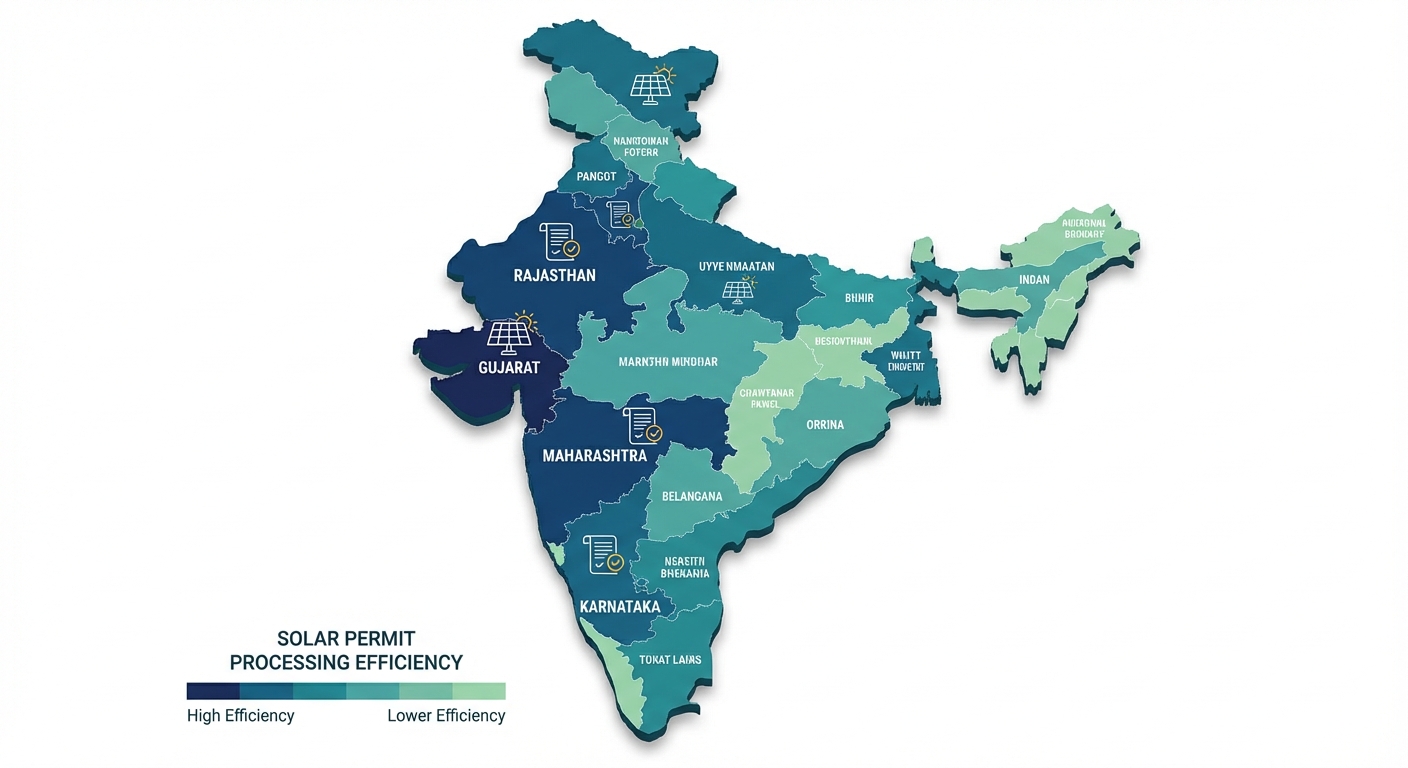
North India presents a mixed picture. Delhi has made significant strides with its online solar portal, offering approvals for residential rooftop systems in 15-20 days for straightforward applications. However, commercial projects still face 30-45 day timelines. Haryana’s processing times range from 25-40 days depending on the DISCOM jurisdiction, with DHBVN generally faster than UHBVN. Punjab has improved its systems in 2026, with average processing times of 30-35 days for rooftop installations. Uttar Pradesh remains challenging, with timelines stretching from 45-75 days across its multiple DISCOMs, though Noida and Greater Noida areas see faster approvals. Rajasthan, despite being a solar powerhouse, shows variation—Jaipur and urban areas process permits in 30-40 days, while rural ground-mount projects can take 60-90 days due to additional land-related clearances.
West India leads in permit efficiency. Gujarat stands out with its single-window clearance system processing rooftop permits in 7-15 days for residential and 15-25 days for commercial installations. This efficiency has made Gujarat the preferred destination for solar EPC companies. Maharashtra shows urban-rural disparity—Mumbai and Pune process permits in 20-30 days through MSEDCL’s improved systems, while tier-2 and tier-3 cities may take 35-50 days. Madhya Pradesh has streamlined processes in 2026, with average timelines of 25-35 days for most installations.
South India demonstrates strong performance overall. Karnataka’s BESCOM jurisdiction processes permits in 20-30 days, making Bangalore an attractive market. Tamil Nadu has improved significantly, with TANGEDCO approvals now taking 25-35 days compared to 60+ days in previous years. Andhra Pradesh and Telangana both offer 30-40 day processing times, with Hyderabad’s TSSPDCL particularly efficient. Kerala’s KSEB processes permits in 30-45 days, with coastal areas sometimes facing additional scrutiny due to environmental considerations.
East India generally lags behind. West Bengal’s CESC areas in Kolkata process permits in 35-45 days, but WBSEDCL jurisdictions can take 50-70 days. Odisha has improved to 40-50 day timelines in urban areas. Bihar remains challenging, with processing times often exceeding 60 days due to administrative bottlenecks.
Several factors affect these timelines beyond state efficiency. Project capacity plays a role, systems under 10 kW often qualify for expedited processing, while installations above 100 kW face additional technical scrutiny. Complete and accurate documentation can reduce processing times by 30-40%, while incomplete submissions trigger rejection and resubmission cycles that double timelines. The time of year matters too, with fiscal year-end periods (March-April) seeing slower processing due to administrative workload.
Gujarat Solar Permits: A Detailed Case Study
Gujarat’s solar permitting system deserves special attention as a model for efficiency. The state’s single-window clearance mechanism, operated through the Surya Gujarat portal, consolidates multiple approvals into one streamlined process. This system has reduced average processing times by over 60% compared to pre-2024 procedures.
For residential rooftop systems under 10 kW, Gujarat processes permits in just 7-10 days when documentation is complete. Commercial installations between 10-100 kW see approvals in 15-20 days, while larger commercial and industrial projects above 100 kW typically receive clearances within 25-30 days. These timelines assume complete documentation and no technical objections.
Documentation requirements in Gujarat are clearly specified. EPC companies must submit structural stability certificates from licensed engineers, electrical single-line diagrams approved by chartered electrical engineers, site photographs showing installation location, property ownership documents, and existing electricity connection details. For commercial projects, additional fire safety arrangements and building plan approvals are required.
Gujarat’s success rate for first-time submissions is approximately 70%, significantly higher than the national average of 45-50%. Common rejection reasons include inadequate structural analysis for older buildings, incomplete electrical protection schemes, and missing property ownership documentation. The state provides clear feedback on rejections, allowing quick resubmission with corrections.
Maharashtra Solar Permits: Commercial Hub Considerations
Maharashtra, home to India’s financial capital and numerous industrial hubs, presents unique permitting considerations. The Maharashtra State Electricity Distribution Company Limited (MSEDCL) handles most of the state, while Mumbai has additional municipal corporation requirements that add complexity.
MSEDCL’s approval process has improved substantially in 2026, with online portals reducing paperwork and processing times. Standard rooftop installations in Pune, Nashik, and Aurangabad see approvals in 20-25 days. However, Mumbai’s Brihanmumbai Municipal Corporation (BMC) adds another layer, building department approvals for rooftop installations can take an additional 15-20 days, bringing total timelines to 35-45 days.
Industrial areas like Talegaon, Chakan, and MIDC zones have dedicated facilitation cells that expedite approvals for commercial solar projects, recognizing their importance to Maharashtra’s industrial competitiveness. These zones often process permits in 25-30 days.
Timeline variations between urban and rural areas are pronounced. While Pune and Mumbai have digital systems and trained personnel, rural Maharashtra still relies partially on manual processing, extending timelines to 40-55 days. EPC companies working across Maharashtra must account for these variations in project planning.
Rajasthan Solar Permits: Large-Scale Project Focus
Rajasthan’s position as India’s leading solar state brings unique permitting considerations, especially for large ground-mount projects. While rooftop installations follow standard procedures with 30-40 day timelines in urban areas, ground-mount projects face additional complexity.
Land-related approvals dominate the permitting timeline for ground-mount installations. Agricultural land conversion through the Revenue Department can take 45-60 days alone. EPC companies must obtain land conversion orders, NOCs from the Tehsildar, and sometimes gram panchayat approvals before even approaching the DISCOM for electrical clearances.
Rajasthan’s three main DISCOMs, Jaipur Vidyut Vitran Nigam Limited (JVVNL), Ajmer Vidyut Vitran Nigam Limited (AVVNL), and Jodhpur Vidyut Vitran Nigam Limited (JdVVNL)—have different processing efficiencies. JVVNL, covering Jaipur and surrounding areas, generally processes permits fastest at 30-40 days for rooftop and 60-75 days for ground-mount projects. JdVVNL in western Rajasthan can take 75-90 days for large ground-mount installations due to additional grid stability assessments in areas with high solar penetration.
For EPC companies working on utility-scale projects in Rajasthan, early engagement with the Revenue Department and DISCOM is critical. Starting land conversion processes 90-120 days before planned construction can prevent costly delays.
Essential Documentation for Solar Permits India
Complete and accurate documentation is the single most important factor in securing timely permit approvals. Incomplete submissions are the leading cause of rejections, often doubling the effective processing time. Understanding exactly what authorities require, and preparing it correctly the first time, separates efficient EPC companies from those constantly fighting delays.
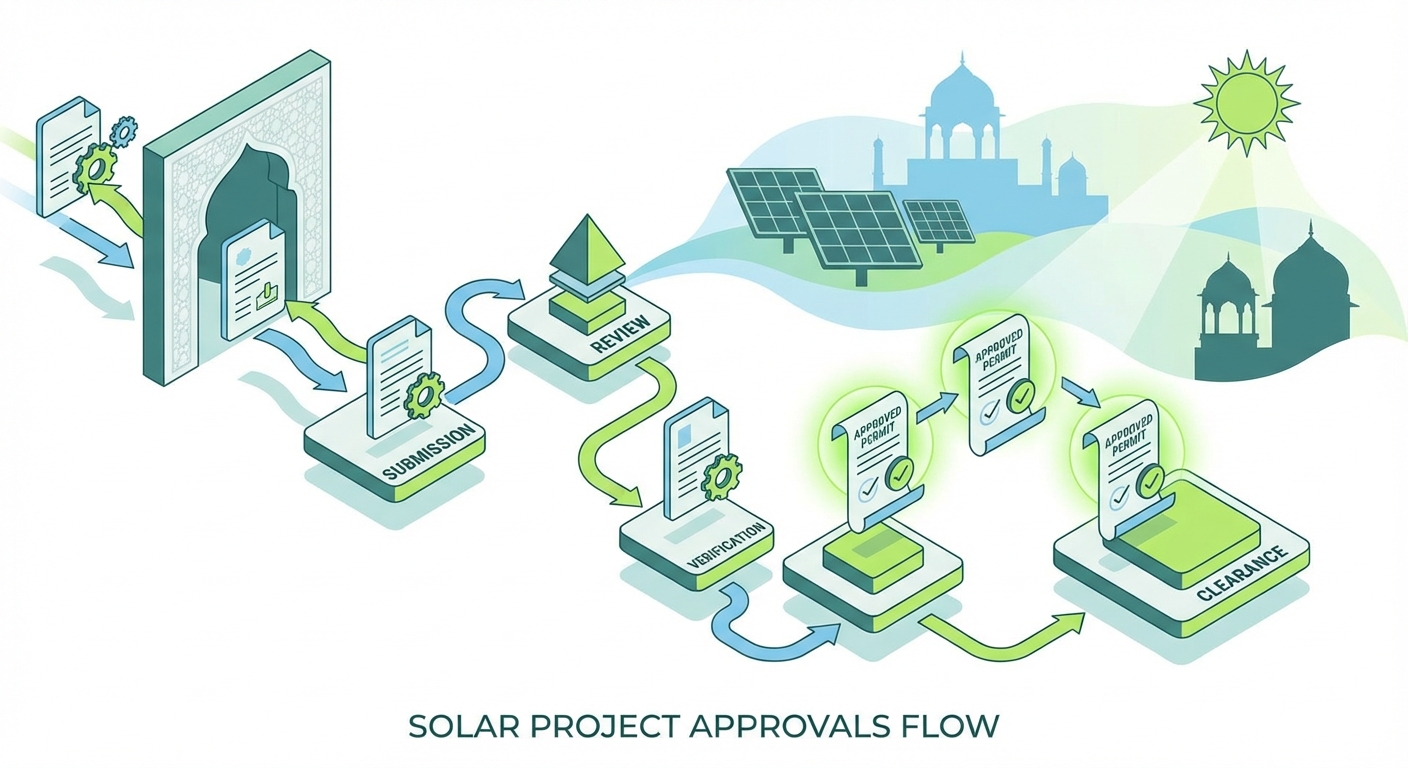
Technical drawings and engineering designs form the core of any permit application. These must include detailed layout drawings showing panel placement, mounting structure details, and dimensional specifications. The drawings should clearly indicate distances from building edges, access pathways, and shadow-free zones. For rooftop installations, roof plans with structural member locations are essential. Ground-mount projects require site plans with boundary demarcations and topographical details.
Structural stability certificates are mandatory for rooftop installations and must be prepared by licensed structural engineers. These certificates verify that the existing structure can safely support the additional dead load of solar panels, mounting systems, and wind loads as per IS 875 standards. The certificate should include structural calculations, existing building drawings, and specific recommendations for mounting system attachment points. Many permit rejections occur because structural certificates lack sufficient detail or are prepared by unqualified engineers.
Electrical single line diagrams (SLDs) must show the complete electrical system from solar panels to the grid connection point. This includes string configurations, inverter specifications, AC and DC cable routing, earthing arrangements, lightning protection systems, and all protection devices like circuit breakers, surge protection devices, and isolation switches. The SLD must comply with CEA regulations and state-specific electrical codes. For net metering applications, the diagram must clearly show bidirectional metering arrangements.
Site survey reports and feasibility studies provide authorities with confidence that the proposed installation is technically viable. These reports should document site conditions, shading analysis, roof condition assessment, and structural observations. For commercial projects, detailed feasibility studies that include energy generation estimates and financial projections strengthen applications. Heaven Designs provides comprehensive site survey services across India, ensuring your permit applications are backed by thorough technical documentation.
Property ownership documents verify the applicant’s right to install solar systems. For owned properties, this includes property deeds, tax receipts, and encumbrance certificates. For leased properties, notarized lease agreements with explicit permission for solar installation are required. Multi-tenant buildings need society NOCs or owner association approvals. Missing or unclear ownership documentation is a common rejection reason, particularly in commercial properties with complex ownership structures.
Load sanction letters from the DISCOM show existing electricity connection details. These documents help authorities verify the installation capacity is appropriate for the sanctioned load and facilitate net metering arrangements. For new connections or load enhancements, separate applications may be required before solar permit processing can begin.
State-specific additional documents vary significantly. Gujarat requires chartered engineer certifications for electrical designs. Maharashtra demands fire safety arrangements for commercial buildings. Karnataka requires building plan approvals from local authorities for certain capacity ranges. Delhi needs structural safety certificates from empaneled engineers. Rajasthan’s ground-mount projects require revenue records and land conversion orders. EPC companies must research specific state requirements to avoid submission rejections.
Common Reasons for Solar Permit Rejections in India
Understanding why permit applications get rejected helps EPC companies avoid these pitfalls and achieve first-time approval success. Analysis of rejection patterns across Indian states reveals several recurring issues that account for the majority of failed applications.
Incomplete or inaccurate technical documentation tops the list, responsible for approximately 35-40% of rejections. This includes missing drawings, unsigned certificates, outdated site photographs, or technical specifications that don’t match submitted designs. Simple oversights like missing engineer signatures or seal impressions trigger rejections despite otherwise complete applications. Creating detailed submission checklists for each state prevents these avoidable errors.
Structural design non-compliance accounts for about 25% of rejections. Common issues include inadequate structural analysis, mounting systems that don’t meet wind load requirements, attachment methods that compromise building integrity, or installations proposed on structures deemed unsuitable for additional loads. Older buildings with uncertain structural capacity face particular scrutiny. Working with experienced structural engineers who understand local building codes and solar-specific load requirements is essential.
Electrical safety violations cause roughly 20% of rejections. These include improper earthing arrangements, inadequate protection devices, cable sizing errors, non-compliant inverter specifications, or unclear isolation and shutdown procedures. Electrical designs must strictly follow CEA regulations and state electrical codes. Single-line diagrams that don’t clearly show all protection devices or that use non-standard symbols often face rejection.
Missing NOCs from relevant authorities create 10-15% of rejections. Fire department NOCs for commercial buildings, society approvals for residential complexes, airport authority clearances for installations near airports, and heritage committee approvals for buildings in protected zones are often overlooked until rejection occurs. Identifying all required NOCs during project planning prevents these delays.
Property title issues cause about 10% of rejections. Unclear ownership, pending legal disputes, properties under mortgage without lender consent, or installations on government land without proper permissions all trigger rejections. Thorough property due diligence before permit submission is critical, especially for commercial projects.
Avoiding these pitfalls requires systematic preparation. Develop state-specific submission checklists that cover all documentation requirements. Engage qualified professionals, licensed structural engineers, chartered electrical engineers, and experienced solar designers, to prepare technical documents. Conduct internal quality reviews before submission to catch errors. For complex projects, consider pre-submission consultations with permitting authorities to clarify requirements. Professional solar design services that understand permitting requirements can significantly improve first-time approval rates.
How to Expedite Solar Permit Approvals in India
While processing times vary by state, EPC companies can take proactive steps to minimize delays and expedite approvals. These strategies, developed from successful projects across India, can reduce effective processing times by 30-50% compared to standard timelines.
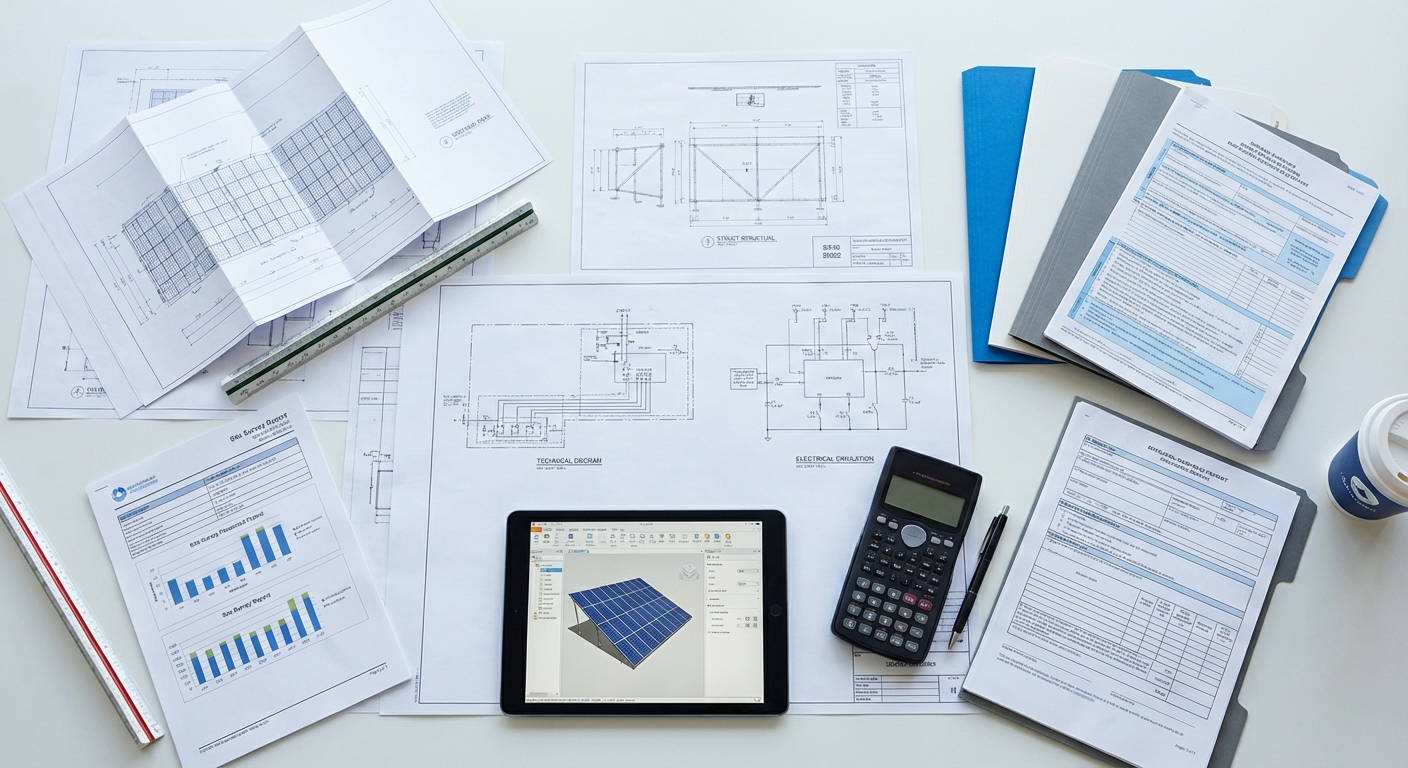
Pre-submission checklist for complete documentation is your first line of defense against delays. Create detailed, state-specific checklists that cover every required document, certification, and approval. Include verification steps for common oversights, engineer signatures, seal impressions, document dates, and version control. Assign responsibility for each checklist item to specific team members. Conduct internal reviews 48 hours before submission to allow time for corrections. This systematic approach can improve first-time approval rates from the national average of 45-50% to over 75%.
Working with experienced design partners dramatically improves permit success rates. Professional solar design companies that specialize in permit-ready documentation understand the nuances of different state requirements and common rejection triggers. Heaven Designs, with over 752 completed projects across India, brings deep expertise in preparing compliant technical documentation that satisfies permitting authorities. Our team of 50+ engineers and consultants stays current with evolving state regulations, ensuring your applications meet the latest requirements. This expertise translates directly to faster approvals and fewer resubmissions.
Leveraging single-window clearance systems where available can cut processing times significantly. States like Gujarat, Karnataka, and Tamil Nadu have implemented online portals that consolidate multiple approvals. These systems provide real-time application tracking, automated document verification, and clear feedback on deficiencies. EPC companies should prioritize learning these platforms and optimizing submissions for their specific requirements. Digital submissions typically process 20-30% faster than manual applications.
Building relationships with local authorities provides long-term benefits. Regular EPC companies in specific jurisdictions develop rapport with permitting officials, understand local interpretation of regulations, and can seek clarification on ambiguous requirements before submission. Attending DISCOM and municipal corporation workshops on solar permitting demonstrates professionalism and builds credibility. While relationships don’t bypass requirements, they facilitate smoother communication and faster resolution of technical queries.
Digital submission platforms and tracking have become standard in progressive states. Familiarize your team with state-specific portals, Gujarat’s Surya Gujarat, Maharashtra’s MSEDCL portal, Karnataka’s BESCOM online system, and Delhi’s solar portal. These platforms often provide submission guidelines, document templates, and FAQ sections that clarify requirements. Use tracking features to monitor application status and respond quickly to queries or document requests. Prompt responses to authority queries can prevent applications from moving to the bottom of processing queues.
Role of professional permit design services cannot be overstated. Specialized permit design services prepare documentation specifically formatted for regulatory approval, not just technical accuracy. This includes proper drawing scales, required annotations, compliance statements, and authority-specific formatting. Heaven Designs’ permit design services ensure your applications are submission-ready, with all technical drawings, structural certificates, and electrical designs prepared to meet state-specific requirements. This focused expertise typically reduces permit processing times by 25-40% compared to generic technical documentation.
For projects with tight timelines, consider parallel processing strategies. Initiate DISCOM applications simultaneously with municipal permits where regulations allow. Start land-related approvals for ground-mount projects well before technical design completion. Engage fire departments early for commercial projects to understand specific requirements. This parallel approach can compress overall timelines even when individual approval processes remain unchanged.
The Role of Professional Solar Design in Permit Success
The quality of your engineering design directly determines permit approval success. Authorities evaluate applications based on technical compliance, safety standards, and regulatory adherence, all of which depend on the expertise behind your design documentation. Professional solar design services provide the technical foundation that makes permit approvals straightforward rather than problematic.
Accurate engineering design ensures permit approval because it demonstrates technical competence and regulatory awareness. When structural calculations properly account for all load conditions, when electrical designs include appropriate protection schemes, and when layout drawings clearly communicate installation details, permitting authorities can quickly verify compliance. Conversely, designs that cut corners or lack technical rigor trigger detailed scrutiny, queries, and often rejection.
Compliance-focused design documentation goes beyond technical accuracy to address specific regulatory requirements. This means preparing drawings in formats authorities expect, including compliance statements that reference relevant standards, and organizing documentation for easy review. Professional designers understand that permitting authorities review dozens of applications, making their job easier through clear, well-organized submissions accelerates approvals.
Structural engineering expertise for permit applications is particularly critical for rooftop installations. Structural certificates must demonstrate that engineers have properly analyzed existing building capacity, calculated solar system loads per IS 875 standards, verified attachment point adequacy, and confirmed overall structural safety. Generic structural certificates often lack the detail authorities require. Heaven Designs’ structural engineering services provide comprehensive analysis that satisfies even the most stringent permitting requirements, reducing rejection risks significantly.
Site survey data for permit submissions provides the factual foundation for your application. Detailed site surveys document existing conditions, identify constraints, and verify that proposed designs are feasible. Surveys should include roof condition assessments, shading analysis, structural observations, electrical infrastructure evaluation, and access considerations. Thorough site surveys prevent the common problem of designs that look good on paper but face practical implementation issues that authorities identify during review.
Cost implications of permit delays versus professional design investment strongly favor upfront investment in quality design services. Consider a typical 100 kW commercial project: professional design services might cost ₹50,000-75,000, while a 30-day permit delay costs ₹1-2 lakhs in extended overheads, delayed revenue, and potential penalties. A rejected application that requires redesign and resubmission can delay projects by 45-60 days, multiplying costs further. The return on investment for professional design services typically exceeds 300-500% when measured against delay costs avoided.
Heaven Designs specializes in creating permit-ready solar designs that expedite approvals across Indian states. Our comprehensive design services include detailed engineering drawings, structural analysis, electrical system design, and complete documentation packages formatted for specific state requirements. With experience across 752+ projects and deep knowledge of regional permitting variations, we help EPC companies avoid common rejection triggers and achieve faster project execution.
Net Metering and Grid Connectivity Permits
Grid connectivity approvals and net metering arrangements represent a distinct permitting track that often runs parallel to building and electrical permits. Understanding this process is essential for EPC companies, as DISCOM approvals can become critical path items that delay project commissioning even when all other permits are secured.
Net metering application process by state follows general frameworks established by State Electricity Regulatory Commissions (SERCs), but implementation varies significantly. Most states require separate net metering applications submitted to the local DISCOM along with technical feasibility studies. The application typically includes system capacity details, inverter specifications, proposed metering arrangements, and electrical single-line diagrams. Some states like Gujarat and Karnataka have streamlined online application systems, while others still require physical submissions with multiple document copies.
DISCOM approval timelines vary from 15 days in efficient jurisdictions to 60+ days in others. The approval process involves technical feasibility assessment, grid capacity verification, metering arrangement planning, and interconnection agreement preparation. DISCOMs evaluate whether local grid infrastructure can accommodate the proposed solar capacity without stability issues. Areas with high solar penetration may face longer approval times or capacity restrictions.
Technical requirements for grid connectivity are stringent and non-negotiable. Inverters must meet IEEE 1547 or equivalent standards for grid interconnection. Anti-islanding protection is mandatory to prevent solar systems from energizing the grid during outages. Bidirectional metering with appropriate accuracy class must be installed. Earthing and lightning protection systems must meet DISCOM specifications. Isolation devices for maintenance and emergency disconnection are required. Many DISCOM rejections occur because proposed equipment doesn’t meet these technical standards or because protection schemes are inadequate.
Metering and billing arrangements require careful coordination. Most states have moved to net metering where solar generation offsets consumption, with surplus fed to the grid. The metering arrangement must accurately measure both import and export. DISCOMs typically provide and install net meters, but coordination on meter location, CT/PT ratios for large installations, and communication systems for smart meters requires advance planning. Delays in meter installation can prevent commissioning even when all other work is complete.
Common delays in net metering approvals include incomplete technical documentation, proposed capacity exceeding sanctioned load, equipment specifications not meeting DISCOM standards, unclear metering arrangements, and pending electricity bill payments. Some DISCOMs require clearance of all outstanding dues before processing solar applications. For commercial and industrial consumers, load enhancement applications may be necessary before solar installation, adding 30-45 days to timelines.
EPC companies should initiate DISCOM applications early in the project cycle, ideally during the design phase. This allows time to address technical queries, modify designs if needed to meet DISCOM requirements, and ensure meter installation schedules align with project commissioning dates. Professional design services that understand DISCOM-specific requirements can prepare technical documentation that expedites these approvals.
Future of Solar Permits India: 2026 and Beyond
The solar permitting landscape in India continues to evolve, with 2026 marking a transition period toward more streamlined, standardized processes. Understanding these trends helps EPC companies prepare for upcoming changes and position themselves advantageously in an increasingly competitive market.
Government initiatives for permit simplification are gaining momentum. The Ministry of New and Renewable Energy has released updated model guidelines for rooftop solar implementation that recommend 30-day maximum processing times for residential systems and 45 days for commercial installations. While these remain recommendations rather than mandates, progressive states are adopting them. The government is also pushing for deemed approvals, where applications are automatically approved if authorities don’t respond within specified timeframes. This concept, already implemented in Gujarat for small residential systems, may expand to other states and larger capacities.
Digital transformation in permitting processes is accelerating. More states are developing online portals that integrate multiple approvals into single platforms. These systems use automated document verification, reducing manual processing time. Some states are experimenting with AI-powered preliminary reviews that flag common errors before human review, potentially cutting processing times by 40-50%. Blockchain-based document verification systems are being piloted to prevent fraud and streamline certificate validation. EPC companies that embrace these digital systems and optimize their workflows accordingly will gain significant competitive advantages.
Standardization efforts across states aim to reduce the current complexity of navigating 28 different state regulatory frameworks. Industry associations are working with MNRE to develop standardized documentation formats, common technical requirements, and unified application procedures. While complete standardization remains years away due to constitutional provisions giving states control over electricity regulation, incremental harmonization is occurring. Standard formats for structural certificates, electrical diagrams, and technical specifications are gradually being adopted across multiple states.
Expected timeline improvements are realistic in the near term. States that currently process permits in 45-60 days are targeting 30-day timelines through process improvements and digital systems. Even traditionally slower states are under pressure to improve as solar adoption accelerates. By 2027-2028, industry experts expect average processing times across India to converge toward 20-30 days for standard rooftop installations and 40-50 days for complex commercial projects. Ground-mount projects will likely remain longer due to inherent land-related complexities, but even these should see 20-30% timeline reductions.
Preparing for upcoming regulatory changes requires EPC companies to stay informed and adaptable. Subscribe to MNRE notifications and state renewable energy agency updates. Participate in industry association forums where regulatory changes are discussed. Build relationships with DISCOMs and municipal authorities who often provide advance notice of procedural changes. Invest in training your team on new digital platforms as they launch. Most importantly, work with design partners who actively track regulatory developments and update their processes accordingly.
The trajectory is clear: solar permits India are becoming faster, more transparent, and more standardized. EPC companies that invest in understanding current state-specific requirements while preparing for digital transformation will be best positioned to capitalize on India’s continued solar growth. Professional design partnerships that stay ahead of regulatory curves provide competitive advantages that translate directly to faster project execution and improved profitability.
Conclusion: Mastering Solar Permits India for EPC Success
Navigating solar permits India successfully requires a combination of technical expertise, regulatory knowledge, and systematic preparation. As this guide demonstrates, processing times vary dramatically across states, from Gujarat’s efficient 7-15 day approvals to slower jurisdictions requiring 60-90 days. Understanding these variations, preparing complete documentation, and working with experienced design partners are the keys to minimizing delays and ensuring project success.
The cost of permit delays far exceeds the investment in professional design services. A single rejected application can delay projects by 45-60 days, costing lakhs in extended overheads and lost revenue. Conversely, EPC companies that prioritize permit-ready documentation, leverage digital submission systems, and partner with specialized design firms consistently achieve 30-50% faster approvals than industry averages.
For EPC companies looking to streamline their permitting processes and reduce project timelines, Heaven Designs offers comprehensive solar design and engineering services specifically focused on regulatory compliance. Our team of 50+ engineers has successfully navigated solar permits India across all major states, preparing documentation that satisfies even the most stringent requirements. From detailed structural analysis to compliant electrical designs and complete permit packages, we ensure your projects move from approval to commissioning without costly delays.
Ready to eliminate permit delays and accelerate your solar projects? Get a Quick Proposal Now! or contact our team at +91 90811 00297 or service@heavendesigns.in to discuss how our permit design services can streamline your next project. With Heaven Designs as your design partner, you gain the technical expertise and regulatory knowledge that transforms permitting from a bottleneck into a competitive advantage.
This blog post was written using thestacc.com