


For solar EPC companies planning megawatt-scale projects across India, conducting a thorough site survey in India is the critical first step that determines project feasibility, cost optimization, and long-term performance. With India’s ambitious renewable energy targets and diverse geographical landscape spanning deserts, coastal regions, mountains, and plains, understanding state-specific site survey requirements has never been more important for successful solar project execution in 2026.
A comprehensive solar site survey goes far beyond simply measuring land dimensions. It involves detailed assessment of terrain characteristics, solar irradiation patterns, soil conditions, grid connectivity, regulatory compliance, and dozens of other parameters that vary significantly across Indian states. For EPC companies working across multiple locations, this complexity can present significant challenges—but also opportunities for those who understand the nuances of regional variations.
This complete guide provides solar EPC companies, commercial developers, and installation businesses with actionable insights into conducting effective site surveys across India’s major solar states, addressing regional challenges, regulatory frameworks, and best practices that maximize project ROI while minimizing risks.
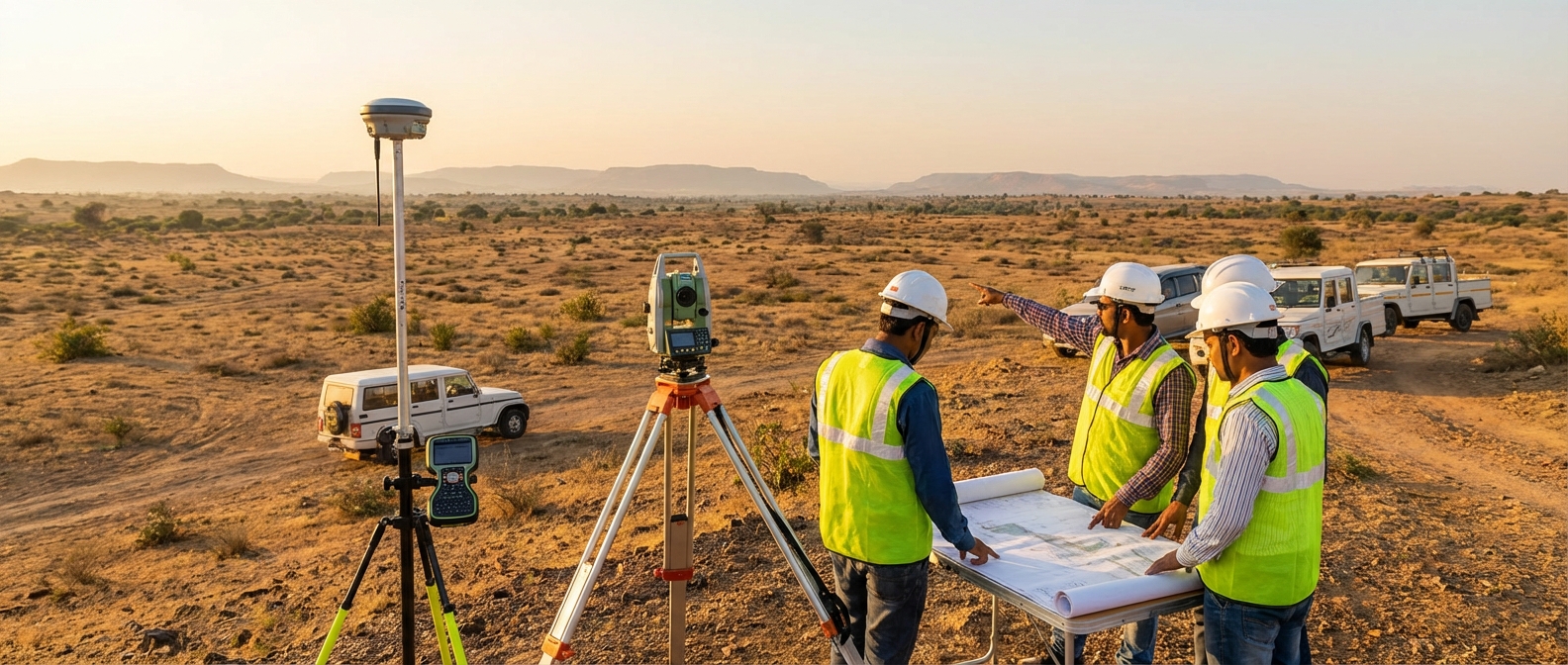
Understanding Solar Site Surveys in the Indian Context
A solar site survey is a comprehensive on-ground assessment that evaluates whether a proposed location is suitable for solar project development. In the Indian context, where geographical, climatic, and regulatory conditions vary dramatically from state to state, site surveys must be tailored to address location-specific challenges and opportunities.
The primary objectives of a solar site survey include:
- Land feasibility assessment: Evaluating topography, terrain conditions, and land availability for optimal solar panel placement
- Solar resource evaluation: Measuring solar irradiation levels, sun path analysis, and shading factors specific to the location
- Technical infrastructure assessment: Analyzing grid connectivity, evacuation capacity, and electrical infrastructure availability
- Geotechnical investigation: Conducting soil testing and foundation analysis for structural engineering requirements
- Regulatory compliance verification: Identifying required approvals, clearances, and state-specific regulatory requirements
- Risk identification: Detecting potential obstacles including land disputes, environmental constraints, or access limitations
For EPC companies, the quality and accuracy of site survey data directly impacts every subsequent phase of the project—from solar design and structural engineering to permit design and final installation. Inadequate or inaccurate survey data can lead to costly design revisions, project delays, budget overruns, and suboptimal energy generation performance.
Heaven Designs has conducted comprehensive site surveys and feasibility studies across India’s diverse geographical regions, leveraging deep local expertise to deliver accurate, actionable survey data that seamlessly integrates with detailed engineering design workflows. With experience across 628+ MW of solar projects, the company understands the critical importance of thorough site assessment in project success.
Critical Parameters Evaluated During Solar Site Surveys in India
A professional solar site survey in India must evaluate multiple interconnected parameters that collectively determine project viability and design requirements. Understanding these critical assessment areas helps EPC companies ensure comprehensive data collection during the survey phase.
Land Topography and Terrain Assessment
Detailed topographical mapping forms the foundation of solar project design. Survey teams measure land elevation, slope gradients, contours, and terrain irregularities that affect panel mounting systems, civil works requirements, and drainage design. In India’s varied landscape, terrain can range from perfectly flat desert land in Rajasthan to rocky, undulating terrain in Karnataka or hilly regions in northeastern states. Each terrain type presents unique engineering challenges and cost implications.
Solar Irradiation and Meteorological Data
Accurate measurement of solar irradiation levels is essential for energy yield calculations and financial modeling. Site surveys collect data on Global Horizontal Irradiance (GHI), Direct Normal Irradiance (DNI), and Diffuse Horizontal Irradiance (DHI). Additionally, meteorological parameters including ambient temperature, wind speed and direction, humidity levels, and rainfall patterns must be assessed. These factors vary significantly across Indian states—coastal Tamil Nadu experiences different conditions than arid Rajasthan or humid West Bengal.
Soil Investigation and Geotechnical Analysis
Comprehensive geotechnical investigation determines foundation design requirements and structural engineering specifications. Soil testing evaluates bearing capacity, soil composition, water table depth, and potential for soil erosion or settlement. In states like Gujarat and Maharashtra with varied soil conditions, geotechnical data is critical for structural engineering design that ensures long-term stability of mounting structures and inverter foundations.
Grid Connectivity and Electrical Infrastructure
Assessment of existing electrical infrastructure determines grid connection feasibility and evacuation capacity. Survey teams evaluate the nearest substation location, available transformer capacity, transmission line routes, and voltage levels. Grid infrastructure varies significantly across Indian states, with some regions offering robust connectivity while others, particularly in remote areas, present significant evacuation challenges that impact project economics.
Shadow Analysis and Shading Considerations
Identification of potential shading sources—including existing structures, trees, hills, or planned future developments—is crucial for accurate energy yield projections. Shadow analysis must account for seasonal sun path variations specific to the project latitude. In densely populated states or industrial areas, nearby structures can significantly impact rooftop solar potential and ground-mount project layouts.
Access Roads and Logistics Assessment
Evaluation of site accessibility determines construction logistics, equipment transportation feasibility, and ongoing operations and maintenance requirements. Survey teams assess existing road conditions, required road improvements, distance from major highways, and potential monsoon-related access challenges. In remote locations across states like Madhya Pradesh or Rajasthan, access infrastructure can significantly impact project timelines and costs.
Water Availability for Operations
Assessment of water sources for panel cleaning and maintenance is particularly important in India’s dusty regions. Survey teams identify nearby water sources, water quality, and availability throughout the year. In water-scarce regions like Rajasthan, water logistics can represent a significant operational consideration that must be factored into project planning.
State-by-State Solar Site Survey Considerations
India’s federal structure means that solar project development involves navigating both central government guidelines and state-specific regulations, policies, and physical conditions. Understanding these regional variations is essential for EPC companies conducting site surveys across multiple locations. The following sections provide detailed insights into major solar states and their unique site survey considerations.
Northern India: Rajasthan, Gujarat, and Punjab
Rajasthan leads India in installed solar capacity and offers some of the most favorable conditions for large-scale solar development. Site surveys in Rajasthan must address:
- Desert terrain characteristics: Predominantly flat land with excellent solar irradiation (5.5-6.5 kWh/m²/day), minimal shading concerns, and abundant land availability
- Dust and sand management: High dust accumulation rates requiring robust cleaning strategies and dust-resistant equipment specifications
- Extreme temperature variations: Significant diurnal temperature swings affecting equipment specifications and structural expansion considerations
- Water scarcity: Limited water availability requiring waterless cleaning solutions or water transportation logistics
- Grid infrastructure: Well-developed solar parks with dedicated evacuation infrastructure, though remote locations may face connectivity challenges
Gujarat offers diverse solar development opportunities across coastal and inland regions. Site survey considerations include:
- Coastal vs. inland variations: Coastal areas experience higher humidity and salt-laden winds requiring corrosion-resistant materials, while inland regions face desert-like conditions
- Industrial zone opportunities: Extensive industrial infrastructure providing excellent grid connectivity and rooftop solar potential
- Saline soil conditions: Particularly in coastal Kutch region, requiring specialized foundation design and corrosion protection
- Cyclone considerations: Coastal projects must account for cyclonic wind loads in structural design
- Progressive regulatory framework: Well-established approval processes and supportive state policies facilitating faster project development
Punjab presents unique agricultural land considerations for solar development:
- Agricultural land regulations: Strict land use conversion requirements and agricultural land protection policies
- High water table: Shallow groundwater levels in many areas affecting foundation design and requiring careful geotechnical assessment
- Seasonal variations: Significant monsoon impact and winter fog affecting solar irradiation patterns
- Grid infrastructure: Well-developed electrical infrastructure supporting agricultural pumping loads
- Land acquisition challenges: Fragmented land ownership requiring multiple stakeholder coordination
Southern India: Karnataka, Tamil Nadu, Andhra Pradesh, and Telangana
Karnataka ranks among India’s top solar states with varied topographical conditions:
- Rocky terrain: Many regions feature hard rock requiring specialized foundation solutions and increasing civil works costs
- Varied topography: Undulating terrain requiring careful grading analysis and terraced mounting solutions
- Monsoon considerations: Significant rainfall requiring robust drainage design and erosion control measures
- Good solar irradiation: 5.0-5.5 kWh/m²/day across most regions with relatively consistent year-round generation
- Established solar parks: Multiple solar parks with pre-developed infrastructure reducing survey complexity
Tamil Nadu offers excellent solar potential with specific coastal considerations:
- Coastal wind factors: High wind speeds in coastal regions requiring enhanced structural design for wind loads
- High ambient temperatures: Elevated temperatures affecting equipment derating and requiring temperature coefficient considerations
- Land acquisition challenges: High population density and land costs in many regions
- Cyclone-prone coastal areas: Eastern coastal regions requiring cyclone-resistant design specifications
- Strong grid infrastructure: Well-developed electrical network supporting large-scale solar integration
Andhra Pradesh and Telangana have emerged as major solar development hubs:
- Large-scale solar parks: Government-developed solar parks with pre-cleared land and evacuation infrastructure
- Government initiatives: Proactive state policies and streamlined approval processes
- Grid capacity: Significant transmission infrastructure investments supporting solar evacuation
- Varied terrain: Mix of flat and undulating terrain requiring site-specific assessment
- Water availability: Better water access compared to western states, though seasonal variations exist
Western and Central India: Maharashtra and Madhya Pradesh
Maharashtra offers diverse solar opportunities across industrial and rural regions:
- Industrial rooftop potential: Extensive industrial infrastructure providing significant rooftop solar opportunities requiring detailed structural load assessments
- Varied terrain: From coastal Konkan region to Vidarbha plateau, requiring location-specific survey approaches
- Regulatory framework: Complex approval processes involving multiple authorities and clearances
- Grid infrastructure: Well-developed in industrial areas, but capacity constraints in some rural regions
- Land costs: Higher land acquisition costs in many regions compared to northern states
Madhya Pradesh offers abundant land and growing solar potential:
- Abundant land availability: Large tracts of available land suitable for utility-scale projects
- Tribal land considerations: Significant portions of land under tribal ownership requiring special clearances and community consultations
- Grid connectivity challenges: Remote locations may face evacuation infrastructure limitations
- Good solar irradiation: 5.0-5.5 kWh/m²/day across most regions
- Developing infrastructure: Ongoing transmission infrastructure development improving project viability
Eastern and Northeastern India: Special Considerations
Eastern and northeastern states present unique challenges for solar development:
- Lower solar irradiation: 4.0-4.5 kWh/m²/day compared to 5.5-6.5 kWh/m²/day in western states, affecting project economics
- High humidity and rainfall: Significant monsoon impact requiring enhanced moisture protection and drainage design
- Challenging terrain: Hilly and mountainous regions in northeastern states limiting suitable land availability
- Limited grid infrastructure: Underdeveloped transmission networks in remote areas
- Land acquisition complexities: Tribal land regulations and community land ownership structures
- Seismic considerations: Some northeastern regions fall in seismic zones requiring earthquake-resistant design

Regulatory Framework and Compliance Requirements
Navigating India’s regulatory landscape is a critical component of solar site surveys. EPC companies must understand both central government guidelines and state-specific requirements to ensure project compliance and avoid costly delays.
Central Electricity Authority (CEA) Guidelines
The CEA provides technical standards and safety requirements for solar installations across India. Site surveys must collect data ensuring compliance with CEA regulations regarding:
- Electrical safety standards and clearance requirements
- Grid connectivity technical specifications
- Equipment standards and certification requirements
- Safety distances from transmission lines and substations
State-Specific Nodal Agency Approvals
Each Indian state has designated nodal agencies (typically State Electricity Regulatory Commissions or dedicated renewable energy departments) that oversee solar project approvals. Site surveys must identify and document requirements for:
- Project registration and application procedures
- Technical feasibility approvals
- Grid connectivity and power evacuation approvals
- Power Purchase Agreement (PPA) requirements for third-party sales
- Net metering or gross metering approvals for rooftop installations
Environmental Clearances and Forest Land Regulations
Depending on project size and location, environmental clearances may be required:
- Environmental Impact Assessment (EIA): Required for projects above certain capacity thresholds (typically 50 MW+)
- Forest clearance: Projects on forest land require Ministry of Environment, Forest and Climate Change approvals
- Wildlife clearances: Projects near protected areas or wildlife corridors require additional assessments
- Coastal Regulation Zone (CRZ) clearances: Projects in coastal areas must comply with CRZ regulations
Land Use Conversion Requirements
Site surveys must identify current land classification and required conversions:
- Agricultural land conversion: Many states restrict or regulate conversion of agricultural land for non-agricultural purposes
- Revenue land conversion: Government land requires specific approval processes
- Industrial land designation: Some states require land to be designated for industrial use
- State-specific procedures: Each state has unique land conversion processes and timelines
Local Body Permissions and NOCs
Multiple local clearances are typically required:
- Gram Panchayat or Municipal Corporation approvals
- Building plan approvals for rooftop installations
- Fire department No Objection Certificates (NOCs)
- Pollution Control Board clearances
- Water and sewage department NOCs if applicable
Heaven Designs’ experience across multiple Indian states enables the company to guide EPC clients through complex regulatory requirements, ensuring site survey data collection aligns with state-specific compliance needs and facilitates smooth permit design and approval processes.
Advanced Technologies and Tools for Site Surveys in 2026
The solar industry has witnessed rapid technological advancement in site survey methodologies. In 2026, leading solar EPC companies in India are leveraging cutting-edge technologies to improve survey accuracy, reduce costs, and accelerate project timelines.
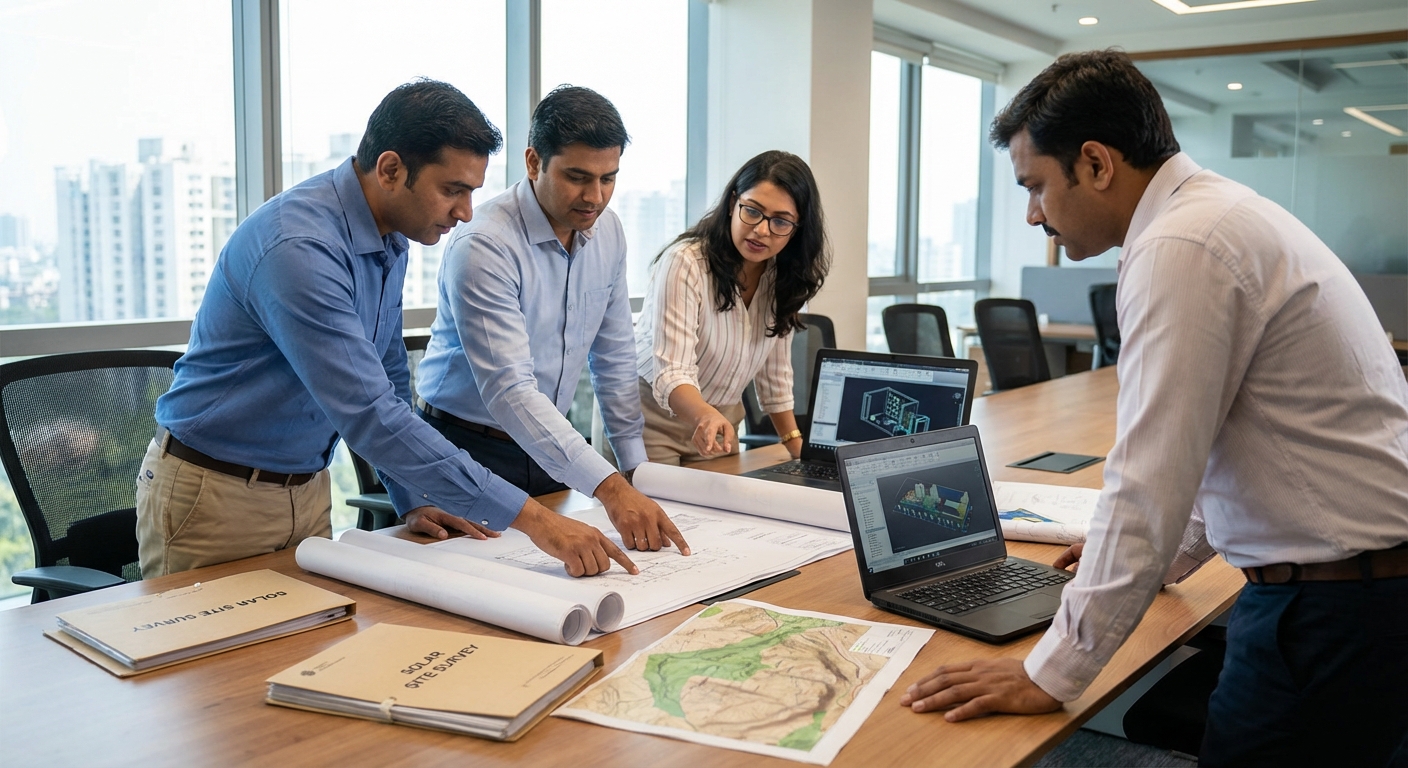
Drone-Based Aerial Surveys and Photogrammetry
Unmanned Aerial Vehicles (UAVs) have revolutionized site survey efficiency. High-resolution drone imagery enables:
- Rapid site mapping: Complete aerial coverage of large sites in hours rather than days
- 3D terrain modeling: Photogrammetry software creates detailed 3D models from drone imagery
- Accurate area calculations: Precise measurement of available land area and usable space
- Shading analysis: Identification of shading sources and shadow patterns throughout the day
- Progress monitoring: Baseline documentation for construction phase comparison
LiDAR Technology for Terrain Mapping
Light Detection and Ranging (LiDAR) technology provides centimeter-level accuracy for terrain mapping:
- Highly accurate elevation data for grading and drainage design
- Vegetation penetration revealing ground surface beneath tree cover
- Detailed contour mapping for civil engineering design
- Integration with CAD software for seamless design workflows
Satellite Imagery and GIS Analysis
Geographic Information System (GIS) platforms combined with satellite imagery enable comprehensive desktop analysis:
- Preliminary site screening: Evaluation of multiple potential sites before on-ground surveys
- Solar irradiation mapping: Historical solar resource data from satellite measurements
- Land use analysis: Identification of land classification and surrounding land use patterns
- Infrastructure mapping: Location of transmission lines, substations, and access roads
- Multi-temporal analysis: Assessment of seasonal variations and historical land use changes
IoT Sensors for Real-Time Meteorological Data
Internet of Things (IoT) enabled weather stations provide continuous on-site data collection:
- Real-time solar irradiation measurement (GHI, DNI, DHI)
- Ambient temperature and module temperature monitoring
- Wind speed and direction tracking
- Rainfall and humidity measurement
- Long-term data collection for accurate energy yield modeling
AI-Powered Feasibility Analysis Tools
Artificial intelligence and machine learning algorithms enhance data analysis:
- Automated shading analysis and optimization
- Predictive modeling for energy yield projections
- Cost optimization algorithms for layout design
- Risk assessment and anomaly detection
- Pattern recognition for identifying optimal site characteristics
Integration with Solar Design Software
Modern site survey data integrates seamlessly with solar design software platforms:
- Direct import of terrain models and site boundaries
- Automated layout generation based on survey constraints
- Real-time design iterations incorporating survey data
- Streamlined workflow from survey to detailed engineering design
- Reduced errors from manual data transfer
Heaven Designs leverages these advanced technologies to deliver comprehensive site survey services that seamlessly integrate with detailed solar design workflows, ensuring EPC clients receive accurate, actionable data that accelerates project development timelines.
Common Challenges in Solar Site Surveys Across India
Despite technological advancements, solar site surveys in India continue to face several persistent challenges that EPC companies must navigate effectively.
Land Ownership Disputes and Title Verification
Land ownership complexities represent one of the most significant challenges in Indian solar projects. Issues include:
- Fragmented land ownership requiring coordination with multiple landowners
- Unclear or disputed land titles delaying project development
- Ancestral property divisions and inheritance disputes
- Encroachments and unauthorized occupants on proposed sites
- Time-consuming title verification and legal due diligence processes
Thorough legal due diligence during the site survey phase can prevent costly project delays and disputes during construction.
Access to Remote Locations and Logistics
Many high-potential solar sites are located in remote areas with limited infrastructure:
- Poor road conditions making site access difficult, especially during monsoons
- Long distances from major cities increasing survey costs and timelines
- Limited local accommodation and facilities for survey teams
- Transportation challenges for survey equipment and instruments
- Communication infrastructure limitations affecting data transmission
Seasonal Variations Affecting Survey Timing
India’s diverse climate creates seasonal constraints on survey activities:
- Monsoon season: Heavy rainfall making site access difficult and affecting equipment operation
- Extreme summer heat: Safety concerns and equipment limitations in high-temperature regions
- Winter fog: Visibility limitations in northern states affecting aerial surveys
- Seasonal flooding: Waterlogging in low-lying areas revealing drainage challenges
- Agricultural cycles: Crop seasons affecting access to agricultural land
Coordination with Multiple Stakeholders
Solar projects involve numerous stakeholders requiring coordination:
- Landowners and local communities
- State electricity boards and distribution companies
- Local government authorities and panchayats
- Environmental and forest departments
- Transmission system operators
- Project developers, investors, and lenders
Effective stakeholder management during the survey phase establishes positive relationships that facilitate smoother project execution.
Data Accuracy and Validation Challenges
Ensuring data accuracy is critical for reliable project design:
- Calibration and maintenance of survey instruments
- Verification of third-party data sources
- Reconciliation of conflicting data from multiple sources
- Quality control processes for field data collection
- Peer review and validation of survey findings
Budget and Timeline Constraints
EPC companies face pressure to minimize survey costs and timelines:
- Balancing comprehensive data collection with budget limitations
- Pressure to accelerate survey timelines to meet project deadlines
- Trade-offs between survey detail and cost efficiency
- Risk of inadequate surveys leading to costly design revisions later
Partnering with experienced survey providers like Heaven Designs helps EPC companies optimize the balance between comprehensive data collection and cost-effective survey execution.
Best Practices for Conducting Effective Solar Site Surveys
Implementing proven best practices ensures solar site surveys deliver accurate, comprehensive data that supports successful project development.
Comprehensive Pre-Survey Desktop Study
Before mobilizing field teams, conduct thorough desktop research:
- Review satellite imagery and topographical maps
- Analyze historical solar irradiation data from databases like NASA POWER or NREL
- Research land records and ownership documentation
- Identify nearby grid infrastructure and substation locations
- Review state-specific regulatory requirements and approval processes
- Assess environmental sensitivities and protected areas
- Evaluate access routes and logistics requirements
Desktop studies reduce field survey time and costs by identifying potential issues before site mobilization.
Engaging Experienced Local Survey Teams
Local expertise provides invaluable advantages:
- Knowledge of regional terrain characteristics and seasonal patterns
- Familiarity with local regulatory processes and authorities
- Established relationships with local communities and stakeholders
- Understanding of regional construction practices and material availability
- Language capabilities for effective communication with local authorities
Using Standardized Checklists and Documentation Protocols
Standardization ensures consistency and completeness:
- Develop comprehensive survey checklists covering all required parameters
- Use standardized data collection forms and templates
- Implement quality control checkpoints throughout the survey process
- Maintain consistent photographic documentation protocols
- Establish clear data validation and verification procedures
Conducting Surveys During Optimal Seasons
Timing surveys appropriately improves efficiency and data quality:
- Avoid monsoon season when possible for better site access and equipment operation
- Consider conducting surveys during different seasons to assess seasonal variations
- Plan surveys around agricultural cycles for agricultural land sites
- Account for regional climate patterns when scheduling field work
Integrating Survey Data with Design Workflows
Seamless integration accelerates project development:
- Use compatible data formats that import directly into design software
- Establish clear data handoff protocols between survey and design teams
- Conduct joint site visits with survey and design engineers
- Implement collaborative platforms for real-time data sharing
- Maintain version control and documentation of survey data updates
Quality Assurance and Peer Review Processes
Independent review catches errors and improves accuracy:
- Implement peer review of survey reports before finalization
- Cross-check field measurements with remote sensing data
- Validate geotechnical findings with regional soil databases
- Review survey conclusions against project requirements
- Conduct site revisits to verify critical findings when necessary
Maintaining Detailed Photographic and Video Documentation
Visual documentation provides invaluable reference material:
- Capture comprehensive site photographs from multiple angles and elevations
- Document existing structures, vegetation, and potential obstacles
- Record access routes and site boundaries
- Use drone video for complete site overview
- Maintain organized photo libraries with clear labeling and metadata
- Include photographs in survey reports for stakeholder communication
How Heaven Designs Delivers Comprehensive Site Survey Services
Heaven Designs brings specialized expertise and proven methodologies to solar site surveys across India, helping EPC companies navigate the complexities of regional variations and regulatory requirements.
Pan-India Coverage with Local Expertise
With experience across all major solar states in India, Heaven Designs combines national reach with deep local knowledge. The company’s network enables efficient survey execution in diverse locations from Rajasthan’s deserts to Karnataka’s rocky terrain to Tamil Nadu’s coastal regions, ensuring state-specific considerations are properly addressed.
Experienced Team of 50+ Engineers and Consultants
Heaven Designs’ team of over 50 skilled engineers and consultants brings multidisciplinary expertise to site survey projects. This depth of technical capability ensures comprehensive assessment across all critical parameters—from geotechnical investigation to electrical infrastructure evaluation to regulatory compliance verification.
Integrated Survey and Design Services
Unlike standalone survey providers, Heaven Designs integrates site survey services with comprehensive solar design services in India. This integration ensures survey data collection is optimized for subsequent design phases, eliminating data gaps and reducing the need for costly resurveys. Survey findings seamlessly flow into detailed engineering design, structural engineering, and permit documentation.
Cost-Effective Solutions for EPC Budgets
Understanding the cost pressures facing EPC companies, Heaven Designs delivers site survey services optimized for value. By leveraging advanced technologies including drone surveys and GIS analysis, the company reduces field survey time and costs while maintaining comprehensive data collection. Transparent pricing and clear deliverables help EPC companies manage solar design costs and engineering costs effectively.
Fast Turnaround Times with Accurate Reports
Project timelines are critical in competitive solar markets. Heaven Designs prioritizes rapid survey execution and report delivery without compromising accuracy. Standardized processes, experienced teams, and efficient workflows enable the company to deliver comprehensive survey reports within aggressive design timelines that keep projects on schedule.
Seamless Transition to Detailed Design
Site survey is just the first step in Heaven Designs’ comprehensive service offering. EPC companies benefit from seamless transition from feasibility studies to detailed engineering design, PMC services, and permit documentation. This continuity eliminates coordination challenges and ensures consistent quality throughout the project development cycle.
Proven Track Record Across 628+ MW
Heaven Designs’ experience across 628+ MW of solar projects for 752+ clients demonstrates the company’s capability to deliver reliable site survey services at scale. This extensive project portfolio spans diverse geographies, project types, and regulatory environments, providing EPC companies with confidence in the company’s ability to handle complex survey requirements.
For EPC companies seeking a reliable design partner that understands the critical importance of thorough site surveys, Heaven Designs offers the expertise, technology, and integrated service approach that accelerates project development while minimizing risks.
Site Survey Deliverables and Documentation
A professional solar site survey should produce comprehensive documentation that supports all subsequent project phases. Understanding expected deliverables helps EPC companies evaluate survey proposals and ensure complete data collection.
Comprehensive Site Survey Report
The primary deliverable is a detailed written report including:
- Executive summary: High-level findings, feasibility conclusions, and key recommendations
- Site description: Location details, access routes, surrounding land use, and site characteristics
- Methodology: Survey techniques, equipment used, and data collection procedures
- Findings by parameter: Detailed results for topography, solar resources, geotechnical conditions, grid infrastructure, etc.
- Regulatory assessment: Required approvals, clearances, and compliance considerations
- Risk analysis: Identified challenges, constraints, and mitigation recommendations
- Recommendations: Optimal project configuration, technology selection, and next steps
Topographical Maps and Contour Drawings
Detailed topographical documentation includes:
- Site boundary survey with coordinates
- Contour maps showing elevation variations
- Cross-sectional profiles
- Slope analysis and grading requirements
- Drainage patterns and watershed analysis
- CAD files compatible with design software
Geotechnical Investigation Reports
Soil testing and geotechnical analysis deliverables:
- Borehole logs and soil profiles
- Laboratory test results (bearing capacity, soil composition, moisture content)
- Water table depth measurements
- Foundation design recommendations
- Soil corrosivity assessment
- Seismic considerations if applicable
Solar Irradiation and Meteorological Data
Solar resource assessment documentation:
- Historical solar irradiation data (GHI, DNI, DHI)
- On-site measurement data if weather station deployed
- Temperature, wind, and humidity profiles
- Seasonal variation analysis
- Energy yield projections and P50/P90 estimates
- Comparison with satellite-derived data sources
Grid Connectivity Assessment
Electrical infrastructure evaluation deliverables:
- Nearest substation location and capacity assessment
- Transmission line routes and distances
- Single-line diagrams of existing infrastructure
- Voltage levels and transformer capacity
- Grid code compliance requirements
- Evacuation scheme recommendations
- Utility coordination requirements
Photographic Documentation and Drone Imagery
Visual documentation package:
- Comprehensive site photographs from multiple angles
- High-resolution drone imagery and orthomosaic maps
- 360-degree panoramic views
- Video documentation of site conditions
- Annotated photographs highlighting key features
- Time-stamped and geo-tagged image files
Feasibility Recommendations and Risk Assessment
Strategic guidance for project development:
- Overall project feasibility conclusion (go/no-go recommendation)
- Optimal project capacity and configuration
- Technology and equipment recommendations
- Identified risks and mitigation strategies
- Critical path items requiring immediate attention
- Alternative scenarios and sensitivity analysis
Cost Estimates and Project Timeline Projections
Financial and scheduling guidance:
- Preliminary capital cost estimates
- Civil works and site preparation cost projections
- Grid connectivity and evacuation infrastructure costs
- Regulatory approval timeline estimates
- Project development schedule recommendations
- Key milestones and critical dependencies
Heaven Designs delivers comprehensive survey documentation packages that provide EPC companies with all necessary information to proceed confidently with detailed design and project development.
Frequently Asked Questions About Solar Site Surveys in India
How long does a typical solar site survey take in India?
Survey duration varies based on project size, location, and complexity. For a typical 1-5 MW ground-mount project, field survey activities generally require 3-7 days, followed by 1-2 weeks for data analysis and report preparation. Larger utility-scale projects (50+ MW) may require 2-3 weeks of field work. Remote locations, challenging terrain, or extensive geotechnical investigation can extend timelines. Desktop studies and preliminary assessments can often be completed in 3-5 days before field mobilization.
What is the cost of conducting a site survey for MW-scale projects?
Site survey costs depend on project scale, location accessibility, survey scope, and technology employed. Costs typically include field team mobilization, equipment and instrumentation, geotechnical testing, drone surveys, data analysis, and report preparation. For accurate cost estimates tailored to your specific project requirements, contact Heaven Designs at service@heavendesigns.in or call +91 90811 00297 to discuss your project needs.
Do I need separate surveys for different states?
Yes, each project location requires a site-specific survey regardless of state. While survey methodologies remain consistent, state-specific considerations—including terrain characteristics, climate patterns, regulatory requirements, and grid infrastructure—vary significantly across India. However, EPC companies working across multiple states benefit from partnering with survey providers like Heaven Designs who understand regional variations and can apply lessons learned across locations to improve efficiency.
Can site surveys be conducted remotely using satellite data?
Remote sensing and satellite data provide valuable preliminary assessment capabilities, including topographical mapping, solar irradiation estimates, and infrastructure identification. However, comprehensive site surveys require on-ground verification for critical parameters including geotechnical conditions, detailed terrain assessment, grid infrastructure evaluation, and regulatory compliance verification. Best practice combines remote sensing for preliminary screening with targeted field surveys for detailed assessment, optimizing both accuracy and cost efficiency.
What season is best for conducting site surveys?
The optimal survey season varies by region. Generally, post-monsoon months (October-November) and winter months (December-February) offer favorable conditions across most Indian states, with good weather, clear visibility for aerial surveys, and accessible site conditions. Avoid monsoon season (June-September) when possible due to access challenges and equipment limitations. However, conducting surveys during different seasons can provide valuable insights into seasonal variations affecting project design. Consult with experienced survey providers to determine optimal timing for your specific location.
How does site survey data integrate with permit design and engineering?
Site survey data forms the foundation for all subsequent design phases. Topographical data feeds directly into layout design and civil engineering. Geotechnical findings determine foundation design and structural specifications. Solar resource data drives energy yield modeling and financial projections. Grid infrastructure assessment shapes electrical design and evacuation schemes. Regulatory findings guide permit documentation and approval strategies. When survey and design services are integrated—as with Heaven Designs’ comprehensive approach—data flows seamlessly between phases, eliminating gaps and reducing the risk of design revisions due to inadequate survey data.
Partner with Heaven Designs for Comprehensive Solar Site Surveys Across India
Conducting thorough, accurate solar site surveys is the critical foundation for successful solar project development across India’s diverse geographical and regulatory landscape. For EPC companies navigating the complexities of state-specific requirements, terrain challenges, and regulatory compliance, partnering with an experienced survey and design provider delivers significant advantages in project timelines, cost optimization, and risk mitigation.
Heaven Designs brings proven expertise across 628+ MW of solar projects, deep understanding of regional variations across Indian states, and integrated survey-to-design services that accelerate project development. The company’s team of 50+ engineers and consultants combines technical excellence with practical knowledge of India’s solar development landscape, delivering comprehensive site survey services that provide EPC companies with the accurate, actionable data needed for confident project execution.
Whether you’re planning a utility-scale ground-mount project in Rajasthan, a commercial rooftop installation in Maharashtra, or a solar park development in Andhra Pradesh, Heaven Designs offers the specialized expertise and integrated service approach that transforms site survey data into successful solar projects.
Ready to conduct a comprehensive site survey for your next solar project? Get a Quick Proposal Now! or contact Heaven Designs at +91 90811 00297 or service@heavendesigns.in to discuss your project requirements and discover how professional site survey services can accelerate your solar development timeline while optimizing project costs and performance.