


When EPC companies undertake solar projects across India, one of the most critical yet often underestimated aspects is structural engineering. From the scorching deserts of Rajasthan to the cyclone-prone coasts of Tamil Nadu, India’s diverse climatic conditions demand specialized structural engineering expertise to ensure solar installations remain safe, compliant, and cost-effective throughout their 25+ year lifespan. This comprehensive guide explains everything solar EPC companies need to know about structural engineering services in India, including what’s included, expected deliverables, compliance requirements, and how proper structural design directly impacts project safety and profitability.
Whether you’re planning a residential rooftop installation or a multi-megawatt ground-mount solar farm, understanding the complete scope of structural engineering India services will help you make informed decisions, avoid costly mistakes, and deliver projects that stand the test of time.
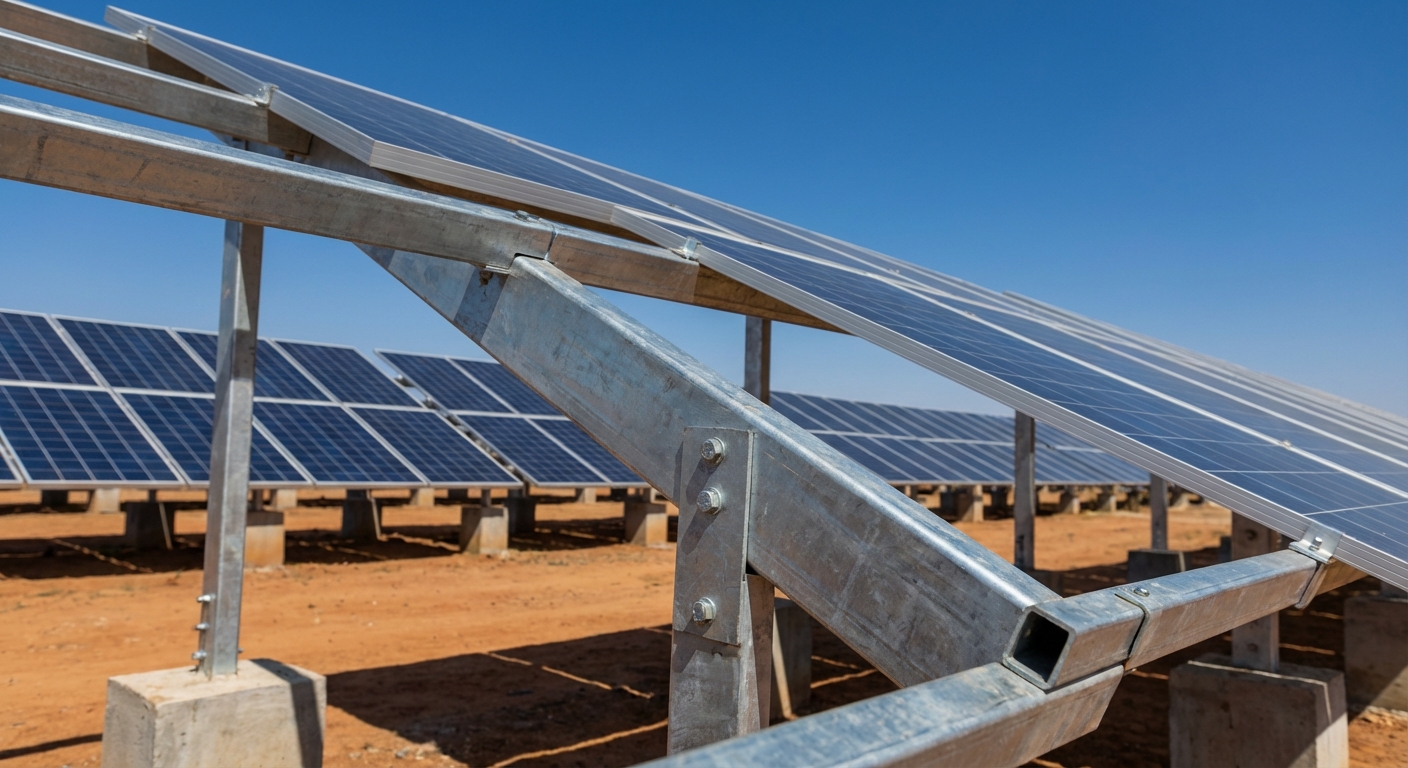
What is Solar Structural Engineering and Why It Matters for Indian Solar Projects
Solar structural engineering encompasses the specialized design and analysis of all load-bearing components in a solar installation, including foundations, module mounting structures, support frames, and connection systems. Unlike conventional structural engineering, solar structural design must account for unique factors such as wind uplift forces on tilted panels, dynamic loads from tracking systems, thermal expansion of materials under extreme temperatures, and the long-term durability requirements of 25-30 year solar assets.
For EPC companies operating in India, structural engineering takes on heightened importance due to the country’s extraordinary climatic diversity. A solar project in Gujarat’s coastal Surat region faces entirely different structural challenges than one in earthquake-prone Uttarakhand or the high-wind zones of Tamil Nadu. Structural engineering India services must address these regional variations while maintaining compliance with national standards and optimizing costs.
The consequences of inadequate structural design are severe and costly. Under-engineered structures risk catastrophic failure during cyclones or earthquakes, leading to complete project loss, safety hazards, insurance claim denials, and reputational damage. Conversely, over-engineered designs waste capital on unnecessary materials, reducing project ROI and making solar installations less competitive. Professional structural engineering strikes the optimal balance—ensuring safety and compliance while maximizing cost-efficiency.
According to industry data, structural components typically represent 15-25% of total project costs for ground-mount installations and 10-15% for rooftop systems. Even modest optimization through proper solar design India practices can yield savings of 5-10% on structural costs without compromising safety—translating to significant financial benefits on megawatt-scale projects.
Beyond cost considerations, structural engineering directly impacts several critical project aspects:
- Project Safety: Properly designed structures protect personnel during installation and maintenance while safeguarding nearby property and people throughout the project lifecycle
- Regulatory Compliance: Meeting IS codes, MNRE guidelines, and local building authority requirements is mandatory for project approvals and grid connectivity
- Insurance and Financing: Banks and insurance providers require certified structural designs before approving project financing or coverage
- Long-term Performance: Structural integrity ensures panels maintain optimal tilt angles and orientations for maximum energy generation over decades
- Warranty Protection: Module and equipment manufacturers may void warranties if installations don’t meet structural specifications
Complete Scope of Solar Structural Engineering Services in India
Professional structural engineering India services for solar projects encompass a comprehensive range of activities, from initial site assessment through final construction documentation. Understanding this complete scope helps EPC companies evaluate service providers and ensure nothing critical is overlooked.
Foundation Design: The Critical First Step
Foundation design forms the literal groundwork of every solar installation. The foundation system must transfer all loads—including the weight of panels, mounting structures, wind forces, and seismic loads—safely into the ground while accounting for soil conditions, groundwater levels, and long-term settlement.
Soil investigation and geotechnical analysis provide the essential data for foundation design. This includes soil boring tests to determine soil type, bearing capacity, cohesion, and angle of internal friction at various depths. For large projects, multiple test locations across the site reveal soil variations that influence foundation design. In India’s diverse geography, soil conditions vary dramatically—from the black cotton soils of Maharashtra that expand and contract with moisture, to the sandy soils of Rajasthan, to the rocky terrain of parts of Karnataka.
Based on geotechnical data and project requirements, structural engineers select appropriate foundation types:
- Pile Foundations: Driven or drilled piles are common for ground-mount solar farms, particularly in areas with poor surface soil or high water tables. Pile design includes determining optimal pile diameter, depth, spacing, and material specifications
- Raft or Mat Foundations: Used when soil bearing capacity is low or loads need distribution over larger areas, common in some rooftop installations and ground-mount projects on weak soils
- Isolated Footings: Individual concrete footings support each structure post, suitable for good soil conditions and smaller installations
- Ballasted Foundations: Non-penetrating systems using concrete blocks or weights, primarily for rooftop installations where roof penetration must be minimized
Foundation design for different project types requires specialized approaches. Rooftop solar India installations demand careful analysis of existing building structural capacity, roof load-bearing limits, and waterproofing considerations. Ground-mount projects require extensive site grading analysis and drainage design. Carport structures involve higher loads and more complex foundation requirements due to elevated mounting heights and larger spans.
Cost optimization in foundation design comes from accurate load calculations and soil analysis. Over-conservative designs waste concrete and steel, while under-designed foundations risk failure. Experienced structural engineers leverage advanced analysis software and regional experience to optimize foundation designs, often achieving 10-15% cost savings compared to generic approaches.
Module Mounting Structure Design and Engineering
The module mounting structure (MMS) is the skeletal framework that holds solar panels at the correct tilt angle and orientation. MMS design involves complex structural analysis to ensure the framework withstands all anticipated loads throughout the project lifetime while minimizing material costs.
Fixed-tilt mounting structures are most common in India, with tilt angles typically ranging from 10-25 degrees depending on latitude. These structures must be engineered for:
- Wind Loads: Both downward pressure and uplift forces, which vary significantly based on panel tilt angle, height above ground, terrain category, and regional wind speeds
- Dead Loads: The permanent weight of panels, mounting hardware, cables, and the structure itself
- Live Loads: Temporary loads from maintenance personnel, cleaning equipment, snow accumulation (in applicable regions), and dust buildup
- Seismic Loads: Earthquake forces based on seismic zone classification per IS 1893
- Thermal Loads: Expansion and contraction due to temperature variations, particularly important in India’s extreme temperature ranges
Single-axis tracker systems, increasingly popular for large ground-mount projects, introduce additional complexity with moving components, motor loads, and dynamic forces during tracking movement and stow positions during high winds.
Material selection significantly impacts both structural performance and project economics. Galvanized steel remains the most common choice for MMS in India, offering excellent strength-to-weight ratios and corrosion resistance at competitive costs. Hot-dip galvanization (HDG) provides superior corrosion protection compared to pre-galvanized steel, essential for coastal installations and high-humidity regions. Aluminum structures offer weight advantages and inherent corrosion resistance but at higher material costs. Structural steel with protective coatings serves for heavy-duty applications.
Structural member sizing involves detailed analysis using finite element analysis (FEA) software to determine optimal cross-sections for purlins, rafters, columns, and bracing members. Connection design—including bolted connections, welded joints, and fastener specifications—is equally critical, as connections often represent the weakest points in structural systems.
For coastal regions of India, including areas around Surat, Mumbai, Chennai, and Visakhapatnam, corrosion protection becomes paramount. Structural engineers specify enhanced galvanization thickness, stainless steel fasteners, and protective coatings to ensure 25+ year durability in salt-laden environments.
Structural Engineering Deliverables: What EPC Companies Should Expect
When engaging structural engineering consultants for solar EPC India projects, EPC companies should expect a comprehensive package of deliverables that enable seamless project execution. Understanding these deliverables helps evaluate service providers and ensures all necessary documentation is received.
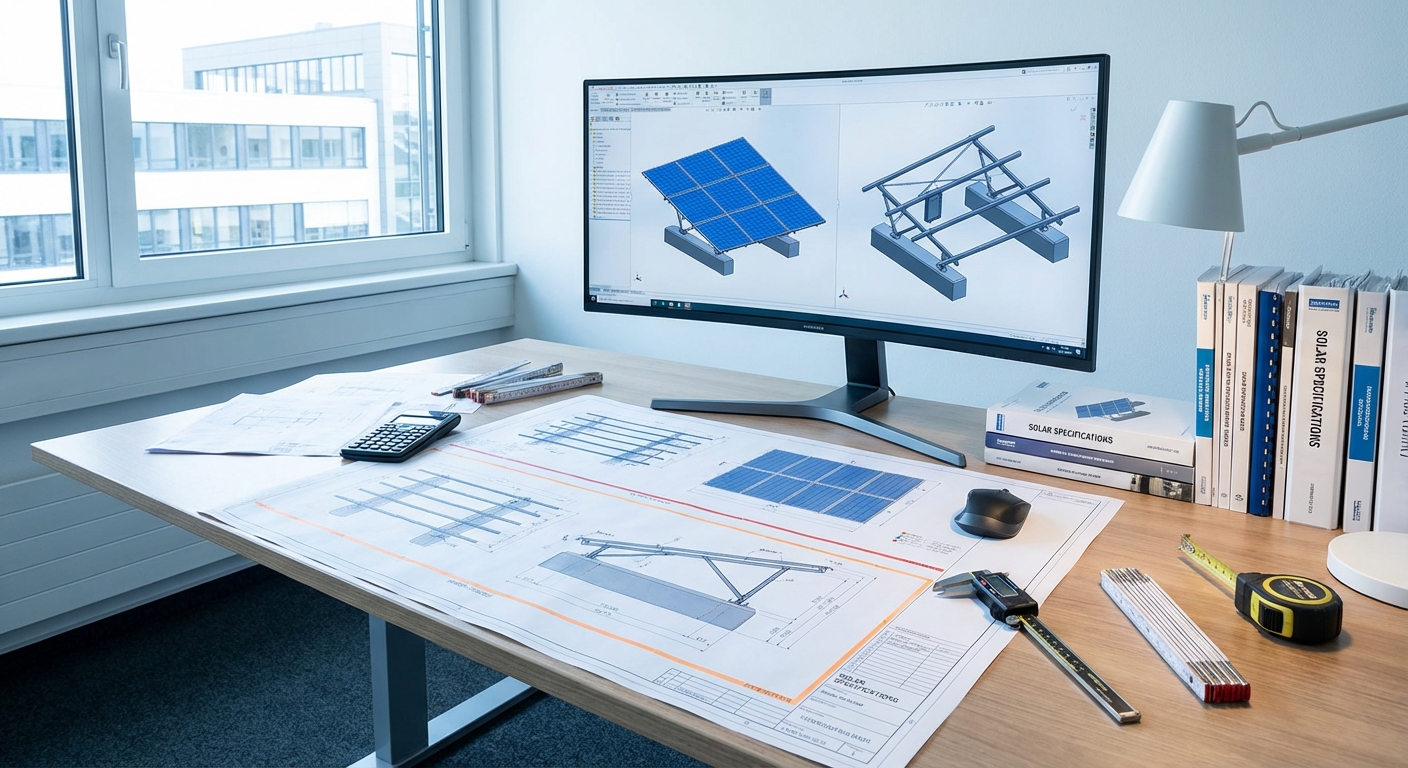
Detailed Structural Drawings
Structural drawings form the primary communication tool between design and construction teams. A complete drawing package includes:
- General Arrangement (GA) Drawings: Overall layout showing structure locations, dimensions, grid lines, and key elevations. These provide the big-picture view of the structural system
- Foundation Drawings: Detailed plans and sections of all foundation elements, including dimensions, reinforcement details, concrete grades, embedment depths, and anchor bolt specifications
- Fabrication Drawings: Shop drawings for MMS fabrication showing individual member dimensions, connection details, hole locations, welding specifications, and assembly instructions
- Erection Drawings: Installation sequence and guidelines for field assembly, including torque specifications, connection sequences, and safety requirements
- Connection Details: Enlarged details of critical connections showing bolt sizes, grades, spacing, edge distances, and installation requirements
Professional solar drawings follow industry standards with clear dimensioning, proper annotation, material callouts, and revision tracking. Digital deliverables typically include AutoCAD DWG files, PDF documents, and sometimes 3D models in formats compatible with BIM (Building Information Modeling) workflows.
Structural Calculation Reports and Design Basis
Calculation reports document the engineering analysis behind the design, providing transparency and enabling third-party review. These reports include:
- Design basis stating applicable codes, standards, load combinations, and safety factors
- Load calculations showing derivation of wind, seismic, dead, and live loads per IS 875, IS 1893, and other relevant standards
- Structural analysis results from computer modeling showing member forces, deflections, and stress ratios
- Foundation design calculations including bearing capacity verification, settlement analysis, and reinforcement design
- Connection design calculations verifying bolt and weld capacities
These calculation reports are essential for obtaining building permits, satisfying permit design requirements, and providing documentation for inspections and certifications.
Bill of Materials and Quantities
A detailed bill of materials (BOM) lists all structural components with specifications, quantities, and sometimes estimated costs. This includes:
- Structural steel members with section sizes, lengths, grades, and quantities
- Fasteners including bolts, nuts, washers with sizes, grades, and quantities
- Concrete volumes and reinforcement quantities for foundations
- Galvanization or coating requirements
- Special components like anchors, clamps, and connectors
Accurate BOMs enable precise procurement, cost estimation, and project planning. They’re essential for competitive bidding and avoiding material shortages during construction.
Third-Party Certification and Stamping Requirements
In India, structural designs for solar projects often require certification by chartered engineers registered with local authorities. The structural engineering consultant should provide:
- Structural stability certificates stamped by licensed structural engineers
- Compliance certificates confirming adherence to IS codes and local regulations
- Load charts and design parameters for submission to authorities
- Documentation formatted per local building department requirements
These certifications are mandatory for obtaining building permits, electrical approvals, and grid connectivity permissions from state electricity boards.
Indian Standards and Compliance Requirements for Solar Structural Design
Structural engineering for solar projects in India must comply with a comprehensive framework of national standards, state regulations, and industry guidelines. Understanding these requirements is essential for solar design India professionals and EPC companies to ensure legal compliance and project approvals.
Key Indian Standards (IS Codes)
IS 875 (Code of Practice for Design Loads) is the foundational standard for load calculations. Part 1 covers dead loads, Part 2 addresses imposed (live) loads, Part 3 details wind loads—particularly critical for solar installations—Part 4 covers snow loads for Himalayan regions, and Part 5 addresses special loads including seismic effects in conjunction with IS 1893.
IS 1893 (Criteria for Earthquake Resistant Design of Structures) governs seismic design across India’s four seismic zones. Solar structures in high-seismic zones (Zones III, IV, and V) require enhanced design considerations, particularly for taller structures and tracker systems. The standard specifies seismic zone factors, importance factors, and response spectrum methods for structural analysis.
IS 800 (Code of Practice for General Construction in Steel) provides design guidelines for steel structures, covering material properties, member design, connection design, and fabrication requirements. This standard is fundamental for MMS design, as most solar mounting structures use structural steel.
IS 456 (Code of Practice for Plain and Reinforced Concrete) governs concrete foundation design, specifying concrete grades, reinforcement requirements, durability considerations, and construction practices. This standard ensures foundations meet strength and durability requirements for India’s varied environmental conditions.
Additional relevant standards include IS 2062 for structural steel specifications, IS 1367 for fastener specifications, and IS 4000 for production and supply of structural steel.
MNRE Guidelines and CEA Regulations
The Ministry of New and Renewable Energy (MNRE) provides guidelines for solar project development, including technical standards for grid-connected systems. While MNRE guidelines focus primarily on electrical aspects, they reference structural safety requirements and mandate compliance with IS codes.
The Central Electricity Authority (CEA) regulations govern grid connectivity and safety standards. For solar projects seeking grid connection, CEA technical standards must be met, which include structural safety certifications.
State-Specific Building Codes and Local Authority Requirements
Beyond national standards, state governments and local building authorities impose additional requirements. These vary significantly across India:
- Municipal corporations in major cities have specific building bye-laws governing rooftop installations, including structural load limits, setback requirements, and fire safety provisions
- Coastal states like Gujarat, Maharashtra, Tamil Nadu, and Odisha have enhanced wind load requirements for cyclone-prone areas
- Some states require additional safety factors or specific certification procedures
- Local authorities may mandate specific drawing formats, submission procedures, and inspection protocols
Experienced solar engineer teams familiar with regional requirements can navigate these varying regulations efficiently, avoiding delays in permit approvals and project execution.
Climatic Zone Considerations Across India
India’s vast geography encompasses extreme climatic variations that profoundly impact solar structural engineering requirements. A one-size-fits-all approach to structural design is inadequate and potentially dangerous. Professional structural engineering India services must account for region-specific environmental challenges.
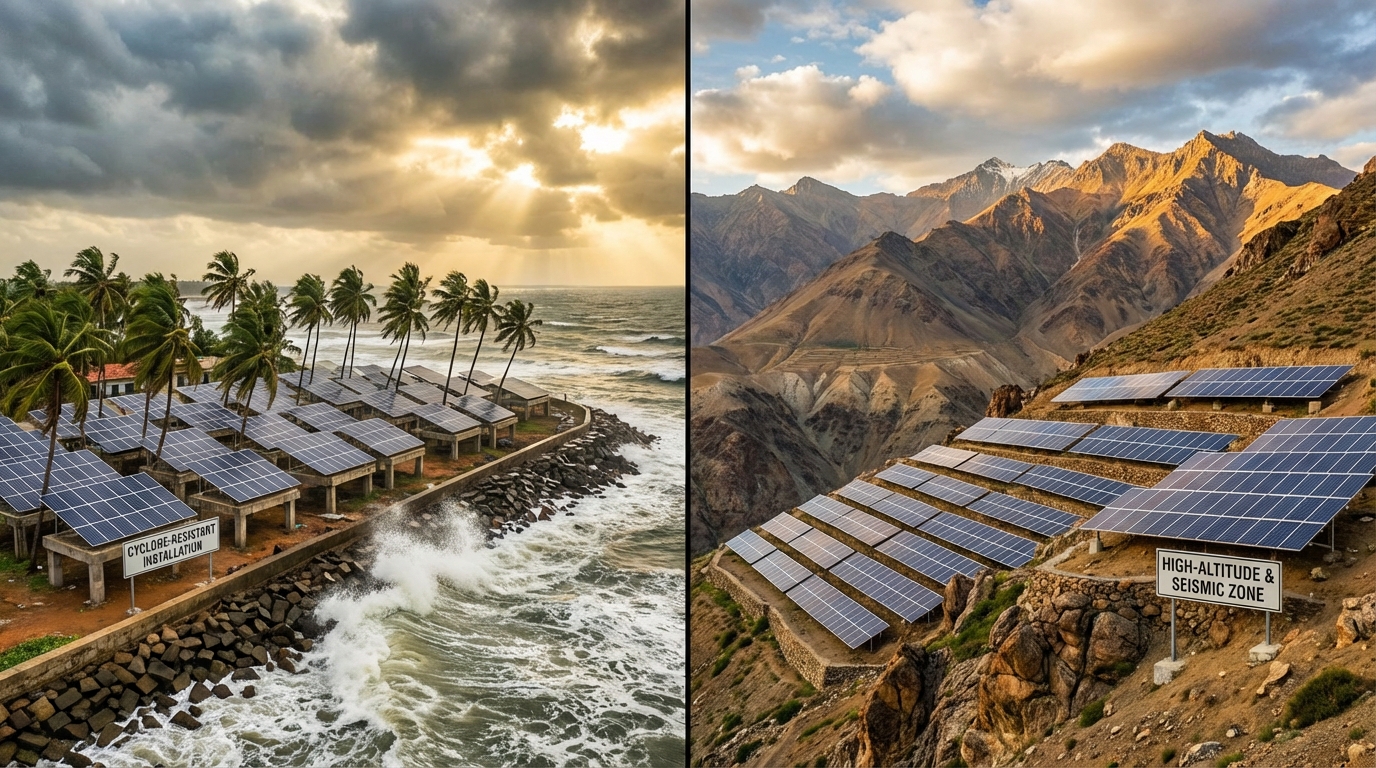
Cyclonic Regions and Coastal Areas
India’s extensive coastline—spanning Gujarat, Maharashtra, Goa, Karnataka, Kerala, Tamil Nadu, Andhra Pradesh, Odisha, and West Bengal—faces cyclonic wind threats. The India Meteorological Department classifies coastal areas into different cyclone risk zones, with the eastern coast particularly vulnerable.
Structural design for cyclonic regions requires:
- Enhanced wind load calculations: Design wind speeds of 50-55 m/s (180-200 km/h) or higher for very severe cyclonic zones, compared to 33-39 m/s for normal wind zones
- Uplift resistance: Special attention to wind uplift forces that can lift panels and structures, requiring robust anchoring systems
- Corrosion protection: Salt-laden air accelerates corrosion, necessitating hot-dip galvanization with minimum 85-micron thickness, stainless steel fasteners, and protective coatings
- Debris impact considerations: Structures should withstand impact from wind-borne debris during cyclonic events
For solar projects in coastal Gujarat, including the Surat region where Heaven Designs is based, structural engineers must balance cyclonic wind requirements with cost optimization, leveraging local experience to design structures that meet safety standards without unnecessary over-engineering.
High Seismic Zones
Northern India, the Northeast, parts of Gujarat (particularly Kutch region), and the Himalayan belt fall within high seismic zones (Zones IV and V). Earthquake-resistant design for solar structures involves:
- Seismic load calculations: Determining horizontal and vertical seismic forces based on zone factor, importance factor, and structural response
- Ductile detailing: Ensuring connections and members can absorb seismic energy through controlled deformation
- Foundation design: Adequate embedment depth and anchorage to prevent foundation sliding or overturning during earthquakes
- Structural redundancy: Multiple load paths to prevent progressive collapse if individual members fail
Tracker systems in seismic zones require special consideration, as moving components and elevated centers of gravity increase seismic vulnerability. Stow positions and emergency protocols become critical design elements.
High Wind Velocity Areas
Beyond cyclonic regions, several areas of India experience consistently high wind velocities. Rajasthan’s desert regions, parts of Tamil Nadu, and elevated plateaus face sustained high winds that create fatigue loads on structures over time.
Design considerations include:
- Fatigue analysis for connections and members subjected to cyclic wind loading
- Aerodynamic optimization to reduce wind loads through strategic panel spacing and tilt angles
- Robust bracing systems to prevent structural oscillation and resonance
- Wind tunnel testing for large projects to validate design assumptions
Snow Load Considerations for Himalayan Regions
Solar projects in Jammu & Kashmir, Himachal Pradesh, Uttarakhand, and high-altitude areas of other northern states must account for snow accumulation. IS 875 Part 4 provides snow load calculations based on altitude and regional snowfall data.
Snow load design involves:
- Determining ground snow load based on location and altitude
- Calculating roof snow load considering panel tilt angle (steeper tilts shed snow more effectively)
- Accounting for unbalanced snow loads and drift accumulation
- Ensuring structures can support combined snow and wind loads
Interestingly, steeper tilt angles beneficial for snow shedding can increase wind loads, requiring optimization to balance these competing factors.
Temperature Variations and Thermal Expansion
India experiences extreme temperature ranges—from below freezing in northern winters to 45-50°C in summer across much of the country. These temperature swings cause thermal expansion and contraction of structural materials.
Thermal design considerations include:
- Expansion joints in long structural runs to accommodate thermal movement
- Slotted holes in connections to allow controlled movement
- Material selection considering thermal expansion coefficients
- Stress analysis under extreme temperature differentials
Failure to account for thermal effects can lead to buckling, connection failures, and accelerated fatigue damage over the project lifetime.
Project Timeline: From Site Data to Final Deliverables
Understanding the design timeline for structural engineering helps EPC companies plan project schedules realistically and identify potential bottlenecks. Timeline expectations vary based on project size, complexity, and information availability.
Information Required to Start Structural Design
Before structural engineering can commence, EPC companies must provide comprehensive site and project data:
- Site survey data: Topographic survey showing site boundaries, elevations, existing structures, and access points. Professional site survey India services provide this data in formats compatible with design software
- Geotechnical investigation report: Soil boring logs, bearing capacity, soil classification, and groundwater levels from multiple test locations
- Project specifications: Total capacity, module specifications (dimensions, weight), mounting configuration (fixed-tilt or tracker), row spacing, and tilt angles
- Electrical layout: Inverter locations, cable routing requirements, and any electrical equipment requiring structural support
- Local requirements: Applicable building codes, authority requirements, and any client-specific standards
- Site constraints: Access limitations, construction restrictions, and any existing infrastructure to avoid
Incomplete or inaccurate input data is the primary cause of design delays. Investing in thorough feasibility study India work and site surveys upfront accelerates the structural design process significantly.
Typical Timeline for Different Project Sizes
For residential rooftop projects (3-10 kW), structural design typically requires 3-7 days once complete information is received. These smaller projects involve simpler structures and fewer drawings, though rooftop load analysis can add complexity.
Commercial and industrial rooftop projects (50-500 kW) generally require 1-2 weeks for structural design. These projects involve more extensive structural analysis, multiple roof types, and often require coordination with building structural engineers to verify existing roof capacity.
Ground-mount projects under 1 MW typically need 2-3 weeks for complete structural engineering deliverables. This includes foundation design, MMS design, detailed drawings, and calculation reports.
Large-scale ground-mount projects (1-10 MW) require 3-6 weeks for comprehensive structural design. The extended timeline accommodates extensive analysis, multiple foundation types for varying soil conditions, detailed optimization studies, and comprehensive documentation packages.
Utility-scale projects above 10 MW may require 6-12 weeks or more, particularly for tracker systems or projects with complex site conditions. These projects often involve multiple design iterations, third-party review cycles, and extensive coordination with other engineering disciplines.
Design Review and Iteration Cycles
Professional structural engineering follows an iterative process:
- Preliminary design (20-30% of timeline): Initial structural concept, load calculations, and preliminary member sizing
- Detailed design (40-50% of timeline): Comprehensive analysis, final member sizing, connection design, and drawing development
- Review and revision (20-30% of timeline): Client review, incorporation of feedback, third-party review if required, and final documentation
- Certification and approval (10-20% of timeline): Obtaining engineer stamps, preparing authority submission packages, and addressing any authority queries
Efficient communication between EPC companies and structural engineering consultants minimizes iteration cycles. Clear project requirements, prompt feedback, and designated points of contact streamline the process.
Factors That Can Delay Structural Engineering Work
Common delay factors include:
- Incomplete or delayed geotechnical investigation reports
- Changes to project scope or module specifications mid-design
- Unclear or conflicting local authority requirements
- Multiple stakeholder reviews without consolidated feedback
- Delayed responses to engineering queries
- Discovery of site constraints not identified in initial surveys
Proactive project management and clear communication protocols help mitigate these delays.
Fast-Track Design Options for Urgent Projects
When project timelines are compressed, experienced structural engineering firms can offer expedited services through:
- Dedicated project teams working on accelerated schedules
- Parallel processing of different design elements
- Leveraging standardized designs adapted to specific site conditions
- Prioritized review and approval processes
However, fast-track approaches require complete and accurate input data from day one—any information gaps negate time savings. The engineering cost for expedited services may be higher, but can be justified when project schedules demand rapid execution.
How Structural Design Impacts Project Safety and Costs
The quality of structural engineering directly influences two critical project outcomes: safety and economics. Understanding these impacts helps EPC companies appreciate the value of professional structural design services and make informed decisions about engineering investments.
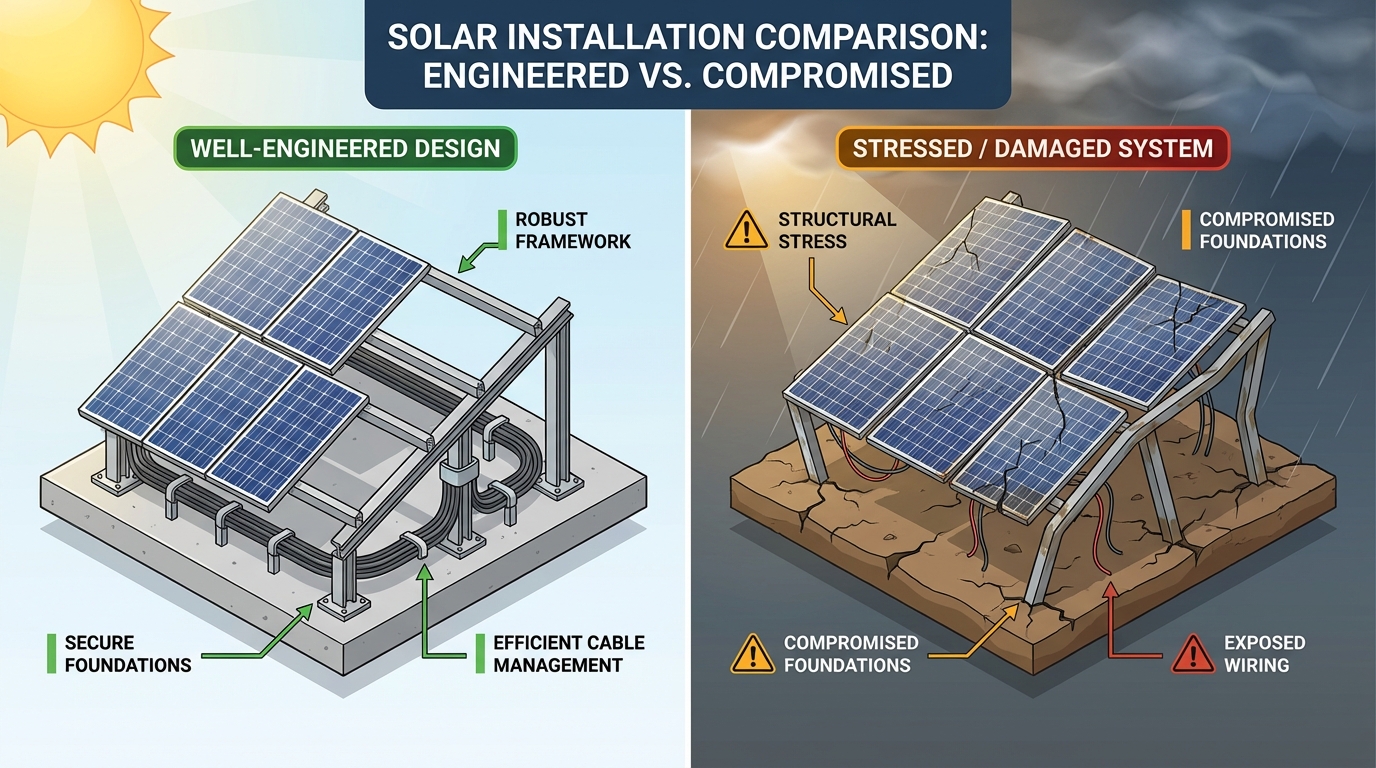
Safety Implications of Inadequate Structural Design
Under-designed or improperly engineered solar structures pose serious safety risks:
- Structural collapse: Catastrophic failure during high winds, earthquakes, or heavy snow can destroy entire installations, potentially causing injuries or fatalities to workers or nearby people
- Progressive failure: Failure of one structural element can trigger cascading failures across the installation
- Panel detachment: Inadequate clamping or connection design can allow panels to become projectiles during storms
- Foundation failure: Inadequate foundations can lead to structure tilting, settling, or complete overturning
- Electrical hazards: Structural movement or failure can damage electrical components, creating shock and fire hazards
Beyond immediate safety concerns, structural failures create legal liability for EPC companies, potentially resulting in lawsuits, insurance claim denials, and reputational damage that impacts future business opportunities.
Conversely, properly engineered structures provide peace of mind throughout the project lifecycle. They withstand design load events without damage, require minimal maintenance, and protect the substantial capital investment in solar assets.
Cost of Over-Engineering vs. Optimization
While under-design is dangerous, over-engineering wastes capital without providing additional value. The challenge lies in finding the optimal balance.
Over-engineering costs manifest in several ways:
- Excessive material quantities increase procurement costs—heavier steel sections, larger foundations, more concrete and reinforcement
- Heavier structures increase transportation and installation costs
- Longer installation times due to handling heavier components
- Reduced project ROI as capital is tied up in unnecessary structural capacity
A common over-engineering scenario involves using generic designs with excessive safety factors rather than site-specific optimized designs. For example, using a standard foundation design developed for poor soil conditions on a site with excellent bearing capacity wastes concrete and steel.
Optimized structural design leverages advanced analysis tools, regional experience, and iterative refinement to minimize material usage while meeting all safety and code requirements. Professional solar design firms achieve optimization through:
- Accurate load calculations specific to site location and conditions
- Advanced structural analysis software (SAP2000, STAAD.Pro, RISA) that identifies optimal member sizes
- Material selection based on local availability and cost-effectiveness
- Connection design that balances fabrication costs with material efficiency
- Experience-based insights from hundreds of completed projects
The cost difference between over-engineered and optimized designs typically ranges from 8-15% of structural costs. On a 5 MW ground-mount project with structural costs of ₹2-2.5 crore, optimization can save ₹16-37.5 lakh—a significant impact on project economics.
Material Cost Savings Through Proper Structural Analysis
Specific areas where structural optimization yields cost savings include:
- Foundation optimization: Right-sizing foundations based on actual soil capacity and loads can reduce concrete volumes by 10-20%
- MMS member sizing: Using structural analysis to select optimal purlin and rafter sections rather than conservative standard sizes
- Span optimization: Determining optimal post spacing that balances foundation costs against structural member costs
- Connection simplification: Designing connections that minimize fabrication complexity while meeting strength requirements
- Material grade selection: Specifying appropriate steel grades (Fe 250, Fe 410, Fe 500) based on actual stress requirements
Long-Term Maintenance and Replacement Costs
Structural design quality impacts lifecycle costs beyond initial construction:
- Corrosion protection: Proper material selection and coating specifications prevent premature corrosion, avoiding costly repairs or replacements
- Fatigue resistance: Designs accounting for cyclic loading prevent fatigue failures that require structural reinforcement
- Accessibility: Thoughtful structural design facilitates maintenance access, reducing labor costs for cleaning and repairs
- Adaptability: Well-designed structures can accommodate future modifications or capacity additions
A solar installation is a 25-30 year investment. Structural engineering that prioritizes durability and maintainability provides superior lifecycle value compared to designs focused solely on minimizing initial costs.
Insurance and Warranty Implications
Insurance providers and equipment manufacturers increasingly scrutinize structural engineering quality:
- Insurance premiums: Projects with certified structural designs from reputable engineers may qualify for lower insurance premiums
- Claim approval: In the event of structural failure, insurance companies investigate whether designs met applicable standards—inadequate engineering can result in claim denials
- Module warranties: Some module manufacturers require installations to meet specific structural standards to maintain warranty coverage
- Performance guarantees: Structural issues that affect panel orientation or tilt can void performance guarantees
Choosing the Right Structural Engineering Partner for Your Solar Projects
Selecting the right structural engineering consultant significantly impacts project success. EPC companies should evaluate potential partners across multiple dimensions to ensure they receive high-quality, cost-effective services.
Key Qualifications to Look For
Essential qualifications for solar structural engineering consultants include:
- Solar-specific experience: General structural engineers may lack understanding of solar-specific loads, mounting systems, and industry practices. Look for firms with dedicated solar engineering experience
- Licensed professional engineers: Ensure the firm employs chartered structural engineers licensed to practice in India and capable of providing stamped certifications
- Track record: Evaluate completed project portfolio—number of projects, total capacity designed, project types (rooftop, ground-mount, tracker), and geographic diversity
- Technical capabilities: Assess the firm’s engineering tools, analysis software, and design methodologies
- Team size and capacity: Ensure the firm has adequate resources to handle your project volume and timeline requirements
Experience with Indian Climatic Conditions and Standards
India’s unique climatic challenges and regulatory environment demand specialized expertise. Ideal structural engineering partners should demonstrate:
- Experience designing for India’s diverse climatic zones—cyclonic regions, seismic zones, high-wind areas, and extreme temperatures
- Thorough knowledge of IS codes (IS 875, IS 1893, IS 800, IS 456) and their application to solar structures
- Familiarity with state-specific building codes and local authority requirements across different Indian states
- Understanding of MNRE guidelines and CEA regulations
- Experience with Indian soil conditions and foundation design for varied geotechnical scenarios
Firms with pan-India experience bring valuable insights from diverse projects, enabling them to anticipate challenges and provide optimized solutions.
In-House Capabilities vs. Outsourced Services
Consider whether the engineering firm offers comprehensive in-house capabilities or relies on outsourced services:
- In-house teams provide better quality control, faster communication, integrated workflows, and accountability. Firms with 50+ in-house engineers can handle multiple projects simultaneously without capacity constraints
- Outsourced services may introduce coordination challenges, quality inconsistencies, and communication delays
- Integrated service offerings: Firms providing both structural engineering and related services (site surveys, PMC services India, electrical design) offer streamlined coordination and single-point accountability
Software and Analysis Tools Used
The design software India firms use directly impacts design quality and efficiency. Industry-standard tools include:
- Structural analysis software: SAP2000, STAAD.Pro, RISA-3D, or ETABS for comprehensive structural modeling and analysis
- Foundation design software: Specialized tools for foundation analysis and design
- CAD software: AutoCAD, Revit, or similar for detailed drawing production
- Solar design software: PVsyst, Helioscope, or similar for system layout and shading analysis that informs structural design
- Wind analysis tools: CFD (Computational Fluid Dynamics) software for complex wind load analysis on large projects
Firms using advanced analysis tools can provide more accurate, optimized designs compared to those relying on manual calculations or simplified methods.
Track Record and Portfolio Evaluation
Request detailed information about the firm’s project portfolio:
- Total megawatts of solar capacity designed
- Number of completed projects and client count
- Project types and sizes (residential, commercial, utility-scale)
- Geographic distribution of projects across Indian states
- Notable or complex projects demonstrating technical capabilities
- Client references and testimonials
Firms with extensive portfolios—such as Heaven Designs with 628+ MW designed for 752+ clients—demonstrate proven capabilities and reliability.
Communication and Collaboration Processes
Effective communication is essential for successful project execution. Evaluate:
- Designated project managers and single points of contact
- Communication protocols and response time commitments
- Project tracking and status reporting systems
- Collaboration tools for document sharing and review
- Willingness to participate in coordination meetings with other project stakeholders
Firms with established processes and dedicated client support teams provide smoother project experiences.
Pricing Models and Cost Considerations
Structural engineering services are typically priced based on:
- Per-kilowatt rates: Common for standardized projects, with rates varying based on project size and complexity
- Fixed project fees: Lump-sum pricing for defined scope, providing cost certainty
- Hourly or time-based rates: Used for consulting services or projects with undefined scope
- Retainer arrangements: For EPC companies with ongoing project pipelines, retainer agreements provide priority service and potentially discounted rates
When evaluating solar design cost, consider value beyond just price. The cheapest option may deliver generic, over-engineered designs that increase construction costs, while moderately higher engineering fees for optimized designs can yield significant material cost savings. Calculate total project cost impact rather than focusing solely on engineering fees.
For EPC companies seeking reliable structural engineering support, partnering with established firms offering comprehensive capabilities, proven track records, and competitive pricing delivers the best overall value. Heaven Designs, with its team of 50+ engineers, 628+ MW of completed design work, and focus on cost-effective optimization, exemplifies the type of design partner that helps EPC companies deliver successful solar projects across India’s diverse conditions.
Frequently Asked Questions About Solar Structural Engineering in India
What is the typical cost of structural engineering services for solar projects in India?
Structural engineering costs vary based on project size, complexity, and scope of services. For residential rooftop projects (3-10 kW), structural design typically costs ₹5,000-15,000. Commercial rooftop projects (50-500 kW) generally range from ₹25,000-1,00,000. Ground-mount projects are often priced per kilowatt, with rates ranging from ₹500-2,000 per kW depending on project size—larger projects benefit from economies of scale with lower per-kW rates. Utility-scale projects above 10 MW may have specialized pricing. These costs typically include structural drawings, calculation reports, and basic certifications. Additional services like geotechnical investigations, third-party reviews, or expedited timelines may incur extra charges. When evaluating solar design cost, consider that optimized structural design can save 8-15% on construction costs, often far exceeding the engineering fee investment.
How long does structural design take for a 1 MW ground-mount solar project?
For a 1 MW ground-mount solar project with complete input data (site survey, geotechnical report, project specifications), structural engineering typically requires 2-3 weeks for comprehensive deliverables. This timeline includes preliminary design (3-5 days), detailed structural analysis and design (7-10 days), drawing preparation (3-5 days), and review/finalization (2-3 days). The timeline assumes prompt client feedback and no major scope changes. Factors that can extend timelines include incomplete geotechnical data, complex site conditions requiring additional analysis, tracker systems (which add complexity), multiple design iterations due to changing requirements, or third-party review requirements. Conversely, experienced firms with standardized workflows and dedicated teams can sometimes deliver on accelerated schedules when project urgency demands. Clear communication and complete information upfront are key to meeting timeline expectations.
Do I need separate structural engineers for rooftop vs. ground-mount projects?
While the fundamental principles of structural engineering apply to both rooftop and ground-mount solar projects, each requires specialized expertise. Rooftop projects involve analyzing existing building structural capacity, determining roof load-bearing limits, designing non-penetrating or minimally invasive mounting systems, coordinating with building structural engineers, and addressing waterproofing and building code compliance. Ground-mount projects focus on foundation design for various soil conditions, optimizing post spacing and structural spans, designing for open-terrain wind exposure, and managing site grading and drainage. Ideally, choose structural engineering consultants with demonstrated experience in both project types. Many specialized solar engineering firms, including Heaven Designs, maintain expertise across all solar project types, providing consistent quality and eliminating the need to engage multiple engineering firms. This integrated approach ensures better coordination and leverages cross-project insights for optimal designs.
What site data is required before structural design can begin?
Comprehensive site data is essential for accurate structural design. Required information includes: Topographic survey showing site boundaries, elevations, contours, existing structures, and access points; Geotechnical investigation report with soil boring logs from multiple locations, soil classification, bearing capacity, cohesion, angle of internal friction, and groundwater levels; Project specifications including total capacity, module specifications (dimensions, weight, efficiency), mounting type (fixed-tilt or tracker), row spacing, tilt angle, and inverter locations; Site photographs showing existing conditions, terrain, and any constraints; Utility information about existing underground utilities to avoid during foundation installation; Local requirements including applicable building codes, authority-specific requirements, and any client standards. Incomplete data is the primary cause of design delays. Investing in thorough site survey India services and geotechnical investigations upfront accelerates the structural design process and ensures accurate, optimized designs.
Can structural design be modified after approval?
Yes, structural designs can be modified after initial approval, but the process and implications depend on the extent of changes and project stage. Minor modifications—such as adjusting foundation locations to avoid unexpected site obstacles, modifying connection details for fabrication convenience, or updating material specifications for availability—can typically be accommodated with revised drawings and minimal re-analysis. Major modifications—such as changing module types (affecting loads), altering mounting configuration, or redesigning for different soil conditions—require comprehensive re-analysis, new calculations, revised drawings, and potentially new certifications. If construction has already begun, modifications become more complex and costly, potentially requiring rework of completed elements. If permits have been obtained, design changes may require re-submission to authorities and approval delays. To minimize modification needs, ensure all project requirements are clearly defined before structural design begins, conduct thorough site investigations to avoid surprises, and complete design reviews carefully before approving for construction. Experienced engineering firms can often accommodate reasonable modifications efficiently, but significant changes will impact timelines and costs.
Who is responsible for structural certification and stamping in India?
In India, structural designs for solar projects must be certified and stamped by licensed structural engineers registered with the relevant state authority or council. The structural engineering consultant engaged for the project is typically responsible for providing these certifications as part of their deliverables. The certifying engineer must be a chartered engineer with appropriate qualifications and registration. Certifications typically include structural stability certificates confirming the design meets applicable IS codes and safety standards, compliance certificates for local building authority requirements, and load charts and design parameters for submission to electricity boards or other regulatory bodies. Some states or local authorities have specific requirements about engineer qualifications or registration jurisdictions. The structural engineering firm should clarify certification responsibilities upfront and ensure their engineers hold appropriate credentials for your project location. For EPC companies working across multiple states, partnering with firms that have pan-India certification capabilities—such as Heaven Designs with experience across multiple states—simplifies the approval process and ensures consistent compliance with varying regional requirements.
Partner with Heaven Designs for Expert Solar Structural Engineering Services
Structural engineering forms the foundation—literally and figuratively—of every successful solar project in India. From the initial foundation design through final module mounting structures, professional structural engineering ensures your solar installations are safe, compliant, cost-optimized, and built to withstand India’s diverse and challenging climatic conditions for 25+ years.
As this comprehensive guide has demonstrated, structural engineering India services for solar projects encompass far more than basic calculations and drawings. They require deep expertise in solar-specific loads and mounting systems, thorough knowledge of Indian standards and regional requirements, experience with India’s varied climatic zones and soil conditions, advanced analysis tools and optimization capabilities, and comprehensive deliverables that enable seamless project execution.
For solar EPC companies seeking to deliver high-quality projects while maximizing profitability, partnering with the right structural engineering consultant is a critical decision. The ideal partner combines technical excellence with practical experience, offers comprehensive in-house capabilities, demonstrates a proven track record across diverse project types, provides responsive communication and collaboration, and delivers cost-effective solutions that optimize total project costs.
Heaven Designs Private Limited brings all these qualities to every solar structural engineering project. With a dedicated team of over 50 skilled engineers and consultants based in Surat, Gujarat, Heaven Designs has completed structural design work for 628+ MW of solar capacity across 752+ projects for EPC clients throughout India and internationally. Their expertise spans all project types—from residential rooftop installations to utility-scale ground-mount solar farms—and all of India’s climatic zones, from cyclonic coastal regions to high-seismic areas to extreme temperature environments.
Heaven Designs’ comprehensive service offering includes not just structural engineering, but also solar 3D pre-design, detailed engineering design, PMC services India, and site survey India services—providing EPC companies with a single, reliable design partner for all solar engineering needs. Their focus on cost-effective optimization and accurate designs helps clients maximize energy generation while minimizing project costs, delivering superior ROI on every installation.
Whether you’re planning a small rooftop installation or a multi-megawatt solar farm, Heaven Designs has the expertise, capacity, and commitment to deliver structural engineering solutions that meet your project requirements, timeline, and budget. Their proven track record, advanced engineering capabilities, and client-focused approach make them an ideal partner for solar EPC companies seeking reliable, high-quality structural engineering services.
Ready to discuss your solar structural engineering needs? Get a Quick Proposal Now! or contact Heaven Designs directly at +91 90811 00297 or service@heavendesigns.in. Their team is ready to help you deliver safe, compliant, and cost-optimized solar projects across India’s diverse conditions.
Invest in professional structural engineering from the start, and build solar projects that stand strong for decades to come.