


Walk into any EPC project review meeting in India, and one question surfaces before almost any other: “Are we sizing this system correctly?” It sounds simple. But solar capacity planning sits at the intersection of energy engineering, financial modeling, site constraints, and regulatory compliance. Get it wrong, and the consequences follow the project for its entire 25-year lifespan. Get it right, and every downstream decision — procurement, structural design, grid connection, client ROI — becomes easier and more defensible.
This guide compiles 22 of the most common solar capacity planning questions that EPC companies ask when sizing systems and optimizing energy generation. Whether you’re working on a 100 kW commercial rooftop in Pune or a 5 MW ground-mount project in Rajasthan, these answers will sharpen your approach to solar capacity decisions in 2026.

Why Solar Capacity Planning Determines Project Success
Before diving into the questions, it helps to understand what’s actually at stake. Solar capacity planning is the process of determining how much generation capacity a solar system needs to meet a specific energy objective — whether that’s offsetting a client’s electricity bill, meeting a grid injection target, or maximizing return on available roof space.
The challenge is that solar capacity is not a single number. It involves installed peak capacity (kWp), actual AC output capacity (kW), expected annual energy generation (kWh), and the ratio between them, the capacity factor. Each of these figures depends on site-specific variables: irradiance, shading, temperature, tilt, losses, and load profile. A system that looks well-sized on paper can underperform by 15, 20% if these variables are not properly modeled during the design phase.
For EPC companies in India, the stakes are especially high. Clients are increasingly sophisticated, grid regulations vary by state, and competition on project bids is intense. Accurate solar capacity planning is no longer a back-office calculation, it’s a core competitive differentiator.
Solar Capacity Basics: Foundational Questions
Q1: What is solar capacity and how is it measured?
Solar capacity refers to the maximum power output a solar system can produce under standard test conditions (STC). It is measured in kilowatts peak (kWp) for the DC side of the system. A 500 kWp system, for example, consists of solar panels whose combined rated output equals 500 kW under STC (1000 W/m² irradiance, 25°C cell temperature, AM 1.5 spectrum). In practice, real-world output is always lower than the STC rating due to temperature, irradiance variation, and system losses.
Q2: What is the difference between kWp, kW, and kWh in solar capacity planning?
kWp (kilowatt peak) is the rated DC capacity of the solar array. kW refers to the actual power output at any given moment, which fluctuates with irradiance and temperature. kWh (kilowatt-hour) is the energy produced over time, the figure that actually appears on an electricity meter and determines financial returns. During solar capacity planning, EPCs must work across all three units: kWp for procurement, kW for inverter sizing, and kWh for yield analysis and client proposals.
Q3: What is a capacity factor and why does it matter for Indian projects?
The capacity factor is the ratio of actual annual energy output to the theoretical maximum if the system ran at full rated capacity for every hour of the year. For solar systems in India, capacity factors typically range from 18% to 25%, depending on location and system design. A 1 MWp system in Rajasthan with a 22% capacity factor will generate approximately 1,927 MWh per year. Understanding the capacity factor helps EPCs set realistic client expectations and validate energy yield simulations before project approval.
Q4: How does solar irradiance in India affect solar capacity planning decisions?
India has one of the highest solar irradiance levels in the world, with Global Horizontal Irradiance (GHI) ranging from about 4.5 kWh/m²/day in the northeast to over 6.5 kWh/m²/day in Rajasthan and Gujarat. This variation directly affects how much energy a given solar capacity will produce. A 1 MWp system in Gujarat will generate significantly more annual energy than the same system in West Bengal. EPCs must use location-specific irradiance data, from sources like NASA POWER, Meteonorm, or NREL, when sizing systems and preparing energy yield reports.
Q5: What is the difference between DC capacity and AC capacity in a solar system?
DC capacity is the total rated output of the solar panels. AC capacity is the rated output of the inverters, which is always lower. The ratio between them is the DC-to-AC ratio (also called the inverter loading ratio). A system with 1,000 kWp of panels and 800 kW of inverter capacity has a DC-to-AC ratio of 1.25. This is a deliberate design choice in solar capacity planning, inverters are clipped at their rated AC output, but the higher DC capacity ensures the inverter operates near full load for more hours each day, improving overall energy yield.
System Sizing Questions EPCs Ask Most Often
Q6: How do you calculate the right solar capacity for a commercial rooftop project?
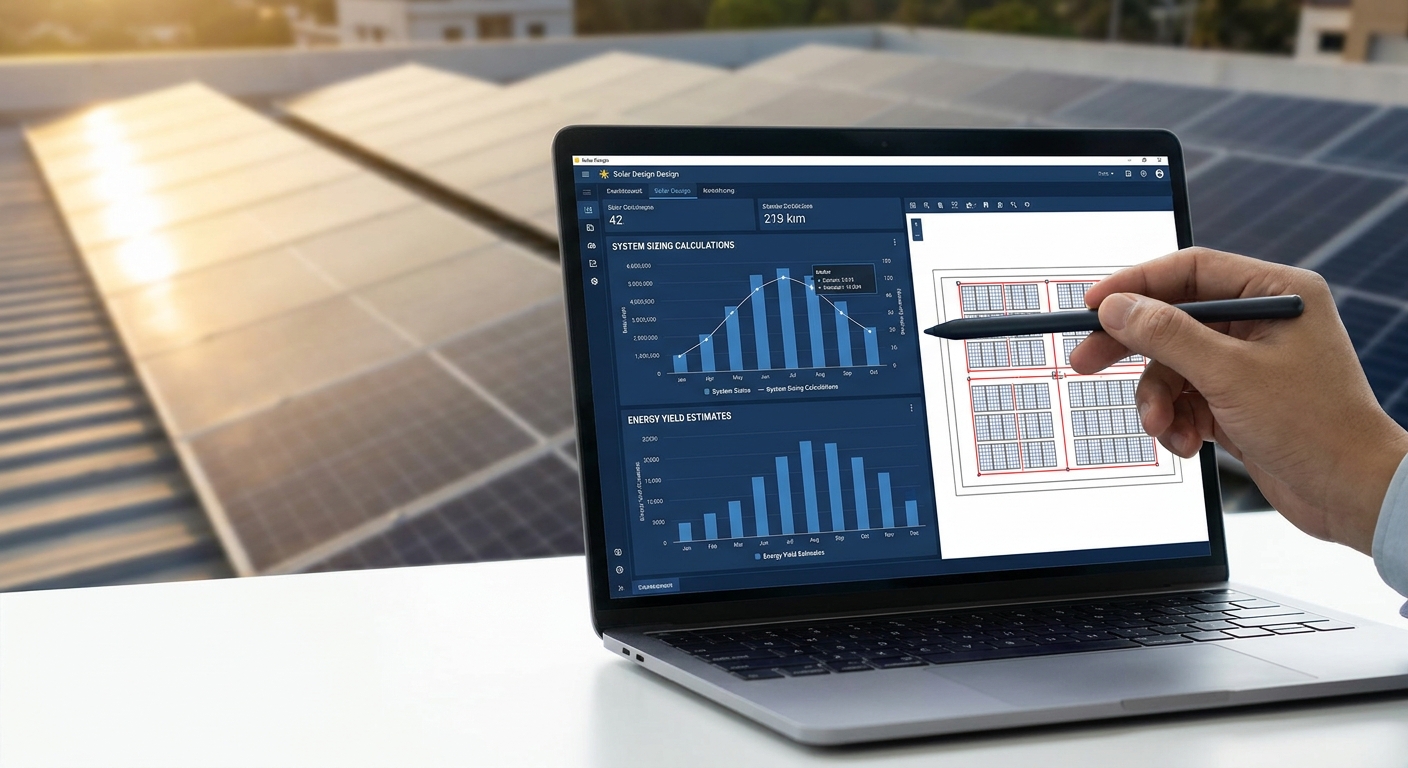
The starting point is the client’s average monthly energy consumption in kWh. Divide the annual consumption by the site’s annual peak sun hours (PSH) and account for system efficiency losses (typically 20, 25%) to get the required kWp. For example, a facility consuming 150,000 kWh/year in a location with 5.5 PSH and 80% system efficiency needs approximately: 150,000 ÷ (5.5 × 365 × 0.80) = 93.5 kWp. However, this is a starting estimate. The final solar capacity must also account for available roof area, structural load limits, grid connection capacity, and net metering limits set by the state DISCOM.
Q7: What load data is needed before sizing a solar system?
Accurate solar capacity planning requires at least 12 months of historical electricity bills showing monthly consumption in kWh and peak demand in kW. Ideally, EPCs should also obtain interval data (15-minute or hourly load profiles) to understand when the client consumes energy. This matters because a solar system generates power during daylight hours, if the client’s peak load occurs at night, a larger battery or grid-export arrangement may be needed. Without proper load data, EPCs risk sizing a system that either underserves the client or generates excess energy that cannot be monetized.
Q8: How does available roof area or land area constrain solar capacity?
Standard crystalline silicon panels require approximately 6, 7 m² per kWp of installed capacity, including spacing for maintenance access and inter-row shading avoidance. A 2,000 m² usable rooftop can typically accommodate 250, 300 kWp. For ground-mount projects, the land requirement is higher, roughly 10, 12 m² per kWp when accounting for row spacing and access roads. During solar capacity planning, EPCs must conduct a proper site survey to measure usable area, identify obstructions, and confirm that the physical space can support the desired system capacity. Heaven Designs’ site survey and feasibility study services are specifically designed to resolve these constraints before detailed design begins.
Q9: What is the DC-to-AC ratio and how should EPCs set it?
The DC-to-AC ratio (inverter loading ratio) is one of the most consequential decisions in solar capacity planning. A ratio between 1.1 and 1.3 is standard for most Indian projects. A higher ratio (e.g., 1.3) means more panels per inverter, which increases energy yield during morning and evening hours but causes more clipping at peak irradiance. A lower ratio (e.g., 1.1) reduces clipping but may leave inverter capacity underutilized. The optimal ratio depends on the site’s irradiance profile, the client’s energy objectives, and the cost difference between additional panels and additional inverter capacity. Energy simulation software like PVsyst is essential for modeling this trade-off accurately.
Q10: How do you size solar capacity for net metering vs. captive consumption projects?
For captive consumption projects, the goal is to match solar generation to on-site load as closely as possible. Oversizing leads to excess generation that cannot be used or exported, reducing ROI. For net metering projects, the system can be sized more aggressively because surplus energy is exported to the grid and credited against future bills. However, most Indian state DISCOMs cap net metering capacity at the sanctioned load of the connection, typically 1:1 with the contracted demand. EPCs must verify the applicable net metering policy in the project’s state before finalizing solar capacity to avoid regulatory non-compliance.
Energy Generation Optimization Through Capacity Planning
Q11: How does panel tilt and azimuth affect energy generation at a given capacity?
For a fixed solar capacity (say, 500 kWp), the annual energy output can vary by 10, 15% depending on panel tilt and orientation. In India, the optimal fixed tilt angle is approximately equal to the site’s latitude (ranging from about 8° in Tamil Nadu to 32° in Jammu). South-facing panels (azimuth = 180°) produce the most energy annually. East or west-facing panels produce less total energy but can shift generation toward morning or afternoon peaks, which may better match certain load profiles. During solar capacity planning, EPCs should model multiple tilt and azimuth scenarios to find the configuration that maximizes energy yield for the specific site and client objective.
Q12: What losses should EPCs account for when estimating energy output?
Energy yield simulations must account for a comprehensive set of losses that reduce actual output below the theoretical DC capacity. Key loss categories include: soiling losses (2, 5% in dusty Indian environments), temperature losses (5, 10% in high-temperature regions), DC wiring losses (1, 2%), inverter efficiency losses (2, 4%), AC wiring losses (0.5, 1%), transformer losses (0.5, 1%), and availability losses due to downtime (0.5, 1%). Combined, these losses typically reduce actual generation to 75, 85% of the theoretical DC yield. Accurate loss modeling is fundamental to credible solar capacity planning and prevents the common mistake of overpromising energy output to clients.
Q13: How does string sizing affect the effective solar capacity of a system?
String sizing determines how panels are connected in series and parallel to match the inverter’s voltage and current operating window. Incorrect string sizing can cause inverters to operate outside their maximum power point tracking (MPPT) range, reducing the effective utilization of the installed solar capacity. In hot Indian climates, where module open-circuit voltage (Voc) drops significantly at high temperatures, strings must be sized to ensure the array voltage stays within the inverter’s operating range across all temperature conditions. EPCs should always verify string sizing calculations against the inverter’s datasheet specifications for the specific temperature range expected at the project site.
Q14: What role does inverter sizing play in maximizing capacity utilization?
The inverter is the gateway between the DC solar array and the AC grid or load. Undersized inverters clip generation during peak irradiance hours, reducing annual energy yield. Oversized inverters add cost without proportional benefit. For optimal solar capacity utilization, inverter sizing should be based on energy simulation results that model the site’s irradiance distribution throughout the year. In locations with high irradiance uniformity (like Rajasthan), a lower DC-to-AC ratio may be appropriate to minimize clipping. In locations with more variable irradiance (like coastal Maharashtra), a higher ratio may be acceptable because peak irradiance hours are fewer.
Q15: How can shading analysis change the recommended solar capacity for a site?
Shading is one of the most underestimated factors in solar capacity planning. Even partial shading of a single panel in a string can reduce the output of the entire string by 20, 80%, depending on the inverter topology. A thorough shading analysis, using tools like PVsyst’s 3D shading module or HelioScope, can reveal that a site’s effective usable area is significantly smaller than its physical area. In some cases, shading analysis leads EPCs to recommend microinverters or DC optimizers to mitigate losses, which changes the system cost and capacity trade-off. Skipping shading analysis is one of the most common and costly errors in solar system sizing. For a deeper look at documentation requirements that support shading analysis, see our guide on how design timeline and cost decisions impact project budgets.
Capacity Planning for Different Project Types in India
Q16: How does solar capacity planning differ for rooftop vs. ground-mount projects?
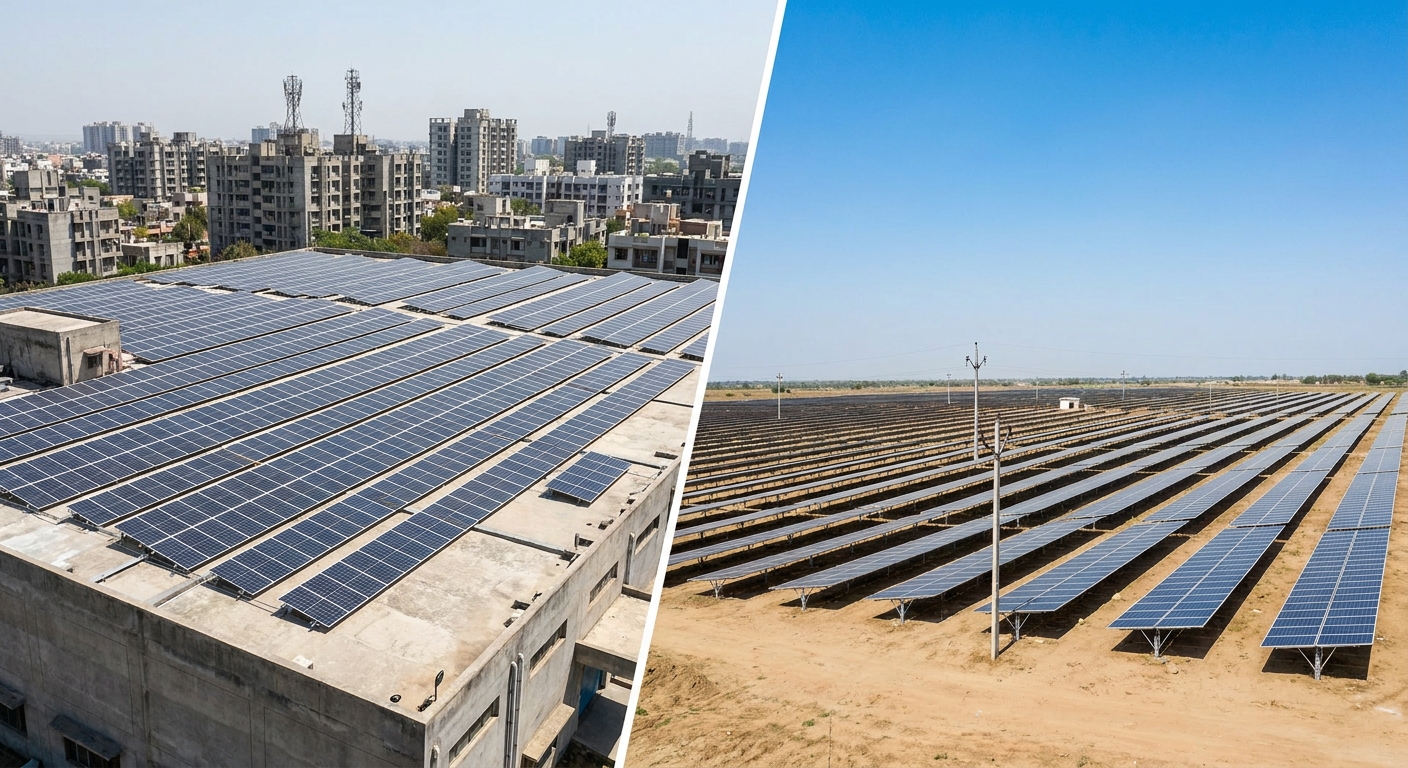
Rooftop solar capacity planning is primarily constrained by available roof area, structural load limits, and the client’s sanctioned load for net metering. The design must work within the existing building’s physical and electrical infrastructure. Ground-mount solar capacity planning, by contrast, is more flexible in terms of panel layout and orientation but introduces additional variables: land topography, soil conditions, inter-row spacing for shading avoidance, and access road requirements. Ground-mount projects also typically involve higher DC-to-AC ratios and more complex string configurations due to larger array sizes. Heaven Designs’ team has extensive experience with both project types across India, see our detailed ground-mount regional design guide for state-specific considerations.
Q17: What capacity considerations are unique to industrial and C&I solar projects?
Commercial and industrial (C&I) solar projects introduce capacity planning challenges that residential projects don’t face. These include: high contracted demand charges that make peak demand management critical, complex load profiles with multiple shifts, power quality requirements (harmonics, power factor), and the need to coordinate solar generation with existing backup power systems (DG sets, UPS). For large C&I projects, EPCs must also consider whether the client’s grid connection can absorb the proposed solar capacity without requiring costly grid upgrades. A detailed load flow analysis is often necessary before finalizing system capacity for industrial clients.
Q18: How do state-specific regulations in India affect solar capacity decisions?
India’s solar regulatory landscape varies significantly by state, and these differences directly affect solar capacity planning. Key variables include: net metering capacity caps (some states limit net metering to systems below 1 MW or to a percentage of sanctioned load), wheeling and banking regulations for open-access projects, DISCOM technical standards for grid interconnection, and state-specific incentive structures that may favor certain capacity ranges. For example, some states offer accelerated depreciation benefits only up to certain capacity thresholds. EPCs must verify the applicable regulations in each project state before finalizing capacity recommendations. Failing to do so can result in systems that are technically sound but commercially non-compliant.
Q19: What capacity planning adjustments are needed for monsoon-heavy regions?
In high-rainfall regions like Kerala, coastal Karnataka, and the northeastern states, solar capacity planning must account for significantly lower irradiance during the monsoon months (June, September). Annual energy yield in these regions can be 15, 25% lower than in high-irradiance states for the same installed capacity. EPCs working in these regions should: use conservative irradiance data that reflects actual monsoon conditions, increase the DC-to-AC ratio slightly to compensate for lower peak irradiance, design for higher soiling losses due to humidity and dust accumulation, and set realistic client expectations about seasonal generation variability. Using multi-year irradiance datasets (P50/P90 analysis) is especially important for bankable energy yield reports in these regions.
Balancing Solar Capacity With Budget and ROI

Q20: How do EPCs balance maximum solar capacity with client budget constraints?
The most common tension in solar capacity planning is between what the site can physically accommodate and what the client can afford. The practical approach is to model multiple capacity scenarios, for example, 80%, 100%, and 120% of the load-matched capacity, and present each with its associated cost, annual generation, payback period, and 25-year NPV. This gives clients a data-driven basis for their budget decision rather than an arbitrary number. EPCs should also identify whether phased installation is feasible: designing the full system upfront but installing in phases allows clients to start with a smaller investment while preserving the option to expand without redesign costs.
Q21: What is the cost impact of oversizing vs. undersizing solar capacity?
Oversizing solar capacity beyond what the site can use or export increases upfront capital cost, may trigger grid connection upgrade requirements, and can create regulatory issues with net metering caps. In the worst case, excess generation is curtailed, reducing the effective ROI. Undersizing leaves energy savings on the table, extends the payback period, and may frustrate clients who expected higher bill savings. The sweet spot in solar capacity planning is a system sized to meet 80, 100% of daytime load for captive projects, or to the maximum net metering-eligible capacity for grid-connected projects. Getting this balance right requires accurate load data, proper irradiance modeling, and a clear understanding of the applicable grid regulations.
Q22: How does a professional feasibility study improve solar capacity decisions?
A professional solar feasibility study transforms capacity planning from an educated guess into an engineering-backed recommendation. It combines site-specific irradiance data, physical site measurements, structural assessment, load analysis, grid connection review, and financial modeling to produce a capacity recommendation that is both technically optimal and commercially viable. For EPC companies in India, a feasibility study also identifies regulatory constraints early, before procurement commitments are made. This prevents the costly scenario of designing a 500 kWp system only to discover that the local DISCOM limits net metering to 200 kWp for that connection. Heaven Designs provides comprehensive solar feasibility study services across India that give EPCs the data they need to make confident capacity decisions.
How Heaven Designs Supports Solar Capacity Planning for EPCs
Accurate solar capacity planning requires more than a formula. It requires experienced engineers who understand the interplay between irradiance data, system losses, grid regulations, structural constraints, and client financial objectives. That’s the work Heaven Designs Private Limited has been doing for EPC companies across India and internationally since the company’s founding.
With a team of 50+ engineers and consultants based in Surat, Gujarat, Heaven Designs has completed design work for 628+ MW of solar projects across 752+ EPC clients in more than three countries. The team’s capacity planning expertise spans every project type: residential rooftop, commercial and industrial rooftop, and MW-scale ground-mount installations.
Heaven Designs’ services directly support every stage of the solar capacity planning process:
- Solar 3D Pre-Design: Preliminary capacity modeling and layout optimization to establish the right system size before detailed engineering begins.
- MW Scale Detailed Engineering Design: Comprehensive electrical single-line diagrams, string layout drawings, and energy yield reports that document and validate the final capacity decisions.
- Site Survey & Land Feasibility: On-ground measurements and assessments across India that provide the accurate physical data capacity planning depends on.
- Solar Civil and Structural Engineering: Structural analysis that confirms whether the proposed capacity is physically supportable by the roof or mounting structure.
- MW Scale Project Management Consultancy (PMC): End-to-end project oversight that ensures capacity planning decisions are correctly implemented through procurement and installation.
- Solar Permit Design: Documentation that ensures the planned solar capacity meets all applicable regulatory requirements for grid connection and net metering approval.
For EPC companies that want to stop second-guessing their system sizing and start winning bids with engineering-backed capacity recommendations, Heaven Designs offers a straightforward path forward. The team works as a dedicated design partner, handling the technical complexity of solar capacity planning so EPCs can focus on client relationships and project execution.
“Accurate solar capacity planning is the foundation of every profitable solar project. When the sizing is right, everything else, procurement, installation, client satisfaction, becomes easier.”
Ready to bring precision to your next solar capacity planning project? Get a Quick Proposal Now! and let Heaven Designs’ engineering team review your project requirements. You can also reach the team directly at +91 90811 00297 or by email at service@heavendesigns.in to discuss your specific capacity planning challenges.
Whether you’re sizing a 50 kW rooftop in Chennai or a 10 MW ground-mount in Rajasthan, the right solar capacity planning process, backed by experienced engineers and validated simulation tools, is what separates projects that deliver on their promises from those that disappoint. Heaven Designs is built to be that engineering backbone for EPC companies across India and beyond.
This blog post was written using thestacc.com