


Your client calls on a Tuesday afternoon. They need a solar design proposal by Friday. The project is a 500 kW commercial rooftop in Pune, and the procurement window closes in four days. You have two choices: rush the design and hit the deadline, or push back and risk losing the bid. Most EPC companies in India have faced this exact moment. And most have made the wrong call at least once.
Understanding solar design timelines India is not just about scheduling. It is a strategic decision that affects permit approval rates, revision cycles, structural safety, and ultimately, your project margins. In 2026, as India’s solar sector pushes toward its 500 GW renewable energy target, EPC companies are under more pressure than ever to deliver faster without compromising quality. This guide breaks down the three main design timeline tiers, compares their real-world outcomes, and gives you a clear framework for choosing the right approach for every project type.

The Real Cost of Getting Your Design Timeline Wrong
When an EPC company chooses a design timeline, they are not just picking a delivery date. They are making a bet on how much risk they are willing to carry. A rushed design that misses a structural load calculation can stall a project for weeks when the mounting supplier flags the error on-site. A thorough design that takes 40 days may cause an EPC to lose a competitive bid to a faster competitor.
Both outcomes are costly. But they are costly in different ways, at different stages of the project lifecycle. The key is understanding which risks apply to which project types, so you can match your design timeline to your actual risk profile rather than defaulting to the fastest or cheapest option available.
Across India’s solar market, design timelines generally fall into three tiers:
- Fast-Track Design: 7 to 10 business days
- Standard Design Timeline: 15 to 30 business days
- Thorough Engineering Approach: 30 to 45 business days
Each tier has a distinct set of deliverables, quality outcomes, and cost implications. Understanding the differences is the first step toward making smarter decisions on every project you bid.
The Three Solar Design Timeline Tiers Explained
Before comparing outcomes, it helps to understand what each tier actually includes. Many EPCs assume that a faster timeline simply means the same work done more quickly. In practice, it usually means a different scope of work entirely.
Tier 1: Fast-Track Design (7–10 Business Days)
Fast-track design services prioritize speed above all else. A typical 7 to 10 day deliverable includes a basic layout drawing, a preliminary single-line diagram, and a rough energy yield estimate. Structural analysis is usually limited to generic load calculations rather than site-specific engineering. Simulation depth is reduced, often relying on default parameters rather than calibrated local data. These designs are useful for bid-stage estimates and preliminary client presentations, but they carry significant risk if used for permit submission or construction execution.
Tier 2: Standard Design Timeline (15–30 Business Days)
The standard tier is the most common choice for commercial and industrial solar projects across India. A 15 to 30 day timeline typically covers full electrical single-line diagrams, detailed layout drawings, basic structural drawings, a PVsyst or HelioScope simulation report, and a bill of materials. This tier balances speed and quality well for projects up to 1 MW, and it aligns with the documentation requirements of most Indian DISCOMs and state-level regulatory bodies.
Tier 3: Thorough Engineering Approach (30–45 Business Days)
The thorough engineering tier is designed for projects where accuracy is non-negotiable. This includes MW-scale ground-mount installations, complex rooftop structures, and projects in states with stringent regulatory requirements. A 30 to 45 day design engagement covers detailed structural engineering with site-specific soil analysis, comprehensive PVsyst simulation with shading analysis, permit-ready documentation packages, civil engineering drawings, and full review cycles. The upfront time investment is higher, but the downstream outcomes, including lower revision rates and higher permit approval rates, typically justify the approach.
Fast-Track Design Timelines India: Speed Gains and Hidden Trade-Offs
Fast-track solar design timelines in India have grown in popularity as competition among EPC companies intensifies. When a client demands a proposal in under two weeks, a 7 to 10 day design service can seem like the only viable option. But the trade-offs are real and often underestimated.
What Fast-Track Design Actually Delivers
A fast-track design package typically includes a schematic layout, a basic single-line diagram, and a preliminary energy yield estimate. What it usually does not include: site-specific structural calculations, detailed shading analysis, state-specific compliance documentation, or a full review cycle. The design is functional enough for a bid presentation, but it is rarely sufficient for permit submission or construction execution without significant revision.
Quality Implications and Revision Rates
Fast-track designs carry a higher revision rate than standard or thorough designs. Common issues include layout errors that emerge during site survey, structural assumptions that do not match actual roof conditions, and electrical designs that require rework to meet DISCOM requirements. Each revision cycle adds time and cost that was not budgeted at the outset. In many cases, the total time from fast-track design to construction-ready documentation exceeds the time a standard design would have taken in the first place.
When Fast-Track Is Appropriate
Fast-track design timelines are genuinely useful in specific scenarios. These include bid-stage estimates where a rough layout is sufficient, preliminary feasibility checks before committing to a full site survey, and small residential rooftop projects under 20 kW where structural complexity is low. For these use cases, a fast-track design delivers real value without exposing the EPC to unacceptable risk.
For a deeper look at how design timeline choices affect your overall project budget, see our guide on Solar Design Timeline & Cost: How Project Duration Impacts Budget.
Standard Design Timelines India: The 15, 30 Day Benchmark
The 15 to 30 day standard design timeline is the workhorse of India’s solar EPC industry. It covers the full range of documentation that most commercial and industrial projects require, without the extended engagement of a thorough engineering approach. For the majority of projects between 100 kW and 1 MW, this tier represents the best balance of speed, quality, and cost.
What the Standard Tier Covers
A standard design engagement typically delivers: detailed electrical single-line diagrams, panel layout drawings with row spacing and shading analysis, a PVsyst simulation report with P50 and P90 yield estimates, basic structural drawings for mounting systems, a bill of materials, and a preliminary compliance checklist for the relevant state’s DISCOM requirements. This documentation package is sufficient for permit submission in most Indian states and provides the construction team with a reliable execution blueprint.
Cost-to-Quality Ratio
The standard tier offers the strongest cost-to-quality ratio for most Indian EPC projects. The design fee is higher than fast-track, but the lower revision rate and higher permit approval rate mean that the total cost of design, including rework, is typically lower. For commercial and industrial projects where client relationships and repeat business are at stake, the standard tier is the minimum recommended approach.
Limitations of the Standard Tier
The standard design timeline has clear limitations for complex projects. MW-scale ground-mount installations, projects on structurally challenging rooftops, and projects in states with complex regulatory requirements often need more depth than a standard engagement provides. Attempting to use a standard design for these projects frequently results in revision cycles that push the total timeline well beyond what a thorough design would have required.
Thorough Engineering Design Timelines India: The 30, 45 Day Approach
For large-scale and high-stakes solar projects, the thorough engineering approach is not a luxury. It is a risk management strategy. A 30 to 45 day design engagement delivers the depth of analysis and documentation that MW-scale projects require to move from design to construction without costly interruptions.

What Comprehensive Design Includes
A thorough engineering design package covers every dimension of the project. On the structural side, this means site-specific soil analysis, detailed foundation design, and mounting system engineering that accounts for local wind and seismic loads. On the electrical side, it includes detailed cable sizing calculations, protection coordination studies, and grid interconnection documentation. The simulation component uses calibrated local weather data and detailed shading models to produce accurate P50 and P90 yield estimates. The documentation package is permit-ready for submission to MNRE, DISCOM, and state-level regulatory bodies.
Quality Outcomes and Project Success Metrics
Projects designed with a thorough engineering approach consistently show lower revision rates, higher permit approval rates on first submission, and fewer on-site surprises during construction. The upfront investment in comprehensive design reduces the frequency of change orders, which are one of the most significant sources of cost overrun in Indian solar EPC projects. For MW-scale projects where a single week of construction delay can cost lakhs of rupees, the ROI on thorough design is straightforward to calculate.
Ideal Project Types for the Thorough Approach
The thorough engineering tier is the right choice for: ground-mount projects above 1 MW, rooftop projects on industrial structures with complex load requirements, projects in states with stringent regulatory documentation requirements, and any project where the client has contractual performance guarantees tied to energy yield. It is also the appropriate choice for projects where the EPC is working with a new site type or a new state’s regulatory framework for the first time.
For EPCs evaluating whether a thorough feasibility study should precede the design engagement, our Solar Feasibility Study in India: Complete Process Guide for EPC Companies in 2026 provides a detailed breakdown of the pre-design phase.
Head-to-Head Comparison: Design Timelines India Across All Three Tiers
The following comparison covers the key dimensions that matter most to EPC decision-makers when evaluating solar design timelines in India.
Timeline, Deliverables, and Quality Metrics
| Dimension | Fast-Track (7, 10 Days) | Standard (15, 30 Days) | Thorough (30, 45 Days) |
|---|---|---|---|
| Core Deliverables | Schematic layout, basic SLD, rough yield estimate | Full electrical drawings, structural drawings, PVsyst report, BOM | Complete engineering package, structural analysis, permit-ready docs, detailed simulation |
| Typical Revision Rate | High (2, 4 revision cycles common) | Moderate (1, 2 revision cycles) | Low (0, 1 revision cycles) |
| Permit Approval Rate | Lower (frequent resubmissions) | Moderate to high | High (first-submission approval common) |
| Design Fee | Lowest upfront | Moderate | Higher upfront |
| Total Cost (incl. rework) | Often highest | Moderate | Typically lowest |
| Best-Fit Project Type | Bid estimates, small residential (<20 kW) | Commercial/industrial (100 kW, 1 MW) | MW-scale ground mount, complex rooftop, regulated projects |
| Structural Engineering Depth | Generic calculations | Basic site-specific drawings | Full site-specific structural analysis |
| Regulatory Compliance | Partial | Meets most state DISCOM requirements | Full MNRE, DISCOM, and state-level compliance |
How Indian Regulatory Requirements Affect Timeline Choice
India’s solar regulatory landscape varies significantly by state. States like Rajasthan, Gujarat, and Maharashtra have well-established DISCOM documentation requirements that a standard design can typically meet. However, states with newer solar policies or stricter grid interconnection requirements may demand documentation depth that only a thorough engineering approach can provide. For ground-mount projects, MNRE’s technical standards and the Central Electricity Authority’s grid connectivity norms add another layer of documentation that fast-track designs rarely address adequately. EPCs working across multiple states should factor state-specific regulatory requirements into their timeline decisions from the outset.
For EPCs managing ground-mount projects across different Indian states, our Ground Mount India: Complete Regional Design Guide 2026 covers state-specific design and compliance requirements in detail.
When to Choose Speed vs. Thoroughness: A Decision Framework for EPCs
The right solar design timeline is not a fixed answer. It depends on a combination of project-specific factors that every EPC company needs to evaluate before committing to a design engagement. The following framework helps you make that decision systematically.

Choose Fast-Track When:
- You are preparing a bid-stage estimate and the project has not yet been awarded
- The project is a small residential rooftop under 20 kW with standard structural conditions
- The client needs a preliminary layout for internal approval before committing to full design
- You have a trusted design partner who can escalate to a full design quickly if the bid is won
- The project timeline allows for revision cycles after the initial fast-track delivery
Choose Standard Design When:
- The project is a commercial or industrial rooftop between 100 kW and 1 MW
- The client requires permit-ready documentation for DISCOM submission
- The project has a defined construction start date that allows 15 to 30 days for design
- The structural conditions are standard and do not require site-specific soil analysis
- The project is in a state with well-established DISCOM documentation requirements
Choose Thorough Engineering When:
- The project is above 1 MW, whether rooftop or ground-mount
- The site has complex structural conditions, unusual roof geometry, or challenging soil profiles
- The project is in a state with stringent or evolving regulatory requirements
- The client has contractual performance guarantees tied to energy yield
- The EPC is working with a new site type, new state, or new technology configuration for the first time
- The project involves grid interconnection at 33 kV or above
The Hybrid Approach: Phased Design Timelines
Many experienced EPCs use a phased design approach that combines the speed of fast-track with the quality of thorough engineering. In this model, a fast-track design is delivered within 7 to 10 days for bid submission. Once the project is awarded, the design is upgraded to a full engineering package over the following 20 to 30 days. This approach allows EPCs to compete on speed during the bid stage while ensuring construction-ready quality before breaking ground. The key is working with a design partner who can manage both phases seamlessly, without treating the fast-track design as a standalone deliverable that needs to be discarded and restarted.
Key Insight: The most expensive design timeline is not the thorough one. It is the fast-track design that requires three revision cycles, a permit resubmission, and an on-site rework before construction can begin. Total cost of design is always more important than upfront design fee.
How Heaven Designs Optimizes Solar Design Timelines for Indian EPCs
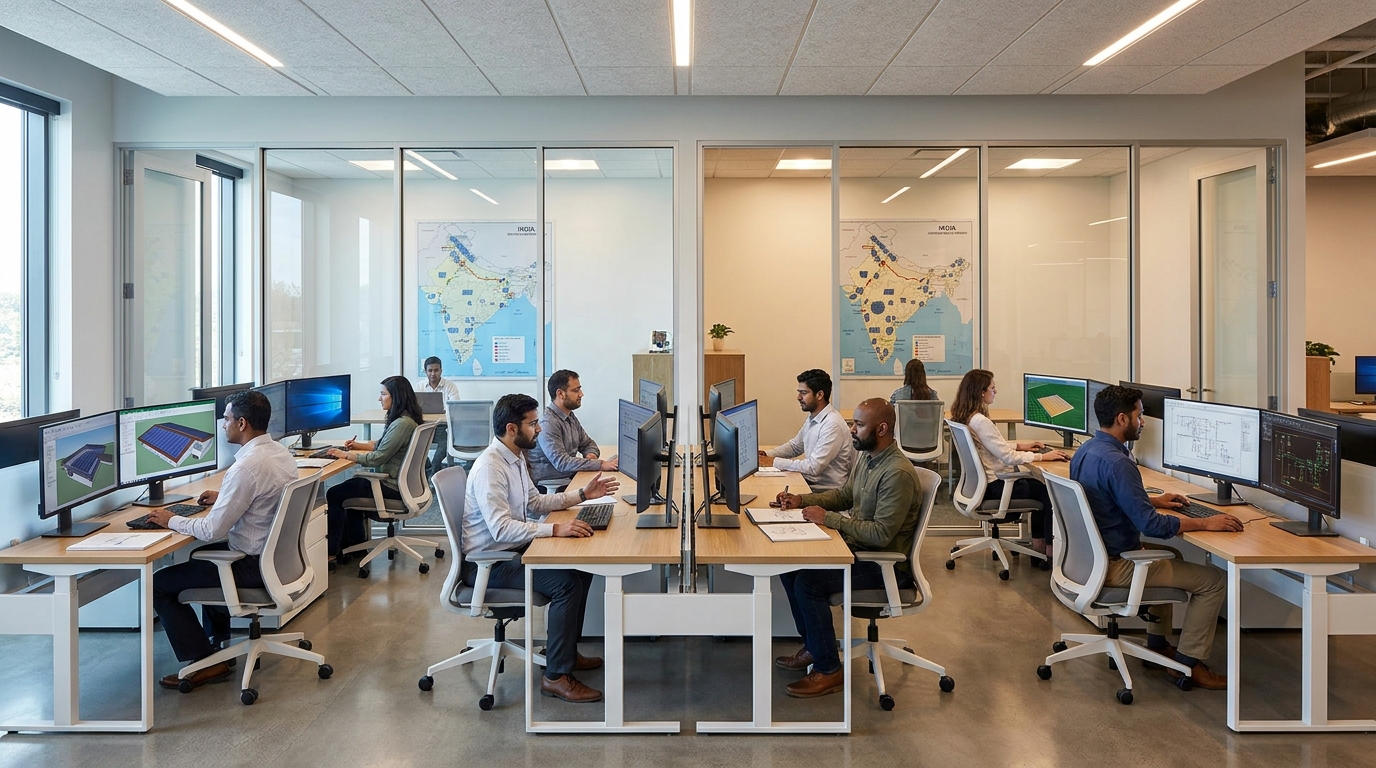
Heaven Designs Private Limited has built its service model around one core insight: EPC companies should not have to choose between speed and quality. With a team of over 50 skilled solar engineers and consultants based in Surat, Gujarat, Heaven Designs uses parallel workstreams and structured review processes to deliver high-quality designs faster than most single-engineer or small-team providers can manage.
How Parallel Workstreams Compress Design Timelines
In a traditional design workflow, electrical, structural, and simulation work happens sequentially. One engineer finishes the layout before another starts the structural drawings. Heaven Designs’ team structure allows these workstreams to run in parallel. The electrical team, structural team, and simulation team work simultaneously on different components of the same project, then integrate their outputs in a coordinated review cycle. This approach can reduce a standard 30-day design to 15 to 20 days without reducing the scope or quality of deliverables.
Services Aligned to Every Timeline Tier
Heaven Designs offers a full range of solar design services that map directly to the three timeline tiers described in this guide:
- Solar 3D Pre-Design: Rapid preliminary design for bid-stage estimates and client presentations, aligned with fast-track timelines
- MW Scale Detailed Engineering Design: Comprehensive drawings and documentation for commercial, industrial, and ground-mount projects, aligned with standard and thorough timelines
- Solar Civil and Structural Engineering: Site-specific structural analysis and foundation design for complex projects requiring thorough engineering
- Site Survey and Land Feasibility: On-ground data collection across India that feeds directly into accurate design inputs, reducing revision cycles at every tier
- Solar Permit Design: Compliance-focused documentation packages that meet state-specific DISCOM and MNRE requirements
- MW Scale Project Management Consultancy (PMC): End-to-end project oversight for large-scale solar installations
With 628+ MW of design work completed for 752+ solar EPC clients across India and international markets, Heaven Designs has the track record and team depth to support EPCs at every stage of the design timeline decision. Whether you need a fast-track pre-design for a bid due tomorrow or a thorough engineering package for a 10 MW ground-mount project, the team is structured to deliver both without compromise.
According to the Ministry of New and Renewable Energy (MNRE), India’s solar capacity additions continue to accelerate, making accurate and timely design documentation more critical than ever for EPCs competing in this market. The Central Electricity Authority (CEA) also publishes updated grid connectivity and technical standards that directly affect the documentation depth required for MW-scale projects.
Frequently Asked Questions About Solar Design Timelines India
Can a 7-day fast-track design be used for permit submission in India?
In most cases, no. Fast-track designs typically lack the documentation depth required by Indian DISCOMs and state-level regulatory bodies. They may be sufficient for preliminary client approval or bid-stage estimates, but permit submission usually requires a standard or thorough design package. Using a fast-track design for permit submission often results in rejection and resubmission, which adds more time than a standard design would have taken initially.
What causes the most delays in standard design timelines?
The most common causes of delay in standard design timelines are incomplete site survey data, late delivery of equipment specifications from the procurement team, and multiple revision cycles triggered by scope changes from the client. EPCs can reduce these delays by ensuring that site survey data and equipment specifications are finalized before the design engagement begins, and by locking the project scope before the design team starts work.
How does project size affect the recommended design timeline tier?
Project size is one of the strongest predictors of the appropriate design timeline tier. Projects under 20 kW can often be handled with fast-track designs. Projects between 100 kW and 1 MW are well-served by standard timelines. Projects above 1 MW, particularly ground-mount installations, almost always require the thorough engineering approach to manage structural complexity, regulatory documentation, and simulation accuracy at scale.
Is it possible to get thorough design quality in a faster timeline?
Yes, with the right design partner. Firms with large, specialized engineering teams can run parallel workstreams that compress the timeline for thorough design without reducing scope. A team of 50+ engineers can deliver a comprehensive design package in 20 to 25 days that a smaller team would need 40 days to complete. The key is choosing a design partner with the team depth and process maturity to support parallel delivery.
What should EPCs ask a design partner before committing to a timeline?
Before committing to any design timeline, EPCs should ask: What is included in the deliverable at this timeline? What are the most common causes of revision cycles for this project type? What data do you need from us before starting, and what happens to the timeline if that data is delayed? Do you have experience with this state’s DISCOM requirements? Can you show examples of similar projects completed within this timeline? These questions will quickly reveal whether a design partner’s timeline commitment is realistic or optimistic.
Make Your Next Design Timeline Decision with Confidence
Choosing the right solar design timeline in India is one of the most consequential decisions an EPC company makes on every project. Rush the design and you risk revision cycles, permit rejections, and on-site rework that erode your margins and damage client relationships. Over-engineer the timeline and you risk losing bids to faster competitors. The framework in this guide gives you the tools to match your design timeline to your project’s actual risk profile, not just its deadline.
Whether you need a fast-track pre-design for a bid due this week, a standard design package for a commercial rooftop project, or a thorough engineering engagement for a MW-scale ground-mount installation, Heaven Designs has the team and the process to deliver. With 50+ engineers, 628+ MW of completed design work, and deep experience across India’s diverse regulatory landscape, we help EPCs get the right design at the right time, every time.
Ready to match your next project to the right design timeline? Get a Quick Proposal Now! and tell us your project type, size, and deadline. Our team will recommend the right design timeline tier and get you a detailed proposal within 24 hours. You can also reach us directly at +91 90811 00297 or service@heavendesigns.in to discuss your specific design timelines India requirements with a senior engineer.
This blog post was written using thestacc.com