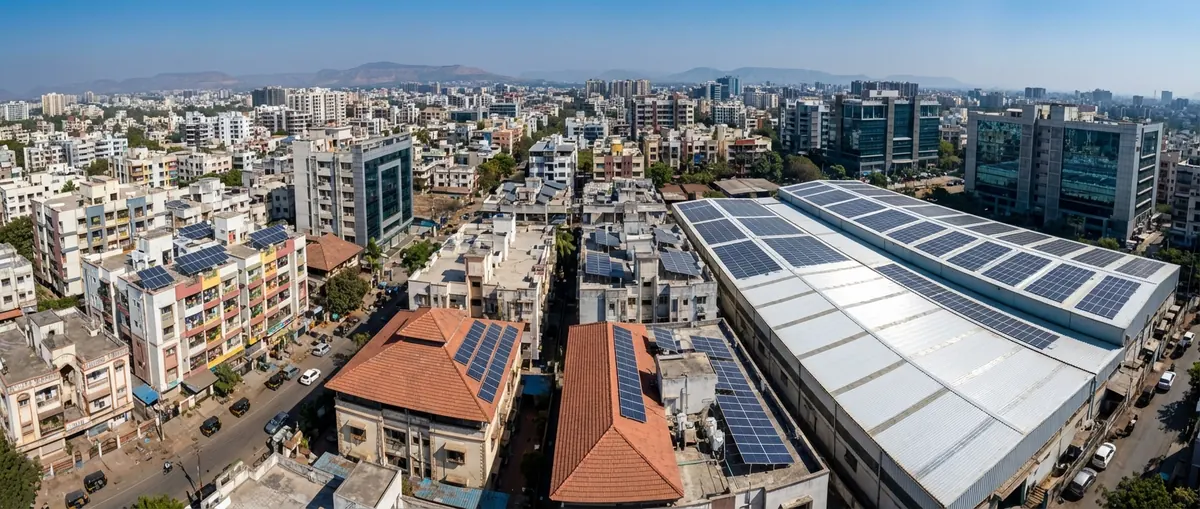
Andhra Pradesh has one of India’s most ambitious solar targets — 10 GW of rooftop solar by 2030 under the AP Solar Policy 2023 — yet first-pass rejection rates at APEPDCL sub-division offices remain above 30 percent, driven by EPCs submitting drawings that do not match APERC’s updated 2022 net metering format requirements.
This guide gives solar EPCs in the APEPDCL jurisdiction a complete operational playbook: the five drawing formats APEPDCL requires under the AP Net Metering Drawing Standard, the AP DISCOM portal workflow, all five approval stages, and the ten rejection reasons that account for the majority of re-submissions.
Direct answer. APEPDCL solar net metering is governed by APERC Net Metering Regulations 2022, covering Eastern and Western Andhra Pradesh districts: East Godavari, West Godavari, Visakhapatnam, Vizianagaram, Srikakulam, Krishna, Guntur, and Prakasam districts. Applications require five drawing types — APEPDCL-format SLD, General Arrangement, Earthing Diagram, Net Meter Schematic, and Structural Certificate — submitted via the AP DISCOM portal. Processing takes 30–60 days for ≤10 kW and 50–90 days for larger systems. ALMM modules and MNRE-approved inverters are mandatory from 2023 onward.
APEPDCL’s Jurisdiction — Andhra Pradesh’s Two-DISCOM Structure
Andhra Pradesh’s power distribution was restructured after the 2014 AP bifurcation and again after operational reorganisation in 2020. The two AP DISCOMs are regulated by APERC — the Andhra Pradesh Electricity Regulatory Commission:
| DISCOM | Districts Served | Headquarters |
|---|---|---|
| APEPDCL (AP Eastern Power Distribution Company Limited) | Visakhapatnam, Vizianagaram, Srikakulam, East Godavari, West Godavari, Krishna, Guntur, Prakasam | Visakhapatnam |
| APSPDCL (AP Southern Power Distribution Company Limited) | Nellore, Kurnool, Kadapa, Chittoor, Anantapur, and partially Guntur/Prakasam in southern areas | Tirupati |
This guide covers APEPDCL. The framework also applies to APSPDCL with symbol-set and sub-division variations. For a state-by-state comparison, see DISCOM net metering process across India. For neighbouring state guides, see TANGEDCO Solar Net Metering Guide (Tamil Nadu) and BESCOM Solar Net Metering Guide (Karnataka).
AP Solar Policy 2023 context. The Government of Andhra Pradesh's Solar Policy 2023 targets 10 GW of rooftop solar by 2030 and mandates that all new commercial and industrial buildings above 500 sqm install solar rooftop systems. This policy-driven pipeline makes APEPDCL net metering approvals a volume-critical skill for EPCs operating in AP's coastal commercial and industrial corridor.
Eligibility — Consumer Categories Under APERC 2022 Regulations
| Consumer Category | AP Tariff Code | Max System Size | Export Rate |
|---|---|---|---|
| Domestic LT | LT Category I | Up to 10 kW (1-phase) / 75 kW (3-phase) | APERC pooled cost |
| Commercial LT | LT Category II | Up to 150 kW | APERC pooled cost |
| Industrial LT | LT Category III / IV | Up to 500 kW | APERC pooled cost |
| Agricultural pump (metered) | LT Category V | Up to 5 kW | APERC pooled cost |
| HT consumers | HT Category I / II | Up to 1 MW | APERC pooled cost |
| Government | LT / HT Government | Up to 1 MW | APERC pooled cost |
Field tip. APERC's pooled cost rate for FY2024–25 was approximately ₹3.40–₹3.70/kWh. Andhra Pradesh's coastal districts (Visakhapatnam, Krishna, Guntur) have some of India's highest GHI values — the combination of high irradiance and APEPDCL's commercial tariffs (₹8–₹10/kWh for HT industrial) produces payback periods below 5 years for most industrial rooftop projects despite the moderate export rate.
The AP Net Metering Drawing Standard — 5 Mandatory Formats
Single Line Diagram — APEPDCL Format
Must use APEPDCL's symbol standard for grid connection, metering, and protection. Required elements: PV array → DC protection → inverter → AC main switch → bidirectional net meter → APEPDCL grid. The [SLD](/glossary/sld/) must include: consumer service connection number in title block, conductor sizes, fault protection ratings, inverter make/model, anti-islanding callout, and a generation meter note (APEPDCL requires a separate generation meter on the DC or AC side for capacity accounting). Systems above 25 kW must show a protection relay.
General Arrangement / Site Layout
To-scale layout of module positions, cable trays, inverter location, earthing pits, and distance from APEPDCL meter board. North arrow and scale bar mandatory. APEPDCL specifically requires that the layout show the nearest APEPDCL 11 kV feeder direction and approximate distance — a piece of information that helps the AE at Stage 2 quickly determine grid injection feasibility. Obtain this from the APEPDCL sub-division or from a site visit before drawing preparation.
Earthing and Lightning Protection Diagram
Standalone drawing showing GI strip earthing from module frames and inverter body to earthing electrode, lightning rod location and protection radius, electrode specification (pipe/plate, depth, soil type, target resistance ≤5 Ω). Andhra Pradesh's coastal districts experience high lightning strike frequency during the monsoon — the lightning rod protection radius calculation is required to confirm coverage of the entire array footprint.
Net Meter Connection Schematic
Bidirectional net meter and generation meter positions in the meter board, export path, isolation arrangement. APEPDCL's requirement for a generation meter (in addition to the bidirectional net meter) means this schematic must show two meters in the board — the generation meter on the inverter AC output side and the net energy meter at the APEPDCL service entrance. Many EPCs miss the generation meter requirement entirely.
Structural Load Certificate
Signed and stamped structural engineer certificate under IS 875. APEPDCL requires this for all systems. Andhra Pradesh's coastal areas (Visakhapatnam, Krishna, Godavari) fall in IS 875 Part 3 Basic Wind Speed zone 50 m/s — among India's highest wind zones. The structural certificate must reference this zone, and module mounting hardware must be rated for the corresponding wind uplift loads. This is a non-negotiable engineering requirement, not just a compliance formality.
Watch out. APEPDCL's generation meter requirement — a separate meter from the bidirectional net meter, measuring total solar generation on the inverter AC output side — is unique to AP among India's major DISCOMs. It adds approximately ₹2,000–₹4,000 to the installation cost and must be shown in Drawing 4 (net meter schematic). EPCs from other states entering the AP market miss this requirement almost universally on the first submission.
Full Document Checklist
Category A — Consumer and Property Documents
- APEPDCL electricity bill (service connection number, tariff category, sanctioned load)
- Property ownership proof (patta passbook or registered sale deed)
- Aadhaar card / PAN card of consumer
- NOC from property owner if tenant
Category B — Technical Drawings (5 Formats)
- SLD — APEPDCL format with generation meter note and anti-islanding callout (Drawing 1)
- General Arrangement with nearest APEPDCL 11 kV feeder direction (Drawing 2)
- Earthing and Lightning Protection Diagram with lightning rod coverage radius (Drawing 3)
- Net Meter Connection Schematic with both generation meter and net energy meter (Drawing 4)
- Structural Load Certificate referencing IS 875 zone 50 m/s for coastal districts (Drawing 5)
- Load calculation sheet — signed by contractor
Category C — Equipment Compliance
- Module datasheets with ALMM compliance certificate
- Inverter on current MNRE-approved list
- Anti-islanding test certificate
- Generation meter specification sheet
Category D — Contractor and Inspection
- Electrical contractor licence — Andhra Pradesh state scope, valid
- CEIG or AP Electrical Inspector report for systems above 25 kW
- Installation completion certificate signed by licensed contractor
Category E — Portal and Payment
- Application registered on AP DISCOM portal (apepdcl.in or JNTU digital portal integration)
- Scanned documents uploaded; reference number noted
- Physical file submitted at APEPDCL sub-division with portal reference
- Application fee and net meter cost deposit
Stage-by-Stage APEPDCL Approval Process
30–55
Days — ≤10 kW clean submission
Heaven Designs field data, Q1 2026
50–80
Days — 10–100 kW
Heaven Designs field data, Q1 2026
65–90
Days — 100 kW to 1 MW
Heaven Designs field data, Q1 2026
~60%
First-pass approval — APEPDCL divisions
Mercom India, 2024 rooftop tracker
Stage 1 — Portal Submission and Physical File Acceptance
Complete the AP DISCOM portal application, upload scanned documents, and submit the physical file at the APEPDCL sub-division. AE performs a format check; the clock starts on full-file acceptance.
Stage 2 — Technical Feasibility
DE/AE assesses feeder hosting capacity against APERC’s 30% threshold. APEPDCL’s industrial coastal belt (Visakhapatnam port area, Krishna delta industrial estates) experiences feeder saturation for large C&I applications above 100 kW.
Timeline: 10–18 working days.
Stage 3 — Drawing Review
Five drawings reviewed by APEPDCL’s technical team. The generation meter note on SLD, 11 kV feeder direction on GA, lightning rod coverage calculation, dual-meter net meter schematic, and IS 875 zone 50 m/s on the structural certificate are the most common checkpoints.
Timeline: 10–18 working days.
Field tip. APEPDCL's coastal districts see active monsoon from June to October — cyclone season. APEPDCL drawing reviewers in Visakhapatnam and Kakinada are particularly thorough about wind zone compliance in structural certificates. Submit in the October–March window when review volumes are lower and reviewers are less likely to flag marginal wind load calculations.
Stage 4 — Net Meter and Generation Meter Installation
APEPDCL installs both a bidirectional net energy meter and a generation meter. The dual-meter installation is more complex than most state DISCOMs and takes longer. Track via the AP DISCOM portal; escalate at 25 working days.
Timeline: 12–25 working days.
Stage 5 — Commissioning and Registration Certificate
EPC commissions with APEPDCL AE present. AP CEI inspection required above 25 kW. APEPDCL issues a Solar Generation Unit Registration Certificate used for AP Solar Policy 2023 reporting, APERC records, and insurance.
Net Metering Billing and Settlement in Andhra Pradesh
APERC’s pooled cost mechanism determines the export rate annually. The billing cycle is monthly net computation with year-end cash settlement.
| Billing Scenario | APEPDCL Treatment |
|---|---|
| Monthly net import | Billed at applicable tariff |
| Monthly net export | Banked as credit |
| Year-end surplus | Cash settlement at APERC pooled cost |
| Generation meter data | Used for AP Solar Policy 2023 compliance reporting |
PROS — APEPDCL NET METERING
- 1 MW ceiling for HT consumers — accommodates large industrial projects
- AP Solar Policy 2023 mandates rooftop solar for new C&I buildings — strong demand pipeline
- High coastal GHI (5.5–6.2 peak sun hours) produces excellent yield
- High APEPDCL industrial tariffs make payback economics very attractive
- Year-end cash settlement — surplus units not forfeited
CONS — APEPDCL NET METERING
- Dual meter (net + generation) requirement is unique to AP — adds cost and drawing complexity
- Zone 50 m/s wind specification increases structural compliance overhead in coastal areas
- First-pass rejection rate remains above 30% due to EPCs using pre-2022 templates
- Feeder saturation in Visakhapatnam port industrial area
- 11 kV feeder direction requirement on GA drawing needs sub-division coordination upfront
Verdict. APEPDCL’s coastal territory offers some of India’s best rooftop solar economics — high irradiance, high tariffs, strong AP government policy push. The operational challenge is APEPDCL’s drawing format uniqueness: the generation meter requirement and the IS 875 zone 50 m/s wind specification set AP apart from most other states. EPCs that update their templates for these two requirements and gather the 11 kV feeder direction before drawing preparation will achieve near first-pass approval rates in APEPDCL.
Andhra Pradesh Solar Market Context
Andhra Pradesh targets 10 GW of rooftop solar by 2030 under AP Solar Policy 2023. According to Mercom India’s Andhra Pradesh solar tracker, the state had approximately 4,800 MW of total installed solar by Q1 2025, with rooftop growing rapidly in Visakhapatnam, Krishna, and Guntur districts. The AP Industrial Development Corporation (APIDC) has made solar rooftop mandatory for all new factories in its industrial estates — a significant captive market for APEPDCL net metering.
MNRE’s PM Surya Ghar allocation for Andhra Pradesh targets 4.5 lakh residential installations through 2026, with APEPDCL handling the northern coastal districts.
IEA Solar PV 2024 notes Andhra Pradesh’s coastal irradiance advantage — combined with the state’s manufacturing growth in the Visakhapatnam Special Economic Zone and Krishna-Guntur industrial corridor — as a major driver of India’s distributed solar growth through 2030.
IRENA Renewable Energy Statistics 2023 highlights India’s southeastern coastal states as some of the highest-irradiance grid-connected zones in the Asia-Pacific region — Andhra Pradesh’s coastal GHI is among the best in the country.
The 10 Most Common APEPDCL Rejection Reasons
| # | Rejection Reason | Fix |
|---|---|---|
| 1 | Generation meter missing from SLD and net meter schematic | Add generation meter to both Drawing 1 and Drawing 4 — APEPDCL requires it for capacity accounting |
| 2 | IS 875 wind zone not specified in structural certificate | Specify IS 875 Part 3 Basic Wind Speed zone 50 m/s for Visakhapatnam, Godavari, Krishna coastal districts |
| 3 | Nearest 11 kV feeder direction absent from GA drawing | Obtain feeder direction from APEPDCL sub-division before drawing preparation; add to GA as a directional annotation |
| 4 | Lightning rod coverage radius not shown for coastal installations | Show the protection radius calculation; all of APEPDCL’s coastal territory is in high lightning-strike zones |
| 5 | SLD uses APSPDCL symbols instead of APEPDCL symbols | APEPDCL and APSPDCL have different utility-side symbols; confirm which AP DISCOM you are submitting to |
| 6 | ALMM compliance missing for modules | Mandatory for all post-January 2023 applications |
| 7 | Service connection number absent from SLD title block | Add the consumer’s 11-digit APEPDCL service connection number to every drawing’s title block |
| 8 | Earthing diagram attached as a note on SLD | Produce as a standalone drawing — two separate sheets required |
| 9 | Contractor licence not AP-state scope | AP DISCOM installations require an AP state-registered electrical contractor; confirm licence scope |
| 10 | Portal and physical file inconsistent system capacity | Reconcile capacity, module make/model, and inverter make/model between portal and physical file before submission |
How Heaven Designs Helps Andhra Pradesh EPCs
APEPDCL’s generation meter requirement and wind zone specification are the two most reliably missed requirements in AP net metering submissions from EPCs entering the state from other markets. Heaven Designs’ AP-specific drawing templates have both pre-built — so the first AP project submits clean rather than learning through rejection.
- Solar Rooftop Detailed Engineering Design — Full APEPDCL-format drawing package: SLD with generation meter and anti-islanding callout, GA with 11 kV feeder annotation, earthing schematic with lightning rod coverage radius, dual-meter net meter schematic, structural certificate with IS 875 zone 50 m/s. Delivered 3–5 business days.
- Electrical CEIG Drawings — AP Electrical Inspector-ready drawings for systems above 25 kW.
- Solar 3D Pre-Design — 48-hour 3D layout for AP coastal rooftop projects; includes preliminary wind load assessment flag for coastal IS 875 zone compliance.
- Site Survey & Land Feasibility Services — AP site surveys include feeder capacity pre-check and 11 kV feeder direction identification, so drawings can be prepared with the correct GA annotation from the start.
- Download sample deliverables — Sample pack includes an APEPDCL-format SLD and dual-meter net meter schematic from a completed Visakhapatnam commercial rooftop project.
For the foundational context: DISCOM, net metering in India, and SLD glossary entries.
FAQ
What is APEPDCL’s maximum net metering system size?
1 MW for HT consumers under APERC Net Metering Regulations 2022. For LT domestic consumers, the limit is the consumer’s sanctioned load (typically up to 10 kW for single-phase, 75 kW for three-phase). All systems are subject to feeder hosting capacity — pre-check for systems above 100 kW in Visakhapatnam and Krishna delta industrial areas.
Why does APEPDCL require a generation meter in addition to the net energy meter?
APERC requires generation data for AP Solar Policy 2023 compliance reporting — the government tracks total solar generation, not just net import/export, to measure progress against the state’s 10 GW rooftop target. The generation meter on the inverter AC output side provides gross generation data that flows into APEPDCL’s AP Solar Policy reporting database. This dual-meter requirement adds approximately ₹2,000–₹4,000 to installation costs and must be factored into project pricing for AP.
Does the IS 875 wind zone 50 m/s affect mounting hardware selection?
Yes, significantly. Zone 50 m/s (Basic Wind Speed) corresponds to a design wind pressure that is substantially higher than India’s median zone (44 m/s). Module mounting rails, clamps, and roof anchors must be specified to handle the higher wind uplift force. The structural engineer’s certificate must confirm that both the mounting system and the roof structure can withstand this force. For EPCs sourcing standard mounting hardware, confirm with the manufacturer that the specific product is rated for zone 50 m/s applications.
How does APEPDCL’s process compare to APSPDCL in southern Andhra Pradesh?
APSPDCL (serving Nellore, Kurnool, Chittoor, etc.) uses a similar five-drawing framework under the same APERC regulations but has a different symbol set and different sub-division contact structure. APEPDCL is generally considered the larger, more organised DISCOM with better portal infrastructure. EPCs moving between AP DISCOMs must maintain separate drawing templates — using APEPDCL format in APSPDCL sub-divisions produces rejections.
What is the Andhra Pradesh CEI inspection process for solar systems above 25 kW?
The AP Chief Electrical Inspector (CEI), under the AP Energy Department, conducts inspection for captive generating plants above 25 kW connecting to the grid. The EPC must apply for a CEI inspection after system installation is complete and before the APEPDCL commissioning visit. CEI scheduling in Andhra Pradesh typically takes 10–15 working days. The CEI certificate must be submitted to APEPDCL as part of the Stage 5 commissioning package.
Is there a PM Surya Ghar subsidy for AP residential consumers?
Yes. Residential consumers in APEPDCL’s jurisdiction are eligible for PM Surya Ghar central subsidies. AP does not have a separate state subsidy over and above the central scheme as of FY2024–25. The AP DISCOM portal has partial integration with the PM Surya Ghar national portal; consumers may need to separately register on the national portal and cross-reference their APEPDCL application number.