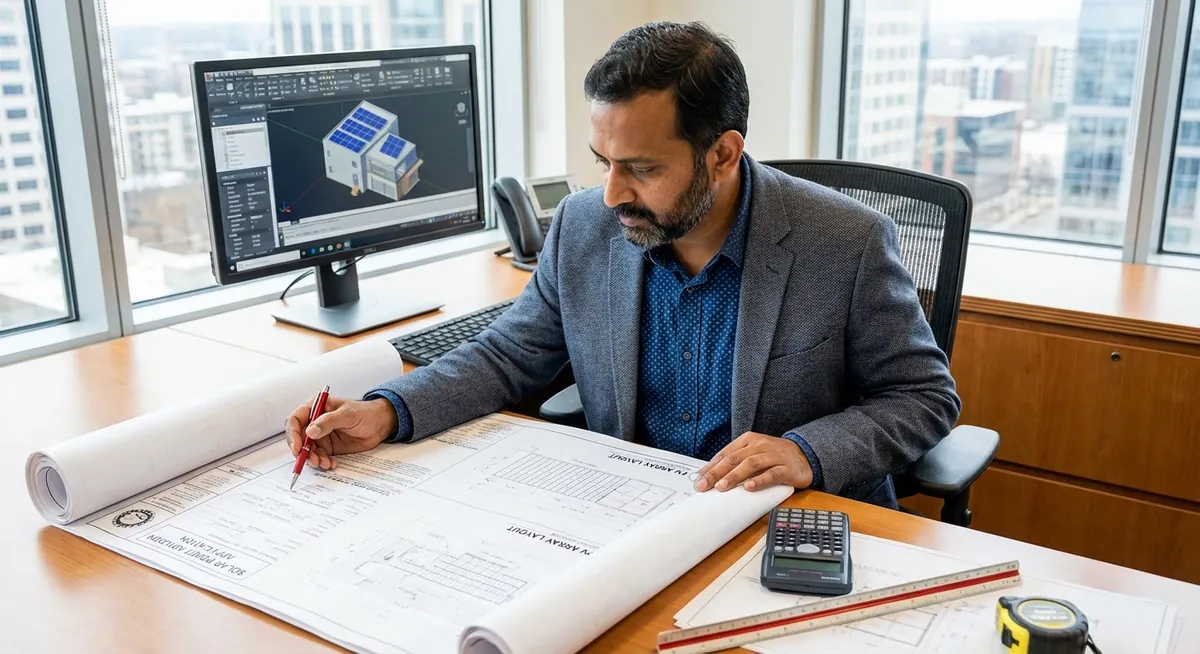
Chicago is the largest solar installation market in Illinois and one of the most technically distinctive urban solar AHJs in the Midwest. Unlike Sun Belt cities where residential solar is primarily roof-mounted on single-family homes in lower-density neighborhoods, Chicago’s solar market is dominated by urban flat-roof commercial buildings, dense residential neighborhoods with limited roof access, and a significant community solar segment. The City of Chicago Department of Buildings (DOB) processes solar permits through its Chicago Building and Safety (BACP in older terminology; now City of Chicago DOB) system — and Chicago’s building code includes local amendments to NEC that are different from the rest of Illinois.
For installers entering the Chicago solar market from other geographies, the most critical knowledge gaps are: Chicago’s local building code amendments, the distinction between ComEd interconnection and Chicago permit processes, and the flat-roof fire setback standard that applies to Chicago’s predominant commercial building stock.
Direct answer. Chicago solar permits are issued by the City of Chicago Department of Buildings (DOB). Residential solar requires an electrical permit; commercial solar requires both a building permit and an electrical permit. Chicago uses NEC 2017 with Illinois/Chicago amendments (as of 2026; code upgrade status: confirm current adoption). ComEd (Commonwealth Edison) is the primary T&D utility for Chicago and most of northeastern Illinois. Chicago’s Illinois Shines (Adjustable Block Program) is the primary solar incentive for both residential and commercial systems.
Chicago Solar Market Context
Chicago’s solar market differs from Sunbelt solar markets in several important ways:
- Flat-roof commercial dominance — Chicago’s urban building stock is primarily flat-roof commercial and multi-family, making rooftop solar on commercial flat roofs a large portion of the market
- Illinois Shines (Adjustable Block Program) — Illinois’ primary solar incentive, administered by the Illinois Power Agency, provides Renewable Energy Credits (RECs) purchased upfront for 15 years — similar in structure to a capacity-block incentive
- Low average irradiance vs. California — Chicago averages approximately 4.0–4.5 kWh/m²/day GHI compared to 5.2+ for LA — lower but still economically viable, especially for commercial systems with high electricity rates
- Cold climate — Snow load and sub-zero temperatures affect structural design and equipment selection
- High commercial electricity rates — ComEd commercial rates create favorable solar economics for C&I applications
According to the Solar Energy Industries Association (SEIA), Illinois has grown significantly as a solar market, driven by the Illinois Shines program. The Illinois Power Agency administers the Illinois Shines Adjustable Block Program.
Chicago DOB — The Permitting Authority
The City of Chicago Department of Buildings (DOB) is the AHJ for all solar installations within the City of Chicago. Chicago DOB operates through its online permit portal (chicago.gov/city/en/depts/bldgs.html).
Chicago Solar Permit Types:
- Residential solar (R-3, 1–2 family): Electrical permit required; building permit typically not required unless structural work is involved
- Multi-family and commercial solar: Both building permit and electrical permit required
- Ground-mount solar: Building permit + electrical permit + foundation permit
Chicago vs. rest of Illinois AHJ: Chicago DOB is separate from all suburban and downstate Illinois AHJs. Suburban Chicago municipalities — Naperville, Evanston, Oak Park, Schaumburg — each have their own building departments. Cook County (unincorporated) has the Cook County Building Department. The ComEd interconnection process is the same regardless of which AHJ issues the permit, but the permit requirements differ significantly between Chicago DOB and suburban AHJs.
Chicago Building Code — NEC and Local Amendments
Chicago uses the Chicago Building Code (CBC), which adopts NEC 2017 with Chicago-specific amendments. Key differences from NEC 2017 base:
Chicago-specific electrical code notes for solar:
- Chicago requires conduit (rigid metallic conduit or EMT) for most wiring within the building — Chicago does not allow exposed plastic conduit (PVC) in many occupancies. Solar wiring inside a Chicago building must use metallic conduit.
- Chicago’s local fire code includes specific provisions for rooftop equipment access and fire department operations that affect solar array layout beyond the standard IFC setbacks
- Chicago has specific requirements for rooftop equipment that is visible from neighboring buildings in historic districts
Chicago conduit requirement. Solar permit packages for Chicago buildings must specify metallic conduit (rigid IMC/RMC or EMT) for all wiring inside the building. If your standard permit drawing notes "conduit per NEC 690.31" without specifying the conduit type, a Chicago plan examiner will flag this as non-compliant with the CBC's conduit requirements. Specify EMT or IMC on the SLD for all indoor conduit runs.
ComEd Solar Interconnection — Illinois Shines Integration
ComEd (Commonwealth Edison) is the T&D utility for Chicago and most of northeastern Illinois. ComEd’s distributed generation interconnection process integrates with the Illinois Shines Adjustable Block Program:
ComEd DG Interconnection Application:
| System Size | Track | Timeline | Notes |
|---|---|---|---|
| ≤ 10 kW (residential) | Simplified (Level 1) | 15–25 business days | Standard screening; UL 1741 inverter |
| 10 kW–2 MW | Standard (Level 2) | 45–90 business days | Technical feasibility study; may need distribution upgrade |
| > 2 MW | Full Study (Level 3) | 90–180+ business days | System impact study |
ComEd + Illinois Shines timeline integration: For Illinois Shines projects, the installer must obtain a ComEd interconnection reservation before the Illinois Power Agency Approved Vendor can submit the project to the Illinois Shines program. This creates a sequencing requirement: ComEd application first, then Illinois Shines program enrollment.
Illinois Shines (Adjustable Block Program) — Impact on Solar Design
The Illinois Shines Adjustable Block Program is the primary solar incentive in Illinois. It works by pre-purchasing Renewable Energy Credits (RECs) from solar projects for 15 years at a fixed price set by the block rate at the time of enrollment.
Illinois Shines key parameters:
- REC price: fixed at enrollment; declining blocks (earlier = higher rate)
- Payment structure: upfront payment for 15 years of projected production
- Equipment requirements: inverter must meet PJM/ComEd interconnection requirements (IEEE 1547-2018 compliance)
- Revenue-grade metering: required for systems > 10 kW applying under Illinois Shines
- Approved Vendor: Illinois Shines projects must be submitted by an IPA-approved vendor
Impact on permit package: For Illinois Shines projects, the permit package must include equipment specifications that confirm IEEE 1547-2018 inverter compliance and, for > 10 kW systems, a revenue-grade production meter specification.
Chicago Flat-Roof Solar — Specific Design Considerations
Chicago’s building stock includes a large proportion of flat-roof commercial buildings, multi-family buildings, and row houses with flat or low-slope roofs. Flat-roof solar installations have specific design requirements:
Ballasted vs. penetrating mounting on Chicago flat roofs:
| Mounting Type | Structural Requirement | Permit Documentation |
|---|---|---|
| Ballasted (non-penetrating) | Structural check for distributed dead load; wind uplift analysis for ballast adequacy; roof membrane adequacy | Ballasted racking system spec; ballast calculation; structural calc showing roof capacity for added dead load |
| Penetrating (through-membrane) | Roof penetration details; waterproofing method; structural framing analysis | Penetration detail from racking manufacturer; waterproofing spec; structural calc |
Chicago flat-roof fire setbacks: Chicago’s fire code (adopting IFC Chapter 6) requires access pathways and setbacks on flat roofs for solar installations:
- Perimeter setback: minimum 6 feet from parapet wall (higher than the 18-inch IFC default for sloped roofs, due to flat-roof access requirements)
- Interior pathways: 6-foot-wide access path through the array for buildings > 250 feet in any dimension
- Equipment room access: clear path to rooftop HVAC, access hatches, and stairway penthouses
Chicago flat-roof setback note. Chicago's 6-foot perimeter setback for flat-roof commercial solar is significantly larger than the 18-inch setback for pitched residential roofs. On a 100-foot-wide flat-roof commercial building, this setback consumes approximately 10–12% of the usable roof area on each side. Pre-design layout for Chicago commercial projects must account for this setback standard before calculating the usable array area.
Chicago Snow Load — Critical Structural Requirement
Chicago’s snow load is one of the most significant structural design parameters for Midwest solar installations:
| Location | Ground Snow Load (Pg) | Roof Snow Load (Ps) Estimate | Notes |
|---|---|---|---|
| Chicago city | 25 psf | 17.5–20 psf (sloped; slope factor Cs varies) | ASCE 7-22 Figure 7.2-1 |
| North suburbs (Evanston, Waukegan) | 25–30 psf | Similar to Chicago | Lake effect increases north of city |
| West suburbs (Naperville, Aurora) | 20–25 psf | Slightly lower | Inland, less lake effect |
| South suburbs | 20–25 psf |
Solar structural impact of Chicago snow load:
- Flat-roof ballasted solar must include snow accumulation analysis — ballasted systems on flat roofs have lower weight than penetrating systems, and must demonstrate that the combined dead load + snow load + wind uplift does not exceed the roof’s structural capacity
- The ballast weight designed to resist wind uplift must be confirmed to not cause overload when added to snow accumulation
- Sloped residential roofs benefit from reduced roof snow load (slope factor Cs < 1.0), which partially offsets the higher ground snow load
The Chicago Solar Permit Package Framework
Roof Plan with Chicago Fire Setbacks
Flat-roof commercial: 6-foot perimeter setback from parapet; 6-foot interior pathways for large arrays. Sloped residential: 18-inch IFC setbacks at ridge, valley, hip, perimeter. Access path to rooftop equipment labeled. Array layout with dimensions.
Electrical SLD with Metallic Conduit Specification
SLD complying with Chicago Building Code (NEC 2017 + Chicago amendments). Specify EMT or IMC for all indoor conduit runs. Rapid shutdown per NEC 690.12. 120% busbar calculation per NEC 705.12. Revenue-grade meter if Illinois Shines > 10 kW.
Structural Analysis (Snow + Wind)
Structural analysis per IBC 2021 (Chicago CBC). Snow load: 25 psf ground snow load for Chicago. Wind: ASCE 7-22 Vult ~90 mph, Exposure B for city interior, C for lakefront. Flat-roof ballasted: combined dead + snow + wind uplift analysis. Sloped residential: rafter capacity + uplift. PE stamp required for commercial.
Equipment Cut Sheets + IEEE 1547 Confirmation
Module, inverter, and racking cut sheets. For Illinois Shines projects: inverter IEEE 1547-2018 compliance confirmation. Revenue-grade meter spec for > 10 kW Illinois Shines systems. UL 9540 for BESS if included.
Chicago Solar Permit Performance Data
25 psf
Ground snow load — Chicago structural design parameter
ASCE 7-22 Figure 7.2-1
6 ft
Flat-roof commercial perimeter setback (larger than IFC default)
Chicago Fire Code / Chicago DOB
15 yr
Illinois Shines REC purchase period — fixed at enrollment
Illinois Power Agency CEJA, 2024
96.2%
Heaven Designs first-pass approval — all Midwest AHJs
Heaven Designs internal, Q1 2026
Common Chicago Solar Permit Corrections
| # | Correction | Fix |
|---|---|---|
| 1 | PVC conduit specified for indoor runs | Specify EMT or IMC for all indoor conduit per Chicago Building Code |
| 2 | Flat-roof perimeter setback uses 18-inch IFC (wrong for Chicago commercial) | Apply Chicago’s 6-foot commercial flat-roof setback; note Chicago Fire Code reference |
| 3 | Snow load absent from structural calculation | Add 25 psf ground snow load per ASCE 7-22 for Chicago address |
| 4 | Revenue-grade meter not specified for Illinois Shines > 10 kW | Add revenue-grade meter to SLD with accuracy class specification |
| 5 | IEEE 1547-2018 compliance not confirmed for Illinois Shines inverter | Include IEEE 1547-2018 compliance statement in inverter cut sheet or inverter specifications |
| 6 | Ballasted roof mounting: combined snow + ballast load not analyzed | Add combined load analysis: dead (ballast + racking + modules) + snow load vs. roof structural capacity |
| 7 | ComEd interconnection application not referenced in commercial package | Include ComEd application reference number in commercial permit package |
How Heaven Designs Serves Chicago and Illinois Installers
Chicago’s flat-roof fire setback standard, metallic conduit requirement, snow load structural analysis, and Illinois Shines revenue metering documentation are all captured in Heaven Designs’ Midwest permit workflow.
- Solar Permit Design (USA) — Chicago DOB and suburban Illinois permit packages. Snow load structural analysis. Metallic conduit specification for Chicago buildings. Illinois Shines revenue-grade meter documentation. 4–7 business days. 96.2% first-pass approval rate.
- Solar Civil & Structural Engineering — IL-licensed PE structural calculations for commercial rooftop and flat-roof ballasted systems.
- NEC 706 Battery Storage Solar Permit — BESS permit guide for Illinois Shines-paired storage systems.
- Download sample deliverables — Sample Chicago commercial permit set with flat-roof setbacks and Illinois Shines documentation.
For broader US permit context, see How to Submit a Solar Permit Package to an AHJ and Commercial vs. Residential Solar Permit Design.
Glossary: AHJ, NEC 705, rapid shutdown.
FAQ
Does Chicago require a PE stamp on residential solar permits?
Chicago DOB’s residential electrical permit for solar does not typically require a PE stamp for standard residential systems. However, the structural analysis — confirming rafter or roof deck capacity — requires a PE stamp for commercial systems and is strongly recommended for residential systems on older Chicago graystones, rowhouses, and multi-flat buildings where roof framing may be below modern load tables. Chicago’s residential building stock includes significant pre-1940s construction where roof framing is often marginally sized for additional loads.
What is the Illinois Shines program for solar?
Illinois Shines (formally the Adjustable Block Program) is the Illinois Power Agency’s incentive program for distributed solar. It provides Renewable Energy Credits (RECs) purchased at a fixed rate for 15 years from the date of program enrollment. The REC price is set by the block level at enrollment — earlier blocks paid higher rates; later blocks pay lower rates as capacity fills. Illinois Shines requires an IPA-approved vendor to submit the project application, ComEd interconnection documentation, and a revenue-grade production meter for systems > 10 kW.
What NEC version does Chicago use?
Chicago uses the Chicago Building Code (CBC), which adopts NEC 2017 with Chicago-specific local amendments. As of 2026, Chicago has not yet adopted NEC 2020 or NEC 2023 at the city level, though Illinois state code has moved toward NEC 2020 adoption in many jurisdictions. Confirm the current Chicago DOB code adoption status before finalizing permit drawing code references — using a code citation that the current Chicago CBC does not contain creates a plan correction.
Does ComEd offer net metering for solar customers in Illinois?
Yes. ComEd offers net metering to residential and small commercial solar customers under Illinois’ net metering law. ComEd net metering credits customers at the retail rate for solar energy exported to the grid — a full retail rate credit, unlike California’s NEM 3.0 structure. The net metering arrangement is established through the ComEd interconnection process. ComEd credit for net excess generation (NEG) accumulated over a billing period is rolled forward as a monetary credit on the next bill.
Can I use SolarApp+ for Chicago solar permits?
No. As of 2026, Chicago DOB has not adopted SolarApp+. Chicago solar permits are filed through the City of Chicago permit portal (chicago.gov/depts/bldgs.html) as standard electrical or combined building/electrical permit applications. Some suburban Chicago municipalities have adopted SolarApp+ (Naperville, for example), but Chicago city proper requires manual permit application. Timeline for Chicago DOB residential electrical permits: typically 7–15 business days.