


Selecting the right design partner is one of the most critical decisions a solar EPC company will make. The quality of your engineering design directly impacts project profitability, installation efficiency, regulatory compliance, and long-term system performance. With India’s solar market expanding rapidly and competition intensifying, partnering with a skilled solar design firm can mean the difference between project success and costly delays.
For solar EPC companies operating in India and international markets, the challenge isn’t just finding a design partner—it’s finding the right one. Poor design choices lead to permit rejections, structural failures, energy generation shortfalls, and damaged client relationships. Conversely, an experienced design partner brings specialized expertise, proven processes, and the technical capabilities needed to deliver accurate, cost-effective solar installations that maximize ROI.
This comprehensive guide walks you through 12 critical selection criteria to evaluate when choosing a solar design partner in 2026. Whether you’re outsourcing your first project or reconsidering your current partnership, these evaluation standards will help you make an informed decision that sets your EPC business up for long-term success.

Why Choosing the Right Design Partner Matters for Solar EPCs
The solar design phase establishes the foundation for every subsequent project stage. A comprehensive design package includes site assessments, structural calculations, electrical schematics, equipment specifications, and permit-ready documentation. When these elements are executed correctly by a qualified design partner, your EPC company benefits from smoother installations, fewer change orders, and higher client satisfaction.
Consider the financial implications. Design errors discovered during installation can cost 10 to 15 times more to fix than catching them during the design review phase. A structural miscalculation might require expensive engineering modifications. An electrical design flaw could delay interconnection approval by months. These setbacks directly impact your bottom line through extended labor costs, equipment demobilization, and potential contract penalties.
The complexity of solar projects continues to grow in 2026. Commercial and industrial installations now routinely incorporate energy storage systems, advanced monitoring platforms, and sophisticated optimization algorithms. Ground mount projects in India face diverse soil conditions, varying wind load requirements, and region-specific regulatory frameworks. Rooftop installations must account for structural limitations, shading analysis, and fire safety codes that differ across jurisdictions.
Strategic outsourcing to a specialized design partner allows your EPC company to focus on core competencies like sales, procurement, and installation while accessing deep engineering expertise without maintaining a large in-house design team. This model provides scalability during peak seasons, access to specialized software and tools, and the ability to take on diverse project types without hiring additional staff.
1. Evaluate Team Size and Engineering Expertise
The size and composition of your potential design partner’s engineering team directly correlates with their capacity, reliability, and technical depth. A robust team ensures your projects receive adequate attention even during busy periods and provides access to specialized expertise across different solar applications.
When evaluating team size, look for providers with at least 20 to 30 dedicated solar engineers for small to mid-sized EPC companies, or 50+ engineers if you’re handling megawatt-scale projects regularly. Larger teams offer several advantages: they can handle multiple concurrent projects, provide faster turnaround times, and maintain continuity if individual engineers are unavailable. Companies like Heaven Designs, with over 50 skilled engineers and consultants, demonstrate the capacity to serve 752+ clients across multiple countries simultaneously.
Beyond headcount, examine the qualifications and specializations within the team. Essential credentials include:
- Licensed Professional Engineers (PE) with solar-specific experience
- Structural engineers qualified for civil and structural engineering calculations
- Electrical engineers experienced in solar PV system design and utility interconnection
- CAD specialists proficient in industry-standard design software
- Project managers with proven track records in solar project delivery
Ask about the team’s experience with your specific project types. A design partner specializing in rooftop solar India installations brings different expertise than one focused on utility-scale ground mount projects. Verify they have engineers familiar with the structural considerations, permit requirements, and installation challenges relevant to your target market.
Request information about continuing education and professional development. The solar industry evolves rapidly with new technologies, updated building codes, and changing utility requirements. Your design partner should invest in ongoing training to keep their team current with industry best practices and emerging design methodologies.
2. Assess Turnaround Time Commitments and Delivery Track Record
Project timelines directly impact your cash flow, client satisfaction, and competitive positioning. A design partner who consistently delivers on schedule enables you to provide reliable timelines to your clients and maintain project momentum from sale to installation.
Industry-standard turnaround times vary by project complexity and scope. For residential rooftop systems, expect 3 to 5 business days for permit design packages. Commercial installations typically require 7 to 14 days depending on system size and complexity. Megawatt-scale ground mount projects with comprehensive detailed engineering design may need 3 to 6 weeks for complete documentation including structural calculations, electrical schematics, and construction drawings.
Don’t just accept promised timelines at face value. Request historical performance data showing actual delivery times over the past 6 to 12 months. Calculate the percentage of projects delivered on time, average delays, and the reasons for any significant overruns. A reliable design partner should achieve 90% or better on-time delivery rates.
Understanding the relationship between solar design timeline and project costs helps you evaluate whether expedited services justify premium pricing or if standard timelines align better with your project schedules and budget constraints.
Watch for these red flags in timeline commitments:
- Unrealistically fast promises that seem too good to be true usually are
- Vague delivery estimates without specific milestone dates
- No buffer time for revisions or client feedback cycles
- Inconsistent timelines that vary significantly between similar projects
Discuss how the design partner handles rush projects or urgent requests. While you shouldn’t rely on expedited services regularly, having the option for critical situations provides valuable flexibility. Clarify any additional costs for accelerated delivery and the minimum notice required.
3. Verify Quality Assurance Processes and Standards
Quality assurance separates professional solar design firms from amateur operations. Comprehensive QA processes catch errors before they reach your desk, ensure regulatory compliance, and maintain consistency across all deliverables. When evaluating a potential design partner, dig deep into their quality control methodology.
A robust QA process should include multiple review stages. At minimum, expect:
- Peer review where a second engineer checks all calculations and design decisions
- Senior engineer approval before any deliverables are released to clients
- Automated checking tools that verify calculations and flag potential errors
- Compliance verification against applicable building codes and standards
- Final quality audit reviewing completeness and presentation quality
Ask about industry certifications and compliance standards the firm maintains. ISO 9001 certification demonstrates commitment to quality management systems. Membership in professional organizations like the Solar Energy Industries Association or local engineering societies indicates engagement with industry standards and best practices.
Request specific quality metrics. What is their typical error rate? How many design revisions do projects require on average? What percentage of their permit designs achieve first-time approval? A high-quality design partner should achieve 95% or better first-submission approval rates for permit applications.
Understand their revision policy. How many rounds of revisions are included in the base price? What constitutes a revision versus a scope change? Clear policies prevent disputes and ensure you receive polished deliverables without unexpected additional charges.
Examine sample deliverables from completed projects. Professional documentation should be well-organized, clearly labeled, and easy for installers to follow. Drawings should meet industry drafting standards with consistent formatting, appropriate detail levels, and comprehensive notes addressing installation considerations.
4. Review Software Capabilities and Technical Tools
The software platforms and technical tools your design partner uses directly impact design accuracy, efficiency, and the sophistication of analysis they can provide. Modern solar design requires specialized software for energy modeling, structural analysis, electrical calculations, and CAD drafting.
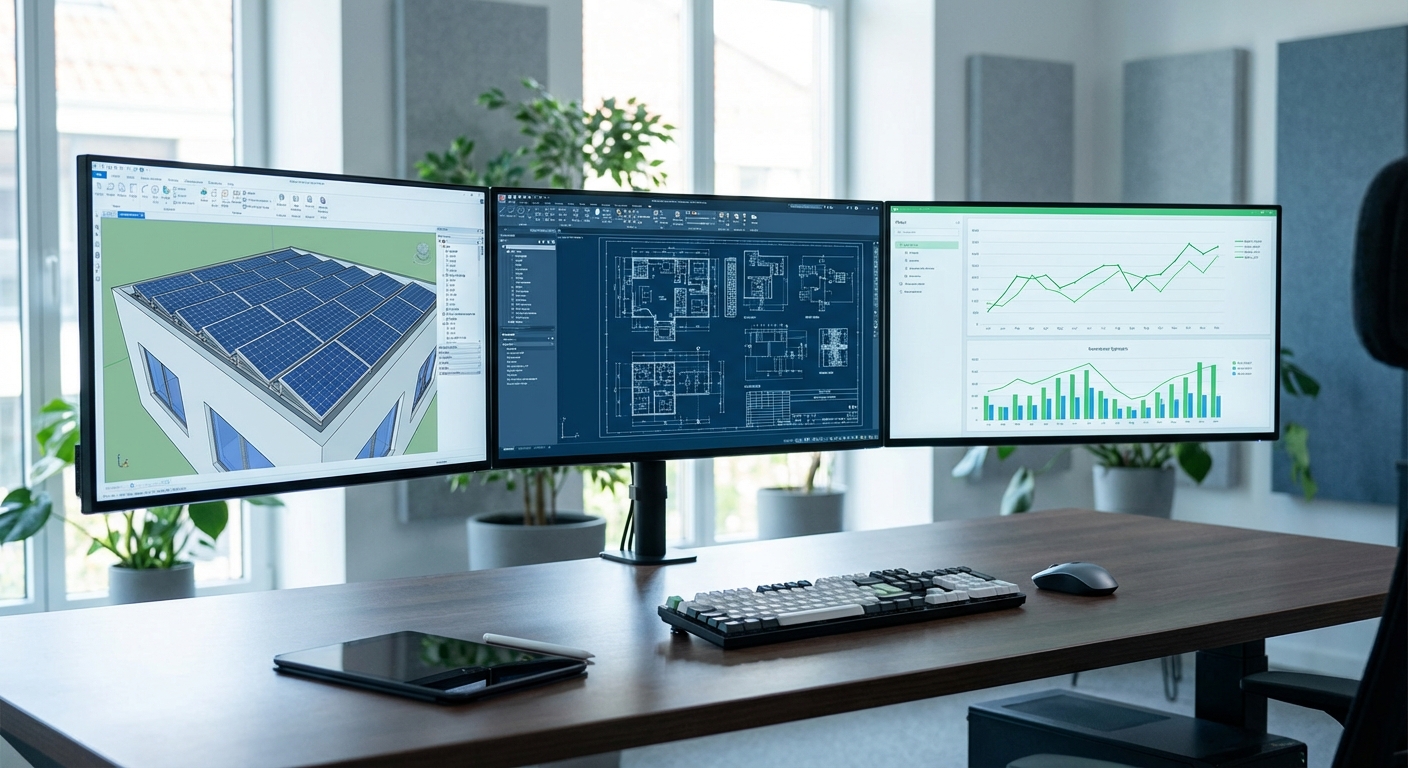
Essential software capabilities include:
Energy Modeling and Simulation: Tools like PVsyst, Helioscope, or Aurora Solar enable accurate energy production forecasting, shading analysis, and system optimization. These platforms model real-world conditions including weather patterns, equipment specifications, and site-specific factors to predict system performance.
CAD and Drafting Software: Professional-grade AutoCAD or similar platforms are necessary for creating accurate construction drawings, electrical schematics, and site plans. The design partner should produce drawings compatible with your installation team’s workflows and meeting local permit authority requirements.
Structural Analysis Tools: Specialized software for wind load calculations, snow load analysis, and structural engineering ensures designs meet safety requirements and building codes. This is particularly critical for rooftop installations where structural capacity varies significantly.
Electrical Design Software: Tools for voltage drop calculations, wire sizing, conduit routing, and protection device coordination ensure electrical designs meet National Electrical Code requirements and utility interconnection standards.
Verify software compatibility with your existing systems. Can they export files in formats your team uses? Do their energy models integrate with your proposal software? Seamless data exchange eliminates manual re-entry and reduces errors.
Ask about their approach to design software India market specifically. Do they have tools configured for Indian building codes, regional weather data, and local utility requirements? Experience with India-specific design considerations ensures compliance with local standards.
Beyond standard software, inquire about proprietary tools or processes they’ve developed. Many leading firms create custom calculation spreadsheets, automated checking tools, or specialized workflows that improve efficiency and accuracy. These innovations often indicate a commitment to continuous improvement and technical excellence.
5. Examine Portfolio and Project Verification
A design partner’s portfolio provides concrete evidence of their capabilities, experience, and track record. However, don’t accept portfolio claims at face value. Implement a verification process to ensure the projects they showcase represent genuine completed work.
Request detailed information about their project history including:
- Total megawatt capacity designed as an indicator of experience scale
- Number of completed projects across different categories
- Geographic distribution showing regional expertise
- Project types including residential, commercial, industrial, and ground mount
- Client diversity demonstrating ability to serve different EPC company sizes and specializations
Companies with substantial portfolios like Heaven Designs, which has completed 628+ MW of design work for 752+ clients across multiple countries, demonstrate proven capacity and reliability at scale. These numbers indicate they’ve successfully navigated diverse project requirements and maintained client relationships over time.
Don’t just review the numbers—examine actual project examples. Request sample deliverables from projects similar to yours. Review the completeness of documentation, quality of drawings, and thoroughness of technical specifications. This hands-on evaluation reveals more than marketing materials ever will.
Verify portfolio claims by requesting client references. Contact 3 to 5 current or recent clients and ask specific questions about their experience:
- Did the design partner deliver projects on time and within budget?
- How did they handle revisions or unexpected challenges?
- What was the quality of communication and project management?
- Would they use this design partner again for future projects?
- What could the design partner improve?
Look for experience relevant to your target markets. If you focus on rooftop solar India installations, verify they have substantial experience with Indian building codes, local permit processes, and region-specific structural considerations. For ground mount projects, confirm they understand soil conditions, foundation design, and environmental considerations specific to your project locations.
6. Understand Pricing Transparency and Cost Structure
Pricing for solar design services varies significantly based on project complexity, scope, turnaround time, and the provider’s expertise level. Understanding the cost structure and ensuring pricing transparency helps you budget accurately and avoid unexpected expenses that erode project margins.
Common pricing models in the industry include:
Per-Watt Pricing: Many design partners charge based on system capacity, typically ranging from $0.02 to $0.08 per watt depending on project complexity and services included. This model provides predictable costs that scale with project size.
Fixed Project Pricing: Flat fees for specific deliverables work well for standardized services like residential permit design packages. This approach offers budget certainty but may not accommodate scope changes easily.
Hourly Rates: Time-based billing suits custom engineering work or consulting services where scope is difficult to define upfront. Rates typically range from $75 to $200 per hour based on engineer expertise and location.
Tiered Service Packages: Some providers offer basic, standard, and premium service levels with different deliverables and turnaround times at corresponding price points.
Request detailed pricing breakdowns showing what’s included at each level. Watch for hidden costs that might include:
- Revision fees beyond the included rounds
- Rush delivery surcharges
- Charges for additional file formats or deliverable copies
- Fees for client calls or project meetings
- Costs for site visit coordination or travel
While engineering cost is an important consideration, the lowest price rarely delivers the best value. A design partner charging premium rates but delivering error-free designs that achieve first-time permit approval saves money compared to a budget provider whose work requires multiple revision cycles and causes installation delays.
Calculate the total cost of ownership including your internal review time, revision requests, and potential installation issues. A slightly higher upfront design investment that eliminates downstream problems typically provides superior ROI.
For transparency on how design investments impact overall project economics, consider how project duration affects budget allocation across all phases of solar development.
7. Test Communication Standards and Responsiveness
Effective communication forms the backbone of successful partnerships. A technically skilled design partner who communicates poorly creates frustration, delays, and misunderstandings that undermine project success. Evaluate communication capabilities as rigorously as technical qualifications.
During your initial interactions, assess responsiveness. How quickly do they reply to inquiries? Do they provide substantive answers or vague responses? Are they proactive in asking clarifying questions to understand your requirements? These early signals predict how communication will function during actual projects.
Clarify communication channels and protocols:
- Primary contact person: Who will be your main point of contact?
- Backup contacts: Who handles communication if the primary contact is unavailable?
- Communication platforms: Email, phone, video calls, project management software?
- Response time commitments: What’s the expected response time for routine questions versus urgent issues?
- Status update frequency: How often will you receive project progress updates?
For EPC companies operating across India and international markets, language capabilities matter. Verify that your design partner has team members fluent in your preferred business language. Miscommunication due to language barriers causes costly errors and project delays.
Discuss project management and reporting systems. Professional design partners use project management platforms that provide real-time visibility into project status, milestone completion, and deliverable readiness. Access to a client portal where you can track all active projects, download completed work, and submit new requests streamlines collaboration.
Ask about their escalation process for issues or concerns. How do they handle disagreements about design approaches? What’s the process if you’re unsatisfied with deliverables? Clear escalation paths prevent small issues from becoming major conflicts.
Time zone considerations affect communication for international partnerships. If your design partner operates in a different time zone, understand how they manage real-time communication needs. Do they have team members available during your business hours? What’s the typical turnaround time for questions submitted outside their working hours?
8. Evaluate Comprehensive Service Offerings
The breadth of services your design partner offers impacts your operational efficiency and the consistency of your project deliverables. Working with a single provider for multiple design and engineering needs simplifies vendor management, ensures design consistency, and often provides better value than coordinating multiple specialized contractors.
Comprehensive solar design services should include:
Preliminary Design and Feasibility: Early-stage services like solar 3D pre-design help you evaluate project viability before committing to detailed engineering. These assessments identify potential challenges, estimate system capacity, and provide preliminary cost estimates that inform your proposals and client discussions.
For projects requiring thorough upfront analysis, partnering with firms experienced in solar feasibility studies in India ensures you have accurate data for decision-making before investing in full design development.
Detailed Engineering Design: Complete construction documentation including electrical single-line diagrams, three-line diagrams, equipment layouts, cable schedules, conduit routing, and installation details. For megawatt-scale projects, this includes comprehensive drawing sets that guide every aspect of installation.
Permit Design Services: Permit-ready documentation tailored to local authority requirements including site plans, structural calculations, electrical plans, and compliance documentation. Experienced permit design specialists understand jurisdiction-specific requirements and format preferences that expedite approval.
Structural Engineering: Civil and structural engineering services including foundation design, mounting system specifications, wind and snow load calculations, and structural adequacy assessments for rooftop installations. This specialized expertise is critical for project safety and code compliance.
Site Survey Services: Professional site survey India capabilities including topographic surveys, structural assessments, shading analysis, and site condition documentation. Accurate site data forms the foundation for reliable design work.
Project Management Consultancy: For large-scale developments, PMC services India provide ongoing engineering support throughout construction including design clarifications, RFI responses, submittal reviews, and quality assurance oversight.
A design partner offering this full spectrum of services, like Heaven Designs with their comprehensive portfolio from pre-design through PMC services, provides continuity throughout the project lifecycle. You work with engineers already familiar with your project rather than onboarding new consultants at each phase.
Even if you don’t need all services immediately, having access to expanded capabilities supports business growth. As you take on larger or more complex projects, your existing design partner can scale services to match your evolving needs.
9. Check Scalability and Capacity for Growth
Your design partner should grow with your business. As your EPC company expands into new markets, takes on larger projects, or experiences seasonal demand fluctuations, your design partner must scale capacity to match your needs without compromising quality or timelines.
Assess their ability to handle multiple concurrent projects. Ask about their current workload and capacity utilization. A firm operating at 95% capacity may struggle to accommodate your projects during busy periods. Look for partners with sufficient buffer capacity or the ability to rapidly scale resources when needed.
Discuss their approach to peak season management. Solar EPC companies often experience seasonal demand variations. Your design partner should have strategies for handling increased volume during busy periods, whether through flexible staffing, overtime capacity, or resource allocation systems that prioritize client needs.
Inquire about their growth trajectory and future plans. A design partner investing in team expansion, new software capabilities, and service development demonstrates commitment to long-term client relationships. Conversely, a stagnant firm may lack the vision and resources to support your growth.
Evaluate flexibility for urgent or rush projects. While you shouldn’t abuse expedited services, having the option for critical situations provides valuable insurance. Understand their capacity to accommodate rush requests, associated costs, and minimum notice requirements.
Consider long-term partnership potential beyond transactional project relationships. The best design partner relationships evolve into strategic partnerships where the design firm understands your business model, client preferences, and competitive positioning. This familiarity enables them to provide increasingly tailored services that align with your specific needs.
Ask about account management for high-volume clients. Will you have a dedicated account manager? Do they offer preferential pricing or priority scheduling for committed volume? These partnership benefits reward loyalty and ensure your projects receive appropriate attention.
10. Assess Regional and Local Market Knowledge
Solar project requirements vary significantly across regions due to different building codes, utility interconnection standards, environmental conditions, and regulatory frameworks. A design partner with deep regional expertise navigates these variations efficiently, producing designs that meet local requirements without extensive revisions.
For EPC companies operating in India, regional knowledge is particularly valuable. Building codes, structural requirements, and permit processes differ between states and even between municipalities within the same state. A design partner experienced in solar EPC India projects understands these nuances and designs accordingly.
Verify their experience with specific regional challenges:
Structural and Environmental Conditions: Different regions face varying wind zones, seismic zones, snow load requirements, and soil conditions. Designs must account for these factors to ensure structural integrity and long-term performance. For example, ground mount projects in India require region-specific design approaches based on local conditions.
Regulatory and Permit Requirements: Each jurisdiction has unique permit application processes, required documentation, and approval timelines. A design partner familiar with local authority expectations produces permit packages that achieve faster approval with fewer revision requests.
Utility Interconnection Standards: Utility companies have different technical requirements for interconnection applications, protection schemes, and metering configurations. Regional expertise ensures electrical designs meet utility specifications from the initial submission.
Local Installation Practices: Understanding regional installation methods, available materials, and contractor capabilities allows designers to create practical, buildable designs rather than theoretical solutions that prove difficult to execute in the field.
Ask about their presence or network in your target markets. Do they have local engineers familiar with regional requirements? Have they completed projects in the specific states or regions where you operate? Request examples of permitted projects in your target jurisdictions as proof of regional expertise.
For international EPC companies serving multiple countries, verify the design partner has experience with international building codes and standards. Designs for projects outside India may need to comply with IBC, Eurocode, or other international standards depending on project location.
11. Review Data Security and Intellectual Property Protection
When you share project information with a design partner, you’re entrusting them with sensitive data including site details, client information, pricing, and proprietary design approaches. Robust data security and clear intellectual property agreements protect your business interests and client confidentiality.
Discuss their data security protocols and infrastructure:
- Data storage security: How and where is project data stored? Is it encrypted?
- Access controls: Who has access to your project files? How is access managed and monitored?
- Backup systems: What redundancy exists to prevent data loss?
- Cybersecurity measures: What protections exist against unauthorized access or data breaches?
Request information about their confidentiality policies and willingness to sign non-disclosure agreements. A professional design partner should readily agree to NDAs protecting your client information, project details, and business practices.
Clarify intellectual property ownership for design deliverables. Typically, you should receive full ownership of all design documents, calculations, and drawings upon payment. Verify this is explicitly stated in service agreements to avoid disputes about usage rights or restrictions.
Discuss their policies regarding client information protection. Will they use your projects in their marketing materials or portfolio? If so, do they request permission first? Can you require anonymity for sensitive projects? Clear agreements prevent uncomfortable situations where your proprietary projects appear in competitor-facing marketing.
For EPC companies working on government projects or installations with security considerations, verify the design partner can accommodate special confidentiality requirements. Some projects may require additional security clearances, restricted information handling, or enhanced data protection measures.
Ask about their employee confidentiality agreements. Do all engineers and staff sign confidentiality agreements preventing them from sharing client information? What happens to project data when employees leave the company?
12. Identify Critical Red Flags When Choosing a Design Partner

Recognizing warning signs early in the evaluation process saves you from costly mistakes and problematic partnerships. Watch for these critical red flags that indicate a design partner may not meet your needs or could create significant problems:
Unrealistic Promises and Guarantees: Be skeptical of providers promising impossibly fast turnaround times, guaranteed permit approval, or results that seem too good to be true. Professional engineers understand the complexities and variables involved in solar design and make realistic commitments rather than overpromising.
Lack of Verifiable Credentials: If a potential partner can’t provide professional engineering licenses, project references, or portfolio verification, proceed with extreme caution. Legitimate firms readily share credentials and welcome due diligence.
Poor Communication or Responsiveness: If communication is difficult during the sales process, it will only worsen during actual projects. Slow responses, vague answers, or difficulty reaching decision-makers indicate organizational problems that will frustrate you throughout the partnership.
No Quality Assurance Process: Firms that can’t articulate their QA methodology or claim they don’t need formal review processes because their engineers “don’t make mistakes” lack the professional rigor required for reliable design work.
Resistance to Transparency: Reluctance to share pricing details, provide sample deliverables, or discuss their processes suggests they’re hiding something. Professional design partners operate transparently and welcome informed client evaluation.
Extremely Low Pricing: While cost matters, pricing significantly below market rates raises questions about quality, engineer qualifications, or business sustainability. Remember that design errors cost far more to fix than the savings from choosing the cheapest provider.
Limited or Outdated Portfolio: A sparse portfolio or one showing only old projects suggests the firm may be inexperienced, struggling to retain clients, or not actively engaged in current solar design work.
No Formal Contracts or Agreements: Professional relationships require clear written agreements defining scope, deliverables, timelines, pricing, and terms. Firms operating on handshake agreements or verbal commitments create unnecessary risk.
Unwillingness to Provide References: If a design partner can’t or won’t provide client references, question why. Satisfied clients are typically happy to provide references, so reluctance suggests potential problems.
Lack of Insurance Coverage: Professional liability insurance (errors and omissions coverage) protects both parties if design errors cause problems. Firms without adequate insurance expose you to unnecessary risk.
High Staff Turnover: Frequent engineer turnover disrupts project continuity and suggests organizational problems. Ask about staff retention rates and average engineer tenure.
Scope Creep in Pricing: Watch for firms that quote low initial prices but then add numerous charges for standard services that should be included. This practice indicates either poor estimating or intentional low-balling to win business.
Making Your Final Decision: A Practical Evaluation Framework
After evaluating potential design partners across all 12 criteria, you need a systematic approach to make your final selection. A weighted scoring framework helps you objectively compare options and make a decision aligned with your priorities.
Create a scoring matrix assigning weights to each evaluation criterion based on your specific needs. For example:
- Technical expertise and qualifications: 20%
- Quality assurance processes: 15%
- Turnaround time and reliability: 15%
- Portfolio and track record: 10%
- Communication and responsiveness: 10%
- Pricing and value: 10%
- Software capabilities: 5%
- Service breadth: 5%
- Regional expertise: 5%
- Scalability: 5%
Score each candidate on a 1-10 scale for each criterion, then calculate weighted totals. This quantitative approach reduces bias and ensures you’re evaluating all factors systematically rather than making decisions based on a single impressive characteristic or personal rapport.
Before committing to a long-term partnership, consider conducting a pilot project or trial engagement. Start with a smaller, less critical project to evaluate the design partner’s performance firsthand. This low-risk approach lets you assess quality, communication, and reliability before entrusting them with major projects.
During the trial period, evaluate:
- Did they deliver on time as promised?
- Was the quality of deliverables acceptable?
- How did they handle questions and revision requests?
- Were there any unexpected issues or surprises?
- How did their work perform during permitting and installation?
Think beyond transactional relationships toward building long-term partnerships. The best design partner relationships develop over time as the design firm learns your preferences, understands your business model, and aligns their processes with your needs. This familiarity creates efficiency gains and quality improvements that benefit both parties.
Discuss partnership development opportunities including:
- Volume commitments in exchange for preferential pricing or priority service
- Dedicated account management for streamlined communication
- Custom processes or templates tailored to your specific requirements
- Collaborative improvement initiatives to enhance quality and efficiency
- Regular business reviews to assess performance and identify opportunities
Once you’ve selected your design partner, establish clear onboarding processes. Provide comprehensive information about your business, typical project types, client expectations, and quality standards. The more context you provide upfront, the better they can tailor their services to your needs.
Set up regular communication cadences including project kickoff calls, milestone check-ins, and periodic business reviews. These touchpoints maintain alignment, address issues proactively, and strengthen the partnership over time.
Document lessons learned from early projects and use them to refine processes. What worked well? What could be improved? Collaborative problem-solving builds stronger partnerships and continuously improves outcomes.
Take the Next Step Toward EPC Success
Choosing the right design partner is a strategic decision that impacts every aspect of your solar EPC business. The 12 criteria outlined in this guide provide a comprehensive framework for evaluating potential partners and making an informed selection that supports your growth and project success.
Remember that the cheapest option rarely delivers the best value. Invest in a design partner with proven expertise, robust processes, and the capacity to scale with your business. The right partnership eliminates design-related delays, reduces installation problems, and enables you to confidently take on more complex and profitable projects.
As you evaluate options, prioritize firms with substantial track records, transparent operations, and commitment to quality. Companies like Heaven Designs, with over 50 engineers, 628+ MW of completed design work, and 752+ satisfied clients across multiple countries, demonstrate the scale, expertise, and reliability that successful EPC companies need in a design partner.
Whether you’re outsourcing design work for the first time or reconsidering your current partnerships, applying these selection criteria ensures you make a decision that strengthens your competitive position and sets your projects up for success. The right design partner becomes a strategic asset that enables you to deliver superior results to your clients while optimizing your internal resources and maximizing profitability.
Ready to find a design partner that meets these rigorous standards? Heaven Designs offers comprehensive solar engineering design services backed by a team of 50+ skilled engineers, proven processes, and a track record of delivering accurate, cost-effective designs for solar EPC companies globally. From preliminary feasibility studies to detailed engineering design, permit packages, structural engineering, and PMC services, we provide the full spectrum of design support your EPC business needs. Get a Quick Proposal Now! or reach out directly at +91 90811 00297 or service@heavendesigns.in to discuss how we can support your next solar project.
This blog post was written using thestacc.com