A Detailed Project Report (DPR) for MNRE submission is the single most consequential document an Indian solar developer prepares. It determines whether a project receives scheme approval, subsidy disbursement, and connectivity priority — or gets returned for corrections that cost 3–6 months. Most DPRs submitted by mid-market EPCs are returned not because the project is unviable, but because the document does not follow the MNRE’s prescribed format, misses mandatory sections, or uses data from unacceptable sources. This tutorial covers the complete DPR template, section by section, with the specific data requirements and common failure modes for each section.
Direct answer. An MNRE-compliant solar DPR must contain: (1) project overview and promoter details, (2) site feasibility study with GPS coordinates and land status, (3) solar resource assessment using MNRE-accepted data sources, (4) technical design section including PVsyst simulation with P50/P90 yield, equipment BOQ with BIS/ALMM compliance evidence, SLD, and structural assessment, (5) financial analysis with IRR, DSCR, and tariff calculations, (6) grid connectivity plan with STU/DISCOM approval letters, (7) environmental clearance status, and (8) implementation schedule. Missing or inadequate data in any of these sections triggers a return. The DPR template prescribed by MNRE differs by scheme — PM-KUSUM, SECI utility-scale, and rooftop subsidy have different format requirements.
This guide is written for Suresh — the India utility-scale developer — and covers the format, data sources, and quality checks needed to prepare a DPR that passes MNRE review in 2026.
Why DPRs Get Returned — The Most Common Failure Modes
Before diving into the template, understanding why DPRs are returned saves time. According to Mercom India’s 2024 project approval analysis, the top five DPR rejection reasons are:
43%
Inadequate solar resource data
Mercom India DPR analysis, 2024
31%
Missing connectivity approvals
Mercom India DPR analysis, 2024
28%
Non-ALMM equipment specification
Mercom India DPR analysis, 2024
The fourth and fifth reasons — incorrect financial model format and incomplete land documentation — each account for approximately 20% of returns. The good news: all five are entirely preventable with the right template and pre-submission checklist.
Section 1 — Project Overview and Promoter Details
This is the DPR cover section. MNRE reviewers use this section to verify eligibility before reading the technical content. It must contain:
1.1 Project Identification
- Project name, location (district, state), and GPS coordinates of the site boundary (centre point + corner points)
- Installed capacity (DC and AC, in kW or MW)
- Technology type (ground-mount / rooftop / floating) and module technology (mono-PERC, TOPCon, bifacial)
- Proposed commissioning date
- Applicable MNRE scheme (PM-KUSUM Component A/B/C, SECI tender reference, rooftop subsidy)
1.2 Promoter / Applicant Details
- Legal entity name, PAN, GST registration
- Authorised signatory details
- Track record of previous solar projects (with commissioning certificates as annexures)
- Financial net worth certification (for utility-scale — usually CA-certified statement)
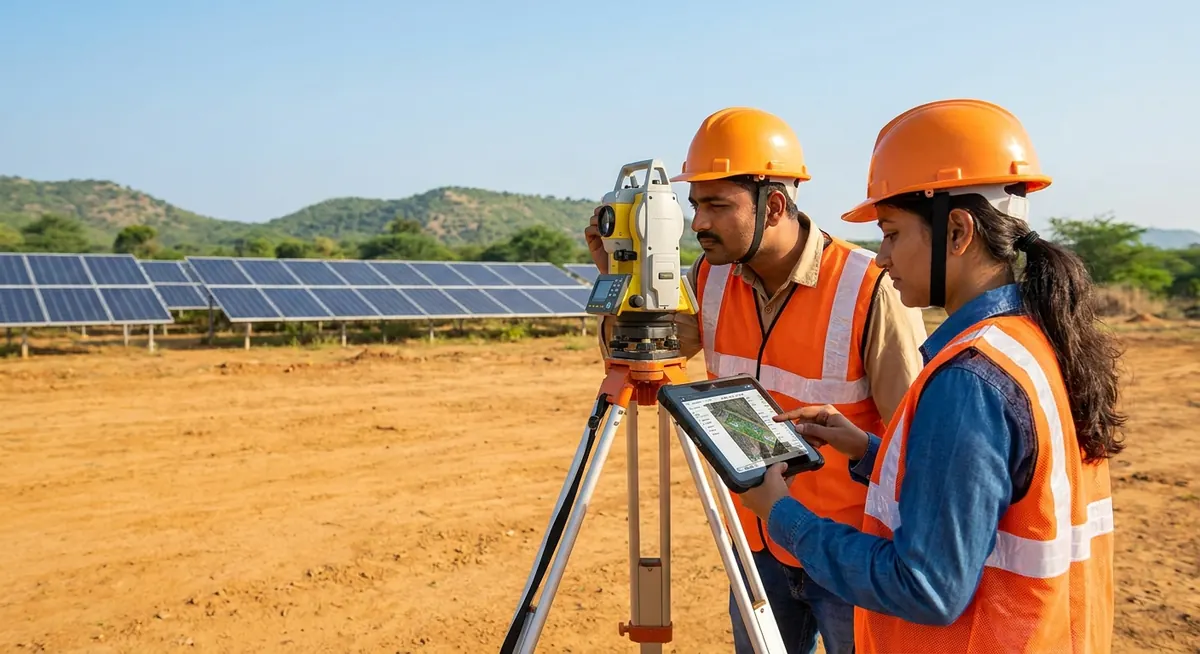
Field tip. Many DPRs are returned because the GPS coordinates are entered as decimal degrees without specifying WGS84 datum, or the coordinates describe the project address rather than the actual array footprint. Use Google Earth Pro to generate the corner coordinates of the array footprint in WGS84 decimal degrees and include a satellite image excerpt with the coordinates marked.
Section 2 — Site Feasibility Study
This section must establish that the site is technically and legally suitable for solar development. Required elements:
2.1 Land Status
- Land ownership or lease documentation (registry deed, lease agreement)
- Land use classification (agricultural / industrial / wasteland / government)
- If agricultural land: No Objection Certificate (NOC) from the state revenue department or an agricultural land diversion order
- Survey / khasra numbers for all parcels in the project footprint
2.2 Site Technical Assessment
- Terrain assessment: slope analysis, drainage, flooding risk
- Soil bearing capacity (for ground-mount) or structural roof assessment (for rooftop)
- Shadow-free area calculation showing the net usable area vs total site area
- Access road and logistics assessment
2.3 Grid Proximity and Evacuation
- Distance to the nearest available grid injection point (with voltage level)
- Existing capacity at the proposed injection point (STU/DISCOM capacity letter — mandatory annexure)
- Proposed evacuation line route (map with corridor, distance, and right-of-way status)
This section directly connects to the solar feasibility study process. A weak site feasibility section is one of the most common DPR rejection triggers because connectivity approval letters are frequently missing.
Section 3 — Solar Resource Assessment
The solar resource section is the most technically scrutinised part of the DPR. MNRE reviewers — and any independent engineer reviewing the DPR — verify three things: data source, methodology, and output plausibility.
Accepted Data Sources (by MNRE):
- Solargis Prospect or Solargis Identify — acceptable for all project sizes
- Meteonorm 8.x or later — acceptable for projects above 1 MW
- NASA POWER — acceptable only for pre-feasibility (not for final DPR)
- On-site irradiance measurement (minimum 12 months) — highest credibility, required for projects above 50 MW submitting to IREDA/PFC
Required Outputs:
- Global Horizontal Irradiance (GHI) — annual and monthly
- Direct Normal Irradiance (DNI) — for tracker and bifacial projects
- Diffuse Horizontal Irradiance (DHI)
- Temperature data (ambient, daily max/min, monthly averages)
- Wind speed and direction (for Faiman thermal model in PVsyst)
- Soiling assessment (monthly soiling loss rate derived from site data or validated regional database)
Watch out. Using NASA POWER free data as the meteo source in the final DPR PVsyst simulation is the single most common technical rejection cause for utility-scale DPRs. MNRE specifically requires Solargis or Meteonorm for projects above 5 MW. Submitting a NASA POWER-based PVsyst report will result in return within the first technical review.
Section 4 — Technical Design
This is the largest section and requires the most engineering effort. For MNRE submission, the technical design section must include:
4.1 PVsyst Energy Yield Simulation
- PVsyst simulation report (full output, not summary): P50 and P90 annual yield, monthly generation profile, loss diagram, horizon file, 25-year degradation-adjusted yield table
- Simulation input summary table: module model, inverter model, tilt, azimuth, pitch, GCR, soiling loss profile, albedo, meteo data source, PVsyst version
- P50/P90 analysis with uncertainty quantification methodology
4.2 Equipment Bill of Quantities (BOQ) The BOQ must include:
- Solar PV modules: make, model, wattage, quantity, with IS 16221 BIS BRN and ALMM Part I listing reference
- Inverters: make, model, kW rating, quantity, with IS 16221 Part III BIS BRN and ALMM Part III listing reference
- Mounting structure: type (fixed tilt / tracker), material (hot-dip galvanised steel), foundation type
- Cables: DC (class 2 solar cable, rated 1500V DC), AC cables, earthing cable
- Protection equipment: SPDs, fuses, combiner boxes, RMU
- Metering: Class 0.2 energy meter per CEA Connectivity Regulations 2019
4.3 Electrical Drawings The DPR must include a preliminary single-line diagram (SLD) showing:
- DC stringing layout (number of strings per MPPT)
- Inverter configuration (string vs central)
- Step-up transformer
- Grid interconnection to injection point
- Metering and protection scheme
4.4 Civil and Structural Assessment
- Structural foundation design basis (IS 875 Part 3 wind load calculation)
- Soil investigation report (for ground-mount above 1 MW)
- Mounting structure design basis (material grade, corrosion protection specification)
Section 5 — Financial Analysis
The financial section must follow MNRE’s prescribed financial model format for the applicable scheme. Key elements:
5.1 Project Cost
| Component | Unit | Quantity | Rate | Amount (₹ Cr) |
|---|---|---|---|---|
| Solar modules | ₹/Wp | Wp | Mkt rate | X |
| Inverters | ₹/kW | kW | Mkt rate | X |
| Mounting structure | ₹/MW | MW | Design basis | X |
| Civil works | Lump sum | — | Site basis | X |
| Electrical and HV | ₹/MW | MW | Design basis | X |
| SCADA and monitoring | Lump sum | — | Standard | X |
| Land acquisition/lease | Per acre per year | Acres | Market rate | X |
| Project development (incl. DPR) | % of EPC | — | 3–5% | X |
| Total EPC cost | ₹/MW | MW | — | X |
5.2 Financial Ratios
For IREDA-financed projects (see IREDA financing criteria), the DPR must demonstrate:
- Project IRR (equity) ≥ 14% (IREDA minimum)
- Debt Service Coverage Ratio (DSCR) ≥ 1.20 in each year
- Loan tenor ≤ 18 years
- Debt:equity ratio ≤ 75:25
For PFC (Power Finance Corporation) financing, similar ratios apply with slight variations in DSCR threshold (≥ 1.15 for some schemes).
5.3 Tariff Calculations
- For SECI auctions: demonstrate that the quoted tariff is consistent with the financial model at the bid capacity factor and O&M escalation assumptions
- For PM-KUSUM: demonstrate compliance with the state-notified tariff ceiling
Section 6 — Grid Connectivity Plan
This section must include:
- Copy of the Preliminary Connectivity Application (PCA) acknowledgment from the STU/DISCOM
- Proposed injection point and voltage level
- Evacuation line route map (Google Earth KMZ file or georeferenced PDF)
- Estimated evacuation infrastructure cost (transmission line + substation bay)
- Timeline for evacuation infrastructure commissioning vs project COD
If the connectivity application has progressed to an interconnection study, include the study results and any STU capacity upgrade requirements.
Section 7 — Environmental Clearance
- Environmental Impact Assessment (EIA) status for the project category (Category A, B1, or B2 under EIA Notification 2006)
- For most solar projects below 25 MW: self-certification that project is exempt from EIA requirement (applicable categories vary by state)
- For projects above 25 MW: EIA report summary and MoEF&CC clearance status
- Forest land diversion status (if applicable)
- Water body clearance (for floating solar — state irrigation or water resources department NOC)
The DPR-Ready Framework — The 8-Section MNRE Submission Checklist
The DPR-Ready Framework is a pre-submission quality check that validates all eight sections before the DPR leaves your office.
Section 1 Check: GPS coordinates verified in Google Earth; promoter documents CA-certified
Verify that the GPS coordinates of the project footprint match the land documents. Do not use Google Maps address — use surveyed corner coordinates.
Section 2 Check: Land documents registered; NOC obtained; STU capacity letter dated within 6 months
STU capacity letters older than 6 months are treated as stale by MNRE reviewers. Obtain a fresh letter within 2 months of DPR submission.
Section 3 Check: Meteo data from Solargis/Meteonorm; soiling profile site-specific; TMY based on ≥ 10 years
Attach the Solargis data certificate or Meteonorm data summary as an annexure to the DPR. This is a commonly missing document that triggers a query.
Section 4 Check: PVsyst full report attached; all equipment BIS BRN and ALMM verified; SLD complete to metering point
The SLD must show metering and protection elements, not just the DC-to-inverter layout. An incomplete SLD causes the entire technical section to be returned.
Section 8 — Implementation Schedule
The implementation schedule must show realistic milestones from DPR approval to COD:
| Milestone | Months from DPR Approval |
|---|---|
| Land acquisition completion | 0–3 months |
| Environmental clearance (if required) | 0–6 months |
| Connectivity agreement signing | 3–9 months |
| EPC tender award | 4–8 months |
| Equipment procurement (modules, inverters) | 5–10 months |
| Civil works commencement | 6–10 months |
| Electrical installation | 8–14 months |
| Grid connection and commissioning | 12–18 months |
| COD declaration | 13–20 months |
Need a DPR-ready PVsyst simulation and BOQ?
Heaven Designs delivers MNRE-format DPR technical sections: PVsyst simulation with Solargis data, ALMM-verified BOQ, SLD, and structural assessment — all in one package.
Get the sample pack →How Heaven Designs Helps
Preparing an MNRE-compliant DPR requires coordinating 8 sections of technical, legal, financial, and environmental documentation — and getting any one section wrong causes a 3–6 month delay. Heaven Designs delivers the technical engineering sections of the DPR (PVsyst simulation, BOQ, SLD, structural assessment) in MNRE-format, ready for the promoter’s legal and financial team to integrate.
- Solar Ground Mount Design — PVsyst simulation, BOQ, SLD, structural assessment for DPR Section 4.
- Site Survey & Land Feasibility — site technical assessment for DPR Section 2.
- Electrical CEIG Drawings — CEIG-format SLD for grid connectivity and technical design sections.
- MW-Scale PMC — DPR preparation coordination, MNRE submission management, IE review preparation.
- Download a sample deliverable — see a DPR-format PVsyst simulation report and BOQ.
Contact us to start your DPR preparation. We deliver the technical package within 10–15 business days.
FAQ
What is the difference between a DPR for PM-KUSUM and a DPR for a SECI tender?
PM-KUSUM DPRs typically follow the scheme-specific format prescribed by the respective state nodal agency (e.g., RRECL for Rajasthan, MNRE for central component). The financial analysis focuses on the PM-KUSUM tariff ceiling and subsidy component. SECI DPRs follow the SECI tender RFP format, with the financial analysis focused on the bid tariff and the technical specifications aligned with SECI’s quality requirements. Both require the same core technical sections (PVsyst, BOQ, SLD), but the format and financial model differ.
How long does it take for MNRE to approve a DPR once submitted?
MNRE’s prescribed timeline is 30–60 days for scheme approval, but actual timelines depend on the scheme and the DPR quality. A complete, first-round-pass DPR typically receives approval within 45–90 days. DPRs with missing connectivity documentation or inadequate solar resource data can take 6–12 months if corrections require new connectivity applications or new meteo data procurement.
What financial model format does MNRE require for IREDA-financed projects?
IREDA requires the financial model in a specific Excel format that it provides to applicants. The model must include: project cost (equipment-wise), financing structure (debt:equity, loan tenor, interest rate), revenue projections (generation × tariff, year-by-year for the loan tenor), O&M cost escalation (typically 5% per year), and financial ratios (IRR, DSCR, NPV). The financial model must be submitted as the original Excel file (not a PDF) to allow IREDA’s financial team to verify formulas and assumptions.
Can I submit a DPR without all land documents if some land acquisition is pending?
No. MNRE requires clear land status at the time of DPR submission. For projects on government-leased land, the lease agreement or allotment letter must be submitted. For projects on private land, the registered sale deed or registered lease agreement is required. Projects with partial land acquisition pending are typically not eligible for scheme approval until 100% of the required land is secured.
What PVsyst inputs does MNRE specifically check in the technical review?
The most commonly checked PVsyst inputs are: meteo data source (must be Solargis or Meteonorm for projects above 5 MW), soiling loss assumptions (checked against regional norms — values significantly below 2%/year for dry-land sites trigger a query), meter losses (must be included; their omission is a common error), and module model (must be ALMM-listed). The 25-year degradation table is also checked to ensure Year 1 degradation is applied correctly and the table matches the module warranty document.
Does the DPR need to be prepared by a licensed engineer or certified agency?
For projects above 1 MW, the technical sections of the DPR (specifically the PVsyst simulation, structural assessment, and SLD) should be prepared or reviewed by a licensed electrical/solar engineer. MNRE does not mandate specific professional credentials for DPR preparation, but IREDA and PFC (as lenders) require that the Independent Engineer (IE) reviewing the DPR is a CRISIL, DNV, or Bureau Veritas-empanelled agency. The DPR technical sections prepared by Heaven Designs are engineered to meet IE review standards, not just MNRE format requirements.
What is the required PVsyst uncertainty analysis for P90 calculation in the DPR?
The P90 yield calculation requires a structured uncertainty analysis covering: meteo data uncertainty (Solargis: ±2% GHI; Meteonorm: ±3% GHI), PVsyst model accuracy uncertainty (typically ±1–2%), soiling uncertainty (±0.5–1.0%), and degradation uncertainty. The combined uncertainty (root sum of squares method) is applied to the P50 yield to derive P90. A Gaussian distribution is assumed, with P90 corresponding to 1.28 standard deviations below P50. According to IRENA’s renewable energy cost framework, meteo data quality is the primary driver of P90 uncertainty band width.