


Most solar EPC companies in India lose money on engineering before the first panel ever reaches the roof. Not because they lack skill, but because they price design costs as an afterthought. When a bid goes out with engineering bundled into a vague “project overhead” line, design margins quietly disappear, and by the time the project closes, the EPC has subsidized the client’s engineering work out of its own pocket.
This guide is for EPC companies that want to stop that pattern. Whether you’re bidding on a 50 kW rooftop solar project in Surat or a 5 MW ground-mount installation in Rajasthan, the principles for protecting your design margins are the same: map your costs accurately, apply the right markup strategy, and present engineering value in a way clients understand and accept.
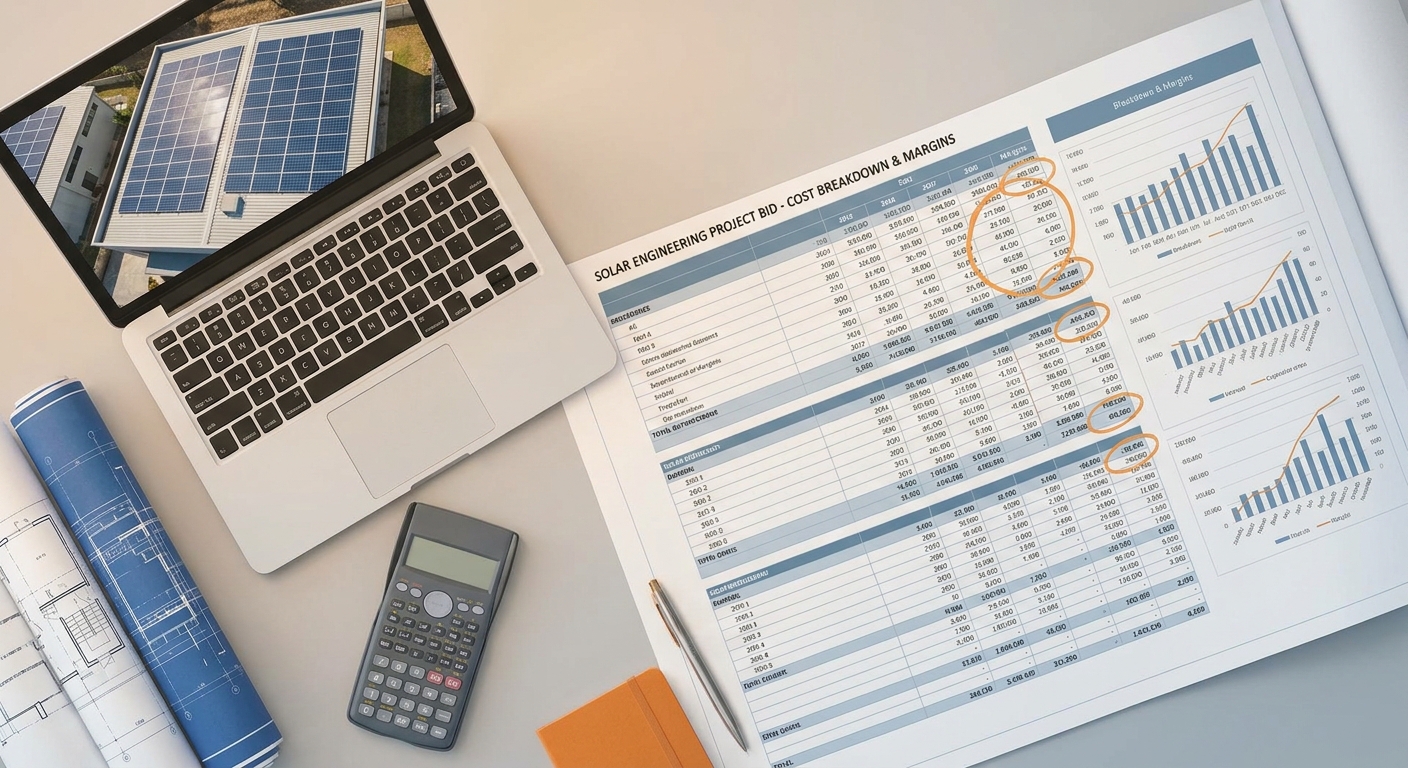
Why Design Margins Erode Before a Single Panel Is Installed
Here’s a scenario that plays out regularly across India’s solar EPC market. A company wins a competitive bid on a 2 MW commercial project. The panel and inverter costs are priced precisely. The installation labor is accounted for. But the engineering line item, covering site survey, detailed design, structural calculations, and permit documentation, was estimated loosely at 1.5% of project value because “that’s what we’ve always used.”
Three revision cycles later, the actual design cost is 2.8% of project value. The EPC absorbs the difference. That gap, roughly ₹4–6 lakh on a mid-size project, comes directly out of profit. Multiply that across six projects in a year, and you have a serious margin problem that no amount of procurement efficiency can fix.
The root cause is almost always the same: design costs are treated as invisible overhead rather than a billable, margin-generating service. In India’s competitive solar market in 2026, where EPCs are under constant pressure to sharpen bids, this habit is especially damaging. Clients compare quotes on panel cost per watt, not on engineering quality, so EPCs race to compress the one line item that actually protects the entire project.
Protecting your design margins starts with understanding exactly what engineering costs you’re carrying, and then building a pricing structure that reflects their true value.
1. Map Every Engineering Cost Before You Build Your Bid
The first step to protecting design margins is knowing what you’re actually spending on engineering. Most EPCs underestimate this because they only count the obvious costs: the design software license, the engineer’s salary, or the outsourced design fee. The real cost picture is wider.
Direct Engineering Costs to Include
- 3D pre-design and preliminary layout: The initial feasibility visualization that determines panel count, shading analysis, and system sizing before detailed work begins.
- Detailed engineering design: Single-line diagrams, layout drawings, string sizing, equipment schedules, and all documentation required for procurement and installation.
- Civil and structural engineering: Foundation design, mounting structure calculations, wind and seismic load analysis, especially critical for ground-mount and large rooftop projects.
- Permit design and documentation: State-specific compliance drawings, utility interconnection packages, and net metering applications. Permit requirements vary significantly across Indian states, which affects both time and cost.
- Site survey and land feasibility: Physical site assessment, shading surveys, soil testing coordination, and roof load verification for rooftop solar India projects.
Indirect Engineering Costs EPCs Routinely Miss
- Revision cycles: Every design change requested by the client, the utility, or the structural engineer costs time. Budget for at least two to three revision rounds on any project above 100 kW.
- Coordination time: The hours your project manager spends briefing the design team, reviewing drawings, and managing client feedback are engineering costs, even if they don’t appear on a design invoice.
- Rework from site conditions: When actual site conditions differ from initial assumptions, design rework is almost inevitable. A contingency of 10–15% on your engineering cost estimate is not excessive; it’s prudent.
- Software and tool costs: PVsyst licenses, AutoCAD subscriptions, and structural analysis tools are real costs that belong in your engineering cost register.
Build a design cost register for every project type you bid on. A residential rooftop project has a different cost profile than a 10 MW ground-mount installation. Using a single engineering cost estimate across all project types is one of the fastest ways to destroy design margins on complex projects. For a deeper look at how project duration affects your engineering budget, see our guide on Solar Design Timeline & Cost: How Project Duration Impacts Budget.
2. Choose the Right Markup Strategy for Design Costs
Once you know your true engineering costs, the next question is how much to mark them up. There is no single correct answer, but there are three main approaches, each with different implications for your design margins.
Cost-Plus Markup
The most straightforward approach: calculate your engineering cost and add a fixed percentage margin. A 20–35% markup on outsourced design fees is common among Indian EPCs for standard projects. Cost-plus works well when your cost estimates are accurate and the project scope is clearly defined. It breaks down when scope creep is likely or when the client has a history of requesting revisions, because your markup is fixed while your costs keep growing.
Value-Based Pricing for Engineering
A more sophisticated approach is to price engineering based on the value it delivers, not the hours it takes. A well-executed feasibility study that prevents a ₹50 lakh site acquisition mistake is worth far more than the ₹1, 2 lakh it costs to produce. When you frame engineering this way, both internally and in client conversations, you create room for healthier design margins without needing to justify every hour.
Value-based pricing works especially well for structural engineering and permit design, where the cost of getting it wrong (failed inspections, structural failures, delayed interconnections) is orders of magnitude higher than the design fee itself.
Percentage-of-Project vs. Fixed-Fee Design Line Items
Many EPCs default to pricing engineering as a percentage of total project value, typically 2, 4% for standard projects. This is simple but imprecise. A 2 MW project in a structurally complex location (high wind zone, poor soil conditions, complex roof structure) requires significantly more engineering effort than a 2 MW project on flat, stable ground. Using the same percentage for both means you’re undercharging on one and potentially overcharging on the other.
A better approach is to use fixed-fee design packages for well-defined project types (standard rooftop residential, standard ground-mount) and cost-plus with a defined contingency for complex or first-of-type projects. This gives clients pricing clarity while protecting your design margins when complexity increases.
3. Build Design Margins Into Your Bid Structure
How you present engineering costs in a bid is just as important as how you calculate them. EPCs that bundle design into a single “engineering and overhead” line item make it easy for clients to challenge the number without understanding what it covers. EPCs that present design as a transparent, itemized service make it much harder to cut.
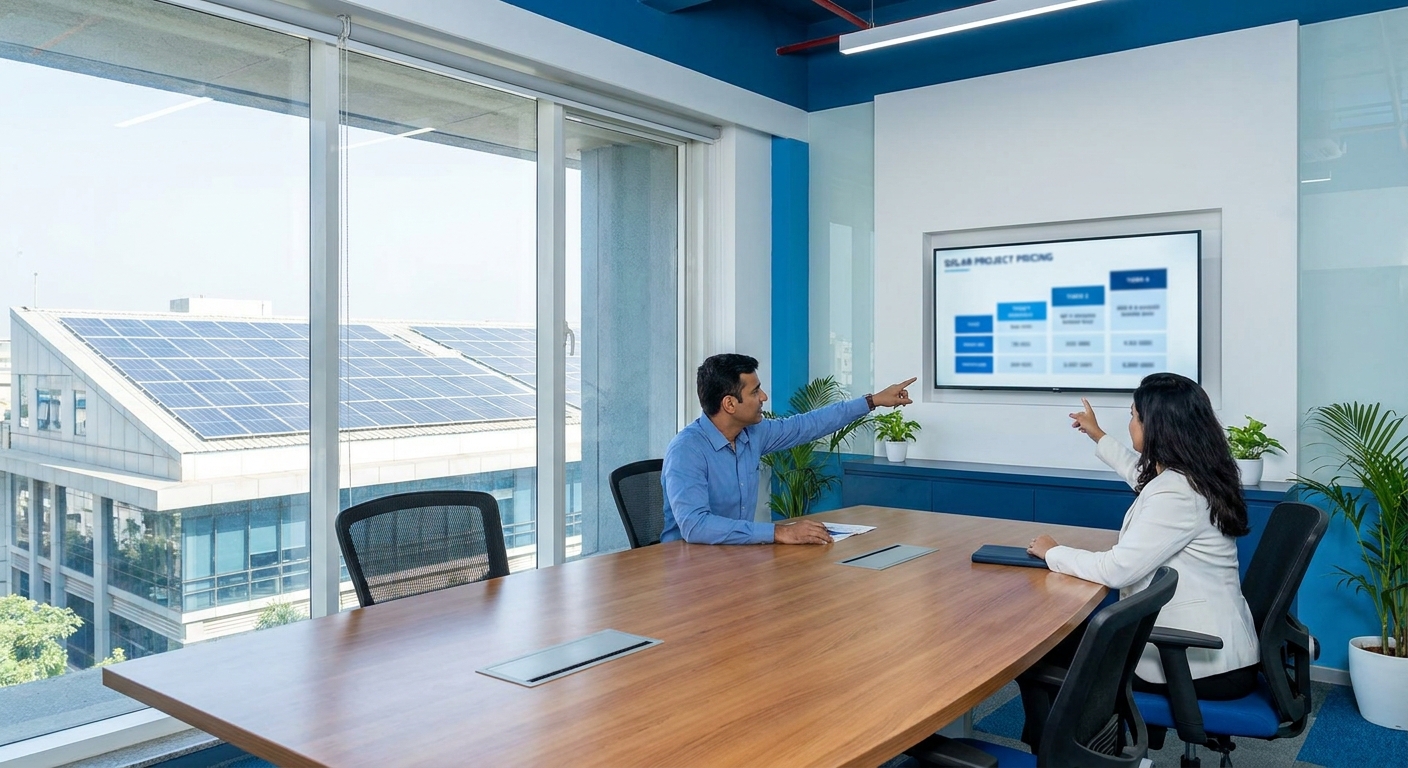
Separate Design as a Distinct Line Item
Every bid should show engineering design as its own line item, broken down by service type where possible. This does two things: it makes the cost visible and defensible, and it signals to the client that design is a professional service, not a free add-on. EPCs that present engineering transparently consistently report less pushback on design fees than those who bury the cost.
Tiered Design Packages
Consider offering clients a choice of design service tiers. For example:
- Standard Package: Detailed engineering drawings, single-line diagram, layout plan, and basic permit documentation. Suitable for straightforward rooftop solar India projects with standard structural conditions.
- Comprehensive Package: Everything in Standard, plus structural engineering calculations, advanced shading analysis, full permit design package, and one round of revision included.
- Premium Package: Everything in Comprehensive, plus site survey, feasibility study, PMC support during construction, and unlimited revisions within defined scope.
Tiered packaging does two things for your design margins. First, it anchors the conversation on which package the client needs, not whether they need engineering at all. Second, it creates upsell opportunities on projects where clients initially choose the lower tier but encounter complexity that requires upgrading.
Protecting Margins When Clients Push Back
Client pushback on engineering fees is common, especially in India’s price-sensitive solar market. The most effective response is not to discount, but to reduce scope. If a client wants to cut the design fee, show them exactly what gets removed from the deliverables. Most clients, when faced with the choice between paying for structural calculations or accepting liability for a mounting system that hasn’t been properly engineered, choose to pay.
Define your revision policy clearly in every contract. Specify how many revision rounds are included in the base fee and what the cost is for additional revisions. This single step can recover 15, 20% of lost design margins on projects with active clients.
4. Justify Engineering Costs to Clients With Confidence
The ability to justify design costs is a sales skill as much as a technical one. EPCs that can articulate the value of engineering in business terms, not just technical terms, win more bids at better margins.
Frame Design Cost as Risk Mitigation
Every engineering service you provide reduces a specific project risk. Use this framing explicitly in client conversations:
- Site survey and feasibility study: Prevents costly surprises after procurement. A thorough solar feasibility study in India can identify site constraints that would require expensive design changes or equipment substitutions mid-project.
- Structural engineering: Protects the client’s building and the EPC’s liability. In states with high wind loads or seismic activity, skipping proper structural calculations is not a cost saving; it’s a deferred liability.
- Permit design: Reduces the risk of permit rejection and project delays. In states where utility interconnection queues are long, a rejected application can add months to a project timeline, costing far more than the permit design fee.
- Detailed engineering design: Reduces installation errors, rework, and warranty claims. Accurate drawings mean your installation crew works faster and makes fewer mistakes.
Use ROI Language
Clients respond to numbers. When justifying engineering costs, quantify the downside of cutting corners. A permit rejection that delays a project by 60 days costs the client lost energy generation revenue. A structural failure costs insurance claims, reputational damage, and potential legal liability. A poorly designed system that underperforms by 8% costs the client thousands of rupees per year in lost generation for the system’s entire 25-year life.
Compare those numbers to your engineering fee. The math almost always favors paying for quality design. According to the International Renewable Energy Agency (IRENA), design and engineering quality is one of the top factors affecting long-term solar plant performance, with poorly designed systems showing 10, 15% lower energy yields over their operational lifetime.
Use Deliverables as Proof of Value
Show clients what they’re getting. A comprehensive engineering package, including 3D pre-design visualizations, detailed structural drawings, permit-ready documentation, and energy simulation reports, is tangible evidence of professional work. EPCs that present sample deliverables during the bid process consistently report higher client acceptance of engineering fees.
5. Outsource Design Strategically to Protect Margins
One of the most effective ways to protect design margins is to control your engineering cost base. For most small and mid-size EPCs in India, maintaining a full in-house engineering team is expensive and inefficient. A team of four to six engineers represents a fixed monthly cost of ₹8, 15 lakh or more, regardless of how many projects are active. When project volume drops, that fixed cost destroys margins.

The Case for Outsourced Design Partnerships
Outsourcing engineering design to a specialized partner converts a fixed cost into a variable one. You pay for design when you have projects, not when you don’t. This structural change alone can improve your design margins by 5, 10 percentage points on an annualized basis, because your engineering cost scales with your revenue rather than running ahead of it.
Beyond cost structure, a specialized design partner brings capabilities that most EPC in-house teams can’t match: dedicated structural engineering expertise, familiarity with permit requirements across multiple Indian states, advanced simulation software, and the capacity to handle multiple projects simultaneously without quality degradation.
What to Look for in a Design Partner
Not all design partners protect your margins equally. When evaluating a design partner, look for:
- Transparent, predictable pricing: Fixed-fee or per-MW pricing models that let you build accurate bids without engineering cost uncertainty.
- Defined deliverable packages: Clear documentation of what’s included in each design package, so you can price client bids with confidence.
- Revision policy clarity: How many revisions are included? What triggers additional charges? This directly affects your margin protection.
- Turnaround time guarantees: Design delays cost you money. A partner with reliable turnaround times lets you manage client expectations and project timelines accurately.
- Multi-state permit expertise: For EPCs operating across India, a design partner with experience in multiple state regulatory environments reduces the risk of permit rejections that erode margins.
Heaven Designs Private Limited works with 752+ solar EPC clients across India and international markets, providing engineering design services that are priced to be predictable and deliverable-focused. With a team of 50+ engineers covering everything from 3D pre-design and detailed engineering to structural calculations and permit documentation, the model is built specifically to help EPCs maintain healthy design margins by converting engineering from a cost uncertainty into a managed, billable line item. For EPCs working on ground-mount projects, our Ground Mount India: Complete Regional Design Guide 2026 covers the specific engineering requirements that affect design costs across different regions.
6. Common Mistakes That Destroy Design Margins on Solar Projects
Even EPCs that understand the principles above make avoidable mistakes that erode design margins project after project. Here are the five most common ones.
Mistake 1: Treating Design as a Cost Center Instead of a Profit Center
When engineering is viewed purely as an overhead expense, the instinct is to minimize it. When it’s viewed as a billable service with its own margin, the instinct is to price it correctly and deliver it well. The mental shift matters. EPCs that treat design as a profit center actively track engineering revenue, engineering cost, and design margin separately from overall project margin. This visibility drives better pricing decisions.
Mistake 2: Not Accounting for Revision Rounds in the Bid
A design that goes through four revision cycles costs roughly twice as much as one that’s approved on the second round. If your bid assumes one revision and the project requires four, you’ve absorbed three rounds of unplanned engineering cost. Always include a revision allowance in your engineering cost estimate, and always define revision limits in your client contract.
Mistake 3: Using a Single Markup Rate Across All Project Types
A 25% markup on engineering costs works fine for a standard 100 kW rooftop project. It may be completely inadequate for a 5 MW ground-mount project in a high-wind zone requiring detailed structural engineering, geotechnical assessment, and complex permit documentation. Segment your markup strategy by project type and complexity. Your design margins will be more consistent as a result.
Mistake 4: Failing to Escalate Design Costs for Complex Sites
Some sites are simply harder to design for. Rooftops with multiple orientations, ground-mount sites with challenging terrain, projects in states with complex permit requirements, and installations near airports or heritage zones all require more engineering effort. If your bid doesn’t reflect this complexity, you’ll absorb the cost difference. Build a complexity premium into your engineering pricing for non-standard sites. The Ministry of New and Renewable Energy (MNRE) guidelines and state-level DISCOM requirements vary significantly, and navigating them takes real engineering time that must be priced into your bids.
Mistake 5: Absorbing Design Overruns Instead of Billing Change Orders
When a client requests a significant scope change mid-project, such as adding a battery storage component, changing the mounting system, or redesigning the layout after procurement, that’s a change order, not a free revision. EPCs that absorb these costs to “keep the client happy” are training clients to expect unlimited design changes for free. A clear change order process, defined in the original contract, protects your design margins and sets professional expectations from day one.
Design Margins FAQ: What Solar EPCs Ask Most
What is a healthy design margin for solar EPC projects in India?
A healthy design margin for solar EPC projects in India typically ranges from 20, 35% above your fully loaded engineering cost, depending on project type and complexity. Residential rooftop projects with standardized designs can support margins at the lower end of this range. Complex MW-scale ground-mount projects with structural engineering, multi-state permit requirements, and PMC services can support margins at the higher end. The key is knowing your true cost base before applying any markup.
Should design costs be a fixed line item or a percentage of project value?
For standard, well-defined project types, fixed-fee design packages give you better margin predictability and make client conversations easier. For complex or first-of-type projects, a cost-plus approach with a defined contingency is safer. Many experienced EPCs use fixed fees for the base design scope and cost-plus for any work outside that scope, which gives clients pricing clarity while protecting design margins when complexity increases.
How do I handle design cost overruns mid-project?
The best way to handle overruns is to prevent them through clear scope definition and revision limits in your contract. When overruns do occur due to genuine scope changes requested by the client, issue a change order immediately. Document the additional work required, the cost, and the timeline impact. Clients who understand that scope changes have costs are far less likely to request unnecessary revisions. Clients who have never been charged for changes will keep requesting them indefinitely.
Can outsourcing design actually improve my margins?
Yes, when done correctly. Outsourcing converts a fixed engineering cost into a variable one, which improves margins during low-volume periods. It also gives you access to specialized expertise (structural engineering, multi-state permit knowledge, advanced simulation tools) that would cost significantly more to maintain in-house. The key is choosing a design partner with transparent, predictable pricing so you can build accurate bids. If your design partner’s costs are unpredictable, outsourcing can hurt margins as much as help them.
How do I price permit design and site survey costs into bids?
Permit design and site survey costs should always be separate, itemized line items in your bid. Permit design costs vary significantly by state in India, so build a state-specific cost reference for the markets you operate in. Site survey costs depend on project size, site accessibility, and the scope of assessment required. Never bundle these into a general engineering line item, because when they cost more than expected (which they often do in complex states or remote sites), you have no visibility into where the overrun occurred.
Protect Your Design Margins on Every Project You Bid
Healthy design margins don’t happen by accident. They’re the result of accurate cost mapping, disciplined markup strategy, transparent bid structure, and the confidence to justify engineering value to clients who may not immediately see it. For solar EPC companies in India competing in a market where every rupee of margin matters, getting this right is not optional; it’s the difference between a sustainable business and one that wins bids but loses money on every project.
If you’re ready to take the guesswork out of engineering costs and build bids that protect your design margins from the start, Heaven Designs can help. With fixed-fee, deliverable-based engineering packages covering everything from 3D pre-design and detailed engineering to structural calculations, permit documentation, and PMC services, we give EPCs the cost predictability they need to price confidently and win profitably. Get a Quick Proposal Now! to see how our engineering services fit your next project, or reach us directly at +91 90811 00297 or service@heavendesigns.in.
This blog post was written using thestacc.com