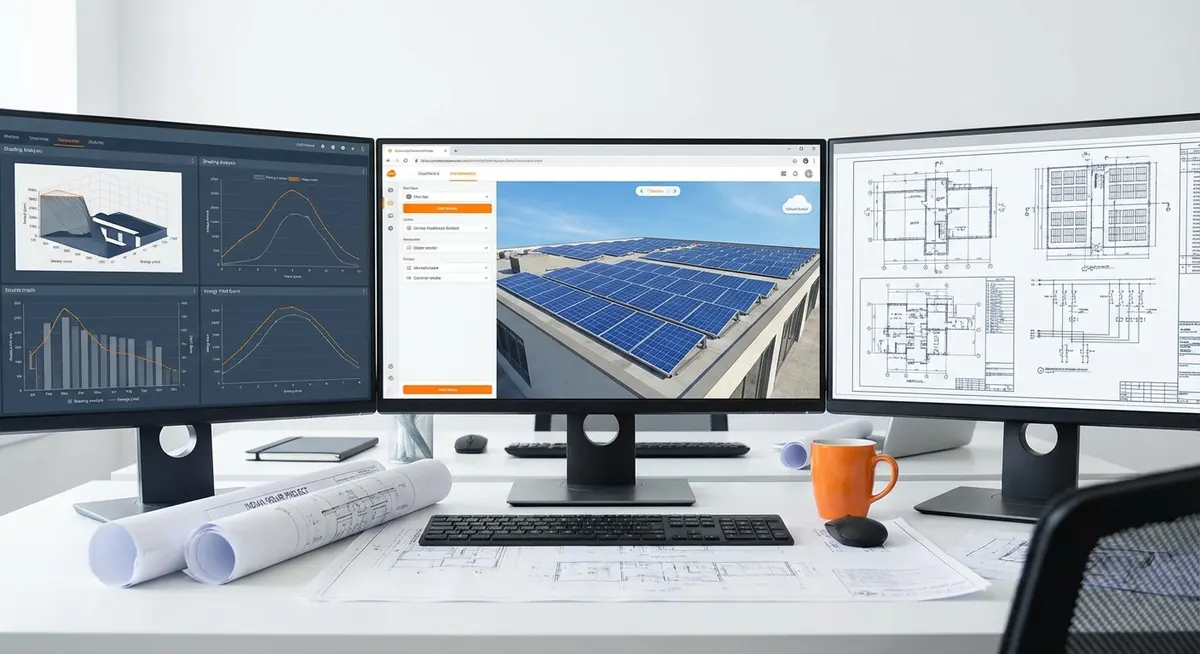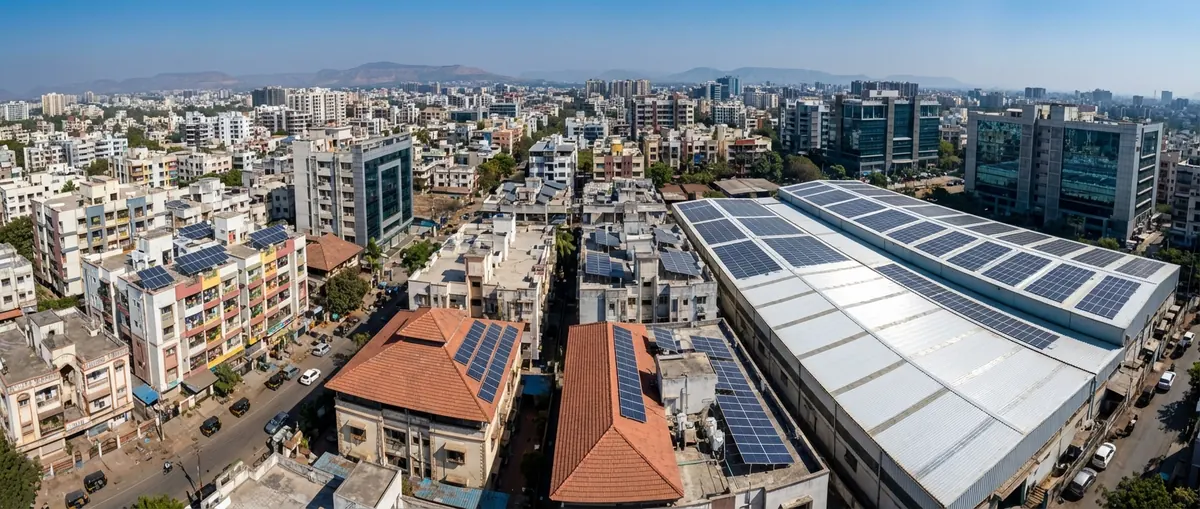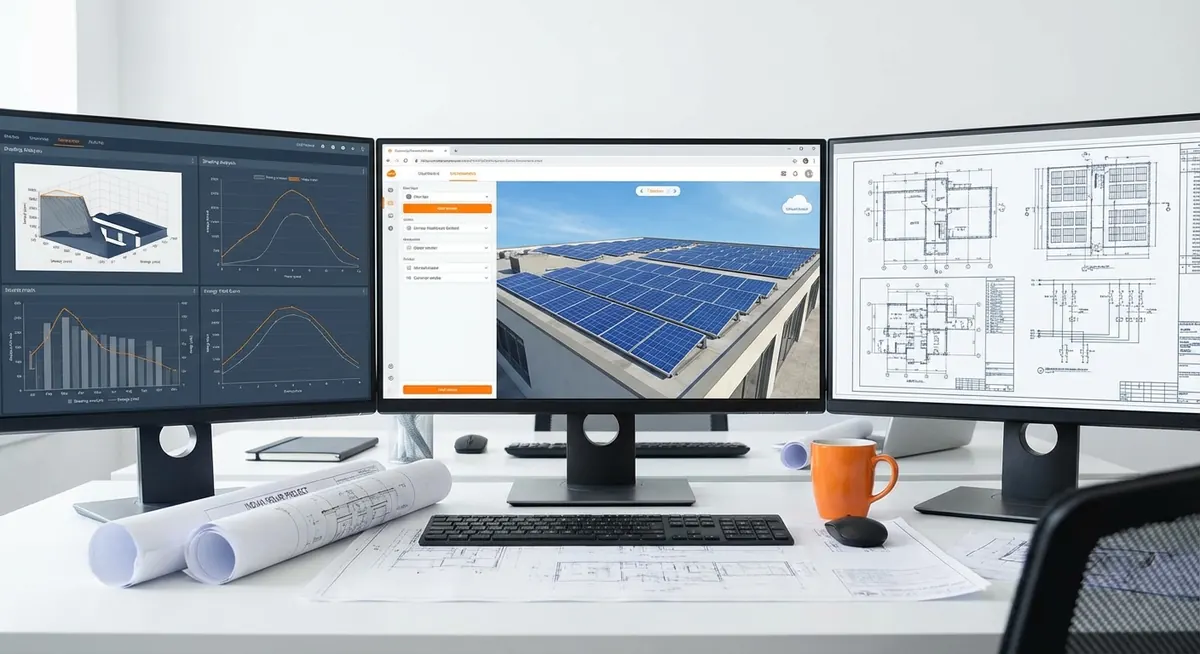
Every EPC founder or installer eventually faces the same Monday-morning question: is the software subscription you are paying $2,400–$9,600 per year actually converting into permits faster, or is it just a cost center that your design team uses because it was there when they joined? Aurora Solar and Helioscope each dominate different corners of the market, but neither is a full-service design partner. Heaven Designs sits in a third category entirely — a managed engineering bench that delivers the output, not the tool license. This guide breaks down all three across the ten dimensions that move your P&L.
Direct answer. Aurora Solar and Helioscope are design software platforms costing $200–$800/month that require in-house designers to operate. Heaven Designs is a managed engineering service that delivers stamped permit packets, PVsyst reports, and IFC-grade drawings — no software license, no headcount. For US installers needing AHJ-ready sets in 4–7 business days or Indian EPCs needing DISCOM-format drawings, a managed bench typically delivers faster and at lower per-project cost than either software platform alone.
This guide serves two audiences: Mike, the US residential and C&I installer who wants AHJ first-pass approval without expanding his payroll, and Rohan, the Indian EPC founder who needs DISCOM-format drawings and bankable PVsyst reports without hiring a third senior designer. If you are evaluating where to spend your engineering budget in 2026, every number below ties directly to your margin per project.
What Aurora Solar Actually Is — and Is Not
Aurora Solar is a cloud-based solar design and proposal platform built for US residential and commercial installers. It ingests satellite imagery, runs shading analysis, sizes strings, and exports a proposal-grade 3D render. The platform has a permit-design module that generates AHJ submission packets, and it integrates with CRMs like Salesforce.
What Aurora does not do: it does not stamp drawings. It does not provide a licensed PE on the permit. It does not follow up with the AHJ if a correction comment arrives. The platform produces a design artifact; your team — or a separate stamping service — converts that artifact into an approved permit.
Definition. Aurora Solar is a design-and-proposal SaaS tool. It automates shade analysis, string sizing, and proposal generation. A PE stamp and AHJ submission are still required — Aurora does not supply them.
Aurora’s pricing in 2026 sits at roughly $200–$800/month per user depending on the tier, with enterprise pricing available for multi-branch operations. According to SEIA’s 2025 US Solar Industry Data, the average US residential installer closes 8–14 projects per month. At $400/month for Aurora, that is $28–$50 of software cost per project — before the salary cost of the designer running it.
$200–$800
Aurora Solar monthly cost/user
Aurora Solar pricing page, 2026
78%
Avg AHJ first-pass rate (industry)
NABCEP installer survey, 2025
9–14 days
Avg AHJ turnaround with in-house Aurora
Solar Power World installer poll, 2025
96.2%
HD first-pass AHJ approval rate
Heaven Designs internal, Q1 2026
What Helioscope Actually Is — and Is Not
Helioscope is an engineering-grade simulation and layout tool built by Folsom Labs (now part of Aurora Solar’s parent Accenture). It is stronger on the yield-modeling side than Aurora’s core tool, produces bankable-quality performance estimates, and handles larger commercial and utility-scale projects more gracefully.
Where Helioscope excels: detailed loss modeling, tracker simulation, and complex roof geometry handling. Where it falls short for a solo installer or a lean EPC team: it requires a trained designer to interpret the output, it does not produce PE-stamped drawings, and the learning curve for advanced features is steep.
For Indian EPCs, Helioscope does not natively output DISCOM-format single-line diagrams, BOQ formats aligned to MNRE tender templates, or IS 875-compliant structural load reports. An Indian EPC would still need a separate CAD layer to convert Helioscope output into submission-ready drawings.
Field tip. Helioscope's yield modeling is strong enough for MOFU commercial presentations, but lenders in India (IREDA, PFC, SBI) require a [PVsyst](/glossary/pvsyst/) report with a licensed IE sign-off — Helioscope output alone does not satisfy that gate.
Helioscope pricing runs approximately $1,500–$4,500/year for residential tiers and higher for commercial. When you add the designer salary (₹55,000–₹90,000/month in India, or $55k–$80k/year in the US), the total cost of ownership per project becomes the real comparison point.
Heaven Designs — The Managed Engineering Bench Model
Heaven Designs is not software. It is a 50-engineer firm in Surat and Ahmedabad that acts as your external engineering department — delivering permit packets, PVsyst reports, IFC-grade drawings, CEIG-ready electrical drawings, and structural calculations across a client portal with designer chat.
The model works like this: you upload a site capture (satellite coordinates, utility bill, roof photos or drone data), specify the project parameters, and Heaven Designs delivers a stamped permit packet in 4–7 business days for US projects, or a complete DISCOM-format drawing set in 3–5 business days for Indian projects. You never manage the software, the designer’s learning curve, or the AHJ revision loop.
For the US market, Heaven Designs carries PE licenses across 38 states. For the Indian market, the firm produces CEIG-approved electrical drawings, IS 875 Part 3-compliant structural calculations, and DISCOM-format SLDs that pass TANGEDCO, MSEDCL, UGVCL, BESCOM, and other state DISCOM reviews.
See how to choose a solar design partner for a detailed evaluation framework, and offshore vs onshore design outsourcing for a broader cost model.
The Three-Way Feature Comparison Table
| Dimension | Aurora Solar | Helioscope | Heaven Designs |
|---|---|---|---|
| Nature | SaaS design tool | SaaS simulation tool | Managed engineering service |
| Monthly cost | $200–$800/user | $125–$375/user | Per-project (no seat fee) |
| PE-stamped drawings | No (separate vendor) | No (separate vendor) | Yes — included |
| AHJ first-pass approval | ~78% industry avg | ~74% industry avg | 96.2% (HD internal) |
| NEC 2023 compliance | Self-service | Self-service | PE-verified |
| DISCOM format drawings | No | No | Yes |
| PVsyst / bankable yield | No | Partial (not lender-accepted in India) | Yes — IE-accepted |
| IS 875 structural calcs | No | No | Yes |
| Turnaround (US permit) | 9–14 days (in-house) | 10–14 days (in-house) | 4–7 business days |
| Designer headcount needed | Yes — your hire | Yes — your hire | No |
| India compliance ready | No | No | Yes |
| Africa / DFI deliverables | No | No | Yes |
The Tool-vs-Service Decision Framework — The 3-Pillar Fit Test
This is Heaven Designs’ proprietary evaluation method for EPCs deciding between a software subscription and a managed engineering bench. It does not appear in any software vendor’s marketing — because the vendors have no incentive to run this analysis for you.
Volume threshold test
Calculate your monthly project volume. If you complete fewer than 15 projects per month, a software seat plus one full-time designer usually costs more per project than a managed service. Above 40 projects/month, an in-house team with tool licenses typically achieves economies of scale — but only if your designer retention is above 80%.
Compliance complexity test
Count the number of distinct regulatory bodies your projects must satisfy. A US installer working in a single state with a stable AHJ may manage with software. An EPC crossing multiple Indian DISCOMs, or a US developer working across 5+ states with different PE requirements, will spend more engineering management time than the software saves — the managed bench arbitrages that complexity.
Revision-cost test
Track how many AHJ revisions or DISCOM rejection cycles your last 20 projects generated. Each revision adds 3–7 business days and direct labor cost. If your revision rate exceeds 25%, the cost of those cycles likely exceeds the fee differential between software-plus-staff and a managed service with a first-pass SLA.
Apply all three tests before your next budget cycle. The answer is rarely “always software” or “always managed service” — it depends on your volume, geography, and revision track record.
Aurora vs Helioscope — Head to Head for US Installers
For US residential and C&I installers, the Aurora-versus-Helioscope debate has a clearer answer than most people admit.
| Dimension | Aurora Solar | Helioscope |
|---|---|---|
| Best for | Sales-to-permit pipeline | Engineering-grade yield modeling |
| Roof complexity | Excellent (AI-driven) | Good (manual polygons) |
| Commercial/utility yield | Limited | Strong |
| Proposal quality | Excellent | Functional but not sales-optimized |
| API / CRM integration | Strong | Moderate |
| NEC 2023 string sizing | Automated | Semi-automated |
| Rapid shutdown flagging | Basic | Basic |
| India market relevance | Very low | Low |
| PE stamp | Not included | Not included |
AURORA PROS
- Fast roof modeling from satellite imagery
- Sales-grade proposal output
- Strong CRM integrations
- Rapid shutdown module flagging
AURORA CONS
- No PE stamp included
- Requires trained in-house designer
- Not suited for India DISCOM compliance
- Yield modeling less rigorous than Helioscope
Verdict. For a US residential installer closing 8–20 projects per month, Aurora’s proposal pipeline is genuinely valuable for the sales stage. But Aurora alone does not get you to a stamped permit. The combo of Aurora (design) + Heaven Designs (stamp + AHJ submission) outperforms Aurora-plus-internal-PE for most installers under 30 projects/month.
Aurora vs Helioscope vs Heaven Designs — India EPC Perspective
Indian EPCs face a different problem set entirely. The relevant outputs are DISCOM-format SLDs, CEIG-approved electrical drawings, IS 875 Part 3-compliant structural reports, MNRE DCR-compliant BOQs, and PVsyst reports acceptable to IREDA and PFC. Neither Aurora nor Helioscope was built for this stack.
Watch out. Aurora Solar does not generate DISCOM-format drawings. Using Aurora output directly for an Indian DISCOM submission will result in rejection — the format, symbology, and certification block are non-compliant with CEIG standards.
For Rohan’s EPC — operating across Maharashtra, Gujarat, and Rajasthan with MSEDCL, UGVCL, and RRVPNL submissions — the engineering stack needed is: PVsyst for yield, AutoCAD / ETAP for SLD generation in CEIG format, IS 875 Part 3 for structural, and a CEIG-approved signatory for electrical drawings. Heaven Designs provides this complete stack from one intake form through the client portal.
Review the CEIG drawing approval process and MNRE DCR compliance guide for the full regulatory context.
See what a complete Indian EPC drawing set looks like
Download a redacted sample: DISCOM-format SLD, IS 875 structural report, and CEIG-ready electrical drawing — all from one Heaven Designs project.
Get the sample pack →Total Cost of Ownership — The Full Accounting
Software subscriptions are visible costs. The hidden costs live in designer salary, benefits, training, attrition replacement, and revision cycles. Here is a simplified annual cost model for a US installer running 15 projects/month:
| Cost component | Aurora + In-house designer | Heaven Designs managed |
|---|---|---|
| Software subscription | $4,800/yr | $0 |
| Designer salary (US, mid-level) | $65,000/yr | $0 |
| Benefits (25% of salary) | $16,250/yr | $0 |
| PE stamp (external, per project) | $7,200/yr ($40/project) | Included |
| AHJ revision rework (25% rate) | $9,000/yr | Included in SLA |
| Total annual cost | $102,250 | ~$32,400 (at $180/project) |
| Cost per project (15/mo) | $568 | $180 |
These numbers vary by market and project type — get a project quote to see the exact math for your volume. The core insight is that the revision-rework cost and the PE stamp cost are often invisible in a software-only budget model.
For the India market, the hidden-cost calculation is even sharper. Read the hidden cost of an in-house solar designer for the full ₹17L annual model.
How Heaven Designs Helps
When you hire Heaven Designs, you get the deliverable without the overhead. The engineering bench works as a white-label extension of your firm — your client sees your logo on the drawings.
- Solar Permit Design — NEC 2023-compliant PE-stamped permit packets in 4–7 business days across 38 US states, with AHJ revision handling included.
- Electrical CEIG Drawings — CEIG-approval-ready electrical drawings for all major Indian state DISCOMs, signed by licensed CEIG-approved engineers.
- Solar Rooftop Detailed Engineering Design — Complete IFC-grade packs: GA, SLD, structural calc, BOQ, mounting schedule.
- Solar Ground Mount Design — Utility-scale layout, tracker yield study, civil foundation, structural STAAD report.
- Download a sample deliverable — Review a real permit packet or DISCOM drawing set before you commit.
Contact us to discuss your project pipeline and get a per-project rate sheet.
FAQ
Is Aurora Solar or Helioscope better for NEC 2023 compliance?
Aurora Solar has a more complete rapid shutdown flagging module and is more tightly integrated with the US residential sales-to-permit workflow. Helioscope is stronger for engineering-grade yield modeling but produces less sales-stage output. Neither platform produces a PE-stamped, AHJ-ready permit packet without a separate stamping service. For full NEC 2023 compliance including rapid shutdown per NEC 690.12 and NEC 705 interactive system rules, the engineer reviewing the output is more important than the software generating it.
Can I use Aurora Solar for Indian DISCOM submissions?
No. Aurora Solar generates drawings to US standards and formats. Indian DISCOM submissions require CEIG-format electrical drawings with IS 16-series symbology, a CEIG-approved engineer’s signature, and compliance with CEA Connectivity Regulations 2019. Aurora output cannot be directly submitted to any Indian DISCOM. You would need a complete CAD redraw in Indian format — at which point you have paid twice for the same design.
What does Heaven Designs cost per project compared to an Aurora subscription?
A fully loaded Aurora Solar subscription plus mid-level in-house designer plus external PE stamp typically costs $450–$600 per project at 15 projects/month. Heaven Designs’ managed permit service ranges from $140–$250 per residential project depending on state and complexity, with PE stamp included. For Indian projects, the per-project rate depends on system size and deliverable scope — contact the team for a rate sheet.
Does Helioscope produce bankable yield reports for Indian lenders?
Helioscope’s performance simulation is engineering-grade but is not the standard tool for Indian lender acceptance. IREDA, PFC, SBI Capital, and most Independent Engineers (IEs) in India require a PVsyst report — specifically a PVsyst .PRJ file and the corresponding simulation report PDF. Helioscope output can be presented as supplementary material but does not substitute for a PVsyst bankable yield report at the IREDA or PFC gate.
How long does Heaven Designs take to deliver a US permit packet?
Standard turnaround is 4–7 business days from complete site data submission. This includes PE stamp across 38 states. Rush delivery (2–3 business days) is available for an expedite fee. AHJ correction comment responses are handled within 24 hours under the standard SLA.
Which tool is best for a mixed US-India EPC operation?
No single software platform handles both markets well. The most practical configuration for a mixed-market EPC is: Aurora Solar for US proposal-stage visualization (if the sales team finds it valuable), plus Heaven Designs as the engineering and stamping back-end for both US permit packets and Indian DISCOM drawing sets. This eliminates the need for multiple software seats and multiple country-specific designer hires.
Does Heaven Designs offer white-label drawings?
Yes. All deliverables can carry your company’s logo, address block, and title block. The drawings reach your client under your brand. This is the standard configuration for EPCs and installers who subcontract engineering — the end customer sees your firm’s engineering capability, not the subcontractor’s.
What happens if the AHJ rejects my permit application?
Heaven Designs includes AHJ revision handling within the standard permit design engagement. If the AHJ issues a correction notice, the engineering team responds within 24 hours with a revised drawing set. The revision is not a separate charge for standard correction types. Structural corrections triggered by site-specific AHJ requirements beyond the original scope are handled at a defined revision rate disclosed upfront. See solar design mistakes for the most common AHJ rejection triggers.