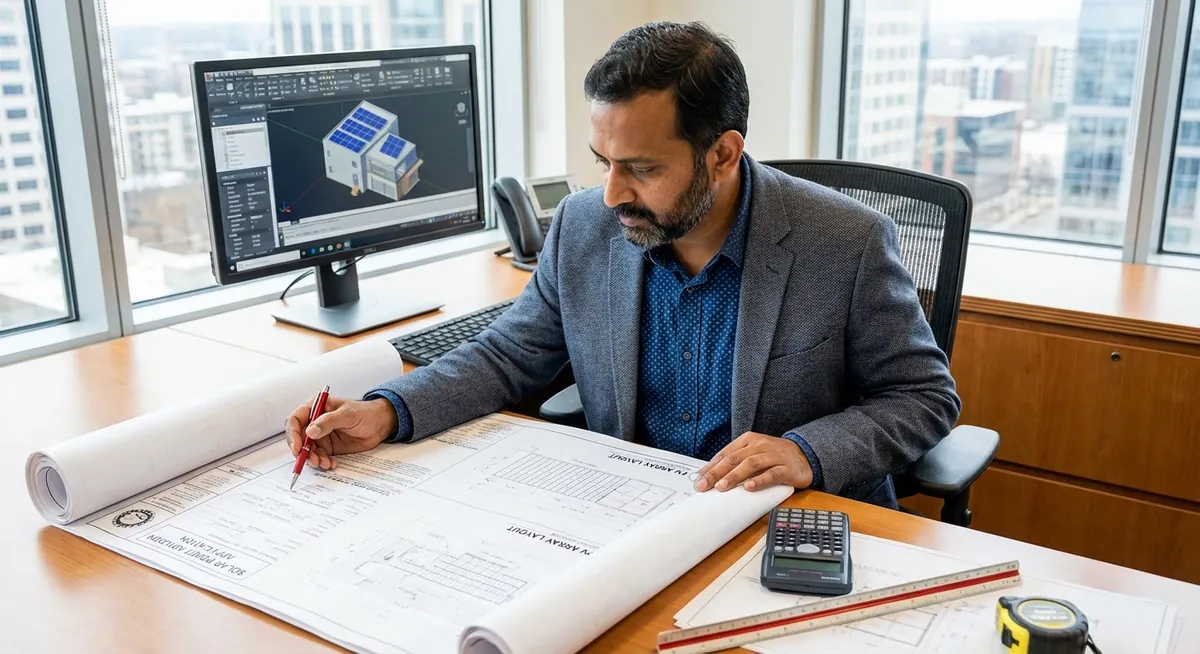
New York City is the largest solar permit market in the northeastern United States — and one of the most technically demanding AHJs in the country for solar installations. The NYC Department of Buildings (DOB) processes solar permits through its Buildings Information System (DOB BIS) with requirements that go significantly beyond most municipal building departments: full professional engineering (PE) stamp on all drawings, a detailed 3-line diagram for commercial systems, and multiple NYC Local Law compliance checks layered on top of the base NEC 2020 electrical requirements.
An installer moving from California or Texas to NYC for the first time will encounter a permitting landscape that is more rigorous, more bureaucratic, and more dependent on local relationships — particularly with registered NYC expediters — than almost any other US market. Understanding the DOB BIS system, the PE-stamp requirements, the Con Edison interconnection timeline, and the unique NYC fire and structural rules is the baseline for a functional NYC solar permit operation.
Direct answer. NYC solar permits require a DOB BIS filing with a NY PE-stamped drawing set (electrical SLD + 3-line diagram for commercial + structural calculations), a Con Edison or PSEG Long Island interconnection application (for properties outside the five boroughs), and compliance with NYC Local Laws including NYC Electrical Code (NEC 2020 with NYC amendments), NYC Building Code (NYCBC), and NYC Fire Code. Residential systems on Class 1 (R-3) buildings ≤ 25 kW may qualify for NYC’s SolarApp+ pathway, which issues permits in 1–5 business days. All other systems require full DOB plan examination, typically 15–45 business days.
NYC DOB — The Permitting Authority for Solar in the Five Boroughs
The NYC Department of Buildings (DOB) is the AHJ for all building permits in Manhattan, Brooklyn, Queens, the Bronx, and Staten Island. Every solar installation that adds a structure to or penetrates a building requires a DOB permit — there is no Houston-style electrical-only pathway in NYC.
NYC permitting operates through two systems:
- DOB BIS (Buildings Information System) — the legacy permit system used for most residential work
- DOB NOW — the newer online portal for self-certification jobs, new buildings, and alterations
Solar permit applications in NYC are filed as Alteration Type 2 (Alt-2) applications when the work is limited to the solar installation. If the solar project triggers other building work (electrical service upgrade, structural reinforcement, roof repair), the scope may require an Alteration Type 1 (Alt-1) application.
Critical distinction. NYC's five boroughs each have their own DOB borough office with different staffing levels and plan examination queues. Manhattan and Brooklyn are historically slower on standard plan exam; Queens and Staten Island have moved faster for residential solar. If you have flexibility in project scheduling, understanding borough-specific turnaround differences can meaningfully affect your pipeline planning.
The NYC Solar Permit Pathway — SolarApp+ vs. Full DOB Plan Exam
NYC adopted SolarApp+ in 2023 as an expedited pathway for qualifying residential solar installations. The dual-pathway system means installers must first screen for SolarApp+ eligibility before defaulting to full plan examination.
| Parameter | SolarApp+ (NYC) | Full DOB Plan Exam |
|---|---|---|
| System size | ≤ 25 kW AC | Any size |
| Occupancy | R-3 single-family and small residential | All occupancies |
| Drawing requirements | Auto-generated SLD + prescriptive structural | Full NY PE-stamped drawing set |
| PE stamp | Not required for SolarApp+ pathway | Required — NY-licensed PE |
| Typical timeline | 1–5 business days | 15–45 business days (residential); 30–90 days (commercial) |
| Storage co-permit | Not eligible | Separate Alt-2 application |
| Expediter needed | Not typically | Strongly recommended |
| First-pass approval rate | ~72% (NYC data, 2024–2025) | ~65% (standard plan check round 1) |
SolarApp+ in NYC. NYC's SolarApp+ adoption covers Class 1 (R-3) residential buildings with wood-frame or light steel-frame construction. NYC's dense urban housing stock includes many masonry rowhouses and brownstones — these may not qualify for the prescriptive structural pathway. Verify the building's construction type in DOB BIS before assuming SolarApp+ eligibility.
For the broader US permit framework, see How to Submit a Solar Permit Package to an AHJ and Solar PE Stamp Explained.
NYC SolarApp+ Eligibility — The 9-Point Screening Checklist
Before filing a NYC solar permit via SolarApp+, screen the project against these nine conditions. A single disqualifying item routes the project to full DOB plan exam.
- Occupancy class: Class 1 residential (R-3 single-family, 1–2 family dwelling). Multi-family, commercial, and industrial are not eligible.
- System size: ≤ 25 kW AC total inverter output.
- Roof structure: Wood-frame roof construction with standard rafter spacing ≤ 24 inches on-center. Masonry, concrete, and structural steel roofs are not eligible for the prescriptive pathway.
- Inverter type: UL 1741-listed utility-interactive inverter; must be in SolarApp+ database.
- Racking: Must use a racking system listed in SolarApp+‘s pre-approved product library.
- Interconnection method: Load-side interconnection using the 120% busbar rule (NEC 705.12(D)(3)). Supply-side (line-side tap) disqualifies.
- No battery storage: BESS cannot be included in the same SolarApp+ permit application.
- No panel upgrade: Electric service panel upgrade must be a separate Alt-2 application before or concurrent with the solar permit.
- Building in good standing: DOB BIS shows no open violations requiring cure before new permit issuance. Check the property’s DOB BIS record for open violations before submitting.
Field tip. NYC DOB BIS open violations are the most common unexpected disqualifier for NYC SolarApp+ submissions. Always run an address lookup at the DOB BIS portal before starting the SolarApp+ application — an open ECB (Environmental Control Board) violation can block permit issuance until resolved, adding weeks to a project timeline.
Full DOB Plan Exam — The NYC Solar PE Drawing Set
For systems that do not qualify for SolarApp+, or for any commercial solar installation, NYC requires a full NY PE-stamped drawing set submitted through DOB BIS or DOB NOW.
The NYC Solar Engineering Drawing Framework
NYC solar permit drawing sets follow a standard five-document structure that the DOB plan examiner expects in this order:
Site Plan + Roof Plan
Property survey context, roof area with module layout, fire setback annotations per NYC Fire Code Chapter 6, roof access path per NYC Fire Code 504, and roof drainage annotation. PE-stamped.
Electrical Single-Line Diagram (SLD)
Complete SLD from PV array through inverter, AC disconnect, rapid shutdown device, interconnection point, and utility meter. NYC Electrical Code (NEC 2020 + NYC amendments) compliance. Conductor sizing, OCPD ratings, and grounding system. PE-stamped.
3-Line Diagram (Commercial Systems)
For commercial systems and any installation with 3-phase service, a 3-line diagram is required showing all three phases, neutral, and ground. Shows all protective devices, metering, and utility-side interface. PE-stamped. This is the document most commonly missing or incorrect in non-NYC-experienced permit packages.
Structural Calculations
NYC Building Code (NYCBC 2022) structural analysis: dead load from modules + racking, wind uplift per ASCE 7-22 for NYC wind zone (Vult 115 mph, Exposure B or C depending on location), and snow load (NYC ground snow load: 30 psf). Rafter/truss capacity check for the additional concentrated point loads. PE-stamped.
Equipment Schedules + Specifications
Equipment schedule listing all major components (modules, inverter, racking, rapid shutdown device, disconnects). Cut sheets confirming UL listings. Con Edison equipment compatibility confirmation where required. NYC DOB requires these on the stamped drawing set, not as separate attachments.
The 3-Line Diagram — NYC’s Most-Requested Missing Document
The 3-line diagram requirement is the element that catches the most non-NYC solar permit designers off-guard. In most US states, a single-line diagram (SLD) is sufficient for all residential and commercial solar permit packages. NYC’s commercial solar permit process — and any installation with 3-phase service — requires a 3-line diagram as a separate, distinct drawing.
What a 3-line diagram shows (vs. an SLD):
| Element | SLD | 3-Line Diagram |
|---|---|---|
| Phase representation | Single line (simplified) | Three separate lines (A, B, C phases) |
| Neutral and ground | Often shown as single conductor | Explicitly shown per phase |
| Protective device sizing | Shown once per circuit | Shown per phase with trip curves |
| Metering | Block diagram | Full CT/PT metering wiring |
| Utility interface | Interconnection point only | Complete utility service entry with meter socket and utility disconnect |
| Use case | All residential; commercial basic | All 3-phase commercial; required by most NYC plan examiners for any commercial system |
Watch out. NYC plan examiners specifically look for the 3-line diagram on commercial solar applications. Submitting only an SLD for a commercial system results in a plan correction requiring a 3-line diagram, adding one complete correction round (~15 business days) to the timeline. This single mistake is the most expensive recurring error in commercial NYC solar permitting.
NYC Fire Code Requirements for Solar
NYC adopts the International Fire Code (IFC) with NYC-specific amendments. The key fire code requirements for solar installations that affect the permit drawing set:
Roof Access Path (NYC Fire Code 504.4):
- A minimum 36-inch-wide access path from the roof access point to each section of the solar array must be maintained
- The access path cannot be blocked by solar modules or racking
Fire Setbacks:
- Ridge setback: 18 inches from the ridge
- Hip and valley setbacks: 18 inches
- Perimeter setback: 18 inches from the roof edge
- These setbacks apply on all roof planes with solar
Array Sectioning:
- Arrays must be sectioned into areas ≤ 150 square feet with internal pathways of ≥ 36 inches between sections for flat/low-slope roofs
- Pitched roofs: standard setback requirements apply without mandatory sectioning within the array
Rapid Shutdown System (NYC Electrical Code, NEC 690.12):
- Required on all NYC solar installations
- The rapid shutdown initiation device must be located at the utility service entrance, accessible to first responders without entering the building
- NYC DOB plan examiners specifically verify the initiation device location on the SLD
Con Edison Solar Interconnection — NYC’s Utility Process
Consolidated Edison (Con Edison) serves Manhattan, the Bronx, Brooklyn, Queens, and Westchester County. For NYC solar installations, the Con Edison interconnection application runs parallel to the DOB permit and is a separate process.
Con Edison Distributed Generation Interconnection Process:
| System Size | Interconnection Track | Typical Timeline | Key Requirement |
|---|---|---|---|
| ≤ 25 kW (residential) | Simplified Track 1 | 20–40 business days | UL 1741 inverter; load-side only |
| 25–500 kW (C&I) | Standard Track 2 | 45–90 business days | Technical feasibility study; revenue-grade metering |
| > 500 kW | Full Study Track 3 | 90–180+ business days | System impact study; distribution upgrade analysis |
Con Edison requires:
- Completed Con Edison DG interconnection application (online portal)
- Technical drawings (SLD, 3-line for commercial)
- Equipment specifications (inverter must meet Con Edison’s technical requirements)
- Copy of DOB permit (or evidence of application) — required before Con Edison final approval
Parallel tracking tip. Submit the Con Edison interconnection application at the same time as the DOB permit application — do not wait for DOB permit issuance before submitting to Con Edison. The two processes run concurrently; starting Con Edison after DOB approval adds 4–10 weeks to the project timeline. Most experienced NYC solar permit coordinators file both on the same day.
NYC Expediter — When You Need One and What They Do
A DOB expediter is a licensed professional who specializes in navigating the NYC DOB permit system, including managing plan examination queues, responding to plan examiner comments, and coordinating across DOB borough offices. For solar permits, expediters become valuable in three scenarios:
When to use an NYC solar permit expediter:
-
Commercial systems with full plan exam — The plan examiner queue for Alt-2 commercial applications is managed differently from residential. An expediter with relationships in the commercial plan review division can often identify the specific plan examiner assigned to a project and communicate directly.
-
Projects with open DOB violations — An expediter can navigate the violation resolution process (identifying the originating inspector, arranging re-inspection, clearing the violation record) faster than a first-time applicant unfamiliar with DOB BIS.
-
Large multi-family or mixed-use buildings — These require additional NYC Building Code review beyond the scope of a standard solar Alt-2 filing. An expediter ensures the application is structured correctly to avoid a reclassification to Alt-1 scope.
What an expediter does not do: An expediter manages the DOB administrative process — they are not the PE of record for the stamped drawings. The engineering drawings must come from a NY-licensed PE. The expediter and the PE are separate engagements.
NYC Structural Considerations — Snow Load and Wind Zone
New York City’s structural engineering requirements for solar include snow load and wind load parameters that differ from most US markets:
NYC Structural Parameters:
- Ground snow load: 30 psf (pounds per square foot) — NYC’s latitude and climate require snow load analysis that is irrelevant in Florida or Texas
- Design wind speed: Vult approximately 115 mph (ASCE 7-22, NYC); Exposure B for most urban locations; Exposure C or D for coastal Staten Island and waterfront locations
- Seismic: NYC is Seismic Design Category A or B — seismic loads are generally not the governing design condition for solar
Snow load impact on solar structural design: Solar array snow load analysis must consider:
- The additional dead load of accumulated snow on the array (module surface typically allows some snow to slide)
- The increased point loads on roof attachment fasteners during snow accumulation
- Roof slope — NYC has a significant stock of flat and low-slope commercial roofs where snow accumulation is highest
Note. NYC has a very large stock of pre-war and early-20th-century masonry buildings — brownstones, walk-up apartment buildings, and pre-WWII commercial structures — with roof framing that predates modern load tables. Structural analysis for solar on these buildings sometimes uncovers marginal rafter or joist capacity, requiring either a reduced array size or additional structural reinforcement. Always include a structural adequacy assessment in the design phase before selling the final system size to the customer.
NYC Solar Permit Fees
NYC DOB permit fees for solar installations vary by system type and filing method. Approximate fee schedule as of 2026:
| Item | Approximate Cost |
|---|---|
| DOB Alt-2 filing fee (residential solar) | $250–$500 |
| DOB plan examination fee | $150–$350 (included in filing for residential SolarApp+) |
| DOB electrical permit (separate from building permit) | $200–$450 |
| NYC expediter fee (if used) | $500–$2,000 depending on scope |
| NY PE stamp (structural + electrical) | $500–$1,500 depending on system size |
| Con Edison DG application fee | $0 for Track 1; varies for Track 2–3 |
| NYC State surcharges | ~$50–$100 |
Total NYC permitting cost for a standard residential system (not SolarApp+ eligible): approximately $1,500–$4,000 including engineering and permit fees. SolarApp+-eligible systems reduce this significantly.
NYC Performance vs. Other Northeast AHJs
1–5
Business days — NYC SolarApp+ permit issuance
NYC DOB data, 2024–2025
15–45
Business days — full DOB plan exam (residential)
NYC DOB, 2024–2025 averages
96.2%
Heaven Designs first-pass approval — all Northeast AHJs
Heaven Designs internal, Q1 2026
30 psf
NYC ground snow load — structural design parameter
ASCE 7-22 / NYCBC 2022
The 12 Most Common NYC Solar Permit Plan Corrections
| # | Correction | Fix |
|---|---|---|
| 1 | 3-line diagram missing on commercial application | Always include 3-line diagram for any commercial or 3-phase system |
| 2 | Fire setback annotation absent or incorrect on roof plan | Add 18-inch setback lines on all roof edges, ridges, valleys, hips |
| 3 | Roof access path not shown (NYC Fire Code 504.4) | Annotate 36-inch access path from roof access hatch to each array section |
| 4 | PE not NY-licensed (out-of-state PE stamp) | NY PE license required; verify NY PE license number on drawings |
| 5 | Snow load not included in structural calculation | 30 psf ground snow load must be in the structural calc |
| 6 | Rapid shutdown device location not labeled on SLD | Show rapid shutdown initiation device at service entrance on SLD |
| 7 | NYC Electrical Code amendments not referenced | SLD notes must reference NYC Electrical Code (NYCECC), not just NEC 2020 |
| 8 | Open DOB violation blocking permit issuance | Run DOB BIS address check before submission; resolve open violations first |
| 9 | Interconnection method not specified on SLD | Explicitly state load-side interconnection and the 120% busbar compliance on SLD |
| 10 | Masonry roof assumed wood-frame for prescriptive structural | Verify building construction type in DOB BIS before using prescriptive structural pathway |
| 11 | Equipment schedule on separate sheet (not on stamped drawing) | Include equipment schedule on stamped drawing set per DOB requirement |
| 12 | Con Edison equipment approval not confirmed | Verify inverter is on Con Edison’s technical requirements list for DG equipment |
NYC vs. Other Northeast Metros — AHJ Comparison
NYC ADVANTAGES
- SolarApp+ available — fastest pathway in Northeast for qualifying residential
- High project values absorb engineering and permit costs
- Dense urban market means high volume per service area
- NY-SUNRUN and NYSERDA incentive programs increase customer demand
NYC CHALLENGES
- PE stamp required on all non-SolarApp+ drawings — no prescriptive exemption
- 3-line diagram required for commercial — adds design time and cost
- Aging building stock often has marginal structural capacity
- DOB open violation screening required on every address before permit filing
- Con Edison interconnection timeline adds 4–10 weeks post-permit
Verdict. NYC is a demanding but high-value solar permit market. The SolarApp+ pathway has transformed residential solar throughput — installers who qualify the majority of their projects for SolarApp+ can maintain competitive lead times. Commercial solar in NYC requires genuine NYC-specific engineering expertise (3-line diagrams, NYC fire code, NYC snow load) that makes outsourcing to a NY-licensed PE team more cost-effective than building this capability in-house for most installers.
NY State Outside NYC — Key Differences
For installers working outside the five boroughs, the permitting landscape changes substantially:
- Westchester, Nassau, Suffolk counties: Con Edison or PSEG Long Island are the utilities; local municipal building departments are the AHJ (not DOB). Requirements vary significantly by municipality — some adopt SolarApp+, others require manual plan check.
- Upstate NY (Albany, Buffalo, Rochester, Syracuse): National Grid or NYSEG is the utility; RG&E in Rochester. NEC 2020 base code but local amendments vary. Generally less complex than NYC with faster timelines.
- New York State Energy Research and Development Authority (NYSERDA): NYSERDA’s NY-Sun program provides incentives for residential and commercial solar across NY State. The NY-Sun Megawatt Block incentive structure affects project economics but not the permit process directly.
According to the Solar Energy Industries Association (SEIA), New York is a top-10 US state by installed solar capacity, with strong growth driven by the NY-Sun program and offshore wind development context. The NYSERDA NY-Sun program has facilitated over 5,000 MW of distributed solar in the state as of 2025. The National Renewable Energy Laboratory (NREL) permitting report 2024 identified NYC as one of the nation’s most technically complex municipal solar permit environments. The NYC Department of Buildings processes over 15,000 solar permit applications annually as of 2025, making it the single-largest municipal solar permit volume in the Northeast.
How Heaven Designs Serves NYC and Northeast Installers
NYC’s PE stamp requirement, 3-line diagram requirement, NYC Fire Code setbacks, snow load structural calculations, and Con Edison interconnection documentation create a permit package complexity that is significantly higher than most US markets. These are precisely the conditions where outsourced engineering and permit design delivers the clearest ROI.
- Solar Permit Design (USA) — NYC-specific permit packages including NY PE-stamped drawings, 3-line diagrams for commercial, NYC Fire Code setback-compliant roof plans, and snow load structural calculations. 4–7 business days. 96.2% first-pass approval rate.
- Solar Civil & Structural Engineering — NY-licensed PE structural calculations for NYC solar installations including snow load, NYC wind zone, and pre-war building structural assessments.
- Solar 3D Pre-Design — 48-hour sales-stage layout with NYC Fire Code setback annotation — identifies SolarApp+ eligibility before design lock.
- Download sample deliverables — Sample NYC residential permit set including SLD, roof plan with fire setbacks, and structural calculations.
For the broader US permit framework, see Solar PE Stamp Explained and How to Submit a Solar Permit Package to an AHJ.
FAQ
Does NYC require a PE stamp on all solar permit drawings?
For SolarApp+-eligible residential systems, a PE stamp is not required — SolarApp+ uses a prescriptive structural pathway that does not require individual engineering review. For all other NYC solar permits (commercial systems, systems exceeding SolarApp+ eligibility limits, masonry buildings, and any system requiring full DOB plan examination), a NY-licensed PE stamp on the structural calculations and electrical drawings is required. The PE must hold an active NY State Professional Engineer license — a PE license from another state is not accepted.
What is the DOB BIS and how does it work for solar permits?
DOB BIS (Buildings Information System) is the NYC Department of Buildings’ permit management system. Solar permit applications are filed as Alteration Type 2 (Alt-2) applications. The property owner or licensed contractor files the application online or in person at the DOB borough office. DOB BIS maintains the property’s permit history, open violations, and certificate of occupancy records. Before filing any NYC solar permit, check the property’s DOB BIS record to confirm no open violations that would block permit issuance.
How long does Con Edison solar interconnection take in NYC?
For residential systems ≤ 25 kW (Track 1), Con Edison typically processes the interconnection application in 20–40 business days from receipt of a complete application. For commercial systems 25–500 kW (Track 2), the timeline is typically 45–90 business days including technical feasibility study. Filing the Con Edison application concurrently with the DOB permit application — rather than waiting for DOB permit issuance — is the most effective way to minimize total project timeline.
Can I use SolarApp+ for NYC brownstones and rowhouses?
It depends on the building’s construction type. Many NYC brownstones and rowhouses have masonry bearing-wall construction with wood-joist floor and roof framing. If the roof framing is wood-frame with standard rafter spacing ≤ 24 inches, the building may qualify for SolarApp+‘s prescriptive structural pathway. However, if the masonry walls or structural condition creates a non-standard loading scenario, the system requires full DOB plan examination with PE-stamped structural calculations. Verify the specific building’s construction type in DOB BIS before committing to the SolarApp+ pathway.
What is the difference between a 3-line diagram and a single-line diagram for NYC solar?
A single-line diagram (SLD) represents the electrical system using a single line to represent each circuit, regardless of the number of conductors. A 3-line diagram shows all three phases explicitly, including phase-specific conductor sizes, protective device settings, CT/PT metering circuits, and the utility interface at the service entrance. NYC DOB plan examiners require 3-line diagrams for commercial solar installations and all 3-phase systems. Using an SLD where a 3-line diagram is required results in a plan correction, adding approximately 15 business days to the permit timeline.
Does NYC have a net metering program?
New York State has a net metering program governed by the New York Public Service Commission (PSC). NYC customers on Con Edison receive net metering credits for excess solar generation sent back to the grid. Con Edison’s net metering tariff provides a bill credit at the full retail electricity rate for net excess generation. The net metering arrangement is established through the Con Edison interconnection process — after the interconnection agreement is executed, Con Edison installs a bi-directional meter. NYC customers may also be eligible for Community Distributed Generation (CDG) if their building or roof characteristics make direct solar installation impractical.