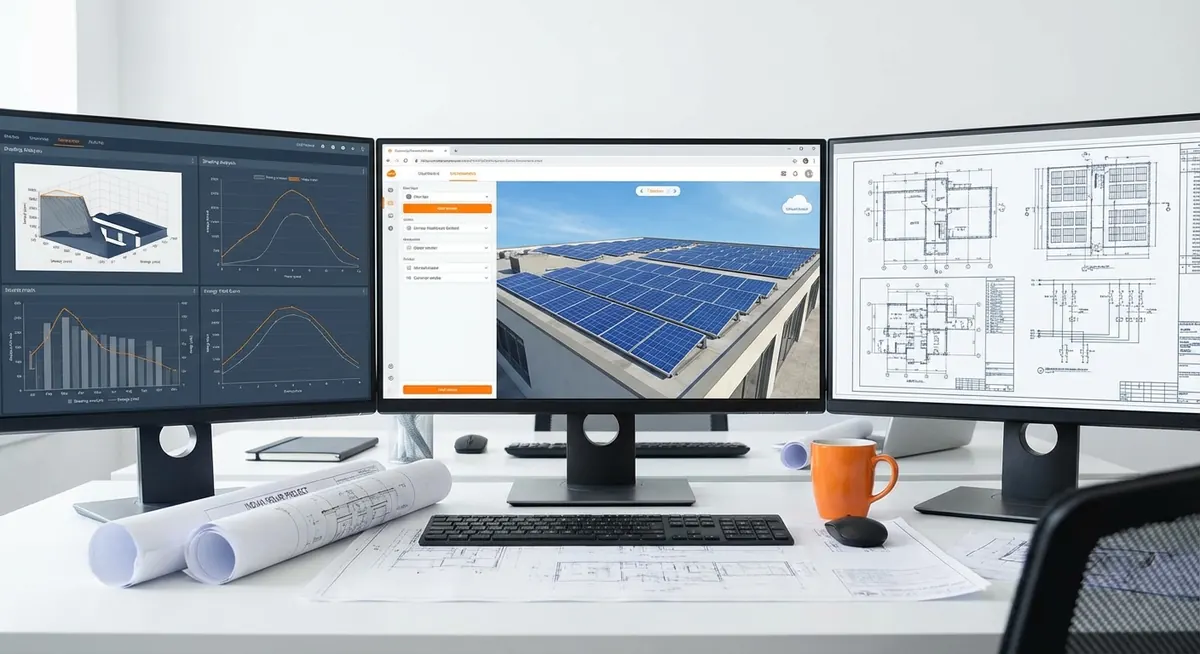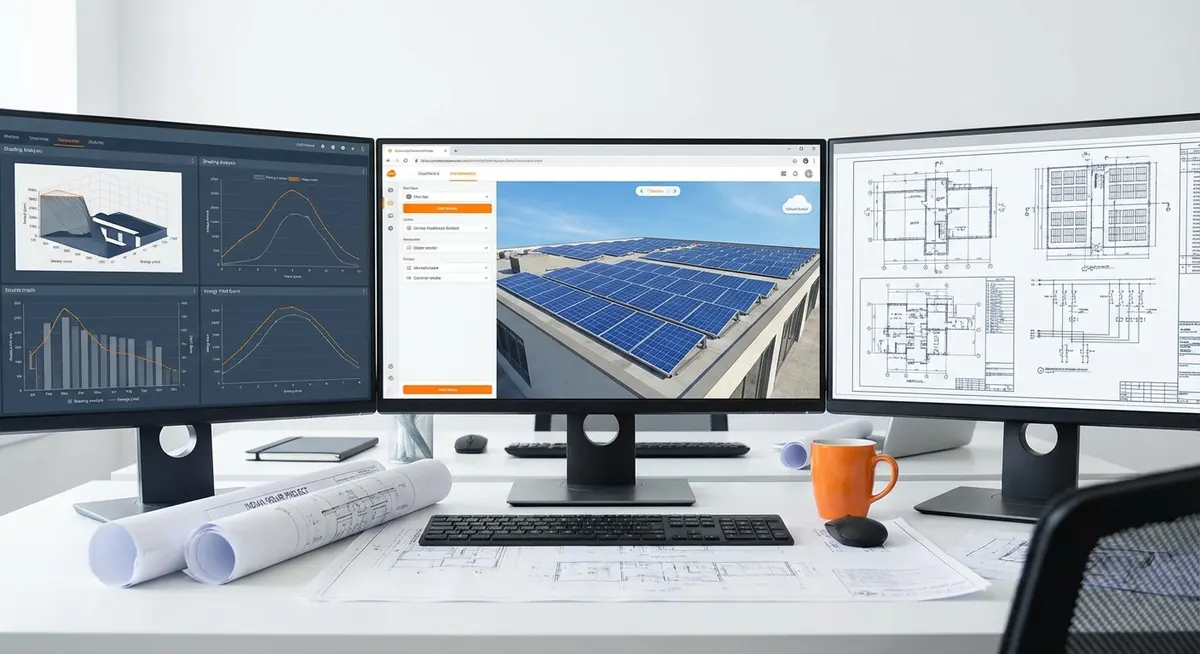
Floating solar is not a ground-mount simulation with water underneath. The physics are different enough that a standard PVsyst template produces results that independent engineers reject on sight. Water albedo, suppressed soiling due to moisture, cooling from evaporation, tilt constraints from the pontoon system, and wake effects on a water surface all require specific inputs that the software does not automatically account for. If you are preparing a bankable PVsyst report for a floating solar project — whether on a reservoir, irrigation canal, or industrial pond — this tutorial covers every non-standard configuration step.
Direct answer. Configuring PVsyst for floating solar requires four non-standard settings: (1) water albedo of 0.05–0.10 replacing the default 0.20 land albedo for monofacial arrays, or 0.07–0.12 for bifacial rear-side with shallow-water reflection; (2) reduced soiling loss of 1.0–2.0% per month instead of the land-site default; (3) Faiman thermal model activated with lower U0/U1 coefficients to capture evaporative cooling (typically 5–10°C cell temperature reduction vs ground-mount); and (4) tilt angle constrained to the pontoon design range, typically 10–15°. Using ground-mount defaults on a floating site inflates P50 yield by 2–4% through albedo error alone, which is sufficient to trigger IE re-simulation.
India has over 600 GW of water body surface area suitable for floating solar, according to MNRE’s floating solar potential assessment. The future of floating solar power plants in India is significant — but the bankability of every project starts with an accurate energy yield model. This tutorial walks through each PVsyst configuration step with the exact menu paths and recommended parameter values.
Why Floating Solar Needs Its Own PVsyst Configuration
The core difference between floating and ground-mount PVsyst modelling comes down to three physical phenomena that water bodies create:
First, albedo from water is lower than from land. Water is a specular reflector, not a diffuse reflector. The PVsyst albedo input represents diffuse (Lambertian) reflectance. For water surfaces at typical solar angles (30–70°), the diffuse albedo is 0.05–0.10 — significantly lower than the software default of 0.20 (green vegetation). For monofacial modules at water level, this means the albedo contribution to irradiance is lower than on land. For bifacial modules, the effective rear-surface albedo depends on water depth, turbidity, and pontoon geometry.
Second, soiling is suppressed. Dust deposition is reduced near water bodies because ambient humidity suppresses particle adhesion and periodic moisture from dew or mist passively cleans panels. Field data from top floating solar power plants in India shows soiling rates of 0.8–2.0%/month compared to 3–6%/month for dry-land sites in comparable climates.
Third, module temperatures are lower. Evaporative cooling from the water surface reduces the heat island effect that surrounds land-based arrays. Field measurements from NTPC’s Ramagundam floating solar project (50 MW) and THDC’s Tehri project report cell temperatures 4–8°C lower than equivalent ground-mount arrays in the same climate, translating to 1.5–3% higher energy yield.
Step 1 — Setting the Correct Albedo for Water Surfaces
Navigate to Project Settings → Site and Meteo → Albedo in PVsyst. The default is 0.20. Change this based on your array configuration:
Definition. Albedo in PVsyst represents the diffuse reflectance of the surface beneath the array. For floating solar, this is the water surface reflectance, which varies from 0.04 (deep, dark water, high sun angle) to 0.30 (shallow, turbid water, low sun angle). The effective annual average for simulation purposes is 0.06–0.10 for most Indian reservoir sites.
| Array Type | Water Condition | Recommended Albedo | Notes |
|---|---|---|---|
| Monofacial, any tilt | Deep, clear water | 0.06 | Deep water absorbs most light |
| Monofacial, any tilt | Shallow, turbid | 0.10 | Bottom reflection adds to diffuse |
| Bifacial, rear gap > 0.5 m | Deep, clear water | 0.08 | Rear-side gain partially offset by low albedo |
| Bifacial, pontoon with white floor | Reflective pontoon | 0.20–0.35 | Use pontoon reflectance, not water albedo |
| Canal-top, cover > 60% of surface | Covered canal | 0.15 | Mix of water + canal wall reflectance |
Field tip. If you are modelling bifacial floating modules with a white or light-coloured pontoon deck, measure the pontoon surface reflectance using a portable albedometer at noon on a clear day. Pontoon material albedo (0.25–0.55 for white HDPE) is more relevant to rear-side yield than water albedo for most floating array geometries.
The financial impact of albedo error: on a 10 MW bifacial floating project, changing albedo from 0.20 (incorrect default) to 0.08 (correct for deep water) reduces bifacial gain from approximately 6% to 3.5% — a 2.5% reduction in annual P50 yield. At ₹3.5/kWh and 22 MUs/year, this is ₹19 lakh/year of phantom revenue that will be flagged by the IE.
Step 2 — Configuring Soiling Loss for a Water Environment
Floating solar arrays experience substantially lower soiling than land-based systems. The mechanism: ambient relative humidity near water bodies is typically 15–25% higher than inland sites, which increases the cohesion of dust particles with dew-moistened glass surfaces — but simultaneously increases the frequency of natural cleaning events (morning dew, occasional rain, mist from water surface).
In PVsyst, navigate to System Losses → Soiling Loss and enter monthly values:
| Month | Rajasthan Reservoir | Tamil Nadu Reservoir | Maharashtra Canal |
|---|---|---|---|
| January | 1.5% | 0.8% | 1.0% |
| February | 2.0% | 1.0% | 1.5% |
| March | 2.5% | 1.2% | 2.0% |
| April | 2.5% | 1.5% | 2.0% |
| May | 2.0% | 1.5% | 1.8% |
| June | 0.5% | 0.3% | 0.5% |
| July | 0.3% | 0.2% | 0.3% |
| August | 0.3% | 0.2% | 0.3% |
| September | 0.5% | 0.3% | 0.5% |
| October | 1.0% | 0.6% | 0.8% |
| November | 1.2% | 0.7% | 1.0% |
| December | 1.5% | 0.8% | 1.0% |
These values are conservative estimates based on field data from existing Indian floating solar installations. A site-specific soiling campaign using pyranometer loggers on clean and uncleaned panels provides the most defensible numbers for a lender submission.
1.4%
Avg annual soiling, floating (India)
NTPC Ramagundam field data, 2024
4.8%
Avg annual soiling, ground-mount (Rajasthan)
Bridge to India soiling database, 2024
3.4%
Soiling advantage (floating vs ground)
Comparative, same climate zone
Step 3 — Activating the Faiman Thermal Model for Evaporative Cooling
The default NOCT thermal model in PVsyst uses a fixed temperature coefficient without wind speed correction. The Faiman model — the more physically accurate alternative — accounts for convective heat transfer, which is enhanced by the air flow over water surfaces and by evaporative cooling of the pontoon system.
To activate the Faiman model: go to Advanced Simulation → Detailed Losses → Thermal Loss Factor and select “Faiman Model.” Enter the parameters:
| Parameter | Ground-Mount Default | Floating Solar Recommended |
|---|---|---|
| U0 (constant heat loss factor) | 25 W/m²/K | 29 W/m²/K |
| U1 (wind-dependent factor) | 6.3 W/m²/K/(m/s) | 8.0 W/m²/K/(m/s) |
The higher U0 and U1 values for floating solar reflect the additional cooling from water evaporation and enhanced convection over open water surfaces. Field validation from the NREL floating solar technical review (2022) confirms that open-rack floating modules operate 5–8°C cooler than ground-mount equivalents at similar irradiance and ambient temperature.
Field tip. Do not use NOCT values from the module datasheet for floating applications — NOCT is measured under standard land conditions (1 m/s wind, 800 W/m² irradiance, 20°C ambient). The effective NOCT for a floating module is typically 40–43°C vs 44–46°C for ground-mount, because of the water cooling effect. Use the lower effective NOCT when the Faiman model is not available.
The yield benefit: at a typical Indian summer peak of 42°C ambient and 900 W/m² GHI, a ground-mount module reaches 72°C cell temperature using NOCT = 45°C. A floating module at the same conditions reaches 64–67°C with the evaporative cooling effect modelled. At a power temperature coefficient of -0.35%/°C (standard for monofacial PERC), the 5–8°C difference translates to 1.75–2.8% higher peak power — which compounds to approximately 1.0–1.8% in annual energy yield.
Step 4 — Setting Tilt Angle Constraints for Pontoon Systems
Most floating solar pontoon systems use tilt angles of 10–15°. Some canal-top systems use lower tilts of 5–8°. The tilt is constrained by:
- Pontoon structural stability at higher tilt angles (wind uplift increases with tilt)
- Mutual shading between rows at low GCR (ground coverage ratio) values typical on water
- Self-cleaning requirements — steeper tilts aid dust shedding, but the reduced soiling advantage of floating reduces this benefit
Watch out. Running a PVsyst tilt optimisation for a floating project without constraining the tilt range to the pontoon system's structural limits will produce an optimal tilt recommendation (typically 22–28° for India) that the pontoon design cannot achieve. This creates a discrepancy between the simulation and the actual installation tilt that will be flagged by the structural engineer and the IE.
In PVsyst, set the tilt under System → Array → Orientation → Tilt. For floating systems, use the pontoon manufacturer’s specified tilt. For pre-feasibility models where the pontoon system has not been selected, model three scenarios:
| Tilt Scenario | Annual GHI Capture (vs optimal) | Application |
|---|---|---|
| 10° (typical canal-top) | -3.5 to -5.0% vs optimal | Canal-top, high wind-load constraint |
| 12° (standard reservoir floating) | -2.5 to -3.5% vs optimal | Most Indian reservoir sites |
| 15° (elevated pontoon structure) | -1.5 to -2.5% vs optimal | Sites with structural capacity for higher tilt |
| 22–28° (true optimal for India) | Reference 0% | Not achievable for most floating pontoons |
Step 5 — Handling the Near-Shading Scene for Floating Arrays
The 3D near-shading scene for floating solar differs from ground-mount in two key ways: the array is typically arranged in a circular or rectangular island pattern rather than infinite rows, and the array edges interact differently with the surrounding water surface.
The key setup steps:
- Import the pontoon layout coordinates from the floating solar vendor’s CAD file. Do not use the PVsyst default rectangular array tool — it does not capture the island-pattern geometry.
- Set the ground plane to the water surface — the reflectance of the ground plane in the 3D scene should be set to the water albedo value from Step 1.
- Use “module string” shading rather than “linear” shading to correctly model the electrical impact of partial shading on pontoon-mounted strings where all strings are typically oriented in the same direction.
- Verify GCR against the pontoon specifications — floating arrays typically have GCR (ground coverage ratio) of 0.30–0.45, which is lower than optimised ground-mounts at 0.40–0.55, to allow maintenance access and wind load distribution.
Note. For large floating arrays (above 10 MW) arranged in multiple interconnected island modules, the near-shading scene should model each island as a separate array block and verify that the inter-island spacing reflects the actual installation plan. Island-to-island shading can reduce edge-module yield by 1–2% if islands are placed too closely together.
The 4-Step Floating Solar Albedo Protocol
The core of accurate floating solar PVsyst modelling is a structured albedo characterisation process. The 4-Step Floating Solar Albedo Protocol ensures the albedo input reflects actual site conditions rather than software defaults.
Water Body Characterisation
Measure water depth, turbidity (Secchi depth), and colour at the array footprint. Shallow, turbid, light-coloured water has higher albedo (0.10–0.15); deep, clear, dark water has lower albedo (0.04–0.07).
Pontoon Surface Assessment
Measure or obtain from the pontoon manufacturer the deck surface reflectance. White HDPE pontoons: 0.45–0.55. Grey or dark pontoons: 0.15–0.25. Calculate the area-weighted average albedo of water + pontoon deck that the rear side of bifacial modules "sees."
Seasonal Variation Modelling
Indian reservoirs show seasonal water level variation of 2–8 metres between monsoon (high water, maximum cover, lowest albedo from depth) and summer (low water, exposed mud banks, higher albedo from silt). Model monthly albedo where seasonal variation exceeds 0.05.
PVsyst Input and Sensitivity Analysis
Enter the characterised albedo value(s) into PVsyst. Run a sensitivity analysis at ±0.05 albedo to quantify the impact on bifacial gain. Document the basis for the albedo value in the simulation report appendix with the measurement methodology.
Meteo Data Selection for Floating Solar Sites
Floating solar sites — especially on reservoirs and canals — often sit at GPS coordinates where standard meteo datasets have reduced accuracy because of the microclimate effects of the water body. Reservoirs can create local humidity domes that suppress afternoon GHI through increased cloud formation in summer months. According to Solargis’s floating solar data methodology, microclimate corrections for large tropical reservoirs can reduce bankable GHI estimates by 1–3% compared to standard land-based satellite data at the same coordinates.
Definition. For floating solar, use Solargis Prospect TMY data at the GPS coordinates of the array centre. For reservoirs larger than 50 km², request the Solargis microclimate correction which accounts for the lake-effect humidity impact on GHI. This correction reduces GHI by 1–3% in summer months for large tropical reservoirs.
The comparison of meteo data sources for floating solar:
| Source | Accuracy | Floating Microclimate Correction | Cost | IE Acceptance |
|---|---|---|---|---|
| Solargis Prospect TMY | ±2% GHI | Available on request | Paid | Universal |
| Meteonorm 8.x | ±3% GHI | Not available | Paid (bundled with PVsyst) | Universal |
| NASA POWER | ±5–8% GHI | Not available | Free | Pre-feasibility only |
| On-site pyranometer (1 year) | ±0.5% | Captures actual microclimate | Field cost | Highest credibility |
For SECI tenders and IREDA-financed floating solar projects above 20 MW, Heaven Designs recommends commissioning a 12-month on-site irradiance monitoring campaign using a reference pyranometer, with Solargis Prospect as the concurrent satellite dataset. The comparison between on-site and satellite data allows validation of the Solargis TMY and establishes the site uncertainty factor for P90 calculation.
Bifacial Floating Solar — Rear-Side Yield Calculation
Bifacial modules on floating platforms require special attention in the rear-side yield calculation. The standard PVsyst bifacial model assumes the rear side sees a uniform ground reflectance (albedo) over a flat surface. On a floating array, the rear side sees:
- Water surface between pontoon rows (low specular albedo)
- Pontoon deck surface (potentially high diffuse albedo)
- Sky view from the edges of the array (relevant for modules at the array perimeter)
Field tip. For bifacial floating arrays, model the rear-side albedo as the area-weighted average of water albedo (multiplied by the fraction of rear-side view that is water) and pontoon deck albedo (multiplied by the deck fraction). A typical geometry with 60% water / 40% pontoon deck gives an effective albedo of 0.60 × 0.07 + 0.40 × 0.40 = 0.042 + 0.16 = 0.20 — which happens to match the software default, but for different reasons than assumed.
The view factor approach: if you have the pontoon layout dimensions, calculate the rear-side view factor to water vs pontoon deck using the separation distance between the module rear and the surface below. Most floating pontoon systems have a module-to-surface gap of 0.3–0.8 m. At 0.5 m gap with 2.5 m module length (portrait orientation), approximately 70–75% of the rear-side view factor falls on the area directly below — which in an island layout is primarily pontoon deck, not water.
Comparing Ground-Mount vs Floating PVsyst Configuration
| Parameter | Ground-Mount Standard | Floating Solar Correction | P50 Impact |
|---|---|---|---|
| Albedo | 0.20 (vegetation default) | 0.06–0.12 (water) | -1.5 to -2.5% for bifacial |
| Soiling loss | 3.0–8.0%/year | 1.0–2.0%/year | +1.0 to +3.0% |
| Thermal model | NOCT default | Faiman with lower U0/U1 | +1.0 to +2.0% |
| Tilt angle | 22–28° (optimised) | 10–15° (pontoon constrained) | -2.0 to -4.0% |
| Meteo dataset | Standard TMY | Microclimate-corrected TMY | ±1.0 to ±2.0% |
Verdict. When all corrections are applied, floating solar projects in India show P50 yields 2–5% higher than equivalent land-mounted arrays at the same site — driven primarily by the soiling and thermal advantages outweighing the albedo reduction and tilt constraint. This yield premium is what makes floating solar financially viable for reservoir sites where land costs are high and water availability reduces O&M cleaning costs.
Need a bankable PVsyst report for your floating solar project?
Heaven Designs delivers floating solar PVsyst simulations with water albedo characterisation, Faiman thermal model, pontoon-constrained tilt, and IE-ready appendix documentation.
Get the sample pack →How Heaven Designs Helps
Floating solar PVsyst modelling requires site-specific characterisation that most EPC teams do not have in-house. The standard approach — adapting a ground-mount PVsyst template — produces results that IEs reject at the first review. Heaven Designs has developed a floating-specific modelling workflow used on projects from 1 MW canal-top to 50 MW reservoir installations.
- Bankable PVsyst Reports — floating solar variant with water albedo protocol, Faiman thermal model, and soiling characterisation.
- Solar Ground Mount Design — extended to floating platform geometry, pontoon layout coordinates, GCR calculation for water bodies.
- Site Survey & Land Feasibility — includes water body bathymetric survey, albedometer measurement, and pontoon structural site assessment.
- MW-Scale PMC — owner’s engineer for floating solar EPC contracts, including IE review management.
- Download a sample deliverable — floating solar PVsyst report sample with annotated input settings.
Contact us to discuss your floating solar project. We deliver the first simulation iteration within 5 business days.
FAQ
What albedo value should I use for a floating solar project in PVsyst?
For monofacial modules on deep, clear Indian reservoirs, use 0.06–0.08. For shallow, turbid reservoirs, use 0.08–0.12. For bifacial modules, calculate the area-weighted average of water albedo and pontoon deck albedo based on the rear-side view factor geometry. Never use the default 0.20 for water-surface floating arrays without supporting measurement data.
How much does evaporative cooling improve floating solar performance?
Field data from NTPC Ramagundam and other Indian floating installations shows module cell temperatures 5–8°C lower than equivalent ground-mount arrays in the same climate. At a typical power temperature coefficient of -0.35%/°C for monofacial PERC, this translates to approximately 1.75–2.8% higher peak power output, which compounds to 1.0–1.8% in annual P50 yield improvement.
Why is the tilt angle lower for floating solar than ground-mount?
Floating pontoon systems constrain tilt to 10–15° because of structural stability considerations — higher tilts increase wind uplift forces on the array, which creates dynamic loading on the pontoon anchoring system. Additionally, higher tilts increase inter-row shading on water where GCR is typically lower than optimised ground-mount. The yield cost of the lower tilt (2–4% vs ground-mount optimal) is partially offset by soiling and thermal advantages.
Can I use the same meteo data for floating solar as I use for ground-mount at the same location?
Standard Solargis or Meteonorm TMY data is acceptable for most floating solar sites below 20 MW. For large reservoirs (above 50 km² area) or canal projects where the water body creates a measurable humidity microclimate, request the Solargis microclimate correction or commission an on-site pyranometer measurement. The on-site measurement is the most defensible option for IREDA-financed projects.
How do I model a floating solar project with bifacial modules in PVsyst?
Activate the bifacial module option in PVsyst under System → Array → Bifacial Module. Enter the bifacial factor from the module datasheet (typically 0.70–0.80 for standard bifacial PERC). Set the rear-side albedo to the area-weighted average of water and pontoon deck reflectance. Enable the Perez rear-side irradiance model. Run a sensitivity analysis at ±0.05 rear albedo and document the bifacial gain range in the simulation appendix.
What is the difference in soiling rates between floating and ground-mount solar?
Floating solar arrays experience 1.0–2.0%/year annual soiling loss compared to 3.0–8.0%/year for dry-land sites in comparable Indian climates. The reduction comes from higher ambient humidity near water bodies (which reduces dust particle adhesion) and from occasional natural cleaning from dew or mist. This soiling advantage contributes approximately 1.5–3.5% to the floating solar yield premium over ground-mount.
Does the open access solar mechanism apply to floating solar projects?
Yes. Floating solar projects qualify for open access under state electricity regulatory commission rules if they meet the applicable capacity thresholds. The MNRE floating solar guidelines and the CEA Connectivity Regulations 2019 both accommodate floating solar as a standard renewable energy source. The PVsyst simulation and DPR requirements are the same as for ground-mount open access projects, with the floating-specific adjustments described in this article. According to IRENA’s floating solar technical assessment, floating PV is one of the fastest-growing renewable energy sub-sectors globally, with India targeting 10 GW by 2030.