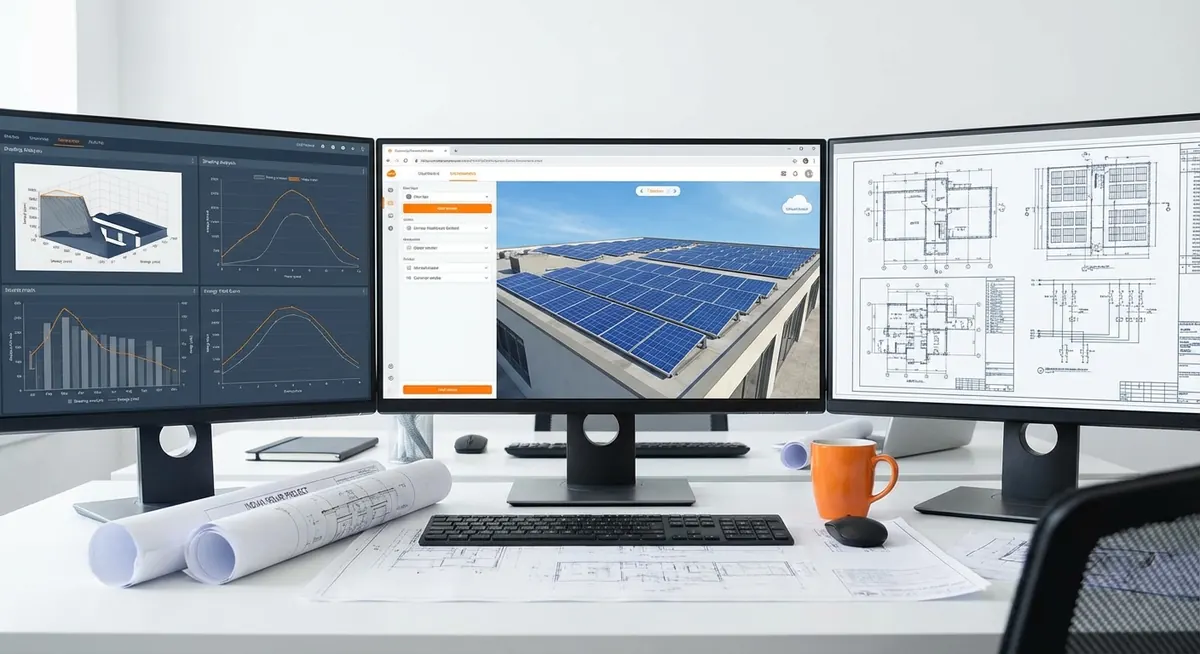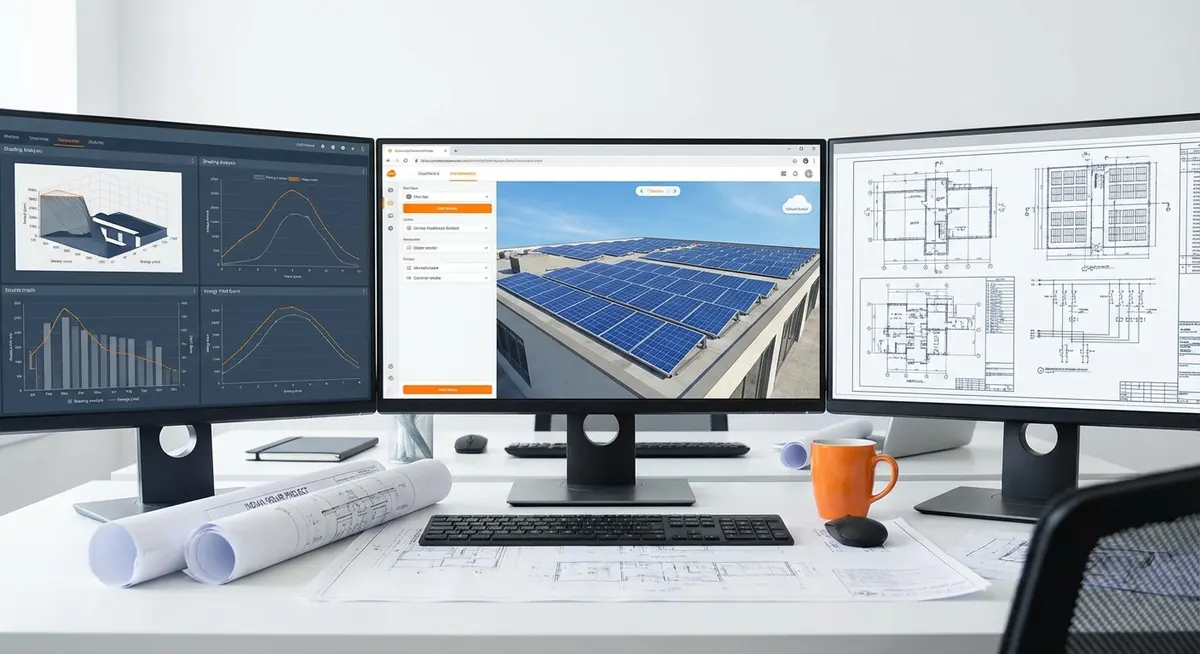
The PVsyst loss diagram — the waterfall chart that runs from gross irradiance on the collector plane down to final AC energy delivered — is the single most important exhibit in a bankable independent energy report (IEA). Independent engineers review each loss percentage and compare it against benchmarks for the site type, climate zone, and system configuration. A loss category that sits outside the accepted benchmark range will trigger a comment in the IE review, a sensitivity factor adjustment, and potentially a revised P50/P90 that affects the financeable loan quantum.
Understanding what each loss category represents, what the normal range is for different project types, and which levers the design engineer controls is essential for producing a simulation that passes IE review on the first submission — and for making system design decisions (cleaning frequency, monitoring budget, inverter sizing) that maximize production over the project’s 25-year life.
Direct answer. The PVsyst loss diagram breaks the energy conversion chain from incident irradiance to final AC output into 10–15 individually modeled loss categories. Bankable IEA simulations for Indian and global utility-scale projects use this diagram as the primary evidence in lender due diligence. Total system losses for a well-designed utility-scale ground-mount project in India typically range from 18–26%, leaving 74–82% of incident irradiance converted to delivered AC energy (PR 0.74–0.82). The six categories with the largest independent impact on total yield are: soiling, thermal losses, module quality (LID/mismatch), inverter efficiency, DC wiring, and availability.
How PVsyst Structures the Loss Chain
PVsyst calculates the loss diagram in two stages:
-
Irradiance-to-DC energy: Converting incident plane-of-array irradiance to DC energy at the module terminals, accounting for all losses that occur before the inverter.
-
DC-to-AC energy: Converting DC energy at the inverter input to AC energy at the inverter output, including inverter efficiency losses and AC-side losses.
The final Performance Ratio (PR) is the ratio of actual AC energy delivered to the ideal energy output if the system operated at Standard Test Conditions (STC) throughout the year. PR is the summary metric — but the loss diagram is the proof behind it.
Performance Ratio defined. PR = E_AC / (G_POA / G_STC × P_STC), where E_AC is annual AC energy delivered, G_POA is annual plane-of-array irradiance, G_STC is 1,000 W/m² (STC reference), and P_STC is DC nameplate capacity at STC. PR normalizes production for the irradiance level, allowing direct comparison of system performance across sites with different solar resources. A well-designed 10 MW Indian ground-mount project should achieve PR 0.76–0.82 on first-year commissioning. PR below 0.72 warrants input review before IEA submission.
The Loss Diagram Framework — 11 Loss Categories
The framework below maps each PVsyst loss category to its typical range, the primary design and site variables that drive it, and the benchmark reference for bankable IEA review.
Horizon/Far Shading
Long-distance terrain or structural features that block the sun for part of the day. Modeled from a horizon profile file. Site-specific; often near-zero for flat open sites.
Near Shading (Optical)
Inter-row shading and near-object shading on the irradiance reaching the module surface. Determined by 3D scene geometry, tilt, pitch, and row configuration. The primary lever is pitch-to-height ratio.
IAM (Incidence Angle Modifier)
Reduction in module output when sunlight arrives at oblique angles. Particularly significant for morning and evening hours. Uses the module-specific IAM curve from the .pan file.
Soiling Loss
Dust, bird droppings, and particulate accumulation on the module surface. Configurable monthly. The single most variable loss category across sites and regions. Critical for India and MENA.
Thermal Loss
Reduction in module efficiency as operating temperature rises above STC 25°C. Governed by Uc (constant heat loss) and Uv (wind-speed-dependent) thermal coefficients and module temperature power coefficient.
Module Quality (LID + Mismatch)
Light-Induced Degradation (LID) reduces module output in the first hours/days of exposure. Mismatch reflects the statistical distribution of module power across the fleet — not all modules at exact nameplate. Together typically 1.5–3%.
DC Wiring / Ohmic Losses
Resistive losses in DC cables between modules and inverter/combiner. Determined by cable sizing, string lengths, and current. Bankable target: 0.5–1.5% for well-designed large systems.
Inverter Losses
Conversion losses from DC to AC in the inverter, including partial-load efficiency penalties. PVsyst uses the full inverter efficiency curve (hourly simulation); peak efficiency typically 97–99%; weighted annual loss 2–4%.
AC Wiring / Transformer Losses
Resistive losses in AC cables and transformer iron/copper losses. Typically 0.5–1.5% for string inverter systems; up to 2–3% for central inverter systems with long MV cable runs.
System Availability
Fraction of time the system is offline due to scheduled maintenance, inverter faults, or grid curtailment. PVsyst allows separate scheduled and unscheduled availability inputs. Bankable range: 97–99% annual availability.
Degradation (Annual)
Annual decline in module output capacity due to UV exposure, thermal cycling, and other aging mechanisms. Industry standard: 0.4–0.5%/year for tier-1 monocrystalline PERC/TOPCon modules. PVsyst applies this across the 25-year simulation period.
Loss Benchmarks by System Type
| Loss Category | Utility-Scale India (Desert) | Utility-Scale India (Monsoon) | US Southwest Ground-Mount | US Northeast Ground-Mount | Acceptable Range |
|---|---|---|---|---|---|
| Far/horizon shading | 0.1–0.5% | 0.1–0.3% | 0.0–0.3% | 0.0–0.5% | 0–1.0% |
| Near shading (inter-row) | 1.5–3.0% | 1.5–3.0% | 1.5–3.0% | 2.0–4.0% | 1–5% |
| IAM | 2.5–3.5% | 2.5–3.5% | 2.5–3.5% | 3.0–4.0% | 2–5% |
| Soiling | 3.0–7.0% | 1.5–4.0% | 1.5–3.5% | 0.5–2.0% | Site-specific |
| Thermal | 4.0–7.0% | 3.5–5.5% | 3.0–6.0% | 2.0–4.0% | 2–8% |
| LID | 1.0–2.0% | 1.0–2.0% | 1.0–2.0% | 1.0–2.0% | 0.5–3% |
| Mismatch | 0.5–1.5% | 0.5–1.5% | 0.5–1.5% | 0.5–1.5% | 0.3–2% |
| DC wiring ohmic | 0.5–1.5% | 0.5–1.5% | 0.5–1.5% | 0.5–1.5% | 0.3–2% |
| Inverter efficiency | 2.0–3.5% | 2.0–3.5% | 2.0–3.5% | 2.0–3.5% | 1.5–4% |
| AC wiring/transformer | 0.5–1.5% | 0.5–1.5% | 0.5–1.5% | 0.5–1.5% | 0.3–2.5% |
| Availability | 1.0–3.0% | 1.0–3.0% | 1.0–2.0% | 1.0–2.0% | 1–3% |
| Total losses | 18–26% | 17–24% | 17–24% | 16–23% | 15–28% |
Red-flag ranges for IE review. Loss categories that routinely trigger IE comments: soiling below 1.0% for Indian sites without documented monthly cleaning (too optimistic); thermal losses below 2.5% for Rajasthan or Gujarat ground-mount in summer (physically implausible given ambient temperatures); availability above 99.5% for new projects without proven O&M track record (over-optimistic); PR above 0.85 for a first-year Indian ground-mount (requires justification if thermal and soiling parameters are conventional).
Soiling Loss Deep Dive — The Most Variable Category
Soiling is the loss category with the widest site-to-site variation and the most direct relationship to O&M protocol decisions. For Indian utility-scale projects, soiling loss is often the difference between a 78% and an 82% PR — a gap that represents real rupees in annual energy revenue.
Soiling Variables in PVsyst:
PVsyst allows monthly soiling input (twelve independent values, one per month). This monthly profile allows the simulation to reflect:
- Pre-monsoon dust accumulation peaks (April–June in northern India)
- Post-monsoon cleaning effect (lower soiling in October–November)
- Winter fog and dew soiling patterns in northern plains
- Year-round high soiling in desert sites (Rajasthan, Kutch)
India Soiling Benchmarks by Region:
| Region | Annual Average Soiling | Pre-Monsoon Peak | Post-Monsoon Low | Cleaning Frequency Required for 2% Target |
|---|---|---|---|---|
| Rajasthan (desert) | 4.0–8.0% | 8–12% (May) | 1–2% (October) | Every 7–10 days |
| Gujarat (Rann of Kutch) | 5.0–9.0% | 9–14% | 1.5–3% | Every 7–10 days |
| Karnataka (Bellary area) | 2.0–4.0% | 3–5% | 1–2% | Every 14–21 days |
| Tamil Nadu (coastal) | 1.5–3.0% | 2–4% | 0.5–1.5% | Every 21–30 days |
| Andhra Pradesh | 2.0–4.5% | 3–7% | 1–2% | Every 14–21 days |
| Maharashtra (Vidarbha) | 2.5–5.0% | 4–7% | 1–2% | Every 14–21 days |
Soiling–O&M linkage tip. The soiling loss assumption in a PVsyst simulation should be explicitly tied to the O&M cleaning frequency specified in the O&M contract. If the simulation assumes 2% annual soiling loss (corresponding to bi-weekly cleaning in Rajasthan) but the O&M contract specifies monthly cleaning, the simulated soiling is inconsistent with the contracted maintenance protocol. IEs reviewing IREDA-funded projects routinely cross-check the simulation's soiling assumption against the O&M contract schedule — a discrepancy will trigger a correction request.
Soiling Optimization — Cleaning Frequency vs. Water Cost
The optimal cleaning frequency for a given site is where the marginal revenue from the incremental production gain equals the marginal cost of the additional cleaning cycle. For a 10 MW project in Rajasthan:
- One cleaning cycle: 5–8 minutes/MW/cleaning for robotic cleaning, 15–20 minutes/MW for manual water washing
- Cost per cleaning cycle: approximately ₹15,000–25,000 for a 10 MW manual wash; ₹8,000–12,000 for robotic system
- Revenue per 1% soiling loss recovery: approximately ₹2–3 lakh/year for a 10 MW project at ₹3.50/kWh PPA rate
The math typically supports cleaning every 7–10 days in high-soiling desert sites and every 21–30 days in moderate-soiling sites. This cleaning interval should be the input assumption in the PVsyst monthly soiling profile.
Thermal Loss Deep Dive — Temperature Coefficient and Uc/Uv
Thermal losses represent the efficiency reduction as module cell temperature rises above the 25°C STC reference. For hot-climate sites (India, MENA, US Southwest), thermal losses are the second-largest loss category after soiling.
PVsyst Thermal Model:
PVsyst calculates cell temperature from ambient temperature using two thermal coefficients:
- Uc (constant loss factor): heat transfer in W/m²·°C, independent of wind speed. Represents the still-air thermal behavior of the mounting configuration.
- Uv (wind-related factor): additional heat transfer in W/m²·°C per m/s of wind speed.
Cell temperature Tc = T_ambient + (G_POA / (Uc + Uv × Vwind)) × (1 − η_module)
Uc/Uv Benchmarks by Mounting Configuration:
| Mounting Type | Uc | Uv | Notes |
|---|---|---|---|
| Free-standing (open-rack ground-mount) | 25–29 | 1.2–2.0 | Best thermal performance; open air circulation |
| Rooftop with 10+ cm gap | 20–25 | 1.5–2.0 | Gap allows convective cooling |
| Rooftop flush-mount (< 5 cm gap) | 15–20 | 0.5–1.5 | Worst thermal performance; highest temperature rise |
| Single-axis tracker (open) | 25–29 | 1.2–2.0 | Similar to free-standing; wind matters more |
| BIPV/integrated | 10–15 | 0.5–1.0 | Highest operating temperatures |
For a 10 MW Rajasthan ground-mount with Uc = 29, Uv = 1.5, and an average summer ambient temperature of 42°C, the module operating temperature at 1,000 W/m² and 3 m/s wind is approximately 65–70°C. At a typical PERC temperature coefficient of -0.34%/°C, this represents an efficiency loss of approximately 14% relative to STC — an instantaneous loss, but the annual average thermal loss figure in PVsyst will be 4–7% depending on the seasonal temperature profile.
| Parameter | PERC (mono) | TOPCon | HJT (heterojunction) | N-type Bifacial |
|---|---|---|---|---|
| Temperature coefficient (Pmax) | -0.34 to -0.37%/°C | -0.29 to -0.33%/°C | -0.24 to -0.26%/°C | -0.28 to -0.32%/°C |
| Thermal advantage over PERC | Baseline | 10–15% less thermal loss | 25–30% less | 15–20% less |
| NOCT | 43–46°C | 43–45°C | 43–45°C | 43–45°C |
For hot-climate utility-scale projects, the thermal coefficient is one of the strongest arguments for TOPCon or HJT modules over PERC — the difference of 0.05–0.12%/°C in temperature coefficient translates to 0.3–0.8% in annual yield for a hot Indian site, which compounds across 25 years of production.
Module Quality Losses — LID, Mismatch, and Power Guarantee
PVsyst separates module quality losses into two components:
LID (Light-Induced Degradation):
LID occurs during the first hours of exposure to sunlight, when boron-oxygen complexes in p-type silicon form acceptor states that reduce carrier lifetime. For standard p-type PERC modules, LID is typically 1.0–2.0% of initial STC power. For n-type TOPCon and HJT modules, LID is effectively zero (these use n-type silicon which does not exhibit the same boron-oxygen mechanism).
The PVsyst LID input is a single percentage that represents the first-year power loss relative to nameplate. Standard values:
- p-type PERC: 1.0–2.0%
- TOPCon (n-type): 0.0–0.5%
- HJT: 0.0–0.3%
- Bifacial PERC (p-type): 1.0–2.0% (same as mono PERC; bifacial does not eliminate LID)
Mismatch:
Mismatch represents the power loss from connecting modules with slightly different Vmp or Imp values in the same string or array. Even within a “flash-sorted ±3%” power tolerance bin, modules have small differences in V-I characteristics that cause the MPPT to operate at a compromise point.
Bankable mismatch values:
- Standard flash-sorted Tier-1 supply (±3% tolerance): 0.5–1.0%
- Premium flash-sorted (±1.5% bin): 0.3–0.5%
- Worst-case poorly matched modules: 1.5–3.0%
For bankable IEA purposes, the combined LID + mismatch value should be explicitly stated and justified by the manufacturer’s LID test report and the procurement specification’s flash-sort tolerance.
DC Wiring Losses — Cable Sizing and Ohmic Loss Calculation
DC wiring losses in PVsyst represent the resistive (I²R) heat dissipation in DC cables between the module string outputs and the inverter DC input terminals.
PVsyst DC Wiring Loss Configuration:
PVsyst accepts two input modes:
- Global loss fraction — a single percentage applied to all DC energy (simpler; used for early-stage simulations)
- Per-segment cable sizing — specify cable cross-section, length, and current for each circuit segment (string cables, main cables, combiner output cables); PVsyst calculates resistance and ohmic loss
For a bankable IEA, per-segment cable sizing is strongly preferred. The derivation:
- At STC: I = P_module × Isc_ratio (typically 1.05 × Isc for continuous rating)
- Resistance per segment: R = ρ × L / A (ρ = 0.0172 Ω·mm²/m for copper, 0.0285 for aluminum)
- Voltage drop: V_drop = I × R
- Loss fraction: P_loss / P_string = I² × R / (V_mp × I_mp)
Bankable DC wiring loss target: 0.5–1.5%. Values above 2.0% indicate under-sized cables or excessively long runs that should be remediated in the design stage.
Design implication. The DC wiring loss calculation should drive cable sizing decisions in the detailed engineering phase. Upsizing string cables from 4 mm² to 6 mm² reduces resistive loss by 33% at the cost of 50% more copper. For strings longer than 30 meters, the yield improvement from 6 mm² cable typically pays back the incremental copper cost within 2–3 years — making it a positive-NPV design decision that should be reflected in the simulation's loss assumptions and in the BOQ.
Inverter Losses and Clipping Analysis
PVsyst models inverter efficiency using the manufacturer’s efficiency curve — a mapping of DC power input to AC power output efficiency at different load levels. Most modern string inverters achieve peak efficiency of 97.5–99.0% at 50–75% of rated DC input.
Clipping Loss — DC/AC Ratio:
When the DC array peak power exceeds the inverter nominal AC rating, the inverter limits output to its maximum AC power. The DC energy above this limit is “clipped.” PVsyst models this clipping explicitly as a separate loss entry in the loss diagram.
| DC/AC Ratio | Clipping Loss (India, high irradiance) | Annual Yield Impact |
|---|---|---|
| 1.0:1.0 (no oversizing) | 0.0% | Baseline |
| 1.1:1.0 | 0.3–0.8% | Slightly positive net yield from cheaper DC components |
| 1.2:1.0 | 1.0–2.5% | Commonly optimum in India; improved capacity utilization |
| 1.3:1.0 | 2.5–5.0% | High clipping; optimum only for low-irradiance sites |
| 1.4:1.0 | 5.0–9.0% | Excessive for most sites; requires explicit justification |
For Indian utility-scale ground-mount projects in high-irradiance states (GHI >5.5 kWh/m²/day), a DC/AC ratio of 1.15–1.25 is commonly the financial optimum: clipping loss of 1–3% is offset by the lower DC cost per unit of AC output. The PVsyst clipping analysis generates the exact clipping percentage for any DC/AC ratio — this should be the basis for the ratio selection in the pre-design report.
System Availability — Modeling Maintenance Downtime
Availability loss is often underestimated by design engineers focused on energy physics, but it is a critical component of the bankable yield calculation. PVsyst separates availability into:
- Scheduled downtime — planned maintenance windows, inverter servicing, cleaning-related shutdown
- Unscheduled downtime — unexpected inverter faults, protection trips, grid curtailment
For bankable IEA purposes, availability assumptions should reference the O&M contract terms:
| O&M Category | Typical Availability | Notes |
|---|---|---|
| New project, standard O&M | 98.5–99.0% | First year; some shakedown downtime |
| Established project, premium O&M | 99.0–99.5% | Mature O&M team; proactive monitoring |
| Remote site, basic O&M | 97.0–98.5% | Longer travel time for repairs; higher unscheduled downtime |
| Grid curtailment zones (India) | 96.0–98.0% | Additional to equipment availability; DISCOMs curtail heavily in some states |
Grid curtailment in India deserves specific attention for developers in states with high renewable penetration. Rajasthan, Gujarat, and Tamil Nadu have experienced significant curtailment events where grid constraints force solar plants to back-down output. For projects in these states, the availability loss input should separate equipment availability from curtailment risk — and curtailment risk should be separately analyzed in the financial model using DISCOM curtailment data.
Reading a PVsyst Loss Diagram — Red Flags and Optimization
Red Flags That Indicate Over-Optimistic Assumptions:
| Red Flag | Implication | Corrective Action |
|---|---|---|
| Soiling < 1.5% for Indian desert site | Implausible without documented RO-water robotic cleaning | Adjust monthly soiling profile to match cleaning contract |
| Thermal loss < 3.5% for Rajasthan summer | Under-stated ambient temperature or Uc too high | Verify ambient temperature data; use site-appropriate Uc/Uv |
| LID = 0.0% for p-type PERC modules | Missing mandatory first-year loss | Add manufacturer-specified LID (typically 1.0–2.0%) |
| Availability = 100% | Physically impossible for any operating project | Use minimum 98.0% for new projects |
| DC wiring loss < 0.3% | Under-representation of actual cable losses | Verify per-segment cable sizing calculation |
| PR > 0.85 | Extremely unusual; requires complete loss audit | Review all inputs against benchmarks |
Red Flags That Indicate Under-Optimistic Assumptions (also problematic):
| Red Flag | Implication | Corrective Action |
|---|---|---|
| Soiling > 8% without justification | Over-conservative; reduces bankable yield | Document site conditions or measured soiling data |
| Availability < 97% for standard project | Under-represents capable O&M | Reference equivalent O&M contract terms |
| Clipping > 5% | DC/AC ratio too high; design error | Resize array or inverter |
| Mismatch > 2.5% | Module procurement standard too loose | Reference flash-sort tolerance in procurement spec |
How Heaven Designs Documents PVsyst Simulations for Bankable IEA
11
Loss categories independently documented in every bankable IEA report
Heaven Designs internal standard, 2026
P50/P90
Both exceedance probabilities included in every utility-scale simulation
IREDA and IFC project finance standard
5–7
Business days for full PVsyst IEA report delivery
Heaven Designs turnaround SLA, standard ground-mount
For EPC companies and project developers needing bankable PVsyst simulations, Heaven Designs delivers IEA-ready reports with full loss diagram documentation, P50/P90 methodology, weather data provenance, and revision support when IE review comments arrive.
- Solar Rooftop Detailed Engineering Design — Full IFC pack including PVsyst bankable yield report, SLD, structural, and BOQ.
- Solar Ground Mount Design — Utility-scale PVsyst simulation with tracker yield, bifacial optimization, and full loss model.
- Solar 3D Pre-Design — 48-hour pre-design with initial yield estimate before committing to full PVsyst simulation budget.
- Site Survey and Land Feasibility — Irradiance measurement and site data collection as PVsyst input package.
Related: PVsyst vs Helioscope for Utility-Scale | PVsyst Soiling Loss Modeling India and Africa | PVsyst Bifacial Gain Modeling Tutorial | PVsyst Tracker Yield Study Methodology
Glossary: PVsyst, Performance Ratio, P50/P90.
The NREL solar power forecasting report establishes the uncertainty methodology framework referenced in PVsyst P50/P90 calculations. IEA Solar PV reports reference bankable yield assessment methodology in project finance contexts. The MNRE solar scheme guidelines and IREDA financing product documentation both reference independent energy reports as loan documentation requirements for utility-scale projects.
FAQ
What is the PVsyst loss diagram?
The PVsyst loss diagram is a waterfall chart that breaks the energy conversion pathway from incident plane-of-array irradiance to final AC output into individually modeled loss categories. Each category — soiling, thermal, IAM, near shading, LID/mismatch, DC ohmic, inverter, AC ohmic, availability — is expressed as a percentage of the energy at that stage in the chain. The final Performance Ratio (PR) is the ratio of AC output to the irradiance × nameplate capacity product. The loss diagram is the primary technical exhibit in an independent energy assessment (IEA) for project financing.
What is a good Performance Ratio for an Indian utility-scale project?
For a well-designed utility-scale ground-mount project in India (Rajasthan, Gujarat, Karnataka, Andhra Pradesh), a first-year PR of 0.76–0.82 is the bankable benchmark. PR above 0.82 for a hot-climate Indian site should be justified with supporting loss model inputs — it implies either unusually favorable thermal conditions, very low soiling, or TOPCon/HJT modules with better temperature coefficients. PR below 0.72 indicates either over-optimistic nameplate capacity assumptions, under-modeled losses, or a design issue (excessive clipping, poor cable sizing) that should be corrected before IEA submission.
How do I configure soiling loss in PVsyst for an Indian project?
In PVsyst, navigate to Project → Losses → Soiling and enter monthly soiling values. For an Indian utility-scale site, use measured soiling data if available, or reference published dustfall and soiling studies for the region. Rajasthan desert sites typically use 4–8% annual average with a peak of 8–12% in May and trough of 1–2% in October. Link the monthly soiling assumption to the cleaning frequency specified in the O&M contract — if the contract specifies 14-day cleaning, the soiling values should reflect the maximum accumulation expected in 14 days between cleanings.
What causes high thermal losses in PVsyst simulations for hot climates?
High thermal losses occur when ambient temperatures are high (>35°C consistently) and the Uc/Uv thermal coefficients are low (indicating poor heat dissipation). For Rajasthan ground-mount projects, thermal losses of 5–7% in summer months are physically correct — cell temperatures of 60–70°C at peak irradiance hours are expected. Reducing thermal losses requires either module technology choice (TOPCon/HJT with better temperature coefficients), mounting configuration that improves airflow (open-rack ground-mount with >30 cm clearance vs flush-mount), or accepting that the climate drives inherent thermal losses that cannot be engineered away.
Why does my PVsyst simulation show higher yield than Helioscope for the same project?
PVsyst and Helioscope can diverge for multiple reasons. If PVsyst shows significantly higher yield: (1) check that both tools use the same weather data source and irradiance dataset; (2) verify that Helioscope’s soiling, thermal, and availability assumptions are not more conservative than PVsyst’s; (3) confirm that both tools model the same DC/AC ratio and clipping behavior. If Helioscope shows significantly higher yield: (1) PVsyst may be applying more granular loss categories not modeled in Helioscope (spectral correction, LID, detailed IAM); (2) weather data sources may differ, especially for non-US sites. A divergence of more than 3% warrants an input-by-input reconciliation.
How should degradation be modeled in PVsyst for a 25-year yield report?
PVsyst applies degradation as an annual percentage reduction in DC nameplate power. Industry standard for Tier-1 monocrystalline PERC modules is 0.4–0.5%/year after the first year (which includes LID as a separate category). TOPCon and HJT modules are warrantied at 0.4%/year and sometimes lower in premium product lines. For a 25-year simulation: Year 1 output includes LID; years 2–25 apply the annual degradation rate. The cumulative effect of 0.5%/year degradation over 25 years represents approximately 11% lower output in Year 25 than Year 1 (compound, not simple). This degradation profile is the foundation of the project’s long-term P50 energy production schedule used in financial model debt service projections.
What availability loss is realistic for a new Indian solar plant?
For a new Indian utility-scale plant under standard O&M contract, 98.0–98.5% annual availability is the conservative-realistic benchmark. This accounts for 1.5–2.0% downtime from scheduled maintenance windows, inverter trips, protection relay testing, and occasional grid unavailability. For plants in grid-constrained zones with documented DISCOM curtailment (Rajasthan, Gujarat in certain grid conditions), availability for the yield calculation should separate equipment availability (98.5%) from grid curtailment (quantified separately based on state grid data). Claims of 99.5%+ availability for new plants without demonstrated O&M track record are typically flagged by independent engineers as over-optimistic.