


An EPC project manager in Pune once told us something that stuck: “We didn’t know what we were missing until the DISCOM rejected our interconnection application — three weeks before the scheduled commissioning date.” The missing item? A utility-specific single-line diagram that their design vendor had simply never included in the package. The project stalled. The client relationship suffered. The cost of that omission far exceeded the entire design fee.
That scenario plays out more often than it should across solar EPC companies in India and internationally. The root cause is almost always the same: no one defined the design deliverables upfront. When EPCs don’t know exactly what documents, drawings, and reports they should receive from their engineering partner, they can’t catch gaps until those gaps become expensive problems on site or at the permit office.
This guide gives you a complete, structured checklist of every solar design deliverable your engineering partner should hand over — organized by phase, with quality benchmarks and red flags to watch for at each stage. Whether you’re managing a 100 kW rooftop solar India project or a 10 MW ground-mount installation, this checklist applies.

What Solar Design Deliverables Actually Mean for EPCs
Design deliverables are the complete set of documents, drawings, calculations, and reports that an engineering partner produces and hands over to an EPC company at defined project milestones. They are not just “the drawings.” A full deliverables package covers everything from the initial site survey report through to permit-ready drawing sets, structural calculations, energy yield simulations, and as-built documentation.
The distinction matters because many EPCs receive partial packages and assume they are complete. A design vendor might deliver beautiful 3D layouts and a single-line diagram but omit the cable sizing schedule, the earthing design, or the structural load calculations. Each missing item creates a downstream risk: permit rejection, procurement errors, installation rework, or structural failure.
Design deliverables also vary by project type. A residential rooftop project in Maharashtra requires a different document set than a 5 MW ground-mount project in Rajasthan. Understanding what applies to your specific project type is the first step in setting clear acceptance criteria with your design partner and managing your project timeline effectively.
Why a Defined Deliverables List Protects Your Business
When you specify design deliverables in your engineering agreement, you create a contractual baseline. Your design partner knows exactly what to produce. Your project team knows exactly what to review. Your procurement team knows exactly what to reference for equipment ordering. And your site team knows exactly what drawings to work from during installation.
Without that baseline, you’re relying on your vendor’s interpretation of “a complete design package” — which may not match yours, your client’s, or your local DISCOM’s expectations.
1. Pre-Design and Feasibility Documents
The first category of design deliverables covers the work done before detailed engineering begins. These documents establish the project’s technical and financial foundation. If they are missing or superficial, every downstream deliverable is built on uncertain ground.
- Site Survey Report: Must include GPS coordinates, site photographs, shading obstruction mapping, roof or land dimensions, structural condition notes (for rooftop projects), and access route details. A site survey report without shading data or structural observations is incomplete.
- Solar Feasibility Study: Should cover estimated annual energy yield, capacity utilization factor (CUF), financial viability summary, grid connectivity assessment, and any site-specific constraints. For ground-mount projects, it should also address land topography and soil type. Learn more about what a thorough solar feasibility study in India should include and how it shapes your project scope.
- 3D Pre-Design Model: A preliminary layout showing panel placement, row spacing, shadow analysis, and estimated system capacity. This is the visual deliverable that helps clients approve the concept before detailed engineering begins.
- Load Analysis Summary: For commercial and industrial projects, a review of the client’s consumption data, demand profile, and grid import/export requirements. This directly informs system sizing decisions.
Acceptance criterion: The site survey report must be based on an actual site visit, not satellite imagery alone. The feasibility study must reference site-specific data, not generic regional averages.
2. Electrical Engineering Design Deliverables
Electrical design deliverables form the technical core of any solar project package. These documents guide procurement, installation, and commissioning. They are also the documents most frequently reviewed during permit applications and utility interconnection approvals.
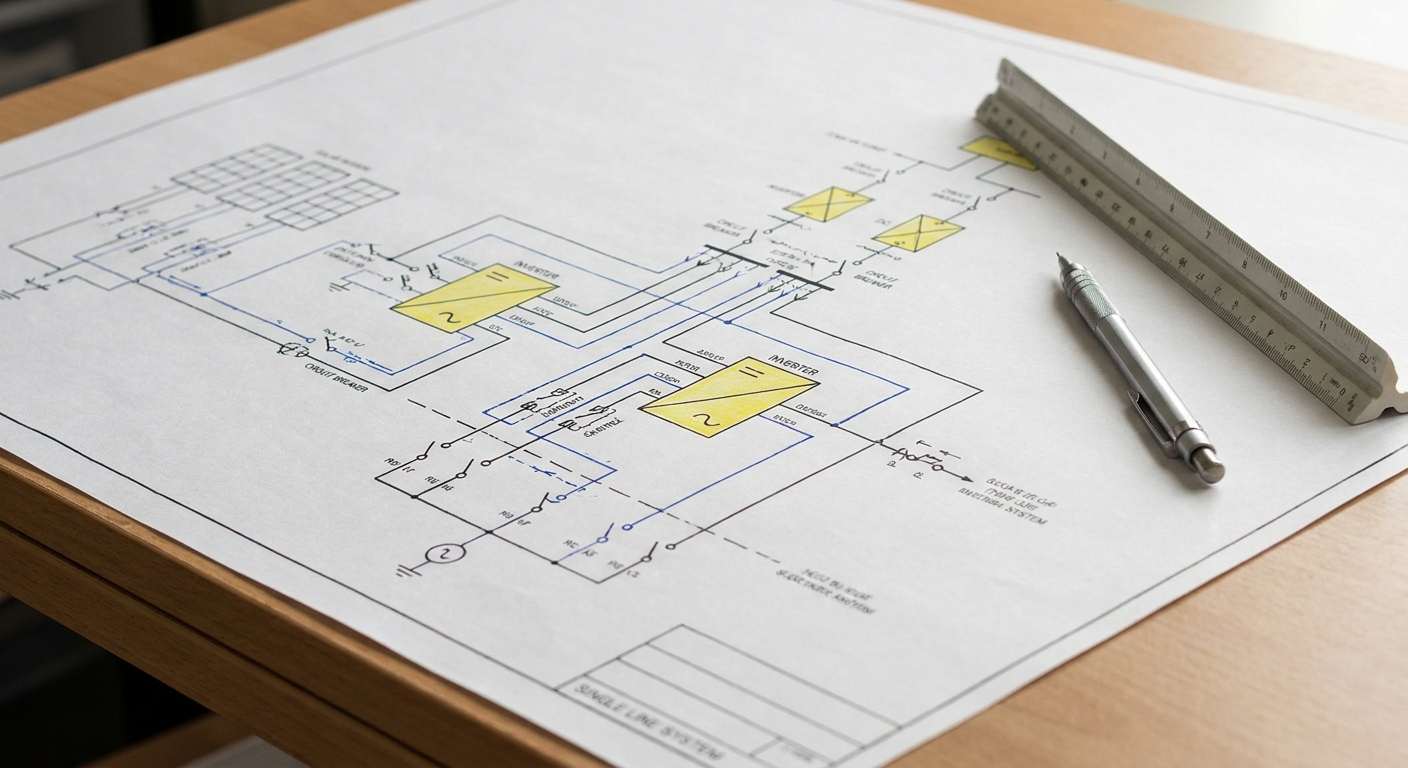
Single-Line Diagram (SLD)
The SLD is the most referenced document in any solar project. A complete SLD must show the full electrical architecture: PV array configuration, string groupings, DC combiner boxes, inverter connections, AC distribution, metering arrangement, grid connection point, and protection devices. An SLD that shows only the inverter-to-grid section is not a complete deliverable.
String Layout and Inverter Sizing Calculations
Your engineering partner must provide documented calculations showing how strings are configured, why a specific inverter model and capacity was selected, and how the DC/AC ratio was determined. These calculations should reference the actual module and inverter datasheets for the specified equipment.
Cable Sizing Schedule
A complete cable sizing schedule lists every cable run in the system, DC string cables, DC main cables, AC cables from inverter to distribution board, and grid connection cables, with conductor size, length, voltage drop calculation, and current-carrying capacity. This document directly drives procurement. Missing or generic cable schedules lead to incorrect material orders and installation delays.
Protection and Earthing Design
This deliverable covers surge protection device (SPD) specifications, DC and AC protection relay settings, earthing conductor sizing, and earthpit design. For rooftop solar India projects, lightning protection design is often required by state regulations and should be included here.
Energy Yield Simulation Report
A professional energy yield report, typically generated using PVsyst, HelioScope, or equivalent design software India platforms, must include: irradiation data source and reference year, system losses breakdown (soiling, wiring, mismatch, inverter efficiency, temperature), P50 and P90 yield estimates, and monthly generation profile. A simulation report that only shows annual kWh output without loss factor detail is not acceptable as a complete deliverable. According to NREL’s solar research guidelines, accurate loss modeling is one of the most critical factors in reliable energy yield prediction.
3. Structural and Civil Engineering Deliverables
Structural design deliverables are the category most commonly missing or incomplete in packages from under-resourced design vendors. Yet they carry the highest risk: a structural failure on a rooftop or ground-mount installation creates safety hazards, insurance liability, and potential legal exposure for the EPC.
- Structural Load Calculations: Must cover dead load (panel and mounting weight), live load (maintenance personnel), wind load (based on IS 875 Part 3 for India), and seismic load where applicable. Calculations must reference the specific mounting system being used, not generic assumptions.
- Foundation Design Drawings: For ground-mount projects, this includes pile or footing design, embedment depth, concrete mix specifications, and anchor bolt details. The regional soil conditions across India vary significantly, and foundation designs must reflect actual geotechnical data from the site.
- Roof Load Assessment: For rooftop projects, a structural assessment of the existing roof’s capacity to carry the additional solar load. This must be signed by a licensed structural engineer and should reference the roof’s construction type, age, and condition as observed during the site survey.
- Bill of Materials (BOM) for Structural Components: A complete list of mounting rails, clamps, fasteners, brackets, and hardware with quantities, specifications, and material grades. The BOM must match the structural drawings exactly.
- Soil Investigation Report: For ground-mount projects above 500 kW, a geotechnical report covering soil bearing capacity, water table depth, and corrosivity classification. This is a prerequisite for accurate foundation design.
Acceptance criterion: All structural drawings must carry the stamp and signature of a licensed structural engineer. Unstamped structural calculations are not acceptable deliverables for any project where structural integrity is a safety consideration.
4. Permit Design and Compliance Documents
Permit design deliverables are the documents submitted to regulatory authorities, DISCOMs, and local bodies to obtain approvals for grid connection, net metering, and construction. These are distinct from detailed engineering drawings, they are formatted and organized specifically for regulatory review.
- Permit-Ready Drawing Sets: Simplified versions of the SLD and layout drawings formatted to meet the specific requirements of the relevant DISCOM or state electricity board. In India, these requirements vary by state, and a drawing set that works for MSEDCL in Maharashtra may not meet BESCOM’s requirements in Karnataka or GUVNL’s requirements in Gujarat.
- Net Metering Application Documents: Completed application forms, system specification sheets, and supporting calculations required for net metering registration. Your design partner should know the current requirements for each state where you operate.
- DISCOM/Utility Interconnection Drawings: Specific drawings showing the point of common coupling (PCC), metering arrangement, protection relay settings, and grid interface equipment. These are often the most technically specific permit documents and must match the utility’s technical standards exactly.
- Fire Safety Documentation: For commercial and industrial rooftop projects, fire safety compliance documents including fire suppression system coordination, cable routing through fire-rated areas, and emergency shutdown procedures.
- Statutory Compliance Checklist: A document confirming that the design meets all applicable standards, IS codes for India, IEC standards for international projects, with specific clause references. The Ministry of New and Renewable Energy (MNRE) publishes updated technical standards that should be referenced in this checklist.
5. Project Management and Reporting Deliverables
Beyond technical drawings, a complete design deliverables package includes management and coordination documents that keep the project organized from design through construction. These are often overlooked but are critical for MW-scale projects where multiple teams work in parallel.

Design Basis Report (DBR)
The DBR is the master reference document for the entire project. It records every design assumption, standard, and decision made during the engineering process: site parameters used, equipment selection rationale, applicable codes and standards, and any deviations from standard practice. If a question arises during construction about why a design decision was made, the DBR is where the answer should be found.
Revision Log and Change Management Records
Every drawing and document should carry a revision history. The revision log tracks what changed, when, why, and who approved the change. For projects with multiple design iterations, which is most projects, this document prevents teams from working from outdated drawings.
Design Schedule and Milestone Tracker
A document showing the planned delivery dates for each deliverable, actual delivery dates, and any outstanding items. This is particularly important for solar EPC India companies managing multiple projects simultaneously, where design delays on one project can cascade into procurement and construction delays across the portfolio.
Vendor Coordination Documents
For MW-scale projects, the design package should include equipment datasheets for all specified major components (modules, inverters, mounting systems, transformers), vendor technical approval (VTA) documents, and any equipment-specific installation requirements that affect the design.
As-Built Drawing Requirements
Clarify upfront whether as-built drawings are included in the design scope. As-builts reflect the actual installed condition of the system and are required for warranty claims, insurance documentation, and future maintenance. Many design contracts exclude as-builts by default, make sure your agreement addresses this explicitly.
Quality Standards: How to Verify Each Design Deliverable
Receiving a document is not the same as receiving a quality deliverable. Here is how to verify the key items in your design deliverables package before accepting them.
- SLD Review: Check that all protection devices are shown with ratings, that the metering arrangement matches the utility’s requirements, and that the diagram is consistent with the cable sizing schedule and BOM.
- Structural Drawing Review: Confirm that the drawings carry a licensed engineer’s stamp, that load calculations reference the actual site wind zone and seismic zone, and that the specified mounting system matches what is in the BOM.
- Simulation Report Accuracy: Verify that the irradiation data source is appropriate for the project location (NREL, Meteonorm, or NASA POWER for India), that the system losses are realistic (total losses typically 15 to 25% for well-designed systems), and that the report uses the actual module and inverter models specified for the project.
- BOM Cross-Check: Compare the BOM against the structural drawings, electrical drawings, and equipment datasheets. Every item shown in a drawing should appear in the BOM with a quantity. Discrepancies between drawings and BOM are a common source of procurement errors.
- Document Naming and Version Control: All deliverables should follow a consistent naming convention that includes project name, document type, revision number, and date. A folder of files named “drawing_final_v3_REVISED_USE THIS ONE.pdf” is a red flag for poor document management.
Red Flags: Incomplete or Substandard Design Deliverables
Knowing what good looks like is important. Knowing what bad looks like is essential. These are the most common red flags that indicate your design deliverables package is incomplete or substandard.

- No engineer stamp on structural drawings. Unstamped structural calculations have no legal standing and cannot be submitted for permits. If your vendor cannot provide stamped structural drawings, they are not a qualified structural engineering partner.
- Generic, non-site-specific calculations. If the wind load calculation references a generic “medium wind zone” without citing the actual wind zone for the project location per IS 875, the calculation is not site-specific. The same applies to soil bearing capacity assumptions that don’t reference an actual geotechnical report.
- No revision history on drawings. Drawings without revision blocks suggest the vendor does not maintain version control. This creates serious risk when design changes are made, you cannot be certain which version of a drawing is current.
- Simulation reports without loss factor breakdown. A PVsyst report that only shows the final annual yield number without detailing soiling losses, wiring losses, mismatch losses, and inverter efficiency is not a complete simulation deliverable. You cannot verify the accuracy of the yield estimate without the loss breakdown.
- Permit drawings that don’t match local DISCOM requirements. This is one of the most expensive red flags. If your design partner is not familiar with the specific technical standards of MSEDCL, BESCOM, GUVNL, TPDDL, or whichever utility governs your project’s state, their permit drawings will likely be rejected. Always ask your vendor to confirm they have successfully submitted permit applications to the relevant DISCOM before.
- Incomplete or missing BOM. A BOM that lists only major equipment (modules, inverters) without structural hardware, cable quantities, protection devices, and balance-of-system components is not a complete deliverable. An incomplete BOM leads directly to procurement gaps and site delays.
- No Design Basis Report. The absence of a DBR means there is no documented record of design assumptions. If a question arises during construction or commissioning, there is no authoritative reference to consult.
Setting Acceptance Criteria with Your Design Partner
The most effective way to ensure you receive complete design deliverables is to define acceptance criteria before the design work begins. Here is how to do that in practice.
Write a Deliverables Schedule into Your Design Contract
Your engineering agreement should include a deliverables schedule, a table listing every document and drawing to be produced, the format it will be delivered in (PDF, DWG, native software file), the milestone at which it will be delivered, and the review period you have before acceptance. This removes ambiguity and gives both parties a clear reference point.
Define Review Cycles and Approval Gates
Specify how many rounds of review and revision are included in the design fee, and what constitutes an “approved” deliverable. A common structure for solar EPC India projects is: first issue for review, one round of comments and revisions, second issue for approval. Additional revision rounds beyond this scope should be addressed in the contract.
Ask the Right Questions Before Signing
Before engaging a design partner, ask these questions directly:
- Can you provide a sample deliverables list from a comparable completed project?
- Are structural drawings stamped by a licensed structural engineer in India?
- Do you have experience submitting permit applications to the DISCOM in my project’s state?
- What design software do you use for energy yield simulation, and can you provide the native project file?
- Are as-built drawings included in your scope, or are they a separate service?
A professional solar engineer or design firm should be able to answer all of these questions clearly and provide sample documentation on request. At Heaven Designs, every project engagement begins with a defined scope of deliverables agreed upon before work starts, so EPC clients know exactly what they will receive and when. If you want to discuss the specific deliverables package for your next project, call us at +91 90811 00297 or email service@heavendesigns.in.
Frequently Asked Questions About Solar Design Deliverables
How many drawings should a 1 MW solar project include?
A complete design deliverables package for a 1 MW ground-mount project typically includes 15 to 25 individual drawings and documents: site layout drawing, SLD, string layout drawing, cable routing drawing, earthing layout, lightning protection drawing, structural general arrangement drawing, foundation drawing, structural load calculations, BOM, energy yield simulation report, design basis report, and permit drawing set. Rooftop projects of similar capacity may have fewer structural drawings but additional roof load assessment documentation.
What is the difference between permit design and detailed design?
Permit design produces simplified, regulation-formatted drawings specifically for submission to DISCOMs, local bodies, and regulatory authorities. Detailed design produces the full engineering documentation used for procurement, construction, and commissioning. Both are separate deliverables and both are necessary. A permit drawing set is not a substitute for detailed engineering drawings, and vice versa.
Can I request deliverables in stages rather than all at once?
Yes, and for larger projects this is the recommended approach. A phased delivery structure, pre-design documents first, then electrical design, then structural design, then permit documents, allows your team to review and approve each phase before the next begins. This reduces the risk of late-stage rework caused by errors in early-phase assumptions. Discuss phased delivery milestones with your design partner during contract negotiation.
What file formats should design deliverables be delivered in?
Standard practice for solar design India projects is to deliver drawings in both PDF (for review and submission) and native CAD format (DWG for AutoCAD drawings). Simulation reports should be delivered as PDF with the native PVsyst or HelioScope project file. Calculation documents should be in PDF. Spreadsheet-based documents (BOM, cable schedules) should be in Excel format to allow your team to work with the data directly.
Who is responsible if a deliverable is missing at the time of permit submission?
Responsibility depends on what was agreed in the design contract. If the missing deliverable was listed in the agreed scope and was not delivered, the design partner is responsible for producing it. If it was not listed in the scope, the EPC may need to commission it separately or negotiate an amendment. This is why a detailed deliverables schedule in the contract is so important, it eliminates disputes about scope at the worst possible time.
Do design deliverables differ for international projects versus India-based projects?
The core document types are similar globally, but the specific standards, formats, and regulatory requirements differ. For India-based projects, structural calculations reference IS codes, permit documents follow DISCOM-specific formats, and compliance documentation references CEIG and state electricity board requirements. For international projects, the applicable standards (IEC, NEC, AS/NZS, etc.) and utility interconnection requirements will differ. A design partner with international experience, like Heaven Designs, which serves EPC clients across multiple countries, should be able to adapt the deliverables package to the applicable jurisdiction.
Make Design Deliverables a Non-Negotiable Standard
The EPC companies that consistently deliver projects on time and on budget share one common practice: they define their design deliverables requirements before they sign any engineering agreement. They know exactly which documents they need, what quality standard each must meet, and what the consequences are if something is missing.
Use this checklist as your starting point. Adapt it to your project types, whether rooftop solar India installations, MW-scale ground-mount projects, or commercial and industrial developments. Build it into your standard design contract template. And review it at every project kickoff to confirm your engineering partner’s scope matches your expectations.
If you’re working with a design partner who cannot clearly articulate what design deliverables they will produce, that uncertainty will cost you more than the design fee. The right partner delivers a complete, documented, stamped, and verified package, every time, for every project.
Heaven Designs has delivered complete engineering design packages for 752+ solar EPC clients across India and internationally, covering 628+ MW of solar capacity. Our structured deliverables process ensures every EPC client receives a full, verified package, from site survey through permit-ready drawings and structural calculations. Get a Quick Proposal Now! and let’s define the exact deliverables scope for your next project together.
This blog post was written using thestacc.com