Every Indian EPC founder has tried the freelancer route at least once. It works until it does not. The designer delivers the first two projects flawlessly — then goes dark on week three because they have taken on a larger client. The DISCOM submission deadline arrives. The designer is not responding on WhatsApp. The project is on hold.
This comparison is written for EPC founders who want an honest picture of three design sourcing models — freelancer, in-house, and outsourced specialist firm — before committing to a structure for their next 12 months of design capacity. It covers cost, quality, accountability, SLA, and the four scenarios where each model is the right answer.
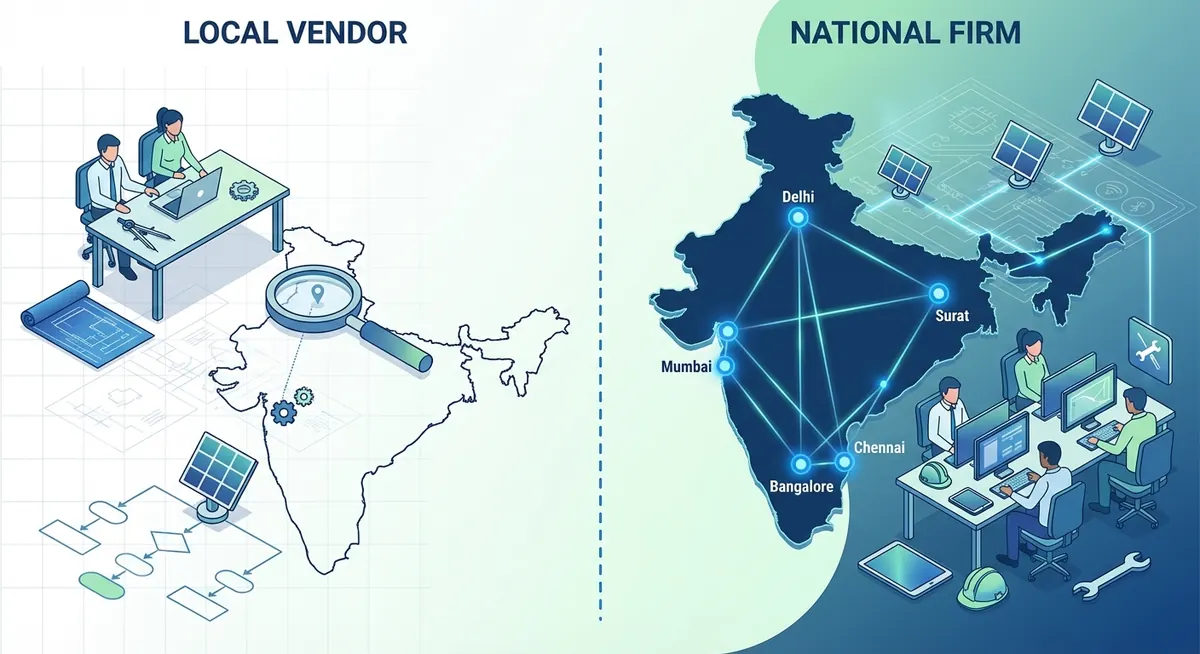
Direct answer. Freelance solar designers in India cost ₹500–1,500 per hour or ₹5,000–15,000 per project for standard rooftop work — lower headline cost than a full-time hire or a specialist firm. However, freelancers carry three structural risks that make them unsuitable for EPCs with consistent monthly volume: no SLA accountability (availability is not guaranteed), no professional indemnity insurance (liability falls entirely on the EPC), and no backup coverage (one designer equals zero redundancy). The Designer Dependency Ladder (defined in this guide) maps how each sourcing model performs as project volume and complexity scale.
The freelancer model is not inherently flawed — it is correctly suited to specific EPC operating conditions. The failure comes from using a freelancer for a job that requires the accountability structure of a firm, or paying firm rates for services that a freelancer could deliver at better value. This guide maps the correct use case for each model.
The Designer Dependency Ladder
The Designer Dependency Ladder describes how the risk profile of each design sourcing model changes as project volume, complexity, and EPC scale increase. Understanding where your EPC sits on the ladder determines which model is correct for you now — and which you should transition to as you grow.
Rung 1: Sole Proprietor EPC (1–2 projects/month, single state)
A qualified freelancer works well at this rung. Volume is low enough that the freelancer can prioritise your work; state-specific DISCOM knowledge can be pre-confirmed; the cost saving vs. a full-time hire is significant. The risk is manageable because one missed deadline does not cascade across multiple concurrent projects.
Rung 2: Growing EPC (3–5 projects/month, 1–2 states)
The freelancer model begins to strain at this rung. Concurrent deadlines mean that a single availability gap from the freelancer affects multiple projects simultaneously. An in-house hire or a specialist firm with an SLA starts to provide better operational reliability at comparable or only marginally higher cost per project.
Rung 3: Mid-Market EPC (5–15 MW/month, 2–4 states)
The freelancer model is not suitable at this rung. Multi-DISCOM format coverage, concurrent project loads, structural scope, and SLA accountability all require a firm — either in-house team or outsourced specialist. The in-house vs. outsourced decision depends on volume consistency and attrition risk.
Rung 4: Large EPC / Developer (15+ MW/month, 5+ states)
At scale, a hybrid model works: an in-house team for proprietary methods and lender-facing deliverables; a specialist firm for volume throughput, DISCOM format management, and structural scope. Pure freelancer engagement is limited to specialist tasks (e.g., a specific state CEIG expert for a one-off project).
The Full Cost and Risk Comparison
| Dimension | Freelancer | In-House Designer | Outsourced Specialist Firm |
|---|---|---|---|
| Cost range (rooftop ≤100 kW) | ₹5,000–12,000/project | ₹14,000–22,000/project (true cost basis) | ₹6,000–9,000/project |
| Cost range (rooftop 100–500 kW) | ₹10,000–25,000/project | ₹18,000–28,000/project | ₹12,000–22,000/project |
| SLA guarantee | None (availability not contractual) | Employment contract (output not SLA-bound) | Written SLA (3–5 days) |
| Backup coverage | None (one person) | None (one person, unless team) | Team backup — engineer unavailability does not affect SLA |
| DISCOM format coverage | Limited to designer’s personal experience | Limited to designer’s personal experience | Active library: 54+ DISCOMs, updated quarterly |
| Structural capability | Rare (requires separate engagement) | Usually limited to electrical; structural is separate | Integrated: electrical + structural from one firm |
| PII insurance | Not available (individual freelancer) | Not applicable (liability on EPC) | Professional indemnity insurance: ₹25–50L/incident |
| IP ownership | Unclear without written agreement | Clear (employment IP clause) | Clear (IP transfers on payment) |
| White-label delivery | Possible (informal) | Inherent | Standard |
| Onboarding time | 1–2 days (informal) | 60–90 days (hiring + onboarding) | 1–2 days (structured) |
| Attrition risk | Moderate (freelancer moves to full-time role) | High (3-year average tenure) | None (firm continues) |
| Revision accountability | Informal (discretionary) | Internal | Contractual (revision policy) |
| Regulatory currency (DISCOM updates) | Not maintained | Depends on individual | Firm maintains updates |
When Freelancers Win — 4 Specific Scenarios
The freelancer model is genuinely the best answer in four scenarios. Outside these four, the accountability and coverage gaps outweigh the cost saving.
Scenario 1: Specialist one-off task. You need a CEIG drawing for a project in a state where you have never operated before and have no current relationship with a full-service firm. A freelancer who specialises in that state’s CEIG format is faster and cheaper than onboarding a new full-service partner for one project.
Scenario 2: Surge capacity on top of an existing team. Your in-house team is at capacity for one month and you need 2–3 additional projects handled without committing to a permanent engagement expansion. A qualified freelancer as a temporary overflow resource works well — as long as you have an in-house engineer to run QC on the freelancer’s output.
Scenario 3: Startup EPC (first 6 months). You are doing 1–2 projects per month while you build your client base. A freelancer allows you to control cash before committing to a full-time hire or a retainer with a specialist firm.
Scenario 4: Research and prototyping. You need a feasibility sketch for a novel installation type (floating solar on a specific reservoir, or a carport with unusual structural constraints) and do not want to commit a firm-engagement fee to an exploratory exercise. A freelancer who charges per hour is cost-effective for a 4-hour feasibility sketch that may not proceed to full design.
When Freelancers Fail — The 4 Failure Modes
Failure mode 1: The availability gap. Your freelancer takes a better-paying project from a large client. They cannot meet your deadline. There is no backup, no SLA, and no contractual remedy. Your project waits.
Failure mode 2: The format gap. Your project moves to a new state. Your freelancer does not know the DISCOM format for that state. They produce a generic SLD. The DISCOM rejects it. You manage the revision cycle at your own cost.
Failure mode 3: The structural gap. The project requires CEIG approval, which requires a structural certificate and STAAD Pro report. Your freelancer is an electrical designer, not a structural engineer. You need to engage a second freelancer. The coordination gap between two freelancers produces format inconsistencies that cause CEIG rejection.
Failure mode 4: The liability gap. The structural calculations contain an error that manifests in a mounting failure during a monsoon storm. The freelancer has no professional indemnity insurance. The liability falls entirely on your EPC. With a professional firm carrying PII insurance, the liability is shared.
Watch out. A freelancer structural engineer cannot carry professional indemnity insurance as an individual in India without being registered as a licensed engineering consultancy (a separate legal entity with regulatory registration). When a freelancer structural engineer signs a structural certificate, they are creating personal professional liability without the insurance to back it. As the EPC engaging them, you absorb that liability gap.
How to Evaluate a Freelance Solar Designer Before Engaging
If you determine the freelancer model is correct for your current situation, these are the minimum evaluation steps before engaging.
Step 1: Technical test. Give the candidate a real brief: a 150 kW rooftop in your primary operating state, with the inverter and module datasheets. Ask for the SLD and a preliminary yield estimate within 48 hours. Evaluate: (a) is the SLD correctly formatted for your DISCOM? (b) is the string voltage and current correct? (c) is the yield estimate from PVsyst or a spreadsheet?
Step 2: DISCOM format confirmation. Ask which DISCOMs they have produced drawings for in the past 6 months. Ask for one sample (with client data redacted). If they cannot produce a format-correct sample for your operating DISCOM, they do not have current DISCOM experience — regardless of what their CV says.
Step 3: Availability commitment. Get a written (WhatsApp or email) commitment on availability: how many concurrent projects can they manage? What is their turnaround for a new brief in their current workload? What happens if they are unavailable when your deadline arrives?
Step 4: IP and confidentiality. Send a simple NDA (2 pages, mutual) before sharing any project details. A professional freelancer signs immediately. A reluctant response to an NDA request signals either inexperience with professional practice or a risk around confidentiality.
Step 5: Rate and payment terms. Get the rate in writing before the first project. Agree on payment terms (typically 50% on brief submission, 50% on delivery). Avoid pure post-delivery payment for a new freelancer relationship — it creates incentive misalignment.
Field tip. Finding a qualified solar design freelancer in India is harder than finding a freelancer who claims solar design experience. Post a paid test on LinkedIn or Naukri (₹1,000–2,000 for the test project) before engaging. You will eliminate 80% of applicants who overstate their PVsyst or DISCOM capability in their CV.
According to IRENA’s 2025 renewable employment report, solar design and engineering roles in India have grown faster than any other segment of the renewable energy workforce — creating both opportunity and scarcity for qualified solar designers. The same market pressure that makes qualified freelancers hard to find makes them quick to take full-time roles when offered — which is the structural attrition risk in the freelancer sourcing model.
Transitioning from Freelancer to Specialist Firm: A Practical Handover Guide
The decision to move from a freelancer to a specialist firm is straightforward once the volume or complexity triggers are met. The transition itself requires active management — because the institutional knowledge that lives in the freelancer’s head (your DISCOM templates, your client title block formats, your preferred string layouts) needs to be transferred before the relationship ends. An unmanaged transition produces a gap: the freelancer disengages before the specialist firm has enough context to continue seamlessly.
This is the handover framework that produces a clean transition in 3–4 weeks.
Step 1: Inventory the freelancer’s deliverable library (Week 1)
Before notifying the freelancer of the transition, request a complete set of all drawings they have produced for your projects in the past 12 months — in both native file format (DXF/DWG for AutoCAD) and PDF. This is your existing IP, and it belongs to you. Frame it as a routine records request — “We are doing a design archive exercise.” Most freelancers comply without resistance.
Also request copies of any DISCOM-specific templates, title blocks, or annotation formats they have been using for your projects. These are the formats your specialist firm will need to maintain continuity of appearance in future DISCOM submissions.
Step 2: Brief the specialist firm before ending the freelancer relationship (Week 2)
Onboard the specialist firm using the deliverable library from Week 1. Provide them with:
- Three completed projects from the past 6 months (SLD + GA + yield summary) as reference examples
- The title block format and naming convention you use on client deliverables
- Your primary operating DISCOMs and the format version the freelancer has been using
- Any client-specific requirements (e.g., “Client X requires the inverter brand name in the title block”)
Ask the specialist firm to produce a sample deliverable from a brief before the freelancer relationship ends. This validates that the specialist firm can match your existing output quality before you create a capacity gap.
Step 3: Run one project in parallel (Week 3)
If your volume allows, run one new project through both the freelancer and the specialist firm simultaneously — the same brief, different teams. Compare the outputs against the quality criteria that matter to you: DISCOM format accuracy, yield calculation methodology, drawing consistency, and turnaround time. This parallel-run provides a quality benchmark and surfaces any onboarding gaps before they affect a live project.
Step 4: Notify the freelancer and establish a clean end date (Week 3–4)
Give the freelancer appropriate notice — typically 2–4 weeks for a relationship with ongoing project volume. Confirm the projects that will continue through the freelancer versus transition to the specialist firm. Avoid creating a situation where the same project has overlapping responsibility between the two parties.
Step 5: Establish the ongoing SLA and reporting rhythm with the specialist firm (Week 4)
Before the transition is complete, confirm the operational rhythm with the specialist firm:
- How will briefs be submitted? (Email, project management tool, WhatsApp for standard work?)
- Who is the primary point of contact at the firm?
- What is the escalation path for urgent revisions?
- What is the revision turnaround SLA, and how is it tracked?
Document these agreements in writing — even informally in a WhatsApp message or email thread. This creates a reference point if the SLA is missed later.
Tip. The most common transition failure is ending the freelancer relationship before the specialist firm has completed their first independent project. Always confirm that the specialist firm has delivered at least one project fully under their own steam before you close the previous relationship. A 2-week overlap where both are available protects your pipeline against onboarding gaps at the specialist firm.
How Heaven Designs Provides the Accountability That Freelancers Cannot
Heaven Designs operates as the outsourced engineering bench for EPCs at every scale — from a Rung 2 EPC doing 3 projects/month to a Rung 4 developer running 50 MW/month. The key differences from the freelancer model:
- Solar Rooftop Detailed Engineering Design — Written SLA (3–5 days), backup coverage, professional indemnity insurance, DISCOM format library for all major states. White-label as standard.
- Solar Civil and Structural Engineering — Structural calculations integrated with electrical drawings from the same team. No coordination gap. IS 875 Part 3 compliant.
- Electrical CEIG Drawings — CEIG-format drawings updated to current state requirements — the specific deliverable most freelancers cannot produce at consistent quality across multiple states.
- Solar 3D Pre-Design — 48-hour sales-stage layouts for bid teams. No waiting for a freelancer’s schedule to open.
- Download a sample deliverable — See the deliverable format and quality before committing to a first project.
Contact us to get a project quote and compare it directly against your current freelancer or in-house cost.
FAQ
Where do I find qualified solar design freelancers in India?
The most reliable sources for qualified solar design freelancers in India are: LinkedIn (filter by “solar engineer” + AutoCAD/PVsyst skills + India location), IIT and NIT alumni networks (for technically strong candidates), and solar industry-specific groups on WhatsApp and Telegram. Platform freelance marketplaces (Upwork, Fiverr) produce variable quality for solar design — always require a technical test before engaging anyone found on a generalist platform.
Can a freelancer produce CEIG-ready drawings?
Some can, for states where they have prior experience. CEIG-ready drawings require knowledge of the specific state’s CEIG authority format requirements, the CEA Connectivity Regulations 2019 annexure format, and the specific earthing and protection scheme requirements that differ by state. A freelancer who has produced CEIG drawings in Maharashtra may not know Karnataka or Gujarat requirements. Always request a CEIG drawing sample from the specific state before engaging.
What is the difference between a solar design freelancer and a solo design consultant?
A solo design consultant typically operates as a registered firm (Proprietorship or LLP), carries professional indemnity insurance, and maintains a formal engagement letter and IP transfer clause. A freelancer operates informally — no registered firm, no PII insurance, informal payment terms. For any project with lender involvement or client-facing liability, the solo consultant model (formal registration + insurance) is safer than the pure freelancer model.
Is it legal for a freelancer to sign structural drawings for CEIG submission?
A freelancer can sign structural drawings if they hold the relevant professional license (Licensed Structural Engineer or equivalent state registration). The issue is PII insurance — an individual without a registered firm cannot easily maintain PII insurance. For CEIG submissions requiring structural certification, the safest approach is to engage a registered structural engineering consultancy rather than an individual freelancer.
At what project volume should I stop using freelancers and move to a specialist firm?
The practical threshold is 4+ concurrent active projects or 3+ MW/month. Below this, a reliable freelancer provides adequate coverage. Above it, the probability of a simultaneous availability gap across multiple projects exceeds an acceptable risk threshold. At 4+ concurrent projects, you are also likely working across 2+ DISCOMs — which requires active format library maintenance that individual freelancers rarely maintain.