Every Indian EPC founder reaches the same inflection point. You have won more projects than your in-house team can handle, your senior designer is threatening to leave, and the next DISCOM submission deadline is in four days. Hiring a full-time designer takes three months minimum, costs ₹8–12 lakh per year in salary alone before overhead, and solves tomorrow’s bottleneck without fixing next quarter’s unpredictability. Outsourcing solar design is the structural answer — but only if you do it correctly.
Direct answer. Outsourcing solar design in India means contracting a specialist engineering firm to produce bankable PV layouts, structural calculations, SLDs, BOQs, and DISCOM-ready drawing packages on a per-project or retainer basis. EPCs that outsource correctly cut per-project engineering cost by 40–60%, reduce design-to-submission timelines from 10–14 days to 3–5 days, and eliminate the single-designer dependency risk that stalls projects when that person resigns. The 6-Gate Outsourcing Readiness Audit (defined in this guide) tells you exactly when your volume justifies the switch and which vendor capabilities to demand.
India’s solar market is on a structural growth curve: MNRE’s current status dashboard tracks over 73 GW installed capacity as of early 2026, with the government’s 500 GW target by 2030 driving sustained project pipeline across C&I, rooftop, and utility segments. That volume demands a new engineering operating model — one where design capacity is variable, not fixed.
This guide covers every stage of the outsourcing decision and execution: when to make the move, how to evaluate vendors, what contracts to demand, how to structure quality control, and how to integrate an external design bench into your live project workflow.
When to Outsource Solar Design — The 6-Gate Readiness Audit
The decision to outsource is not emotional. It is a capacity and cost calculation. Run the 6-Gate Outsourcing Readiness Audit against your current operations. If you clear four or more gates, the switch pays for itself within 60 days.
Volume Gate: ≥ 3 projects/month or ≥ 500 kW/month
Below this threshold, a freelancer or part-time arrangement works. Above it, fixed-cost staffing becomes more expensive per design than a variable outsourced rate — even before you count the hidden costs in Gate 2.
True-Cost Gate: your fully-loaded designer cost exceeds ₹12L/year
Salary is only one layer. Add PF, ESIC, laptop, software licenses (AutoCAD + PVsyst = ₹1.2L/year), annual bonus, recruitment cost (₹60–90k per hire), and lost billable time during onboarding (90 days). Most founders discover the true cost is ₹15–18L/year, not ₹8L.
Bottleneck Gate: design is on the critical path for project handover
If a delayed SLD or DISCOM drawing package has ever held up a commissioning sign-off or prevented a purchase order from closing, design is already a revenue bottleneck. Outsourcing converts it into a managed SLA.
Dependency Gate: one person holds all design knowledge
When your lead designer is on leave, design stops. When they resign, you lose three months of institutional knowledge with them. Outsourced firms provide team continuity — if one engineer is off, another picks up the file within the same SLA window.
Scope Gate: you are winning project types your team cannot handle
Ground-mount utility projects, floating solar, or CEIG-submission drawings require specialist skills. Outsourcing to a multi-discipline firm expands your bid scope without hiring additional specialists for every new project type.
Quality Gate: your current design has triggered DISCOM revision cycles
Each DISCOM revision costs 7–14 days and delays commissioning. Specialized outsourcing firms run DISCOM-format drawing packages for every state their clients operate in — eliminating the revision cycle as a systemic issue, not a one-off fix.
Score your operation: 4 or more gates cleared means outsourcing pays for itself within two project cycles. All 6 cleared means every month you delay is lost margin.
What “Outsourcing Solar Design” Actually Covers
The phrase is used loosely. Before you evaluate vendors, define which deliverables you are outsourcing — because the scope drives both the price and the quality expectations.
Definition. Solar design outsourcing is the contractual transfer of one or more engineering deliverables — PV layout, structural calculations, electrical SLD, BOQ, or DISCOM drawing package — to an external specialist firm that operates under your brand and project timelines, with defined quality, format, and revision SLAs.
The full deliverable menu of a mature outsourcing engagement covers:
| Deliverable | What It Contains | Typical Turnaround |
|---|---|---|
| 3D Pre-design / Layout | Roof capture, panel arrangement, shade analysis, GHI/irradiance map | 24–48 hours |
| PVsyst Yield Report | P50/P90 energy yield, loss waterfall, inverter sizing, soiling model | 3–5 business days |
| SLD (Single-Line Diagram) | AC + DC SLD, protection scheme, metering point, DISCOM-ready format | 2–3 business days |
| GA (General Arrangement) | Rooftop GA, mounting positions, cable tray routing, access paths | 2–3 business days |
| Structural / Civil Package | IS 875 wind analysis, mounting calc, STAAD Pro report, foundation design | 3–7 business days |
| BOQ (Bill of Quantities) | Module, inverter, cable, mounting, BOS — with make/model and quantity | 1–2 business days |
| DISCOM Drawing Package | State-specific format, net meter application, CEIG-ready drawings | 3–5 business days |
| As-Built Drawings | Post-commissioning redline drawings, as-built SLD, punchlist close-out | 2–4 business days |
An EPC that outsources the full stack typically saves 50–65% versus the equivalent fully-loaded in-house cost. An EPC that outsources only the DISCOM package and PVsyst report (partial outsourcing) saves 25–35%.
For a full breakdown of what each deliverable entails, the complete guide to solar design services in India covers the technical content of each document type.
The Real Cost Comparison — In-House vs. Outsourced
The cost conversation is where most founders under-count on the in-house side and over-count on the outsourced side. Here is the correct math.
₹17.4L
True cost of one in-house designer
Heaven Designs cost audit, 2026 — salary + PF + software + recruitment
₹6,000–9,000
Outsourced cost per rooftop project (≤100 kW)
Heaven Designs standard rate, includes SLD + GA + BOQ + DISCOM drawings
193 GW
India solar target balance (2026)
MNRE 2026, 500 GW target vs ~307 GW remaining pipeline
3–5 days
Turnaround for a full rooftop design package
Heaven Designs SLA, standard rooftop up to 500 kW
The per-project comparison makes the case concrete. Assume a 200 kW C&I rooftop project:
| Cost Item | In-House (200 kW, one designer) | Outsourced (Heaven Designs) |
|---|---|---|
| Layout + 3D pre-design | Included in salary | ₹8,000 |
| PVsyst yield report | Included in salary | ₹12,000 |
| SLD + GA | Included in salary | ₹10,000 |
| BOQ preparation | Included in salary | ₹5,000 |
| DISCOM package | Included in salary | ₹8,000 |
| Total per-project cost | ₹14,500 (₹17.4L ÷ ~12 projects/year/designer) | ₹43,000 |
| Revision cost (2 cycles avg) | ₹8,000 delay + designer time | ₹0 (included in SLA) |
| Risk of resignation delay | ₹2–5L in deal delay costs | None (team bench) |
| Effective per-project cost | ₹22,500–27,500 | ₹43,000 |
Field tip. The math flips in outsourcing's favour above 5–6 MW/month in design throughput. At that volume, the revision-cycle cost, the hiring risk premium, and the software license stack make in-house structurally more expensive than outsourced — even before counting the opportunity cost of your senior team spending time on design reviews instead of sales.
For a deeper analysis of in-house vs. outsourced economics, see in-house vs. outsourcing solar design India — which runs the ₹17L math across three EPC scales.
How to Evaluate a Solar Design Outsourcing Partner
Choosing the wrong partner costs more than keeping the work in-house. The evaluation framework must cover five capability categories, not just portfolio samples and pricing.
Capability Category 1 — Technical Depth
A mature solar design firm must demonstrate:
- Multi-software stack: PVsyst (not just Helioscope or Aurora) for bankable yield studies; AutoCAD for drawing production; STAAD Pro or SAP2000 for structural; PVcase or Helioscope for layout optimization.
- DISCOM format mastery: India has 54+ DISCOMs, each with its own drawing format, data-entry portal, and net-metering application procedure. Ask for samples across at least five major DISCOMs (MSEDCL, TANGEDCO, UGVCL, BESCOM, NPCL) before engaging.
- Structural competency: A firm that can only do electrical drawings cannot deliver a bankable CEIG-ready package for states that require structural stamp. Ask for STAAD Pro report samples and IS 875 Part 3 wind calculation examples.
Capability Category 2 — Turnaround SLA and Throughput Guarantee
Promised timelines mean nothing without a throughput guarantee. Ask these exact questions:
- What is the guaranteed turnaround for a standard 500 kW C&I rooftop package (SLD + GA + BOQ + DISCOM drawings)?
- What is your current active client count and total monthly MW throughput?
- When your primary assigned engineer is unavailable, what is the backup protocol and the SLA impact?
- What is your revision SLA — and does the SLA restart after a revision or continue from the original submission timestamp?
A reputable firm answers all four without hesitation. Vague answers on throughput capacity or revision SLA are the leading indicator of future delays.
Capability Category 3 — White-Label and Client-Facing Compatibility
Many EPCs outsource design but present the work to clients under their own brand. This requires:
- Drawings delivered in the EPC’s letterhead template (or a neutral blank template that the EPC stamps)
- No vendor watermarks or branding on delivered documents
- NDA-covered client data handling
- File format compatibility (DWG + PDF minimum; IFC or STEP for civil)
Ask directly: “Do you deliver white-label?” A firm that is uncomfortable with the question does not operate white-label at scale.
Capability Category 4 — Communication and Portal Access
The day-to-day working relationship depends on communication infrastructure:
- Is there a project portal or CRM where you can track deliverable status in real time?
- What is the designated point of contact (single account manager vs. ticket queue)?
- What are the SLA windows for responding to revision requests?
- Can the team communicate on WhatsApp Business for quick clarifications?
For Indian EPCs working across time zones or with multiple DISCOMs simultaneously, real-time status visibility prevents the “I sent it — did you get it?” cycles that consume 2–3 hours per week.
Capability Category 5 — Contract, IP, and Insurance
Your engineering deliverables carry liability. Verify:
- The engagement letter or MSA specifies that all design IP transfers to you on payment.
- Professional indemnity insurance covers structural and electrical calculation errors.
- Confidentiality terms cover your client data, site coordinates, and project BOQ.
- Revision and warranty terms specify how many rounds of DISCOM revision are included, and at what cost revisions beyond that are billed.
Watch out. A solar design firm that cannot produce a professional indemnity certificate or refuses to transfer design IP is not suitable for bankable or lender-reviewed projects. IREDA, PFC, and SBI all require engineering packages certified by a verifiable responsible engineer — verbal assurances do not satisfy due diligence.
The how to choose a solar design partner post runs through these five categories with a scoring rubric for each.
The 5-Stage Solar Design Handoff Protocol
The most common reason outsourcing partnerships underperform is not the vendor’s capability — it is a broken handoff process on the EPC’s side. The 5-Stage Solar Design Handoff Protocol is the operational framework Heaven Designs uses with 300+ EPC clients. Implement it as a standard operating procedure, and first-pass quality improves within the first two projects.
Site Data Package (SDP) — submitted with brief
A complete SDP eliminates 80% of revision requests before they happen. Minimum: site photographs (all four elevations + rooftop), utility bill (3 months), sanctioned load letter, site coordinates (lat/long), roof structure type (RCC / tin shed / factory shed), and the DISCOM name + state. Incomplete briefs are the primary cause of revision cycles.
Scope Confirmation (SC) — within 4 hours of brief receipt
The design firm confirms scope (which deliverables, which DISCOM format, which structural standard), resolves any ambiguities in the SDP, and locks the delivery timeline. This is a single WhatsApp or email thread — not a meeting. If the firm requires a call before confirming scope, their process is not mature enough for volume work.
Draft Review (DR) — intermediate review at 50% of SLA
The firm delivers a draft layout and preliminary SLD for your review before the final package is compiled. You catch strategic issues at the layout stage — where the inverter room is placed, whether the EPC has a client preference for cable routing — before structural and DISCOM formats are locked. This step eliminates the most expensive class of revision request.
Final Delivery and QC Sign-Off (FD) — full package at SLA deadline
The complete package — all agreed deliverables in client-branded format — is delivered via the project portal or a structured Google Drive folder. Your QC checklist (covered in the next section) is run against the delivery before sign-off. Approving a package without running QC is the single most common reason EPCs face DISCOM rejections on outsourced work.
Post-Submission Feedback Loop (PF) — DISCOM response within 30 days
When the DISCOM responds (approval or revision request), log the feedback into your vendor SLA record. Revision requests on the same drawing issue across multiple projects signal a systemic quality gap that must be escalated to the vendor — not absorbed as a normal cost of doing business.
Quality Control — What to Check Before Accepting Any Design Package
Running QC on outsourced work does not mean distrust — it means accountability. A structured QC checklist run by your site engineer takes 20–30 minutes per package and catches the issues that cost you 7–14 day DISCOM delays.
Electrical QC checklist (SLD + wiring):
- String voltage (Voc × series modules) must not exceed inverter max input voltage
- String current (Isc × parallel strings) must not exceed MPPT input current rating
- DC cable sizing matches string current with a 25% derating factor (IS 732 / NEC 690 for export projects)
- AC cable sized for the inverter’s rated AC output current at the relevant ambient temperature
- Earthing and surge protection shown per IS 3043
Layout QC checklist (GA + roof plan):
- Shadow-free zone confirmed for 09:00–15:00 equinox sun position
- DISCOM-required clearances shown: walkway, fire lane, parapet setback
- Roof load specified and not exceeded (for RCC: generally 15–25 kg/m² ballasted; for tin shed: much lower)
DISCOM package QC (for India submissions):
- Correct DISCOM logo, form number, and revision history block
- Metering point shown and matches utility letter
- Net meter rating matches sanctioned load
- Drawing signed and stamped by the responsible engineer (required for CEIG submissions)
For more detail on CEIG drawing approval, the process, and what format each state authority requires, the service page covers the full CEIG submission protocol.
Pricing Models — What You Should Expect to Pay
Solar design outsourcing in India is priced via three models. Choose the model that matches your project volume and consistency.
PER-PROJECT PRICING
- Rooftop ≤100 kW: ₹6,000–9,000
- C&I 100–500 kW: ₹12,000–22,000
- Ground mount ≥1 MW: ₹35,000–75,000
- Best for: 1–4 projects/month
MW-BAND RETAINER
- ₹2,500–4,500/kW of commissioned capacity
- Monthly MW bands (e.g., 0–5 MW tier)
- Overflow projects at per-project rate
- Best for: 5–20 MW/month consistent volume
DEDICATED BENCH
- ₹65,000–1,10,000/engineer/month
- Dedicated 1–3 engineers on your projects only
- Works under your branding + portal
- Best for: 20+ MW/month or complex project mix
For detailed pricing benchmarks by project type, the solar design pricing models analysis covers what the market charges and how to negotiate retainer bands.
White-Label vs. Branded Outsourcing — Which Model Is Right for You
White-label outsourcing means the design firm operates invisibly — all deliverables carry your brand, your letterhead, and your document numbering. Branded outsourcing means the design firm’s name appears on drawings (appropriate for sub-contractor arrangements where the client knows a specialist is involved).
| Dimension | White-Label | Branded / Sub-Contractor |
|---|---|---|
| Client perception | You present as a full-service EPC | Client knows a specialist was involved |
| Document control | Your letterhead, your numbering | Vendor letterhead, dual-brand or vendor-only |
| Best for | Rooftop + C&I EPCs selling full-service | Utility developers with sophisticated clients |
| IP ownership | Transfers to you on payment | Specify in contract — default varies |
| Pricing premium | 0–15% premium for template setup | Standard |
| DISCOM submission | Submitted under your company name | Can be either — specify in scope |
For an EPC that positions itself as an engineering-capable company to its clients, white-label is the only viable model. Clients paying a C&I EPC premium do not expect to see a sub-contractor’s name on their CEIG submission. For more on how this works operationally, white-label solar design services covers the full mechanics.
Verdict. For most Indian C&I and rooftop EPCs operating at 3–15 projects/month, white-label outsourcing on a per-project basis is the optimal model. It preserves client relationships, eliminates hiring risk, and converts a fixed engineering cost into a variable cost that scales with your pipeline — not against it.
Integrating Your Outsourced Team Into Live Project Operations
Outsourcing fails operationally when the EPC treats the external firm as an external entity rather than an extended team. The integration protocol that eliminates friction:
Standardize your brief template. Create a standard brief form (PDF or Google Form) that captures all Site Data Package fields. Every project brief goes through this form. It takes 10 minutes to complete and eliminates 40 minutes of back-and-forth clarification calls per project.
Assign a single internal liaison. One person in your operations team owns the relationship with the design partner. They receive deliveries, run the QC checklist, log revisions, and track the SLA record. Avoid multiple people submitting briefs and receiving deliveries — it creates version control problems.
Use a shared project tracker. A simple Google Sheet or Airtable with columns: Project Name / Scope / Brief Submitted / Draft Review / Final Delivery / DISCOM Status / Revision Count. This gives your team real-time visibility without relying on the vendor for status updates.
Review SLA performance monthly. Track: (a) on-time delivery rate, (b) first-pass DISCOM acceptance rate, (c) revision rounds per project. A well-run outsourcing partner maintains an 85%+ on-time rate and a 90%+ first-pass DISCOM acceptance rate. Below those thresholds, escalate before they become systemic.
Note. According to IRENA's Renewable Power Generation Costs 2025, India's utility solar LCOE reached $0.033/kWh in 2025 — a 90% reduction since 2010. Competitive pressure at those margins makes engineering cost control a survival issue, not an optimization exercise. EPCs that carry oversized fixed engineering teams are fighting the cost curve from the wrong position.
The integration phase typically takes 2–3 projects to reach full operating efficiency. After five completed projects with a single outsourcing partner, the brief-to-delivery cycle compresses by another 15–20% as the team learns your EPC’s formatting preferences, DISCOM formats, and client-specific conventions.
Common Mistakes When Outsourcing Solar Design
The EPCs that get burned by outsourcing partners make predictable mistakes. Avoid them by recognizing them before they cost you a project.
Mistake 1: Choosing on price alone. The cheapest design house delivers drawings that fail DISCOM review — costing you 2 weeks plus the re-design fee. A ₹3,000 saving on the design fee is not worth a ₹50,000 project delay penalty.
Mistake 2: Not specifying DISCOM formats in the scope. A generic SLD is not a DISCOM-ready drawing. If your brief does not specify the exact DISCOM (MSEDCL / TANGEDCO / UGVCL / other) and the format revision number, the vendor defaults to their generic template — which will require revision.
Mistake 3: Treating the first project as a trial with low supervision. The first project with a new partner is the highest-risk one. Increase supervision (draft review + QC checklist), not decrease it. Verify every deliverable against the checklist before accepting.
Mistake 4: No written SLA or revision policy. Without a written turnaround SLA, the vendor prioritizes other clients. Without a written revision policy, you absorb unlimited rework costs. Get both in writing before submitting the first brief.
Mistake 5: Skipping the structural scope. Many EPCs outsource electrical design and handle structural in-house — then discover their structural team’s IS 875 calculations were not in the DISCOM-required format. Outsource the full package (electrical + structural + DISCOM drawings) to one firm for format consistency.
For a more detailed look at these failure modes, the solar design mistakes analysis covers 9 additional common errors with case-specific cost estimates.
Want to see what a professional outsourced design package looks like?
Download a redacted sample package: rooftop GA, SLD, BOQ, and DISCOM drawing from a completed project. Includes MSEDCL and UGVCL format samples.
Get the sample pack →How Heaven Designs Helps EPCs Scale Engineering Capacity
Heaven Designs is the engineering bench for 300+ EPC clients across India, the USA, and Africa. The operating model is simple: your projects, our engineers, your brand. Here is what that looks like in practice.
- Solar Rooftop Detailed Engineering Design — Full IFC-grade package: GA, SLD, structural calcs, BOQ, DISCOM drawings. Delivered in 3–5 business days for standard C&I rooftop projects. White-label as standard.
- Solar Ground Mount Design — Utility-scale and mid-scale ground-mount layouts, tracker yield analysis, civil and structural packages, CEIG-ready electrical drawings.
- Electrical CEIG Drawings — CEIG-approval-ready electrical drawings for all Indian states. We track format requirements for 54+ DISCOMs and update templates when DISCOM portals change their requirements.
- STAAD Pro Reports — IS 875 Part 3 compliant structural reports for mounting on rooftop (RCC, tin shed, GI structure) and ground-mount (pile, ballasted, fixed tilt, tracker).
- Solar 3D Pre-Design — Sales-stage 3D layout + shade analysis in 48 hours. Bid same week without committing engineering resources.
- Download a sample deliverable — Redacted samples from live projects. See the deliverable before you commit.
Contact us to get a project quote, confirm DISCOM format coverage for your state, or set up a retainer arrangement for consistent volume.
FAQ
What is the minimum project size worth outsourcing solar design for?
Outsourcing solar design makes economic sense from 25 kW upward for rooftop projects. Below 25 kW, the brief-and-handoff overhead is disproportionate to the project revenue. Above 25 kW, the per-project outsourcing cost (₹4,000–6,000 for a basic 25–50 kW residential/commercial rooftop) is consistently below the equivalent in-house cost at any volume above 2 projects/month.
How do I ensure the outsourced designer understands my DISCOM’s specific format requirements?
Provide the DISCOM name, state, and — if available — the latest DISCOM portal drawing format PDF in your first brief. A specialist firm maintains format templates for every major Indian DISCOM and updates them when portals change. Ask your prospective partner which DISCOM formats they have on file and how recently those templates were updated. If they cannot answer that question specifically, they are not DISCOM-format specialists — they are generalists.
What happens if the DISCOM rejects the submitted drawings?
This depends entirely on your contract terms. A reputable outsourcing partner includes one revision round in the base price, covers DISCOM revision requests that result from errors in the design, and charges an additional fee only for client-originated scope changes or DISCOM format changes introduced after submission. Get the revision policy in writing before you submit the first brief.
Can I outsource only part of the design package — for example, just the DISCOM drawings?
Yes. Partial outsourcing is common, particularly for EPCs that have in-house AutoCAD capacity but lack DISCOM format expertise or CEIG drawing approval experience. The most common partial outsourcing scope is: DISCOM drawing package only (the EPC delivers the SLD and GA, the outsourcing firm produces the DISCOM-format versions and manages the net-meter application). Specify exactly which deliverables are in scope in your engagement letter.
How long does it take to onboard an outsourcing partner and get the first project delivered?
A mature outsourcing firm can deliver the first project within 72 hours of receiving a complete brief and signed engagement letter. The onboarding process — NDA signature, project portal access, DISCOM format confirmation, brief template walkthrough — takes 1–2 business days. Do not confuse onboarding with a procurement process. The right partner onboards fast; the wrong partner requires weeks of internal approvals before you can submit a brief.
Is the design IP mine to use, or does the vendor retain rights?
Your IP. The industry-standard position for solar design outsourcing is that design IP transfers to the client on payment. The outsourcing firm retains no rights to reuse, reproduce, or reference your project designs. Confirm this in writing — a professional firm will have this stated in their standard engagement letter without prompting. If a firm is reluctant to confirm IP transfer in writing, walk away.
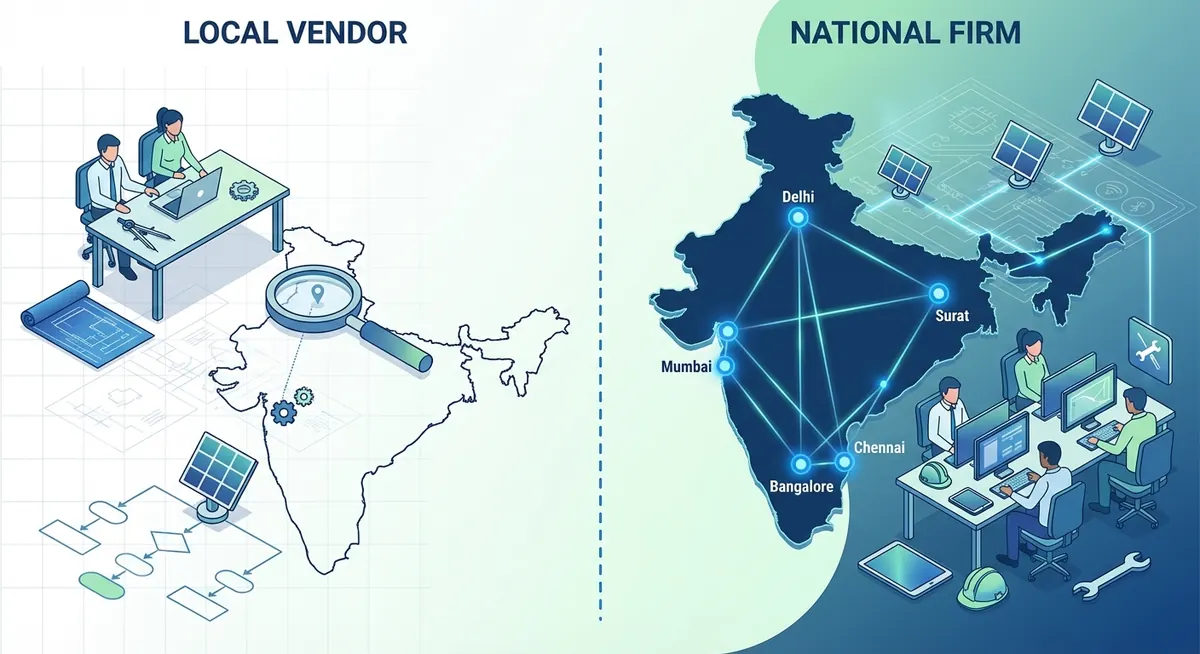
What is the difference between outsourcing to a local design firm and outsourcing to an offshore firm?
The key difference is regulatory knowledge, not time zone. A local Indian firm understands DISCOM formats, IS standards, CEIG approval processes, and MNRE scheme documentation natively. An offshore firm (e.g., a design house in another country) may have lower headline prices but will produce generic electrical drawings that require significant local adaptation before DISCOM submission — often costing more in rework than the original saving. For projects in India, the outsourcing partner must have direct, current knowledge of the specific DISCOM you are submitting to. For export and USA projects, the partner needs NEC 2023 fluency and state PE coverage — a different competency entirely. The offshore vs. onshore design outsourcing comparison covers this distinction with specific cost data.