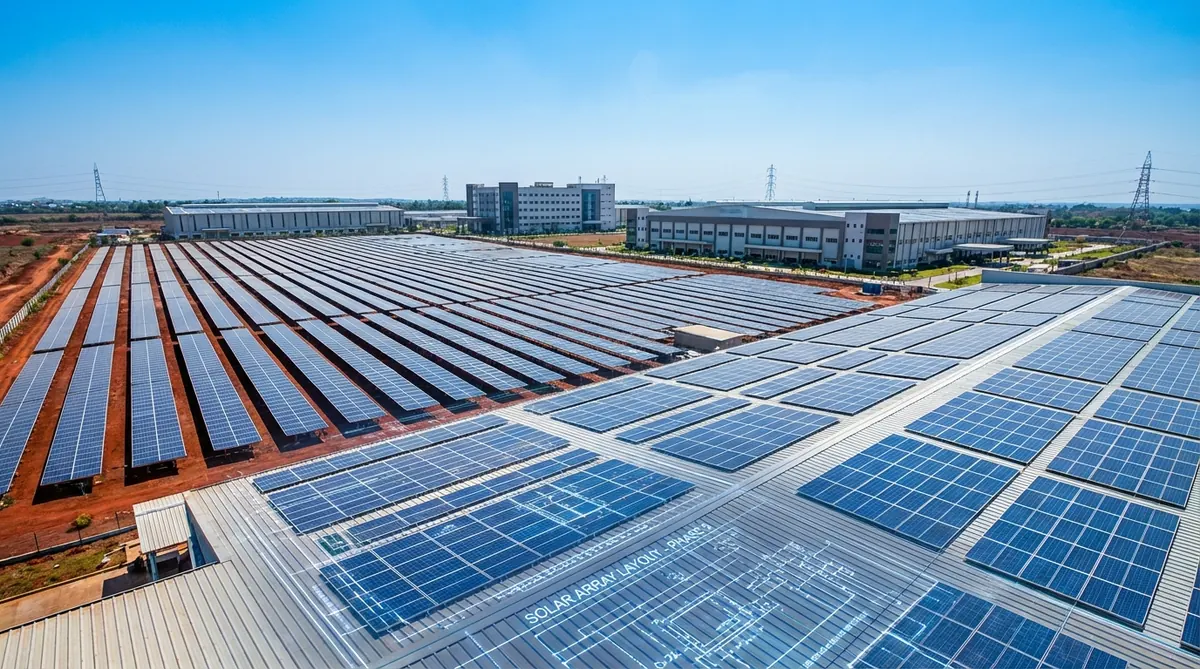
Lightning and earthing failures are responsible for some of the most expensive solar plant losses in India and Africa. A single direct lightning strike to a module on an unprotected rooftop can destroy the entire string’s junction boxes, burn multiple combiner box fuses, and send a surge through the inverter’s DC input stage that destroys the IGBT power block — resulting in ₹3–8 lakh in equipment damage per event. An earthing system that has not been tested for years can develop high soil resistance that prevents fault current from clearing, leaving the inverter chassis at dangerous touch potentials that expose maintenance staff to electric shock.
Direct answer. Solar earthing design in India follows IS 3043 (Code of Practice for Earthing), which requires: a measured soil resistivity survey, earthing electrode sizing for the maximum fault current and duration, and verification that the earthing resistance does not exceed 1 Ω for sensitive electronic equipment (inverters) and 4 Ω for general HV equipment. Lightning protection for solar plants follows IS 2309 and IEC 62305, with surge protective devices (SPDs) per IEC 62561-7 installed at the DC array (Class D/Type 3), DC main cable (Class B/Type 1), and AC inverter output (Class C/Type 2) to protect against lightning-induced transients.
This reference covers the complete earthing and lightning protection design methodology for solar plants in India, with code references to IS 3043, IS 2309, IEC 62305, IEC 62561, and the CEA Regulations.
The Four-Layer Solar Earthing System
A solar plant’s earthing system has four layers, each with a different function and design requirement:
Definition. Earthing (also called grounding) is the deliberate connection of electrical equipment frames and non-current-carrying metalwork to the earth via a low-impedance conductor and earth electrode. Earthing serves three functions: (1) limiting touch voltage on equipment frames to safe levels during faults, (2) providing a return path for fault current that activates overcurrent protection, and (3) stabilising the system voltage reference.
Layer 1 — DC Array Earthing: The PV module frames and mounting rail system must be connected to the earthing system. This is the EGC (Equipment Grounding Conductor) system for the DC side. Every module frame, mounting rail, and combiner box metal enclosure is bonded together and connected to the DC earthing bar. In India, IS 3043 Clause 8.1 specifies that all exposed metalwork must be earthed. In the USA, NEC 690.43 specifies the grounding of PV systems.
Layer 2 — DC Circuit Earthing (for grounded systems): In grounded DC systems (common for larger inverters in India), one pole of the DC circuit (typically the negative) is connected to earth through the earthing electrode. In ungrounded (floating) DC systems (common for transformerless inverters), neither pole is connected to earth but the system must have a ground fault protection device (GFPD or GFPE) that detects if a DC conductor contacts ground.
Layer 3 — AC System Earthing: The inverter AC output neutral and the distribution transformer neutral are earthed at the earthing electrode. IS 3043 specifies the neutral earthing arrangement for different system configurations (TN-S, TN-C-S, TT systems).
Layer 4 — Lightning Protection Earthing: The lightning protection system’s down-conductors terminate at a dedicated set of earth electrodes that are bonded to the electrical earthing system at a common bonding point. This bond prevents dangerous potential differences between the lightning protection system and the electrical earthing system during a lightning event.
IS 3043 Earthing Design — The Five-Step Methodology
The IS 3043 Solar Earthing Protocol (ISEP) is Heaven Designs’ proprietary framework for designing solar earthing systems that comply with IS 3043 and satisfy CEIG review on the first submission.
Soil Resistivity Survey
Conduct the Wenner four-electrode soil resistivity test at the proposed electrode locations. Measure at electrode spacings of 1, 2, 3, 5, 8, and 10 metres. Perform measurements in two perpendicular directions to detect anisotropic soil (soil with different resistivities in different directions — common in layered geology). Calculate the equivalent uniform soil resistivity using the geometric mean of the measured values at the spacing corresponding to the planned electrode depth.
Electrode Type Selection
Select the earthing electrode type based on soil conditions: (a) Driven rod electrodes (IS 3043 Clause 5.2) — most common; use 25 mm copper-bonded steel rods, 2–3 m length, driven to at least 1 m depth below permanent moisture. (b) Strip electrodes (IS 3043 Clause 5.3) — horizontal copper tape buried at 0.5–0.6 m depth; effective in shallow rocky ground where driving rods is not feasible. (c) Ring electrodes — copper tape forming a ring around the installation; used for large area installations like rooftop and ground-mount arrays.
Earthing Resistance Calculation
Calculate the resistance to earth of the proposed electrode configuration using IS 3043 formulae or IEEE 80 methods. For a single driven rod: R = (ρ / 2πL) × [ln(4L/d) − 1], where ρ = soil resistivity (Ω·m), L = rod length (m), d = rod diameter (m). For multiple rods in parallel, apply the grouping factor. Compare the calculated resistance to the target: ≤ 1 Ω for electronic equipment protection, ≤ 4 Ω for HV substation earthing per IS 3043.
Earthing Conductor Sizing
Size the earthing conductor using IS 3043 Table 4, based on the fault current and the fault duration. The formula from IS 3043: A = I × √t / K, where A = conductor cross-section (mm²), I = fault current (A), t = fault duration (s), K = material constant (for copper: 159 A·s^0.5/mm²; for aluminium: 105). For a 100 A fault at a rooftop inverter with 1-second fault duration: A = 100 × √1 / 159 = 0.63 mm² — minimum 16 mm² for mechanical protection per IS 3043. The 16 mm² floor is the minimum mechanical size for outdoor earthing conductors.
Post-Installation Testing
Measure the installed earthing resistance using the fall-of-potential method (IS 3043 Clause 12.1). The test must be conducted after the complete earthing system is installed, before commissioning. The measured resistance must be ≤ 1 Ω for the inverter earthing. Document the test results in the commissioning report — CEIG inspectors often request proof of earthing resistance measurement during the energisation inspection.
IEC 62305 Lightning Risk Assessment
IEC 62305 (Protection Against Lightning) requires a risk assessment to determine whether the installation needs lightning protection and, if so, what level of protection is required. The risk assessment uses four parameters:
- Ng (Ground flash density): Lightning strikes per km² per year at the site location. In India, Ng varies from 2 (arid Rajasthan) to 12 (humid northeastern states). The Bureau of Indian Standards (BIS) isokeraunic maps provide state-level data.
- Collection area (Ae): The effective area that “attracts” lightning strikes to the structure, based on the physical dimensions and height.
- Risk factor Ra: Probability of injury to persons per year, calculated from Ng, Ae, and building use characteristics.
- Tolerable risk (Rt): 10⁻⁵ per year for loss of human life (IEC 62305-2 Table 1).
If Ra > Rt, lightning protection is required. For most solar plants above 15 m height in areas with Ng > 4, the risk assessment justifies lightning protection.
≤1 Ω
Target earthing resistance for inverters
IS 3043 Clause 8.3
16 mm²
Minimum copper EGC for outdoor earthing
IS 3043 Table 4
IEC 62305
Lightning protection standard
IEC, adopted by BIS as IS
IEC 62561
SPD component standard
IEC, part 7 covers SPDs for solar
Surge Protective Devices — SPD Selection for Solar
Surge Protective Devices (SPDs) protect the inverter and associated electronics from lightning-induced voltage transients. IEC 61643-11 and IEC 62561-7 govern SPD requirements for solar PV systems.
SPDs are classified by their test current impulse:
- Class I / Type 1: Test with 10/350 μs impulse (direct lightning current). Installed at the entry point of the lightning protection system — DC main cable combiner or the AC service entrance.
- Class II / Type 2: Test with 8/20 μs impulse (induced lightning current). Installed at the inverter AC output terminal and at distribution panels.
- Class III / Type 3: Test with 1.2/50 μs impulse (very low residual surge). Installed close to sensitive equipment — at inverter MPPT inputs.
For a solar rooftop installation, the minimum SPD specification is:
| Location | SPD class | Uc (voltage protection) | Maximum current (Imax) | Note |
|---|---|---|---|---|
| DC array junction box | Class II/Type 2 | ≥ 1.2 × Voc_max (DC) | ≥ 10 kA | Per IEC 62561-7 |
| DC main cable combiner | Class I/Type 1 | ≥ 1.2 × Voc_max (DC) | ≥ 25 kA (10/350 μs) | When LPS is installed |
| Inverter AC output | Class II/Type 2 | ≥ 1.1 × Vac_max | ≥ 20 kA | Per inverter manufacturer |
| Distribution board | Class II or III | ≥ 1.1 × Vac_max | ≥ 10 kA | Residual protection |
Watch out. Many solar installers in India purchase the cheapest SPDs available in the market without verifying the discharge current rating. An SPD rated at 10 kA (Imax) and installed at the DC array on a building with a direct lightning protection system will be destroyed on the first direct strike — because a direct strike can deliver 100 kA or more in the first return stroke. Class I / Type 1 SPDs with Iimp ≥ 12.5 kA (10/350 μs) are required at locations that may conduct direct lightning current.
Lightning Protection System Design — The Air Termination Network
For buildings with rooftop solar that require a lightning protection system (LPS) per the IEC 62305 risk assessment, the LPS air termination network (the lightning rod or conductor on the roof) must be positioned to protect the solar modules without itself creating a shading problem.
The IEC 62305-3 Rolling Sphere Method determines the protected zone:
- For LPS Level III (most common for industrial buildings), the rolling sphere radius is 45 m
- For Level II: 30 m
- For Level I: 20 m
A lightning mast of height h protects a cone of base radius r = √(Rs² - (Rs - h)²) at ground level, where Rs is the rolling sphere radius. For a 4 m mast on a 10 m building (14 m total) with RS = 45 m (Level III): r = √(45² - (45-4)²) = √(2025 - 1681) = √344 = 18.5 m radius at the building level.
Field tip. Position lightning masts at the perimeter of the rooftop PV array rather than in the centre. A central mast creates structural shading on adjacent modules. Perimeter masts protect the array while shading only the edge modules (or the walkway between the mast and the first module row). Use the LPS design software (DEHN BASIS or equivalent) to verify that the rolling sphere protection cone covers the entire array at the proposed mast positions.
Bonding — The Critical Connection Between LPS and Electrical Earthing
IEC 62305-3 requires that all earthing systems at a site (LPS earthing, electrical earthing, telecommunications earthing) be bonded together at a common bonding bar. This prevents dangerous potential differences between different earthed systems during a lightning event — a potential difference that can drive current through electronic equipment connected between the two earthed systems.
For a solar rooftop installation, the bonding requirements:
- The LPS down-conductor earthing electrode is connected to the main earthing bar (MEB) of the electrical system via a bonding conductor (minimum 16 mm² copper).
- All data cables (SCADA, monitoring) that run between the rooftop and the inverter room must be enclosed in a metal conduit (or use fibre optic cables) to prevent data cables from conducting lightning surge between the two earthed zones.
- The module frames (earthed via the EGC) are connected to the LPS air termination via the module mounting structure — this is the critical reason that the mounting structure must be electrically continuous (no painted or anodised joints that break conductivity) and must be connected to the LPS.
SPD Coordination — Ensuring the Cascade Works
Installing SPDs without ensuring they are coordinated is common and dangerous. Coordination means that the Class III SPD at the inverter input is protected by the Class II SPD at the array combiner, which is in turn protected by the Class I SPD at the building LPS entry point. Without coordination, a surge that exceeds the Class III SPD’s withstand capacity arrives at the inverter without being adequately clamped by the upstream devices.
IEC 61643-12 provides the coordination guidelines:
- The distance between adjacent SPD stages must be at least 10 m of cable (or a coordination choke of 1.5 μH must be installed)
- The protection level (Up) of the upstream SPD must be equal to or less than the Uc of the downstream SPD
- The SPD at each stage must be sized for the maximum surge current it can receive — not just for the maximum surge from the environment, but from the parallel strings that feed the same SPD
EARTHING BEST PRACTICES
- Test soil resistivity before designing the electrode system
- Use copper-bonded steel rods minimum 2 m long, 25 mm diameter
- Add bentonite clay around electrodes in high-resistivity soils
- Measure installed resistance before commissioning
- Bond all earthing systems at a common bonding bar
COMMON EARTHING ERRORS
- Using GI rods instead of copper-bonded rods in corrosive soil
- Not testing earthing resistance after installation
- LPS and electrical earthing bonded far from each other
- SPD installed without backup fuse (SPD failure cascades)
- Module frames not electrically connected to earthing
Need earthing and lightning protection design for your solar project?
Heaven Designs produces IS 3043 and IEC 62305-compliant earthing and lightning protection design reports — with SPD selection, soil resistivity analysis, and CEIG-accepted drawings.
Download an earthing design sample →How Heaven Designs Helps with Solar Earthing and Lightning Protection
Indian solar EPCs need earthing and lightning protection design that satisfies CEIG on the first submission and actually protects the installation from storm events. Heaven Designs provides:
- Electrical CEIG Drawings — CEIG-approved earthing drawings: electrode layout plan, earthing conductor schedule, soil resistivity report summary, and bonding diagram — submitted as part of the HV/LV electrical approval package.
- Solar Civil & Structural Engineering — Lightning protection air termination design: mast positioning using rolling sphere method, down-conductor routing, and foundation design for lightning masts.
- Solar Rooftop Detailed Engineering Design — Complete rooftop engineering package including earthing and SPD specification per IS 3043 and IEC 62561-7.
- Solar Ground Mount Design — Utility-scale plant earthing grid design per IS 3043 / IEEE 80, perimeter earth ring, and pile-to-ring bonding for tracker-mounted structures.
- Download a sample deliverable — Download a redacted earthing design report showing the ISEP Framework output and soil resistivity analysis.
According to IEC 62305-3 (Protection Against Lightning — Part 3: Physical Damage to Structures and Life Hazard), all photovoltaic systems installed on structures taller than 20 m must undergo the formal risk assessment before deciding whether LPS is required. In India, IS 2309 requires mandatory lightning protection for buildings above 15 m height in lightning-prone areas — which covers most industrial and commercial rooftop solar sites in Maharashtra, Gujarat, Rajasthan, and Karnataka.
For cable routing that works with the earthing system, see solar cable routing — DC, AC, earthing best practices for rooftops. Contact us for earthing and lightning protection design for your current project.
FAQ
What earthing resistance is required for a solar inverter in India?
IS 3043 Clause 8.3 specifies that the earthing resistance for electronic equipment (including power electronics such as solar inverters) must not exceed 1 Ω. Most inverter manufacturers independently specify ≤ 1 Ω as a warranty condition. For general electrical equipment (not electronics), IS 3043 permits up to 4 Ω. The 1 Ω requirement is stricter and is the design target for all inverter earthing installations.
Can I use the building’s existing earthing system for the solar inverter?
Yes, if the building’s existing earthing system has a measured resistance of ≤ 1 Ω and the existing earthing conductors are sized for the solar fault current. Most older industrial buildings in India have earthing systems designed for the building’s electrical load and may not be sized for the solar fault current or may have deteriorated over time. Always measure the existing earthing resistance before connecting a new inverter. If the measured resistance is above 1 Ω, install additional earth electrodes and bond them to the existing system.
What is the difference between IS 2309 and IEC 62305 lightning protection?
IS 2309 (Code of Practice for Protection of Buildings and Allied Structures Against Lightning) is the Indian standard, first published in 1969 and revised in 1985. IEC 62305 (Protection Against Lightning) is the international standard, first published in 2006 and revised in 2010 and 2021. IS 2309 uses an older “protection angle” method that is generally more conservative (requires taller masts for the same protection radius) than IEC 62305’s rolling sphere method. For new solar projects, IEC 62305 is preferred because it is current, internationally recognised, and accepted by DFI lenders for bankability assessments. Both are acceptable to the CEIG.
How many SPD stages are required for a 100 kWp rooftop solar installation?
For a 100 kWp rooftop installation without a direct lightning protection system, two SPD stages are the minimum: Class II at the DC combiner/array output and Class II at the inverter AC output. If the building has a direct lightning protection system or is in a high-thunderstorm area (Ng > 6), add a Class I SPD at the DC main cable entry point (between the rooftop combiner and the inverter room). The Class I SPD at this location must be separated from the Class II SPD at the inverter by at least 10 m of cable or a coordination inductor, per IEC 61643-12.
Is the lightning protection system mandatory for all solar installations in India?
No — lightning protection is mandatory only when the IEC 62305 or IS 2309 risk assessment shows that the calculated risk exceeds the tolerable risk threshold. For most ground-mounted solar plants in flat terrain with Ng < 4, the risk assessment typically does not require a formal LPS. For rooftop solar on buildings above 15 m in high-thunderstorm areas (Ng > 6), IS 2309 mandates lightning protection for the building — and the solar system must be integrated with that LPS. For ground-mounted utility-scale plants in high-thunderstorm areas, IEC 62305 risk assessment may justify LPS depending on plant area, height, and lightning density.
How often should earthing resistance be tested after installation?
IS 3043 recommends annual testing of earthing resistance for installations with electronic equipment (including solar inverters). The test must be performed using the fall-of-potential method (IS 3043 Clause 12.1), not a simple continuity test. Earthing resistance can increase significantly over time due to soil drying (especially in summer in India), corrosion of the electrode material (especially GI electrodes), or mechanical damage to the earthing conductor. An earthing system that passed the commissioning test at 0.8 Ω may measure 3.5 Ω after five years without maintenance — above the inverter manufacturer’s warranty threshold.