


For solar EPC companies and developers in India, understanding the complete solar project cost structure is essential for competitive bidding, accurate budgeting, and maintaining healthy profit margins. In 2026, with evolving technology, fluctuating material prices, and increasing competition, a comprehensive grasp of every cost component—from initial design to final commissioning—can make the difference between a profitable project and a financial setback.
This guide breaks down every aspect of solar project cost for residential, commercial, and utility-scale installations. Whether you’re planning a 5 kW rooftop system or a 50 MW ground mount solar farm, you’ll discover the exact cost factors, hidden expenses, and optimization strategies that successful EPC companies use to deliver projects on budget while maximizing returns.

Understanding Solar Project Cost Components in 2026
The total solar project cost encompasses far more than just solar panels and inverters. A complete budget includes design and engineering services, equipment procurement, labor and installation, project management, permits and approvals, and various miscellaneous expenses that often catch inexperienced developers off guard.
In India’s solar market, accurate cost estimation has become increasingly critical. With tender prices becoming more competitive and margins tightening, EPC companies cannot afford cost overruns or budget surprises. A typical solar project budget breaks down approximately as follows:
- Equipment and materials: 60-70% of total project cost
- Labor and installation: 15-20% of total project cost
- Design and engineering: 3-5% of total project cost
- Project management and consultancy: 2-4% of total project cost
- Permits, approvals, and miscellaneous: 5-8% of total project cost
These percentages vary based on project scale, location, technology choices, and whether you’re executing a rooftop or ground mount installation. Understanding how each component contributes to your overall budget allows you to identify optimization opportunities without compromising quality or performance.
The solar project cost landscape in India has evolved significantly. While module prices have decreased over the past decade, other components like skilled labor, quality inverters, and professional engineering services maintain their value. Smart EPC companies recognize that investing in proper design and planning upfront reduces expensive rework and change orders during construction, ultimately lowering the total project cost.
1. Design and Engineering Costs: The Foundation of Your Budget
Professional design and engineering services form the foundation of any successful solar project. While these costs typically represent only 3-5% of your total budget, they have an outsized impact on overall project economics, energy generation, and long-term performance.
The solar design cost varies based on project complexity, scale, and the level of detail required. For a comprehensive MW-scale project, expect design and engineering expenses to include several distinct phases and deliverables.
Solar 3D pre-design services provide preliminary layouts and feasibility analysis before committing to detailed engineering. This phase typically costs between ₹15,000 to ₹50,000 for residential and small commercial projects, and ₹1-3 per watt for larger installations. Pre-design helps you evaluate site suitability, estimate energy generation, and create preliminary budgets for client proposals.
Detailed engineering design for MW-scale projects represents the most substantial design investment. Comprehensive engineering packages include single-line diagrams, layout drawings, electrical schematics, cable schedules, earthing designs, and complete bill of materials. For utility-scale projects, detailed engineering typically costs ₹0.50 to ₹2.00 per watt depending on project complexity and site conditions.
Permit design services ensure your project meets all regulatory requirements and local building codes. Permit-ready drawing packages prepared by qualified engineers expedite approval processes and prevent costly delays. Budget ₹20,000 to ₹1,00,000 for permit design depending on jurisdiction requirements and project size.
Many EPC companies face a critical decision: should they invest in building an in-house design team or partner with specialized design consultancies? The economics often favor outsourcing, especially for companies executing fewer than 20-30 projects annually. Maintaining a full-time team of solar engineers requires significant overhead—salaries, software licenses, training, and management—that can exceed ₹50 lakhs annually.
Specialized design partners like Heaven Designs offer cost-effective alternatives, providing access to a team of 50+ experienced engineers without the overhead burden. This approach converts fixed costs into variable costs, improving your financial flexibility while ensuring access to specialized expertise for complex projects.
Site Assessment and Feasibility Study Expenses
Before detailed design begins, comprehensive site assessment establishes the technical and economic viability of your solar project. These upfront investments prevent expensive mistakes and ensure your project assumptions are grounded in reality.
Site survey costs vary significantly across India based on location accessibility, project scale, and survey complexity. A basic site survey for a rooftop installation might cost ₹5,000 to ₹15,000, while comprehensive surveys for utility-scale ground mount projects can range from ₹50,000 to ₹3,00,000. Remote or difficult-to-access locations increase survey costs due to travel time and logistical challenges.
Professional site surveys capture critical data including GPS coordinates, roof or land dimensions, shading analysis, electrical infrastructure assessment, and photographic documentation. This information directly impacts design accuracy and cost estimation reliability.
A comprehensive feasibility study goes beyond basic site surveys to evaluate technical, financial, and regulatory viability. Feasibility studies for commercial and utility-scale projects typically cost ₹1,00,000 to ₹10,00,000 depending on project size and analysis depth. These studies examine grid connectivity, land suitability, environmental considerations, financial modeling, and risk assessment.
Geotechnical investigations are essential for ground mount installations to determine soil bearing capacity and foundation requirements. Soil testing costs range from ₹30,000 to ₹2,00,000 depending on the number of test pits, laboratory analysis requirements, and site conditions. Skipping geotechnical studies can lead to foundation failures or over-engineered structures that unnecessarily inflate costs.
Shadow analysis and energy assessment services use specialized software to model shading impacts and predict energy generation. These analyses cost ₹10,000 to ₹50,000 for most projects but provide critical data for financial modeling and system optimization. Accurate energy predictions help you set realistic client expectations and avoid performance guarantee disputes.
Structural and Civil Engineering Investment
Structural and civil engineering ensures your solar installation can withstand wind loads, seismic forces, and environmental conditions throughout its 25-year lifespan. The engineering cost for structural design varies based on mounting system complexity and local building code requirements.
For rooftop solar installations, structural engineering focuses on roof load capacity analysis and mounting system design. Expect to invest ₹15,000 to ₹1,00,000 for structural engineering depending on roof type, building age, and local wind zone classifications. Older buildings or complex roof geometries require more extensive analysis and potentially reinforcement designs.
Ground mount structural engineering encompasses foundation design, mounting structure specifications, and civil works planning. For utility-scale projects, structural engineering typically costs ₹0.30 to ₹1.00 per watt. This investment includes foundation calculations for different soil conditions, wind and seismic load analysis, and detailed structural drawings for fabrication.
Foundation design represents a critical cost variable in ground mount projects. Soil conditions dramatically impact foundation requirements—stable soil might allow simple driven piles, while poor soil conditions may require expensive concrete foundations. Proper geotechnical investigation and structural engineering prevent both foundation failures and unnecessary over-engineering.
Wind load and seismic analysis ensures your installation meets Indian Standard codes (IS 875 for wind loads, IS 1893 for seismic design). These analyses are mandatory for permit approvals and insurance coverage. The cost is typically included in comprehensive structural engineering packages but may add ₹20,000 to ₹1,00,000 as a standalone service for complex projects.
2. Equipment and Material Costs: The Largest Budget Component
Equipment and materials represent 60-70% of total solar project cost, making procurement strategy and technology selection critical to project economics. In 2026, EPC companies face numerous choices across solar panels, inverters, mounting structures, and balance of system components, each with distinct cost-performance trade-offs.
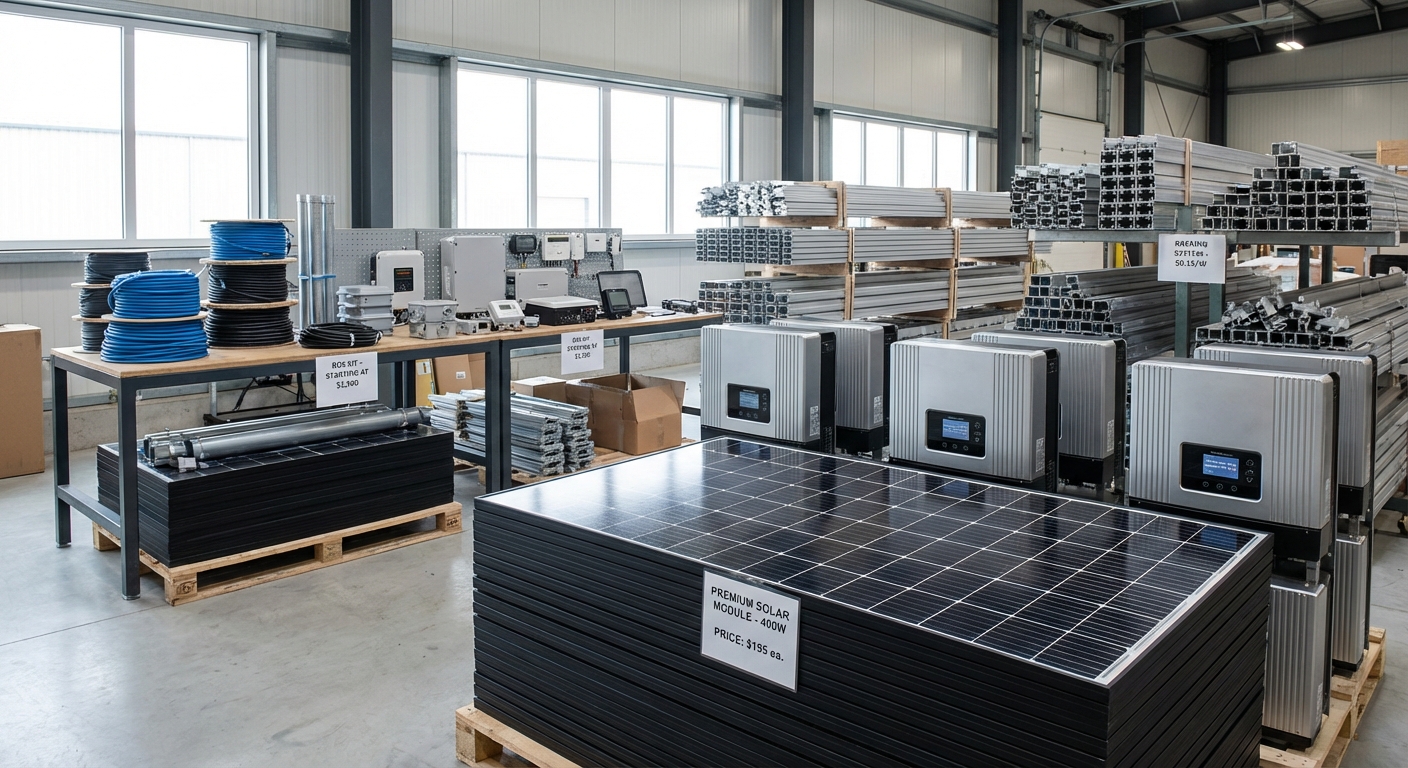
Smart procurement strategies can reduce equipment costs by 10-15% without compromising quality. This includes bulk purchasing for multiple projects, establishing relationships with reliable suppliers, timing purchases to avoid price spikes, and carefully evaluating the total cost of ownership rather than just upfront prices.
The equipment budget must balance initial costs against long-term performance, warranty coverage, and maintenance requirements. Choosing the cheapest components often leads to higher lifecycle costs due to failures, reduced energy generation, and increased maintenance expenses.
Solar Panel Cost Analysis
Solar panels remain the most visible component of your project and typically account for 35-45% of total equipment costs. In 2026, Indian solar panel prices range from ₹15 to ₹25 per watt depending on technology, efficiency, brand reputation, and purchase volume.
Monocrystalline solar panels dominate the market due to superior efficiency and space optimization. Expect to pay ₹18 to ₹25 per watt for quality monocrystalline modules from reputable manufacturers. Higher efficiency panels (20-22% efficiency) command premium prices but reduce balance of system costs by requiring less mounting structure and installation labor per kilowatt.
Polycrystalline panels offer lower upfront costs at ₹15 to ₹20 per watt but with reduced efficiency. These panels make sense for ground mount projects with ample available land where space constraints don’t drive system design. However, the market share of polycrystalline technology continues declining as monocrystalline prices decrease.
Bifacial solar modules capture light from both front and rear surfaces, increasing energy generation by 5-15% depending on ground reflectivity and mounting height. Bifacial panels cost ₹2-4 per watt more than standard modules but can improve project economics in the right applications. Proper design and site conditions are essential to realize bifacial benefits.
For MW-scale projects, bulk procurement discounts significantly impact panel costs. Purchasing 1 MW or more from a single manufacturer can reduce per-watt costs by ₹2-4 compared to smaller orders. However, single-source procurement increases supply chain risk, so balance cost savings against delivery reliability and vendor financial stability.
Warranty and performance guarantees add value beyond initial purchase price. Standard warranties include 10-12 years for product defects and 25 years for performance (typically guaranteeing 80-85% of rated power after 25 years). Premium manufacturers offer enhanced warranties that reduce long-term risk but may add ₹1-2 per watt to upfront costs.
Inverter and Electrical Components Budget
Inverters convert DC power from solar panels into AC power for grid connection or consumption. Quality inverters are critical for system reliability and energy harvest, typically representing 10-15% of total equipment costs.
String inverters are the most common choice for residential and commercial installations, costing ₹4 to ₹8 per watt of AC capacity. Modern string inverters offer excellent efficiency (97-98%), built-in monitoring, and modular redundancy. For a 100 kW commercial system, expect to invest ₹4,00,000 to ₹8,00,000 in string inverters.
Central inverters suit utility-scale projects above 1 MW, offering economies of scale at ₹3 to ₹6 per watt. While central inverters reduce per-watt costs, they create single points of failure that can take entire arrays offline. Many developers now prefer string inverters even for large projects due to improved reliability and granular monitoring.
Transformer and switchgear expenses facilitate grid connection and electrical protection. For medium-voltage grid connections common in MW-scale projects, budget ₹1,00,000 to ₹10,00,000 for transformers depending on capacity and voltage requirements. Switchgear, circuit breakers, and protection devices add another ₹50,000 to ₹5,00,000 depending on system complexity.
Cabling and wiring costs are often underestimated but can represent 5-8% of total project costs. DC cables connecting panels to inverters must be properly sized to minimize losses while avoiding unnecessary over-sizing. AC cables from inverters to the grid connection point require careful design for voltage drop and safety. Budget ₹2 to ₹5 per watt for complete cabling including DC strings, AC distribution, and earthing conductors.
Monitoring systems and SCADA provide real-time performance data and fault detection. Basic monitoring comes integrated with modern inverters, but comprehensive SCADA systems for utility-scale projects cost ₹50,000 to ₹5,00,000. These systems pay for themselves by enabling rapid fault detection and optimizing maintenance schedules.
3. Labor and Installation Costs Across India
Labor and installation typically account for 15-20% of total solar project cost, with significant regional variations across India. Understanding local labor markets and optimizing installation efficiency directly impacts project profitability.
Regional labor cost variations reflect local wage rates, skill availability, and market competition. Metropolitan areas like Mumbai, Delhi, and Bangalore command higher labor rates (₹500-800 per day for skilled workers) compared to tier-2 and tier-3 cities (₹300-500 per day). However, higher wages often correlate with greater productivity and quality, potentially reducing overall installation time and rework costs.
Solar installation requires both skilled and unskilled labor with distinct cost structures. Skilled electricians and solar technicians with proper training and certification earn ₹600-1,000 per day, while general laborers for material handling and site preparation earn ₹300-500 per day. A typical installation crew for a commercial project includes 1-2 skilled electricians, 2-3 solar technicians, and 3-5 general laborers.
For a residential rooftop installation (5-10 kW), labor costs typically range from ₹3-5 per watt, totaling ₹15,000 to ₹50,000. Installation time ranges from 2-5 days depending on roof complexity and crew experience.
Commercial and industrial installations (50 kW to 1 MW) benefit from economies of scale, with labor costs dropping to ₹2-4 per watt. A 500 kW commercial rooftop might require ₹10-20 lakhs in labor costs over 2-4 weeks of installation time.
Utility-scale ground mount projects achieve the lowest per-watt labor costs at ₹1.50-3.00 per watt due to standardized processes and efficient crew deployment. However, total labor costs for a 10 MW project still reach ₹1.5-3 crores, requiring careful project management and scheduling.
Installation timeline directly impacts labor costs through crew utilization and project overhead. Efficient project scheduling that minimizes weather delays, coordinates material deliveries, and maintains steady work flow reduces labor costs per watt. Conversely, projects with frequent stops and starts due to poor planning or material shortages inflate labor expenses through crew downtime and remobilization costs.
The choice between contractor vs. in-house installation teams involves trade-offs between control and flexibility. In-house teams provide quality control and scheduling flexibility but require continuous project pipeline to maintain utilization. Contractors offer variable cost structure and specialized expertise but may prioritize other clients during peak seasons. Most successful EPC companies use hybrid approaches, maintaining core teams supplemented by contractors during peak periods.
Safety equipment and training represent essential investments that protect workers and reduce liability. Budget ₹50,000 to ₹5,00,000 for safety equipment including harnesses, helmets, safety barriers, and first aid supplies depending on project scale. Safety training programs cost ₹5,000 to ₹20,000 per worker but dramatically reduce accident rates and associated costs.
4. Project Management and Consultancy Expenses
Professional project management and consultancy services ensure projects stay on schedule, within budget, and meet quality standards. While PMC services add 2-4% to total project costs, they typically deliver value many times their cost through risk mitigation and optimization.
For MW-scale solar projects, PMC services cost structure typically ranges from ₹0.50 to ₹2.00 per watt depending on service scope and project complexity. A comprehensive PMC package for a 10 MW project might cost ₹50 lakhs to ₹2 crores, covering design review, procurement support, construction supervision, quality assurance, and commissioning assistance.
Quality assurance and quality control programs prevent defects and ensure installations meet design specifications. QA/QC services include material inspection, installation audits, testing and commissioning, and documentation verification. Budget ₹0.30 to ₹1.00 per watt for comprehensive QA/QC programs that catch issues before they become expensive problems.
Project coordination and supervision keeps multiple contractors, suppliers, and stakeholders aligned. Full-time site engineers for supervision cost ₹50,000 to ₹1,50,000 per month depending on experience and project complexity. For a 6-month construction period, supervision costs might total ₹3-9 lakhs, but this investment prevents coordination failures that can delay projects by weeks or months.
Documentation and reporting requirements vary by project but typically include daily progress reports, quality documentation, as-built drawings, and commissioning records. Professional documentation costs ₹20,000 to ₹2,00,000 depending on project scale and client requirements. Proper documentation is essential for warranty claims, performance verification, and future maintenance.
The value delivered by professional PMC services far exceeds their cost for most projects. Experienced PMC providers identify design optimizations, negotiate better supplier terms, prevent construction defects, and accelerate project timelines. A good PMC partner might reduce total project costs by 3-5% while improving quality and reducing risk, delivering ROI of 2-3 times their fees.
5. Hidden and Miscellaneous Solar Project Costs
Beyond major cost categories, numerous smaller expenses accumulate to represent 5-8% of total solar project cost. These hidden costs often catch inexperienced developers off guard, leading to budget overruns and reduced profitability.
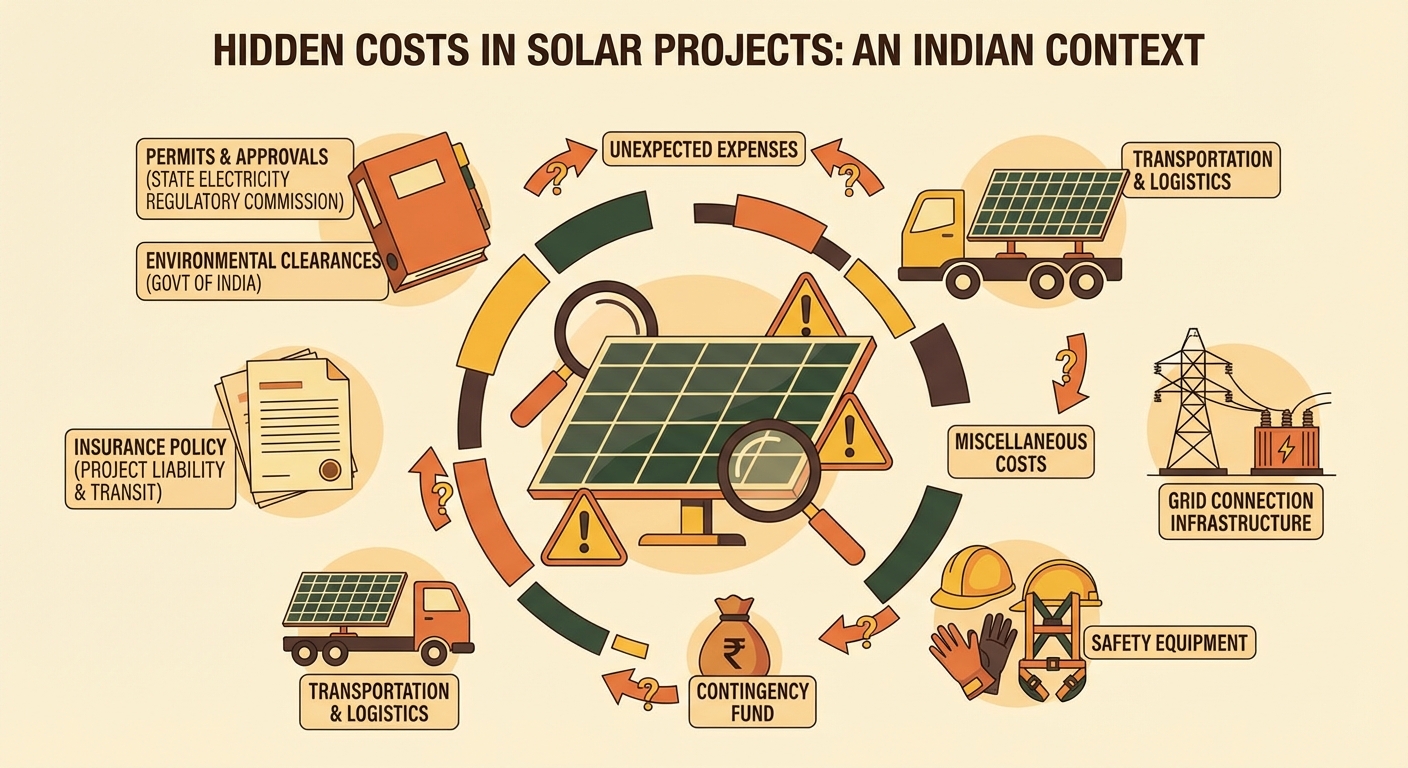
Permit and approval fees vary dramatically across Indian states and municipalities. Some jurisdictions charge flat fees (₹5,000 to ₹50,000), while others assess percentage-based fees on project value. Factor in costs for building permits, electrical permits, fire safety approvals, and environmental clearances where applicable. For utility-scale projects, budget ₹1-5 lakhs for comprehensive permit packages.
Grid connection and net metering charges represent significant expenses for grid-tied systems. Distribution companies charge for meter installation, grid connectivity studies, and infrastructure upgrades. These costs range from ₹10,000 for small residential systems to ₹10-50 lakhs for MW-scale projects requiring dedicated feeders or substation upgrades. Connection timelines and costs vary by state, so research local utility requirements early in project planning.
Insurance and warranty costs protect your investment against equipment failure, natural disasters, and liability claims. Construction all-risk insurance during installation costs 0.2-0.5% of project value. Long-term operational insurance adds another 0.3-0.6% annually. Extended warranties beyond standard manufacturer coverage cost 1-2% of equipment value but can provide peace of mind for risk-averse clients.
Transportation and logistics expenses are often underestimated, especially for remote project sites. Shipping solar panels and inverters from ports or manufacturing facilities to project sites costs ₹0.50 to ₹2.00 per watt depending on distance and accessibility. Factor in costs for material handling equipment, storage, and site security during construction. For a 5 MW project in a remote location, logistics might add ₹25-1 crore to total costs.
Contingency budget recommendations provide buffer for unexpected expenses and scope changes. Industry best practice suggests 5-10% contingency for well-planned projects, increasing to 10-15% for projects with higher uncertainty. A ₹5 crore project should include ₹25-50 lakhs contingency to handle unforeseen site conditions, design changes, or market price fluctuations. Unused contingency improves project margins, while inadequate contingency forces difficult trade-offs or scope reductions.
Financing and interest costs impact total project economics even if not directly part of construction budget. If you’re financing equipment purchases or carrying project costs before client payments, interest expenses can add 1-3% to effective project costs. Efficient cash flow management and favorable payment terms with suppliers and clients minimize financing costs.
Solar Project Cost Breakdown by Scale and Type
Understanding how solar project cost varies by scale and installation type helps you create accurate budgets and identify the most profitable market segments for your EPC business.
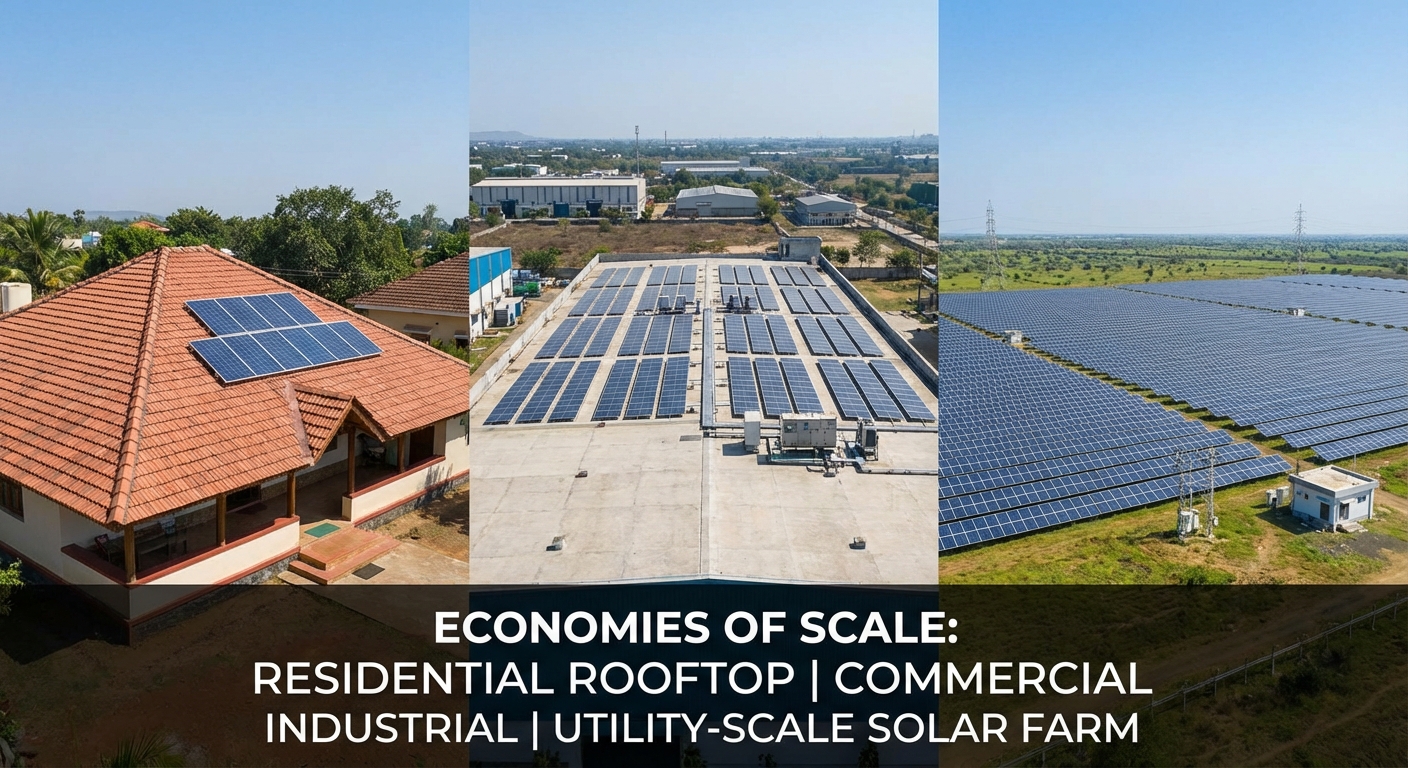
Residential Rooftop Solar Project Cost Structure (1-10 kW)
Residential solar installations represent the highest per-watt costs due to limited economies of scale and higher relative overhead. In 2026, expect total installed costs of ₹45-65 per watt for quality residential systems.
Cost breakdown for a typical 5 kW residential system (₹2.5-3.25 lakhs total):
- Solar panels (5 kW): ₹90,000-1,25,000 (₹18-25 per watt)
- Inverter (5 kW): ₹30,000-40,000 (₹6-8 per watt)
- Mounting structure: ₹25,000-35,000 (₹5-7 per watt)
- Balance of system (cables, connectors, earthing): ₹20,000-30,000
- Design and engineering: ₹10,000-20,000
- Labor and installation: ₹15,000-25,000
- Permits and net metering: ₹10,000-20,000
- Miscellaneous and contingency: ₹10,000-20,000
Residential projects require proportionally more design time, site visits, and customer interaction per kilowatt, increasing overhead costs. However, residential clients often accept higher margins, and government subsidies in some states can improve project economics.
Commercial and Industrial Solar Cost Breakdown (10 kW – 1 MW)
Commercial and industrial installations achieve better economies of scale while maintaining manageable project complexity. Total installed costs typically range from ₹35-50 per watt depending on system size and site conditions.
Cost breakdown for a typical 500 kW commercial rooftop (₹1.75-2.5 crores total):
- Solar panels (500 kW): ₹90 lakhs-1.25 crores (₹18-25 per watt)
- Inverters (500 kW): ₹25-35 lakhs (₹5-7 per watt)
- Mounting structure: ₹20-30 lakhs (₹4-6 per watt)
- Balance of system: ₹15-25 lakhs
- Design and engineering: ₹3-5 lakhs
- Labor and installation: ₹10-20 lakhs
- Project management: ₹3-5 lakhs
- Permits, grid connection, and miscellaneous: ₹5-10 lakhs
Commercial projects offer attractive margins with professional clients who understand solar economics. These projects benefit from standardized processes while avoiding the extreme complexity of utility-scale developments.
Utility-Scale Ground Mount Project Expenses (1 MW+)
Utility-scale ground mount installations achieve the lowest per-watt costs through economies of scale, bulk procurement, and optimized processes. Total installed costs range from ₹30-45 per watt for projects above 5 MW.
Cost breakdown for a typical 10 MW ground mount project (₹30-45 crores total):
- Solar panels (10 MW): ₹16-20 crores (₹16-20 per watt)
- Inverters (10 MW): ₹4-6 crores (₹4-6 per watt)
- Mounting structure and foundations: ₹4-6 crores (₹4-6 per watt)
- Balance of system: ₹2-3 crores
- Design and engineering: ₹50 lakhs-1 crore
- Labor and installation: ₹1.5-3 crores
- Project management consultancy: ₹50 lakhs-2 crores
- Land preparation and civil works: ₹50 lakhs-1.5 crores
- Grid connection and substation: ₹1-3 crores
- Permits, insurance, and miscellaneous: ₹50 lakhs-2 crores
Utility-scale projects require sophisticated project management, significant working capital, and ability to manage complex stakeholder relationships. However, they offer opportunities for substantial revenue and establish credentials for future large-scale work.
Cost Per Watt Analysis Across Different Project Scales
The relationship between project scale and per-watt costs demonstrates clear economies of scale:
- 1-5 kW residential: ₹50-65 per watt installed
- 5-10 kW residential: ₹45-55 per watt installed
- 10-50 kW small commercial: ₹40-50 per watt installed
- 50-500 kW commercial: ₹35-45 per watt installed
- 500 kW-1 MW large commercial: ₹33-42 per watt installed
- 1-5 MW utility-scale: ₹32-40 per watt installed
- 5+ MW utility-scale: ₹30-38 per watt installed
These ranges reflect quality installations using reputable components and professional installation practices. Cutting corners on design, materials, or labor can reduce upfront costs but typically increases lifecycle costs through reduced performance, higher maintenance, and shorter system life.
Cost Optimization Strategies for EPC Companies
Reducing solar project cost without compromising quality requires strategic thinking across design, procurement, and execution. The most successful EPC companies in India employ multiple optimization strategies simultaneously.
Design optimization represents the highest-leverage cost reduction opportunity. Professional design services that optimize panel layout, minimize cable runs, right-size inverters, and select appropriate mounting systems can reduce material costs by 5-10%. A well-designed 1 MW project might save ₹15-30 lakhs in material costs compared to a suboptimal design, far exceeding the ₹5-10 lakhs investment in quality design services.
Specific design optimizations include maximizing DC-to-AC ratios to reduce inverter costs, optimizing string configurations to minimize cable losses, selecting mounting systems appropriate for site conditions rather than over-engineering, and using accurate shading analysis to avoid wasted capacity in shaded areas.
Strategic procurement and vendor management reduces equipment costs through volume discounts, favorable payment terms, and reliable supply chains. Establish relationships with 2-3 preferred suppliers for each major component category, providing them consistent volume in exchange for competitive pricing and priority allocation during supply shortages.
Timing procurement strategically around market cycles can save 5-15% on major components. Solar panel prices fluctuate based on global supply-demand dynamics, with typical low points in Q2 and Q4. However, balance price optimization against project timeline requirements and storage costs.
Efficient project scheduling minimizes labor costs through optimal crew utilization and reduced project duration. A well-planned project with coordinated material deliveries, proper site preparation, and efficient work sequences can reduce installation time by 20-30%, directly cutting labor costs. Develop standardized installation procedures and invest in crew training to improve productivity.
Technology selection for best ROI requires evaluating total cost of ownership rather than just upfront prices. Higher-efficiency panels cost more initially but reduce balance of system costs and improve energy generation. Quality inverters with better warranties cost more upfront but reduce maintenance costs and downtime over the system’s 25-year life.
Leveraging specialized design partners reduces overhead costs while accessing expert capabilities. Rather than maintaining expensive in-house design teams with software licenses, training, and management overhead, partner with specialized firms like Heaven Designs. This approach converts fixed costs to variable costs, improving financial flexibility while ensuring access to experienced engineers for complex projects.
For EPC companies executing 10-20 projects annually, outsourcing design services typically costs ₹20-40 lakhs per year compared to ₹50-80 lakhs for maintaining an equivalent in-house team. The cost savings directly improve project margins while reducing management complexity.
Quality vs. cost balance requires careful judgment. The cheapest components and fastest installation rarely deliver the best long-term results. Focus on optimizing value, the relationship between cost, performance, and reliability, rather than simply minimizing costs. Projects that cut corners on quality face higher warranty claims, reduced energy generation, and damage to your reputation that costs far more than the initial savings.
How Professional Design Services Impact Overall Solar Project Cost
The relationship between design investment and total solar project cost is counterintuitive, spending more on professional design services typically reduces overall project costs while improving performance and profitability.
Upfront design investment vs. long-term savings demonstrates clear ROI. A comprehensive design package costing ₹5-10 lakhs for a 1 MW project (0.5-1% of total budget) typically delivers savings of ₹15-50 lakhs through optimized layouts, right-sized components, and reduced rework. The return on design investment often exceeds 3-5 times the initial cost.
Reduced rework and change orders represent one of the most significant benefits of quality design. Construction changes due to design errors or omissions cost 3-5 times more than getting the design right initially. Professional design services that include thorough site assessment, accurate engineering calculations, and comprehensive documentation prevent expensive mid-construction surprises.
Common design-related issues that cause costly rework include inadequate roof load analysis requiring structural reinforcement, incorrect cable sizing causing voltage drop issues, improper grounding design failing inspections, and layout conflicts with roof obstacles discovered during installation. Each of these problems can add ₹50,000 to ₹5,00,000 in unplanned costs.
Optimized energy generation increases project ROI by maximizing revenue over the system’s lifetime. Professional design services that include detailed shading analysis, optimal tilt and orientation selection, and proper string configuration can improve energy generation by 5-10% compared to basic designs. For a 1 MW project generating ₹60 lakhs in annual revenue, a 5% generation improvement adds ₹3 lakhs per year—₹75 lakhs over 25 years.
Faster permit approvals reduce project delays and carrying costs. Permit-ready designs prepared by qualified engineers with knowledge of local requirements typically receive approval in 2-4 weeks compared to 6-12 weeks for incomplete or non-compliant submissions. Each month of delay costs ₹50,000 to ₹5,00,000 in lost revenue and extended overhead, making fast permit approval valuable.
Risk mitigation through proper engineering prevents catastrophic failures that can destroy project economics. Structural failures due to inadequate wind load analysis, electrical fires from improper design, or grid connection issues from non-compliant designs can cost millions in repairs, liability, and lost revenue. Professional engineering services that follow Indian Standards and best practices dramatically reduce these risks.
Case example: A solar EPC company in Gujarat partnered with Heaven Designs for a 5 MW commercial project. The comprehensive design package cost ₹25 lakhs (0.5% of the ₹17.5 crore project budget) but delivered ₹65 lakhs in value through optimized panel layout that reduced mounting structure costs by ₹30 lakhs, right-sized inverters saving ₹15 lakhs, and improved cable routing reducing copper costs by ₹20 lakhs. The project also received permit approval in 3 weeks rather than the typical 8-10 weeks, avoiding ₹15 lakhs in delay costs. Total ROI on design investment exceeded 3.5 times.
Frequently Asked Questions About Solar Project Cost
What is the average cost per watt for solar projects in India in 2026?
Average solar project cost per watt varies significantly by scale and type. Residential rooftop systems cost ₹45-65 per watt installed, commercial installations range from ₹35-50 per watt, and utility-scale ground mount projects achieve ₹30-45 per watt. These costs include all components, labor, design, permits, and miscellaneous expenses for turnkey installations using quality components.
How much should design and engineering cost as a percentage of total project budget?
Professional design and engineering services typically represent 3-5% of total solar project cost for comprehensive packages including pre-design, detailed engineering, structural analysis, and permit-ready drawings. For a ₹5 crore project, expect to invest ₹15-25 lakhs in design services. This investment delivers ROI of 3-5 times through optimized designs, reduced rework, and faster approvals.
What are the typical payment terms for solar project costs?
Standard payment terms for solar EPC projects follow milestone-based structures: 10-30% advance payment upon contract signing, 30-40% upon material delivery to site, 20-30% upon installation completion, and 10-20% upon successful commissioning and grid connection. Payment terms vary based on client creditworthiness, project scale, and competitive dynamics. Favorable payment terms improve cash flow and reduce financing costs.
How can EPC companies reduce solar project costs without compromising quality?
Cost optimization without quality compromise requires strategic approaches: invest in professional design services to optimize layouts and component selection, establish preferred vendor relationships for volume discounts, improve installation efficiency through crew training and standardized processes, time procurement strategically around market cycles, and partner with specialized design firms to reduce overhead. Focus on reducing total cost of ownership rather than just upfront costs.
What factors cause the most cost overruns in solar projects?
The most common causes of solar project cost overruns include inadequate site assessment leading to unexpected conditions, design errors requiring rework during construction, poor procurement planning causing material delays and price increases, underestimated labor requirements, permit delays due to incomplete documentation, and insufficient contingency budgets. Comprehensive planning, professional design services, and realistic contingency allocation prevent most overruns.
Take Control of Your Solar Project Costs in 2026
Understanding every component of solar project cost empowers you to create accurate budgets, identify optimization opportunities, and deliver profitable projects that satisfy clients and build your reputation. From design and engineering through equipment procurement, labor, and hidden expenses, each cost category requires strategic thinking and careful management.
The most successful EPC companies in India recognize that professional design and engineering services represent investments rather than expenses. By partnering with specialized design firms, you access expert capabilities without the overhead burden of maintaining in-house teams, converting fixed costs to variable costs while improving project quality and profitability.
Heaven Designs has helped 752+ solar EPC clients across India and internationally optimize their project costs while improving quality and performance. Our team of 50+ experienced engineers delivers comprehensive design services that reduce material costs, prevent expensive rework, accelerate permit approvals, and maximize energy generation, typically delivering ROI of 3-5 times our design fees.
Whether you’re planning a residential rooftop installation or a utility-scale ground mount project, accurate cost estimation and strategic optimization separate profitable projects from financial disappointments. Don’t let inadequate planning or suboptimal designs erode your margins and reputation.
Ready to optimize your solar project cost structure and improve profitability? Get a Quick Proposal Now! to discover how professional design services can reduce your total project costs while improving quality and performance. Contact our team at service@heavendesigns.in or call +91 90811 00297 to discuss your specific project requirements and receive a detailed cost analysis.
This blog post was written using thestacc.com