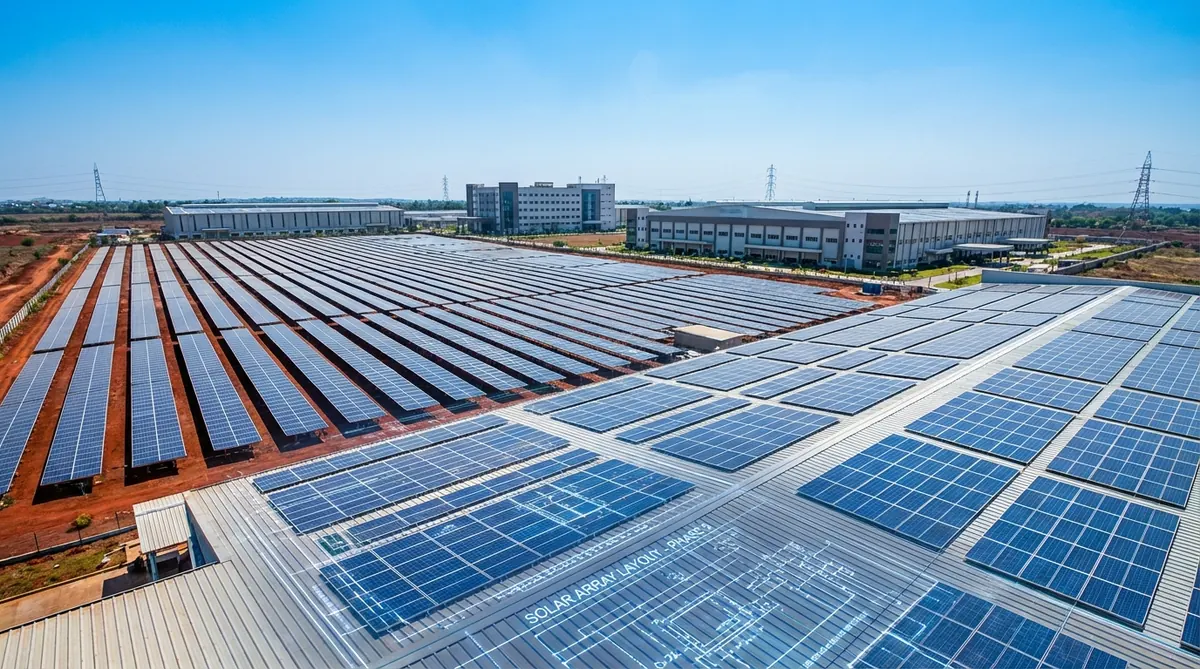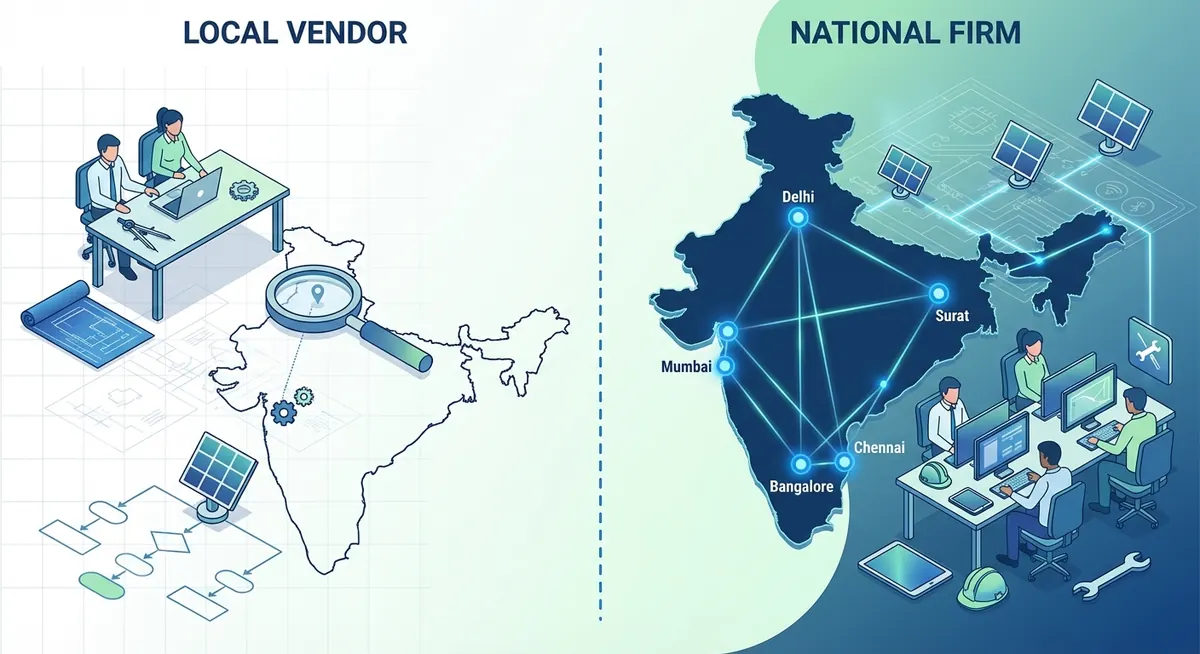
Picking a solar rooftop design company in India used to be straightforward: find someone who could draw an SLD, hand them the site photos, and hope the DISCOM accepted the package on the first submission. That era is over. With India’s rooftop solar capacity crossing 17 GW in 2026 and DISCOM portals upgrading their format requirements across Maharashtra, Gujarat, Tamil Nadu, and Karnataka simultaneously, the design partner you choose now determines whether your projects move in 4 days or 14.
This guide is structured for Indian C&I EPC founders and project managers who are evaluating design companies for an ongoing outsourcing relationship — not a one-off project. It covers what a professional solar rooftop design company actually delivers, how to score vendors across five capability pillars, current market pricing, and the specific red flags that predict expensive DISCOM revision cycles.
Direct answer. A solar rooftop design company in India is a specialist engineering firm that produces the complete design package for grid-connected rooftop solar systems: 3D layout, PVsyst yield report, single-line diagram, general arrangement drawing, structural calculations, bill of quantities, and DISCOM-format net-metering drawings. Top-tier firms deliver white-label packages in 3–5 business days with a 90%+ first-pass DISCOM acceptance rate. The 5-Pillar Vendor Scorecard (defined in this guide) is the systematic method for separating professional firms from price-only vendors that cost you 14-day revision cycles.
India’s rooftop solar market is one of the most policy-driven construction segments in the world. According to MNRE’s current status data, India had installed approximately 17.5 GW of rooftop solar capacity by early 2026, with the Phase II Rooftop Solar Programme targeting a further 30 GW through residential and C&I incentives. That volume creates a large market of design service providers — and an equally large variance in quality.
What a Professional Solar Rooftop Design Company Actually Delivers
The deliverable set matters as much as the vendor. Many companies market themselves as “solar design firms” but produce only AutoCAD SLDs without yield simulation, structural analysis, or DISCOM-format-specific drawing packages. Before evaluating vendors, establish exactly which deliverables your project pipeline requires.
The complete rooftop design package for a C&I project (100–500 kW) should include:
| Deliverable | What It Contains | Why It Matters |
|---|---|---|
| 3D Pre-Design Layout | Panel arrangement, shade analysis, row spacing, irradiance heatmap | Sales stage — wins client sign-off before engineering budget is spent |
| PVsyst Simulation | Energy yield (kWh/year), P50/P90, performance ratio, loss waterfall | Lender requirement; sets client expectation on generation guarantee |
| Single-Line Diagram (SLD) | AC + DC SLD, protection scheme, metering point, inverter specs | DISCOM submission; CEA Connectivity requirement; client handover |
| General Arrangement (GA) | Rooftop layout, cable routing, access paths, mounting positions | DISCOM submission; structural contractor reference |
| Structural Calculations | IS 875 Part 3 wind load, mounting dead load, foundation type | Required for building permit; CEIG submission in many states |
| Bill of Quantities (BOQ) | Module, inverter, cable, mounting, BOS — with make/model | Procurement; client quotation; performance guarantee basis |
| DISCOM Drawing Package | State-specific format, net-meter application, annex forms | Net-metering approval; grid synchronisation clearance |
| As-Built Drawings | Post-commissioning redlines, as-built SLD | Handover documentation; warranty coverage; O&M reference |
Definition. A DISCOM drawing package is a set of electrical and layout drawings prepared specifically in the format mandated by the local distribution company for net-metering approval. Each of India's 54+ DISCOMs has a different format, revision history block, and annexure requirement. A generic SLD is not a DISCOM drawing package — and submitting one is the most common cause of first-pass rejection.
For a deeper understanding of what each document contains and how it feeds into the DISCOM approval process, the solar engineering documentation guide covers the full drawing hierarchy from bid stage to as-built.
The 5-Pillar Vendor Scorecard
Score every design company you evaluate across these five pillars. A total score below 35/50 rules out the vendor for anything beyond a trial project. A score above 42/50 indicates a mature, scalable partner.
Pillar 1 — Technical Capability (10 points)
Award points as follows:
- PVsyst simulation capability (not just Aurora or Helioscope): 3 points
- DISCOM format library covering 10+ states: 3 points
- Structural calculation capability (IS 875 Part 3 + STAAD Pro): 2 points
- CEIG-ready electrical drawing production: 2 points
Most vendors score 4–6 on this pillar. Vendors scoring 9–10 are specialists, not generalists.
Pillar 2 — Turnaround SLA (10 points)
- Standard rooftop package (≤500 kW) in ≤ 3 business days: 5 points
- ≤ 5 business days: 3 points
- ≤ 7 business days: 1 point
- Guaranteed backup coverage if assigned engineer is unavailable: 3 points
- No backup guarantee: 0 points
Field tip. Ask for the last 10 completed project delivery records before signing any engagement. A vendor who claims a 3-day SLA but cannot show documented delivery timestamps for recent projects is providing a marketing claim, not an operational promise.
Pillar 3 — DISCOM Format Mastery (10 points)
- Confirmed DISCOM format library for the states where you primarily operate: up to 5 points
- Last template update within 6 months: 2 points
- First-pass DISCOM acceptance rate above 90% (with documented evidence): 3 points
This pillar is the most differentiating. Most vendors score 4–6. Vendors with active DISCOM format libraries updated quarterly score 8–10.
Pillar 4 — White-Label and IP (10 points)
- White-label delivery as standard (your letterhead, your document numbering): 5 points
- IP transfer clause in standard engagement letter: 3 points
- Professional indemnity insurance covering structural and electrical errors: 2 points
Pillar 5 — Communication and Scalability (10 points)
- Dedicated account manager (single point of contact): 3 points
- Project portal or tracker with real-time status: 3 points
- Volume scalability confirmed (can handle 2× your current monthly volume): 2 points
- WhatsApp Business or equivalent for rapid brief clarifications: 2 points
Current Market Pricing for Solar Rooftop Design in India (2026)
Pricing varies significantly by project size, deliverable scope, and vendor tier. These benchmarks reflect 2026 market rates for a complete design package (layout + PVsyst + SLD + GA + BOQ + DISCOM drawings).
₹6,000–9,000
Residential / small C&I (≤100 kW)
Full package including DISCOM drawings
₹12,000–22,000
Mid C&I (100–500 kW)
Full package + structural calcs
₹25,000–55,000
Large C&I / industrial (500 kW–2 MW)
Full IFC-grade package
Beware of vendors pricing below ₹4,000 for a complete ≤100 kW package. At that price point, one of three corners is being cut: PVsyst simulation is replaced by a spreadsheet, the structural calculation is omitted, or the DISCOM drawing is a non-state-specific generic template. Any of these will result in a revision cycle that costs you more than the ₹2,000 you saved.
For a full pricing analysis with per-deliverable breakdowns, the solar design cost breakdown article covers what each deliverable costs individually versus as a bundled package.
DISCOM Format Coverage — The Most Important Differentiator
India’s distribution companies (DISCOMs) are state-run or privatised entities that each maintain their own net-metering application format, drawing standards, and portal requirements. A solar rooftop design company operating in India must maintain an active, updated format library for every DISCOM in the states it serves.
The DISCOMs with the most specific drawing requirements in 2026 include:
| DISCOM | State | Known format requirements | Portal |
|---|---|---|---|
| MSEDCL | Maharashtra | 4 drawing sheets with specific title block, annexure E & F | MSEDCL net-metering portal |
| UGVCL / MGVCL / PGVCL | Gujarat | Uniform Gujarat format, Suraksha Shakti annexure | Gujarat solar portal (GUVNL-linked) |
| TANGEDCO | Tamil Nadu | State-specific SLD with bidirectional meter callout | TANGEDCO e-portal |
| BESCOM | Karnataka | BESCOM format revision 3 (updated Q4 2025) | BESCOM net-metering portal |
| BSES Rajdhani / BRPL | Delhi | Delhi Electricity Regulatory Commission (DERC) format | DVVNL portal |
| CESC | West Bengal | CESC-specific format, separate LT and HT drawing | CESC online |
Watch out. DISCOM drawing formats are not static. BESCOM updated its format in Q4 2025; MSEDCL revised its annexure requirements in early 2026. A design company that has not updated its templates within the past 6 months is producing drawings against a stale format — which will fail the first-pass review regardless of how technically correct the design is.
Before signing an engagement with any design company, ask: “Which DISCOM format was most recently updated in your template library, and on what date?” The answer tells you whether the firm actively maintains its format library or whether it relies on years-old templates.
For the full DISCOM submission process, state by state, the DISCOM net-metering process guide [/discom-net-metering-process-india-state-by-state/] covers every major state’s net-metering approval pathway, timeline, and required drawing formats. Note: that article will publish on this site as part of the Wave 1 series.
Red Flags That Predict Expensive DISCOM Rejection Cycles
These are the observable warning signs — identifiable before you engage — that predict future DISCOM rejection cycles and project delays.
Red flag 1: No state-specific DISCOM format samples. Ask for a sample drawing from your primary state. If the vendor provides a generic SLD without DISCOM-specific title block, annexures, and format controls, they do not maintain a state-specific library.
Red flag 2: PVsyst simulation not in scope. Some design companies produce AutoCAD drawings only and outsource or skip simulation. PVsyst simulation is required for any project above 100 kW seeking net-metering above Category C. Ask specifically: “Do you run PVsyst, or do you use an alternative tool?” Helioscope and Aurora can produce yield simulations, but PVsyst is the lender-accepted standard in India. A firm that cannot demonstrate PVsyst fluency cannot serve utility developers or any client whose project requires bankable yield certification.
Red flag 3: No structural scope. Many states require a structural stability certificate from a licensed structural engineer as part of the net-metering application (particularly for industrial rooftops with flat slab or tin shed structures). A design company that does not offer structural calculations forces you to engage a separate structural engineer — creating a coordination gap that delays the DISCOM package.
Red flag 4: Per-revision billing beyond the first revision. A professional design firm accepts one revision round as part of the base price and covers DISCOM-comment-driven revisions at no charge (because those revisions result from format issues in the firm’s original package, not from scope changes). Vendors that bill per revision after the first round are externalizing their quality failures.
Red flag 5: No documented first-pass acceptance rate. Ask: “What percentage of your DISCOM submissions are accepted without a revision request?” A firm that cannot answer this question with a number has not been tracking its quality systematically. The industry benchmark for a specialist firm is 88–92% first-pass acceptance.
The red flags when choosing a solar design partner post covers 12 additional warning signs with specific examples of how each one manifests in a live project context.
How to Structure the Engagement — Contracts, SLAs, and Onboarding
A professional solar rooftop design company engagement requires four documents before the first project brief is submitted.
1. Non-Disclosure Agreement (NDA). Covers your client data, site coordinates, project BOQ, and business terms. Standard term: 3 years post-engagement. Mutual NDA is the professional standard — if the vendor declines a mutual NDA, that is a red flag.
2. Engagement Letter / Statement of Work. Specifies: deliverable list, brief format, turnaround SLA, revision policy (rounds included, cost of additional), pricing structure, invoice and payment terms. This document is the contract. A verbal engagement has no enforceable SLA.
3. IP Assignment Clause. Explicitly states that design IP transfers to you on payment. This must be in writing. In the absence of a written IP clause, Indian contract law defaults to the creator retaining IP rights — the opposite of what you need for client handover.
4. Professional Indemnity Certificate. Evidence that the firm carries PI insurance covering structural and electrical calculation errors. Standard coverage is ₹25–50 lakh per incident for mid-market design firms. Without this, a structural error on a roof-mounted system creates uncapped liability for your EPC.
Onboarding a new design partner takes 1–2 business days: NDA execution, brief template walkthrough, DISCOM format confirmation, project portal access. A firm that requires more than 3 days to complete onboarding is not operationally ready for your volume.
WHAT A GOOD ENGAGEMENT LOOKS LIKE
- NDA signed within 24 hours
- First brief submitted via standard form
- SC (scope confirmation) within 4 hours
- Draft review at Day 2 of 5-day SLA
- Final package at Day 4–5
- QC checklist run by your team before acceptance
WHAT A POOR ENGAGEMENT LOOKS LIKE
- No formal brief — brief via WhatsApp message
- No SC — vendor starts work without confirming scope
- No draft review — only final delivery
- Generic SLD delivered without DISCOM format
- DISCOM rejection on first submission
- Vendor charges for revision or blames client
How Heaven Designs Helps Indian EPCs Get Design Done Right
Heaven Designs serves as the embedded engineering bench for 300+ EPC clients across India — operating white-label, on your timeline, in DISCOM-specific formats for every major state.
- Solar Rooftop Detailed Engineering Design — Complete IFC-grade package: layout, PVsyst, SLD, GA, structural calcs, BOQ, DISCOM drawings. Delivered in 3–5 business days for ≤500 kW rooftop projects.
- Electrical CEIG Drawings — CEIG-ready electrical drawings for all states requiring CEIG approval. We track format updates for 54+ DISCOMs.
- Solar 3D Pre-Design — Sales-stage 3D layout + shade analysis in 48 hours. Deliver a visual to the client before committing to full design budget.
- STAAD Pro Reports — IS 875 Part 3 structural reports for rooftop mounting — RCC slab, tin shed, GI structure, factory roof.
- Download a sample deliverable — Redacted samples from live MSEDCL, UGVCL, and TANGEDCO projects.
Contact us for a rate card specific to your states and project volume, or to confirm DISCOM format coverage before your next project brief.
FAQ
What should I look for first when evaluating a solar rooftop design company in India?
Start with DISCOM format coverage for your primary operating states. Technical capability matters, but a firm that cannot produce DISCOM-format-correct drawings for MSEDCL or TANGEDCO is not useful to a Maharashtra or Tamil Nadu EPC, regardless of how sophisticated their PVsyst analysis is. After confirming DISCOM coverage, evaluate turnaround SLA and revision policy.
How many design companies are operating in India in 2026?
There is no official registry. The market includes approximately 200–400 firms that describe themselves as solar design companies, ranging from independent freelancers to 50-engineer specialty firms. Of these, perhaps 30–50 maintain active, updated DISCOM format libraries for more than 10 states. The rest produce generic drawings that require client-side DISCOM adaptation. Price is not a reliable proxy for which tier a vendor falls into.
Is a PVsyst report required for all rooftop projects in India?
Not universally. For projects below 10 kW (PM Surya Ghar), most DISCOMs accept a simpler feasibility statement. For projects above 100 kW, most DISCOMs and all lenders require a PVsyst simulation. For any project subject to IREDA, PFC, or SBI lending, a bankable PVsyst report is a hard requirement regardless of project size. Always check the specific DISCOM’s net-metering application checklist for your project size and connection category.
Can a solar rooftop design company also prepare the net-metering application?
Yes. Most full-service design companies prepare the complete net-metering application package: drawing set, application form, utility bill copy, technical specification sheets for the inverter and modules, and — where required — the structural certificate. Some DISCOMs now have online portals where the design company can submit directly on the EPC’s behalf. Ask your prospective vendor whether they handle portal submission or deliver a submission-ready package for you to upload.
What is the typical revision count on a rooftop DISCOM submission in India?
According to design firms operating across multiple states, the average first-pass DISCOM acceptance rate in India is approximately 65–70% across all vendor tiers. Specialist firms with active DISCOM format libraries achieve 88–92%. The most common causes of revision requests are: incorrect title block format, missing annexures, wrong metering point callout, and stale protection scheme references. All are preventable with format-current templates.
How do I verify that a design company’s structural calculations are IS 875 compliant?
Ask for a sample STAAD Pro report from a completed project. A compliant structural report should reference IS 875 Part 3 (Wind Loads on Structures) explicitly, show the wind speed for the project location based on IS 875 wind zone mapping, and provide the calculated wind pressure on the module array with the appropriate shape coefficient. If the report does not explicitly cite IS 875 Part 3 and show the wind zone classification, it does not meet the standard required for CEIG submission or building permit purposes.