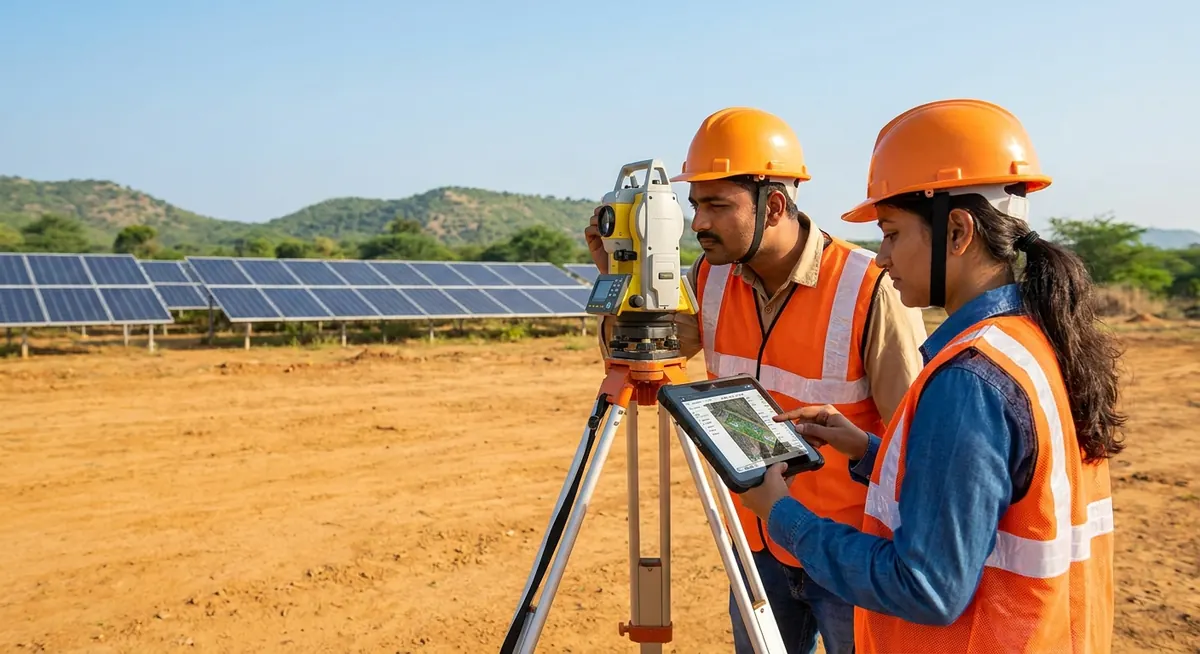
West Africa spans some of the most diverse solar resource conditions on Earth — from the Sahel’s 7.0 kWh/m²/day peak irradiance in Mali and Burkina Faso to the coastal humidity corridors of Côte d’Ivoire and Ghana where cloud cover reduces GHI to 4.3–4.8 kWh/m²/day during the June–September monsoon. Understanding these variations is not academic. The difference between using a regional average irradiance dataset and a site-specific Solargis TMY translates directly into PV system sizing errors of 10–20% and energy yield forecast errors that can fail lender bankability reviews.
Direct answer. Solar project bankability in West Africa depends on four technical pillars: (1) site-specific irradiance data from Solargis or Meteonorm (not regional averages), (2) a seasonal soiling loss model that accounts for Harmattan dust events (8–14% dry-season loss in the Sahel), (3) a voltage quality assessment for grid-connected projects that documents the local distribution network’s voltage regulation capacity, and (4) a P50/P90 energy yield report produced in PVsyst or HOMER that a qualified independent engineer can validate for the lender.
This knowledge base article addresses the four technical pillars that determine whether a West African solar project receives DFI financing or goes back to the drawing board for a second feasibility study.
West Africa Irradiance Zones — The Data Every Designer Needs
West Africa divides into four distinct irradiance regimes based on the interaction of the Inter-Tropical Convergence Zone (ITCZ), the Harmattan wind, and coastal ocean effects.
Definition. Global Horizontal Irradiance (GHI) is the total solar radiation received per unit area on a horizontal surface. It is the primary design input for flat-plate PV systems. GHI = DNI × cos(zenith angle) + DHI. In West Africa, the ratio of DHI to GHI is higher than in North Africa or southern Europe due to elevated atmospheric aerosol loading from the Harmattan.
| Irradiance zone | Countries | Annual GHI (kWh/m²/day) | Seasonal variation | Key design challenge |
|---|---|---|---|---|
| Sahel (Zone 1) | Mali, Burkina Faso, Niger, northern Nigeria | 5.8–7.0 | Low (±15%) | Dust soiling 10–14% dry season |
| Sudan Savanna (Zone 2) | Northern Ghana, central Nigeria, northern Côte d’Ivoire | 5.0–5.8 | Moderate (±20%) | Transition zone — mixed dust and cloud |
| Guinea Savanna (Zone 3) | Southern Ghana, Lagos state, southern Côte d’Ivoire | 4.5–5.2 | High (±30%) | Monsoon cloud cover June–September |
| Coastal Humid (Zone 4) | Coastal Nigeria, Accra, Abidjan, Lomé | 4.3–4.8 | High (±35%) | Marine aerosol + cloud; high humidity degradation |
For grid-connected utility-scale projects, Zone 1 and Zone 2 sites are the most attractive from a yield perspective. For off-grid and hybrid projects where the system must deliver reliable power year-round, Zone 3 and Zone 4 sites require careful battery sizing for the June–September low-irradiance period.
According to IRENA’s 2023 West Africa renewable energy capacity data, Nigeria (5.1 GW installed), Ghana (0.6 GW), and Senegal (0.4 GW) lead the region’s solar deployment, but none of these countries has yet built the grid infrastructure to absorb the renewable capacity their irradiance resources could support.
7.0
kWh/m²/day peak GHI
Mali Sahel, Solargis P50 annual
4.3
kWh/m²/day lowest GHI
Coastal Ghana/Côte d'Ivoire
14%
Peak Harmattan soiling loss
Sahel, January (GSMA/IEC data)
±8%
P50 vs P90 GHI uncertainty
Solargis West Africa validation
Harmattan Dust and the Soiling Loss Problem
The Harmattan is a dry, dust-laden wind that blows from the Sahara Desert across West Africa from November to March. During peak Harmattan events, aerosol optical depth (AOD) at 550 nm can exceed 1.5 — orders of magnitude above the European reference value of 0.10–0.15 that most PVsyst default configurations use.
A PVsyst simulation using the default soiling loss of 2–3% on a Sahel site during Harmattan season will overestimate annual energy yield by 8–12% compared to what the plant actually produces. This is not a marginal error — it is the difference between a project that meets its P90 yield target and one that triggers a performance security call from the lender.
The correct approach is a monthly soiling model, not an annual average:
| Month | Harmattan intensity | Recommended soiling loss | Cleaning frequency |
|---|---|---|---|
| November | Moderate | 6–8% | Every 3 weeks |
| December | High | 10–12% | Every 2 weeks |
| January | Peak | 12–14% | Every 10 days |
| February | High | 10–12% | Every 2 weeks |
| March | Moderate-declining | 6–8% | Every 3 weeks |
| April–May | Transition | 3–5% | Monthly |
| June–September | Monsoon (rain cleans panels) | 1–2% | No scheduled cleaning |
| October | Post-monsoon build-up | 3–4% | Monthly |
Field tip. For the bankable PVsyst report, document the soiling model source explicitly — either from Meteonorm aerosol optical depth data for the site coordinates or from a published IEC technical report on soiling in the region. A soiling model without a cited source will be questioned by the independent engineer during lender due diligence.
The soiling loss input in PVsyst accepts monthly values. Use the table above as the starting point for Sahel sites and apply a 20% conservative uplift on the peak Harmattan months if the plant does not have an automated cleaning system.
For bifacial modules, the soiling impact on the rear face is different from the front face — rear-face soiling loss from dust buildup on the ground surface below the module is typically 1–3% annually. This bifacial rear soiling is often ignored in West Africa PVsyst models, creating a systematic overestimation of bifacial gain.
Voltage Quality in West African Distribution Networks
Grid-connected solar projects in West Africa face a voltage quality challenge that does not exist in European or North American interconnection. The distribution networks in Nigeria (33 kV and 11 kV), Ghana (33 kV), and Côte d’Ivoire (HTB at 90 kV/30 kV) were designed for one-directional power flow from the national utility to consumers. When a solar plant injects power into these networks, the local voltage can rise above the permitted band (typically ±10% of nominal), triggering inverter protection trips.
The technical sequence of problems:
- Solar plant generates peak power at noon, injecting into the 11 kV or 33 kV feeder.
- Feeder voltage rises as the injected power encounters the feeder impedance (usually 0.3–0.8 Ω/km on aging conductors).
- When voltage exceeds 110% of nominal (i.e., 12.1 kV on an 11 kV feeder), the inverter’s OVP (over-voltage protection) trips the plant offline.
- Plant re-connects after the LVRT delay (typically 3–5 minutes), voltage rises again, plant trips again.
- In extreme cases, the plant cycles on and off throughout the peak generation hours, reducing effective yield by 15–30%.
Watch out. The voltage rise problem in West African distribution networks is rarely disclosed by the utility during the interconnection approval process. It only becomes visible after commissioning. Conduct a power flow simulation of the interconnection feeder as part of the feasibility study — do not rely on the utility's verbal assurance that "the feeder can absorb the generation."
The engineering mitigations for voltage quality in West African grid-connected solar:
| Mitigation | Applies when | Cost impact |
|---|---|---|
| Inverter reactive power (Q) absorption | Minor voltage rise (< 5% above nominal) | Reduces inverter capacity factor — check derating |
| On-load tap changer (OLTC) at grid point | Voltage rise > 5% above nominal | USD 80,000–200,000 for 10 MVA transformer |
| Grid reinforcement (new conductor, larger transformer) | Chronic voltage violation on feeder | USD 200,000–1M+; utility may not act for years |
| Export curtailment agreement | All other mitigations uneconomical | Reduces plant revenue; must be modelled in yield forecast |
| Battery storage absorbing excess generation | Peak shaving reduces injection | Adds BESS CAPEX but enables reliable dispatch |
Irradiance Data Selection — The Bankability Hierarchy
Not all irradiance datasets carry equal weight with DFI lenders. The bankability hierarchy for West Africa irradiance data, from most to least accepted:
Tier 1 (fully bankable):
- Solargis GeoModel Solar site assessment (20-year TMY, P50/P90 uncertainty quantification)
- Meteonorm 8 (recommended for sites within 50 km of a reference meteorological station)
- On-site measurement campaign (12 months minimum, using calibrated pyrheliometer)
Tier 2 (acceptable for prefeasibility; requires independent validation for financial close):
- NASA POWER 30-year average GHI (±10–15% uncertainty; acceptable for preliminary sizing only)
- SolarAnywhere historical data (acceptable in some IFC-financed projects)
Tier 3 (not acceptable for DFI financial close):
- Generic West Africa averages from published maps
- Satellite-derived data without site-specific validation
- Irradiance data older than 20 years
The P90 yield scenario deserves specific attention. Most DFI lenders require that debt service can be covered by the P90 annual energy production (the yield level exceeded in 90% of years). For West Africa sites, the P90/P50 ratio is typically 0.91–0.94, meaning P90 is 6–9% below P50. A project financed with a P50-based financial model but with P90 yield obligations in the power purchase agreement will fail its debt service in approximately one in three years.
The West Africa Bankability Checklist — A Four-Point Protocol
The West Africa Bankability Protocol (WABP) is Heaven Designs’ proprietary four-point framework for ensuring that a solar project in West Africa can pass DFI technical due diligence on the first submission.
Irradiance Validation
Procure Solargis or Meteonorm site-specific TMY. Cross-check P50 GHI against NASA POWER 30-year average for the same coordinates. If the two sources differ by more than 8%, flag for independent engineer review before committing to the financial model. Document the irradiance source, vintage, and uncertainty band in the feasibility report.
Soiling Model Documentation
Build the monthly soiling model using the Harmattan seasonal table. Apply the model in PVsyst or HOMER with the soiling values entered month by month — not as an annual average. Document the soiling source (Meteonorm AOD data or published IEC reference) and the proposed O&M cleaning schedule with cleaning costs included in the financial model OPEX.
Voltage Quality Assessment
Run a power flow simulation of the interconnection feeder at peak solar injection using the feeder impedance data from the utility. Identify the maximum injection level before voltage exceeds 110% of nominal. If this level is below the plant's peak generation, design the mitigation (Q absorption, OLTC, or curtailment) and model the revenue impact in the financial model.
P50/P90 Yield Report
Produce a PVsyst or HOMER simulation report documenting P50 and P90 annual energy production. The P90 figure must reflect all losses including the monthly soiling model, voltage curtailment if applicable, and module degradation over the project life. The financial model's debt service calculations must be based on P90, not P50, for AfDB and IFC financing.
Comparing Irradiance Data Sources for West Africa
| Attribute | Solargis GeoModel | Meteonorm 8 | NASA POWER | On-site measurement |
|---|---|---|---|---|
| Spatial resolution | 250 m | Station interpolation | 0.5° (~50 km) | Point measurement |
| Temporal coverage | 1994–present | 1991–2020 | 1984–present | Project-specific |
| P50/P90 uncertainty | ±3–5% | ±5–8% | ±10–15% | ±2–3% |
| Harmattan/AOD correction | Included | Partial | Not included | Measured |
| Cost per site | USD 200–800 | Software licence | Free | USD 5,000–15,000 |
| DFI bankability | Full (Tier 1) | Full (Tier 1) | Pre-feasibility only | Highest (Tier 1+) |
| Delivery time | 2–5 days | Immediate | Immediate | 12+ months |
For projects above USD 1M CAPEX, Solargis is the standard. For projects between USD 200k–1M, Meteonorm is sufficient. For preliminary sizing only, NASA POWER is acceptable with a documented 10% conservative derate applied to account for the higher uncertainty.
Need a bankable energy yield report for a West Africa project?
Heaven Designs produces DFI-accepted P50/P90 energy yield reports for West African solar projects, applying the WABP framework and Harmattan-corrected soiling models.
Discuss your project →How Heaven Designs Helps West Africa Solar Developers
West African solar project developers need engineering support that understands both the technical nuances (Harmattan soiling, voltage quality, DFI documentation) and the commercial constraints (import duty, local content, USD billing). Heaven Designs provides:
- Site Survey & Land Feasibility Services — Solargis irradiance data procurement, soiling factor selection by microclimate, voltage quality pre-assessment from utility feeder data.
- MW-Scale Project Management Consultancy — Owner’s engineer services including WABP audit, IE coordination, and bankable documentation preparation for AfDB, IFC, and bilateral DFI submissions.
- Solar Ground Mount Design — Utility-scale PV layout design incorporating site-specific soiling zones, tracker yield simulation, and structural design for Harmattan wind loads.
- Download a sample deliverable — Download a redacted West Africa energy yield report showing the Harmattan soiling model and P50/P90 uncertainty analysis.
For the HOMER Pro modeling walkthrough that applies these irradiance inputs, see HOMER Pro for African hybrid projects. For mini-grid feasibility methodology, see solar mini-grid feasibility in sub-Saharan Africa. Contact us with your project details and we will scope the bankable energy yield report engagement.
According to AfDB’s New Deal on Energy for Africa, the continent needs USD 25–35 billion in annual investment to achieve universal electricity access by 2030, with solar and hybrid systems providing 70% of new connections. Every project that fails DFI technical due diligence because of an inadequate irradiance dataset or missing soiling model delays that investment by 12–24 months.
FAQ
What is the Harmattan and how does it affect solar panels?
The Harmattan is a dry, dusty wind that blows from the Sahara Desert across West Africa from November to March. It carries fine silica and clay particles that deposit on solar panel surfaces, blocking sunlight and reducing electrical output. Peak Harmattan events can reduce PV output by 12–14% within days of a panel cleaning. For Sahel-zone projects, the annual soiling loss from the Harmattan averages 6–9% of annual energy production — compared to 1–2% in Europe. Projects that do not model this seasonal soiling loss overestimate annual energy yield and cannot meet their P90 performance targets.
Can I use the same soiling loss for a project in Lagos and one in Kano?
No. Lagos sits in the Coastal Humid zone (Zone 4) where monsoon rainfall from June to September washes panels naturally, and Harmattan dust penetration is limited by coastal humidity. The annual soiling loss in Lagos is 2–4%. Kano is in the Sahel zone (Zone 1) where Harmattan is intense from November to March and annual soiling loss is 8–12%. Using Lagos soiling data for a Kano project overstates the energy yield by 5–8% annually. Always use zone-specific soiling factors.
How do DFI lenders validate the irradiance data in an energy yield report?
DFI lenders typically appoint an independent engineer (IE) to review the energy yield report. The IE will cross-check the submitted irradiance data source, vintage, and coordinates against publicly available datasets (NASA POWER, Solargis sample data). If the project uses Meteonorm or Solargis data, the IE will verify that the site coordinates in the data file match the project coordinates. If the two differ by more than 10 km, the IE will flag this as a bankability risk requiring re-simulation with corrected data.
What voltage regulation standard applies to grid-connected solar in Nigeria?
Nigeria’s electricity regulatory framework, governed by the Nigerian Electricity Regulatory Commission (NERC), references the grid code published by the Transmission Company of Nigeria (TCN). Under TCN’s Grid Code (2012, revised 2019), distributed generation connected to the 33 kV or 11 kV distribution network must maintain voltage within ±10% of nominal at the point of common coupling. Generation facilities that cause voltage violations are required to install reactive power compensation or reduce output. The TCN grid code is available through NERC’s official publications.
Is bifacial PV technology cost-effective in West Africa given the dust problem?
Bifacial modules offer a yield advantage of 5–15% over monofacial modules in West Africa through rear-side irradiance capture from the bright, sandy ground surface (high albedo) common in Sahel zones. However, the Harmattan dust deposits on both the front and rear surfaces, and rear-surface cleaning is more difficult than front-surface cleaning in fixed-tilt ground-mount configurations. In practice, bifacial modules outperform monofacial modules in West Africa when the O&M plan includes both front and rear surface cleaning. The bifacial yield model in PVsyst must use the correct albedo value (0.30–0.40 for sandy soil) and must apply soiling to the rear face independently.
What is a reasonable performance ratio target for a West Africa utility-scale project?
A well-designed and properly maintained utility-scale project in the Sahel zone (Zone 1) should achieve an annual performance ratio of 76–80% after soiling. Coastal zone (Zone 4) projects achieve slightly higher PR (80–83%) due to lower temperature losses, but the absolute energy production is lower due to reduced GHI. For DFI reporting, the performance ratio is calculated as the actual annual specific yield (kWh/kWp) divided by the theoretical maximum (annual GHI in kWh/m² × system efficiency). A PR below 74% on an annual basis is a performance trigger that requires investigation under most AfDB and IFC project monitoring frameworks.