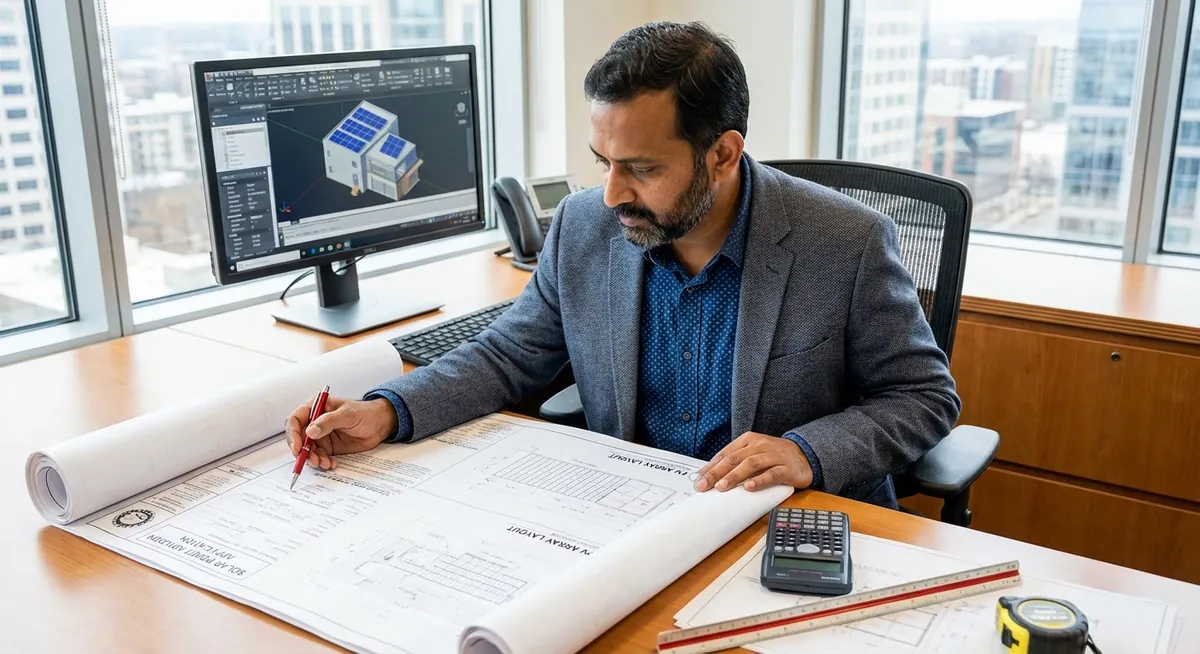
Texas is America’s fastest-growing solar market by new installations — over 5 GW of residential and C&I solar added in 2024 alone — and unlike California or Florida, Texas has no statewide solar permitting standard. Each city and county creates its own AHJ rules, which produces a permitting landscape that ranges from Houston’s no-permit residential zones to Austin Energy’s detailed technical standards for interconnection. An installer working across Texas metro areas must maintain working knowledge of four entirely different permitting ecosystems.
Direct answer. Texas solar permits are governed at the local AHJ level — there is no state-mandated solar permitting standard. Houston’s COH (City of Houston) allows residential solar without a building permit in most cases but requires an electrical permit and utility interconnection application. Dallas requires a building permit with structural engineering for roof-mounted systems. Austin Energy has the most detailed technical interconnection standards in Texas. San Antonio CPS has its own generator application and interconnection process. The electrical code base is NEC 2020 in most Texas jurisdictions as of 2026.
Texas AHJ Matrix — The Four Major Markets
| City / Market | Building Permit | Electrical Permit | Structural Analysis | PE Stamp | AHJ / Utility | Typical Timeline |
|---|---|---|---|---|---|---|
| Houston (COH) | Not required for residential < 50 kW on existing roof | Required | Not required (prescriptive) | Not required for residential | COH Permitting; CenterPoint Energy interconnection | 3–7 days (electrical permit) |
| Dallas (City) | Required | Required | Required (IBC scope) | Required for structural | City of Dallas Development Services | 7–15 days |
| Austin | Required | Required | Required | Required > 10 kW | City of Austin Development Services; Austin Energy interconnection | 7–21 days |
| San Antonio | Required | Required | Required for commercial | Required for commercial | City of San Antonio DPLU; CPS Energy interconnection | 5–14 days |
| Fort Worth | Required | Required | Site-specific | Site-specific | City of Fort Worth Development; Oncor interconnection | 7–15 days |
| Plano | Required | Required | Required | Sometimes | City of Plano Building Inspection | 5–12 days |
Texas's largest market advantage. Houston's no-permit approach for residential solar dramatically reduces per-project permit overhead — many Houston residential installations can be completed with only an electrical permit and a CenterPoint Energy interconnection application, cutting permitting time to 3–7 days. This is one of the reasons Houston leads Texas in solar installation volume per capita despite lower average irradiance than West Texas.
For the broader US permitting framework, see How to Submit a Solar Permit Package to an AHJ and Solar PE Stamp Explained.
Houston Solar Permits — The No-Building-Permit Market
The City of Houston does not require a building permit for residential solar installations on existing roofs under 50 kW AC system size. This is the most installer-friendly residential solar permitting policy in any major US city.
What Houston does require:
-
Electrical permit — Required for all grid-tied solar installations. Apply through the City of Houston Permitting Center (HoustonPermittingCenter.org). Typical fee: $150–$350 for residential systems.
-
CenterPoint Energy interconnection application — CenterPoint is the transmission and distribution utility for most of Houston. Residential systems < 25 kW typically qualify for CenterPoint’s simplified interconnection process (Rule 25.211 Interconnection Application). Response time: 10–30 days.
-
For Reliant Energy / NRG / other REPs — The retail electric provider (REP) and CenterPoint are separate entities in Texas’s deregulated market. The interconnection application goes to CenterPoint (wires owner), not the REP.
What a Houston residential electrical permit package needs:
- Application form (available on HPC portal)
- Electrical SLD showing PV array → inverter → AC disconnect → utility meter → load panel
- Conductor sizing, OCPD ratings, interconnection method
- Inverter cut sheet (UL 1741 listed)
- Module specifications
Field tip. Houston's no-building-permit policy applies to residential occupancies on existing structures. New construction solar, commercial systems, and ground-mount systems require a standard building permit with structural engineering. Verify occupancy type before assuming the no-permit pathway applies.
Dallas Solar Permits — Building Permit with Structural Review
Dallas requires a full building permit for all rooftop solar installations. The City of Dallas Development Services processes solar permits through its online permit portal (DallasCityHall.com).
Dallas solar permit requirements:
- Building permit application
- Site plan showing panel locations and setbacks
- Roof plan with module layout
- Electrical SLD
- Structural analysis confirming rafter/truss capacity under the Dallas wind speed zone (ASCE 7-22, Dallas typically Vult ~120 mph, exposure B)
- Equipment cut sheets
Dallas AHJ specifics:
- Dallas uses NEC 2020 (adopted 2022)
- Rapid shutdown required per NEC 690.12
- Dallas does not require AFCI for solar (not adopted as local amendment)
- Oncor is the T&D utility for Dallas; interconnection application separate from permit
Dallas timeline: 7–15 business days for standard residential plan check; 15–30 days for commercial.
Austin Energy — The Most Technical Solar Interconnection in Texas
Austin Energy (the municipally owned utility for Austin) has the most detailed solar technical standards of any Texas utility, reflecting Austin’s progressive energy policy. Austin Energy’s technical standards for distributed generation include:
Austin Energy Grid Requirements:
- Inverter must meet UL 1741-SA or UL 1741-SB (advanced inverter functions) for systems > 10 kW
- Frequency-watt and volt-watt response functions must be enabled
- Anti-islanding per IEEE 1547-2018
- Revenue-grade metering required for systems > 10 kW
City of Austin Building Permit:
- Required for all solar installations
- Austin adopts NEC 2020 with City of Austin amendments
- Structural review required for all roof-mounted systems
- Fire setback requirements follow International Fire Code (IFC) standards similar to California’s model (18-inch valley, ridge, and hip setbacks)
Austin Energy Customer Generation Application:
- Separate from city building permit
- Submit online through Austin Energy’s MyAccount portal
- Systems ≤ 10 kW: simplified application, 10–20 day review
- Systems > 10 kW: standard application, 20–45 day review
Austin Energy watch out. Austin Energy's UL 1741-SA/SB requirement for systems > 10 kW — requiring advanced inverter grid support functions — is stricter than most Texas utilities. Some lower-cost string inverters meet UL 1741 but not UL 1741-SA. Confirm the specific inverter model meets Austin Energy's grid requirements before spec-ing it on an Austin > 10 kW project.
San Antonio CPS Energy — Generator Application Process
CPS Energy (City Public Service) serves San Antonio as the municipally owned integrated utility. CPS Energy has its own generator application process that runs parallel to the City of San Antonio building permit.
CPS Energy Distributed Generation Application:
- Online application through CPS Energy’s customer portal
- Systems ≤ 20 kW: simplified process, 10–20 day review
- Systems > 20 kW: standard process, 20–45 day review
- CPS requires the inverter to be on CPS Energy’s approved inverter list (separate from UL 1741 listing)
City of San Antonio DPLU Permit:
- Required for all solar installations
- San Antonio adopts NEC 2020
- Structural review required per ASCE 7 for the San Antonio wind zone (~120 mph Vult, exposure B–C)
- SAWS (San Antonio Water System) coordination required if roof drainage is affected
Texas Wind Zones — ASCE 7 Requirements by City
Texas spans multiple ASCE 7 wind zones that affect structural design:
| City | ASCE 7-22 Vult (mph) | Exposure Category | Notes |
|---|---|---|---|
| Houston | 130–145 | C or D (coastal) | Hurricane zone; higher than inland |
| Galveston / coastal | 165–185 | D | HVHZ-comparable wind speeds |
| Dallas-Fort Worth | 115–125 | B | Inland; relatively moderate |
| Austin | 115–120 | B | Central Texas plateau |
| San Antonio | 115–120 | B | |
| El Paso | 100–110 | B | Lowest major Texas city |
| West Texas (Midland/Odessa) | 110–120 | B–C | High Plains wind exposure |
Note. Texas coastal areas (Galveston, Corpus Christi, Beaumont) are subject to wind speeds comparable to Florida non-HVHZ zones. Structural analyses for coastal Texas must use the site-specific wind speed from ASCE 7's online hazard tool, not a city-average assumption.
Texas Solar Electrical Code — NEC 2020 Adoption Status
Texas does not have a statewide electrical code adoption mandate — municipalities adopt codes independently. As of 2026:
- Houston: NEC 2020 (adopted 2022 by City of Houston)
- Dallas: NEC 2020 (adopted 2022)
- Austin: NEC 2020 (adopted 2022 with local amendments)
- San Antonio: NEC 2020 (adopted 2022)
- Unincorporated areas: NEC 2017 or NEC 2020 depending on county; confirm with the specific authority
For all major Texas metros, NEC 2020 is the working standard. Key NEC 2020 solar provisions: rapid shutdown (NEC 690.12), arc fault (NEC 690.11), load-side interconnection (NEC 705.12), and storage (NEC 706).
How Heaven Designs Serves Texas Installers
Texas’s multi-city AHJ landscape — ranging from Houston’s streamlined electrical-only process to Austin Energy’s advanced inverter requirements — is exactly the type of multi-jurisdiction complexity where outsourced permit design pays off.
- Solar Permit Design (USA) — Texas-specific permit packages for Houston, Dallas, Austin, San Antonio, Fort Worth, and other Texas AHJs. PE-stamped structural calculations where required. 4–7 business days. 96.2% first-pass approval rate.
- Solar 3D Pre-Design — Sales-stage layout in 48 hours; provides the roof plan and setback information needed for any Texas AHJ permit submittal.
- Download sample deliverables — Sample Texas permit package (Houston electrical permit format).
Glossary: AHJ, NEC 705, rapid shutdown.
FAQ
Does Texas require a solar permit for residential installations?
It depends entirely on the city. Houston does not require a building permit for residential solar under 50 kW — only an electrical permit. Dallas, Austin, and San Antonio require both a building permit and an electrical permit. In unincorporated county areas outside major cities, there may be no permit requirement at all. Always verify with the specific city or county AHJ for the project address.
What is the difference between CenterPoint, Oncor, and Austin Energy for solar interconnection?
These are the T&D (transmission and distribution) utilities serving different Texas regions. CenterPoint Energy serves the Houston area. Oncor serves Dallas-Fort Worth. Austin Energy serves Austin. CPS Energy serves San Antonio. The interconnection application must go to the utility that owns the distribution wires serving the property — not the retail electricity provider. In Texas’s deregulated market, most residential customers choose their retail provider but cannot choose their wires utility.
Does Texas require rapid shutdown for solar?
Yes, under the NEC 2020 adoption in major Texas cities. NEC 690.12 rapid shutdown is required for roof-mounted solar systems in Houston, Dallas, Austin, and San Antonio. The specific rapid shutdown system implementation must meet the requirements of the AHJ’s adopted NEC version.
How does Texas’s deregulated electricity market affect solar interconnection?
Most of Texas operates under ERCOT (Electric Reliability Council of Texas) within a deregulated retail electricity market. Residential solar customers have two separate relationships: with their retail electric provider (REP, who sets the electricity rate and export credit) and with the wires utility (CenterPoint, Oncor, etc., who own the distribution grid). The interconnection application goes to the wires utility. The net metering or bill credit arrangement goes to the REP. Some Texas REPs offer better solar export compensation than others — but this does not affect the permit or interconnection process with the wires utility.
Is a PE stamp required for residential Texas solar permits?
Depends on the city. Houston does not require a PE stamp for residential solar electrical permits. Dallas requires structural engineering (and typically a PE stamp) for building permits. Austin requires a PE stamp for systems > 10 kW. San Antonio requires a PE stamp for commercial systems. In unincorporated areas, requirements vary by county. Always check the specific AHJ’s permit application requirements before designing the permit package.