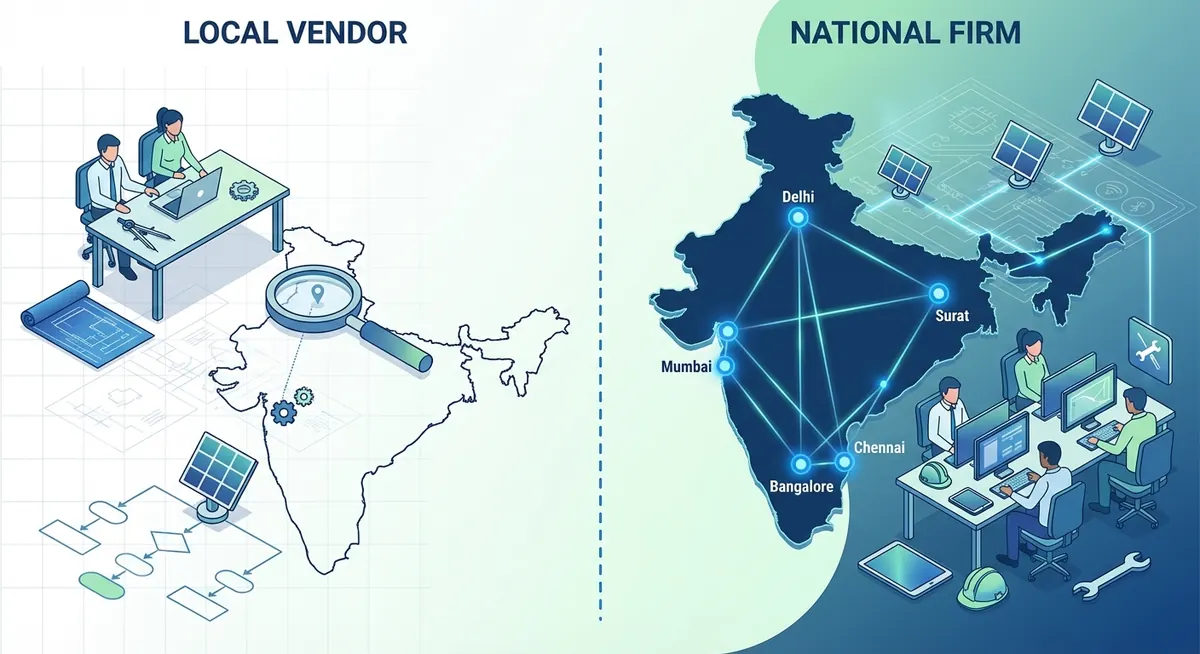
An Indian EPC founder hires a solar designer at ₹70,000/month. Eighteen months later, the designer resigns for a 28% hike at a competitor. The founder opens a LinkedIn post, interviews four candidates over two weeks, hires a replacement, spends three months watching the replacement rebuild what was lost — and the cycle starts again. The spreadsheet shows the cost as ₹70,000/month × 18 months = ₹12.6 lakhs. The actual cost, fully modeled, is closer to ₹17–₹21 lakhs — and the cycle repeats every 18 months. This article builds the complete financial model of solar designer attrition and shows why most Indian EPCs carry a silent ₹15–₹20 lakh-per-designer-per-year cost that never appears as a single line item.
Direct answer. A solar designer at ₹70,000/month costs an Indian EPC ₹17–₹21 lakhs/year when designer attrition is modeled correctly: base CTC including statutory contributions (₹10.2L), software licenses (₹3.5L), annualized recruitment cost (₹1.3L), ramp-loss productivity gap (₹0.84L), and knowledge loss per departure (₹1.8–₹3.2L). The Designer Turnover Cost Calculator — Heaven Designs’ six-component proprietary model — isolates each component and shows the outsourcing crossover at approximately 35 MW/year for a well-managed EPC.
This analysis targets Rohan — the Indian EPC founder who is delaying the outsourcing decision until he has “more projects.” The math shows the decision almost always should go the other way.
The Structural Reason Indian Solar Designers Leave
Solar designer attrition in India is not an individual HR problem — it is a structural market condition that will not improve materially in the next 3–5 years. According to Mercom India’s 2025 Solar Workforce Analysis, India added 24.5 GW of solar capacity in 2025, but the pool of qualified solar design engineers grew by only 18% in the same period. The result is a persistent supply-demand imbalance that allows PVsyst-trained engineers with 2+ years of experience to extract 25–35% salary hikes by changing employers.
The average tenure of a solar designer in India is 18–24 months. At that tenure and a 40%+ attrition rate, every EPC with an in-house design function will replace its designer 2.5–3.3 times in a five-year window. This is not an outlier scenario — it is the base case.
42%
Solar designer attrition rate, India 2025
Mercom India, 2025
18–24 mo
Average designer tenure (India, experienced)
Heaven Designs HR data, 2025
28–35%
Average salary hike when changing employers
Heaven Designs salary survey, 2025
₹17–21L
True annual cost per ₹70K/month designer
Heaven Designs Turnover Cost Calculator, 2025
According to Bridge to India’s Solar Market Outlook 2025, India needs to install 50 GW per year by 2027 to meet its 500 GW by 2030 target — an installation rate requiring a 2.5x increase in EPC capacity. The MNRE National Solar Energy Federation of India workforce assessment identifies engineering talent shortage as a top-three constraint on India’s solar installation acceleration, corroborating the structural nature of the attrition problem. That pressure on the talent pool will intensify the attrition cycle for in-house designers, not reduce it.
The Designer Turnover Cost Calculator — Six-Component True Cost Model
The Designer Turnover Cost Calculator is Heaven Designs’ proprietary framework for calculating the annualized total cost of maintaining one in-house solar designer, with turnover modeled explicitly. It has six components. Most EPC founders calculate only Component 1.
Component 1 — Base CTC Including All Statutory Items
Monthly salary ₹70,000 × 12 = ₹8.4L gross. Employer PF contribution: 12% of basic = approximately ₹1.0L. ESI: 3.25% on salary up to ₹21,000/month = ₹0.12L. Gratuity accrual per Payment of Gratuity Act: 4.81% × 12 months = ₹0.40L. Statutory bonus provision: minimum 8.33% of basic per Payment of Bonus Act = ₹0.42L. True annual CTC including all statutory items: ₹10.2 lakhs for a ₹70,000/month hire.
Component 2 — Software and Tool Licenses
One [PVsyst](/glossary/pvsyst/) license (₹90,000/year), one AutoCAD LT seat (₹50,000/year), STAAD Pro access — shared seat amortized to ₹60,000/year per designer. Training course and NABCEP-equivalent certification renewal: ₹50,000. Total software and tools: ₹2.5–₹3.5 lakhs per designer per year depending on the specific tool stack. For EPCs that also maintain an in-house Aurora or Helioscope seat, this rises to ₹4–₹4.5 lakhs.
Component 3 — Annualized Recruitment Cost
Each departure triggers recruitment costing 1–2 months' salary in consultancy fees or LinkedIn Premium time (₹70,000–₹1.4L) plus 15–25 hours of interview time for founders and senior technical staff (₹7,500–₹12,500 at ₹500/hour opportunity cost). At 18-month average tenure, the recruitment cost amortizes to ₹7,500–₹13,500/month — or ₹0.9–₹1.6 lakhs per year.
Component 4 — Ramp-Loss Productivity Gap
A new solar designer produces at 30–45% capacity during Months 1–3 (tool familiarization, DISCOM format learning, project system learning) and 65–80% during Months 4–6. The productivity gap in Months 1–3 = 60% loss × ₹70,000/month × 3 months = ₹1.26L in paid salary for reduced output. Annualized over 18-month tenure: ₹0.84L/year in effective ramp-loss cost.
Component 5 — DISCOM Relearning Cost
Each designer accumulates DISCOM-specific knowledge over their tenure: which format variation MSEDCL Nashkabad accepts versus Pune circle, BESCOM's informal expediting process, KSEB's specific checklist items. When they leave, the replacement must reconstruct this through trial-and-error — averaging 4–8 hours per active project. At 4 active projects per departure, that is 16–32 hours × ₹330/hour = ₹5,000–₹10,500 in direct rework time. But DISCOM relearning also drives submission errors and comment rounds that cost ₹15,000–₹40,000 in project delay per submission round.
Component 6 — Client Relationship Rebuild Cost
The departing designer has built client-facing relationships — they know the client's preferred review format, their approval timeline, their specific marking-up style. The replacement must rebuild these relationships from zero. The risk during this period is not just internal inefficiency — it is a visible disruption to the client, who notices when a familiar designer name stops appearing on drawing title blocks. Client relationship rebuild cost is the most difficult to quantify but includes: potential project delay cost (₹20,000–₹80,000 per week on a C&I project with LOD in place), reputational risk on repeat-business clients, and the sales cost to replace a dissatisfied client relationship.
Building the Full Annual Cost Model
Summing the six components for a ₹70,000/month solar designer with 18-month average tenure:
| Component | Annual Cost |
|---|---|
| Base CTC — all statutory items | ₹10.20 lakhs |
| Software and tool licenses | ₹3.50 lakhs |
| Annualized recruitment cost | ₹1.30 lakhs |
| Ramp-loss productivity gap | ₹0.84 lakhs |
| DISCOM relearning cost | ₹0.72 lakhs |
| Client relationship rebuild | ₹1.20 lakhs |
| Total True Annual Cost | ₹17.76 lakhs |
The ₹70,000/month salary implies an annual cost of ₹8.4 lakhs. The true cost is ₹17.76 lakhs — a multiplier of 2.1x. This is not a theoretical exercise. Every component is a real, recurring cost the EPC absorbs whether or not the accounts recognize it.
Watch out. The software license cost does not disappear when the designer leaves. PVsyst and AutoCAD licenses are annual contracts and are non-refundable mid-cycle. If the seat is unused for 3–4 months between the old designer leaving and the new hire reaching productive output, the license cost is pure waste — paid for capacity that generated zero deliverables. At ₹3.5L/year in software, a 4-month gap wastes ₹1.17 lakhs in unused license every 18 months.
What Happens in the Last 90 Days Before Resignation
The productivity loss during notice period and the final 90 days before resignation is the most underestimated component of designer turnover. A designer who has decided to leave but has not yet resigned typically shows a specific productivity pattern:
Days 90–60 before notice: Output quality begins to decline. The designer stops investing effort in improving templates, updating DISCOM format knowledge, or training junior staff. They shift to purely completing assigned tasks — the institutional knowledge transfer that happens organically among engaged employees stops.
Days 60–30 before notice: Discretionary effort collapses. The designer completes assignments but avoids taking on new projects that would still be active at their departure date. They start organizing their personal files and begin the handover process mentally, even without formally initiating it.
Days 30–0 (notice period): The designer is formally in notice but may spend 40–60% of their time on their own transition activities: completing final deliverables, documenting incomplete items minimally, and handling HR processes. Productive design output during notice is typically 30–50% of normal capacity.
The 90-day pre-resignation productivity decline is an invisible cost — it does not appear in any HR report, but it represents approximately 1.5–2 months of productive designer output lost per departure event. At ₹70,000/month, that is ₹1.05–₹1.40 lakhs of salary paid for significantly reduced output — a cost component that is not explicitly modeled in the Designer Turnover Cost Calculator’s Component 4 (which covers post-hire ramp) but exists symmetrically on the pre-departure end.
Definition. Designer attrition in the Indian solar industry refers to the voluntary departure of trained solar design engineers (PVsyst, AutoCAD, STAAD Pro proficient) from a single employer within 18–24 months. It is driven by the persistent supply-demand imbalance in qualified solar engineering talent against a backdrop of India's 24.5 GW annual installation rate and a training pipeline that has not scaled proportionally.
The 18-Month Cycle — How the Cost Compounds Over Five Years
Most EPCs think of designer turnover as a one-time event. At 42% attrition and 18-month average tenure, every designer position turns over 3.3 times in a five-year window. Here is what that looks like financially:
| Year | Designer Status | Annual True Cost |
|---|---|---|
| Year 1 | Hire 1 (ramp Months 1–3, productive Months 4–12) | ₹19.4L (elevated ramp loss) |
| Year 2 | Hire 1 leaves Month 18, Hire 2 starts | ₹20.8L (recruitment + ramp + knowledge loss) |
| Year 3 | Hire 2 productive | ₹17.1L |
| Year 4 | Hire 2 leaves Month 18, Hire 3 starts | ₹21.2L |
| Year 5 | Hire 3 productive | ₹18.4L |
| 5-Year Total | ₹96.9 lakhs |
At 20 MW/year throughput, this five-year cost of ₹96.9 lakhs for one designer represents ₹0.97 lakhs per MW — just in designer cost. A two-designer team doubles this to ₹1.94 lakhs/MW in designer overhead before factoring in utilization efficiency.
The solar designer salary India breakdown shows that mid-senior designers command ₹75,000–₹95,000/month in 2026 — pushing the true annual cost model above ₹20 lakhs for current hires. The cycle is not becoming cheaper; it is becoming more expensive with every SECI auction India completes.
Why In-House Solar Designers Leave — The Root Cause Analysis
Compensation is the primary trigger — but it is not the only one. Understanding the full departure model helps EPCs decide whether retention spending is efficient or whether the structural condition makes outsourcing the better response.
Primary cause — compensation gap: PVsyst-trained engineers with 2+ years of experience can earn 28–35% more by changing employers than by requesting an internal hike. Most EPCs offer 8–12% annual increments — below the market clearance rate. When the designer realizes the gap, the internal raise request rarely closes it because the EPC’s margin does not support a 35% counter-offer.
Secondary cause — project monotony: A solar designer at a C&I-focused EPC produces 50–80 kW to 500 kW projects repetitively. After 18 months, the technical challenge is minimal. Larger firms — utility-scale developers, lender-side IEs, consulting firms — offer more technically diverse work. The move is partly financial and partly professional development.
Tertiary cause — progression ceiling: Most small-to-mid EPCs have one design role with one pay band. There is no natural progression from designer to lead designer to design manager. A designer who wants to manage a team or take on more structural responsibility must change firms to do so.
The retention alternatives each have costs:
-
Match the market hike (30% every 18 months): Year 1 salary of ₹70K becomes ₹91K at Month 19, ₹1.18L at Month 37. Over five years with one retained designer, the total true CTC cost is ₹101 lakhs — marginally more expensive than the turnover cycle (₹96.9L) but avoids recruitment and ramp loss.
-
Create a progression ladder: Promote the designer to Lead Designer with a ₹85,000/month salary and a junior designer hire at ₹40,000/month below them. Total two-person team cost: ₹30–₹35L/year in true CTC — efficient at 30+ MW/year throughput.
-
Hybrid — one senior retainer + outsourced production: Retain one senior designer at ₹90,000–₹1,00,000/month as the client relationship manager, quality reviewer, and project coordinator. Outsource all production work. This eliminates the ramp-loss cycle, the DISCOM relearning cycle, and the software idle-seat cost entirely.
The Hidden Project-Delay Cost That Never Gets Captured
The most materially significant cost of designer attrition rarely appears in any analysis: the project delay cost when a designer departs mid-project. A 500 kW C&I project where the designer leaves in Week 3 of the CEIG drawing phase has:
- 3 days of transition time to hand over incomplete drawings
- 1 week of replacement onboarding before the replacement can continue the drawings
- 2–3 additional revision rounds due to format unfamiliarity
- A CEIG approval delay of 2–4 weeks versus the original timeline
On a project with a contractual LOD (Letter of Demand) linked to CEIG approval, a 3-week delay costs ₹50,000–₹2,00,000 depending on the project size and LOD terms. On projects without LOD, the delay costs the EPC in working capital tied up in a project that cannot invoice. For an EPC with ₹8–₹12 Cr in project pipeline, a 3-week delay per designer departure event represents ₹6–₹12 lakhs in delayed invoice collection — a cash flow impact that is real but never attributed to “designer turnover.”
The Outsourcing Alternative — What the Numbers Look Like
An EPC at 15–20 MW/year with two in-house designers at ₹70,000/month carries ₹35.5 lakhs/year in true designer cost (2 × ₹17.76L). The same throughput outsourced to Heaven Designs at a per-project rate — 75 projects at 200 kW average, at ₹85,000 per project — costs ₹63.75 lakhs. Gross comparison: outsourcing is 79% more expensive.
But this comparison ignores two variables that change the arithmetic entirely:
Variable 1 — Utilization. At 62% utilization (the industry average for in-house designers who handle customer liaison, site visits, and revisions alongside production), two designers produce 15–18 MW/year. The effective cost per MW is ₹35.5L ÷ 17 MW = ₹2.09L/MW. Outsourced at ₹85,000 per project with 200 kW average: ₹4.25L/MW. At full utilization, in-house is cheaper per MW.
Variable 2 — Pipeline variance. In a slow quarter where the pipeline drops to 12 MW/year (common during monsoon or pre-election periods), in-house cost stays at ₹35.5L while outsourced cost drops to ₹42.5L × 0.6 = ₹25.5L — outsourcing is cheaper. Over a full year with seasonal variance, the actual cost gap is substantially smaller than the full-utilization comparison suggests.
The crossover analysis shows outsourcing is financially superior below approximately 35 MW/year with consistent utilization. Above that threshold, a well-managed in-house team with low attrition and high utilization becomes competitive. The solar designer hiring versus outsourcing ROI analysis covers the utilization-weighted comparison across all pipeline variance scenarios.
Calculate your actual designer cost before the next hire decision
Download Heaven Designs' sample deliverable pack and compare the outsourced per-project cost to your true designer cost. The math typically resolves the hire-versus-outsource decision in under 30 minutes.
Get the sample pack →The Math That Makes ₹6,000/Project Outsourcing Cheaper Than ₹70K/Month In-House
The comparison between outsourcing and in-house is not ₹70,000/month versus ₹6,000/project — it is ₹17.76 lakhs/year versus the actual outsourced cost at the EPC’s project volume and average project size.
For an EPC at 10 MW/year with an average project size of 150 kW:
- Number of projects per year: 67
- Outsourced cost at ₹6,000/project for a 150 kW rooftop SLD set: ₹4.02L/year
- Full IFC package per project (BOQ, SLD, structural, GA) at ₹25,000–₹40,000: ₹16.75–₹26.8L/year
At ₹25,000 per full IFC project: the outsourced cost is ₹16.75L — versus ₹17.76L for one in-house designer. The math favors outsourcing at this volume before factoring in zero attrition risk, zero software overhead, zero ramp loss, and zero idle-time waste.
At 20 MW/year (133 projects at 150 kW average), outsourced full IFC cost at ₹25,000/project = ₹33.25L versus two in-house designers at ₹35.5L true cost. Still favorable for outsourcing, and the outsourced cost scales down in slow periods while in-house cost remains fixed.
According to IRENA’s Renewable Power Cost analysis, India’s solar LCOE targets require EPCs to operate at increasingly tight margins — the pressure on design cost efficiency will only increase as module prices stabilize and labor costs escalate. Converting design from a fixed cost to a variable cost is the structural response to this margin pressure.
Pros and Cons — In-House vs Outsourced Design Under India’s Attrition Reality
IN-HOUSE — WHEN IT WORKS
- Deep client relationship continuity at senior level
- Immediate availability for site visits and customer meetings
- Lower per-MW cost above 35 MW/year at high utilization
- Proprietary design IP built over multiple projects
IN-HOUSE — THE ATTRITION REALITY
- 42% attrition rate — rehire every 18 months at market rate
- True cost is 2.1x the salary figure
- Software licenses paid even during idle-seat periods
- Knowledge loss costs ₹1.8–₹3.2L per departure event
- Salary escalation compounds 28–35% every 18-month cycle
- Pre-departure productivity decline is an invisible cost
Verdict. For EPCs below 35 MW/year, India’s 42% attrition rate makes the in-house design model financially worse than most hiring decision spreadsheets show. The turnover cycle adds ₹7–₹9 lakhs/year to the apparent cost of maintaining one designer — a recurring expense that compounds every 18 months. Outsourcing eliminates attrition risk, software overhead, and ramp loss entirely. The right in-house investment below 35 MW/year is one senior designer who manages quality and client relationships while a specialist outsourcing firm handles production.
How Heaven Designs Helps — Converting Fixed to Variable Design Cost
Heaven Designs operates as an on-demand engineering bench: you pay per project, not per designer-month. The bench scales with your pipeline — 2 projects in the slow season, 18 projects in peak commissioning season — with no idle cost and no attrition risk. State-specific CEIG and DISCOM format knowledge is maintained centrally across 16 Indian states, eliminating the DISCOM relearning cycle entirely.
- Solar Rooftop Detailed Engineering Design — Per-project pricing with two revision rounds included. No fixed monthly cost, no idle-time overhead, no software seat cost.
- Outsource Solar Design — Ultimate Guide — The complete guide to structuring an outsourcing relationship that maintains quality and DISCOM format compliance while converting design cost to a variable.
- Electrical CEIG Drawings — CEIG-compliant electrical drawings for all major Indian states, with state-specific format templates maintained and updated from every approval cycle.
- Hidden Cost of In-House Solar Design — Companion analysis covering the non-salary fixed costs that compound the attrition impact.
- Download a sample deliverable — Compare a Heaven Designs outsourced deliverable to your current in-house output before making the switch decision.
Contact Heaven Designs to model the outsourcing alternative for your specific project volume, average project size, and current team structure.
FAQ
Why is the true cost of an Indian solar designer 2x their salary?
The 2x multiplier comes from five cost components beyond the gross salary: statutory contributions (PF, ESI, gratuity, bonus) add 20–22% to the gross salary; software licenses (PVsyst, AutoCAD, STAAD Pro) add ₹2.5–₹3.5L per designer per year; annualized recruitment cost at 18-month average tenure adds ₹0.9–₹1.6L; ramp-loss during the first 3–6 months adds ₹0.84L; and DISCOM relearning and client relationship rebuild add ₹0.7–₹1.2L per departure event. The resulting true annual cost for a ₹70,000/month designer is ₹17–₹21 lakhs.
How often do Indian solar designers actually change jobs?
Solar designer attrition in India reached 42% in 2025 per Mercom India data, implying an average tenure of approximately 18–24 months for experienced designers. The structural driver is a supply-demand imbalance in PVsyst-trained engineers relative to India’s 24.5 GW annual installation rate. Designers with 2+ years of experience and PVsyst proficiency can command 28–35% salary hikes by changing employers — a market incentive that will persist until the training pipeline for solar engineers closes the gap with installation capacity growth.
What institutional knowledge is lost when a solar designer leaves?
When a designer leaves, they take with them: DISCOM-specific format knowledge accumulated from previous submissions (which version of the SLD format MSEDCL Nashkabad accepts, the informal expediting process for BESCOM, KSEB’s specific inspection checklist), client-specific preferences (preferred drawing format, markup style, approval timeline), file organization and version control knowledge (which drawing revision was submitted to CEIG, where the active project files are), and personal relationships with client contacts who prefer working with a specific engineer.
Is retaining a designer with a salary match cheaper than replacing them?
The five-year financial models are surprisingly close: retaining a designer with 30% hikes every 18 months costs approximately ₹101 lakhs over five years versus ₹96.9 lakhs for the turnover cycle with replacement hires. Retention is marginally more expensive on a raw cost basis but avoids the recruitment disruption, the ramp-loss cycle, the DISCOM relearning period, and the client relationship rebuild — all of which have significant non-financial costs in addition to the quantified components.
At what MW/year volume does in-house solar design become cheaper than outsourcing?
The crossover point is approximately 35–40 MW/year for a well-managed in-house team with designer utilization consistently above 80% and low attrition. Below that threshold, the fixed cost of maintaining a design bench — including turnover amortization, software, and ramp costs — exceeds the variable cost of outsourcing at standard market rates. At 20 MW/year with seasonal variance, the in-house model typically costs ₹0.5–₹0.8 lakhs per MW more than outsourcing after full true-cost modeling.
How does software license cost interact with designer turnover?
Software licenses (PVsyst, AutoCAD, STAAD Pro) are annual contracts and non-refundable mid-cycle. When a designer leaves in Month 8 of a 12-month license cycle, the remaining 4 months of license cost is paid for a seat generating zero deliverables. At ₹3.5L/year per designer in software, a departure in Month 8 wastes ₹1.17 lakhs in unused license — a cost the Designer Turnover Cost Calculator captures in Component 2 but that most EPC HR analyses omit entirely.
What is the optimal staffing model for an Indian EPC at 20 MW/year?
At 20 MW/year, the recommended model is one in-house senior designer at ₹85,000–₹1,00,000/month who serves as the client relationship manager, quality reviewer, and DISCOM liaison — paired with Heaven Designs handling production work. The senior designer’s true cost (₹20–₹23L/year) is justified by the client relationships and institutional knowledge they maintain. Production outsourcing converts the remaining design cost from fixed to variable — eliminating idle-time waste during slow quarters and scaling cost with revenue.