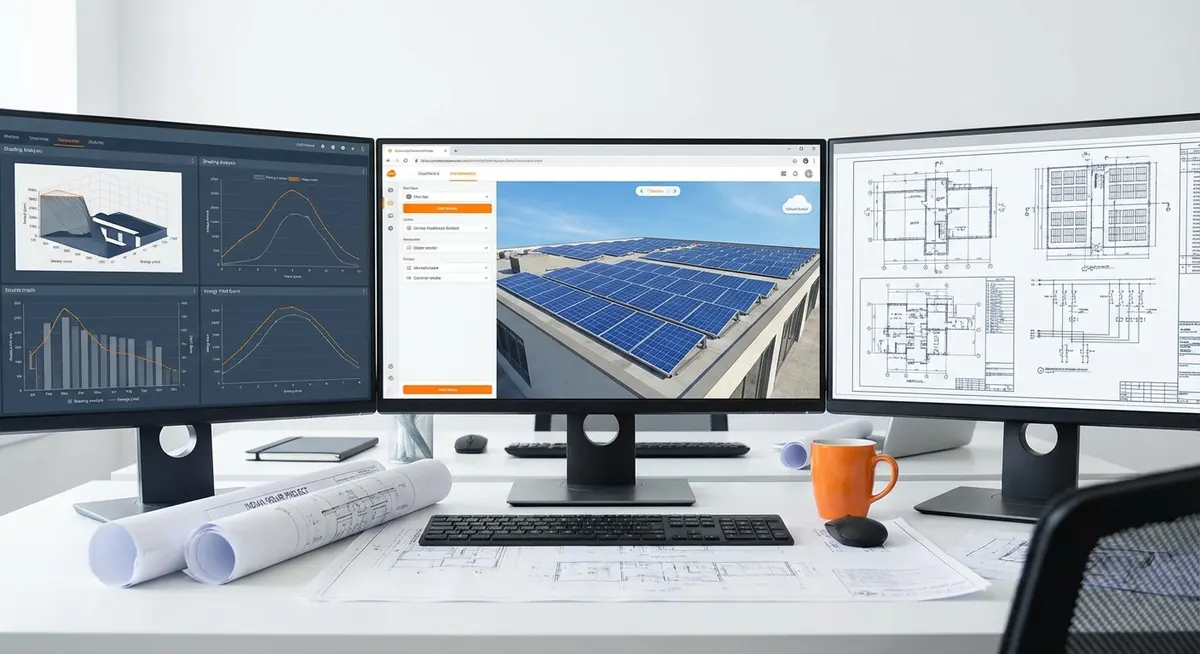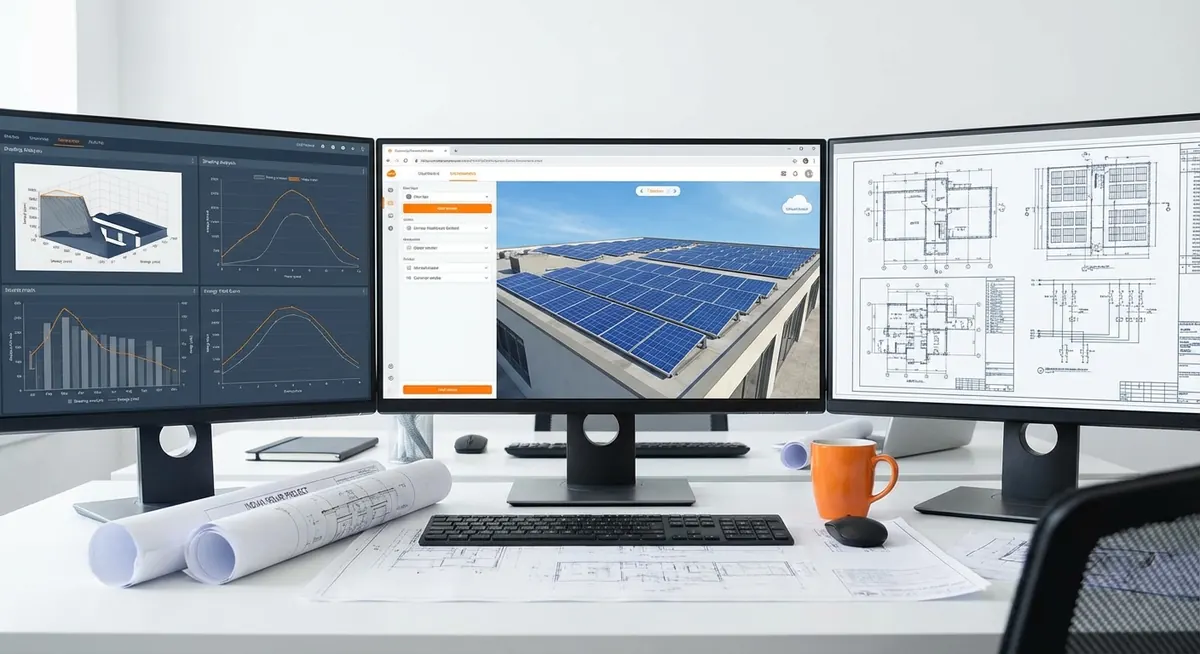
A telecom tower operator in West Africa wants to move from diesel to a solar-diesel-battery hybrid. A C&I developer in Rajasthan is designing an industrial plant with a 2 MW solar array, 500 kWh BESS, and backup diesel generator. In both cases, the simulation software choice determines whether the financial model reflects reality or produces an optimistic number that the plant can never achieve. The choice between HOMER Pro and PVsyst is not about which tool is “better” — it is about which tool answers the specific question your project needs answered.
Direct answer. HOMER Pro is the correct choice when the primary question is system dispatch optimization — how should the solar, battery, and diesel (or grid) resources be sequenced to minimize cost of energy or maximize renewable fraction over 8,760 hours per year. PVsyst is the correct choice when the primary question is bankable energy yield — the exact kWh the solar array will produce, modeled with site-specific irradiance and hardware-level loss accounting. For hybrid projects that need both, the professional workflow is: PVsyst for solar yield → HOMER Pro for dispatch optimization → combined output for the bankability report.
This comparison is written for Tunde — the African EPC developer designing DFI-financed hybrid microgrids — and Suresh — the Indian utility-scale developer adding BESS to a solar project and needing both a bankable PVsyst yield study and a dispatch model for the financial feasibility study.
What HOMER Pro Does — and What It Cannot Do
HOMER (Hybrid Optimization Model for Electric Renewables) was developed by NREL and is now commercially maintained by UL Solutions. HOMER Pro is the professional version used by engineering consultants worldwide for mini-grid feasibility, telecom hybrid sizing, and C&I behind-the-meter storage optimization.
Definition. HOMER Pro is a techno-economic simulation platform that models the hourly dispatch of multiple energy resources — solar PV, wind, diesel generators, battery storage, and grid connections — over a full year (8,760 hourly time steps) and computes the optimal system configuration that minimizes the levelized cost of energy (LCOE) or another objective function defined by the user.
HOMER Pro strengths:
- Dispatch modeling: optimal sequencing of solar, battery, and diesel every hour of the year
- Sensitivity analysis: automated sizing of multiple component combinations (e.g., 50 to 500 kWh battery in 50 kWh steps × 100 to 500 kW PV in 50 kW steps)
- Grid economics: time-of-use tariff modeling, demand charge reduction, grid sell-back
- Load modeling: imports actual load data in hourly format, synthesizes loads from monthly totals
- LCOE and IRR calculation built into the platform
- DFI reports: HOMER Pro outputs are standard in IFC, AfDB, and USAID project documentation
HOMER Pro limitations:
- PV yield modeling is not bankable: HOMER uses a simplified one-diode model with user-entered irradiance data — not a validated radiative transfer simulation. The yield numbers HOMER produces are useful for dispatch optimization but will not pass a lender’s IE review for bankability.
- No hardware-specific loss modeling: HOMER does not account for mismatch loss, wiring loss, soiling profiles, near-shading from horizon or obstructions, or bifacial gain in the way PVsyst does.
- Limited module and inverter library: HOMER’s equipment database is smaller than PVsyst’s; African and Indian market modules may not be available.
What PVsyst Does — and Where It Falls Short for Hybrids
PVsyst is the industry-standard solar energy yield simulation tool used by IEs, lenders, and bankability-focused engineering teams worldwide. According to PVsyst’s technical documentation, the software uses a validated radiation model, hardware-specific component databases, and loss-cascade methodology to produce a certified P50/P90/P99 annual yield report.
PVsyst strengths:
- Bankable yield: the only tool widely accepted by IEs and project finance lenders for solar yield certification
- Hardware-specific loss modeling: wiring ohmic loss, mismatch, near-shading, soiling, degradation, spectral correction, bifacial rear irradiance — all modeled with component-level data
- Meteo data integration: accepts Solargis, Meteonorm, and NSRDB data directly
- P50/P90/P99 exceedance: built-in inter-annual variability calculation accepted by IREDA, PFC, IFC, and AfDB
- Module and inverter database: 25,000+ equipment entries
PVsyst limitations:
- No dispatch modeling: PVsyst cannot model the hourly interaction between a solar array, battery storage, diesel generator, and load. It treats storage in a simplified way — useful for self-consumption modeling but not for dispatch optimization.
- No economic optimization: PVsyst does not compute LCOE, IRR, or the optimal battery/diesel/solar sizing combination.
- No load-following simulation: PVsyst assumes grid-connected or simple battery self-consumption scenarios; it is not designed for off-grid or complex hybrid dispatch.
$3,495
HOMER Pro annual license
UL Solutions, 2025
€1,250
PVsyst annual license
PVsyst, 2025
8,760
Hourly time steps in HOMER Pro
HOMER documentation, 2025
±2%
PVsyst yield accuracy (validated)
NREL benchmark study, 2023
Head-to-Head Comparison
| Dimension | HOMER Pro | PVsyst |
|---|---|---|
| Primary use case | Hybrid dispatch optimization + LCOE | Bankable solar energy yield |
| Bankability for lenders | Not bankable alone for yield | Accepted by IREDA, IFC, AfDB, PFC |
| Dispatch modeling | Full hourly dispatch (solar/battery/diesel/grid) | Simplified self-consumption only |
| LCOE / IRR calculation | Built-in | Not included |
| Battery modeling | Full cycle-by-cycle with SOC tracking | Simplified |
| Diesel generator modeling | Full load curve + fuel consumption | Not included |
| PV yield accuracy | Simplified (not IE-acceptable alone) | High accuracy; IE-acceptable |
| Meteo data integration | Manual import (hourly CSV) or NASA/PVGIS | Solargis, Meteonorm, NSRDB direct import |
| Module/inverter library | Smaller; may lack Indian/African equipment | 25,000+ modules and inverters |
| Sensitivity analysis | Automated multi-variable optimization | Manual parametric runs |
| Best for Africa off-grid | Yes — standard DFI tool | No — use PVsyst for yield, HOMER for dispatch |
| Best for IREDA-financed hybrid | No alone — use in tandem with PVsyst | Yes for yield section |
| Software cost | $3,495/yr | €1,250/yr (~₹1.1L/yr) |
| Learning curve | Moderate (2–3 weeks to proficiency) | Steep (4–8 weeks to bankable output) |
The Hybrid Simulation Cascade — The Professional Workflow
The Hybrid Simulation Cascade is Heaven Designs’ proprietary workflow for projects that need both a bankable PVsyst yield study and a HOMER Pro dispatch model. It eliminates the double-entry problem (where PVsyst and HOMER produce different yield numbers for the same project) by sequencing the two tools in a one-direction data flow.
PVsyst Solar Yield Simulation
Run the full PVsyst simulation: site-specific irradiance (Solargis or Meteonorm), hardware-specific losses, near-shading, soiling, degradation. Extract the hourly energy output profile (8,760 hours) as a CSV from PVsyst's detailed simulation output. This CSV becomes the solar input file for HOMER Pro — ensuring that HOMER's dispatch model uses the same solar generation profile that the bankable PVsyst report documents.
Load Profile Development
Develop the hourly load profile for the site: for telecom towers, this is typically 250–600 W continuous with cooling peaks; for industrial C&I, it is the 15-minute demand data from the utility meter or the process engineer's load schedule. Import the load profile into HOMER Pro in the required hourly format. The accuracy of the load profile is the single biggest uncertainty in hybrid simulation — spend the time here.
HOMER Pro System Configuration
Set up the HOMER Pro model: import the PVsyst hourly solar profile as a custom generator (not the HOMER PV panel model), add the battery storage model with realistic round-trip efficiency (85–92% for lithium-ion; 75–80% for lead-acid), add the diesel generator with site-specific fuel curve and fuel cost, and set the dispatch strategy (load-following or cycle-charging).
Optimization Run
Run the HOMER Pro optimization across the defined sensitivity ranges for battery size, solar array size, and diesel capacity. The output is a cost-ranked list of system configurations — the optimal configuration minimizes NPC (net present cost) or LCOE subject to the reliability constraint (e.g., unmet load fraction ≤ 1%). This optimization takes 15 minutes to 4 hours depending on the sensitivity range.
Combined Bankability Output
The bankability report for lenders contains: (a) PVsyst P50/P90/P99 yield study — signed by the engineer, accepted by the IE; (b) HOMER Pro dispatch simulation — showing the optimal system configuration, renewable energy fraction, diesel consumption, and LCOE; (c) a bridging table confirming that the solar generation used in HOMER Pro matches the PVsyst P50 output. This two-tool approach is now standard practice for IFC and AfDB-financed hybrid projects in Africa.
Africa Use Case — Hybrid Telecom Tower Design
For Tunde’s Africa context, the HOMER Pro workflow is the DFI standard. IFC-financed telecom tower hybridization projects in West Africa (Nigeria, Ghana, Senegal) use HOMER Pro for dispatch modeling and sizing. PVsyst is used for the bankable yield section.
A typical 10-site telecom tower hybrid project in Nigeria:
- Load: 350 W average per tower, 420 W peak (AC load with air conditioning)
- Solar: 2.4 kWp per tower
- Battery: 10 kWh lithium-iron-phosphate per tower
- Diesel: 3 kVA generator per tower (backup only)
- Target renewable fraction: ≥ 90%
HOMER Pro optimizes the battery size (key sensitivity) and verifies that the 90% renewable fraction target is achievable without excessive diesel runtime. The PVsyst simulation (using Meteonorm West Africa data or Solargis) provides the hourly solar profile that HOMER uses. According to IFC’s renewable energy financing framework, hybrid mini-grid projects must demonstrate technical feasibility through an hourly simulation model — HOMER Pro is explicitly cited as an accepted platform.
India Use Case — C&I Solar + BESS Behind-the-Meter
For an Indian C&I manufacturer in Rajasthan adding 2 MW solar + 500 kWh BESS to manage peak demand charges:
What PVsyst answers: How many kWh will the 2 MW solar array produce in a Rajasthan location, accounting for soiling, degradation, inverter losses, and the specific module technology? The answer is the bankable yield input for the financial model.
What HOMER Pro answers: Given that solar yield, and given the plant’s hourly load profile, how should the 500 kWh battery charge and discharge to minimize the monthly demand charge and maximize self-consumption? Should the battery be sized at 400 kWh or 600 kWh to optimize the payback?
Field tip. For Indian C&I projects, HOMER Pro's peak-demand reduction analysis requires accurate demand-tariff data from the DISCOM's Schedule of Tariff. The demand charge reduction simulation is only as good as the tariff inputs. Obtain the exact ToU structure and demand charge rate from the DISCOM before running the HOMER model — a 20% error in the demand charge assumption changes the BESS payback by 3–4 years.
Pros and Cons — HOMER Pro
HOMER PRO STRENGTHS
- DFI-standard dispatch modeling platform
- Multi-resource optimization (solar + wind + diesel + grid + storage)
- Automated sensitivity analysis across component sizes
- Built-in LCOE and NPV calculation
- Widely recognized by AfDB, IFC, USAID project evaluators
HOMER PRO LIMITATIONS
- Solar yield model not accepted by lenders for bankability
- No hardware-specific loss modeling (mismatch, soiling, shading)
- Manual load profile import required (no built-in load synthesis from site data)
- High license cost ($3,495/yr) relative to Indian EPC budgets
- Learning curve significant for optimal sensitivity analysis setup
Verdict. Use HOMER Pro when your project has a complex energy source mix (solar + diesel + storage, or solar + wind + grid) and the primary deliverable is an optimized system configuration with LCOE and dispatch strategy. Use PVsyst when the primary deliverable is a bankable yield study for a lender, IE, or project finance process. For DFI-financed hybrid projects and Indian BESS projects that need both, use the Hybrid Simulation Cascade: PVsyst first → HOMER Pro second → combined output for bankability.
Get a sample hybrid simulation output
Download a redacted combined PVsyst + HOMER Pro bankability report from a recent DFI-financed hybrid project — showing the Hybrid Simulation Cascade workflow in practice.
Get the sample pack →How Heaven Designs Helps
Heaven Designs runs both PVsyst and HOMER Pro workflows in-house, enabling the Hybrid Simulation Cascade for DFI-financed African hybrid projects and Indian C&I BESS projects in a single engagement. The solar yield side uses calibrated Solargis or Meteonorm data; the dispatch side uses HOMER Pro with load profiles validated against site meter data or operator-supplied consumption records.
- Bankable PVsyst Reports — P50/P90/P99 yield studies accepted by IFC, AfDB, IREDA, and PFC
- Hybrid Solar + Diesel + Battery Design Guide — Full engineering guide to hybrid solar system design
- BESS Sizing for C&I Solar — Battery sizing walkthrough for behind-the-meter Indian C&I projects
- Solar Ground Mount Design — Full IFC-grade layout and electrical design for the PV array component of hybrid systems
- MW-Scale Project Management Consultancy — Owner’s engineer covering both PVsyst and HOMER deliverables for DFI-financed projects
- Download a sample deliverable — Sample PVsyst report and HOMER Pro dispatch summary from a real hybrid project
Contact us to discuss your hybrid simulation requirements — whether Africa off-grid or Indian C&I BESS.
FAQ
When should I use HOMER Pro instead of PVsyst for solar design?
Use HOMER Pro when the primary question is: how should multiple energy sources (solar, battery, diesel, grid) be dispatched to minimize cost or maximize renewable fraction? Use PVsyst when the primary question is: what is the bankable annual energy yield of the solar array? For hybrid projects that need both answers, use HOMER Pro and PVsyst together via the Hybrid Simulation Cascade — PVsyst provides the hourly solar profile, HOMER Pro optimizes the dispatch and sizing.
Can HOMER Pro produce a bankable energy yield report for lenders?
No. HOMER Pro’s solar simulation uses a simplified model that is not accepted by Independent Engineers or project finance lenders for energy yield certification. HOMER Pro is accepted by DFI lenders (IFC, AfDB) as the platform for demonstrating feasibility and dispatch optimization of hybrid systems, but the solar yield section of a DFI bankability report must be supported by a PVsyst report or an equivalent tool using a validated radiation model.
What irradiance data sources does HOMER Pro accept?
HOMER Pro accepts irradiance data in several formats: it can access NASA POWER data directly from within the software (free but lower accuracy), it can import Solargis or Meteonorm data as a custom hourly time series in CSV format, and it can use PVGIS data downloaded in the appropriate format. For bankable hybrid projects, using the same Solargis dataset in both PVsyst and HOMER Pro ensures consistency between the yield report and the dispatch model.
Is HOMER Pro used in India for solar BESS projects?
HOMER Pro is used in India primarily for off-grid and island-mode hybrid projects — telecom towers, remote communities, industrial facilities with weak grid connections. For grid-connected C&I solar + BESS projects where the primary benefit is peak-demand reduction under the DISCOM’s ToU tariff, HOMER Pro is one of several platforms used — alongside custom Excel models and SAM (NREL System Advisor Model). For IREDA-financed grid-connected BESS, lenders do not require a HOMER Pro report; they require a PVsyst yield study and a financial model showing DSCR ≥ 1.25× at P90.
How accurate is HOMER Pro’s solar yield simulation?
HOMER Pro’s built-in PV simulation (when using the HOMER PV panel model with NASA or PVGIS data) typically produces yield estimates within ±5–10% of a validated PVsyst simulation. This accuracy is sufficient for system sizing optimization but not for bankable yield certification. The Hybrid Simulation Cascade eliminates this accuracy gap by substituting the PVsyst-simulated hourly profile for the HOMER solar model — ensuring the dispatch simulation uses the same bankable yield data as the lender’s yield report.
What dispatch strategies does HOMER Pro support for solar-diesel-battery systems?
HOMER Pro supports two primary dispatch strategies: load-following (the diesel generator produces only enough power to meet the immediate load deficit above what solar and battery can supply — minimizing fuel consumption) and cycle-charging (the diesel generator runs at or near full capacity and charges the battery when it runs, maximizing generator efficiency per fuel unit). HOMER Pro also supports a “combined dispatch” strategy that selects the lower-cost option hourly. For African telecom tower applications where fuel delivery is unreliable, load-following with a high minimum battery state of charge (SOC) threshold is typically optimal.
Does Heaven Designs provide HOMER Pro simulation services for African projects?
Heaven Designs provides HOMER Pro dispatch simulation as part of its hybrid solar engineering service for DFI-financed projects in Africa. The workflow follows the Hybrid Simulation Cascade described in this guide — PVsyst yield simulation using Solargis or Meteonorm Africa data, followed by HOMER Pro dispatch optimization, followed by a combined bankability report in the format required by IFC, AfDB, or the specific DFI funding the project. See the hybrid solar diesel battery design guide for the full engineering methodology. According to NREL’s HOMER Pro validation study (2023), the platform achieves within ±3% accuracy of real-world hybrid system performance when load data and irradiance inputs are accurate — confirming its suitability for DFI project documentation.
The African Development Bank’s clean energy financing framework, documented in the AfDB Energy Sector Strategy, recognizes hybrid simulation tools as essential for assessing mini-grid and off-grid project viability — directly supporting the use of HOMER Pro as part of the technical documentation package for AfDB-financed solar projects across Sub-Saharan Africa.