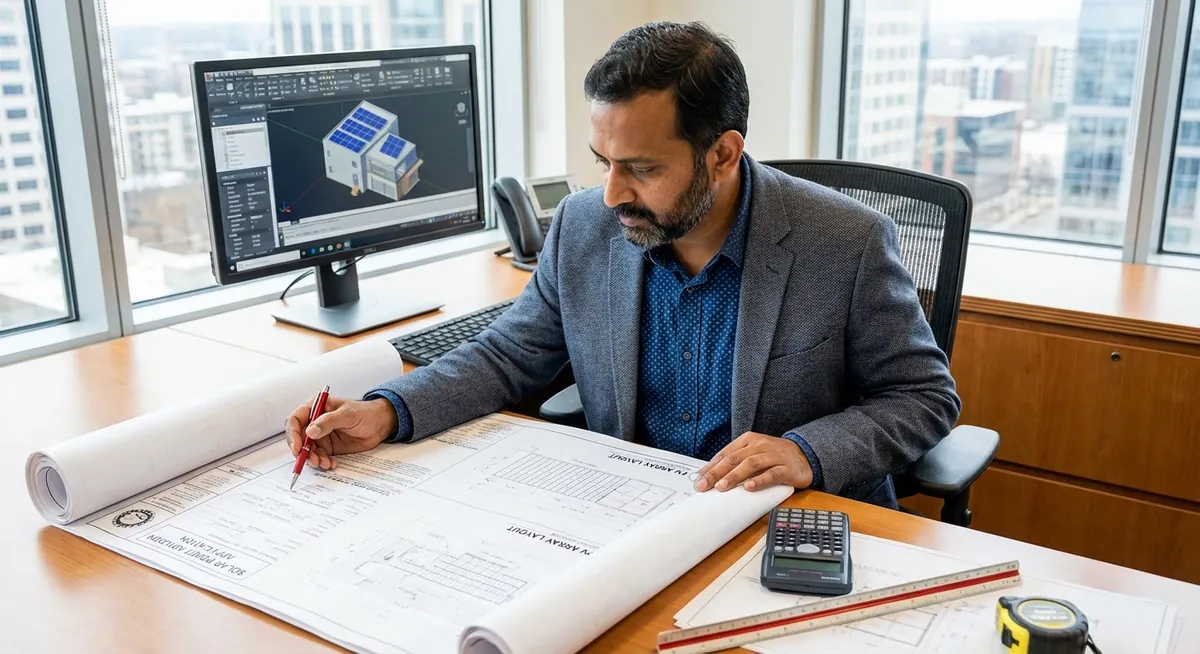
New Jersey ranks consistently among the top five US states for solar installations per capita, driven by New Jersey Board of Public Utilities (NJBPU) incentive programs, high retail electricity rates that improve solar economics, and a policy environment that has actively supported solar deployment for over two decades. Despite this favorable policy context, New Jersey’s permitting landscape is fragmented in a way that creates operational complexity for solar installers: NJ has 564 municipalities, each with its own local building department as the AHJ, and two major investor-owned utilities — PSE&G and JCP&L — with different interconnection processes serving different geographies.
An installer working across NJ’s residential and C&I markets encounters a patchwork of local permit requirements, two distinct utility interconnection workflows, NJ-specific structural requirements for snow load, and the NJBPU’s Transition Incentive (TI) program requirements that affect system design and documentation.
Direct answer. New Jersey solar permits are issued by the local municipal building department (AHJ), not a state-level authority. Every NJ municipality requires a building permit and an electrical permit for solar installations. Interconnection applications go to the T&D utility — PSE&G for northeast and central NJ, JCP&L for central and western NJ, Atlantic City Electric for South Jersey, and Rockland Electric for a small northern area. The NJ Uniform Construction Code (UCC) governs the permit process statewide, with NEC 2021 (transitioning from NEC 2017 in some municipalities) as the electrical code base. PE-stamped structural calculations are required for commercial systems and strongly recommended for residential in municipalities with active structural review.
New Jersey Solar Market Overview
New Jersey’s solar market is primarily driven by three NJBPU programs:
- Transition Incentive (TI) Program — The current capacity-based incentive replacing SREC (Solar Renewable Energy Certificate) legacy programs. TI provides a fixed payment per kWh generated for 15 years for qualifying residential and C&I projects.
- Community Solar — Allows customers without suitable roofs to subscribe to off-site community solar projects and receive bill credits.
- Successor Solar Incentive (SuSI) Program — The longer-term NJBPU program replacing TI, with separate residential and commercial tracks.
According to the Solar Energy Industries Association (SEIA), New Jersey had over 5,000 MW of installed solar capacity as of 2025, with over 200,000 residential solar installations. The NJBPU actively tracks solar capacity by utility territory and program type.
Permit and incentive timing. For TI and SuSI program applications, the NJBPU registration requires a copy of the utility interconnection agreement, which comes after the permit is issued and the system is inspected. Plan your project timeline to include: permit application → permit issuance → installation → inspection → utility interconnection → NJBPU program registration.
New Jersey AHJ Landscape — 564 Municipalities
New Jersey’s 564 municipalities are the permitting authority for solar installations. There is no county-level solar permit in NJ (unlike California where some counties are AHJs for unincorporated areas). Every solar installation — residential or commercial — requires a permit from the municipal building department where the property is located.
NJ Uniform Construction Code (UCC) — The New Jersey UCC governs construction standards statewide. The UCC adopts the International Building Code (IBC) with NJ amendments and NEC (currently NEC 2017 with NJ amendments in many jurisdictions, though NEC 2021 is being adopted). The UCC creates a baseline across all 564 municipalities, but local interpretations and review rigor vary substantially.
NJ permit variation in practice. Two municipalities five miles apart can have dramatically different permit timelines and requirements. Princeton Borough and Hopewell Township share geography but have different building department staffing, different turnaround times, and different preferences for drawing format. Installers working at volume in NJ need a municipality-by-municipality knowledge base, updated regularly — or outsourced permit design that already has this knowledge built in.
For the broader US permit framework, see How to Submit a Solar Permit Package to an AHJ and Solar PE Stamp Explained.
NJ Utility Territory Map — PSE&G vs. JCP&L vs. ACE
The interconnection application for a New Jersey solar system goes to the T&D utility serving the property’s address — not the retail electricity supplier. Understanding which utility serves a given address is the first step in any NJ solar project.
| Utility | Territory | Approximate % of NJ Residential Customers |
|---|---|---|
| PSE&G (Public Service Electric and Gas) | Northeast NJ (Essex, Hudson, Union, Bergen, Passaic, Middlesex, Somerset) | ~50% |
| JCP&L (Jersey Central Power & Light) | Central and western NJ (Ocean, Monmouth, Morris, Warren, Sussex, Hunterdon) | ~25% |
| Atlantic City Electric (ACE) | South Jersey (Atlantic, Cape May, Cumberland, Salem, Gloucester, Camden south) | ~20% |
| Rockland Electric | Small area in Bergen/Passaic border | < 5% |
How to identify the utility for a given NJ address: Use the NJ Board of Public Utilities’ utility territory lookup tool, or check the customer’s electric bill — the utility name is listed on the bill header. Never assume territory based on county — multiple utilities serve some counties.
PSE&G Solar Interconnection — Parallel Generation Application
PSE&G (Public Service Electric and Gas) serves the densest solar market in New Jersey. PSE&G’s solar interconnection process for distributed generation is called the Parallel Generation Interconnection Application.
PSE&G Interconnection Tracks:
| System Size | Track | Typical Timeline | Requirements |
|---|---|---|---|
| ≤ 10 kW (residential) | Expedited Track | 10–20 business days | Standard application; UL 1741 inverter |
| 10–2,000 kW | Standard Track | 30–60 business days | Technical feasibility study |
| > 2,000 kW | Study Track | 60–120+ business days | System impact study required |
PSE&G Parallel Generation Application requires:
- Completed PSE&G Parallel Generation Application form (online portal)
- Electrical SLD showing inverter, disconnects, and utility meter
- Inverter cut sheet confirming UL 1741 listing
- Copy of building/electrical permit (or evidence of permit application)
- For systems > 10 kW: signed interconnection agreement
Field tip — PSE&G. PSE&G's online portal for parallel generation applications requires the "service agreement number" from the customer's PSE&G account — not the meter number. First-time applicants sometimes use the wrong field, causing the application to be filed under the wrong account and requiring a restart. Pull the service agreement number directly from the customer's PSE&G bill before starting the application.
JCP&L Solar Interconnection — Distributed Generation Application
JCP&L (Jersey Central Power & Light) serves central and western New Jersey. JCP&L’s DG interconnection process has a different application structure than PSE&G and includes a specific anti-islanding verification requirement.
JCP&L DG Application Requirements:
| System Size | Track | Timeline | Key Difference vs. PSE&G |
|---|---|---|---|
| ≤ 10 kW | Level 1 (Simplified) | 15–25 business days | JCP&L requires inverter model verification against its approved inverter list |
| 10 kW–2 MW | Level 2 (Standard) | 45–90 business days | Feasibility study; may require distribution upgrades |
| > 2 MW | Level 3 (Full Study) | 90–180+ business days | System impact study |
JCP&L-specific requirements:
- Inverter must meet IEEE 1547-2018 anti-islanding requirements (JCP&L specifies this explicitly in its interconnection application, where PSE&G relies on UL 1741)
- JCP&L requires a copy of the issued building permit before granting final interconnection approval (not just evidence of application)
- Revenue-grade production meter required for systems > 10 kW applying under TI program
The New Jersey Solar Permit Drawing Package Framework
The NJ solar permit drawing package follows a consistent structure across the 564 municipalities, with local variations in specific requirements. The following framework covers the baseline requirements that satisfy the NJ UCC and the major utility interconnection applications.
Site Plan + Roof Plan
Property boundary, house location, and roof plan with module layout. Fire setback annotations per International Fire Code (IFC) Chapter 6 as adopted by NJ. Array dimensions and system nameplate capacity noted.
Electrical Single-Line Diagram (SLD)
Complete SLD from PV array through inverter, AC disconnect, rapid shutdown device, and utility interconnection point. NEC 2017/2021 compliance (depending on municipality's adopted version). Conductor sizing, OCPD ratings, and interconnection method (load-side 120% busbar rule per NEC 705.12).
Structural Analysis
Rafter/truss capacity analysis under NJ loading: dead load (modules + racking), wind uplift per ASCE 7-22 for NJ wind zones (Vult 110–130 mph depending on location; coastal NJ up to 130 mph), and snow load (NJ ground snow load: 25–30 psf for most of the state). Required by most NJ municipalities for commercial systems; required by larger municipalities (Newark, Trenton, Jersey City) for residential as well.
Equipment Specifications
Cut sheets for modules, inverter, racking, and rapid shutdown device. UL listing confirmations. For systems applying under TI/SuSI programs, NJ Clean Energy Program-eligible equipment confirmation.
NJ UCC Compliance Checklist
Many NJ municipalities have a specific solar permit checklist as part of their application. Confirm the municipality-specific checklist before submitting — missing a required item on the checklist is the most common cause of incomplete application returns in NJ.
New Jersey Snow Load — Structural Design Requirement
New Jersey’s latitude and climate create meaningful snow load requirements that affect solar structural design — a requirement absent in Florida and Texas solar installations.
NJ Ground Snow Load by Region (ASCE 7-22):
| Region | Pg (Ground Snow Load) | Notes |
|---|---|---|
| Northern NJ (Morris, Sussex, Warren, Passaic highlands) | 30–40 psf | Highest in state; elevated terrain |
| Central NJ (Middlesex, Somerset, Hunterdon, Monmouth) | 25–30 psf | Moderate |
| South Jersey (Burlington, Camden, Atlantic, Cape May) | 20–25 psf | Lower; coastal influence |
| Coastal areas (Jersey Shore) | 20 psf | Ocean proximity reduces accumulation |
Solar structural impact of NJ snow load:
- Snow load on solar arrays is partially offset by the tendency of snow to slide off tilted modules
- For design purposes, ASCE 7 allows a roof snow load reduction factor (Cs) for sloped roofs, which applies to the solar array zone
- Flat and low-slope commercial roofs (pitch ≤ 2:12) do not benefit from this reduction — full ground snow load governs
Note. Many NJ building departments' solar permit checklists specifically ask for snow load analysis. Using a structural calculation that was designed for a Florida or Texas system — with no snow load — will fail NJ structural review. Every NJ structural calculation must include site-specific ground snow load from ASCE 7-22 Figure 7.2-1 or the NJ-specific amendment tables.
NEC Code Version in New Jersey
New Jersey’s adoption of NEC versions varies by municipality, which creates specific compliance complexity for installers and permit designers:
| Code Version | Status in NJ (2026) |
|---|---|
| NEC 2017 | Still the base code in most NJ municipalities (adopted at state level per NJ UCC) |
| NEC 2020 | Adopted in some progressive municipalities that have updated locally |
| NEC 2021 | State-level NJ UCC cycle transitioning; check current NJ DCA (Division of Consumer Affairs) adoption status |
Practical implication: A permit package designed strictly to NEC 2023 without verifying the municipality’s adopted code version may reference provisions that the local plan examiner’s code edition does not contain. The safest approach is designing to NEC 2020 (which is backward-compatible with 2017 provisions for most residential solar requirements) and noting code compliance on the drawings.
Key NEC provisions for NJ solar:
- Rapid shutdown (NEC 690.12): Required under NEC 2017 and later. All NJ municipalities with NEC 2017+ require rapid shutdown for rooftop solar.
- Arc fault protection (NEC 690.11): Required under NEC 2017 and later for string inverter systems with DC wiring in or on a building.
- Load-side interconnection (NEC 705.12): The 120% busbar rule for load-side solar connections.
- Storage (NEC 706): Required for any system including BESS.
NJ Permit Timelines — Major Municipalities
NJ’s 564 municipalities produce highly variable permit timelines. The following reflects current averages for major markets:
| Municipality / County | Typical Solar Permit Timeline | Notes |
|---|---|---|
| Newark (Essex) | 10–20 business days | Online permit portal; moderate queue |
| Jersey City (Hudson) | 15–25 business days | Online filing available; moderate-high volume |
| Trenton (Mercer) | 10–20 business days | |
| Edison (Middlesex) | 7–15 business days | Active solar market; familiar with solar permits |
| Toms River (Ocean) | 7–15 business days | JCP&L territory; high residential volume |
| Princeton (Mercer) | 10–20 business days | Detailed technical review; plan examiners familiar with solar |
| Atlantic City (Atlantic) | 5–12 business days | ACE territory |
| Larger suburban townships | 5–15 business days | Variable; some adopt SolarApp+ |
NJBPU Incentive Programs — Impact on Permit Package
The NJBPU’s solar incentive programs (TI, SuSI) create documentation requirements that tie into the permit package:
Transition Incentive (TI) / Successor Solar Incentive (SuSI) documentation requirements:
- Production meter: TI program requires a revenue-grade production meter for systems > 10 kW. The meter must be specified on the SLD in the permit package.
- System capacity: The as-built system capacity (kW DC and kW AC) must match between the permit drawings and the NJBPU registration application. Any discrepancy triggers a review.
- Equipment eligibility: NJBPU programs have equipment eligibility lists (modules must be Tier-1 manufacturers; inverters must be UL 1741 listed). The permit package’s cut sheets serve as the documentation basis for the NJBPU registration.
Watch out — revenue-grade metering. If a project qualifies for TI or SuSI incentives and the system is > 10 kW, the production meter must be revenue-grade (IEC 62053 Class 0.5 or better). A standard monitoring meter that came with the inverter is not typically revenue-grade. Confirming the metering specification in the permit package upfront prevents a situation where the permit is approved and installation is complete, but the system cannot be registered for incentives due to a non-conforming production meter.
Common NJ Solar Permit Corrections by Category
| # | Correction | Most Common Municipalities | Fix |
|---|---|---|---|
| 1 | Snow load missing from structural calc | Statewide | Add site-specific ground snow load from ASCE 7-22 for the project address |
| 2 | Fire setback annotation missing on roof plan | Statewide | Add IFC-compliant setbacks: 18-inch ridge, valley, hip, and perimeter setbacks |
| 3 | Rapid shutdown device not shown on SLD | Statewide | Show RSD device on SLD with initiation device at service entrance |
| 4 | Interconnection method not specified (load-side vs. supply-side) | PSE&G territory | State explicitly on SLD: “load-side interconnection per NEC 705.12(D)(3)“ |
| 5 | NEC version conflict (drawing references 2023 provision but municipality is on 2017) | Multiple municipalities | Verify municipality’s adopted NEC version before finalizing drawing notes |
| 6 | Revenue-grade meter not shown on SLD for >10 kW TI system | JCP&L, PSE&G territories | Add production meter symbol and specify meter accuracy class on SLD |
| 7 | PE stamp not NJ-licensed for commercial structural | Commercial projects | NJ PE license required; verify on NJ Division of Consumer Affairs PE verification tool |
| 8 | Municipality-specific checklist not completed | Variable | Download the municipality-specific solar permit checklist; complete all items before submission |
NJ vs. Neighboring State Permit Comparison
NJ ADVANTAGES
- NJ UCC creates consistent baseline across municipalities
- Strong NJBPU incentive programs create high customer demand
- High retail electricity rates make solar ROI compelling
- SolarApp+ adopted by growing number of municipalities
NJ CHALLENGES
- 564 municipalities = 564 different process nuances
- NEC version fragmentation (2017 vs. 2020 vs. 2021 depending on municipality)
- Snow load structural analysis required (absent in FL/TX)
- Two major utilities (PSE&G, JCP&L) with different application formats
- Revenue-grade metering for TI/SuSI > 10 kW adds per-project documentation overhead
Verdict. New Jersey is a strong solar market with genuinely attractive incentive programs — but the 564-municipality permitting landscape and the NEC version fragmentation create enough per-project variability that a dedicated permit design workflow pays off. The most efficient approach for NJ volume is maintaining a municipality-specific requirement database that is updated as municipalities adopt new codes or change portal systems, and filing PSE&G and JCP&L interconnection applications concurrently with the building permit to minimize total project timeline.
How Heaven Designs Serves New Jersey Installers
New Jersey’s municipality-by-municipality permit process, dual-utility interconnection workflows, snow load structural requirements, and TI/SuSI metering documentation are exactly the type of multi-variable permitting environment where outsourced permit design creates direct cost savings.
- Solar Permit Design (USA) — NJ-specific permit packages for PSE&G and JCP&L territories. NJ-licensed PE structural stamps where required. Snow load and wind load analysis per ASCE 7-22. Municipality-specific checklist compliance. 4–7 business days. 96.2% first-pass approval rate.
- Solar Civil & Structural Engineering — NJ PE-stamped structural calculations for commercial and large residential systems. Snow load and wind uplift per ASCE 7-22.
- Solar 3D Pre-Design — 48-hour sales-stage layout with IFC setback annotation and busbar calculation — catches eligibility issues before permit preparation.
- Download sample deliverables — Sample NJ residential permit set compliant with PSE&G interconnection requirements.
For broader US permit context, see NYC Solar Permit Guide, California AHJ Solar Permit Guide, and How to Submit a Solar Permit Package to an AHJ.
Glossary: AHJ, NEC 705, rapid shutdown.
FAQ
Does New Jersey require a PE stamp on residential solar permits?
Not universally, but many municipalities do. Under the NJ UCC, residential solar structural analysis is required for any alteration that affects the building’s structural elements. In practice, most larger NJ municipalities (Newark, Jersey City, Trenton) require a PE stamp on the structural calculations for residential solar. Smaller townships may accept a prescriptive structural pathway. When in doubt, include a PE-stamped structural analysis — the cost of preparing it is lower than the cost of a plan correction round requiring it after initial rejection.
What is the difference between PSE&G and JCP&L for solar interconnection in NJ?
PSE&G and JCP&L are the two major T&D utilities in NJ serving different geographic areas. PSE&G serves the northeast (Essex, Hudson, Union, Bergen, Middlesex, Somerset counties). JCP&L serves central and western NJ (Ocean, Monmouth, Morris, Warren, Sussex, Hunterdon). The key practical difference for solar: PSE&G relies on UL 1741 as the primary inverter qualification standard; JCP&L specifically requires IEEE 1547-2018 anti-islanding compliance verification. JCP&L also requires a copy of the issued permit before granting final interconnection approval, while PSE&G accepts an evidence-of-application approach.
Does New Jersey have a statewide solar permitting standard?
NJ does not have a single solar-specific permit standard that supersedes local AHJ requirements. The NJ Uniform Construction Code (UCC) provides a statewide construction code baseline, but each municipality applies it through its own building department. NJBPU has supported efforts to streamline solar permitting through SolarApp+ adoption and model solar ordinance guidance — but adoption remains voluntary and varies by municipality.
How does the NJ SREC/TI/SuSI program affect solar permit design?
The NJBPU incentive programs create documentation requirements that should be built into the permit design from the start. Key impacts: (1) Production metering — systems > 10 kW under TI/SuSI require a revenue-grade production meter that must be specified on the SLD in the permit package. (2) System capacity matching — the kW AC and kW DC on the permit drawings must match the NJBPU registration exactly; post-installation changes trigger a revision process. (3) Equipment eligibility — permit cut sheets serve as the documentation base for NJBPU equipment eligibility verification.
What is the timeline from NJ solar permit application to utility interconnection?
For a typical residential system in PSE&G territory: permit application → permit issuance (7–20 business days depending on municipality) → installation → inspection (2–5 business days scheduling) → PSE&G interconnection application processing (10–20 business days for ≤ 10 kW Expedited Track) → net metering activation. Total typical timeline: 6–12 weeks from permit application to utility interconnection and net metering activation. JCP&L timelines are similar for Level 1 systems but may be longer if the issued permit requirement delays the interconnection application start.
Can NJ homeowners install solar without a permit?
No. The NJ UCC requires a permit for all solar installations as alterations to existing structures. Installing solar without a permit creates legal liability for the installer, may void manufacturer warranties, and will prevent the system from being approved for NJBPU incentive programs (which require a utility interconnection agreement that cannot be obtained without a permitted and inspected installation).