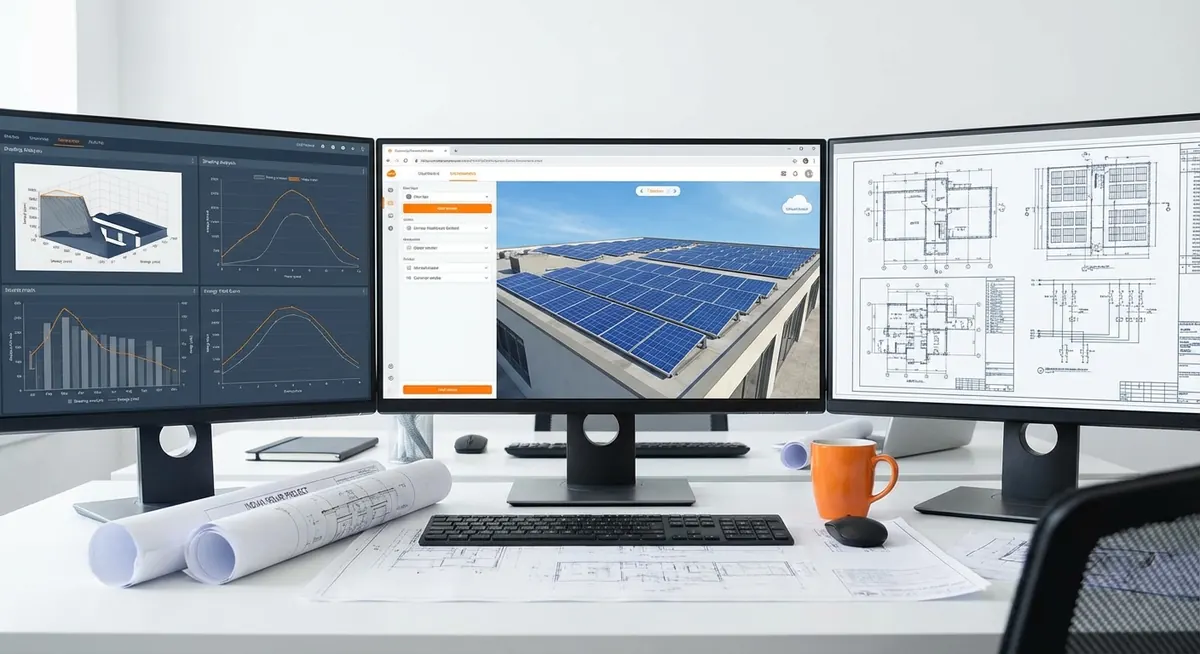
Every solar structural engineer faces the same question before opening a new project file: SAP2000, STAAD Pro, or a manual calculation? The wrong answer costs money twice — once when the client’s independent engineer rejects the deliverable format, and again when the analysis has to be rebuilt from scratch in the correct tool. For Indian EPCs bidding on SECI tenders, IREDA-financed ground-mounts, or DISCOM-connected rooftops, the structural analysis tool selection directly determines whether the calculation package is accepted on first submission.
Direct answer. SAP2000 is the correct tool for solar structures requiring non-linear analysis, dynamic seismic response, or complex shell element modeling — particularly US C&I projects in high-seismic zones and large tracker arrays. STAAD Pro is the standard for Indian solar (fixed-tilt ground-mount and rooftop) because its IS 800:2007 and IS 875 Part 3 code modules match what Indian IEs and lenders expect. Manual calculations per IS 800 are acceptable for rooftop systems below 100 kW using manufacturer-certified racking with ICC-ESR or BIS approval. The Structural Analysis Selection Matrix maps project type, complexity, budget, and lender requirement to a tool recommendation in under 60 seconds.
This guide serves three audiences: Rohan whose lender is asking for a STAAD Pro model, the structural engineer unsure whether SAP2000 adds value for a 50 MW ground-mount, and the EPC founder who wants to know if manual calculations will pass the CEIG technical review for a 75 kW rooftop.
What Each Tool Actually Does — Before Comparing Them
Understanding what SAP2000, STAAD Pro, and manual calculations are designed for prevents the most common error: using a tool beyond its intended scope (manual calcs for utility-scale) or below it (SAP2000 for a simple fixed-tilt row).
SAP2000 (Computers and Structures, Inc.) is a general-purpose finite element analysis (FEA) platform used globally for building, bridge, and non-building structural design. It handles frame elements, shell elements, and solid elements — making it capable of modeling any structure from a simple beam to a full offshore platform. Its dynamic analysis modules (modal analysis, response spectrum, time-history) are among the most mature in commercial structural software. According to CSI’s SAP2000 technical overview, the software is used by engineers in over 160 countries for structures requiring non-linear and dynamic analysis — it is the de facto standard in US structural engineering practice for non-building structures.
STAAD Pro (Bentley Systems) is a frame analysis and design software with deep integration of international codes including IS 800:2007, IS 875 Part 3, IS 1893, AISC 360, and BS 5950. Its member design module checks section capacity against the applicable code automatically after analysis — a critical workflow advantage for solar structures where hundreds of member utilization checks are required per row. For Indian solar projects, STAAD Pro’s built-in IS code modules, standard section database (including Indian SHS, RHS, angles, and channels), and IS 875 wind load zone maps make it the dominant tool in practice.
Manual calculations use closed-form beam formulas from standard references (IS 800:2007 Section 8, Roark’s Formulas for Stress and Strain), manufacturer-certified allowable load tables from BIS or ICC-ESR reports, and equilibrium equations. They do not require FEA software and produce results as hand-calculations or structured spreadsheets that a PE or structural engineer signs.
< 100 kW
Systems where manual calcs are typically sufficient
Heaven Designs structural team guideline, 2025
100 kW–50 MW
Primary STAAD Pro range for India ground-mount
Heaven Designs project data, 2025
> 50 MW
Tracker or complex geometry — SAP2000 or STAAD
Heaven Designs structural team guideline, 2025
3–5 days
STAAD report turnaround (2 MW standard structure)
Heaven Designs internal SLA, 2025
Head-to-Head Comparison — SAP2000 vs STAAD Pro vs Manual
| Criterion | SAP2000 | STAAD Pro | Manual Calcs |
|---|---|---|---|
| IS 800:2007 code support | Limited — custom input required | Excellent — built-in | Manual per IS 800 |
| IS 875 Part 3 wind load | Limited | Excellent — built-in zone map | Manual per IS 875 |
| AISC 360 / ASCE 7-22 support | Excellent | Good | Manual per AISC ASD/LRFD |
| Shell element modeling | Excellent | Limited | Not feasible |
| Dynamic seismic (response spectrum) | Excellent | Good | Equivalent static only |
| Tracker torsional analysis | Good — shell elements | Good — frame model | Not practical |
| Repetitive row efficiency | Moderate | High — one model per row type | High — spreadsheet template |
| Learning curve | Steep (4–8 weeks) | Moderate (2–4 weeks) | Low (existing engineer skills) |
| IE / lender acceptance — India | Accepted with IS narrative | Excellent — standard | Small projects only |
| IE / lender acceptance — US | Excellent — standard | Accepted | Small projects with PE stamp |
| Annual software cost (India) | ₹4–6.5L/yr | ₹3.5–5.5L/yr | Near zero |
| Output report format | Engineering-standard PDF | Engineering-standard PDF | Structured spreadsheet / PDF |
Definition. IS 800:2007 is the Bureau of Indian Standards code of practice for general construction in steel. It governs the design of steel members (tension, compression, bending, shear) and connection design for all steel structures in India including solar mounting systems. STAAD Pro's IS 800:2007 module automates the member capacity checks specified in Sections 6 through 10 of the code, producing a utilization ratio for every member in the model.
When SAP2000 Is the Right Tool for Solar
SAP2000 outperforms STAAD Pro in three specific solar scenarios. Outside these scenarios, the additional setup time and cost rarely produce engineering value above what STAAD Pro delivers.
Scenario 1: Non-Standard and Complex Geometry
Carport structures with varying bay widths, multi-level canopies that cantilever over vehicle lanes, or building-integrated photovoltaic (BIPV) systems connected to the building’s structural frame all involve geometry that STAAD Pro’s frame-element approach handles less cleanly. SAP2000’s shell element capability allows the engineer to model the full structural assembly — including the skin of a BIPV panel as a composite shell element — with load transfer through the entire system. This is particularly important when the solar structure and the building structure share load paths.
Scenario 2: Dynamic Seismic Analysis
In seismic zones requiring a response spectrum analysis or time-history analysis — Zone IV–V in India per IS 1893, or Seismic Design Category D and above in the US per ASCE 7-22 — SAP2000’s dynamic analysis tools are the engineering community’s preferred platform. According to IRENA’s 2022 Utility-Scale Solar Cost Analysis, tracker structures in high-seismic regions require specific dynamic load analysis that plain equivalent-static methods underestimate by 15–25%. SAP2000 handles this directly.
Scenario 3: Tracker Torsional Load Path
Single-axis tracker torque tubes transmit torsional loads through a complex sequence: wind on the module creates aerodynamic torque, which loads the drive shaft, which transfers into the torque tube, which distributes into multiple foundation piles through a statically indeterminate load path. A full torsional analysis for unusual ground geometry, non-uniform pile spacing, or closely-spaced rows where aerodynamic interaction between arrays occurs requires SAP2000’s shell or solid element capability — STAAD Pro’s frame model of the torque tube is an approximation that may be unconservative for non-standard tracker configurations.
Field tip. When a lender or IE requests a SAP2000 model for an India project, pair the model output with a narrative IS 800 code-check document that translates the SAP2000 results into IS code utilization ratios. Many Indian IEs are more familiar with STAAD Pro output formats — a well-written IS code narrative bridges the gap and eliminates review delays.
When STAAD Pro Is the Standard Choice for Indian Solar
STAAD Pro is the dominant tool in Indian solar structural engineering for reasons that go beyond software capability — it is about IE acceptance, code integration, and workflow efficiency at scale.
For fixed-tilt ground-mount projects from 100 kW to 50 MW in India, STAAD Pro is the practical standard because:
-
IS 800:2007 and IS 875 Part 3 are natively integrated. The engineer inputs the wind zone from the IS 875 map, the STAAD module applies the correct basic wind speed, terrain category, and shape factor automatically. The member design check runs against IS 800:2007 code equations with zero manual code translation.
-
Indian section library is complete. STAAD Pro’s India section database includes SHS (square hollow sections), RHS (rectangular hollow sections), ISA (equal and unequal leg angles), ISMC (channels), and ISMB (beams) in all standard BIS dimensions. The engineer selects the section from the database — no manual section property input required.
-
IE and lender acceptance is highest. IREDA, PFC, SBI Renewable Energy, and private project finance banks in India have reviewed thousands of STAAD Pro structural reports. Their IEs have standardized checklists built around STAAD output formats. A SAP2000 report for the same structure requires additional explanation that adds review time and creates uncertainty in the lender’s process.
-
Repetitive row modeling is efficient. A 50 MW ground-mount uses hundreds of identical mounting row units. STAAD Pro models one representative row with the full IS 875 wind load applied and validates it — the engineer then states that all identical rows are covered by this model. This is accepted practice and avoids modeling the entire project.
According to BIS IS 800:2007, the code applies to all steel structures including non-building structures such as solar mounting systems, and member design must follow the code’s limit state design (LSD) approach. STAAD Pro’s IS 800 module implements LSD directly.
Read more about how STAAD Pro output connects to IREDA lender due diligence requirements and the complete solar engineering workflow for Indian EPCs.
When IS 800 + Manual Calculations Suffice
Manual calculations are not a fallback for when software is unavailable — they are the correct tool for a specific range of solar structural problems. Using STAAD Pro on a 50 kW rooftop with standard manufacturer-certified racking adds cost and time with no engineering benefit.
Manual calculations are appropriate and accepted when all of the following conditions hold:
- The system uses a racking manufacturer whose BIS certification or ICC-ESR covers the specific roof type, tile/deck type, attachment spacing, and wind pressure at the project site.
- The system is below 100 kW with standard geometry — no cantilever sections, no hillside grade changes, no non-standard module orientation.
- The client or AHJ does not require FEA output — a PE-stamped or licensed engineer-stamped spreadsheet calculation is accepted.
- The structure is statically determinate or near-determinate — every load path is identifiable by inspection without a computational model.
The critical failure mode of manual calculations is applying them to indeterminate structures. A fixed-tilt row with a central column and cantilevered ends is statically indeterminate — the internal forces depend on the relative stiffness of the members, which cannot be solved by hand equilibrium equations alone. When an engineer applies manual calculations to an indeterminate structure and uses conservative assumptions, they are making an assumption they cannot verify without FEA.
| System Characteristic | Manual | STAAD Pro | SAP2000 |
|---|---|---|---|
| Residential rooftop ≤ 20 kW, standard racking with BIS cert | ✓ Preferred | Overkill | Overkill |
| Small commercial rooftop 20–100 kW, ICC-ESR covered | ✓ Acceptable | Acceptable | Overkill |
| Ground-mount 100 kW–10 MW, India, fixed-tilt | Borderline | ✓ Preferred | Acceptable |
| Ground-mount 10–50 MW, India, fixed-tilt | ✗ Insufficient | ✓ Standard | Acceptable |
| Large tracker array, India or US | ✗ | ✓ Standard | ✓ Preferred for seismic |
| BIPV / structure integrated into building | ✗ | ✗ Insufficient | ✓ Required |
Watch out. Using manual calculations for a project where the lender or IE later requests FEA creates a costly rebuild — the engineer must re-create the analysis in STAAD Pro or SAP2000 from scratch, including site parameter input, model setup, load application, and report generation. This rebuild cost is typically ₹1.5–₹3 lakhs for a 2–10 MW project and adds 5–8 days to the submission timeline.
The Structural Analysis Selection Matrix
The Structural Analysis Selection Matrix is Heaven Designs’ proprietary four-axis framework for selecting the correct analysis tool before starting any solar structural project. It evaluates project type, structural complexity, client/lender deliverable requirement, and budget to produce a tool recommendation in a single decision process — preventing the costly error of completing an analysis in the wrong tool.
Axis 1 — Project Type and Market
India project → STAAD Pro as default. US project → SAP2000 or STAAD Pro depending on PE's primary tool. Africa or international project with DFI lender → confirm the lender's IE standard before starting. The project market determines the code jurisdiction, which determines the tool that natively produces that jurisdiction's code documentation.
Axis 2 — Structural Complexity
Statically determinate or near-determinate with standard geometry → manual or STAAD Pro. Statically indeterminate with non-standard geometry → STAAD Pro. Dynamic loading (seismic response spectrum), shell element requirement, or torsional path analysis → SAP2000. Confirm the structure's determinacy by inspection before choosing the tool.
Axis 3 — Client and Lender Deliverable Requirement
If the client specifies "STAAD Pro model required" or "SAP2000 model required" → that ends the decision. If the tender document says "structural calculation report per IS 800, engineer's discretion" → use Axes 1 and 2 to decide. If the net meter application or CEIG approval requires a licensed structural engineer's stamp → manual with PE stamp may suffice if Axis 2 permits.
Axis 4 — Budget and Analysis Cost
The structural analysis cost as a proportion of project CAPEX should be 0.3–0.8% for projects above 500 kW. If the project budget allows only ₹50,000 in structural analysis cost on a ₹2 Cr project (2.5% — too high), manual with a licensed engineer stamp is the appropriate scope. Never select a tool that makes the structural analysis budget disproportionate to the project value.
Apply the matrix sequentially: a result of “STAAD Pro” from Axis 3 overrides Axes 1 and 2. A result of “SAP2000 required” from Axis 2 overrides Axis 4 — the complexity demands it. The matrix forces the tool selection conversation to happen before the scope is agreed, not after.
IS 800 + Manual Calcs — What the Code Actually Permits
IS 800:2007 does not mandate FEA. Section 5 of the standard defines the methods of structural analysis acceptable under the code: elastic analysis, plastic analysis, and advanced analysis. For solar mounting structures — which are typically simple frame structures with elastic behavior — elastic analysis by hand (using beam theory and equilibrium) is fully code-compliant as long as the assumptions of the analysis are stated and the member capacity checks follow IS 800:2007 Chapter 6 onward.
The conditions under which IS 800 + manual calculations produce code-compliant results:
- The structure is analyzed as a single-degree-of-freedom or near-determinate system
- The loading is applied per IS 875 Part 3 for wind and IS 875 Part 1 for dead load (module self-weight)
- Member capacity checks follow IS 800:2007 Chapter 8 (bending) and Chapter 7 (compression)
- Connection design follows IS 800:2007 Chapter 10
- The calculation is signed and sealed by a licensed structural engineer
According to IEEE’s published structural design guidelines for solar PV systems, simple frame structures with well-defined load paths are appropriate for elastic hand calculation methods — the critical requirement is that the engineer explicitly states the assumed load path and the analysis method, not that FEA is used.
The limitation is not regulatory — it is practical. Manual calculations become unmanageable for structures with more than three or four load cases, multiple redundant members, or load combinations that interact (wind uplift combined with seismic lateral load). Once a structure reaches that complexity, the error risk in manual calculation exceeds the cost of a STAAD Pro model.
Pros and Cons — Tool-by-Tool for Indian Solar EPCs
STAAD PRO — FOR INDIA EPC
- IS 800 and IS 875 built in — no manual code translation
- Indian sections library complete
- IE and lender acceptance is highest in India
- Repetitive row model is efficient
- Report format is familiar to DISCOM reviewers
SAP2000 — WHEN IT IS WORTH IT
- Shell element modeling for complex geometry
- Dynamic seismic analysis — response spectrum and time-history
- Tracker torsional analysis
- US project standard — AISC 360 and ASCE 7-22 native
- BIPV and building-integrated structures
Verdict. For the typical Indian EPC working on fixed-tilt ground-mount or C&I rooftop projects, STAAD Pro is the correct default — it produces IS code documentation directly, is accepted by all major Indian lenders and IEs, and is more efficient per project than SAP2000 for repetitive structures. SAP2000 earns its additional setup cost only when the structure involves dynamic seismic, non-linear behavior, or complex geometry that STAAD Pro cannot model accurately. The risk is not using the wrong FEA tool — it is applying manual calculations to a structure that genuinely requires FEA.
How to Structure the Structural Report for IREDA and Lender Review
The tool used to produce the analysis is only part of the deliverable — the report structure determines whether the IE accepts it on first submission. A STAAD Pro model that produces a .std file and a raw output report is not a complete deliverable. A complete structural calculation report for Indian project finance includes:
- Design basis. Site parameters: wind zone per IS 875 Part 3, seismic zone per IS 1893, soil bearing capacity from geotechnical report, exposure category, terrain category.
- Load summary. Dead loads (module weight, racking weight), wind loads (pressure coefficients per IS 875 Part 3 for the specific array geometry), live loads (maintenance access if applicable), load combinations (IS 800 Clause 5.5.1 load combination for LSD).
- Model description. STAAD Pro or SAP2000 model description: number of nodes, member types, section properties, support conditions, applied loads.
- Member utilization results. Tables showing unity check (utilization ratio) for each critical member — chord, rafter, column, cross-brace — with IS 800 clause reference for the check.
- Foundation reactions. Maximum uplift, maximum compression, and lateral force at each pile/column base for the governing load combination — inputs to the geotechnical engineer’s pile design.
- Deflection check. Maximum deflection under service loads versus the allowable deflection per IS 800 Clause 5.6.
- Section approval. Statement by the licensed structural engineer that the analysis complies with IS 800:2007 and IS 875 Part 3, with their license number and seal.
According to IREDA’s Solar Loan Appraisal Guidelines, the structural calculation report is a required document in the lender’s pre-disbursement technical review checklist, and it must be signed by a licensed structural engineer. A STAAD Pro model file alone does not satisfy this requirement.
Need a STAAD Pro structural report for your project?
Download Heaven Designs' sample STAAD Pro structural report — IS 800:2007 code check, IS 875 Part 3 wind load inputs, foundation reactions, and lender-ready format for a 2 MW ground-mount.
Get the sample pack →How Heaven Designs Handles Structural Analysis Tool Selection
Heaven Designs’ structural team works primarily in STAAD Pro for India projects and produces SAP2000 models for US projects where the PE of record specifies it. The Structural Analysis Selection Matrix is applied at project intake — tool selection is confirmed before the structural scope is contracted, not discovered after the model is built.
For Indian EPCs, the most common request is a STAAD Pro model and report for IREDA or PFC project finance, or a structural calculation report for CEIG submission on a large rooftop. Both are standard services. For projects where the EPC is unsure whether manual calcs or STAAD Pro is appropriate, Heaven Designs provides a scope recommendation as part of the project kickoff — at no additional charge.
- STAAD Pro Report and Calculations — IS 800:2007 compliant member design, IS 875 Part 3 wind load, foundation reactions, and full lender-ready report for India ground-mount and rooftop.
- Solar Civil and Structural Engineering — Full civil and structural analysis in STAAD Pro or SAP2000, with scope recommendation included. PE stamp available for US projects.
- Bankable PVsyst Reports and Structural Analysis Bundle — Combined PVsyst yield and structural analysis package for IREDA and bank submissions.
- Download a sample structural deliverable — See a STAAD Pro report alongside a structural sheet from an IFC drawing package.
Contact the Heaven Designs structural team if you are unsure whether your project requires manual, STAAD Pro, or SAP2000 analysis — we will confirm within one business day.
FAQ
Is SAP2000 accepted by Indian lenders and IEs for solar project finance?
SAP2000 is generally accepted by Indian lenders and independent engineers for solar structural calculations, particularly for tracker structures or projects with non-standard geometry where STAAD Pro’s frame model is insufficient. The output must be accompanied by a narrative IS 800:2007 code check document that makes the compliance clear — Indian IEs familiar with STAAD Pro’s output format may require additional explanation when reviewing SAP2000 results. Pairing the SAP2000 model output with a structured IS code narrative removes this barrier in most lender review processes.
Can manual calculations be used for utility-scale solar in India?
Manual calculations are not accepted as the primary structural analysis method for utility-scale (1 MW and above) solar projects in India by major lenders including IREDA, PFC, and SBI Renewable Energy. They may be used for preliminary design or as a cross-check on FEA output, but the formal structural calculation report submitted for project finance or tender qualification must be based on FEA — STAAD Pro or SAP2000. For private C&I rooftop projects below 500 kW without lender involvement, manual calculations signed by a licensed structural engineer are generally accepted by CEIG and DISCOM technical review.
What is the difference between a STAAD Pro structural report and a STAAD Pro model file?
A STAAD Pro model file (.std file) is the software input file containing geometry, section properties, material properties, loads, and analysis commands. It is the engineer’s working document but is not a complete deliverable for lender or CEIG submission — a reviewer cannot extract compliance information from a .std file without running the software. A structural calculation report takes the STAAD Pro output and presents it in a structured document: design basis, site parameters, load calculations with code references, model description, member utilization tables, foundation reactions, and a licensed engineer’s statement of compliance. The report is the deliverable; the model file is supporting documentation.
How long does a STAAD Pro report take for a standard 2 MW ground-mount?
Heaven Designs’ standard turnaround for a STAAD Pro structural analysis report for a fixed-tilt 2 MW ground-mount with standard geometry is 3–5 business days from receipt of complete design inputs: site wind zone, soil bearing capacity from geotechnical report, structure geometry drawings or racking vendor specification, and module datasheet. Complex geometry — hillside installations, non-standard racking systems, close row spacing requiring aerodynamic interaction assessment — takes 5–10 days. Rush delivery in 48 hours is available for standard structures.
Does the STAAD Pro model file need to be submitted to IREDA?
Most Indian lenders and IEs require only the structured structural calculation report, not the STAAD Pro .std model file. Some technically sophisticated IEs may request the model file to verify specific load combinations or section assignments — in which case it is provided as supporting documentation. Heaven Designs retains all STAAD Pro model files for 5 years post-delivery and provides them to clients on request for lender due diligence queries.
When does IS 875 Part 3 require a site-specific wind study instead of the standard wind zone map?
IS 875 Part 3 permits use of the standard wind zone map for most sites. A site-specific wind study (using Computational Fluid Dynamics or physical wind tunnel testing) may be required or advisable when: the site is in a location with documented local funneling effects (narrow valleys, coastal headlands), the project is in a wind zone boundary area where the correct zone assignment is uncertain, or the lender’s IE specifically requests it for a project above 50 MW where the structural cost savings from an accurate lower wind speed justify the study cost. The decision should be made at the design basis stage, not after the STAAD Pro model is complete.
What IS code governs the foundation design for solar ground-mount structures in India?
Foundation design for solar ground-mount structures in India is governed by IS 1904 (Code of Practice for Structural Safety of Buildings — Shallow Foundations) for pad or raft footings and by IS 2911 (Design and Construction of Pile Foundations) for driven or bored piles. The STAAD Pro structural analysis provides the foundation reactions (vertical load, uplift, and lateral force) for the governing load combinations — these reactions are inputs to the geotechnical engineer who designs the pile or footing per IS 2911/IS 1904. The structural engineer and geotechnical engineer must confirm that the assumed fixity or pinned conditions at the foundation base in the STAAD model are consistent with the actual pile/footing behavior.