When a C&I buyer in India receives three solar proposals on the same day — one from an EPC quoting a direct purchase, one quoting a lease, and one offering a power purchase agreement — the tariff headline is the first number everyone looks at and the least useful number for the final decision. The real decision variables sit below the headline: who owns the asset, who carries the performance risk, how the liability appears on the balance sheet under IND AS 116, and what the 25-year internal rate of return looks like under each structure. Getting this wrong by even one model tier costs a 2 MW C&I plant owner ₹1.5–3.0 Cr over the project life.
Direct answer. Solar PPA vs CAPEX vs OPEX in India breaks down as follows: CAPEX (outright purchase) delivers the highest IRR (18–26%) and full depreciation benefit under Section 32 of the Income Tax Act, but requires ₹3–5 Cr per MW of upfront capital. OPEX (third-party lease with generation guarantee) is balance-sheet light under IND AS 116 operating lease treatment and requires zero capex. PPA (power purchase agreement) locks in a fixed tariff for 15–25 years with no asset ownership. The 3-Model Decision Matrix maps ownership cost, risk transfer, balance sheet treatment, and IRR across all three structures so you choose the model that matches your actual financial position.
This article is written for EPC founders who pitch all three models to C&I clients and need a rigorous comparison framework that holds up in a boardroom. It is also useful for CFOs, procurement heads, and facility managers evaluating proposals who need to separate the commercial pitch from the engineering reality. Currency is ₹ throughout; all financial figures assume Indian tax law as of FY 2025-26. For the parallel CFO-level decision framework, see the related CAPEX vs OPEX vs RESCO framework for Indian developers.
What CAPEX, OPEX, and PPA Actually Mean in the Indian C&I Context
The three terms are used loosely in Indian solar sales conversations. A precise definition before any comparison is the foundation of a credible proposal.
Definition: CAPEX Model. The C&I buyer purchases the solar plant outright. The buyer owns the modules, inverters, mounting structure, and electrical BoS. The buyer claims accelerated depreciation (40% in Year 1 under the Income Tax Act) and all generation benefits. Capital expenditure appears on the balance sheet as a fixed asset. The EPC is a contractor who builds, commissions, and exits.
Under CAPEX, all O&M risk, performance risk, and technology obsolescence risk remain with the buyer. This is the model that delivers the highest long-term return — but also demands the most from the buyer’s treasury and technical team. For a well-engineered 2 MW plant in Gujarat, CAPEX generates an unlevered IRR of 18–26% post-tax over 25 years.
Definition: OPEX / RESCO Model. A third-party developer (the RESCO — Renewable Energy Service Company) owns and operates the plant on the buyer's rooftop or land. The buyer pays a fixed tariff per unit (₹/kWh) for electricity consumed, typically for 15–25 years. No capital outlay is required. Under IND AS 116, the arrangement is evaluated to determine if it constitutes a lease — which may require balance sheet recognition even though the buyer paid nothing upfront.
Definition: PPA (Power Purchase Agreement). The buyer agrees to purchase electricity generated by a solar plant — on-site or off-site — at a fixed or escalating tariff for a defined term. The plant owner finances, constructs, and operates the plant. The buyer has no ownership claim, no depreciation benefit, and no asset on the balance sheet. The PPA tariff is the buyer's only financial exposure.
In practice, on-site PPA and OPEX/RESCO are structurally very similar. The distinction typically lies in whether the plant is on the buyer’s premises (on-site RESCO/PPA) or located elsewhere with power wheeled or banked (off-site or group captive PPA). According to Bridge to India’s Corporate Renewable Energy Procurement Report 2025, group captive and open-access PPA structures now account for over 60% of India C&I solar capacity additions, driven by the ability to access utility-scale tariffs without rooftop space constraints.
Who Bears the Risk Under Each Model
Risk transfer is the second dimension of the 3-Model Decision Matrix — and the dimension most EPC sales pitches deliberately obscure.
| Risk Type | CAPEX (Buyer Owns) | OPEX / RESCO | Off-Site PPA |
|---|---|---|---|
| Performance / generation risk | Buyer | Developer | Developer |
| Technology obsolescence | Buyer | Developer | Developer |
| O&M cost inflation | Buyer | Developer | Developer |
| Counterparty credit risk | None | Buyer (developer solvency) | Buyer (developer solvency) |
| Tariff escalation exposure | None (savings grow with DISCOM tariff) | Fixed tariff locks savings ceiling | Escalation clause applies |
| DISCOM policy / net-meter change | Buyer | Shared | Buyer (wheeling charges) |
| End-of-life decommissioning | Buyer | Developer | Developer |
| Exit flexibility | High (buyer sells asset) | Low (termination penalty) | Medium (PPA-dependent) |
The CAPEX model concentrates all technical and operational risk with the buyer — but it also concentrates all the upside. A plant that outperforms its PVsyst P50 yield by 5% generates pure margin for the CAPEX buyer. Under OPEX or PPA, that outperformance benefit flows to the developer.
Field tip. When presenting risk transfer to a C&I CFO, frame it in rupees — not percentages. "Under OPEX, if the plant underperforms by 10%, the developer absorbs ₹18 lakh per year in lost generation revenue, not you" lands better than "performance risk transfers to the developer." Translate every risk dimension into a ₹ number before the boardroom meeting.
Counterparty credit risk is the under-discussed risk in OPEX and PPA. The buyer is contracting for 15–25 years of electricity delivery from a developer whose financial health 10 years from now is uncertain. According to Mercom India’s Renewable Market Outlook 2025, several mid-tier RESCO developers in India restructured or exited the market between 2022 and 2024, leaving C&I buyers with stranded plants and no clear O&M coverage. Developer financial diligence is as important as the tariff.
Balance Sheet Treatment Under IND AS 116
The accounting treatment of OPEX and PPA arrangements is the dimension that most EPC founders are least equipped to discuss — and that CFOs care about most.
IND AS 116 (aligned with IFRS 16) requires lessees to recognize a right-of-use (ROU) asset and a corresponding lease liability for most lease arrangements, including many OPEX solar contracts. Whether a solar arrangement is a lease under IND AS 116 depends on two tests:
- Identified asset test: Is the solar plant a specifically identified asset the buyer has the right to control? An on-site rooftop plant with a dedicated connection point almost always passes this test.
- Control test: Does the buyer have the right to obtain substantially all economic benefits from the asset, and the right to direct how and when it is used? Under most on-site OPEX contracts, the answer is yes.
If both tests pass, the arrangement is a lease. The buyer must recognize an ROU asset equal to the present value of future payments and a corresponding lease liability on the balance sheet. For a 2 MW on-site OPEX plant with a 20-year term at ₹4.50/kWh (approximately ₹1.2 Cr per year in payments), the buyer may need to recognize an ROU asset of ₹9–11 Cr at Day 1, depending on the discount rate. This impacts debt-to-equity ratios and may trigger covenant violations in the buyer’s existing bank agreements.
Watch out. Many OPEX proposals are marketed as "off-balance-sheet" when they are, in fact, operating leases that trigger IND AS 116 recognition. Always get the OPEX contract reviewed by the buyer's statutory auditor before signing — not after. The cost of renegotiating a signed contract after an IND AS 116 surprise is far higher than the cost of legal review upfront.
The only structure genuinely off-balance-sheet for the buyer is a pure off-site PPA (group captive or open access) where the buyer does not control an identified on-site asset. Under this structure, the PPA is an executory contract — a commitment to buy power at a fixed price — and does not trigger IND AS 116.
The 3-Model Decision Matrix
The named framework Heaven Designs uses when presenting all three models to a C&I client is the 3-Model Decision Matrix — a four-dimensional scoring tool that evaluates ownership cost, risk transfer, balance sheet treatment, and 25-year IRR simultaneously. Running through all four dimensions before recommending a model prevents the EPC from defaulting to the model with the highest margin rather than the model that fits the buyer.
Ownership Cost (₹/MW, NPV)
Quantify the total financial commitment in present value terms. For CAPEX, this is the upfront EPC cost less depreciation tax savings. For OPEX and PPA, this is the NPV of all tariff payments over the contract term, discounted at the buyer's WACC. The model with the lowest NPV of total cost wins on this dimension.
Risk Transfer Score (1–5)
Rate each model on how much technical, performance, and counterparty risk the buyer retains. Score 1 (all risk with buyer) to 5 (all risk with developer). Factor in the developer's credit profile when scoring OPEX and PPA — a developer with weak financials scores lower on counterparty risk transfer.
Balance Sheet Impact (IND AS 116)
Determine whether the arrangement triggers IND AS 116 recognition. For on-site OPEX, quantify the ROU asset and lease liability at Day 1. For CAPEX, quantify the fixed asset addition and its impact on gearing ratios. For off-site PPA, confirm executory contract treatment with the auditor.
25-Year IRR (Buyer Perspective)
Calculate the buyer's IRR from avoided electricity cost, after tax, over 25 years. For CAPEX, include the depreciation tax shield. For OPEX and PPA, the effective return is the delta between the contracted tariff and the DISCOM import rate the buyer would otherwise pay, expressed as an IRR on the security deposit or zero-capital base.
The table below applies the 3-Model Decision Matrix to a representative 2 MW C&I rooftop installation in Gujarat, using Q1 2026 EPC cost benchmarks and a DISCOM import tariff of ₹8.50/kWh for HT consumers.
| Dimension | CAPEX | OPEX / RESCO | Off-Site PPA (Group Captive) |
|---|---|---|---|
| Upfront capital (₹ Cr per MW) | ₹3.2–3.8 Cr | Zero | Zero |
| NPV of payments (₹ Cr, 2 MW, 20 yr, 10% discount) | ₹6.5–7.8 Cr (after tax) | ₹8.5–11.0 Cr | ₹6.0–8.5 Cr |
| Depreciation tax shield (₹ Cr, Year 1) | ₹1.0–1.4 Cr | None | None |
| Balance sheet impact (IND AS 116) | Fixed asset addition | ROU asset likely required | None (executory contract) |
| Risk transfer score (1–5) | 2 (buyer retains most) | 4 (developer retains most) | 4–5 |
| Buyer IRR (25-year, post-tax) | 18–26% | 8–14% | 10–18% |
| Contract term | Asset life (25 yr) | 15–20 yr | 15–25 yr |
| Exit flexibility | High (sell asset) | Low (termination penalty) | Medium (PPA-dependent) |
Note. IRR ranges are indicative and vary with the specific DISCOM import tariff, solar irradiation, plant capacity factor, financing cost, and EPC contract terms. Commission Heaven Designs to run a site-specific financial model — including state-level net metering rules and actual irradiance data — before presenting any of these numbers to a buyer's board.
Typical Contract Terms and What C&I Buyers Actually Ask
Indian C&I buyers who have been through one cycle of solar procurement become sharper on contract terms. The questions that arrive most frequently cluster around four areas, and EPCs who cannot answer them credibly lose the deal.
Term and termination. PPA and OPEX contracts in India typically run 15–25 years. Early termination clauses are the source of most disputes. A standard RESCO contract imposes a termination fee equal to the NPV of remaining payments, discounted at a developer-friendly rate (often 14–16%). For most 20-year contracts at ₹4.50/kWh on a 2 MW plant, the Year 8 termination penalty is ₹4–7 Cr. Under CAPEX, the buyer exits by selling the asset at a depreciated value that may still represent ₹1.5–2.5 Cr in Year 8.
Tariff escalation. A fixed tariff PPA at ₹4.50/kWh looks attractive in 2026 when DISCOM tariffs are ₹8.50/kWh. If DISCOM tariffs decrease (a non-trivial risk given MNRE’s grid tariff compression targets), the savings margin narrows. According to SECI’s published auction results for C&I and open-access tenders 2024-25, discovered tariffs for group captive solar ranged from ₹2.80 to ₹3.90/kWh — well below most on-site RESCO offers. Buyers with access to open-access corridors should model both on-site OPEX and group captive PPA before committing.
Performance guarantees. Under CAPEX, the performance guarantee is in the EPC contract — typically a one-year defect liability period. Long-term performance risk sits with the buyer unless a separate O&M contract includes generation guarantees. Under OPEX and PPA, the developer typically guarantees minimum annual generation (CUF or specific yield) with a make-good or tariff-rebate mechanism for shortfalls. The quality of this guarantee depends entirely on the developer’s financial capacity to honor it.
DISCOM compliance. For on-site CAPEX plants connected under net-metering, the buyer owns the interconnection. For OPEX/RESCO plants, the developer typically handles DISCOM interconnection but the buyer must confirm that the agreement assigns the right to inject and bank to the correct party. State-specific DISCOM rules (Maharashtra MERC, Gujarat GEDA, Tamil Nadu TANGEDCO) vary significantly on banking periods, injection limits, and wheeling charges for third-party owned plants.
Which Model Wins in Which Scenario
The 3-Model Decision Matrix produces a clear recommendation once four buyer parameters are known: cost of capital, tax position, balance sheet sensitivity, and operational appetite.
18–26%
CAPEX buyer IRR (post-tax, 25 yr)
Heaven Designs project models, Gujarat benchmark, Q1 2026
60%+
India C&I PPA/RESCO market share (2025)
Bridge to India, Corporate Renewable Procurement, 2025
₹2.80
Lowest group captive tariff (₹/kWh, 2024-25)
SECI auction results, seci.co.in, 2024-25
40%
CAPEX Year 1 accelerated depreciation rate
Income Tax Act, Section 32, India, FY2025-26
Scenario A — Manufacturing SME, profitable, owned factory, 500 kW to 2 MW: CAPEX wins. The buyer has taxable income to shelter, owns the building, and can service a bank loan for the plant. The accelerated depreciation benefit in Year 1 (₹48–56 lakh per MW at current EPC costs) effectively reduces the net payback period by 1.5–2 years. This is the core sweet spot for Indian C&I solar CAPEX.
Scenario B — IT park or commercial real estate, leased buildings, 2–10 MW: Off-site group captive PPA wins. The buyer has no rooftop rights and cannot put a CAPEX plant on a leased building’s balance sheet. They can access large-scale solar at ₹2.80–3.90/kWh through SECI or state DISCOMs. This is the scenario where the buyer’s energy procurement team, not the EPC, typically leads the process.
Scenario C — Capital-constrained MSME, loss-making, 100–500 kW: OPEX/RESCO wins. The buyer cannot use the depreciation benefit (no taxable income), cannot raise capital, and needs to reduce the electricity bill immediately. The RESCO developer provides the plant, guarantees minimum generation, and charges ₹4.00–4.80/kWh versus a DISCOM rate of ₹8–10/kWh for small commercial consumers.
Scenario D — Hospitality or retail, multiple locations, 5–50 MW aggregate: Group captive PPA or open-access PPA wins. The buyer wants a standardized tariff across all locations, cannot manage multiple CAPEX installations, and has an ESG reporting obligation (RE100 commitment). According to IRENA’s March 2025 report on Corporate Renewable PPAs, corporate PPA volume in South Asia grew 34% in 2024, led by hospitality, retail, and food-processing sectors.
CAPEX — LEAD WITH THIS WHEN
- Buyer has cost of capital below 12%
- Buyer is tax-profitable and can use Section 32 depreciation
- Plant is on buyer-owned land or freehold rooftop
- CFO is concerned about IND AS 116 balance sheet recognition
- Buyer values energy independence and asset ownership
OPEX / PPA — LEAD WITH THIS WHEN
- Buyer has no capital for upfront investment
- Buyer is on leased premises with no rooftop rights
- Buyer is loss-making with no taxable income to shelter
- Buyer wants zero O&M responsibility
- Developer can offer a tariff 30%+ below the DISCOM rate
Verdict. The “best” model depends entirely on the buyer’s cost of capital, tax position, balance sheet constraints, and appetite for operational risk. CAPEX delivers the highest IRR for buyers with capital and taxable income. OPEX/RESCO fits capital-constrained or loss-making MSMEs. Off-site PPA suits large multi-site buyers with ESG commitments and open-access access. The EPC’s job is to present all three with honest numbers — not to default to the model with the highest EPC margin.
How EPCs Should Price and Position Each Model
The model an EPC presents first — and most confidently — shapes the buyer’s perception of the entire proposal. This section covers the commercial mechanics that allow an EPC to offer all three models credibly.
CAPEX pricing: The EPC charges a lump-sum EPC price (₹3.2–3.8 Cr per MW for ground-mount in 2026; ₹3.5–4.2 Cr for rooftop with civil and structural work). Payment milestones are typically 30% advance, 30% at delivery, 30% at synchronization, 10% after one-year DLP. The EPC margin lives in the equipment procurement and the engineering fee — both visible in the BOQ. The per-MW solar engineering cost breakdown shows how the engineering component of the CAPEX price is typically 3–7% of the total EPC contract.
OPEX pricing: The EPC typically acts as contractor to the RESCO developer, not as the RESCO itself. The EPC builds and commissions the plant on a fixed-price EPC contract; the RESCO takes the revenue risk and pays a development fee and ongoing O&M contract to the EPC. EPCs who want to capture the long-term OPEX revenue stream must either establish a RESCO subsidiary or partner with a NBFC or infrastructure fund willing to take the RESCO position.
PPA pricing: The EPC calculates the PPA tariff floor by working backward from the developer’s required equity IRR (typically 14–18% for Indian C&I developers). The tariff must be set at a level where the NPV of all PPA payments, minus EPC cost, financing cost, and O&M, delivers this IRR. The lenders due diligence for solar projects in India covers the bankability requirements that PPA-financed projects must meet for construction finance.
Want to see a real 3-Model Decision Matrix output?
Download a redacted financial model comparing CAPEX, OPEX, and PPA for a 2 MW C&I plant in Gujarat — includes IND AS 116 analysis, IRR sensitivity table, PVsyst yield basis, and contract checklist.
Get the sample pack →State-Specific Variables That Shift the Decision
The three-way comparison changes depending on the state because net metering rules, DISCOM tariff structure, and RESCO regulatory framework vary significantly.
| State | Net Metering Banking | DISCOM HT Tariff (₹/kWh) | On-Site RESCO Tariff (est.) | CAPEX Advantage |
|---|---|---|---|---|
| Gujarat | Annual | ₹7.00–₹8.50 | ₹4.20–₹5.00 | High (annual banking maximizes export value) |
| Maharashtra | Monthly | ₹7.20–₹8.10 | ₹4.60–₹5.20 | Moderate (monthly banking limits export credit) |
| Karnataka | Annual | ₹6.80–₹7.90 | ₹4.40–₹5.00 | High |
| Tamil Nadu | Monthly | ₹6.50–₹7.80 | ₹4.20–₹4.90 | Moderate |
| Rajasthan | Annual | ₹7.80–₹9.20 | ₹4.80–₹5.60 | High (high DISCOM tariff amplifies CAPEX savings) |
Gujarat and Rajasthan consistently show the highest CAPEX advantage because annual net metering banking allows full credit for all exported units — maximizing the effective savings rate. Tamil Nadu and Maharashtra’s monthly banking structure reduces the CAPEX advantage for factories with seasonal production swings, making OPEX proportionally more competitive in those states.
The complete solar engineering workflow for Indian EPCs covers the documentation stack — DISCOM application, net metering agreement, interconnection approval — required for each state’s specific process, regardless of the commercial structure chosen.
How Heaven Designs Supports All Three Models
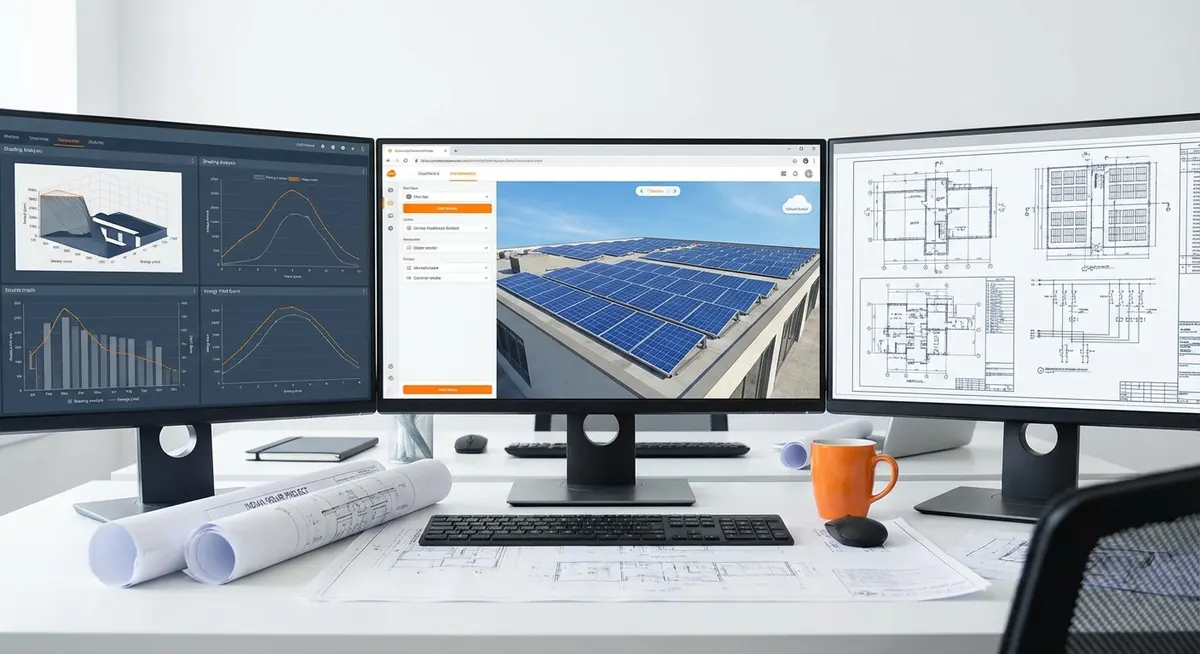
Regardless of which commercial structure the EPC and buyer agree on, the engineering deliverables are identical. A bankable PVsyst simulation, a compliant single-line diagram, a structural analysis, and a detailed BOQ are required whether the plant is sold as CAPEX, leased as OPEX, or financed as PPA. The bankable PVsyst reports guide covers the yield modeling requirements that underpin the tariff for OPEX/PPA and the IRR for CAPEX.
- Solar Rooftop Detailed Engineering Design — Full IFC-grade pack: GA layout, SLD, structural load calculations, BOQ, and mounting specifications. Delivered in the format required by the buyer’s lender or the developer’s project finance bank.
- Solar Ground Mount Design — For open-access and group captive PPA projects requiring utility-scale ground-mount layouts, tracker yield modeling, and civil and structural engineering.
- MW-Scale PMC — Owner’s engineer and PMC services for developers who need independent engineering oversight during RESCO or PPA project execution.
- Download a sample deliverable — See what a bankable PVsyst report and IFC-grade SLD look like before you commission the engineering work.
Contact us to discuss per-project engineering support for your next C&I pitch — CAPEX, OPEX, or PPA.
FAQ
What is the difference between OPEX and RESCO in Indian solar?
OPEX and RESCO are often used interchangeably in India, but RESCO (Renewable Energy Service Company) is the more precise term for a third-party developer that owns and operates a solar plant on a buyer’s premises and sells electricity at a contracted tariff. OPEX is a broader term that encompasses any model where the buyer pays for energy output rather than owning the equipment. Every on-site RESCO arrangement is an OPEX model — the buyer has zero capital outlay and pays only for units consumed, typically for 15–20 years.
Does an OPEX solar contract appear on the balance sheet under IND AS 116?
It depends on the contract structure. IND AS 116 requires a buyer to recognize a right-of-use asset and lease liability if the solar arrangement gives the buyer control of an identified asset for a period of time in exchange for consideration. On-site OPEX contracts — where the developer installs a dedicated plant on the buyer’s rooftop — typically meet the IND AS 116 lease definition, requiring balance sheet recognition even though the buyer paid nothing upfront. Off-site group captive PPA contracts generally do not trigger IND AS 116 because the buyer does not control an identified on-site asset. Always confirm with an IND AS-qualified auditor before marketing the arrangement as off-balance-sheet.
What is the typical payback period for a C&I CAPEX solar plant in India?
For a well-engineered C&I rooftop plant in Gujarat or Rajasthan with an HT commercial DISCOM tariff of ₹8–10/kWh, the simple payback period is typically 3.5–5.5 years. With the 40% first-year accelerated depreciation under the Income Tax Act, the effective payback for a profitable buyer can be 2.5–4 years. The per-MW solar engineering cost article has a detailed breakdown of the EPC cost components that drive this payback calculation.
Can an EPC offer all three models — CAPEX, OPEX, and PPA — to the same buyer?
Yes, and this is the most sophisticated approach for scaling a C&I solar business. EPCs that present a structured comparison of all three models — with honest IRR, risk transfer, and balance sheet numbers — win more mandates than those who pitch only one model. The prerequisite is that the EPC either has its own balance sheet to take RESCO risk, or has a financial partner (NBFC, infrastructure fund, or DFI subsidiary) who can take the RESCO position while the EPC acts as contractor and O&M provider.
What happens at the end of a PPA or OPEX contract term in India?
At the end of the contract term (typically 15–25 years), most contracts offer three options: contract renewal at a renegotiated tariff, transfer of asset ownership to the buyer at a pre-agreed residual value (often ₹1 symbolic or at depreciated book value), or decommissioning by the developer. The transfer option — sometimes called “lease-to-own” — is increasingly popular in India because it gives the buyer the operating benefit during the contract period without upfront capital, and the ownership benefit at the end. Always negotiate end-of-term options before signing, not at year 19.
How does solar PPA pricing compare to DISCOM tariffs in India in 2026?
As of Q1 2026, on-site RESCO/OPEX tariffs for C&I consumers in India range from ₹3.80–5.20/kWh depending on system size, state, developer margin, and interconnection complexity. Group captive PPA tariffs through SECI or state auctions range from ₹2.80–3.90/kWh. Both compare favorably to HT commercial DISCOM tariffs of ₹7.50–11.50/kWh in most Indian states. The savings delta — ₹3–7/kWh — is the economic engine that makes all three solar ownership models attractive, regardless of which model the buyer chooses.
What role does the EPC play in a RESCO or PPA project?
In RESCO and PPA projects, the EPC typically acts as the engineering, procurement, and construction contractor for the developer (the plant owner). The EPC receives a fixed lump-sum or per-MW contract from the developer, builds the plant, and may also take on a long-term O&M contract. The EPC does not take the revenue risk — that sits with the developer who collects tariff payments from the buyer. Some large EPCs have established RESCO subsidiaries to capture both the EPC margin and the long-term revenue stream, but this requires significant balance sheet capacity and careful financial structuring.