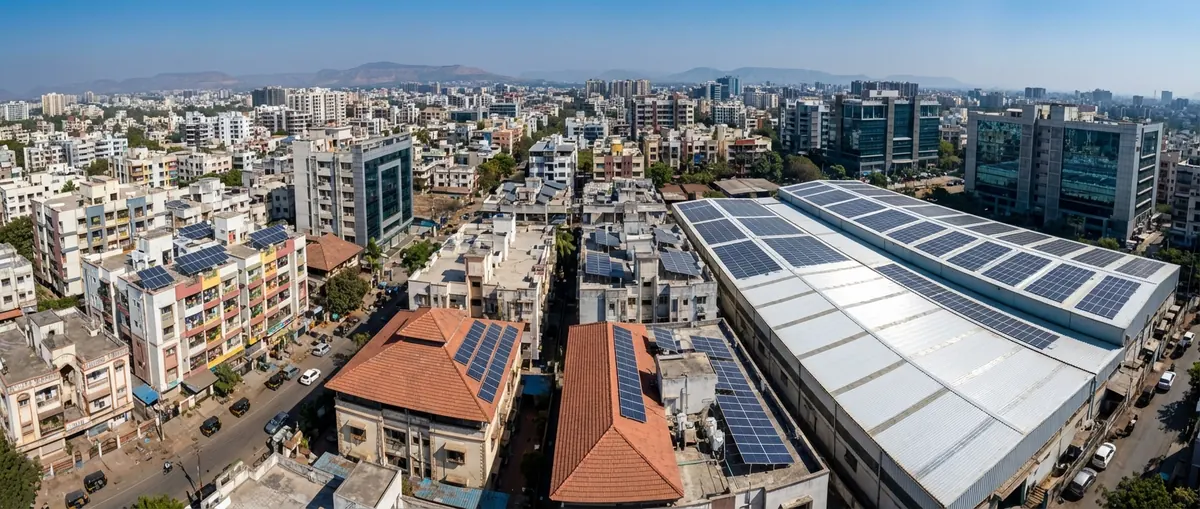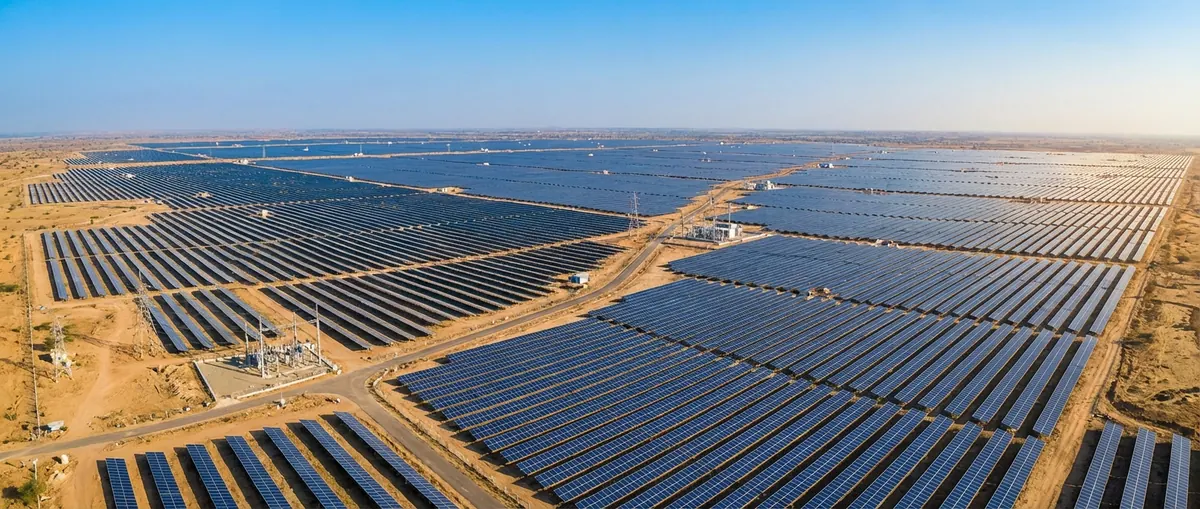
Your monthly electricity bill is not going down. The average industrial tariff in India crossed ₹8 per kWh in FY 2025, and commercial rates in states like Maharashtra and Tamil Nadu are edging toward ₹10-12. A rooftop solar power plant — sized correctly and engineered properly — can replace 70-90% of that grid draw at a landed cost of ₹3.5-4.5 per kWh, locked in for 25 years. That delta is the business case.
Direct answer. Installing a solar power plant delivers electricity at ₹3.5-4.5 per kWh over a 25-year asset life, compared to grid rates of ₹8-12 per kWh and rising. PM-Surya Ghar subsidies of up to ₹78,000 reduce residential payback to 3-5 years. Commercial and industrial projects without subsidy still pay back in 4-7 years through net metering, accelerated depreciation of 40%, and avoided tariff escalation. The decision is not whether solar is cheaper — it is whether your engineering is good enough to capture the full return.
This guide is written for Indian rooftop owners, C&I energy managers, and EPC founders who need more than a marketing pitch. It walks through the real financial mechanics, the government policy stack, the engineering factors that determine actual payback, and the mistakes that kill ROI before the plant is even commissioned.
The Financial Case: What the Numbers Actually Say
Solar economics rest on two variables that most brochures conflate: the cost of solar energy and the cost of grid energy you displace.
The installed cost of a rooftop solar system in India in 2025 ranges from ₹35-55 lakhs per MW (DC), depending on module technology, mounting type, and cable lengths. For a typical 100 kWp C&I rooftop plant, that is ₹35-50 lakhs all-in.
70-90%
Grid bill reduction
C&I rooftop, self-consumption model, India FY25
4-6 yrs
Typical payback period
C&I without subsidy, Mercom India 2025
25+ yrs
Module warranty life
Tier-1 module manufacturers, IEC 61215 tested
40%
Accelerated depreciation
Income Tax Act, C&I capex model, India
The lifetime savings calculation: a 100 kWp plant in a good-irradiance state like Rajasthan or Gujarat generates approximately 150,000-160,000 kWh per year. At ₹8 per kWh displaced, that is ₹12-13 lakhs annually. Over 25 years — applying a modest 3% annual grid tariff escalation — cumulative savings exceed ₹4 crores against a capex of ₹38-45 lakhs. The IRR of a well-designed plant is typically 16-22%.
The key phrase is “well-designed.” A plant with an undersized inverter, incorrect string sizing, or poor cable routing loses 10-15% of its potential generation from day one. That loss compounds over 25 years into crores of rupees. Engineering quality is not a cost — it is a multiplier on every rupee of return.
Government Policy: The Full Incentive Stack in 2025-26
India has the deepest incentive stack for solar in Asia. Understanding each layer — and which projects qualify — separates EPCs who win tenders from those who lose on compliance.
Definition. PM-Surya Ghar Muft Bijli Yojana is the MNRE scheme that provides capital subsidies of ₹30,000-78,000 per household for rooftop solar up to 3 kWp, plus interest-subsidized loans for systems up to 10 kWp. The scheme targets 10 million households by 2027.
| Incentive | Eligible Entity | Benefit | Applicable Scheme |
|---|---|---|---|
| PM-Surya Ghar capital subsidy | Residential (up to 10 kWp) | ₹30k-78k depending on size | MNRE 2024 notification |
| Accelerated depreciation 40% | C&I companies (tax-paying) | Reduces effective capex by ~15% | Income Tax Act Schedule XIV |
| GST concession on solar modules | All buyers | 12% GST vs standard 18% | GST Council 2022 |
| Priority sector lending | Farmers under PM-KUSUM | Subsidized loans at 5-6% | NABARD/RBI circular |
| Net metering credit | Grid-connected prosumers | Sell excess at DISCOM rate | CERC/SERC regulations |
| REC mechanism | Open-access generators | Tradeable certificates | CEA Connectivity Regulations 2019 |
The PM-Surya Ghar scheme is particularly important for small EPCs targeting the residential segment. Under the scheme structure, installers who register on the national portal gain access to a pipeline of subsidy-eligible customers. The subsidy flows directly to the customer through the DISCOM after commissioning, reducing the EPC’s collection risk.
For C&I projects, the accelerated depreciation benefit can cut the effective payback by 1-2 years for profitable companies. A ₹50 lakh plant with 40% depreciation in Year 1 generates an immediate ₹20 lakh deduction — worth ₹5-7 lakhs in tax savings at standard corporate rates.
According to MNRE’s solar schemes portal, India surpassed 100 GW of cumulative solar installed capacity in 2024, with rooftop solar contributing approximately 15 GW. The national target is 500 GW of renewable energy by 2030, of which solar accounts for 450 GW.
The Solar ROI Framework: Five Financial Levers
Most payback calculations use a single number: project cost divided by annual savings. That is wrong. The actual ROI depends on five interacting variables that every engineering decision touches.
System Yield (kWh/kWp)
The specific yield of your location determines how much energy each kilowatt-peak produces annually. Gujarat averages 1,600-1,700 kWh/kWp. Tamil Nadu averages 1,450-1,550 kWh/kWp. Delhi is closer to 1,400 kWh/kWp. A 10% higher-irradiance site cuts payback by nearly a year.
Displaced Tariff Rate
The higher your grid tariff, the better solar economics become. A factory paying ₹10 per kWh gets 2.5x the payback speed of a household paying ₹4 per kWh for the same plant. Industrial and commercial consumers get the strongest financial case.
Self-Consumption Ratio
Energy you consume directly is worth the full avoided-tariff rate. Energy you export via net metering earns only the DISCOM buyback rate, which is typically ₹2-4 per kWh. Systems designed for high self-consumption — matching load profiles to generation — earn 30-50% more effective return per unit generated.
System Losses
Soiling, cable losses, mismatch, inverter clipping, and shading are all avoidable losses that eat into yield. A well-engineered plant holds system losses below 18%. A poorly designed plant can waste 25-35% of potential generation — destroying 2-3 years of payback.
Financing Cost
A solar loan at 10% interest adds approximately ₹5-6 per kWh to the cost of solar energy on a 7-year loan. At ₹8 grid tariff, the economics still work. At ₹4-5 grid tariff, debt-financed solar loses its edge. Match the financing structure to the tariff environment.
Environmental and Energy Security Benefits
The financial case is compelling on its own. The environmental and supply-security arguments make it stronger.
India’s grid is still 60% coal-dependent. According to IEA’s India Energy Profile 2024, the average grid emission factor is approximately 0.72 kg CO2 per kWh. A 100 kWp plant in Gujarat generating 155,000 kWh annually avoids 111 tonnes of CO2 per year — equivalent to taking 24 passenger cars off the road.
Beyond carbon, solar addresses power quality. Industrial areas in India routinely experience voltage sags, frequency fluctuations, and load-shedding that damage equipment and interrupt production. A rooftop solar plant with a quality string inverter provides stable voltage during daylight hours, reducing reliance on captive diesel generators that cost ₹20-25 per kWh to run.
Field tip. If your facility runs diesel backup generators for 100-200 hours per year, that alone — at ₹20-25 per kWh diesel cost — justifies a significant battery or solar+storage investment independent of the grid bill calculation.
India’s 2047 energy independence target — Viksit Bharat — explicitly includes energy self-sufficiency as a pillar. The IRENA Renewable Power Generation Costs 2022 report confirms that utility-scale solar PV is now the cheapest source of new electricity generation globally at $0.049 per kWh — cheaper than coal, gas, and nuclear in all major markets.
Engineering Quality: The Variable Nobody Talks About
The difference between a solar plant that delivers 1,600 kWh/kWp annually and one that delivers 1,300 kWh/kWp is not the modules or the inverter brand. It is the engineering.
Three engineering factors dominate the variance:
Shading analysis accuracy. A shadow analysis done with a simplified 2D model versus a full 3D near-shading analysis in PVsyst can differ by 8-15% in predicted yield. The 3D model accounts for parapet walls, water tanks, satellite dishes, and adjacent buildings that a basic analysis misses. If the analysis is wrong, the string sizing is wrong, and so is every financial model built on it.
String sizing and inverter loading ratio. The inverter loading ratio — the ratio of DC array power to AC inverter rating — must be optimized for each site’s irradiance profile. Over-loading clips yield during peak hours. Under-loading wastes inverter capacity. The optimal ILR in high-irradiance sites like Rajasthan is often 1.25-1.35. Getting this wrong by 10% changes annual generation by 3-5%.
Cable sizing and routing. DC cable losses above 1.5% represent money destroyed in heat every day for 25 years. A voltage drop analysis must be performed for every string run, with cable cross-sections selected to hold losses within the design budget. Poorly routed cables also create shade on modules below, compounding the loss.
The only way to verify all three before construction is an energy yield assessment using validated simulation software with site-specific meteorological data. Every bankable plant — whether 10 kWp or 100 MW — needs this step.
Net Metering: Turning Your Roof Into a Revenue Stream
Net metering allows solar plant owners to feed surplus generation back into the grid and receive credit on their electricity bill. The mechanism exists in all major Indian states, though the rates and procedures differ significantly.
| State | Net Metering Policy | Export Rate | Applicable DISCOM |
|---|---|---|---|
| Gujarat | Available up to 1 MW | ₹2.25-2.75/kWh | DGVCL, MGVCL, PGVCL, UGVCL |
| Maharashtra | Available up to 1 MW | ₹3.00-3.50/kWh | MSEDCL, best |
| Tamil Nadu | Gross metering only | Feed-in tariff | TNEB |
| Rajasthan | Available up to 500 kWp | ₹3.14/kWh | JVVNL, AVVNL |
| Karnataka | Available, process online | ₹3.50-4.00/kWh | BESCOM, CESC |
The net metering process — application to commissioning — takes 30-90 days depending on DISCOM efficiency. EPCs who understand the local DISCOM process, documentation requirements, and single-line diagram formats for approval can significantly accelerate this timeline for their customers. Refer to DISCOM net metering process by state for a detailed state-by-state guide.
Watch out. Net metering applications that are rejected due to incorrect single-line diagrams or non-standard drawing formats cause 60-90 day delays. Every month of delay on a 100 kWp plant costs approximately ₹90,000-1,00,000 in lost generation value. Use DISCOM-approved drawing formats from day one.
Comparing Solar Options: What System Type Is Right for You
Not all solar installations are equal. The right configuration depends on your roof area, load profile, grid reliability, and whether you have battery storage.
GRID-TIED (MOST COMMON)
- Lowest cost, highest ROI
- Net metering credits for exports
- No backup during grid outages
- Payback: 4-6 years C&I, 3-5 years residential with subsidy
OFF-GRID (DIESEL REPLACEMENT)
- Higher capex with battery bank
- No net metering benefit
- Eliminates diesel at ₹20-25/kWh
- Payback: 5-8 years, diesel-cost dependent
| Parameter | Grid-Tied | Solar + BESS | Off-Grid |
|---|---|---|---|
| Installed cost per kWp | ₹38-50k | ₹70-120k | ₹90-150k |
| Backup during outage | None | Yes (battery duration) | Yes (battery bank) |
| Net metering | Yes | Yes | No |
| Best use case | Urban C&I, good grid | Power-quality sensitive loads | Remote sites, high diesel cost |
| Annual O&M | ₹0.5-1.0 lakh/100 kWp | ₹0.8-1.5 lakh/100 kWp | ₹1.0-2.0 lakh/100 kWp |
Maintenance Reality: What You Actually Need to Do
Solar has a reputation for being maintenance-free. That is directionally correct but technically incomplete. The real maintenance list is short — but ignoring it costs money.
Cleaning: Soiling loss in India ranges from 1-3% per month depending on location. A panel in a coastal city accumulates salt; a panel near a highway accumulates particulate matter. Monthly cleaning of a 100 kWp system takes 2-3 hours and costs ₹1,500-3,000 per visit. Skipping it for 6 months costs ₹30,000-50,000 in lost generation at ₹8 per kWh.
Annual inspection: Connections, cable insulation, inverter cooling filters, mounting torques, and string IV curve analysis should be done annually. A thermal imaging camera check (IR thermography) every 2-3 years catches hotspots and failing bypass diodes before they become module replacements.
Inverter servicing: String inverters have 10-year warranties typically. Capacitors degrade. Fan filters clog. A basic inverter service at years 5 and 10 costs ₹3,000-8,000 per inverter and extends life significantly.
The total O&M cost over 25 years is approximately ₹2-5 per kWh of generation — still far below the avoided grid tariff of ₹8-12.
Definition. Performance ratio (PR) is the ratio of actual plant generation to the theoretically possible generation at standard irradiance. A well-maintained plant maintains PR above 0.78. PR below 0.72 signals a maintenance or design problem worth investigating.
Structural and Electrical Design: The Foundation of a 25-Year Asset
A solar power plant is a structural installation first, an electrical system second. The mounting structure must withstand wind loads as defined by IS 875 Part 3, seismic loads in applicable zones, and the cumulative weight of modules, mounting rails, and snow (in northern states).
The electrical design must comply with CEA Connectivity Regulations 2019 for grid connection, and drawings must be approved by the Chief Electrical Inspector (CEIG) before commissioning in most states. The single-line diagram, earthing layout, and protection coordination study are not optional — they are prerequisites for DISCOM connection.
According to CEA’s Technical Standards for Connectivity, solar plants above 100 kWp must submit detailed electrical drawings, protection relay settings, and anti-islanding protection certificates to receive grid connection approval.
Structural failures in Indian rooftop installations — rare but catastrophic when they occur — almost always trace back to one of three causes: incorrect wind load calculation, mismatched clamp torque, or mounting to a roof slab not designed to carry the additional point loads. A structural engineer must review the slab design and confirm the imposed load capacity before any rooftop installation proceeds.
Field tip. Before signing a rooftop solar contract, always obtain the structural drawing of the building and confirm the allowable roof live load in kg/m2. Typical sheet-metal industrial roofs handle 15-25 kg/m2. Standard mounting structures add 12-18 kg/m2. This must be verified, not assumed.
Want to see a complete solar engineering package?
Download a sample IFC pack: GA drawing, single-line diagram, BOQ, and structural report — ready for DISCOM submission.
Get the sample pack →How Heaven Designs Helps You Capture the Full Solar ROI
The financial case for solar is settled. The variable is engineering quality — and that is exactly what EPCs struggle to deliver consistently at scale. Heaven Designs operates as the engineering bench that makes accurate, bankable, DISCOM-ready designs the default output, not the exception.
- Solar Rooftop Detailed Engineering Design — Complete IFC pack including GA drawing, SLD, structural calculations, earthing design, BOQ, and mounting schedule. Delivered in 3-5 business days. Reduces in-house design cost by 60% per project.
- Electrical CEIG Drawings — CEIG-approval-ready electrical drawings in state-specific formats. Cuts approval timelines by 30-45 days compared to self-prepared drawings.
- Solar 3D Pre-Design — Sales-stage 3D layout with shadow analysis and preliminary yield estimate in 48 hours. Quote the project the same week you survey the site.
- Site Survey and Land Feasibility — Irradiance assessment, soiling factor, structural pre-check, and grid proximity analysis before you commit to a project.
- Download a sample deliverable — See exactly what a Heaven Designs IFC pack looks like before you engage.
Every project is delivered through a dedicated designer on the Heaven Designs portal with WhatsApp responsiveness and a revision SLA. You bring the client — we deliver the engineering that wins the net metering connection and keeps the plant generating for 25 years.
FAQ
What is the payback period for a rooftop solar plant in India?
For commercial and industrial installations without subsidy, the payback period is typically 4-7 years depending on the local grid tariff, system size, and quality of design. Residential installations under the PM-Surya Ghar scheme with subsidies of up to ₹78,000 achieve payback in 3-5 years. The key variable is the avoided tariff rate — a factory paying ₹10 per kWh gets payback 40-50% faster than a household on ₹5 per kWh slab.
How much does a 100 kWp rooftop solar plant cost in India?
In 2025, a 100 kWp grid-tied rooftop system costs approximately ₹38-50 lakhs installed, depending on module technology (monocrystalline vs. TOPCon), inverter type, cable lengths, and civil/structural complexity. This translates to ₹38,000-50,000 per kWp. The cost has declined approximately 12% over the past two years due to falling module prices, primarily driven by Chinese oversupply.
Is solar power reliable if there is a grid power cut?
A standard grid-tied solar plant shuts down automatically during a grid outage as an anti-islanding protection requirement. This is mandated by the CEA Connectivity Regulations 2019. To maintain power during outages, you need a solar + battery energy storage system (BESS) or an off-grid configuration. Adding a battery adds ₹30,000-60,000 per kWh of storage capacity to the system cost.
What government subsidy is available for rooftop solar in India in 2025?
Under the PM-Surya Ghar Muft Bijli Yojana, residential consumers receive subsidies of ₹30,000 for 1 kWp, ₹60,000 for 2 kWp, and a flat ₹78,000 for systems of 3 kWp and above. The scheme also provides interest-subsidized loans at 7% for the balance investment. Commercial and industrial consumers do not receive capital subsidy but can claim 40% accelerated depreciation in Year 1 under the Income Tax Act.
How long do solar panels last, and do they need much maintenance?
Tier-1 solar modules carry a 25-year linear power output warranty guaranteeing at least 80% of rated power at the end of 25 years. Actual module lifespans often exceed 30 years. Annual maintenance requirements are minimal: monthly cleaning (2-3 hours per 100 kWp), annual electrical inspection, and inverter servicing at years 5 and 10. Total O&M cost is typically ₹2-5 per kWh generated over the plant lifetime — well below the avoided grid tariff.
What is the environmental impact of a solar installation?
A 100 kWp plant in India generates approximately 150,000-160,000 kWh annually and avoids approximately 108-115 tonnes of CO2 based on the grid emission factor of 0.72 kg CO2/kWh. Over 25 years, that is 2,700-2,875 tonnes of CO2 avoided per 100 kWp. The energy payback period — the time for a solar panel to generate the energy used to manufacture it — is 1.5-2.5 years for crystalline silicon modules, according to IRENA life-cycle analysis data.
Do I need DISCOM approval before installing solar?
Yes. For grid-tied systems, you must apply for net metering/gross metering permission from your DISCOM before or during installation. The application requires an approved single-line diagram, equipment specifications, and — for systems above 100 kWp — CEIG drawing approval in most states. Installing and energizing a grid-tied plant without DISCOM approval violates the CEA Connectivity Regulations 2019 and can result in disconnection.
What is the difference between kW and kWp for solar sizing?
kWp (kilowatt-peak) refers to the DC power output of the solar array under Standard Test Conditions (STC): 1,000 W/m2 irradiance, 25°C cell temperature. kW (AC) refers to the output of the inverter at rated conditions. Real-world generation is always below both figures due to temperature derating, soiling, cable losses, and inverter efficiency. A 100 kWp array connected to an 80 kW inverter (ILR of 1.25) is a typical configuration for high-irradiance Indian sites.