
The drawing revision is only half of an AHJ correction response. The reviewer also needs a reliable map from each original comment to the exact change. Without that map, a corrected set can still be hard to review.
An AHJ plan-check comment response letter provides that map. It records every comment, states the disposition, and points to the revised drawing, calculation, or attachment. This guide focuses on that document. For the wider revision sequence, use the solar permit redline and resubmission workflow.
Quick answer. Write an AHJ plan-check comment response letter as a numbered matrix. Copy each reviewer comment exactly. Then state the disposition, describe the change, cite its precise location, name any supporting file, and record its status. Reconcile the matrix against revision clouds, title blocks, calculations, and the final sheet index before resubmission.
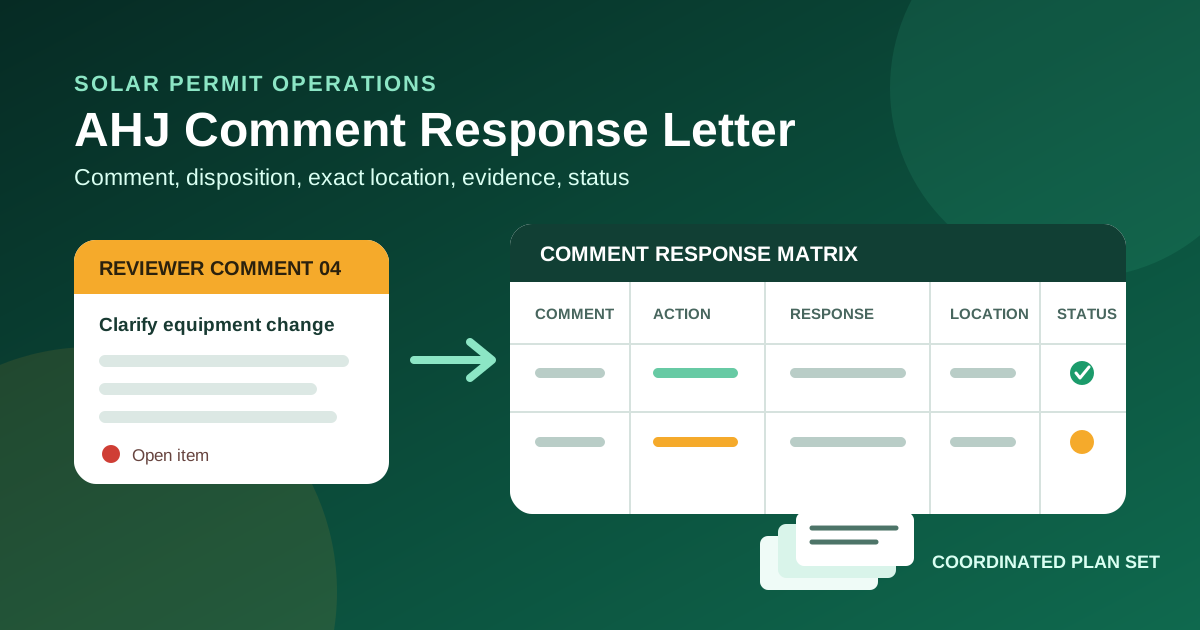
The method below is for US solar permit teams. The actual correction notice and portal instructions control every project. An authority having jurisdiction may require embedded replies, a separate letter, or both.
What an AHJ comment response letter actually does
An AHJ comment response letter turns a marked-up review into a testable list of dispositions. It tells the reviewer what changed and where to verify it. It also gives the project team one record of open items, technical decisions, and attachments.
The response letter is not the revised design. It does not replace the current plan set, signed calculations, equipment data, or portal upload. It connects those items to the original review comments.
A useful letter serves four readers at once:
- The plan reviewer can verify each answer without searching the full set.
- The permit coordinator can confirm that every department received a response.
- The design team can see which values or details changed across disciplines.
- The project manager can identify comments that still need a decision or professional review.
That final reader matters commercially. A hidden open item can hold a project while procurement, installation, and customer scheduling continue. A visible open status lets operations protect the schedule before resubmission.
The letter also creates an audit trail. Six months later, the team can see why a label, attachment pattern, or equipment note changed. That history can inform later work, but it is not a universal precedent. Another AHJ may enforce a different code edition, amendment, or submission format.
A common mistake is treating the response letter as a cover note. A cover note says that plans were revised. A working response matrix proves how every comment was handled.
When should the team build the response matrix?
Follow the controlling AHJ instructions for when responses may begin. If the notice or reviewer permits phased responses, use that process. Otherwise, wait for the current review cycle to close. A building comment, electrical comment, and fire comment may affect the same roof plan. Starting from an incomplete review can produce conflicting edits or repeated work.
Seattle is one jurisdiction-specific example. The Seattle Department of Construction and Inspections tells applicants to wait until all reviews are complete. The project must reach its corrections-required status before responses are uploaded. Seattle then requires consolidated responses across designers, architects, engineers, and owners.
Use this intake sequence:
- Download the complete correction report and every marked-up file.
- Confirm the review cycle number and issue date.
- List every reviewing department shown on the notice.
- Verify that each department has completed its review.
- Save the original files as read-only records.
- Assign a stable internal ID to each comment.
- Record any response deadline printed by the AHJ.
Do not renumber the reviewer comments to make the list prettier. Keep the original department and item number. If two departments both use comment 3, assign internal IDs such as ELEC-03 and FIRE-03. Retain the original number in a separate field.
If the correction report contains duplicate comments, keep both rows. One answer may reference the other, but the matrix should show that each reviewer item received a disposition.
Put the right identifiers in the response-letter header
The header should let a reviewer identify the project before reading the first response. Keep it factual and match the correction notice. A small mismatch in an address, record number, or cycle number can detach the letter from the submitted set.
Include these fields:
| Header field | What to enter | Control check |
|---|---|---|
| Project address | Exact address used in the permit record | Match cover sheet and portal |
| Permit or record number | AHJ identifier | Match the correction notice |
| Project name | Name used in the submitted set | Match title block |
| Review cycle | Cycle or round number | Match portal status |
| Correction date | Date on the AHJ report | Do not use the download date |
| Response date | Date of the current package | Match revision block |
| Applicant contact | Authorized permit contact | Match portal record |
| Design contact | Person coordinating the revisions | State role without implying licensure |
| Drawing revision | Current revision identifier | Match every revised sheet |
| Included files | Plan set, calculations, data sheets, letters | Reconcile before upload |
The file list is more useful than a long introduction. It tells the reviewer what belongs to the package and gives the coordinator a final upload check.
Use the same revision label across the response letter, drawing title blocks, calculations, and file names. If the AHJ prescribes its own naming convention, that convention wins.
Avoid promotional language. The reviewer needs a record, not a sales message. Use a one-sentence opening.
This response addresses plan-review comments dated 14 September 2026 for permit record PV-000123 and accompanies Revision 2 of the plan set.
The permit number above is hypothetical. Replace every sample identifier before use.
How to write an AHJ plan check comment response letter
The matrix is the core of the AHJ plan-check comment response letter. Each row should preserve the reviewer comment and create a traceable path to the submitted evidence. A useful row answers six questions without relying on memory.
| Field | Question it answers |
|---|---|
| Comment ID | Which exact reviewer item is this? |
| Reviewer comment | What did the AHJ ask, word for word? |
| Disposition | Was it revised, clarified, provided, justified without change, or left open? |
| Response | What action did the project team take? |
| Exact location | Where can the reviewer verify the action? |
| Evidence and status | Which file supports it, and is the item closed? |
Copy the reviewer wording exactly. Do not summarize a technical comment in a way that removes a condition or cited reference. Long comments can stay in the matrix or appear in an appendix, but the response must preserve the original item number.
The exact-location field needs more than a sheet number. Use a path such as Sheet E-2, Detail 4, note beside AC disconnect. For calculations, cite the calculation title and page. For an attachment, use the exact file name and relevant page.
This level of precision follows how building departments publish their own correction procedures. Jurisdictions such as Nevada County, California publish plan-review and resubmittal requirements directly, so confirm the current template and required response format with the department handling the project rather than assuming a standard form.
The matrix may live in a document, spreadsheet, or portal reply tool. The format matters less than traceability. The AHJ instructions decide whether the final response must be a separate PDF, embedded in marked plans, or entered into the portal.
Use five dispositions instead of vague status words
Five response dispositions cover most plan-check comments without hiding uncertainty. They describe the action, while a separate status field records whether the row is ready for submission.
Revised
Use Revised when a drawing, calculation, specification, or schedule changed.
Strong response:
Revised. Sheet E-2, Detail 4 now identifies the specified disconnect and its plan location. The equipment schedule on Sheet E-1 was updated to match.
Weak response:
Done. See plans.
The strong version names the changed content and a dependent sheet. The weak version forces the reviewer to search.
Clarified
Use Clarified when the design did not change, but the submitted information was hard to interpret.
Clarified. Sheet G-1, General Note 12 now states the design basis already used in Calculation Package C-1, page 6.
Do not use Clarified to disguise a design change. If a value, location, assembly, or calculation changed, mark the row Revised.
Provided
Use Provided when the comment asks for a missing document or existing evidence.
Provided. The inverter installation instructions are included as
ATT-04_Inverter-Instructions.pdf; the cited mounting condition appears on page 18.
Name the exact file. Attached is not enough when a package contains many documents.
No change, with basis
Use this disposition when the team believes no revision is needed. State the basis and ask for confirmation when the matter remains interpretive.
No drawing change proposed. The project team reads the cited requirement as applying to a different installation condition. See the attached adoption record and the note on Sheet G-1. Please confirm whether this resolves Comment ELEC-07.
Never turn the response into an argument. Identify the adopted edition, local amendment, listing, or project fact supporting the position. A code-based reply needs technical review before submission.
Open, with escalation owner
Use Open when the team cannot responsibly close the row. Name the decision and owner.
Open. The response depends on verified roof-framing dimensions. Site operations owns field verification. Structural review will resume after the signed survey note is received.
An open item should never appear in the final submission package by accident. The final quality check must return zero open rows, unless the AHJ has agreed to a deferred response.
Reference drawings, calculations, and attachments precisely
A response is only as useful as its reference path. The reviewer should reach the supporting evidence without guessing which note, page, or file contains it. Precision also helps the internal checker catch a correction made in only one location.
Use these reference formats:
| Evidence type | Strong reference | Weak reference |
|---|---|---|
| Drawing | Sheet E-2, Detail 4, revision cloud 3 | Electrical plans |
| Schedule | Sheet E-1, Equipment Schedule, inverter row | Schedule updated |
| Calculation | Structural Calculations, page 12, attachment check | See calculations |
| Data sheet | ATT-03_Module-Datasheet.pdf, page 2 | Cut sheet attached |
| Photograph | PHOTO-02_Attic-Framing.pdf, image 4 | Site photo |
| Portal record | Electrical Review, Comment ELEC-06 | Reviewer note |
Avoid page references that depend on a PDF viewer counter when the document has printed page numbers. Use the printed identifier first. If both differ, provide both.
When a comment affects a value appearing across the set, list every dependent location. Common shared values include module quantity, inverter model, service rating, conductor size, attachment spacing, roof-framing dimensions, and project address.
Create a dependency column during internal review, even if the client-facing letter omits it. A module-count change may touch the roof plan, single-line diagram, equipment schedule, string schedule, title block, and application form. Closing the comment after changing one sheet creates a new inconsistency.
The solar permit plan-set contents guide can help identify dependent documents. The permit-package checklist is useful during final assembly.
Use this hypothetical solar comment response matrix
The example below shows the required level of detail. It is a hypothetical training artifact, not a record from an actual project. The comments and identifiers must not be copied into a live submission without project review.
| ID | Reviewer comment | Disposition and response | Exact location | Evidence | Status |
|---|---|---|---|---|---|
| ELEC-01 | Identify the AC disconnect location on the plan and one-line diagram. | Revised. The AC disconnect is now identified on both drawings. The equipment schedule uses the same device tag. | E-1 Equipment Schedule; E-2 Detail 4; A-1 west elevation | Revised plan set R2 | Closed |
| ELEC-02 | Module count differs between roof plan and one-line diagram. | Revised. Both sheets now show the verified design quantity. The string schedule was recalculated from the same design record. | PV-1 array table; E-2 source-circuit block; E-3 string schedule | Design export dated 24 Sep 2026 | Closed |
| STR-01 | Provide the framing dimension used in the attachment calculation. | Provided and revised. The verified dimension is shown on the roof plan and used in the calculation input table. | S-1 Detail 2; Structural Calculations page 5 | PHOTO-02_Attic-Framing.pdf, image 4 | Closed after structural review |
| FIRE-01 | Clarify the access-path dimension beside Array B. | Clarified. A dimension and endpoint labels were added. The array geometry did not change. | PV-1, north side of Array B, cloud 4 | Revised plan set R2 | Closed |
| BLDG-03 | Explain why the requested detail is not shown. | No change proposed. The detail does not apply to the documented roof condition. The existing condition is identified on S-1. Please confirm this response closes the item. | S-1 Existing Conditions note 6 | Site survey page 3 | Awaiting reviewer confirmation |
Notice that each response begins with the disposition. The reviewer can scan the table before reading the supporting explanation.
The sample also separates Closed after structural review from a plain Closed. That distinction helps the permit coordinator confirm that the responsible reviewer completed the check. It does not imply that every project needs a professional seal.
Reconcile the matrix with revision clouds and sheet control
The response matrix and drawing revisions must describe the same package. Revision clouds make changes visible, while the matrix explains why each change exists. Neither one replaces the other.
Use a three-way reconciliation:
- Every
Revisedmatrix row points to at least one visible drawing or document change. - Every revision cloud or marked change maps back to a response row or a disclosed voluntary change.
- Every sheet listed in the response appears in the final sheet index and upload package.
Seattle tells applicants to cloud or circle changes. It also requires voluntary changes to be described in the response. This matters because a voluntary equipment swap can change the review scope even when the AHJ did not request it. Use the PE stamp revision after an equipment swap workflow to control that separate change before resubmittal.
The City of San Diego digital-format notice adds specific sheet-control rules. Its published process requires a complete plan set, visible treatment of deleted sheets, and new sheets at the end of the set. These are San Diego instructions, not a national standard.
Your internal reconciliation table can stay simple:
| Revision marker | Response row | Dependent documents | Checked by |
|---|---|---|---|
| R2-01 on E-2 | ELEC-01 | E-1 and A-1 | Electrical checker |
| R2-02 on PV-1 | ELEC-02 | E-2 and E-3 | Design lead |
| R2-03 on S-1 | STR-01 | Structural calculation pages 5 and 12 | Responsible reviewer |
If the AHJ prohibits clouds on clean sets, keep the marked comparison set separate. Follow its naming and upload rules. Do not assume that one city’s clean-set convention applies elsewhere.
When a comment targets the stamped sheets, it helps to know how to read a PE-stamped solar drawing before you draft the response.
Coordinate comments that cross disciplines
One reviewer comment can create work for several people. The response owner controls the row, but technical ownership should follow the affected document. This prevents a permit coordinator from accepting a change that belongs with an engineer or designer.
Use an ownership map:
| Comment impact | Primary owner | Required coordination |
|---|---|---|
| Address, file name, sheet index | Permit coordinator | All document owners |
| Layout, labels, equipment schedule | Solar designer | Electrical and structural owners |
| One-line diagram or electrical calculation | Electrical design owner | Equipment and application records |
| Roof framing or attachment calculation | Structural design owner | Site survey and layout owner |
| Equipment substitution | Project manager | Design, procurement, and any responsible professional |
| Portal or filing instruction | Authorized applicant | Permit coordinator |
Assign one person to assemble the final letter. That person should not silently rewrite technical answers. Technical owners approve their rows, while the assembler checks consistency, tone, and references.
Use a response freeze before upload. After the freeze, any new design change reopens the affected rows and dependency check. This avoids a late procurement change entering the plan set after the matrix was approved.
For teams handling many correction cycles, a lightweight register helps. Track project, AHJ, cycle, comment owner, current status, response date, and next action. The register should link to the actual response package, not duplicate every technical detail.
This operational layer is distinct from solar permit expediting. Expediting manages routing and status. The response matrix records the technical disposition.
Escalate comments without turning the letter into an argument
Escalate an unclear comment or a conflict between reviewer instructions. Escalation also fits a disputed rule or an out-of-scope request. The goal is a documented decision, not a win.
Use this sequence:
- Restate the comment and the point needing clarification.
- Verify the governing edition, amendment, listing, or project condition.
- Ask the responsible technical owner for a written position.
- Cite the exact supporting document.
- Ask the reviewer a narrow confirmation question.
- Record the answer in the project file.
A neutral response sounds like this:
No change proposed at this stage. The submitted design uses the edition identified on Sheet G-1. The attached adoption record supports that basis. Please confirm whether this resolves the comment or whether a local amendment should be applied.
Avoid statements such as The reviewer is wrong or This was accepted elsewhere. Prior acceptance in another jurisdiction does not establish the current AHJ’s rule.
If a comment affects a signed or sealed document, route it to the responsible licensed professional. Do not alter a calculation and present the prior signature as approval of the new content. The exact signature and seal rules depend on the project and jurisdiction.
Keep the row open until the escalation has an outcome. An email request is not a closed disposition. If the reviewer gives verbal direction, ask how it should be documented in the official record.
Assemble the final correction package around AHJ instructions
The response letter should make the package easier to review, but the correction notice controls the upload. Check required file types, naming, grouping, page orientation, and portal fields before assembly.
Seattle uses embedded responses in its consolidated report plan set and also asks for an updated clean plan set. San Diego publishes its own digital-format and sheet-order rules. San Bernardino County provides another separate set of response and file-grouping instructions.
Those differences support one rule: never turn your internal template into an AHJ assumption.
A typical internal package register includes:
- Response letter or embedded response set.
- Complete current plan set.
- Revised calculations.
- Requested product data or installation instructions.
- Site evidence tied to specific comments.
- Required professional review records.
- Correction notice retained for comparison.
- Upload receipt retained after submission.
The San Bernardino County sample plan-review template requires a written explanation of how each comment was resolved. It also asks applicants to reference notes and details with specificity. Its file-grouping and fee statements apply to that county’s process.
Use the AHJ permit-submission guide for the broader filing sequence. The response letter remains the comment-control layer inside that process.
Run a final response-letter quality check
The final check should compare the matrix, drawings, calculations, attachments, and portal package. Reading the letter alone will not catch a mismatched module quantity or missing revised sheet.
Run these checks in order:
- Completeness: every original comment appears once in the matrix.
- Disposition: every row begins with one of the five defined dispositions.
- Status: no unintended open item remains.
- Location: every response names a precise sheet, detail, page, or file.
- Dependency: shared values match across all affected documents.
- Revision control: clouds, markers, dates, and title blocks agree.
- Sheet control: the index matches the submitted set.
- Attachment control: every named file exists and opens.
- Professional review: changed signed or sealed work has the required review.
- AHJ format: file grouping and naming follow current instructions.
- Tone: responses are factual, neutral, and free of unsupported acceptance claims.
- Upload proof: the team saves the receipt and submitted file list.
Have a checker read each reviewer comment, then inspect the cited location without help from the author. If the checker cannot find the answer quickly, the reference path needs work.
The same checker should compare any revised equipment identifier across the plan set. Equipment changes often reach procurement before every drawing owner receives the update. A response matrix can expose that gap before the reviewer does.
Turn closed comments into a controlled reference library
A closed-comment library can reduce repeated research, but only when each entry keeps its context. Saving a sentence without its AHJ, date, adopted code, equipment, and project condition creates a risky template.
Store these fields:
| Library field | Why it matters |
|---|---|
| AHJ and department | Identifies the reviewing authority |
| Comment wording | Preserves the original issue |
| Response disposition | Shows how the team acted |
| Adopted basis | Records edition, amendment, or source |
| Project condition | Limits the answer to its facts |
| Accepted date | Shows when the outcome occurred |
| Final drawing location | Connects the answer to evidence |
| Reuse warning | Forces project-specific verification |
Treat the library as a research aid. Do not paste an old answer into a new project without verifying the current AHJ requirements and project facts.
The useful metric is not the number of saved responses. Track recurring comment categories and the template, intake, or quality-control defect behind them. Five repeated module-count comments may point to a broken data handoff. Fixing that handoff protects more margin than writing five faster letters.
This is where the response process connects back to prevention. The AHJ rejection-reasons guide organizes common failure modes. The response library shows which ones recur in your own workflow.
How Heaven Designs can support the drawing revision package
Heaven Designs provides solar permit design services for US projects. The team can prepare coordinated drawing revisions and permit documentation within an agreed design scope. Filing responsibility, professional-seal responsibility, and AHJ communication should be defined before work starts.
For an incoming correction cycle, send the complete AHJ report, marked plans, and current editable files. Include submitted calculations, equipment data, site evidence, and portal naming rules. Missing source files can turn a precise correction into a reconstruction task.
The handoff should also identify recent equipment or site changes. A correction response built against an outdated bill of materials can close the reviewer comment while creating a construction mismatch.
Heaven Designs does not claim that one response format will gain approval across every jurisdiction. The AHJ controls acceptance. A qualified project reviewer should verify code, seal, and local-process decisions.
If your team needs a coordinated drawing revision package, share the project scope and correction notice. Confirm filing, professional-seal, and review responsibilities before work starts.
FAQ
What is an AHJ plan-check comment response letter?
It is a numbered record that pairs each AHJ comment with a disposition, explanation, exact document location, supporting evidence, and status. It helps the reviewer verify corrections and helps the project team control open items.
Should I copy the reviewer comment into the response letter?
Yes. Preserve the exact wording and original item number. Summaries can remove conditions or cited references. If the comment is long, place the full text in an appendix and keep a stable reference in the matrix.
Is a revision cloud enough to answer a plan-check comment?
No. A cloud shows where a document changed. It does not explain the disposition, identify related files, or address a no-change position. Use the response matrix and the revision markers together.
What should I write instead of “see revised plans”?
State the disposition, describe the change, and cite its exact location. For example: Revised. Sheet E-2, Detail 4 now identifies the AC disconnect. Sheet E-1 was updated to match.
Can one response row cite several sheets?
Yes. List every affected location when one change appears across the roof plan, one-line diagram, schedule, calculation, or application. This makes the dependency visible and reduces conflicting revisions.
How should I answer a comment I believe does not apply?
Use a no-change disposition with the project-specific basis. Cite the adopted rule, amendment, listing, or documented condition. Ask a neutral confirmation question and keep the item open until the AHJ responds.
Does every revised solar plan need a new PE stamp?
Requirements depend on the changed document, responsible professional, licensing rules, and AHJ process. Route changes to signed or sealed work through the responsible licensed professional. Do not reuse a prior signature as approval of revised content.
Should the response letter include voluntary design changes?
Disclose them when the AHJ instructions require it or when they affect the reviewed package. Seattle specifically asks applicants to describe voluntary changes. Hidden changes can make the matrix and current plan set disagree.