A tender bill of quantities (BOQ) prices a defined bid scope with the information available at bid time. An execution BOQ turns the awarded design into quantities that procurement, construction and change control can use. The two should be related, but they should not be expected to match line for line after surveys, equipment selection and authority comments. The commercial problem is not every change in quantity. It is an unrecorded change whose cost, contract treatment or owner remains unclear until the site team needs material.
For an Indian solar EPC, the useful question is: which quantities were measured, which were assumed, and which became different after the design basis was fixed? A controlled reconciliation answers that question. It compares the tender register with the latest approved drawing revision and records the reason for each delta. It does not erase bid assumptions or silently overwrite them with the new number.
This guide shows how to organise that comparison across modules, structures, cables, switchgear, civil works and installation allowances. It uses an explicitly illustrative cable example to show the arithmetic. Your contract, tender schedule, client instructions and approved drawings govern the real commercial outcome. The SECI tender document for a 44 MW AC project is one official example of a schedule-of-rates format in which the scope and specifications matter beyond the visible line-item description; it is not a template for every EPC contract.
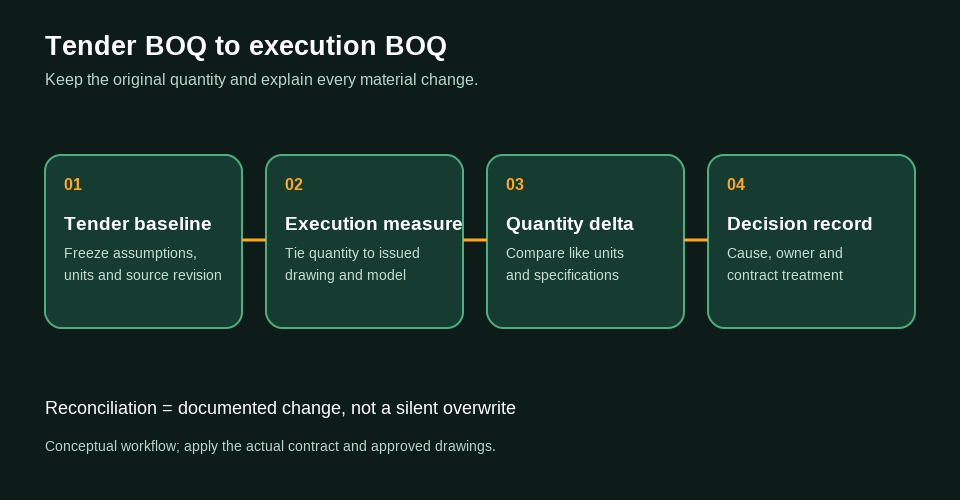
Conceptual workflow. It is not a project measurement or a contract interpretation.
What each BOQ is supposed to control
The tender BOQ supports a bid decision. It should let an estimator price the expected scope and identify assumptions that have not been engineered to construction detail. Some quantities may come from a preliminary PV layout, single-line diagram or route estimate. Others may be allowances because a soil report, final equipment model, cable route or DISCOM condition is not yet available. A good tender BOQ keeps those categories visible.
The execution BOQ supports purchasing and construction. Its quantities should refer to an issued drawing, selected equipment, survey and measurement rule. The buyer needs to know whether a line is a purchase quantity, installed quantity, spare, waste allowance or provisional item. For a cable, “route length” is not automatically the amount to buy: vertical drops, terminations, slack, routing changes and packaging may matter. Those additions should be stated rather than hidden in a round number.
The contract BOQ may be a third document. It can preserve the employer’s schedule and payment units even when the EPC’s internal execution register is more detailed. Do not rename a contract line just because an engineer wants a different procurement split. Maintain a mapping between the tender/contract item and the execution item so the commercial team can assess whether a quantity change is payable, absorbed or subject to approval. That contract interpretation belongs to the agreed terms, not to a generic article.
| Document | Primary decision | Quantity basis | What should remain visible |
|---|---|---|---|
| Tender BOQ | Can the EPC price and bid the scope? | Preliminary drawings, specifications and explicit allowances | Assumptions, exclusions, measurement method, source revision |
| Contract BOQ | What was agreed for payment and variation? | Awarded schedule and contract documents | Original item number, unit, rate basis and change clause |
| Execution BOQ | What must be bought and built? | Coordinated issued design, survey and approved selections | Drawing reference, measured quantity, spare/waste treatment, approval status |
| Reconciliation register | Why did the quantity change? | Tender baseline versus current approved design | Delta, cause, owner, contract treatment and decision date |
The same item can appear in all four views. They should connect by stable IDs. Replacing the tender workbook with a new execution workbook destroys the evidence needed to explain a later difference.
Why the quantities change after award
Some change is unavoidable because more information arrives. A tender roof layout may be based on a plan, while the execution layout uses a measured survey and checks obstacles, access, structure and equipment dimensions. A ground-mount design may change once topography, soil and drainage information is available. A preliminary electrical route may move when the transformer, AC board or trench path is agreed. These are different causes and should be classified rather than combined under “design development.”
Equipment selection can move more than the obvious line item. Changing a module affects count, geometry, string design and possibly mounting hardware. Changing an inverter may alter AC feeder count, cable size, protection and board layout. A different mounting system changes fasteners, rails, steel, ballast or foundations. The execution BOQ should be recalculated from the approved design, while the reconciliation register records the ripple across trades.
Authority and client comments can also change scope. A revised point of connection may increase cable length and alter metering or protection equipment. A changed access requirement can reduce module count or move a route. The EPC should keep the instruction or approval that caused the change alongside the quantity delta. Without that record, a legitimate variation can look like an estimating error, or an estimating omission can be mislabelled as a client change.
Tender instructions sometimes define an inclusive price for work that is not individually itemised. The SECI example above says activities required by specifications or scope can be deemed included even if they are not separately described in the schedule. That provision is specific to that tender. For any new bid, read the actual price schedule, technical specifications, general and special conditions together before assuming that an unlisted item can be charged later.
The line items most likely to hide a delta
PV modules and structures. Module quantity is easy to count, which can make it falsely reassuring. Check whether the tender DC capacity was an exact target or a preliminary size, whether the chosen module rating changed, and whether access clearances or roof exclusions altered the array. Structure quantities require their own measurement basis: rail length, table count, supports, anchors, steel mass or ballast are not interchangeable units. The final fixing design should follow site and structural inputs, not a quantity copied from a previous roof.
DC and AC cables. A simple plan-view line usually understates installed cable length. The route must account for vertical changes, equipment entry, termination, tray or conduit path and site constraints. Cable type, core count and conductor size also matter. If a cable changes size, do not treat the difference as a length-only variance. Review the route and selected equipment against the issued SLD and cable schedule. The existing solar BOQ cable mis-costing guide focuses on that narrower cost leak; this article covers the full tender-to-execution reconciliation.
Switchgear and protection. A tender SLD may show an AC distribution board and breaker without a completed equipment schedule. Execution may require named ratings, protective functions, CTs, meters, enclosures, panel modifications or a transformer interface. The quantity can stay at “one panel” while its cost and scope change materially. Record specification changes, not only counts.
Civil and site works. Trench lengths, road crossings, foundations, cable pits, drainage and reinstatement should refer to a surveyed route and approved construction method. A tender allowance can be reasonable if labelled. It becomes a risk when the bid assumes the simplest route and the execution team discovers a buried obstruction or an access restriction without a contingency or variation path.
Testing, documentation and O&M. These are often spread across different schedule sections. The EPC needs to know whether testing equipment, commissioning records, as-built drawings, spares and maintenance scope are separately measured, included in a package rate or excluded. The 2026 SECI 88 MW balance-of-system tender page illustrates a turnkey scope that includes design, procurement, civil work, permits, installation, testing and five years of O&M. That is an example of breadth, not a price or obligation to copy into a smaller rooftop contract.
A worked reconciliation example without invented prices
Consider a hypothetical AC feeder in a commercial rooftop project. At tender stage, the estimator records 800 m from an early route sketch. After award, a measured route and selected switchboard position yield 920 m of installed cable before any separate spare allowance. The direct length delta is 920 m − 800 m = 120 m. The relative difference against the tender baseline is 120 ÷ 800 = 15%.
That calculation does not tell us the margin effect. To do that, the EPC needs the exact cable specification, purchased length, agreed unit cost, any installation-rate consequence, and the contract treatment. The estimate may have included an allowance or a lump-sum rate; the execution quantity might include a route revision instructed by the client. The formula for a simple material exposure is quantity delta × approved unit cost, but the commercial result can differ if the contract allows a variation or the selected cable changed.
| Field | Tender baseline | Execution measurement | Reconciliation note |
|---|---|---|---|
| AC feeder route | 800 m | 920 m | Hypothetical example only |
| Quantity delta | +120 m | 920 − 800 | |
| Relative delta | +15% | 120 ÷ 800 | |
| Cable specification | Tender assumption | Selected model and size | Verify like-for-like before multiplying by a rate |
| Cause | Early route sketch | Board moved after detailed survey | Attach the survey and drawing revision |
| Commercial treatment | Unknown from these inputs | Contract review needed | Do not label as claim or loss automatically |
If the feeder is now a different conductor size, split the difference into two records: length change and specification change. If the original quantity had an explicit allowance, show that allowance as a separate line. A reconciliation works only when both sides use the same unit and scope.
Build a tender BOQ that can survive execution
Start with a controlled design basis. Record the tender drawings, capacities, equipment assumptions, site survey status, connection concept and issue date. Give each BOQ line a source field: drawing number, equipment schedule, calculation, vendor quote, or allowance. This is easier to maintain than a free-text note at the bottom of a workbook.
Separate measured quantity from allowance. If a route is measured at 800 m and the estimator adds a project-specific purchasing allowance, show both. If only a high-level route is available, mark the whole quantity provisional and state what will replace it. Do not combine a measured value and an undisclosed contingency in one cell, because the execution team cannot later tell whether the changed route exceeded the estimate or merely consumed its allowance.
Use consistent units. Modules are pieces, cable may be route metres or conductor metres, steel may be kilograms or tonnes, and civil work may be cubic metres or itemised assemblies. Add a measurement-rule column for ambiguous items. A “set” can hide a collection of equipment whose contents must be listed. The tender schedule may prescribe a different unit; map the internal estimate to that schedule explicitly.
Run a cross-document check before bid submission. Module count and DC capacity should agree with the layout and yield model. Inverter quantity and AC capacity should agree with the SLD and equipment schedule. Cable estimates should refer to a route and conductor schedule. Structure quantities should reflect the chosen mounting concept. The MNRE residential rooftop technical specification lists system categories such as modules, inverter, mounting, boxes, protection, cables and drawings; it is useful as a broad completeness reminder for that residential programme, not as a C&I BOQ or universal tender requirement.
Before finalising price, ask a second question for each provisional line: “What would make this quantity or specification move?” Typical answers are survey, authority condition, equipment selection, roof structural review, route obstruction or client change. Those triggers become the early warning list for execution. If the tender contract treats an unlisted activity as included, price the risk accordingly or seek clarification before bid close.
Keep the execution BOQ and commercial record aligned
After award, freeze a tender baseline copy. Then create the execution register from the latest coordinated drawings. Preserve the original item ID and add an execution item ID if the procurement breakdown is more detailed. Record every quantity change with its cause, approval status and document evidence. A useful cause list distinguishes survey correction, design development, client instruction, utility or authority condition, equipment substitution, site discovery and estimating error.
Do not make the engineering team decide contract entitlement in a quantity cell. Engineers can show what changed and why. The commercial owner then reads the contract to decide whether a variation, allowance, contingency or internal cost absorbs the difference. Keep the decision and its date beside the delta. That prevents the same item from being argued again when procurement or billing changes hands.
Reconcile at milestones, not only at project close. A practical sequence is after survey, after equipment freeze, after authority comments, before major purchase orders and at as-built closeout. Reconciliation before procurement can still influence a route or equipment choice. Reconciliation after the cable has been installed may only document an avoidable surprise.
The execution register should carry an issue status. “For approval” quantities should not be mixed with “for purchase” quantities unless the buyer can see the distinction. When a drawing changes after a purchase order, record what material is already committed. The difference between design quantity and purchase quantity may be an unavoidable order rounding or spare, rather than a design error. Keep those categories separate.
A pre-issue checklist for the EPC estimator
- Save a dated, read-only tender baseline with the bid drawings and assumptions.
- Match each major BOQ line to a source drawing, model, calculation or labelled allowance.
- Compare like units and like scopes before calculating a percentage variance.
- Split quantity changes from specification and rate changes.
- Record the cause and document that changed each line.
- Identify who decides contract treatment and whether notice is required.
- Flag unresolved site and authority inputs before procurement uses the number.
- Reconcile the final approved drawing set against ordered and installed quantities.
Heaven Designs lists BOQs and related engineering drawings among its deliverables. For a project that needs an engineering package, review the rooftop detailed engineering service or send the tender and drawing register through the contact form. A scoped response should identify the basis, outputs, price and delivery date. The goal is a traceable quantity record that the estimator, buyer and site engineer can all use.