Washington Solar PE Stamp Requirements
When a professional engineer seal is required on Washington solar projects, which seal, and what it is actually attesting to. Send us a project and we confirm the requirement before you commit.
The short answer for Washington
Seismic design is a real consideration across western Washington rather than a nominal check, given Cascadia and Seattle Fault exposure, and it affects attachment and structural detailing. Snow loading in the Cascades and eastern Washington adds a second governing case. Thresholds are set through local enforcement of the state code.
WASHINGTON SIGN-OFF
Engineering sign-off in Washington
Washington engineering documentation has to take seismic seriously across the west, where Cascadia subduction zone and Seattle Fault exposure make it a real design case rather than a nominal category. Add Cascade and eastern Washington snow loading and the state carries two governing structural cases depending on where the project sits.
We confirm the sign-off requirement for your specific project and Washington authority at scoping, so there is no ambiguity at submittal and no surprise cost after the customer has signed.
TWO DIFFERENT SEALS
Structural and electrical are not the same stamp
They are triggered at different thresholds and belong on different sheets. Stamping the whole set indiscriminately adds professional exposure without adding compliance value.
| Seal | What it attests to | Typically triggered by |
|---|---|---|
| Structural seal | Mounting system, roof load capacity, attachment and uplift, snow and seismic performance, foundation design on ground mount | System size thresholds, non-standard roof framing, and in Washington the loading conditions described below |
| Electrical seal | Circuit design, conductor sizing and derating, overcurrent protection, grounding, rapid shutdown and NEC compliance | Larger commercial systems, service upgrades, and jurisdictions that require electrical review independently of structural |
WHEN A SEAL IS NEEDED
Five situations that pull engineering into a Washington project
System size crosses a local threshold
Thresholds in Washington are set locally rather than statewide, so the same system can need a seal filed with Seattle Department of Construction and Inspections and not with Cascade and eastern county departments. We check the specific authority rather than applying a state rule of thumb.
The roof framing is not standard
Trusses at unusual spacing, long spans, existing damage, prior modification, or a roof assembly the racking manufacturer has not tested. Manufacturer span tables stop being valid and a real calculation is required.
The loading case is severe
In Washington, persistent wet conditions west of the Cascades affect flashing and corrosion detail, while eastern Washington is dry with a much wider temperature range. Where the governing case is severe, plan examiners expect calculations rather than a table reference.
Commercial, ground mount or carport
Ground mount brings foundation design and geotechnical assumptions into scope. Carports add vehicle impact and clearance. Both effectively always need engineering input regardless of local thresholds.
A service upgrade or unusual interconnection
Supply-side connections, busbar calculations near the limit, and non-standard interconnection methods draw electrical engineering scrutiny even on modest system sizes.
WHERE IT VARIES
Thresholds differ across Washington
There is no single Washington answer to whether a project needs a seal, because the requirement is set by the reviewing authority. These are the Washington authorities we file with most and what shapes their expectations.
| Authority | Covers | What to know |
|---|---|---|
| Seattle Department of Construction and Inspections | City of Seattle | Seismic provisions applied seriously given Seattle Fault and Cascadia exposure, and a large stock of older timber housing. |
| King County Department of Local Services | Unincorporated King County | Separate from Seattle and from the suburban cities, so metro work spans several authorities. |
| City of Spokane Development Services | Spokane | Eastern Washington conditions with genuine snow loading and colder design temperatures than the coast. |
| City of Tacoma Planning and Development Services | Tacoma | Municipal utility coordination alongside building review, so permit and interconnection sit locally. |
| Cascade and eastern county departments | Chelan, Kittitas and neighbouring counties | High snow loads at elevation and a different climate regime from the Puget Sound lowlands. |
What applies in Washington beyond the base code
- Washington State Building Code with state amendments, plus the Washington State Energy Code
- State amendments to the electrical code administered through Labor and Industries
- Statewide net metering law applying up to a defined system size
- Seismic provisions reflecting Cascadia subduction zone and Seattle Fault exposure
What a Washington seal is attesting to
A seal is not a formality. On Washington work it is a professional statement about performance under these specific conditions.
Wind
Moderate in the Puget Sound lowlands, higher on the Pacific coast and through the Columbia Gorge
Snow
Light in the lowlands but high in the Cascades and meaningful across eastern Washington
Seismic
Significant, reflecting both Cascadia subduction zone and Seattle Fault exposure
Also governing
Persistent wet conditions west of the Cascades affect flashing and corrosion detail, while eastern Washington is dry with a much wider temperature range
HOW WE VERIFY
Calculated, not looked up
Racking manufacturer span tables are useful, and they stop being valid the moment the roof is not the roof the table assumed. Unusual spans, modified framing, heavy loading cases, and non-standard assemblies all need a real calculation.
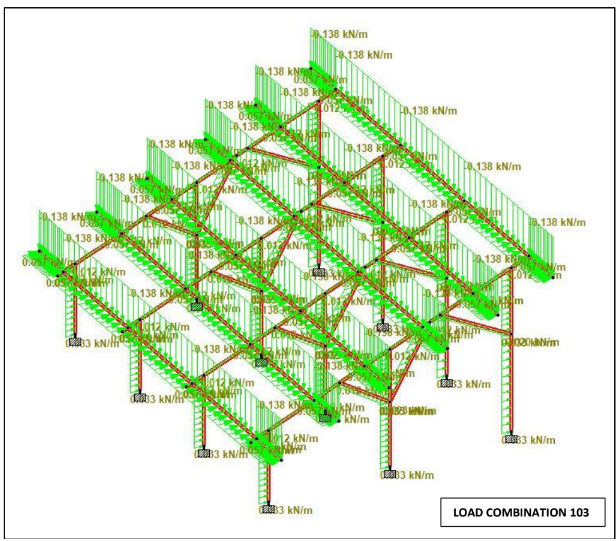
We verify structural cases in STAAD Pro and document the load combinations, so what reaches the plan examiner is analysis rather than an assertion.
About Our STAAD Pro Reports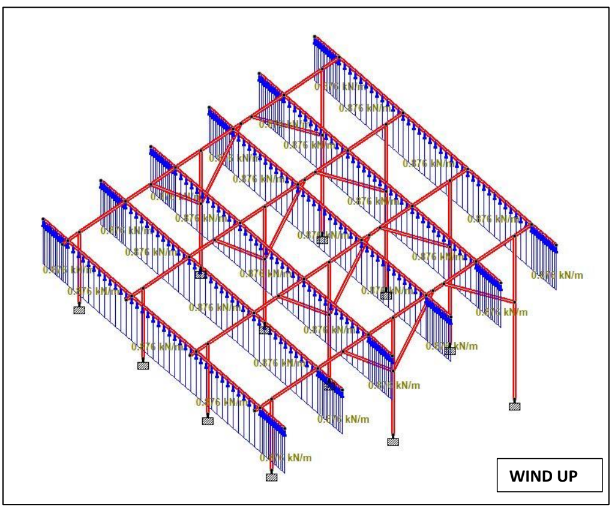
WHAT YOU RECEIVE
Documentation that stands up to review
A seal without supporting analysis is an invitation for a plan examiner to ask for the analysis. On Washington projects the package includes the calculations behind the conclusion, not just the conclusion.
- Load calculations for the governing Washington case, with the load combinations shown rather than summarised
- Attachment and uplift capacity against the actual roof assembly, not a generic assembly
- Member and connection checks where the mounting structure is non-standard
- Foundation design and bearing assumptions on ground mount and carport work
- Electrical calculations covering corrected ampacity, voltage drop and protection coordination
- A clear statement of scope, so the plan examiner can see what the seal does and does not cover
Why installers get this wrong
Assuming a national threshold
Stamping thresholds are set locally rather than nationally, and often locally rather than at state level. A rule of thumb carried from another market is how a project discovers at plan check that it needed a seal.
Leaving it until after the sale
Engineering cost discovered after the customer has signed comes out of margin. Confirming the requirement at scoping means it is priced into the job rather than absorbed.
Treating the seal as paperwork
In Washington the governing case is real: moderate in the puget sound lowlands, higher on the pacific coast and through the columbia gorge. An engineer sealing that is making a professional statement about performance, which is why the calculations matter more than the signature.
Stamping every sheet
Over-stamping creates exposure without compliance value. Structural seal belongs on structural sheets, electrical on electrical.
Not sure whether your project needs a seal?
Send the system size, roof type and jurisdiction. We tell you what Washington requires before you quote the customer, at no cost.
Ask Us FirstGET STARTED
Confirm Washington Engineering Requirements
Tell us the system size, roof type and jurisdiction. We confirm which seals your Washington project needs, what they cover, and the timeline, before you commit anything.
- We reply within 1 business day
- Plan check comments handled with you
- No obligation, no retainer to start
“Heaven Designs has been an exceptional partner for our EPC projects. Their turnaround time and design accuracy are unmatched. We have completed multiple projects with zero design rework. Highly recommended for any solar EPC company looking for reliable design support.”
Prefer to talk first?
FAQ
Washington PE Stamp FAQs
Does Washington require a PE stamp on residential solar?
Can an engineer licensed in another state seal a Washington project?
What is the difference between a structural and an electrical PE stamp?
Should the stamp cover every sheet in the set?
What structural loads does a Washington stamp actually address?
How quickly can engineering sign-off be arranged?
Which Washington requirements sit on top of the base code?
How does the Washington market affect engineering scope?
Do you provide engineering for commercial and ground mount work in Washington?
Why does the utility matter so much in Washington?
Does seismic design really affect rooftop solar in Seattle?
Ready for constructible design packages?
Solar engineering for EPCs. MEP design and BIM for AEC teams. Reply within 1 business day.