Solar Permit Design in West Virginia
Permit plan sets built for West Virginia authorities and utilities, not a national template with the state name changed. Turnaround agreed at scoping.
WEST VIRGINIA PERMIT DESIGN
What makes West Virginia different
West Virginia has a constraint most states do not: terrain. Steep slopes and a housing stock built into hillsides limit usable roof orientation and complicate access across much of the state, which shapes feasibility before any code question arises. Mountain counties also carry genuinely elevated ridge wind exposure alongside substantial snow loading, so the structural case varies considerably across a small geography.
DESIGN DRIVERS
4 things that govern a West Virginia plan set
These are the reasons a set drawn to a generic national template comes back from a West Virginia plan examiner.
Terrain is a real constraint. Steep slopes and hillside construction limit usable roof orientation more than code does across much of the state.
Legislative change permitting power purchase agreements opened the institutional segment, which is now the most active project type.
Net metering carries an aggregate programme cap expressed as a share of utility peak load, so availability is not unlimited.
Mountain county ridge exposure raises wind design considerably above valley values within a small geography.
CODE BASIS
The code framework in West Virginia
West Virginia adopts a state building code with local enforcement, and the State Fire Marshal handles review in some commercial contexts. Net metering exists with an aggregate programme cap. The bigger practical constraint is terrain: steep slopes and a housing stock built into hillsides limit usable roof orientation more than the code does.
We confirm the currently adopted cycle for your specific West Virginia authority at scoping, because adoption is staggered and changes.
What applies on top of the NEC here
- State building code with local enforcement and State Fire Marshal involvement in some commercial review
- Net metering with an aggregate programme cap expressed as a share of utility peak load
- Power purchase agreements permitted following legislative change, which opened institutional projects
- Ridge and mountain exposure provisions affecting wind design
AUTHORITIES
West Virginia authorities we submit to
Each authority has its own submittal route and its own recurring plan check comments. Knowing which one you are filing with changes the drawings.
| Authority | Covers | What to know |
|---|---|---|
| City of Charleston | Charleston | Capital and largest city, with hillside terrain limiting roof orientation on a substantial share of the housing stock. |
| City of Huntington | Huntington | Ohio river valley location with an established review process. |
| City of Morgantown | Morgantown | University town with higher adoption than the state average and substantial institutional building stock. |
| West Virginia State Fire Marshal | Commercial review in some contexts statewide | Commercial projects may route through State Fire Marshal review in addition to local permitting. |
| County departments | Rural West Virginia | Limited permitting capacity in many counties, so the utility interconnection review becomes the effective gate. |
INTERCONNECTION
West Virginia utilities and export rules
Export compensation decides how the system should be sized and whether storage belongs in the design. It also decides what the interconnection drawings must show.
| Utility | Territory | Export and compensation |
|---|---|---|
| Appalachian Power | Southern and central West Virginia, part of AEP | Net metering within the aggregate programme cap, with its own application process |
| Mon Power | Northern West Virginia, part of FirstEnergy | Net metering with separate FirstEnergy application handling |
| Potomac Edison | The eastern panhandle | Net metering, also FirstEnergy, with terms shared across its multi-state territory |
| Wheeling Power | The northern panhandle | Net metering as part of the AEP system |
STRUCTURAL
Loading conditions in West Virginia
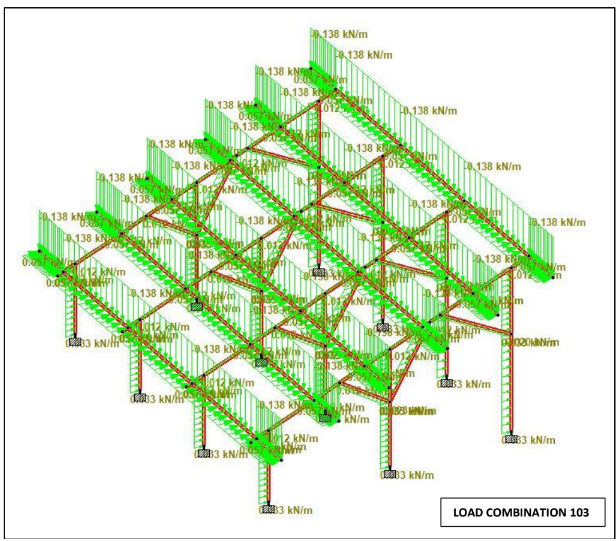
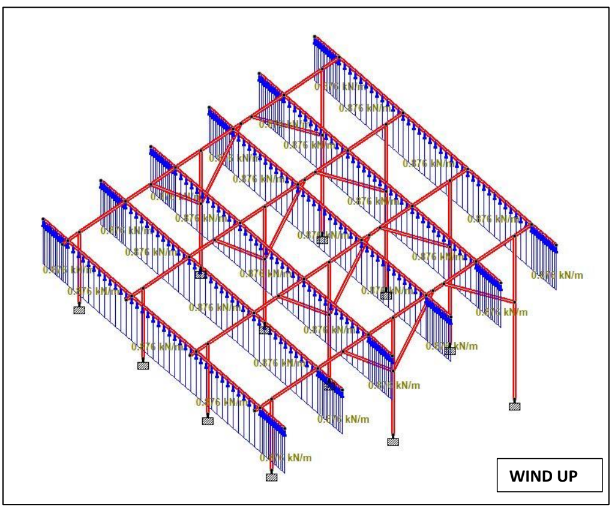
Verified in STAAD Pro where the structure is non standard, rather than read off a racking manufacturer table.
Wind
Moderate in the valleys, with genuinely elevated ridge exposure in the mountain counties
Snow
Substantial, roughly 30 to 40 psf in the mountains and lighter in the western valleys
Seismic
Low across West Virginia
Also governing
Steep terrain limits usable roof orientation and complicates access, and freeze-thaw cycling affects flashing detail
DELIVERABLES
What is in a West Virginia permit plan set
Cover sheet and site plan
Parcel, setbacks and equipment locations to the format the West Virginia authority expects.
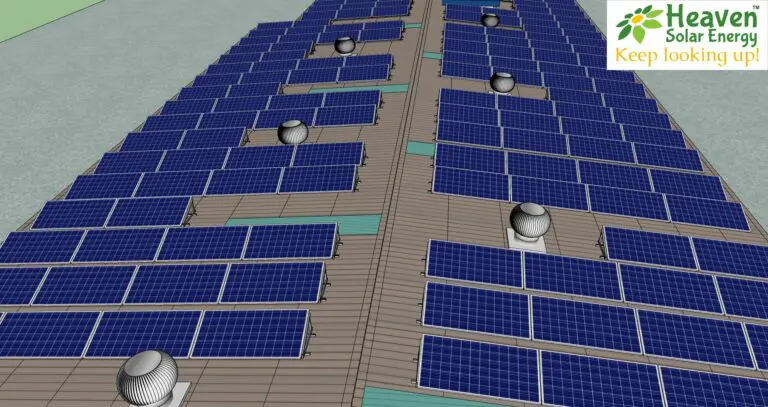
Roof plan and module layout
Layout resolved against fire setbacks and access pathways before module count is fixed.
Attachment detail
Racking, flashing and penetration detail matched to the actual roof assembly.
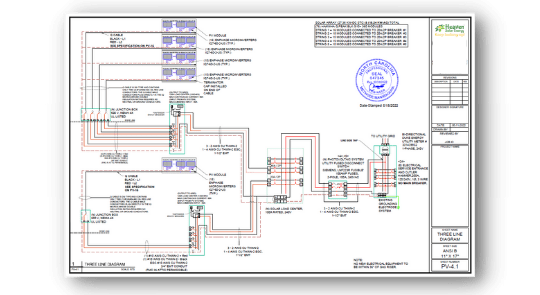
Single line and three line diagrams
Conductor sizing, overcurrent protection, grounding and rapid shutdown per NEC 690.
String layout and bill of material
String sizing checked against inverter operating windows, with a complete BOM.
Equipment specs and calculations
Voltage drop, corrected ampacity and equipment data sheets.
Signage and labelling plan
Placards and labelling to the adopted cycle and any local amendment.
Structural notes and calculations
Wind, snow and seismic notes appropriate to West Virginia loading.
Engineering sign-off in West Virginia
Engineering thresholds are set locally, with State Fire Marshal review applying to some commercial work. Mountain county ridge exposure raises wind design considerably above valley values, and snow loading in the mountains is substantial, so the structural case varies more within the state than the modest market size suggests.
SAMPLE DELIVERABLES
What the drawings look like
Pages from real sets. Judge the output before you send a project.
MARKET CONTEXT
The West Virginia solar market
West Virginia has very low installed capacity, held back by low retail electricity rates in a coal-dominated system and an aggregate net metering cap. Legislative change permitting power purchase agreements opened the institutional segment, and schools, universities and municipal facilities are now the most active project type. Terrain is a genuine constraint on residential work: steep slopes and hillside construction limit usable roof orientation across much of the state.
GET STARTED
Get a West Virginia Permit Design Quote
Send the address, roof photos, equipment list and the serving utility. We reply with scope, engineering sign-off requirements for that West Virginia authority, price and a delivery date.
- We reply within 1 business day
- Plan check comments handled with you
- No obligation, no retainer to start
“Heaven Designs has been an exceptional partner for our EPC projects. Their turnaround time and design accuracy are unmatched. We have completed multiple projects with zero design rework. Highly recommended for any solar EPC company looking for reliable design support.”
Prefer to talk first?
PROCESS
From project to permit ready in West Virginia
Send the project
Site address, roof photos or survey, equipment list, and which West Virginia utility serves the address.
We confirm scope
Deliverables, stamping scope for that jurisdiction, price and delivery date.
We design and check
Drawn, then checked by a second engineer against a jurisdiction specific checklist.
You submit
Permit ready files in your format. Plan check comments handled with you.
FAQ
West Virginia Solar Permit Design FAQs
Why is terrain such a factor in West Virginia?
What changed when power purchase agreements became permissible?
Is the net metering cap a practical concern?
How long does a West Virginia solar permit plan set take?
Which code cycle do you design West Virginia sets to?
What happens if a West Virginia authority rejects the plan set?
Which West Virginia utilities do you prepare interconnection drawings for?
What governs structural design on a West Virginia project?
What applies in West Virginia on top of the base electrical code?
Which authorities do you file West Virginia permits with?
Do you work with West Virginia installers on ongoing volume?
Ready for constructible design packages?
Solar engineering for EPCs. MEP design and BIM for AEC teams. Reply within 1 business day.