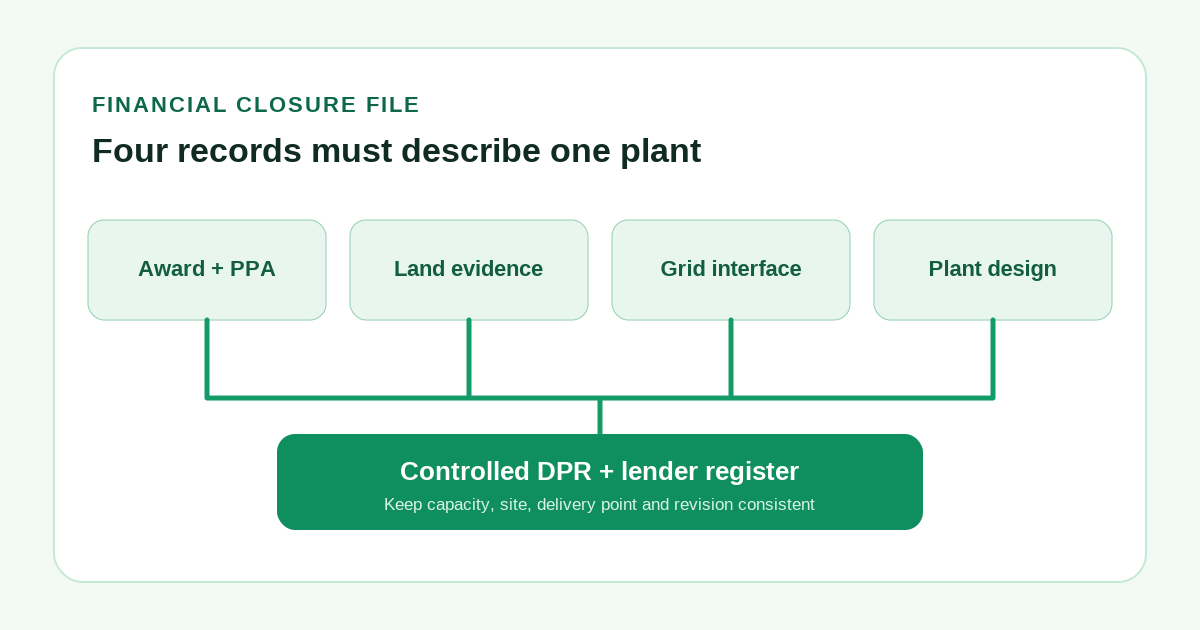
For a PM-KUSUM Component A project, a useful technical file for financing connects four things: the awarded project and PPA, the actual land and grid interface, a defensible plant design, and the energy and cost assumptions used in the lender’s appraisal. A generic solar DPR does not establish that the site is available, the feeder can take the power, or the chosen lender has accepted the proposal. Build a document register from the state implementing agency’s current award and the lender’s live checklist, then make every drawing in the DPR match those records.
Rules checked 23 November 2026. MNRE’s 28 September 2026 office memorandum says the last date for financial closure under Components A and C is 30 November 2026 for eligible projects, with evidence from the lending institution or promoter to be provided to the state implementing agency. The memo also contains a conditional completion timeline. Check MNRE and the state agency for any later order before acting on this deadline. The engineering file should be prepared for the live award and lender, not a remembered scheme timeline.
This guide describes how a developer and EPC can organise the engineering evidence. It does not decide borrower eligibility, loan sanction, subsidy, tariff, land title, or state allocation. Those require current official documents and professional review. The Component A overview is background on the scheme; this article focuses on drawings, traceability and the DPR-to-finance handoff.
Start with the award, PPA and lender conditions
Component A is not a single all-India loan product. MNRE’s 2024 comprehensive PM-KUSUM guidelines describe the scheme framework, while state implementing agencies run allocations and the project transaction. Lenders can apply their own current policies. A developer should identify the exact project award, state order, PPA, land arrangement and financing institution before asking an engineering team to create a DPR. Otherwise the drawings may answer the wrong capacity or connection point.
Create a one-page project control sheet with state, implementing agency, DISCOM, applicant or project company, sanctioned or awarded capacity, project location, feeder or substation reference, PPA counterparty, land parcel reference, lender and loan application number. Add the date and revision of each controlling document. If a field is not settled, mark it open and assign the person who will obtain confirmation. This sheet should be the first page of the engineering file and the source of names used in every drawing.
The current IREDA financing norms effective 1 October 2026 include a PM-KUSUM Component A policy. They state that a PPA with the DISCOM should be available at proposal processing or pre-commitment condition stage and that sufficient land is needed before disbursement, with other conditions governed by IREDA’s financing norms. These are IREDA conditions, not a promise that another bank will ask for the same files. The same document discusses additional agreements and tranche conditions. A borrower should use the current lender checklist and seek clarification on which evidence is due at appraisal, commitment and first disbursement.
The technical team can help by indexing each lender condition to an evidence file. It should not mark a legal or financial condition complete merely because a drawing exists. A cadastral map may show a parcel, but it does not prove title. A preliminary SLD may show a proposed feeder tie-in, but it does not prove the DISCOM has granted connectivity. A signed PPA is a transaction document; the plant design must agree with it, but the engineer does not create the legal right by drawing a cable route.
| Control document | Engineering consequence | Evidence owner |
|---|---|---|
| Award or state sanction | Capacity, project boundary, scheme identity | Developer and state agency |
| PPA | Capacity, delivery point, energy-accounting assumptions | Developer and DISCOM |
| Land instrument | Parcel boundary, access and usable area | Landowner, developer and legal team |
| Connectivity or feeder communication | Voltage, interface and evacuation concept | DISCOM and electrical lead |
| Lender checklist | DPR structure and timing of evidence | Borrower and lender |
This table is a reconciliation tool. The binding requirements are in the live award, PPA and lender documents. If they conflict, resolve the conflict with those parties before issuing a final plant drawing.
Build the DPR around decisions a lender can inspect
A detailed project report is useful when its claims can be traced to evidence. The cover and executive summary should identify the project and current revision, but the substance lies in the site, plant, yield, evacuation, implementation and risk sections. Some lenders provide a format. Use it if they do. If they do not, agree an index with the appraisal team rather than assuming that an old generic solar DPR will pass.
The site section should include location and parcel mapping, survey basis, access route, land use and grading assumptions, and the areas excluded from installation. Identify who verified each land fact. The plant section should show proposed DC and AC capacity, module and inverter basis, array layout, row spacing, support concept, DC collection, AC collection and auxiliary loads. Where models are not final, show a provisional equipment schedule and the design limits that a substitute must meet.
The energy section should give the weather data source, time period, horizon and near-shading assumptions, loss model, degradation treatment and the meter boundary used for the annual generation estimate. Do not call a point estimate a guarantee. If P50/P90 values are requested, show the uncertainty method and source; a software output alone does not settle lender acceptance. The evacuation section should identify the proposed point of interconnection, voltage, line route, bay or panel interface, metering, protection and approvals required. The electrical basis should match the PPA and current utility communication.
The implementation section needs a realistic sequence: land readiness, survey, final engineering, equipment procurement, civil works, electrical works, testing, grid approval and commissioning. A date in the finance model should connect to an actual dependency. If a utility bay is not yet approved, mark it as a schedule risk. The cost section should reconcile major quantities to the drawing revision and the chosen procurement basis. A BOQ with unexplained cable lengths or foundation quantities does not make a strong appraisal file.
None of these sections should invent a project result. A lender can challenge a design assumption even if another project used it successfully. The report should make that challenge easy by showing the source, method and responsible party for each value. That is the central purpose of a source-backed DPR.
Make the layout and SLD agree with the land and connection
The general arrangement is a physical claim: this plant can fit on this parcel with the required access and electrical routes. It should show boundary and coordinate reference, topography source, modules and rows, setbacks or excluded areas, internal roads, inverter stations, transformer or collection area, cable routes and the interconnection direction. A landowner sketch can begin the conversation; a final construction layout needs a survey and current design basis. If land is leased, the usable area and rights of access must be checked with the transaction documents.
The single line diagram is an electrical claim. It should show how the PV arrays reach inverter and AC collection equipment, transformer where needed, protection and isolation, metering and the proposed delivery point. Label the current design stage. A bid-stage SLD can state assumptions, but it should not be filed as a final approval drawing. The generator capacity and meter boundary need to match the finance model and PPA. If the PPA describes one delivery point and the drawing shows another, stop and resolve it before the lender sees both.
Keep an interface register between the drawing set and the external parties. A useful line is: “33 kV connection at named substation, as proposed in utility letter dated X, confirmation pending.” That statement tells the lender what is known. A bare line to a substation on a map can imply approval where there is only a concept. Record line length as measured, estimated or route-dependent, and disclose rights-of-way that are not secured. The electrical engineer can size and check a proposed route only after its basis is defined.
For a Component A project, the capacity and connection are project-specific. The MNRE scheme page and 2024 guidelines describe decentralised grid-connected plants under Component A, but the state award and utility documents control the actual project. Do not transplant a standard 500 kW or 2 MW layout onto a different parcel and declare it “KUSUM-ready.” The engineering dossier should establish what is feasible at the selected site.
Record the evacuation and substation assumptions explicitly
Evacuation is often the point where a promising land parcel becomes a different project. The line route may cross land not controlled by the developer; the substation bay may be unavailable or require work; metering and protection may be defined by the DISCOM; and the selected voltage may change equipment scope. A DPR should distinguish a proposed evacuation arrangement from a utility-confirmed one.
Request the latest utility letter, feeder or substation details, sanctioned point, voltage and connection scheme, if available. Obtain the route survey and note road, waterway and property crossings. Map the line and bay scope with separate ownership columns: who constructs, owns, maintains and pays for each element. Those terms can differ by state and contract. Do not infer them from a standard schematic.
The drawing register can include a site key plan, plant general arrangement, DC and AC SLDs, evacuation route plan, substation or bay interface drawing, metering schematic, protection concept, cable schedule, earthing layout and structural or foundation drawings. That is a candidate list for scoping, not a claim that every state agency or lender requires each item. Assign issue purposes: concept, lender review, utility submission, construction. The right version can then go to the right reviewer.
If a utility or lender has asked for a particular study, such as a grid impact, fault level, protection coordination or detailed line design, record the exact request and source. An engineer should not silently replace it with a generic SLD. Similarly, a financial model should not use a line cost from a preliminary straight-line distance when the route survey indicates crossings or a longer alignment. Keep units, sources and exclusions visible.
Reconcile yield, BOQ and finance assumptions
The annual energy estimate is connected to both plant design and lender appraisal. Start with a documented weather data source, chosen module and inverter, plant DC and AC rating, layout and shading model, electrical losses, availability basis and degradation treatment. State whether the result is at inverter output, plant busbar or the revenue meter. A difference in the meter boundary changes the energy that may be delivered under the PPA.
The bill of quantities should tie to a drawing revision. A layout revision that adds a row can change module count, mounting steel, cable, foundation work and land use. A change in the connection point can alter the line, transformer and bay budget. Without revision control, the finance model can use an old BOQ while the technical report shows a new layout. The cross-document table below is a cheap way to catch that drift.
| Value | DPR | Layout or SLD | BOQ or finance model | Release check |
|---|---|---|---|---|
| DC capacity | Project summary and yield model | Module count × exact module rating | Module quantity and cost | Same installed scope and date |
| AC capacity | Plant design basis | Inverter quantity and rating | Inverter cost and auxiliary equipment | Same model family and limits |
| Delivery point | Energy boundary | Metering and connection symbols | Line, bay and losses | Same PPA and utility basis |
| Land area | Site chapter | Parcel and array boundary | Lease or access provision | Same survey and legal reference |
| Schedule | Implementation chapter | Issue and approval milestones | Interest during construction | Same dependency dates |
The table does not supply a bankable number by itself. It tells the developer which documents must agree before the file is circulated. Keep a discrepancy log with owner and resolution date. A lender should see the final aligned issue, not several similar-looking revisions.
Financial closure is an evidence milestone, not a drawing status
The September 2026 MNRE memorandum requires documentary evidence of financial closure from the lender or promoter by its stated deadline for eligible projects. A completed DPR can support that process, but it does not itself establish that funds are committed. Likewise, a preliminary loan discussion is not the same as a sanction or closure evidence accepted by the state implementing agency. The developer must check the exact current definition and evidence with the state agency and lender.
IREDA’s October 2026 norms make this distinction practical. They separate appraisal or pre-commitment conditions from pre-disbursement requirements, and state specific conditions around PPA and land. A technical team can prepare a controlled drawing package that supports appraisal and then update it when lender conditions or utility decisions change. It cannot promise loan approval. Other lenders may ask for different technical schedules or independent engineering reports.
Before submitting a “final” technical pack, hold a short multi-party check: developer, EPC design lead, land/legal contact, finance lead and utility liaison. Verify the project identity, site, capacity, delivery point, PPA, drawing register, yield model, BOQ, lender checklist and open conditions. Put any remaining risk into the cover letter or condition register rather than hiding it in the appendix. This is not bureaucracy for its own sake. It prevents two teams from representing different plants under the same project name.
The 30 November 2026 closure date is close. A developer working near that date should obtain the latest written instruction from the state implementing agency and check MNRE’s current orders before filing. The scheme framework and the selected state’s order should be read together. A generic article cannot decide whether a particular project qualifies for an extension or whether its evidence meets the agency’s requirements.
Use a document register before requesting engineering work
Start with the award and PPA, then add current land and grid correspondence, survey, equipment choices and lender format. Mark each drawing as existing, required for appraisal, required for utility submission or required later for construction. Identify whether the engineering team is being asked to prepare a concept package, a full DPR or only specific drawings. If a lender needs a report signed or reviewed by a particular professional, name that requirement before scope is agreed.
Heaven Designs’ documented deliverables include layouts, SLDs, BOQs, PVsyst reports and structural calculations. For an enquiry, send the award or tender reference, site and land data, proposed capacity, utility connection information and lender checklist through the contact form. The existing ground-mount design service describes the broader plant-engineering scope. The dedicated PM-KUSUM design page can be linked once its service scope and lead route are live.
The team can then specify the engineering scope, inputs needed, price and delivery date. No technical file alone can guarantee a lender’s sanction, a state agency’s acceptance or a utility’s connection. The useful result is a dossier whose assumptions can be inspected and updated as the project advances.